

- Industry Size (2026)
- USD 3.9 Bn
- Forecast (2036)
- USD 6.1 Bn
- CAGR (2026 to 2036)
- 4.7%
Betaine Market Size, Market Forecast and Outlook By FMI
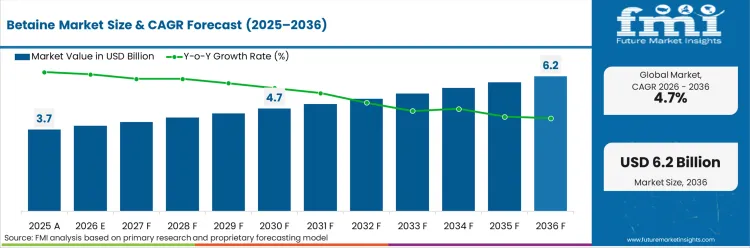
In 2025, the betaine market was valued at USD 3.7 billion. Based on Future Market Insights’ analysis, demand for betaine is estimated to grow to USD 3.9 billion in 2026 and USD 6.1 billion by 2036. FMI projects a CAGR of 4.7% during the forecast period.
Absolute dollar growth of USD 2.2 billion highlights a formulation shift toward milder chemistry alongside critical agricultural end uses. Procurement specification shifts dominate strategic purchasing as fast-moving consumer goods conglomerates phase out sulfated legacy chemistry. According to FMI's estimates, supply-side economics increasingly favor backward-integrated operators controlling fatty-chain intermediates or scalable sugar beet derivatives. Regulatory mandates convert into structurally higher base volumes for high-purity natural extracts.
Summary of Betaine Market
- Betaine Market Definition
- Research quantifies industrial osmolyte and amphoteric surfactant consumption spanning multiple end-use sectors.
- Demand Drivers in Betaine Market
- Personal care formulators mandate mild, low-irritancy cleansing agents.
- Livestock producers require nutritional additives to manage heat stress.
- Regulatory pressure forces transitions toward biobased chemical intermediates.
- Key Segments Analyzed in FMI Report
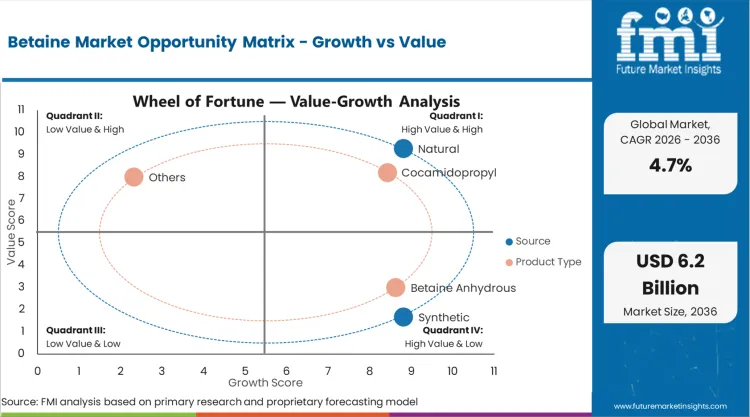
- Source: Natural variants (66% share in 2026) versus synthetic derivatives aligned to cost-sensitive industrial applications.
- Product Type: Cocamidopropyl betaine (37% share) versus betaine anhydrous for feed and pharmaceutical-grade uses.
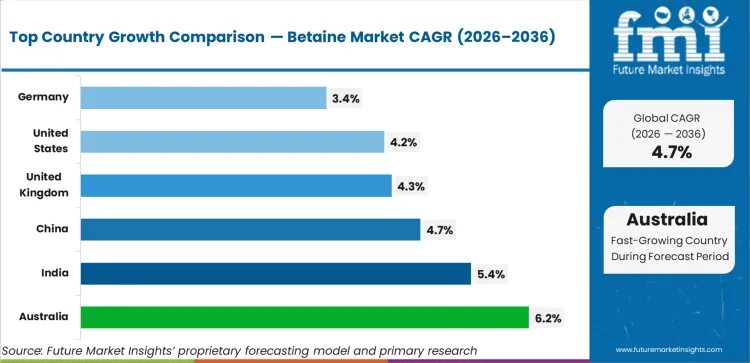
- Geography: High-growth Asia-Pacific and Oceania (Australia 6.2%, India 5.4%, China 4.7%) versus regulatory-intensive mature markets in North America and Europe (U.S. 4.2%, UK 4.3%, Germany 3.4%).
- Analyst Opinion at FMI
- Nandini Roy Choudhury, Principal Consultant for Food & Beverage at Future Market Insights, opines, “In the updated version of the Betaine Market Report for 2026 to 2036, CXOs will find detailed insights into clean-label reformulation mandates reshaping beverage and functional nutrition portfolios. My findings indicate that volatility in sugar beet feedstock pricing directly influences cost structures for natural betaine, while stringent purity and trace impurity thresholds in fortified beverages could restrict supplier eligibility across export-driven food and beverage supply chains.”
- Strategic Implications/Executive Takeaways
- Secure transparent biomass-balanced supply chains to attract premium cosmetic brands.
- Expand powder formulation capacities to mitigate freight costs across export markets.
- Target regional aquaculture clusters to capture unpenetrated animal nutrition revenue.
- Methodology
- Validated through first-hand corporate production and capacity data.
- Zero reliance on speculative third-party market research reports.
- Based on verifiable industrial benchmarks and verified sources.
Avinash Nandanwar, Head of Sourcing and Sustainability, Galaxy Surfactants, said, “As a company committed to enabling responsible beauty and home care solutions, we are constantly evaluating ways to reduce our carbon footprint without compromising on product performance. This collaboration with BASF allows us to innovate with purpose and offer our customers sustainable, science-backed solutions like Galaxy CAPB SB, which meets the growing global demand for high-efficacy yet environmentally conscious formulations. [3]
Country-level demand dispersion reveals robust trajectories across Australia (6.2%), India (5.4%), China (4.7%), United Kingdom (4.3%), United States (4.2%), and Germany (3.4%). Geographic spread demonstrates a dual-engine market architecture where industrialized Western economies prioritize cosmetic reformulation while emerging Asian and Oceanian regions rapidly scale inclusion in commercial livestock and aquaculture feeds.
Betaine Market Definition
Analysis covers organic osmolytes and amphoteric surfactants utilized heavily across industrial applications. Trimethylglycine derivatives serve formulators seeking hydration functions or low-irritation foaming profiles. Agricultural end-users deploy identical molecular structures to mitigate thermal stress in poultry flocks.
Betaine Market Inclusions
Research captures global production encompassing cocamidopropyl betaine alongside anhydrous grades. Volumes reflect direct chemical synthesis outputs and extraction yields from sugar beet processing. Revenue models incorporate spot market transactions and long-term contract pricing.
Betaine Market Exclusions
Evaluations omit downstream finished retail products containing fractional active ingredient percentages. Unprocessed sugar beet crops destined strictly for food refinement remain outside reporting boundaries. Laboratory-scale experimental formulations lacking commercial production validation are excluded.
Betaine Market Research Methodology
- Primary Research: Direct interviews with chemical plant managers confirmed production yields and operating rates.
- Desk Research: Ministry-level agricultural bulletins provided baseline sugar beet cultivation acreage.
- Market-Sizing and Forecasting: Bottom-up formulation analysis mapped surfactant loading ratios against total cosmetic manufacturing volumes.
- Data Validation and Update Cycle: Econometric models underwent peer review against audited corporate disclosures.
Segmental Analysis
Betaine Market Analysis by Source
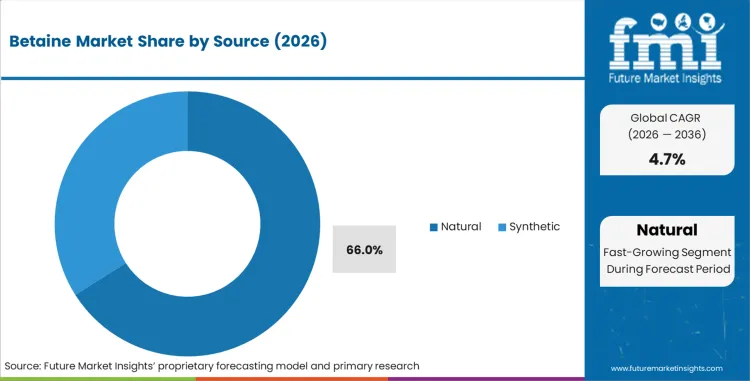
Natural sourcing formats account for 66% of consumption volumes entering 2026. As per FMI's projection, procurement behavior increasingly favors plant-derived extraction to satisfy clean-label mandates imposed by fast-moving consumer goods brands. Sugar beet processing yields dictate fundamental upstream availability, creating tight linkages between agricultural output and chemical derivative pricing. Farmers within United States planted 1.13 million acres of sugarbeets heading into 2025, providing a crucial raw material baseline [5]. Synthesizing identical molecular structures via petrochemical routes remains viable for cost-sensitive industrial buyers. Mass-balance certification bridges pricing gaps between fossil-derived and fully botanical supply chains. Industrial buyers utilize natural surfactant profiles to validate premium retail positioning.
- Procurement trigger: Corporate sustainability targets mandate transitions away from petrochemical precursors toward renewable carbon sources. Formulators secure long-term contracts for botanical extracts starting in 2026, generating structurally higher base volumes for certified material producers.
- Supply-side move: Chemical processors build dedicated refinement infrastructure near major agricultural hubs to minimize biomass transportation costs. Localized extraction facilities launched during recent quarters secure reliable feedstock access, protecting output against regional crop failures.
- Regulatory signal: Stringent trace impurity thresholds restrict synthetic variant usage across sensitive pharmaceutical applications. Finished drug manufacturers mandate verified botanical origins, ensuring high-margin recurring revenue for specialized extraction operations.
Betaine Market Analysis by Product Type
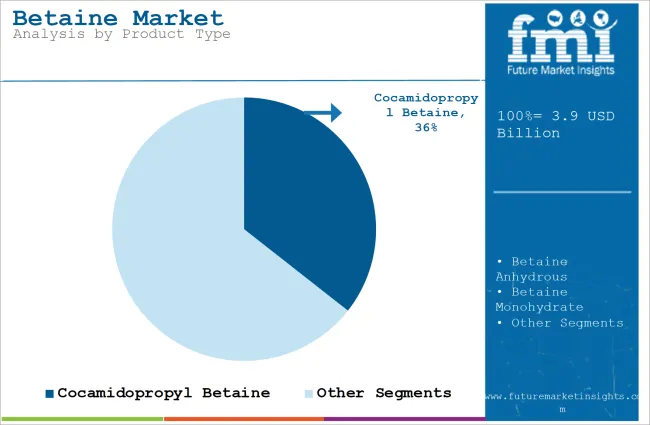
Cocamidopropyl betaine captures a 37% segment share based on unmatched versatility within liquid cleansing systems. Cosmetic formulators deploy amphoteric chemistry to reduce primary surfactant irritancy while boosting foam stability. According to FMI's estimates, demand correlates directly with global production rates of sulfate-free shampoos and mild body washes. Manufacturers continually refine synthesis pathways to minimize residual amidoamine impurities, addressing persistent consumer allergy concerns. Betaine anhydrous variants serve an entirely distinct function as cellular osmolytes. Animal nutrition specialists blend anhydrous powders into specialized feed rations to protect livestock against severe heat stress.
- Technology shift: Advanced continuous flow reactor technology reduces trace impurities during commercial amidation processes. Manufacturers deploying upgraded production lines achieve superior purity specifications, winning procurement bids from tier-one cosmetic multinationals.
- Buyer priority: Formulators require verified palm-free or sustainably certified coconut derivatives to support consumer-facing environmental claims. Procurement teams systematically disqualify vendors lacking traceable supply chains, shifting market share toward integrated producers offering certified intermediates.
- Clinical milestone: Regulatory bodies recently granted marketing approval for specialized anhydrous powder formulations targeting rare genetic disorders. Oji Holdings obtained Japanese manufacturing authorization effective early 2026, opening a highly defensible niche revenue stream [6].
Betaine Market Drivers, Restraints, and Opportunities
Rapid expansion across commercial animal agriculture ecosystems forms a primary demand catalyst. Livestock producers face intensifying thermal stress challenges impacting flock mortality and feed conversion ratios. Farm operators blend organic osmolytes into daily rations to protect cellular hydration during extreme weather events. Aquaculture environments require identical physiological protection to maximize harvest yields. Total global aquaculture output is expected to hit 104.2 million tonnes during 2025, establishing a massive addressable base for functional feed additives [9]. FMI analysts opine that nutritional intervention proves far cheaper than suffering depressed production metrics. Chemical suppliers serving agricultural sectors benefit from recurring volume purchases tied intrinsically to protein consumption trends rather than discretionary spending patterns.
Raw material supply constraints heavily dictate production economics and pricing stability. Extracted variant availability depends entirely on annual sugar beet harvests, exposing chemical refiners to unpredictable agricultural yields. Extreme weather anomalies routinely depress crop tonnage, tightening global supply balances and forcing immediate spot price escalation. Global sugar crop output hit 2.2 billion tonnes recently, yet localized processing bottlenecks frequently restrict actual chemical extraction volumes [1]. Buyers face difficult choices between absorbing volatile natural pricing or reformulating end products using stable synthetic alternatives. Procurement teams mitigate exposure by implementing multi-sourced vendor strategies and qualifying fossil-derived backup grades for non-critical industrial applications.
- Aquatic Nutrition Opportunity: Aquafeed formulators increasingly incorporate functional osmolytes to enhance fish survival rates across high-density farming operations. Surfactant manufacturers diversifying into agricultural distribution channels capture vast new volume streams tied to rising global seafood consumption.
- Pharmaceutical Niches: Rare disease treatments utilizing anhydrous powder formulations present exceptionally high margin potential. Pharmaceutical developers acquiring approved marketing authorizations secure protected commercial pathways, exemplified by recent regulatory clearances.
- Asset Optimization: Multinational chemical conglomerates actively divest non-core amphoteric surfactant units to fund advanced bio-based manufacturing initiatives. Independent regional producers acquire discarded infrastructure to instantly expand local production capacity, mirroring recent transactions across Southeast Asia.
Regional Analysis
Based on regional analysis, Betaine market is segmented into North America, Latin America, Europe, East Asia, South Asia, Oceania and Middle East & Africa across 40+ countries. Full report also offers market attractiveness analysis based on regional trends.
.webp "Top Country Growth Comparison Betaine Market Cagr (2026 2036)")
| Country | CAGR (2026 to 2036) |
|---|---|
| Australia | 6.2% |
| India | 5.4% |
| China | 4.7% |
| United Kingdom | 4.3% |
| United States | 4.2% |
| Germany | 3.4% |
Source: Future Market Insights (FMI) analysis, based on proprietary forecasting model and primary research
Oceania Betaine Analysis
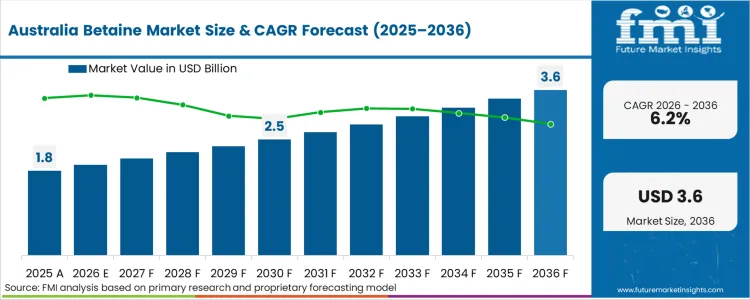
Oceanian demand trajectories reflect deep integration between advanced aquaculture practices and specialized feed additive utilization. Coastal farming operations deploy high-performance nutritional blends to accelerate aquatic biomass generation while managing environmental stressors. FMI analysts opine that regional formulation requirements skew heavily toward high-purity anhydrous grades capable of surviving aggressive feed extrusion processes. Global aquaculture production figures recorded 223.2 million tonnes of total aquatic output, validating immense scale requirements for supportive input chemicals [4]. Domestic cosmetic formulators simultaneously pull specialized amphoteric surfactants to satisfy robust local demand for premium botanical personal care surfactants.
- Australia: Demand for hydration chemistry in Australia is set to grow at 6.2% CAGR through 2036, supported by expanding commercial fish farming infrastructure before procurement and budgeting cycles translate into higher deployment volumes. Regional aquafeed producers blend anhydrous powders to boost thermal resilience, directly linking chemical consumption to rising marine harvest outputs.
Report includes detailed analysis covering Oceanian territories, mapping specific growth vectors across New Zealand and surrounding Pacific island nations. Buyers operating within these jurisdictions face acute logistical hurdles requiring extended inventory planning to overcome geographic isolation. Expanding liquid feed supplements manufacturing capacity near coastal farming zones presents a highly lucrative localization strategy.
South Asia Betaine Analysis
South Asian consumption expands rapidly as rising middle-class demographics drive unprecedented penetration of packaged personal care goods. Formulators transition massive legacy product portfolios away from harsh anionic systems toward mild amphoteric blends. According to FMI's estimates, regional manufacturing hubs secure vital intermediate chemicals through strategic supplier alliances to maintain uninterrupted factory operations.
- India: Growth in amphoteric chemistry across India is estimated at 5.4% CAGR through 2036, driven by rising consumer preference for mild cleansing products that increases the value of reliability and compliance in buyer criteria. Domestic chemical processors actively upgrade amidation reactor infrastructure to supply high-purity ingredients directly to multinational cosmetic brands operating regional blending plants.
Report includes exhaustive intelligence regarding South Asian supply chains, detailing specific commercial dynamics across Bangladesh, Sri Lanka, and Nepal. Domestic regulatory bodies increasingly scrutinize trace impurity levels within cosmetic imports, forcing regional formulators to adopt globally recognized quality standards. Utilizing localized intermediate production shields domestic brands from currency fluctuations and international shipping delays.
East Asia Betaine Analysis
East Asian industrial ecosystems dominate global supply through sheer manufacturing scale and aggressive export orientations. Chemical processors operate immense continuous flow facilities capable of synthesizing vast amphoteric surfactant tonnages at minimal unit costs. Total regional output serves massive internal consumer markets while simultaneously feeding complex global cosmetic supply networks.
- China: China is expected to see amphoteric surfactant adoption rise at 4.7% CAGR from 2026 to 2036 as export-oriented factories expand production, which increases demand for compliant, scalable vendor offerings. Giant domestic manufacturers optimize continuous flow synthesis techniques to flood international markets with cost-competitive cleansing ingredients, pressuring global profit margins.
Report includes comprehensive volume assessments spanning East Asian manufacturing centers, tracking distinct demand patterns across Japan, South Korea, and Taiwan. Strategic emphasis remains heavily focused on securing consistent fatty acid precursor volumes to sustain continuous reactor operations. Manufacturers must increasingly document supply chain sustainability metrics to maintain lucrative export channels into heavily regulated Western markets.
North America Betaine Analysis
North American commercial landscapes feature intense competition among specialized formulators targeting premium retail categories. Brand owners aggressively market sulfate-free shampoos requiring sophisticated amphoteric surfactant packages to achieve acceptable consumer foaming expectations. As per FMI's projection, stringent trace impurity regulations dictate strict procurement parameters for all chemical inputs entering domestic manufacturing facilities. Eton Pharmaceuticals recently acquired an FDA-approved abbreviated new drug application for anhydrous powder formulations, validating lucrative pharmaceutical niches existing alongside bulk cosmetic consumption [8].
- United States: United States is likely to see premium ingredient revenues increase at 4.2% CAGR during 2026 to 2036, given rising consumer scrutiny of cosmetic labels and the resulting push for capacity and workflow upgrades. Domestic agricultural sectors concurrently demand massive anhydrous volumes to protect massive commercial poultry flocks against extreme summer heat events.
Report includes deep structural evaluation of North American chemical consumption, exploring distinct procurement variables across Canada and Mexico. Domestic sugar beet farming output heavily influences natural extract availability for regional industrial buyers seeking localized supply security. North American chemical producers prioritize proprietary formulation blends over raw commodity production to defend operating margins.
Europe Betaine Analysis
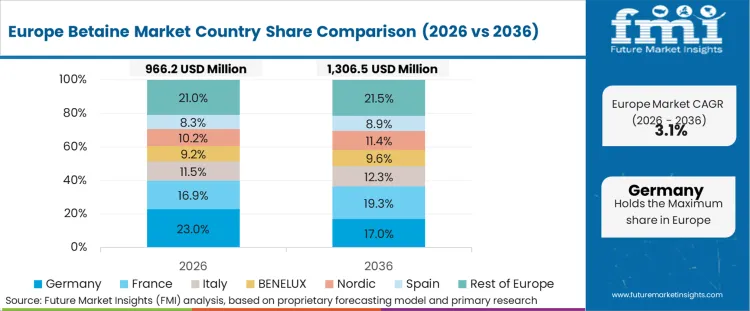
European regulatory environments strictly govern chemical production, forcing a rapid transition toward verified sustainable manufacturing paradigms. Formulators face intense pressure to eliminate petrochemical precursors, driving massive investments into biomass-balanced intermediate supply chains. Regional agricultural policies simultaneously dictate stringent animal welfare standards, elevating nutritional intervention strategies utilizing functional organic osmolytes.
- Germany: Germany is projected to post 3.4% CAGR for biobased chemistry between 2026 and 2036 as strict environmental regulations mandate renewable sourcing, improving the conversion rate from pilots to enterprise rollouts. Advanced specialty chemical producers upgrade domestic reactor networks to process fully certified botanical intermediates, capturing premium pricing from elite cosmetic brands
- United Kingdom: United Kingdom is expected to record 4.3% CAGR in mild surfactant demand over 2026 to 2036 as boutique cosmetic brands proliferate, tightening the link between operational constraints and adoption-led investment. Procurement managers actively source verifiable bio-based nonionic surfactants to differentiate finished products on crowded retail shelving.
Report includes extensive coverage across European territories, tracking shifting chemical demand patterns within France, Italy, and Spain. Imminent eco-labeling requirements compel regional formulators to rapidly replace legacy petrochemical ingredients with fully traceable plant-derived alternatives. Securing long-term biomass-balanced supply agreements constitutes a critical survival strategy for mid-tier European cosmetic manufacturers.
Competitive Aligners for Market Players
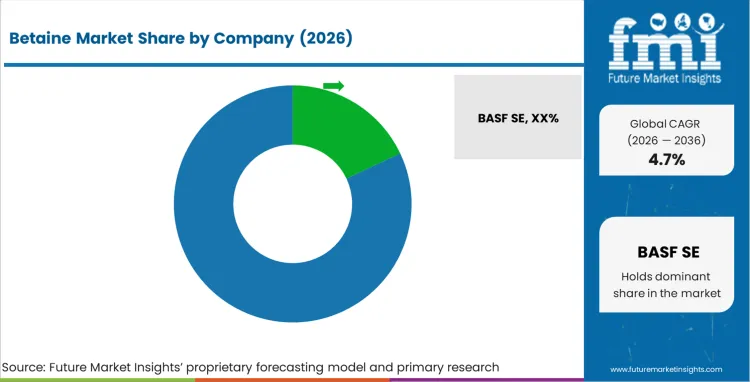
Market participants confront intense pressure to secure verifiable biological precursors as consumer packaged goods giants mandate sweeping sustainability overhauls. Independent chemical processors face severe competitive disadvantages without backward integration into critical fatty-chain intermediates. Strategic partnerships bridge these structural gaps, allowing regional producers to offer globally competitive bio-based surfactant lines.
Formulation purity remains a distinct competitive battleground as regulatory bodies tighten permissible trace impurity thresholds. Facilities deploying advanced continuous amidation reactors consistently achieve superior impurity profiles, capturing lucrative contracts from risk-averse multinational brands. Specialized pharmaceutical applications demand even higher manufacturing discipline, rewarding producers capable of meeting exacting active pharmaceutical ingredient standards.
Capital allocation strategies increasingly favor pivoting away from commoditized bulk chemical production toward specialized functional ingredients. Multinational conglomerates actively shed legacy infrastructure lacking clear sustainability advantages to fund next-generation biosurfactant research. Remaining independent operators acquire discarded infrastructure to consolidate regional market share, driving fundamental industry consolidation.
Recent Developments
Report includes full coverage of key trends from competitive benchmarking. Some recent developments covered in reports:
- In November 2025, Evonik divested specific Southeast Asian amphoteric chemical manufacturing assets affecting approximately sixty employees [2].
- In April 2025, BASF launched Dehyton PK45 formulations derived strictly from Rainforest Alliance certified coconut oil [7].
Key Players in Betaine
- BASF SE
- Evonik Industries AG
- Galaxy Surfactants
- Kao Chemicals
- Inolex
- Solvay S.A.
- Stepan Company
- Clariant AG
- Lubrizol Corporation
Scope of the Report
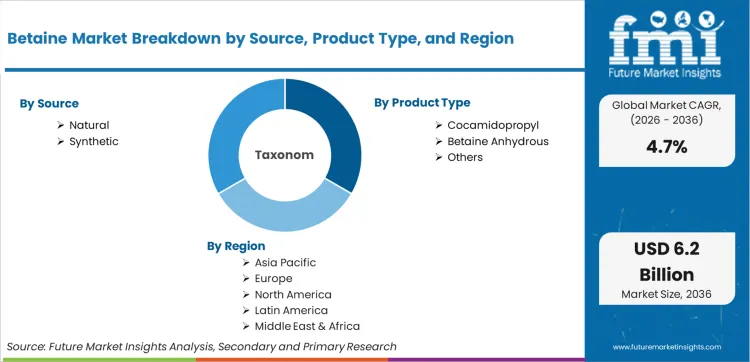
| Metric | Value |
|---|---|
| Quantitative Units | USD 3.9 billion (2026) to USD 6.1 billion (2036), at a CAGR of 4.7% |
| Market Definition | Analysis covers organic osmolytes and amphoteric surfactants utilized heavily across industrial applications, including hydration functions and low-irritation foaming profiles. |
| Source Segmentation | Natural, Synthetic |
| Product Type Segmentation | Cocamidopropyl Betaine, Betaine Anhydrous, Others |
| Application Coverage | Personal Care & Cosmetics, Animal Feed, Pharmaceuticals, Others |
| Regions Covered | North America, Latin America, Europe, East Asia, South Asia, Oceania, Middle East & Africa |
| Countries Covered | United States, Canada, Mexico, Brazil, Argentina, Germany, France, United Kingdom, Italy, Spain, China, India, Japan, South Korea, Indonesia, Australia and 40 plus countries |
| Key Companies Profiled | BASF SE, Evonik Industries AG, Galaxy Surfactants, Kao Chemicals, Inolex, Solvay S.A., Stepan Company, Clariant AG, Lubrizol Corporation |
| Forecast Period | 2026 to 2036 |
| Approach | Hybrid top-down and bottom-up market modeling validated through primary interviews with chemical plant managers, supported by trade data benchmarking and plant level capacity verification |
Betaine Market Analysis by Segments
Source:
- Natural
- Synthetic
Product Type:
- Cocamidopropyl Betaine
- Betaine Anhydrous
- Others
Application:
- Personal Care & Cosmetics
- Animal Feed
- Pharmaceuticals
- Others
Region:
- Asia Pacific
- India
- China
- Japan
- South Korea
- Indonesia
- Australia & New Zealand
- ASEAN
- Rest of Asia Pacific
- Europe
- Germany
- Italy
- France
- United Kingdom
- Spain
- Benelux
- Nordics
- Central & Eastern Europe
- Rest of Europe
- North America
- United States
- Canada
- Mexico
- Latin America
- Brazil
- Argentina
- Chile
- Rest of Latin America
- Middle East & Africa
- Kingdom of Saudi Arabia
- United Arab Emirates
- South Africa
- Turkey
- Rest of Middle East & Africa
Bibliography
- [1] FAO. (2025). Agricultural production statistics 2010-2024.
- [2] Evonik. (2025). Evonik divests betaines business in Indonesia.
- [3] BASF. (2025). Joint news release BASF x Galaxy 1st BMB DMAPA.
- [4] FAO. (2024). The State of World Fisheries and Aquaculture 2024.
- [5] USDA NASS. (2025). Prospective Plantings.
- [6] Oji Holdings. (2026). Manufacturing and marketing approval for Betaine Powder.
- [7] BASF. (2025). BASF introduces new personal care innovations.
- [8] Eton Pharmaceuticals. (2025). SEC Form 10-K.
- [9] FAO GLOBEFISH. (2025). Aquatic products and the global economy.
This bibliography is provided for reader reference and is not exhaustive. The full report contains the complete reference list and detailed citations.
This Report Addresses
- Market intelligence to enable structured strategic decision making across mature and emerging surfactant economies
- Market size estimation and 10 year revenue forecasts from 2026 to 2036, supported by validated capacity and trade benchmarks
- Growth opportunity mapping across natural and synthetic forms with emphasis on biomass-balanced intermediate transitions
- Segment and regional revenue forecasts covering personal care, animal feed, and pharmaceutical applications
- Competition strategy assessment including backward integration models, cost survivability positioning, and compliance capability benchmarking
- Product reformulation and emission compliance tracking including strict pharmaceutical and cosmetic quality thresholds
- Regulatory impact analysis covering trace impurity mandates, clean-label requirements, and export driven specification upgrades
- Market report delivery in PDF, Excel, PPT, and interactive dashboard formats for executive and operational use
Frequently Asked Questions
How large is the demand for Betaine in the global market in 2026?
Demand for Betaine in global markets is estimated to be valued at USD 3.9 billion in 2026.
What will be the market size of Betaine in the global market by 2036?
Sales are projected to reach USD 6.1 billion by 2036.
What is the expected demand growth for Betaine in the global market between 2026 and 2036?
Consumption is expected to grow at a CAGR of 4.7% between 2026 and 2036.
Which Source is poised to lead global sales by 2026?
Natural variants are expected to dominate, capturing approximately 66% of global share in 2026 due to aggressive clean-label procurement mandates.
How significant is the role of Product Type in driving Betaine adoption in 2026?
Cocamidopropyl variations represent a critical segment, projected to hold a substantial 37% share as cosmetic formulators replace harsh anionic systems.
What is driving demand in Australia?
Specialized aquaculture feed requirements and severe thermal stress mitigation strategies are driving growth.
What compliance standards or regulations are referenced for Australia?
Traceability standards governing agricultural feed additives and premium cosmetic imports act as key compliance benchmarks.
What is the Australia growth outlook in this report?
Australia is projected to grow at a CAGR of 6.2% during 2026 to 2036.
Why is India described as a priority region in this report?
Growth accelerates through unprecedented penetration of packaged personal care goods alongside strategic local intermediate production alliances.
What type of demand dominates in India?
Volume-driven consumption of mild amphoteric blends for daily personal care routines dominates regional purchasing.
What is India growth outlook in this report?
India is projected to expand at a CAGR of 5.4% during 2026 to 2036.
Does the report cover China in its regional analysis?
China is included within East Asia under regional scope analysis.
What are the sources referred to for analyzing China?
Official statistics published by international trade bodies covering cosmetics exports and agricultural production bulletins are cited as primary reference sources.
What is the main demand theme linked to China in its region coverage?
Export-oriented manufacturing scaling and optimization of continuous flow synthesis techniques form primary themes.
Does the report cover United States in its regional analysis?
United States is included within North America under regional coverage framework.
What is the main United States related demand theme in its region coverage?
Replacement demand targeting premium sulfate-free formulations and massive agricultural osmolyte requirements are emphasized.
Which product formats or configurations are strategically important for Europe supply chains?
Biomass-balanced intermediate precursors and fully traceable botanical extracts are prioritized due to stringent ecological directives.
What is Betaine and what is it mainly used for?
Chemical derivatives functioning as cellular osmolytes or amphoteric surfactants primarily used across cosmetic formulations and specialized animal feeds.
What does Betaine mean in this report?
Scope refers to global production, trade, and industrial consumption spanning natural extracts and synthetically amidated variations.
What is included in the scope of this Betaine report?
Coverage encompasses material sourced naturally or synthetically, specific molecular types, and end-use industries including pharmaceuticals.
What is excluded from the scope of this report?
Downstream finished retail products containing fractional active ingredient percentages and unprocessed agricultural crops are excluded.
What does market forecast mean on this page?
Forecast represents a model-based projection built on defined macroeconomic assumptions for strategic planning purposes.
How does FMI build and validate the Betaine forecast?
Projections utilize hybrid top-down and bottom-up modeling validated through trade data, capacity checks, and industry review.
What does zero reliance on speculative third party market research mean here?
Primary interviews and verifiable public datasets are utilized instead of unverified syndicated estimates.
Preview the report firsthand - request a free sample
Get SampleGet the brochure for pricing and purchase details.
Get PDFTable of Content
- Executive Summary
- Global Market Outlook
- Demand-side Trends
- Supply-side Trends
- Technology Roadmap Analysis
- Analysis and Recommendations
- Market Overview
- Market Coverage / Taxonomy
- Market Definition / Scope / Limitations
- Research Methodology
- Chapter Orientation
- Analytical Lens and Working Hypotheses
- Market Structure, Signals, and Trend Drivers
- Benchmarking and Cross-market Comparability
- Market Sizing, Forecasting, and Opportunity Mapping
- Research Design and Evidence Framework
- Desk Research Programme (Secondary Evidence)
- Company Annual and Sustainability Reports
- Peer-reviewed Journals and Academic Literature
- Corporate Websites, Product Literature, and Technical Notes
- Earnings Decks and Investor Briefings
- Statutory Filings and Regulatory Disclosures
- Technical White Papers and Standards Notes
- Trade Journals, Industry Magazines, and Analyst Briefs
- Conference Proceedings, Webinars, and Seminar Materials
- Government Statistics Portals and Public Data Releases
- Press Releases and Reputable Media Coverage
- Specialist Newsletters and Curated Briefings
- Sector Databases and Reference Repositories
- FMI Internal Proprietary Databases and Historical Market Datasets
- Subscription Datasets and Paid Sources
- Social Channels, Communities, and Digital Listening Inputs
- Additional Desk Sources
- Expert Input and Fieldwork (Primary Evidence)
- Primary Modes
- Qualitative Interviews and Expert Elicitation
- Quantitative Surveys and Structured Data Capture
- Blended Approach
- Why Primary Evidence is Used
- Field Techniques
- Interviews
- Surveys
- Focus Groups
- Observational and In-context Research
- Social and Community Interactions
- Stakeholder Universe Engaged
- C-suite Leaders
- Board Members
- Presidents and Vice Presidents
- R&D and Innovation Heads
- Technical Specialists
- Domain Subject-matter Experts
- Scientists
- Physicians and Other Healthcare Professionals
- Governance, Ethics, and Data Stewardship
- Research Ethics
- Data Integrity and Handling
- Primary Modes
- Tooling, Models, and Reference Databases
- Desk Research Programme (Secondary Evidence)
- Data Engineering and Model Build
- Data Acquisition and Ingestion
- Cleaning, Normalisation, and Verification
- Synthesis, Triangulation, and Analysis
- Quality Assurance and Audit Trail
- Market Background
- Market Dynamics
- Drivers
- Restraints
- Opportunity
- Trends
- Scenario Forecast
- Demand in Optimistic Scenario
- Demand in Likely Scenario
- Demand in Conservative Scenario
- Opportunity Map Analysis
- Product Life Cycle Analysis
- Supply Chain Analysis
- Investment Feasibility Matrix
- Value Chain Analysis
- PESTLE and Porter’s Analysis
- Regulatory Landscape
- Regional Parent Market Outlook
- Production and Consumption Statistics
- Import and Export Statistics
- Market Dynamics
- Global Market Analysis 2021 to 2025 and Forecast, 2026 to 2036
- Historical Market Size Value (USD Million) Analysis, 2021 to 2025
- Current and Future Market Size Value (USD Million) Projections, 2026 to 2036
- Y-o-Y Growth Trend Analysis
- Absolute $ Opportunity Analysis
- Global Market Pricing Analysis 2021 to 2025 and Forecast 2026 to 2036
- Global Market Analysis 2021 to 2025 and Forecast 2026 to 2036, By Source
- Introduction / Key Findings
- Historical Market Size Value (USD Million) Analysis By Source , 2021 to 2025
- Current and Future Market Size Value (USD Million) Analysis and Forecast By Source , 2026 to 2036
- Natural
- Synthetic
- Natural
- Y-o-Y Growth Trend Analysis By Source , 2021 to 2025
- Absolute $ Opportunity Analysis By Source , 2026 to 2036
- Global Market Analysis 2021 to 2025 and Forecast 2026 to 2036, By Product Type
- Introduction / Key Findings
- Historical Market Size Value (USD Million) Analysis By Product Type, 2021 to 2025
- Current and Future Market Size Value (USD Million) Analysis and Forecast By Product Type, 2026 to 2036
- Cocamidopropyl
- Betaine Anhydrous
- Others
- Cocamidopropyl
- Y-o-Y Growth Trend Analysis By Product Type, 2021 to 2025
- Absolute $ Opportunity Analysis By Product Type, 2026 to 2036
- Global Market Analysis 2021 to 2025 and Forecast 2026 to 2036, By Region
- Introduction
- Historical Market Size Value (USD Million) Analysis By Region, 2021 to 2025
- Current Market Size Value (USD Million) Analysis and Forecast By Region, 2026 to 2036
- North America
- Latin America
- Western Europe
- Eastern Europe
- East Asia
- South Asia and Pacific
- Middle East & Africa
- Market Attractiveness Analysis By Region
- North America Market Analysis 2021 to 2025 and Forecast 2026 to 2036, By Country
- Historical Market Size Value (USD Million) Trend Analysis By Market Taxonomy, 2021 to 2025
- Market Size Value (USD Million) Forecast By Market Taxonomy, 2026 to 2036
- By Country
- USA
- Canada
- Mexico
- By Source
- By Product Type
- By Country
- Market Attractiveness Analysis
- By Country
- By Source
- By Product Type
- Key Takeaways
- Latin America Market Analysis 2021 to 2025 and Forecast 2026 to 2036, By Country
- Historical Market Size Value (USD Million) Trend Analysis By Market Taxonomy, 2021 to 2025
- Market Size Value (USD Million) Forecast By Market Taxonomy, 2026 to 2036
- By Country
- Brazil
- Chile
- Rest of Latin America
- By Source
- By Product Type
- By Country
- Market Attractiveness Analysis
- By Country
- By Source
- By Product Type
- Key Takeaways
- Western Europe Market Analysis 2021 to 2025 and Forecast 2026 to 2036, By Country
- Historical Market Size Value (USD Million) Trend Analysis By Market Taxonomy, 2021 to 2025
- Market Size Value (USD Million) Forecast By Market Taxonomy, 2026 to 2036
- By Country
- Germany
- UK
- Italy
- Spain
- France
- Nordic
- BENELUX
- Rest of Western Europe
- By Source
- By Product Type
- By Country
- Market Attractiveness Analysis
- By Country
- By Source
- By Product Type
- Key Takeaways
- Eastern Europe Market Analysis 2021 to 2025 and Forecast 2026 to 2036, By Country
- Historical Market Size Value (USD Million) Trend Analysis By Market Taxonomy, 2021 to 2025
- Market Size Value (USD Million) Forecast By Market Taxonomy, 2026 to 2036
- By Country
- Russia
- Poland
- Hungary
- Balkan & Baltic
- Rest of Eastern Europe
- By Source
- By Product Type
- By Country
- Market Attractiveness Analysis
- By Country
- By Source
- By Product Type
- Key Takeaways
- East Asia Market Analysis 2021 to 2025 and Forecast 2026 to 2036, By Country
- Historical Market Size Value (USD Million) Trend Analysis By Market Taxonomy, 2021 to 2025
- Market Size Value (USD Million) Forecast By Market Taxonomy, 2026 to 2036
- By Country
- China
- Japan
- South Korea
- By Source
- By Product Type
- By Country
- Market Attractiveness Analysis
- By Country
- By Source
- By Product Type
- Key Takeaways
- South Asia and Pacific Market Analysis 2021 to 2025 and Forecast 2026 to 2036, By Country
- Historical Market Size Value (USD Million) Trend Analysis By Market Taxonomy, 2021 to 2025
- Market Size Value (USD Million) Forecast By Market Taxonomy, 2026 to 2036
- By Country
- India
- ASEAN
- Australia & New Zealand
- Rest of South Asia and Pacific
- By Source
- By Product Type
- By Country
- Market Attractiveness Analysis
- By Country
- By Source
- By Product Type
- Key Takeaways
- Middle East & Africa Market Analysis 2021 to 2025 and Forecast 2026 to 2036, By Country
- Historical Market Size Value (USD Million) Trend Analysis By Market Taxonomy, 2021 to 2025
- Market Size Value (USD Million) Forecast By Market Taxonomy, 2026 to 2036
- By Country
- Kingdom of Saudi Arabia
- Other GCC Countries
- Turkiye
- South Africa
- Other African Union
- Rest of Middle East & Africa
- By Source
- By Product Type
- By Country
- Market Attractiveness Analysis
- By Country
- By Source
- By Product Type
- Key Takeaways
- Key Countries Market Analysis
- USA
- Pricing Analysis
- Market Share Analysis, 2025
- By Source
- By Product Type
- Canada
- Pricing Analysis
- Market Share Analysis, 2025
- By Source
- By Product Type
- Mexico
- Pricing Analysis
- Market Share Analysis, 2025
- By Source
- By Product Type
- Brazil
- Pricing Analysis
- Market Share Analysis, 2025
- By Source
- By Product Type
- Chile
- Pricing Analysis
- Market Share Analysis, 2025
- By Source
- By Product Type
- Germany
- Pricing Analysis
- Market Share Analysis, 2025
- By Source
- By Product Type
- UK
- Pricing Analysis
- Market Share Analysis, 2025
- By Source
- By Product Type
- Italy
- Pricing Analysis
- Market Share Analysis, 2025
- By Source
- By Product Type
- Spain
- Pricing Analysis
- Market Share Analysis, 2025
- By Source
- By Product Type
- France
- Pricing Analysis
- Market Share Analysis, 2025
- By Source
- By Product Type
- India
- Pricing Analysis
- Market Share Analysis, 2025
- By Source
- By Product Type
- ASEAN
- Pricing Analysis
- Market Share Analysis, 2025
- By Source
- By Product Type
- Australia & New Zealand
- Pricing Analysis
- Market Share Analysis, 2025
- By Source
- By Product Type
- China
- Pricing Analysis
- Market Share Analysis, 2025
- By Source
- By Product Type
- Japan
- Pricing Analysis
- Market Share Analysis, 2025
- By Source
- By Product Type
- South Korea
- Pricing Analysis
- Market Share Analysis, 2025
- By Source
- By Product Type
- Russia
- Pricing Analysis
- Market Share Analysis, 2025
- By Source
- By Product Type
- Poland
- Pricing Analysis
- Market Share Analysis, 2025
- By Source
- By Product Type
- Hungary
- Pricing Analysis
- Market Share Analysis, 2025
- By Source
- By Product Type
- Kingdom of Saudi Arabia
- Pricing Analysis
- Market Share Analysis, 2025
- By Source
- By Product Type
- Turkiye
- Pricing Analysis
- Market Share Analysis, 2025
- By Source
- By Product Type
- South Africa
- Pricing Analysis
- Market Share Analysis, 2025
- By Source
- By Product Type
- USA
- Market Structure Analysis
- Competition Dashboard
- Competition Benchmarking
- Market Share Analysis of Top Players
- By Regional
- By Source
- By Product Type
- Competition Analysis
- Competition Deep Dive
- BASF SE
- Overview
- Product Portfolio
- Profitability by Market Segments (Product/Age /Sales Channel/Region)
- Sales Footprint
- Strategy Overview
- Marketing Strategy
- Product Strategy
- Channel Strategy
- Evonik Industries AG
- Galaxy Surfactants
- Kao Chemicals
- Inolex
- Solvay S.A.
- Stepan Company
- BASF SE
- Competition Deep Dive
- Assumptions & Acronyms Used


