

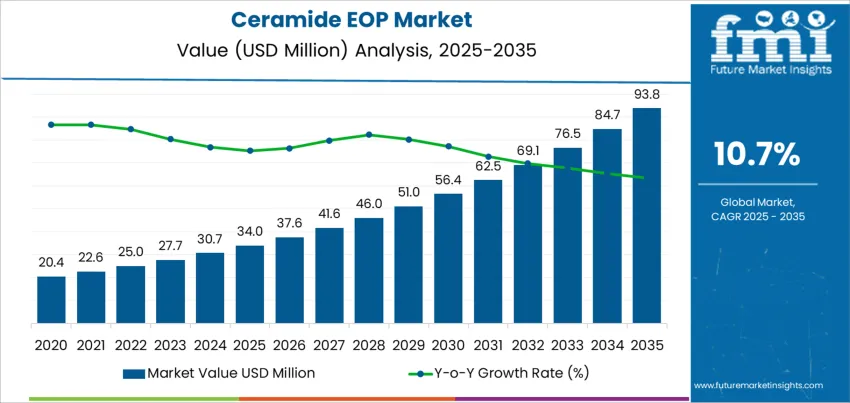
- Industry Size (2025)
- USD 34.0 Mn
- Forecast (2035)
- USD 93.8 Mn
- CAGR (2025 to 2035)
- 10.7%
Ceramide EOP Market Forecast and Outlook 2025 to 2035
The global Ceramide AP (6-II) market is valued at USD 35.5 million in 2025 and is forecasted to reach USD 100.7 million by 2035, recording a CAGR of 11.0%. Growth reflects deeper formulation use of skin-identical lipids that improve barrier recovery and maintain epidermal structure. Ceramide AP (6-II) supports elasticity and aids in controlling roughness in ageing skin, so adoption rises in creams and serums targeting mature users. Wider testing for tolerability in sensitive skin products contributes to consistent long-term usage across daily care routines.
Skin care remains the dominant application. Ceramide AP (6-II) is incorporated into intensive moisturisers, night repair products, body lotions, and cosmeceutical lines focused on firmness and resilience. Demand increases with greater product diversification in hybrid segments such as skin-protective cleansing formats and post-procedure care supplied through medical-aesthetic channels. Ingredient suppliers provide consistent purity grades that comply with dermatology evaluation standards, supporting broader brand participation.
Quick Stats for Global Ceramide EOP Demand
- Global Ceramide EOP Sales Value (2025): USD 34.0 million
- Global Ceramide EOP Forecast Value (2035): USD 93.8 million
- Global Ceramide EOP Forecast CAGR (2025 to 2035): 10.7%
- Leading Application in Global Ceramide EOP Demand: Skin Care
- Key Growth Regions in Global Ceramide EOP Demand: Asia Pacific, Europe, North America
- Top Players in Global Ceramide EOP Demand: BASF SE, Croda International, Evonik Industries, Symrise, Dow
Asia Pacific, Europe, and North America demonstrate strong consumption due to large personal care manufacturing hubs, strong scientific positioning in product claims, and continuous upgrades in lipid delivery systems. Growth is also linked to clean-label preferences and the inclusion of bio-based synthesis methods where feasible. Key suppliers include BASF SE, Croda International, Evonik Industries, Symrise, and Dow. Their focus includes improving scalability, supporting formulation compatibility across varying emulsifiers, and developing supply reliability for high-volume skin care brands requiring validated performance claims.
What is the Growth Forecast for the Ceramide EOP Market through 2035?
An early versus late growth curve comparison for the global ceramide EOP industry indicates a transition from an emerging adoption phase to a more structured expansion pattern. Early growth is driven by heightened awareness of ceramide-rich skincare and strong emphasis on barrier repair in dermatologist-endorsed formulations. During this phase, premium brands lead demand, ingredient innovation introduces optimized lipid ratios, and consumers rapidly shift toward microbiome-friendly and clinical beauty solutions. Growth is faster because baseline penetration is low and new launches frequently highlight ceramide EOP as a differentiating active.
In the later phase, growth becomes steadier as adoption spreads into mass skin health products including cleansers, moisturizers, scalp care, and baby care. Dependency on high price positioning reduces, and supply chain efficiencies encourage broader usage. Regulatory standardization and well-established ingredient safety data support long-term integration into everyday formulations. Although growth moderates slightly as maturity increases, dermatological validation, aging population trends, and increased prevalence of sensitivity-related conditions sustain forward momentum.
Ceramide EOP Market Key Takeaways
| Metric | Value |
|---|---|
| Market Value (2025) | USD 34.0 million |
| Market Forecast Value (2035) | USD 93.8 million |
| Forecast CAGR (2025 to 2035) | 10.7% |
Why is the Demand for Ceramide EOP Growing Globally?
Demand for ceramide EOP is increasing worldwide because advanced skincare formulations require strong barrier repair ingredients that improve the cohesion of the stratum corneum. Ceramide EOP supports structural integrity by aiding the formation of stable lipid layers, which helps reduce moisture loss and enhance resistance to environmental stress. Brands include ceramide EOP in moisturizers, barrier creams and night treatments developed for dry, irritated and post-procedure skin.
Dermatologist recommended product categories expand rapidly in North America, Europe and Asia, strengthening adoption in clinical and retail channels. Consumers look for solutions that address barrier weakness caused by aging, frequent cleansing and exposure to air pollution. Ceramide EOP offers a recognizable scientific benefit that aligns with rising interest in ingredient transparency and evidence based personal care.
Suppliers provide high purity ceramide EOP through fermentation and controlled synthesis, which allows consistent performance in both lightweight and rich formulations. The ingredient works well in combinations with cholesterol and fatty acids used for physiological lipid balance. Constraints include higher cost compared with standard moisturizing agents and the need for skilled formulation to ensure proper distribution in the skin’s barrier layer. Limited awareness in emerging regions may delay adoption in value priced products.
Which End-Use Applications and Product Forms Lead Global Demand for Ceramide EOP?
Demand for Ceramide EOP globally is driven by its essential role in reinforcing the skin’s lipid bilayer, reducing transepidermal water loss, and improving resistance to environmental triggers. Its use in repairing compromised or eczema-prone skin enhances its appeal across dermocosmetic brands and clinical-grade personal care routines. Rising consumer focus on anti-aging and barrier health supports broader adoption of Ceramide EOP across premium moisturizers, concentrated treatments, and sensitive-skin products.
By End-Use Application, Skin Care Represents the Largest Share
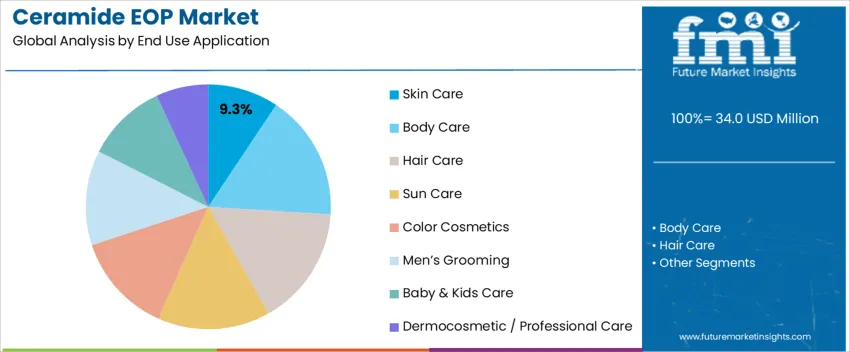
Skin care accounts for 9.3%, supported by applications in advanced hydration systems, soothing creams, and barrier-repair serums targeting dryness, sensitivity, and visible aging signs. Body-care and hair-care lines integrate Ceramide EOP to improve lipid restitution and restore smoothness across scalp and cuticle surfaces. Color cosmetics and sun-care formats incorporate the ingredient to maintain skin hydration during extended product wear or UV exposure. Men’s grooming, baby-care, and professional dermocosmetic formulations value Ceramide EOP for gentle compatibility, high efficacy in fragile skin conditions, and claims backed by dermatological science. Overall, consumer demand aligns with preventive aging strategies and multifunctional comfort-driven product design.
Key Points:
- Skin care leads due to routine barrier defense needs
- Expands into scalp and body-hydration categories
- Strong trust in medical-grade formulations supports uptake
By Product Form, Powder Holds the Largest Share
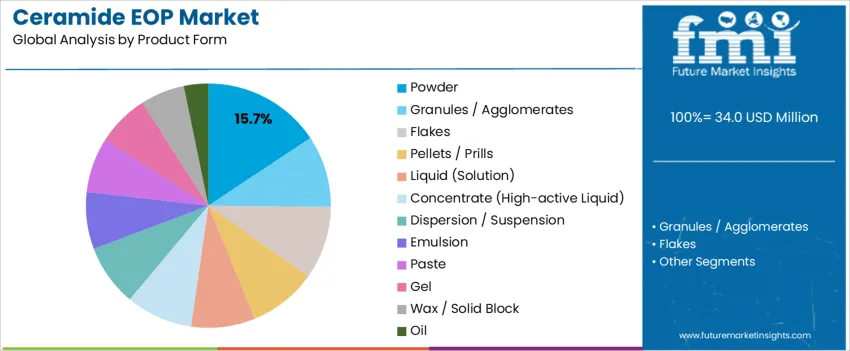
Powder format holds 15.7%, widely preferred for its formulation versatility, long-term stability, and suitability for both emulsified and anhydrous products. It allows precise dosing in premium serums and therapeutic creams targeting clinically recognized dryness and barrier disorders. Other forms including liquids, concentrates, emulsions, and dispersions enable differentiated textures with enhanced sensory performance. These formats support scalable manufacturing and accommodate diverse delivery profiles such as micro-encapsulation and controlled-release systems. Product-form preferences reflect global moves toward high-efficacy ceramide inclusion in products that balance texture aesthetics, compatibility, and strong hydration claims.
Key Points:
- Powder remains dominant due to high purity and stability
- Liquids and emulsions support sensorially refined formulations
- Flexible formats enable innovation in targeted barrier-repair systems
What are the Drivers, Restraints, and Key Trends of the Global Ceramide EOP Market?
Growth in dermatology-aligned skincare, rising prevalence of barrier damage, and expanding adoption in anti-aging and therapeutic formulations are driving demand.
Globally, Ceramide EOP is valued for its structural similarity to naturally occurring ceramides that help rebuild the lipid matrix in skin. Dermatologists recommend ceramides for patients experiencing eczema, irritation and chronic dryness caused by climate, pollution and aggressive actives. Anti-aging brands use Ceramide EOP in moisturizers, recovery creams and eye treatments to support barrier resilience and reduce visible lines linked to dehydration. Pharmaceutical cosmetics and dermocosmetic products include Ceramide EOP in targeted formulations that address conditions such as atopic dermatitis and post-procedure sensitivity. Distribution growth through online beauty channels and pharmacy retail enables wider consumer access across developed and emerging markets, supporting global consumption.
High ingredient cost, complex stabilization requirements and slower penetration in low-cost product portfolios restrain demand.
Ceramide EOP production involves multi-step lipid engineering and controlled purity, increasing raw-material cost compared with conventional emollients. Stability challenges during storage and processing require encapsulation technologies or lamellar formulations, adding technical expense for manufacturers. In mass retail skincare, pricing pressure encourages reduced ceramide usage or switching to lower-cost analogs, limiting rapid expansion into high-volume value segments. Smaller brands may avoid ceramide inclusion due to formulation complexity and limited internal R&D resources. These cost and development barriers lead to incremental rather than universal adoption.
Shift toward microbiome-supportive complexes, increased integration with retinoids and exfoliants for recovery support, and rising focus on bio-derived sustainable sourcing define key trends.
Formulators combine Ceramide EOP with cholesterol and fatty acids to replicate natural skin-lipid ratios and reinforce microbiome-compatible barrier care. Recovery-focused skincare pairs Ceramide EOP with retinoids, AHAs or niacinamide to counteract dryness and enhance treatment tolerance in anti-aging routines. Bio-fermentation and plant-based sourcing gain attention as manufacturers pursue vegan certification and sustainability targets. Scalp and body-care products leverage Ceramide EOP for protective benefits in sensitive areas prone to barrier stress. These developments indicate continued, science-driven growth of Ceramide EOP demand across global dermocosmetic, therapeutic and advanced skincare markets.
Analysis of the Ceramide EOP Market by Key Country
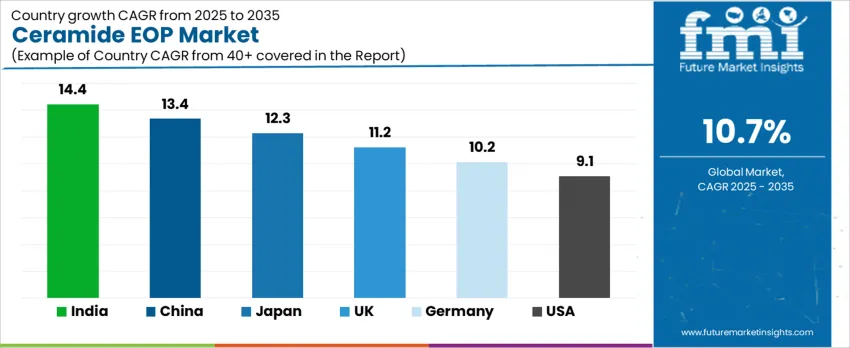
The global Ceramide EOP market is growing as dermocosmetic and medical-skincare brands focus on restoring lipid lamellae in compromised skin barriers. Ceramide EOP contributes to structural reinforcement and moisture retention in formulas addressing chronic dryness, eczema, dermatitis, and age-related lipid depletion. Demand reflects rising clinical interest in barrier-repair routines and increased exposure to strong actives and environmental stress. India leads growth at 14.4% CAGR, followed by China at 13.4%, supported by expanding sensitive-skin and recovery-care product portfolios. Japan advances at 12.3%, with strong biomimetic lipid research. The United Kingdom grows at 11.2%, Germany at 10.2%, and the United States at 9.1%, largely driven by pharmacy and dermatology channels that prioritize validated barrier-support formulations using Ceramide EOP in combination with other skin-identical lipids.
| Country | CAGR (%) |
|---|---|
| India | 14.4% |
| China | 13.4% |
| Japan | 12.3% |
| UK | 11.2% |
| Germany | 10.2% |
| USA | 9.1% |
How is India driving demand for Ceramide EOP?
India records 14.4% CAGR in Ceramide EOP consumption, reflecting strong growth in barrier-repair and recovery-focused skincare. Dermatologists increasingly recommend ceramide-based moisturizers for retinoid-induced irritation, pollution-exposed skin, and post-acne barrier weakness. Local brands formulate Ceramide EOP within multi-ceramide complexes, cholesterol, and fatty acids to mimic physiological lipid ratios. Product portfolios extend from facial creams to body care and scalp serums, supporting daily replenishment in dry and sensitive profiles. E-commerce and pharmacy chains distribute clinical-style products beyond major metros. Ingredient buyers evaluate performance under high heat and humidity, testing for lamellar-structure integrity and stable rheology. Ceramide EOP adoption also increases in pediatric-friendly emollients where low-irritation and structural support are essential.
- Dermatology guidance strengthening barrier-care adoption
- Multi-ceramide complexes imitating physiological lipid structures
- Wider regional access through digital and pharmacy retail
- Pediatric emollients incorporating Ceramide EOP for mild support
How is China expanding Ceramide EOP utilization?
China shows around 13.4% CAGR in Ceramide EOP demand as sensitive-skin and recovery-care categories expand. Skin-barrier impairment associated with pollution, climate variability, and aesthetic procedures creates strong interest in structured lipid restoration. Ceramide EOP is integrated into repair creams, serums, and cleansing systems marketed for calmness and moisture resilience. Medical-aesthetic centers recommend Ceramide EOP formulas following laser and peeling procedures. Domestic manufacturers develop ceramide blends tailored to lamellar-structure compatibility and pH-appropriate systems. Mass and premium brands both use Ceramide EOP to align with barrier-repair narratives. Quality and traceability expectations drive partnerships with suppliers that can document purity, particle-size distribution, and oxidative stability.
- Pollution and procedure-related barrier stress shaping demand
- Recovery creams and serums forming core application base
- Domestic production improving cost-neutral access to ceramide systems
- Supplier traceability and testing influencing procurement decisions
How is Japan supporting advanced Ceramide EOP applications?
Japan grows at about 12.3% CAGR in Ceramide EOP usage, building on long-standing expertise in barrier-focused skincare and biomimetic emulsions. Ceramide EOP is used in moisturizers, cleansing balms, and treatment lotions aimed at dryness related to aging, surfactant use, and environmental transitions. Dermatologists recommend ceramide-based products as supportive care in atopic and sensitive-skin management. Formulators prioritize skin-identical lipid assemblies where EOP contributes to structural reinforcement of lamellae. Japanese brands emphasize soft textures, low fragrance, and rapid absorption suited to daily layering routines. Packaging solutions such as airless pumps support lipid stability in varied humidity conditions. Technical teams assess compatibility with amino-acid and mild non-ionic surfactants to limit barrier disruption.
- Barrier-focused formulations using biomimetic lipid architectures
- Dermatology cooperation in atopic and sensitive-skin protocols
- Texture refinement aligned with daily layering habits
- Packaging and surfactant selection protecting lipid integrity
How is the United Kingdom shaping Ceramide EOP deployment?
The United Kingdom posts about 11.2% CAGR in Ceramide EOP demand, driven by interest in clinical-feeling skincare that addresses cold-weather dryness, active-induced irritation, and compromised barrier conditions. Pharmacies and supermarket health aisles stock repair creams highlighting ceramide content, often alongside niacinamide and glycerin. Ceramide EOP is valued for its structural role in reinforcing lipid lamellae in formulas positioned for eczema-prone or dryness-prone users. Education from dermatology-aligned brands encourages use of barrier-support layers in routines that include retinoids and acids. Procurement teams require high-purity ceramide with consistent performance in stability trials. Formats include face and body moisturizers, hand creams, and targeted barrier serums.
- Pharmacy-led distribution reinforcing barrier-repair positioning
- Co-formulation with humectants and supportive actives
- Cold and windy climate conditions raising dryness concerns
- Stability and purity standards guiding ingredient sourcing
How is Germany reinforcing Ceramide EOP clinical integration?
Germany expands at around 10.2% CAGR in Ceramide EOP utilization, supported by its strong tradition of pharmacy and physician-linked skincare. Ceramide EOP appears in emollient creams formulated for atopic dermatitis, xerosis, and age-related barrier weakening. Dermatologists consider ceramide-containing products as adjunct support in long-term regimens. Manufacturers calibrate lipid ratios of Ceramide EOP with cholesterol and fatty acids to replicate physiological structures. Certification under GMP and alignment with EU cosmetic-safety regulations are essential for supplier selection. Fragrance-free, hypoallergenic profiles dominate, especially in hospital-recommended and pediatric emollients. Retailers present ceramide products in medical-style packaging to match consumer expectations of reliability.
- Physician and pharmacist roles influencing product selection
- Emollient therapies targeting chronic dryness and atopy
- Regulatory and GMP criteria shaping supplier acceptance
- Hypoallergenic positioning supporting sensitive-skin trust
How is the United States expanding Ceramide EOP in dermocosmetic routines?
The United States grows at about 9.1% CAGR in Ceramide EOP demand, led by dermocosmetic brands and OTC formulations focused on barrier repair for retinoid users, exfoliation routines, and dry or mature skin. Ceramide EOP is included in moisturizers, night creams, body lotions, and post-procedure balms. Dermatologists recommend ceramide-enriched products to help maintain barrier function in chronic conditions such as eczema and psoriasis. Retailers stock multi-ceramide complexes in both value and premium tiers, often with supporting clinical-hydration data. Ingredient innovation includes encapsulation and lamellar-gel systems that improve barrier integration. Labelling emphasizes barrier support, moisture retention, and compatibility with active-rich regimens, rather than cosmetic appearance alone.
- Dermocosmetic and OTC channels broadening exposure
- Post-procedure and active-heavy routines generating steady use
- Encapsulation and lamellar-gel systems improving performance
- Clinical-style communication supporting consumer confidence
What does the global competitive structure for Ceramide EOP demand show?
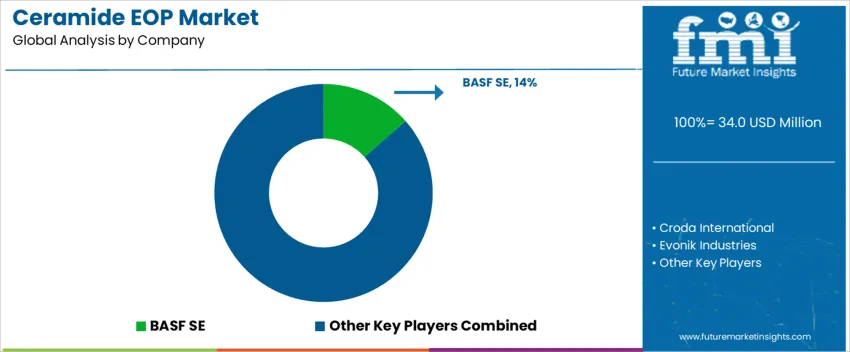
Global demand for Ceramide EOP centers on barrier-repair, dermatologist-aligned hydration, and clinical moisturiser formulations. Its use relies on bio-identical ceramide chemistry, molecular stability in low-water systems, and validated recovery of the stratum corneum lipid matrix. Adoption is concentrated in North America, Europe, and East Asia, where regulatory expectations require documented skin-compatibility and reproducible lipid content.
BASF SE holds about 13.5% share. Its role reflects established manufacturing controls suited for dermocosmetic brands that prioritize measurable barrier outcomes and scalability. Croda International supports premium and clinical-inspired hydration lines using ceramide complexes designed to improve integrity in dryness-prone skin. Evonik Industries sustains influence through high-purity skin-identical lipids deployed in sensitive-skin and professional care.
Symrise extends participation in scalp-care and anti-stress skincare that require predictable performance under environmental exposure. Dow maintains supply presence in large-volume daily moisturisers and cleanser-adjacent applications. Ashland and Clariant supply sustainability-audited ceramides where responsible sourcing and environmental documentation influence approvals by international brand owners. Broader participation from Seppic, Lubrizol, Lonza, Inolex and peers supports mixed-lipid systems containing cholesterol and long-chain fatty acids that aim to enhance moisture-retention efficiency. Competitive advantage depends on controlled stereochemistry, dispersion stability, and verified bioavailability within the skin-lipid bilayer.
Key Players in the Ceramide EOP Market
- BASF SE
- Croda International
- Evonik Industries
- Symrise (incl. IFF/Givaudan actives)
- Dow / Dow Inc.
- Ashland
- Clariant
- Others (Seppic, Lubrizol, Lonza, Inolex etc.)
Scope of the Report
| Items | Values |
|---|---|
| Quantitative Units | USD million |
| End Use Application | Skin Care, Body Care, Hair Care, Sun Care, Color Cosmetics, Men’s Grooming, Baby & Kids Care, Dermocosmetic / Professional Care |
| Product Form | Powder, Granules / Agglomerates, Flakes, Pellets / Prills, Liquid (Solution), Concentrate (High-active Liquid), Dispersion / Suspension, Emulsion, Paste, Gel, Wax / Solid Block, Oil |
| Regions Covered | Asia Pacific, Europe, North America, Latin America, Middle East & Africa |
| Countries Covered | India, China, USA, Germany, South Korea, Japan, Italy, and 40+ countries |
| Key Companies Profiled | BASF SE, Croda International, Evonik Industries, Symrise (incl. IFF/Givaudan actives), Dow / Dow Inc., Ashland, Clariant, Others (Seppic, Lubrizol, Lonza, Inolex etc.) |
| Additional Attributes | Dollar sales by product form and end-use application; inclusion in advanced skin barrier restoration and anti-aging cosmetic formulations; higher adoption in sensitive skin and professional dermatology products; rising innovations in biomimetic ceramides for premium personal care; regional shifts in dermocosmetic consumption across Asia Pacific and North America. |
Ceramide EOP Market by Segment
End Use Application:
- Skin Care
- Body Care
- Hair Care
- Sun Care
- Color Cosmetics
- Men’s Grooming
- Baby & Kids Care
- Dermocosmetic / Professional Care
Product Form:
- Powder
- Granules / Agglomerates
- Flakes
- Pellets / Prills
- Liquid (Solution)
- Concentrate (High-active Liquid)
- Dispersion / Suspension
- Emulsion
- Paste
- Gel
- Wax / Solid Block
- Oil
Region:
- Asia Pacific
- China
- Japan
- South Korea
- India
- Australia & New Zealand
- ASEAN
- Rest of Asia Pacific
- Europe
- Germany
- United Kingdom
- France
- Italy
- Spain
- Nordic
- BENELUX
- Rest of Europe
- North America
- United States
- Canada
- Mexico
- Latin America
- Brazil
- Chile
- Rest of Latin America
- Middle East & Africa
- Kingdom of Saudi Arabia
- Other GCC Countries
- Turkey
- South Africa
- Other African Union
- Rest of Middle East & Africa
Frequently Asked Questions
How big is the ceramide eop market in 2025?
The global ceramide eop market is estimated to be valued at USD 34.0 million in 2025.
What will be the size of ceramide eop market in 2035?
The market size for the ceramide eop market is projected to reach USD 93.8 million by 2035.
How much will be the ceramide eop market growth between 2025 and 2035?
The ceramide eop market is expected to grow at a 10.7% CAGR between 2025 and 2035.
What are the key product types in the ceramide eop market?
The key product types in ceramide eop market are skin care, body care, hair care, sun care, color cosmetics, men’s grooming, baby & kids care and dermocosmetic / professional care.
Which product form segment to contribute significant share in the ceramide eop market in 2025?
In terms of product form, powder segment to command 15.7% share in the ceramide eop market in 2025.
Preview the report firsthand - request a free sample
Get SampleGet the brochure for pricing and purchase details.
Get PDFTable of Content
- Executive Summary
- Global Market Outlook
- Demand-side Trends
- Supply-side Trends
- Technology Roadmap Analysis
- Analysis and Recommendations
- Market Overview
- Market Coverage / Taxonomy
- Market Definition / Scope / Limitations
- Market Background
- Market Dynamics
- Drivers
- Restraints
- Opportunity
- Trends
- Scenario Forecast
- Demand in Optimistic Scenario
- Demand in Likely Scenario
- Demand in Conservative Scenario
- Opportunity Map Analysis
- Product Life Cycle Analysis
- Supply Chain Analysis
- Investment Feasibility Matrix
- Value Chain Analysis
- PESTLE and Porter’s Analysis
- Regulatory Landscape
- Regional Parent Market Outlook
- Production and Consumption Statistics
- Import and Export Statistics
- Market Dynamics
- Global Market Analysis 2020 to 2024 and Forecast, 2025 to 2035
- Historical Market Size Value (USD Million) Analysis, 2020 to 2024
- Current and Future Market Size Value (USD Million) Projections, 2025 to 2035
- Y-o-Y Growth Trend Analysis
- Absolute $ Opportunity Analysis
- Global Market Pricing Analysis 2020 to 2024 and Forecast 2025 to 2035
- Global Market Analysis 2020 to 2024 and Forecast 2025 to 2035, By End Use Application
- Introduction / Key Findings
- Historical Market Size Value (USD Million) Analysis By End Use Application , 2020 to 2024
- Current and Future Market Size Value (USD Million) Analysis and Forecast By End Use Application , 2025 to 2035
- Skin Care
- Body Care
- Hair Care
- Sun Care
- Color Cosmetics
- Men’s Grooming
- Baby & Kids Care
- Dermocosmetic / Professional Care
- Y-o-Y Growth Trend Analysis By End Use Application , 2020 to 2024
- Absolute $ Opportunity Analysis By End Use Application , 2025 to 2035
- Global Market Analysis 2020 to 2024 and Forecast 2025 to 2035, By Product Form
- Introduction / Key Findings
- Historical Market Size Value (USD Million) Analysis By Product Form, 2020 to 2024
- Current and Future Market Size Value (USD Million) Analysis and Forecast By Product Form, 2025 to 2035
- Powder
- Granules / Agglomerates
- Flakes
- Pellets / Prills
- Liquid (Solution)
- Concentrate (High-active Liquid)
- Dispersion / Suspension
- Emulsion
- Paste
- Gel
- Wax / Solid Block
- Y-o-Y Growth Trend Analysis By Product Form, 2020 to 2024
- Absolute $ Opportunity Analysis By Product Form, 2025 to 2035
- Global Market Analysis 2020 to 2024 and Forecast 2025 to 2035, By Region
- Introduction
- Historical Market Size Value (USD Million) Analysis By Region, 2020 to 2024
- Current Market Size Value (USD Million) Analysis and Forecast By Region, 2025 to 2035
- North America
- Latin America
- Western Europe
- Eastern Europe
- East Asia
- South Asia and Pacific
- Middle East & Africa
- Market Attractiveness Analysis By Region
- North America Market Analysis 2020 to 2024 and Forecast 2025 to 2035, By Country
- Historical Market Size Value (USD Million) Trend Analysis By Market Taxonomy, 2020 to 2024
- Market Size Value (USD Million) Forecast By Market Taxonomy, 2025 to 2035
- By Country
- USA
- Canada
- Mexico
- By End Use Application
- By Product Form
- By Country
- Market Attractiveness Analysis
- By Country
- By End Use Application
- By Product Form
- Key Takeaways
- Latin America Market Analysis 2020 to 2024 and Forecast 2025 to 2035, By Country
- Historical Market Size Value (USD Million) Trend Analysis By Market Taxonomy, 2020 to 2024
- Market Size Value (USD Million) Forecast By Market Taxonomy, 2025 to 2035
- By Country
- Brazil
- Chile
- Rest of Latin America
- By End Use Application
- By Product Form
- By Country
- Market Attractiveness Analysis
- By Country
- By End Use Application
- By Product Form
- Key Takeaways
- Western Europe Market Analysis 2020 to 2024 and Forecast 2025 to 2035, By Country
- Historical Market Size Value (USD Million) Trend Analysis By Market Taxonomy, 2020 to 2024
- Market Size Value (USD Million) Forecast By Market Taxonomy, 2025 to 2035
- By Country
- Germany
- UK
- Italy
- Spain
- France
- Nordic
- BENELUX
- Rest of Western Europe
- By End Use Application
- By Product Form
- By Country
- Market Attractiveness Analysis
- By Country
- By End Use Application
- By Product Form
- Key Takeaways
- Eastern Europe Market Analysis 2020 to 2024 and Forecast 2025 to 2035, By Country
- Historical Market Size Value (USD Million) Trend Analysis By Market Taxonomy, 2020 to 2024
- Market Size Value (USD Million) Forecast By Market Taxonomy, 2025 to 2035
- By Country
- Russia
- Poland
- Hungary
- Balkan & Baltic
- Rest of Eastern Europe
- By End Use Application
- By Product Form
- By Country
- Market Attractiveness Analysis
- By Country
- By End Use Application
- By Product Form
- Key Takeaways
- East Asia Market Analysis 2020 to 2024 and Forecast 2025 to 2035, By Country
- Historical Market Size Value (USD Million) Trend Analysis By Market Taxonomy, 2020 to 2024
- Market Size Value (USD Million) Forecast By Market Taxonomy, 2025 to 2035
- By Country
- China
- Japan
- South Korea
- By End Use Application
- By Product Form
- By Country
- Market Attractiveness Analysis
- By Country
- By End Use Application
- By Product Form
- Key Takeaways
- South Asia and Pacific Market Analysis 2020 to 2024 and Forecast 2025 to 2035, By Country
- Historical Market Size Value (USD Million) Trend Analysis By Market Taxonomy, 2020 to 2024
- Market Size Value (USD Million) Forecast By Market Taxonomy, 2025 to 2035
- By Country
- India
- ASEAN
- Australia & New Zealand
- Rest of South Asia and Pacific
- By End Use Application
- By Product Form
- By Country
- Market Attractiveness Analysis
- By Country
- By End Use Application
- By Product Form
- Key Takeaways
- Middle East & Africa Market Analysis 2020 to 2024 and Forecast 2025 to 2035, By Country
- Historical Market Size Value (USD Million) Trend Analysis By Market Taxonomy, 2020 to 2024
- Market Size Value (USD Million) Forecast By Market Taxonomy, 2025 to 2035
- By Country
- Kingdom of Saudi Arabia
- Other GCC Countries
- Turkiye
- South Africa
- Other African Union
- Rest of Middle East & Africa
- By End Use Application
- By Product Form
- By Country
- Market Attractiveness Analysis
- By Country
- By End Use Application
- By Product Form
- Key Takeaways
- Key Countries Market Analysis
- USA
- Pricing Analysis
- Market Share Analysis, 2024
- By End Use Application
- By Product Form
- Canada
- Pricing Analysis
- Market Share Analysis, 2024
- By End Use Application
- By Product Form
- Mexico
- Pricing Analysis
- Market Share Analysis, 2024
- By End Use Application
- By Product Form
- Brazil
- Pricing Analysis
- Market Share Analysis, 2024
- By End Use Application
- By Product Form
- Chile
- Pricing Analysis
- Market Share Analysis, 2024
- By End Use Application
- By Product Form
- Germany
- Pricing Analysis
- Market Share Analysis, 2024
- By End Use Application
- By Product Form
- UK
- Pricing Analysis
- Market Share Analysis, 2024
- By End Use Application
- By Product Form
- Italy
- Pricing Analysis
- Market Share Analysis, 2024
- By End Use Application
- By Product Form
- Spain
- Pricing Analysis
- Market Share Analysis, 2024
- By End Use Application
- By Product Form
- France
- Pricing Analysis
- Market Share Analysis, 2024
- By End Use Application
- By Product Form
- India
- Pricing Analysis
- Market Share Analysis, 2024
- By End Use Application
- By Product Form
- ASEAN
- Pricing Analysis
- Market Share Analysis, 2024
- By End Use Application
- By Product Form
- Australia & New Zealand
- Pricing Analysis
- Market Share Analysis, 2024
- By End Use Application
- By Product Form
- China
- Pricing Analysis
- Market Share Analysis, 2024
- By End Use Application
- By Product Form
- Japan
- Pricing Analysis
- Market Share Analysis, 2024
- By End Use Application
- By Product Form
- South Korea
- Pricing Analysis
- Market Share Analysis, 2024
- By End Use Application
- By Product Form
- Russia
- Pricing Analysis
- Market Share Analysis, 2024
- By End Use Application
- By Product Form
- Poland
- Pricing Analysis
- Market Share Analysis, 2024
- By End Use Application
- By Product Form
- Hungary
- Pricing Analysis
- Market Share Analysis, 2024
- By End Use Application
- By Product Form
- Kingdom of Saudi Arabia
- Pricing Analysis
- Market Share Analysis, 2024
- By End Use Application
- By Product Form
- Turkiye
- Pricing Analysis
- Market Share Analysis, 2024
- By End Use Application
- By Product Form
- South Africa
- Pricing Analysis
- Market Share Analysis, 2024
- By End Use Application
- By Product Form
- USA
- Market Structure Analysis
- Competition Dashboard
- Competition Benchmarking
- Market Share Analysis of Top Players
- By Regional
- By End Use Application
- By Product Form
- Competition Analysis
- Competition Deep Dive
- BASF SE
- Overview
- Product Portfolio
- Profitability by Market Segments (Product/Age /Sales Channel/Region)
- Sales Footprint
- Strategy Overview
- Marketing Strategy
- Product Strategy
- Channel Strategy
- Croda International
- Evonik Industries
- Symrise (incl. IFF/Givaudan actives)
- Dow / Dow Inc.
- Ashland
- Clariant
- Others (Seppic, Lubrizol, Lonza, Inolex etc.)
- BASF SE
- Competition Deep Dive
- Assumptions & Acronyms Used
- Research Methodology


