

- Market Size (2026)
- USD 3.5 Bn
- Forecast (2036)
- USD 5.7 Bn
- CAGR (2026 to 2036)
- 5.0%
Electrostatic Coalescers Market Size, Market Forecast and Outlook By FMI
The electrostatic coalescers market was valued at USD 3.3 billion in 2025. the market is set to reach USD 3.5 billion by 2026-end and grow at a CAGR of 5.0% between 2026-2036 to reach USD 5.7 billion by 2036.
Summary of the Electrostatic Coalescers Market
- Demand and Growth Drivers
- Demand for electrostatic coalescers used in crude oil dehydration and water separation processes at production facilities is driven by growth in upstream oil and gas production.
- Refineries' increasing demands for higher quality crude oil are spurring sales of advanced coalescer systems that deliver lower basic sediment and water (BS&W) content.
- As offshore production expands, There is a need for compact electrostatic coalescer designs that are optimized for the space and weight limitations on platforms.
- Product and Segment View
- Horizontal electrostatic coalescers hold a 34.0% share and dominate the product segment, Due to their established position in high-throughput onshore crude oil dehydration applications.
- The application segment of crude oil dehydration accounts for the largest market share of 45.0% due to the importance of water removal in crude oil processing and pipeline transport specifications.
- The end-use segment is driven by upstream oil and gas, which is a reflection of the concentration of electrostatic coalescer installations in production facilities and gathering stations.
- Geography and Competitive Outlook
- The USA is leading with a CAGR of 5.2% owing to growth of shale oil production and investments in process equipment at production facilities.
- Refinery crude quality requirements and upgrades to North Sea production facilities keep demand sustained for the EU at 5.1% CAGR.
- EPC procurement contracts are more likely to be awarded to companies with proven separation performance data and a history of working with oil and gas operators..
- Analyst Opinion
- “Companies able to provide compact, High-efficiency electrostatic coalescer systems with proven performance in difficult crude oil emulsions are well placed to meet the growing demand for upstream production and refinery quality compliance.
- The market is reacting to heavier crude slates and tighter refinery specs requiring higher separation efficiency.
- Offshore platform compact coalescer designs are an increasing niche of procurement in the overall market.
- Demand is supported by rising global crude oil production and by the increasing focus on crude quality at the point of sale.
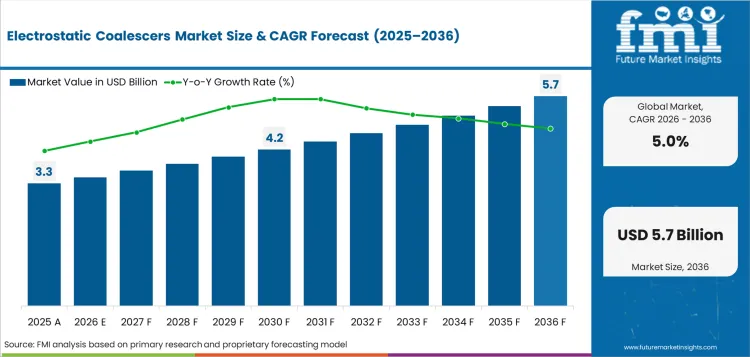
Key Takeaways, Market Size, And Forecast
- 2025 Market Value: USD 3.32 Billion
- 2036 Forecast Value: USD 5.68 Billion
- Forecast CAGR: 7.65% (2021–2036)
- 2026–2036 Growth Rate: 5% CAGR
- Incremental Opportunity: USD 2.19 Billion
- Leading Product Share: Horizontal Electrostatic Coalescers – 34% (2026)
- Key Growth Application: Crude Oil Dehydration & Water-in-Oil Emulsion Treatment
- Top Growth Regions: USA (5.2%) & EU (5.1%) CAGR
Electrostatic Coalescers Market Definition
The electrostatic coalescers market comprises process equipment used for the separation of water-in-oil emulsions in crude oil production and refining operations using electric fields. the market scope includes horizontal, Vertical and combined electrostatic coalescer systems for dehydration, Desalting and emulsion treatment applications.
Electrostatic Coalescers Market Inclusions
The market scope covers all commercially available electrostatic coalescers segmented by Product (Horizontal, Vertical, Combined), application (Crude Oil Dehydration, Desalting, Emulsion Treatment), end Use (Upstream Oil & Gas, Refineries, Petrochemicals), Vessel Size, Voltage Type, installation Type. Revenue sizing covers the forecast period of 2026 to 2036.
Electrostatic Coalescers Market Exclusions
The scope does not cover mechanical coalescers, Centrifugal separators, Gravity settling tanks or chemical demulsifier products used outside of electrostatic equipment.
Electrostatic Coalescers Market Research Methodology
- Primary Research: FMI analysts interviewed manufacturers, Distributors, Procurement specialists and end-use application experts in key markets.
- Desk Research: Information compiled from industry associations, regulatory filings, Certification bodies and manufacturer disclosures.
- Market Sizing and Forecasting: Bottom-up aggregation across product, application, end use, installation type, operation mode, technology, distribution channel segments, with regional adoption curves and cross-referencing against publicly available industry data.
- Data Validation: Cross-checked quarterly with global production data, Trade statistics and manufacturer reported figures.
Why is the Electrostatic Coalescers Market Growing?
- Upstream oil and gas production growth is providing a sustained demand for electrostatic coalescers in crude oil dehydration and water separation applications.
- The need for advanced coalescer systems with higher separation efficiency is driven by increasingly strict crude quality specifications at refineries.
- USA leads the growth with 5.2% CAGR, Fueled by shale production and investment in production facilities.
The electrostatic coalescers market is growing supported by rising demand for efficient water-in-oil separation equipment, driven by growth in crude oil production and tightening quality specifications. Electrostatic coalescers use electric fields to speed up the coalescence and separation of water droplets, and they give a lower BS&W content than gravity settling alone. growth is driven by new plant construction and upgrades to existing process equipment to meet crude quality specifications.
The leaders are horizontal coalescers with 34.0%, Due to their applications in high throughput onshore applications. Crude oil dehydration is 45.0% of applications since water removal is a key step in crude processing and pipeline transport. the market structure benefits established process equipment manufacturers with proven performance data and relationships with oil and gas operators.
Market Segmentation Analysis
- Vertical Electrostatic Coalescers holds the product segment, reflecting established supply and end-use preference.
- Crude Oil Dehydration is the largest segment in the application category with 45% share.
- The biggest end use segment is Upstream Oil And Gas.
The electrostatic coalescers market is segmented by product, application, end use, installation type, operation mode, technology, distribution channel. Each segment reflects distinct procurement criteria, end-use requirements, and pricing structures.
Insights into the Product Segment
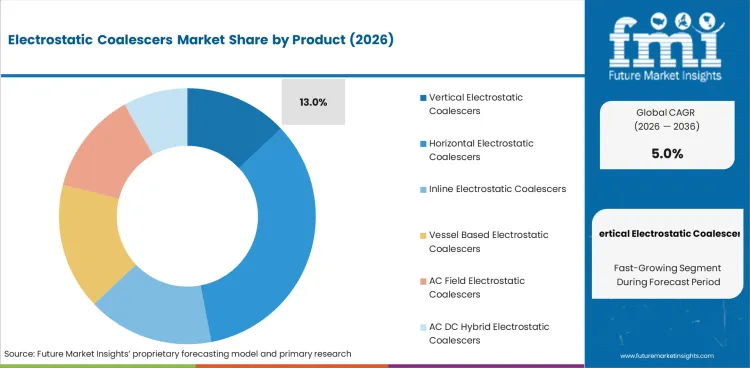
- Product Segment Analysis: Vertical Electrostatic Coalescers is the leader in the product segment. Demand is driven by existing end-use compatibility, Supply chain availability and cost competitiveness against alternative options.
- Other product categories include Compact Vertical Units, Offshore Platforms, Space Constrained Systems, Each addressing specific application requirements and reflecting technical specification diversity across end-use industries.
Insights into the Application Segment
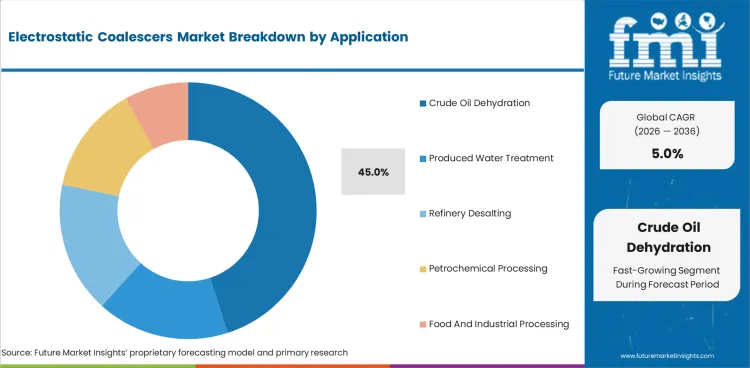
- Crude Oil Dehydration holds the dominance in the application segment with a share of 45%. Demand is driven by existing end-use compatibility, Availability and cost competitiveness in the supply chain versus alternative options.
- Additional application categories are Oil Water Separation, Upstream Production, export Quality Crude, Each of which cater to specific application requirements and demonstrate the diversity of technical specifications across end-use industries.
Electrostatic Coalescers Market Drivers, Restraints, and Opportunities
- Continued growth in upstream oil production and tightening crude quality specifications are creating ongoing demand for electrostatic coalescer systems.
- Coalescer installations are capital intensive, with long project procurement cycles, which leads to demand volatility with oil and gas investment cycles.
- The demand for compact, Weight-optimized coalescer designs with smaller installation footprints is being driven by offshore platform expansion.
The electrostatic coalescers market continues to grow, Shaped by regulatory drivers, Cost structure constraints, and emerging application opportunities. Adoption pace varies by segment, Geography, and price sensitivity of end-use applications.
Crude Quality Compliance
Refineries are tightening crude oil purchase specifications for BS&W content, Driving upstream operators to invest in more efficient dehydration equipment. Electrostatic coalescers deliver the separation performance required to meet these specifications, Particularly for heavier crude slates with stable emulsions.
Capital Investment Cycles
The demand for electrostatic coalescer is linked to the capital expenditure cycle of oil and gas and hence is variable. Procurement is expedited during periods of production expansion and slowed with project delays and spending deferrals during periods of low oil prices.
Offshore Compact Systems
Space and weight constraints on offshore platforms lead to a need for compact electrostatic coalescer designs that provide high separation efficiency with a smaller installation footprint. it's a niche with a premium price point, with specialized engineering expertise.
Analysis of Electrostatic Coalescers Market By Key Countries
.webp "Top Country Growth Comparison Electrostatic Coalescers Market Cagr (2026 2036)")
| Country | CAGR |
|---|---|
| USA | 5.2% |
| EU | 5.1% |
| Japan | 5% |
| South Korea | 5% |
| UK | 4.9% |
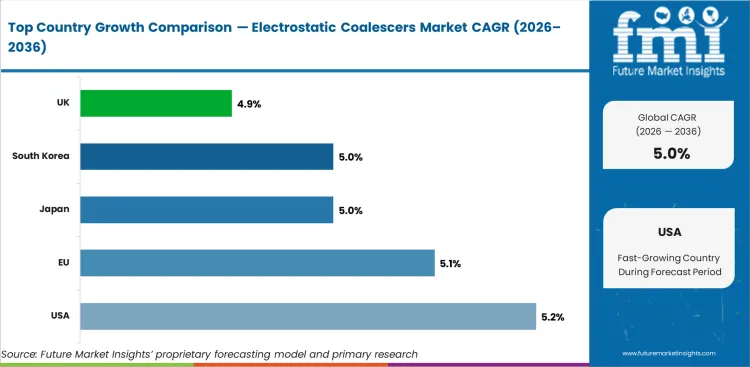
- USA leads with a 5.2% CAGR, reflecting established procurement networks.
- EU at 5.1% shows strong demand due to EU regulatory frameworks.
- Japan (5%) and South Korea (5%) continue growing, Supported by end-use industry expansion.
The global electrostatic coalescers market is expected to grow at a rate of 5% per year from 2026 to 2036. the study covers more than 30 countries, and the main markets are listed below.
Demand Outlook for Electrostatic Coalescers Market in USA
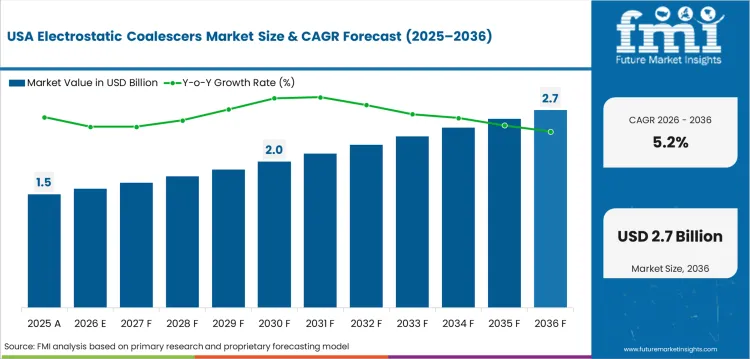
USA is projected to grow at a rate of 5.2% through 2036, reflecting established procurement networks, regulatory compliance investment, and strong end-use demand. Demand is supported by compliance-driven procurement, established distribution networks, and premium product demand.
- Compliance-LED procurement is sustaining demand for products meeting regulatory specifications.
- Established distribution networks support efficient supply chain coverage across end-use sectors.
- Premium product demand is creating value-added procurement channels alongside volume purchasing.
Future Outlook for Electrostatic Coalescers Market in Europe
Europe is projected to grow at a rate of 5.1% through 2036, reflecting EU regulatory frameworks, sustainability mandates, and advanced manufacturing infrastructure. Demand is supported by EU-wide regulatory harmonization, sustainability mandates, and advanced manufacturing infrastructure.
- EU regulatory frameworks are creating compliance-LED demand across member states.
- Sustainability mandates are accelerating adoption of compliant product specifications.
- Advanced manufacturing infrastructure supports efficient production and distribution.
Opportunity Analysis of Electrostatic Coalescers Market in Japan
Japan is projected to grow at a rate of 5% through 2036, reflecting advanced manufacturing capabilities, quality-driven procurement standards, and technology adoption. Demand is supported by quality-driven procurement standards, advanced manufacturing, and technology adoption.
- Quality-driven procurement standards sustain demand for high-specification products.
- Advanced manufacturing capabilities support domestic production and technology adoption.
- Established industry infrastructure enables efficient distribution across end-use sectors.
In-depth Analysis of Electrostatic Coalescers Market in South Korea
South Korea is projected to grow at a rate of 5% through 2036, reflecting technology-LED adoption, manufacturing sector modernization, and export-oriented production capabilities. Demand is supported by manufacturing sector investment, technology adoption, and export-oriented capabilities.
- Technology-LED adoption is driving procurement modernization across industrial applications.
- Manufacturing sector investment supports domestic demand and export competitiveness.
- Regulatory development is raising product specification requirements across categories.
Sales Analysis of Electrostatic Coalescers Market in UK
UK is projected to grow at a rate of 4.9% through 2036, reflecting regulatory alignment with quality standards and established distribution infrastructure. Demand is supported by regulatory alignment, established distribution channels, and quality-driven procurement.
- Regulatory standards alignment is shaping product specifications and procurement criteria.
- Established distribution infrastructure supports efficient market coverage across the region.
- Premium segment demand is creating opportunities for value-added product positioning.
Competitive Landscape and Strategic Positioning
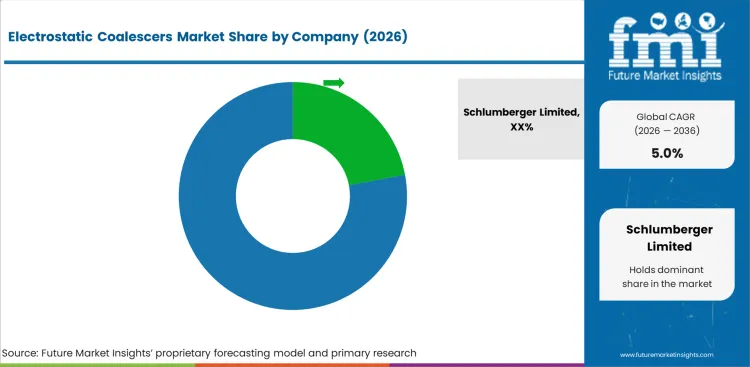
- Schlumberger Limited is the market leader due to established manufacturing infrastructure, Wide product portfolio and strong end-use customer relationships.
- National Oilwell Varco (NOV) and FMC Technologies (TechnipFMC) are competitors thanks to their extensive product lines and regional distribution capabilities.
- Smaller and emerging players are focusing on niche segments and specialized applications to establish themselves in the market.
Schlumberger Limited is a major player due to its extensive manufacturing capacity and existing relationships with end-use customers in multiple geographies. Competitors National Oilwell Varco (NOV) is competing on product portfolio breadth and distribution reach.
FMC Technologies (TechnipFMC) and Alfa Laval AB are competitive in certain product segments and geographies. Barriers to entry include manufacturing scale requirements, regulatory certification timelines and existing procurement relationships.
Cost optimization, Geographic expansion, product specification upgrades and alignment with regulatory compliance timelines are strategic priorities.
Key Companies in the Electrostatic Coalescers Market
Key global companies leading the electrostatic coalescers market include:
- Schlumberger Limited, National Oilwell Varco (NOV), FMC Technologies (TechnipFMC) hold leading positions through established infrastructure and strong customer relationships.
- Alfa Laval AB and VME Process maintain competitive positions through regional expertise and product specialization.
Competitive Benchmarking: Electrostatic Coalescers Market
| Company | Separation Efficiency | Vessel Size Range | Offshore Capability | Geographic Presence |
|---|---|---|---|---|
| Schlumberger Limited | High | Strong | Strong | Global |
| National Oilwell Varco (NOV) | High | Strong | Strong | Global |
| FMC Technologies (TechnipFMC) | High | Strong | Strong | Global |
| Alfa Laval AB | Medium | Moderate | Moderate | Regional |
| VME Process | Medium | Moderate | Moderate | Regional |
Source: Future Market Insights competitive analysis, 2026.
Key Developments in Electrostatic Coalescers Market
- In 2025, Schlumberger Limited continued enhancing compact offshore separation and electro coalescence technologies focused on reducing platform weight and footprint requirements for offshore installations.
- In 2025, Alfa Laval AB strengthened its heavy crude oil separation and dehydration technology portfolio with advanced electrostatic and centrifugal separation solutions for refinery and upstream applications.
Key Players in the Electrostatic Coalescers Market
Major Global Players
- Schlumberger Limited
- National Oilwell Varco (NOV)
- FMC Technologies (TechnipFMC)
- Alfa Laval AB
- VME Process
Emerging Players/Startups
- Alfa Laval AB
- VME Process
Report Scope and Coverage
| Metric | Value |
|---|---|
| Quantitative Units | USD 3.49 billion to USD 5.68 billion, at a CAGR of 5% |
| Market Definition | The electrostatic coalescers market encompasses products categorized by product, application, end use, installation type, operation mode, technology, distribution channel across all major end-use applications. |
| Regions Covered | North America, Latin America, Europe, East Asia, South Asia and Pacific, Middle East and Africa |
| Countries Covered | USA, EU, Japan, South Korea, UK, 30 plus countries |
| Key Companies Profiled | Schlumberger Limited, National Oilwell Varco (NOV), FMC Technologies (TechnipFMC), Alfa Laval AB, VME Process |
| Forecast Period | 2026 to 2036 |
| Approach | Hybrid bottom-up and top-down methodology starting with verified transaction data, Projecting adoption velocity across segments and regions. |
Market Segmentation Analysis
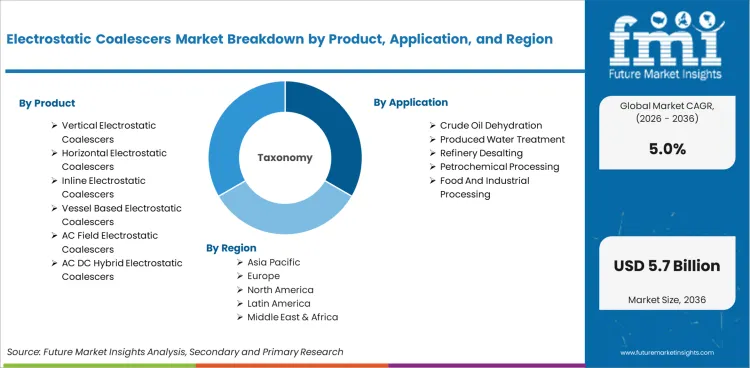
Electrostatic Coalescers Market Segmented by Product:
- Vertical Electrostatic Coalescers
- Compact Vertical Units
- Offshore Platforms
- Space Constrained Systems
- Compact Vertical Units
- Horizontal Electrostatic Coalescers
- High Capacity Units
- Refineries
- Large Flow Applications
- High Capacity Units
- Inline Electrostatic Coalescers
- Pipeline Integrated Systems
- Modular Skid Units
- Onshore Fields
- Pipeline Integrated Systems
- Vessel Based Electrostatic Coalescers
- Pressure Vessel Systems
- Oil Water Separation
- Processing Trains
- Pressure Vessel Systems
- AC Field Electrostatic Coalescers
- Alternating Current Systems
- Standard Emulsions
- Conventional Oil Fields
- Alternating Current Systems
- AC DC Hybrid Electrostatic Coalescers
- Dual Current Systems
- High Stability Emulsions
- Advanced Separation
- Dual Current Systems
Electrostatic Coalescers Market Segmented by Application:
- Crude Oil Dehydration
- Oil Water Separation
- Upstream Production
- Export Quality Crude
- Oil Water Separation
- Produced Water Treatment
- Water Recovery Systems
- Environmental Compliance
- Reuse Systems
- Water Recovery Systems
- Refinery Desalting
- Salt Removal Systems
- Downstream Processing
- Fuel Quality Improvement
- Salt Removal Systems
- Petrochemical Processing
- Chemical Separation
- Process Optimization
- Feedstock Purification
- Chemical Separation
- Food And Industrial Processing
- Oil Based Processing
- Specialty Separation
- Industrial Fluids
- Oil Based Processing
Electrostatic Coalescers Market Segmented by End Use:
- Upstream Oil And Gas
- Exploration And Production
- Offshore Operations
- Onshore Fields
- Exploration And Production
- Midstream Oil And Gas
- Pipeline Operations
- Storage Terminals
- Transportation Systems
- Pipeline Operations
- Downstream Oil And Gas
- Refineries
- Fuel Processing
- Petrochemical Plants
- Refineries
- Chemical Industry
- Process Plants
- Solvent Recovery
- Separation Units
- Process Plants
- Power Generation
- Turbine Systems
- Fuel Conditioning
- Turbine Systems
Electrostatic Coalescers Market Segmented by Installation Type:
- Vessel Based Systems
- Traditional Installations
- Large Scale Plants
- Fixed Infrastructure
- Traditional Installations
- Inline Systems
- Modular Installations
- Skid Mounted Units
- Mobile Processing
- Modular Installations
Electrostatic Coalescers Market Segmented by Operation Mode:
- Continuous Operation
- High Throughput Systems
- Industrial Scale
- 24x7 Operations
- High Throughput Systems
- Batch Operation
- Intermittent Processing
- Controlled Separation
- Small Facilities
- Intermittent Processing
Electrostatic Coalescers Market Segmented by Technology:
- AC Field Systems
- Standard Electrostatic Separation
- Cost Efficient Systems
- Widely Adopted
- Standard Electrostatic Separation
- DC Field Systems
- High Precision Separation
- Complex Emulsions
- Special Applications
- High Precision Separation
- AC DC Hybrid Systems
- Advanced Control Systems
- High Efficiency Separation
- Smart Switching
- Advanced Control Systems
Electrostatic Coalescers Market Segmented by Distribution Channel:
- Direct Sales
- OEM Contracts
- Oil And Gas EPCs
- Long Term Supply
- OEM Contracts
- Distributors And Suppliers
- Industrial Distributors
- Regional Supply
- Global Supply
- Industrial Distributors
- Project Based Sales
- Engineering Procurement Contracts
- Turnkey Solutions
- Large Infrastructure Projects
- Engineering Procurement Contracts
Electrostatic Coalescers Market by Region:
- North America
- USA
- Canada
- Mexico
- Latin America
- Brazil
- Chile
- Rest of Latin America
- Western Europe
- Germany
- UK
- Italy
- Spain
- France
- Nordic
- BENELUX
- Rest of Western Europe
- Eastern Europe
- Russia
- Poland
- Hungary
- Balkan & Baltic
- Rest of Eastern Europe
- East Asia
- China
- Japan
- South Korea
- South Asia and Pacific
- India
- ASEAN
- Australia & New Zealand
- Rest of South Asia and Pacific
- Middle East & Africa
- Kingdom of Saudi Arabia
- Other GCC Countries
- Turkiye
- South Africa
- Other African Union
- Rest of Middle East & Africa
Research Sources and Bibliography
- International Energy Agency. (2025). World Energy Outlook: Oil Production and Processing Report. IEA.
- American Petroleum Institute. (2024). API Standards for Crude Oil Treating Equipment. API.
- Society of Petroleum Engineers. (2025). Upstream Production Facilities and Process Equipment Report. SPE.
- European Commission. (2024). Energy Infrastructure and Refinery Operations Standards. EC.
- Organisation of the Petroleum Exporting Countries. (2025). World Oil Outlook: Production and Quality Trends. OPEC.
This bibliography is provided for reader reference.
This Report Answers
- Estimating the size of the electrostatic coalescers market and revenue projections from 2026 to 2036.
- Segmentation by product, application, end use, installation type, operation mode, technology, distribution channel.
- Insights across more than 30 country and regional markets.
- Analysis of key growth drivers, Restraints, and emerging opportunities.
- Assessment of the competitive landscape and strategic positioning.
- Identification of investment opportunities across primary application segments.
- Supply chain structure and distribution channel analysis.
- Delivery of data in PDF and Excel formats.
Frequently Asked Questions
What is the global market demand for Electrostatic Coalescers Market in 2026?
In 2026, the global electrostatic coalescers market is expected to be worth USD 3.49 billion.
How big will the Electrostatic Coalescers Market be in 2036?
By 2036, the electrostatic coalescers market is expected to be worth USD 5.68 billion.
How much is demand for Electrostatic Coalescers Market expected to grow between 2026 and 2036?
Between 2026 and 2036, the electrostatic coalescers market is expected to grow at a CAGR of 5%.
Which segment is likely to lead the Electrostatic Coalescers Market in 2026?
In the Electrostatic Coalescers Market, Horizontal Electrostatic Coalescers is expected to account for 34% of the product segment in 2026, reflecting strong downstream demand and established procurement patterns.
What is causing demand to rise in USA for the Electrostatic Coalescers Market?
In the Electrostatic Coalescers Market, USA is projected to grow at 5.2% through 2036, reflecting established procurement networks, regulatory compliance investment, and strong end-use demand.
What is causing demand to rise in Europe for the Electrostatic Coalescers Market?
In the Electrostatic Coalescers Market, Europe is projected to grow at 5.1% through 2036, reflecting EU regulatory frameworks, sustainability mandates, and advanced manufacturing infrastructure.
What is the definition of the Electrostatic Coalescers Market?
The electrostatic coalescers market encompasses products categorized by product, application, end use, installation type, operation mode, technology, distribution channel across all major end-use applications.
How does FMI forecast and validate the Electrostatic Coalescers Market?
Forecasting models use a hybrid bottom-up and top-down approach, starting with verified transaction data and cross-referencing against global production statistics and manufacturer disclosures.
Preview the report firsthand - request a free sample
Get SampleGet the brochure for pricing and purchase details.
Get PDFTable of Content
- Executive Summary
- Global Market Outlook
- Demand-side Trends
- Supply-side Trends
- Technology Roadmap Analysis
- Analysis and Recommendations
- Market Overview
- Market Coverage / Taxonomy
- Market Definition / Scope / Limitations
- Research Methodology
- Chapter Orientation
- Analytical Lens and Working Hypotheses
- Market Structure, Signals, and Trend Drivers
- Benchmarking and Cross-market Comparability
- Market Sizing, Forecasting, and Opportunity Mapping
- Research Design and Evidence Framework
- Desk Research Programme (Secondary Evidence)
- Company Annual and Sustainability Reports
- Peer-reviewed Journals and Academic Literature
- Corporate Websites, product Literature, and Technical Notes
- Earnings Decks and Investor Briefings
- Statutory Filings and Regulatory Disclosures
- Technical White Papers and Standards Notes
- Trade Journals, Industry Magazines, and Analyst Briefs
- Conference Proceedings, Webinars, and Seminar Materials
- Government Statistics Portals and Public Data Releases
- Press Releases and Reputable Media Coverage
- Specialist Newsletters and Curated Briefings
- Sector Databases and Reference Repositories
- FMI Internal Proprietary Databases and Historical Market Datasets
- Subscription Datasets and Paid Sources
- Social Channels, Communities, and Digital Listening Inputs
- Additional Desk Sources
- Expert Input and Fieldwork (Primary Evidence)
- Primary Modes
- Qualitative Interviews and Expert Elicitation
- Quantitative Surveys and Structured Data Capture
- Blended Approach
- Why Primary Evidence is Used
- Field Techniques
- Interviews
- Surveys
- Focus Groups
- Observational and In-context Research
- Social and Community Interactions
- Stakeholder Universe Engaged
- C-suite Leaders
- Board Members
- Presidents and Vice Presidents
- R&D and Innovation Heads
- Technical Specialists
- Domain Subject-matter Experts
- Scientists
- Physicians and Other Healthcare Professionals
- Governance, Ethics, and Data Stewardship
- Research Ethics
- Data Integrity and Handling
- Primary Modes
- Tooling, Models, and Reference Databases
- Desk Research Programme (Secondary Evidence)
- Data Engineering and Model Build
- Data Acquisition and Ingestion
- Cleaning, Normalisation, and Verification
- Synthesis, Triangulation, and Analysis
- Quality Assurance and Audit Trail
- Market Background
- Market Dynamics
- Drivers
- Restraints
- Opportunity
- Trends
- Scenario Forecast
- Demand in Optimistic Scenario
- Demand in Likely Scenario
- Demand in Conservative Scenario
- Opportunity Map Analysis
- Product Life Cycle Analysis
- Supply Chain Analysis
- Investment Feasibility Matrix
- Value Chain Analysis
- PESTLE and Porter’s Analysis
- Regulatory Landscape
- Regional Parent Market Outlook
- Production and Consumption Statistics
- Import and Export Statistics
- Market Dynamics
- Global Market Analysis 2021 to 2025 and Forecast, 2026 to 2036
- Historical Market Size Value (USD Million) Analysis, 2021 to 2025
- Current and Future Market Size Value (USD Million) Projections, 2026 to 2036
- Y-o-Y Growth Trend Analysis
- Absolute $ Opportunity Analysis
- Global Market Pricing Analysis 2021 to 2025 and Forecast 2026 to 2036
- Global Market Analysis 2021 to 2025 and Forecast 2026 to 2036, by Product
- Introduction / Key Findings
- Historical Market Size Value (USD Million) Analysis By Product , 2021 to 2025
- Current and Future Market Size Value (USD Million) Analysis and Forecast By Product , 2026 to 2036
- Vertical Electrostatic Coalescers
- Compact Vertical Value (USD Million)s
- Offshore Platforms
- Space Constrained Systems
- Horizontal Electrostatic Coalescers
- High Capacity Value (USD Million)s
- Refineries
- Large Flow Applications
- Inline Electrostatic Coalescers
- Pipeline Integrated Systems
- Modular Skid Value (USD Million)s
- Onshore Fields
- Vessel Based Electrostatic Coalescers
- Pressure Vessel Systems
- Oil Water Separation
- Processing Trains
- AC Field Electrostatic Coalescers
- Alternating Current Systems
- Standard Emulsions
- Conventional Oil Fields
- AC DC Hybrid Electrostatic Coalescers
- Dual Current Systems
- High Stability Emulsions
- Advanced Separation
- Vertical Electrostatic Coalescers
- Y-o-Y Growth Trend Analysis By Product , 2021 to 2025
- Absolute $ Opportunity Analysis By Product , 2026 to 2036
- Global Market Analysis 2021 to 2025 and Forecast 2026 to 2036, by Application
- Introduction / Key Findings
- Historical Market Size Value (USD Million) Analysis By Application, 2021 to 2025
- Current and Future Market Size Value (USD Million) Analysis and Forecast By Application, 2026 to 2036
- Crude Oil Dehydration
- Oil Water Separation
- Upstream Production
- Export Quality Crude
- Produced Water Treatment
- Water Recovery Systems
- Environmental Compliance
- Reuse Systems
- Refinery Desalting
- Salt Removal Systems
- Downstream Processing
- Fuel Quality Improvement
- Petrochemical Processing
- Chemical Separation
- Process Optimization
- Feedstock Purification
- Food And Industrial Processing
- Oil Based Processing
- Specialty Separation
- Industrial Fluids
- Crude Oil Dehydration
- Y-o-Y Growth Trend Analysis By Application, 2021 to 2025
- Absolute $ Opportunity Analysis By Application, 2026 to 2036
- Global Market Analysis 2021 to 2025 and Forecast 2026 to 2036, by End Use
- Introduction / Key Findings
- Historical Market Size Value (USD Million) Analysis By End Use, 2021 to 2025
- Current and Future Market Size Value (USD Million) Analysis and Forecast By End Use, 2026 to 2036
- Upstream Oil And Gas
- Exploration And Production
- Offshore Operations
- Onshore Fields
- Midstream Oil And Gas
- Pipeline Operations
- Storage Terminals
- Transportation Systems
- Downstream Oil And Gas
- Refineries
- Fuel Processing
- Petrochemical Plants
- Chemical Industry
- Process Plants
- Solvent Recovery
- Separation Value (USD Million)s
- Power Generation
- Turbine Systems
- Fuel Conditioning
- Upstream Oil And Gas
- Y-o-Y Growth Trend Analysis By End Use, 2021 to 2025
- Absolute $ Opportunity Analysis By End Use, 2026 to 2036
- Global Market Analysis 2021 to 2025 and Forecast 2026 to 2036, by Installation Type
- Introduction / Key Findings
- Historical Market Size Value (USD Million) Analysis By Installation Type, 2021 to 2025
- Current and Future Market Size Value (USD Million) Analysis and Forecast By Installation Type, 2026 to 2036
- Vessel Based Systems
- Traditional Installations
- Large Scale Plants
- Fixed Infrastructure
- Inline Systems
- Modular Installations
- Skid Mounted Value (USD Million)s
- Mobile Processing
- Vessel Based Systems
- Y-o-Y Growth Trend Analysis By Installation Type, 2021 to 2025
- Absolute $ Opportunity Analysis By Installation Type, 2026 to 2036
- Global Market Analysis 2021 to 2025 and Forecast 2026 to 2036, by Operation Mode
- Introduction / Key Findings
- Historical Market Size Value (USD Million) Analysis By Operation Mode, 2021 to 2025
- Current and Future Market Size Value (USD Million) Analysis and Forecast By Operation Mode, 2026 to 2036
- Continuous Operation
- High Throughput Systems
- Industrial Scale
- 24x7 Operations
- Batch Operation
- Intermittent Processing
- Controlled Separation
- Small Facilities
- Continuous Operation
- Y-o-Y Growth Trend Analysis By Operation Mode, 2021 to 2025
- Absolute $ Opportunity Analysis By Operation Mode, 2026 to 2036
- Global Market Analysis 2021 to 2025 and Forecast 2026 to 2036, by Technology
- Introduction / Key Findings
- Historical Market Size Value (USD Million) Analysis By Technology, 2021 to 2025
- Current and Future Market Size Value (USD Million) Analysis and Forecast By Technology, 2026 to 2036
- AC Field Systems
- Standard Electrostatic Separation
- Cost Efficient Systems
- Widely Adopted
- DC Field Systems
- High Precision Separation
- Complex Emulsions
- Special Applications
- AC DC Hybrid Systems
- Advanced Control Systems
- High Efficiency Separation
- Smart Switching
- AC Field Systems
- Y-o-Y Growth Trend Analysis By Technology, 2021 to 2025
- Absolute $ Opportunity Analysis By Technology, 2026 to 2036
- Global Market Analysis 2021 to 2025 and Forecast 2026 to 2036, by Distribution Channel
- Introduction / Key Findings
- Historical Market Size Value (USD Million) Analysis By Distribution Channel, 2021 to 2025
- Current and Future Market Size Value (USD Million) Analysis and Forecast By Distribution Channel, 2026 to 2036
- Direct Sales
- OEM Contracts
- Oil And Gas EPCs
- Long Term Supply
- Distributors And Suppliers
- Industrial Distributors
- Regional Supply
- Global Supply
- Project Based Sales
- Engineering Procurement Contracts
- Turnkey Solutions
- Large Infrastructure Projects
- Direct Sales
- Y-o-Y Growth Trend Analysis By Distribution Channel, 2021 to 2025
- Absolute $ Opportunity Analysis By Distribution Channel, 2026 to 2036
- Global Market Analysis 2021 to 2025 and Forecast 2026 to 2036, by Region
- Introduction
- Historical Market Size Value (USD Million) Analysis By Region, 2021 to 2025
- Current Market Size Value (USD Million) Analysis and Forecast By Region, 2026 to 2036
- North America
- Latin America
- Western Europe
- Eastern Europe
- East Asia
- South Asia and Pacific
- Middle East & Africa
- Market Attractiveness Analysis By Region
- North America Market Analysis 2021 to 2025 and Forecast 2026 to 2036, by Country
- Historical Market Size Value (USD Million) Trend Analysis By Market Taxonomy, 2021 to 2025
- Market Size Value (USD Million) Forecast By Market Taxonomy, 2026 to 2036
- By Country
- USA
- Canada
- Mexico
- By Product
- By Application
- By End Use
- By Installation Type
- By Operation Mode
- By Technology
- By Distribution Channel
- By Country
- Market Attractiveness Analysis
- By Country
- By Product
- By Application
- By End Use
- By Installation Type
- By Operation Mode
- By Technology
- By Distribution Channel
- Key Takeaways
- Latin America Market Analysis 2021 to 2025 and Forecast 2026 to 2036, by Country
- Historical Market Size Value (USD Million) Trend Analysis By Market Taxonomy, 2021 to 2025
- Market Size Value (USD Million) Forecast By Market Taxonomy, 2026 to 2036
- By Country
- Brazil
- Chile
- Rest of Latin America
- By Product
- By Application
- By End Use
- By Installation Type
- By Operation Mode
- By Technology
- By Distribution Channel
- By Country
- Market Attractiveness Analysis
- By Country
- By Product
- By Application
- By End Use
- By Installation Type
- By Operation Mode
- By Technology
- By Distribution Channel
- Key Takeaways
- Western Europe Market Analysis 2021 to 2025 and Forecast 2026 to 2036, by Country
- Historical Market Size Value (USD Million) Trend Analysis By Market Taxonomy, 2021 to 2025
- Market Size Value (USD Million) Forecast By Market Taxonomy, 2026 to 2036
- By Country
- Germany
- UK
- Italy
- Spain
- France
- Nordic
- BENELUX
- Rest of Western Europe
- By Product
- By Application
- By End Use
- By Installation Type
- By Operation Mode
- By Technology
- By Distribution Channel
- By Country
- Market Attractiveness Analysis
- By Country
- By Product
- By Application
- By End Use
- By Installation Type
- By Operation Mode
- By Technology
- By Distribution Channel
- Key Takeaways
- Eastern Europe Market Analysis 2021 to 2025 and Forecast 2026 to 2036, by Country
- Historical Market Size Value (USD Million) Trend Analysis By Market Taxonomy, 2021 to 2025
- Market Size Value (USD Million) Forecast By Market Taxonomy, 2026 to 2036
- By Country
- Russia
- Poland
- Hungary
- Balkan & Baltic
- Rest of Eastern Europe
- By Product
- By Application
- By End Use
- By Installation Type
- By Operation Mode
- By Technology
- By Distribution Channel
- By Country
- Market Attractiveness Analysis
- By Country
- By Product
- By Application
- By End Use
- By Installation Type
- By Operation Mode
- By Technology
- By Distribution Channel
- Key Takeaways
- East Asia Market Analysis 2021 to 2025 and Forecast 2026 to 2036, by Country
- Historical Market Size Value (USD Million) Trend Analysis By Market Taxonomy, 2021 to 2025
- Market Size Value (USD Million) Forecast By Market Taxonomy, 2026 to 2036
- By Country
- China
- Japan
- South Korea
- By Product
- By Application
- By End Use
- By Installation Type
- By Operation Mode
- By Technology
- By Distribution Channel
- By Country
- Market Attractiveness Analysis
- By Country
- By Product
- By Application
- By End Use
- By Installation Type
- By Operation Mode
- By Technology
- By Distribution Channel
- Key Takeaways
- South Asia and Pacific Market Analysis 2021 to 2025 and Forecast 2026 to 2036, by Country
- Historical Market Size Value (USD Million) Trend Analysis By Market Taxonomy, 2021 to 2025
- Market Size Value (USD Million) Forecast By Market Taxonomy, 2026 to 2036
- By Country
- India
- ASEAN
- Australia & New Zealand
- Rest of South Asia and Pacific
- By Product
- By Application
- By End Use
- By Installation Type
- By Operation Mode
- By Technology
- By Distribution Channel
- By Country
- Market Attractiveness Analysis
- By Country
- By Product
- By Application
- By End Use
- By Installation Type
- By Operation Mode
- By Technology
- By Distribution Channel
- Key Takeaways
- Middle East & Africa Market Analysis 2021 to 2025 and Forecast 2026 to 2036, by Country
- Historical Market Size Value (USD Million) Trend Analysis By Market Taxonomy, 2021 to 2025
- Market Size Value (USD Million) Forecast By Market Taxonomy, 2026 to 2036
- By Country
- Kingdom of Saudi Arabia
- Other GCC Countries
- Turkiye
- South Africa
- Other African Union
- Rest of Middle East & Africa
- By Product
- By Application
- By End Use
- By Installation Type
- By Operation Mode
- By Technology
- By Distribution Channel
- By Country
- Market Attractiveness Analysis
- By Country
- By Product
- By Application
- By End Use
- By Installation Type
- By Operation Mode
- By Technology
- By Distribution Channel
- Key Takeaways
- Key Countries Market Analysis
- USA
- Pricing Analysis
- Market Share Analysis, 2025
- By Product
- By Application
- By End Use
- By Installation Type
- By Operation Mode
- By Technology
- By Distribution Channel
- Canada
- Pricing Analysis
- Market Share Analysis, 2025
- By Product
- By Application
- By End Use
- By Installation Type
- By Operation Mode
- By Technology
- By Distribution Channel
- Mexico
- Pricing Analysis
- Market Share Analysis, 2025
- By Product
- By Application
- By End Use
- By Installation Type
- By Operation Mode
- By Technology
- By Distribution Channel
- Brazil
- Pricing Analysis
- Market Share Analysis, 2025
- By Product
- By Application
- By End Use
- By Installation Type
- By Operation Mode
- By Technology
- By Distribution Channel
- Chile
- Pricing Analysis
- Market Share Analysis, 2025
- By Product
- By Application
- By End Use
- By Installation Type
- By Operation Mode
- By Technology
- By Distribution Channel
- Germany
- Pricing Analysis
- Market Share Analysis, 2025
- By Product
- By Application
- By End Use
- By Installation Type
- By Operation Mode
- By Technology
- By Distribution Channel
- UK
- Pricing Analysis
- Market Share Analysis, 2025
- By Product
- By Application
- By End Use
- By Installation Type
- By Operation Mode
- By Technology
- By Distribution Channel
- Italy
- Pricing Analysis
- Market Share Analysis, 2025
- By Product
- By Application
- By End Use
- By Installation Type
- By Operation Mode
- By Technology
- By Distribution Channel
- Spain
- Pricing Analysis
- Market Share Analysis, 2025
- By Product
- By Application
- By End Use
- By Installation Type
- By Operation Mode
- By Technology
- By Distribution Channel
- France
- Pricing Analysis
- Market Share Analysis, 2025
- By Product
- By Application
- By End Use
- By Installation Type
- By Operation Mode
- By Technology
- By Distribution Channel
- India
- Pricing Analysis
- Market Share Analysis, 2025
- By Product
- By Application
- By End Use
- By Installation Type
- By Operation Mode
- By Technology
- By Distribution Channel
- ASEAN
- Pricing Analysis
- Market Share Analysis, 2025
- By Product
- By Application
- By End Use
- By Installation Type
- By Operation Mode
- By Technology
- By Distribution Channel
- Australia & New Zealand
- Pricing Analysis
- Market Share Analysis, 2025
- By Product
- By Application
- By End Use
- By Installation Type
- By Operation Mode
- By Technology
- By Distribution Channel
- China
- Pricing Analysis
- Market Share Analysis, 2025
- By Product
- By Application
- By End Use
- By Installation Type
- By Operation Mode
- By Technology
- By Distribution Channel
- Japan
- Pricing Analysis
- Market Share Analysis, 2025
- By Product
- By Application
- By End Use
- By Installation Type
- By Operation Mode
- By Technology
- By Distribution Channel
- South Korea
- Pricing Analysis
- Market Share Analysis, 2025
- By Product
- By Application
- By End Use
- By Installation Type
- By Operation Mode
- By Technology
- By Distribution Channel
- Russia
- Pricing Analysis
- Market Share Analysis, 2025
- By Product
- By Application
- By End Use
- By Installation Type
- By Operation Mode
- By Technology
- By Distribution Channel
- Poland
- Pricing Analysis
- Market Share Analysis, 2025
- By Product
- By Application
- By End Use
- By Installation Type
- By Operation Mode
- By Technology
- By Distribution Channel
- Hungary
- Pricing Analysis
- Market Share Analysis, 2025
- By Product
- By Application
- By End Use
- By Installation Type
- By Operation Mode
- By Technology
- By Distribution Channel
- Kingdom of Saudi Arabia
- Pricing Analysis
- Market Share Analysis, 2025
- By Product
- By Application
- By End Use
- By Installation Type
- By Operation Mode
- By Technology
- By Distribution Channel
- Turkiye
- Pricing Analysis
- Market Share Analysis, 2025
- By Product
- By Application
- By End Use
- By Installation Type
- By Operation Mode
- By Technology
- By Distribution Channel
- South Africa
- Pricing Analysis
- Market Share Analysis, 2025
- By Product
- By Application
- By End Use
- By Installation Type
- By Operation Mode
- By Technology
- By Distribution Channel
- USA
- Market Structure Analysis
- Competition Dashboard
- Competition Benchmarking
- Market Share Analysis of Top Players
- By Regional
- By Product
- By Application
- By End Use
- By Installation Type
- By Operation Mode
- By Technology
- By Distribution Channel
- Competition Analysis
- Competition Deep Dive
- Schlumberger Limited
- Overview
- Product Portfolio
- Profitability by Market Segments (Product/Age /Sales Channel/Region)
- Sales Footprint
- Strategy Overview
- Marketing Strategy
- Product Strategy
- Channel Strategy
- National Oilwell Varco (NOV)
- FMC Technologies (TechnipFMC)
- Alfa Laval AB
- VME Process
- Other Companies (combined)
- Schlumberger Limited
- Competition Deep Dive
- Assumptions & Acronyms Used


