

- Industry Size (2026)
- USD 379.4 Mn
- Forecast (2036)
- USD 984.3 Mn
- CAGR (2026 to 2036)
- 10.0%
Demand for Robocall Mitigation in Japan 2026 to 2036
Demand for robocall mitigation in Japan is valued at USD 379.4 million in 2026 and is forecasted to reach USD 984.3 million by 2036, reflecting a CAGR of 10.0%. Demand accelerates as nuisance calls, voice phishing, and spoofing incidents increase across fixed-line and mobile networks. Regulatory pressure, consumer protection priorities, and public trust considerations drive deployment of advanced mitigation systems across national telecom infrastructure.
Robocall analytics lead solution usage because data-driven detection enables real-time identification, scoring, and blocking of fraudulent call traffic. Advanced analytics platforms analyze call origin, traffic patterns, behavioral signatures, and spoofing indicators to improve accuracy. Integration with carrier networks and authentication frameworks strengthens enforcement effectiveness and reduces false positives. Government leads end-use adoption due to high exposure to impersonation scams, public service disruption, and sensitive citizen data risks. Public agencies prioritize robust mitigation platforms to protect emergency services, administrative hotlines, and citizen-facing communication systems.
Kyushu & Okinawa, Kanto, Kansai, Chubu, and Tohoku represent key growth regions supported by dense telecom networks and nationwide policy enforcement. NEC Corporation, NTT DOCOMO, KDDI, SoftBank Corporation, and Rakuten Mobile anchor competitive activity through carrier-grade analytics platforms, network-level integration, and continuous algorithm enhancement aligned with Japan’s telecommunications security requirements.
Quick Stats for Demand for Robocall Mitigation in Japan
- Japan Robocall Mitigation Sales Value (2026): USD 379.4 million
- Japan Robocall Mitigation Forecast Value (2036): USD 984.3 million
- Japan Robocall Mitigation Forecast CAGR (2026 to 2036): 10.0%
- Leading Solution in Japan: Robocall Analytics
- Key Growth Regions in Japan: Kyushu & Okinawa, Kanto, Kansai, Chubu, Tohoku
- Top Players in Japan: NEC Corporation, NTT DOCOMO, KDDI, SoftBank Corporation, Rakuten Mobile
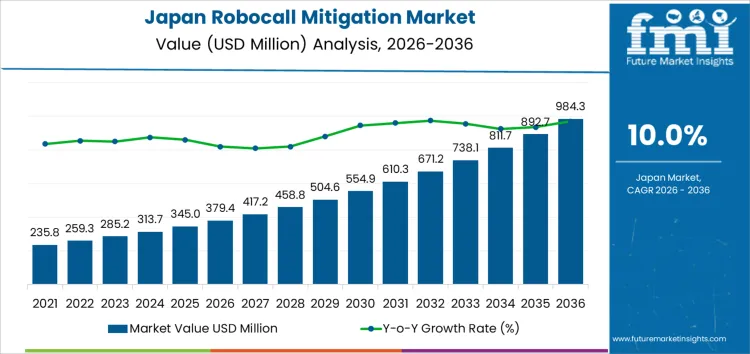
Japan Robocall Mitigation Key Takeaways
| Metric | Value |
|---|---|
| Japan Robocall Mitigation Sales Value (2026) | USD 379.4 million |
| Japan Robocall Mitigation Forecast Value (2036) | USD 984.3 million |
| Japan Robocall Mitigation Forecast CAGR (2026 to 2036) | 10.0% |
Why is the Demand for Robocall Mitigation in Japan Growing?
Demand for robocall mitigation in Japan grows due to rising incidence of automated nuisance calls targeting households, enterprises, and public institutions. Increased use of voice over IP technology lowers entry barriers for mass calling operations, which raises call volumes across fixed line and mobile networks. Aging population segments face higher exposure to fraud related calls, which elevates priority for call screening and blocking solutions. Financial institutions and telecom operators respond to social engineering risks by strengthening inbound call authentication and traffic analysis systems. Regulatory attention toward consumer protection encourages carriers to deploy network level mitigation tools that detect spoofing and abnormal call patterns.
Enterprises adopt robocall mitigation platforms to protect customer service lines from disruption and reputational risk. Expansion of cloud telephony within businesses increases need for software based filtering and real time call verification. Integration of artificial intelligence supports pattern recognition across large call datasets, improving identification accuracy. Public awareness campaigns increase reporting of suspicious calls, which improves feedback loops for mitigation systems. Smart device adoption enables end users to apply application based call filtering aligned with domestic language and behavioral patterns. Coordination between telecom providers supports standardized frameworks for call authentication across Japan.
How Are the Segments Classified in the Demand for Robocall Mitigation in Japan?
Demand for robocall mitigation in Japan is shaped by rising nuisance call volumes, protection of public communication channels, and regulatory oversight of telecom networks. Buyers assess detection accuracy, caller identity verification, real-time response capability, and integration with existing network infrastructure. Adoption patterns reflect strong institutional involvement, with emphasis on maintaining trust in voice communications across government, telecom, and enterprise environments.
By Solution, Do Robocall Analytics Account for the Largest Share of Demand in Japan?
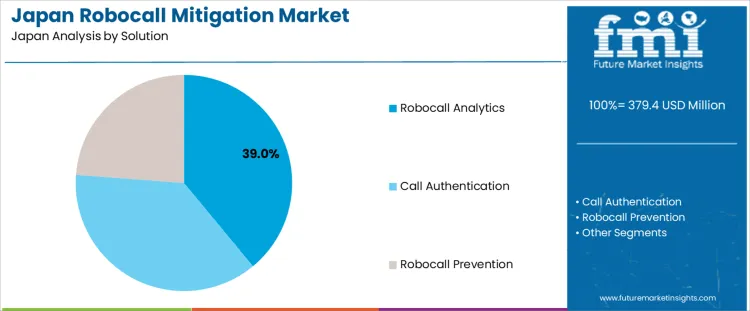
Robocall analytics hold 39.0%, making them the leading solution segment in Japan. These platforms analyze call traffic patterns, frequency anomalies, and behavioral signals to identify robocall activity at scale. Analytics tools support early-stage detection and enable informed mitigation actions before call blocking occurs. Call authentication holds 37.2%, focusing on verification mechanisms that reduce caller ID spoofing and improve call legitimacy. Robocall prevention holds 23.8%, applying blocking and filtering controls at network or endpoint level. Solution distribution reflects priority on intelligence-led identification within Japan’s telecom governance framework.
Key Points:
- Robocall analytics lead due to large-scale detection capability.
- Authentication solutions address caller identity integrity.
- Prevention tools apply downstream blocking measures.
By End Use, Does Government Represent the Largest Share of Demand in Japan?
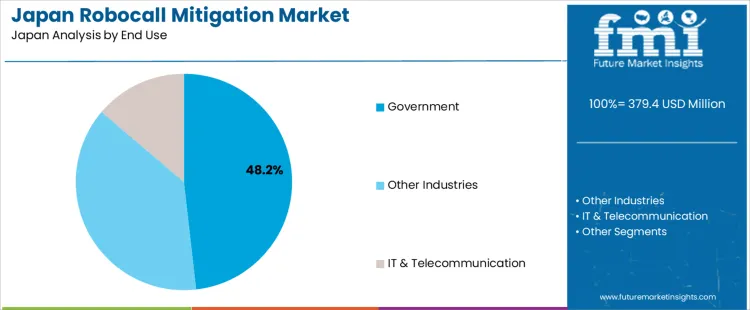
Government end users hold 48.2%, making them the leading end-use segment in Japan. Public institutions require robust robocall mitigation to protect citizen services, emergency communications, and official outreach channels. Other industries hold 38.0%, including finance, healthcare, and enterprises seeking to limit fraud exposure and communication disruption. IT and telecommunication end users hold 13.8%, deploying solutions to preserve network reliability and subscriber trust. End-use distribution reflects strong public-sector responsibility for communication security within Japan’s regulated telecom environment.
Key Points:
- Government leads due to protection of public communication services.
- Enterprises address fraud and operational disruption risks.
- Telecom operators support network-level integrity measures.
What are the Key Dynamics in the Robocall Mitigation Industry in Japan?
Demand increases as Japan addresses rising nuisance calls, scam activity targeting elderly populations, and misuse of VoIP-based calling services. Robocall mitigation focuses on call filtering, spoofing prevention, and network-level controls rather than aggressive blocking. Adoption aligns with telecom operator responsibility, consumer protection priorities, and government-led fraud prevention initiatives. Deployment remains concentrated among major carriers and enterprise communication systems operating under Japan’s tightly regulated telecom framework.
How do consumer protection priorities and telecom operator accountability drive demand in Japan?
Japan experiences persistent issues with fraud calls impersonating government offices, financial institutions, and delivery services. Elderly households represent a key risk group, prompting public concern and policy attention. Major telecom operators implement network-side filtering, call labeling, and AI-based anomaly detection to reduce scam traffic. Enterprises adopt mitigation tools to protect inbound call centers from spoofed or automated traffic. Government agencies collaborate with carriers on public awareness campaigns and data sharing related to fraudulent numbers. Preference for preventive network controls over end-user apps shapes solution design. Demand remains driven by operator-led initiatives rather than fragmented third-party consumer tools.
How do regulatory structure, technology limits, and adoption behavior influence demand stability?
Japan’s telecom environment is dominated by a small number of large carriers, limiting rapid competitive deployment of diverse mitigation platforms. Caller ID spoofing rules and number management practices differ from STIR SHAKEN-style frameworks, affecting solution architecture. Legacy network segments constrain real-time authentication capability. Consumers show limited tolerance for false positives, requiring conservative filtering thresholds. Privacy expectations restrict aggressive call data analysis. Enterprises prioritize reliability over experimental solutions. Demand remains stable within carrier and enterprise domains, while broader expansion depends on regulatory alignment, technical standardization, and continued focus on fraud prevention within Japan’s highly controlled telecommunications ecosystem.
How Is Demand for Robocall Mitigation in Japan Evolving by Region?
Demand for robocall mitigation in Japan is increasing due to rising scam activity, regulatory oversight, and migration toward IP-based calling platforms. Kyushu and Okinawa lead with a 12.5% CAGR, supported by mobile-first usage and carrier-led filtering deployment. Kanto follows at 11.5%, driven by enterprise authentication needs, financial services exposure, and technology adoption. Kansai records a 10.1% CAGR, shaped by SME protection requirements and contact center usage. Chubu posts 8.9%, reflecting manufacturing-linked enterprise demand. Tohoku shows 7.8%, supported by consumer protection initiatives. Rest of Japan records 7.4%, reflecting steady replacement-driven adoption. Regional variation reflects call volume intensity, digital penetration, and compliance readiness across Japan.
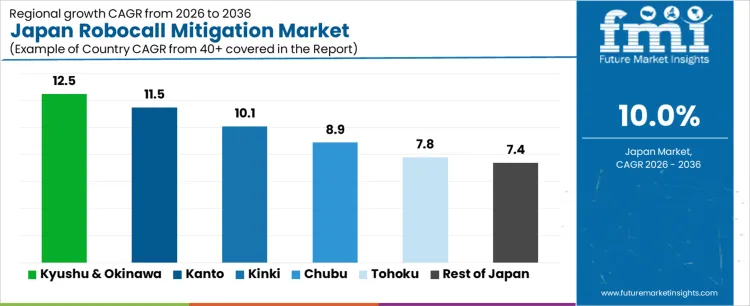
| Region | CAGR (2026 to 2036) |
|---|---|
| Kyushu & Okinawa | 12.5% |
| Kanto | 11.5% |
| Kansai | 10.1% |
| Chubu | 8.9% |
| Tohoku | 7.8% |
| Rest of Japan | 7.4% |
How is Kyushu and Okinawa driving demand for Robocall Mitigation in Japan?
Kyushu and Okinawa drive demand through high mobile usage, tourism-linked call traffic, and increased scam exposure. Region’s CAGR of 12.5% reflects strong rollout of carrier-provided robocall filtering, caller ID verification, and AI-based call analytics. Consumers rely on default network-level protection rather than third-party applications. Small businesses adopt mitigation tools to protect customer communications during peak travel seasons. Telecom operators prioritize real-time blocking, spoofing detection, and automatic labeling of suspicious calls. Demand favors scalable, network-integrated solutions requiring minimal user intervention. Growth remains carrier-led, supported by rising complaint volumes and consumer protection focus.
- High mobile subscriber and call traffic density
- Carrier-led network-level filtering adoption
- Tourism-driven scam exposure mitigation
- Preference for automatic and default protection
How is Kanto driving demand for Robocall Mitigation in Japan?
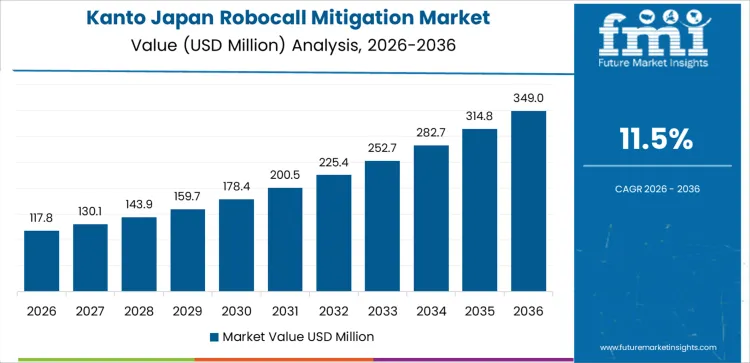
Kanto demand is shaped by enterprise concentration, financial services exposure, and regulatory scrutiny. Region’s CAGR of 11.5% reflects strong adoption of call authentication, branded calling, and analytics platforms by banks, insurers, and large enterprises. Organizations prioritize protecting outbound communications to maintain customer trust. Integration with contact center systems and CRM platforms supports verified calling workflows. Telecom operators and technology providers collaborate on STIR-like authentication frameworks adapted to domestic standards. Demand emphasizes data accuracy, audit readiness, and enterprise-grade reliability. Growth aligns with compliance cycles and digital transformation initiatives.
- Financial services and enterprise call protection
- Branded and authenticated outbound calling
- Contact center system integration
- Compliance-driven technology adoption
How is Kansai driving demand for Robocall Mitigation in Japan?
Kansai demand reflects balanced adoption across SMEs, regional enterprises, and service providers. Region’s CAGR of 10.1% is supported by use of robocall mitigation tools to reduce spoofing, nuisance calls, and customer disruption. SMEs adopt bundled solutions offered by telecom providers due to cost efficiency. Call analytics and blocking features are prioritized over advanced customization. Retail, healthcare, and logistics firms seek protection for inbound service lines. Demand growth remains steady, aligned with operational risk management rather than regulatory pressure alone.
- SME-focused bundled mitigation solutions
- Inbound service line protection needs
- Cost-efficient carrier offerings
- Steady operational risk management adoption
How is Chubu driving demand for Robocall Mitigation in Japan?
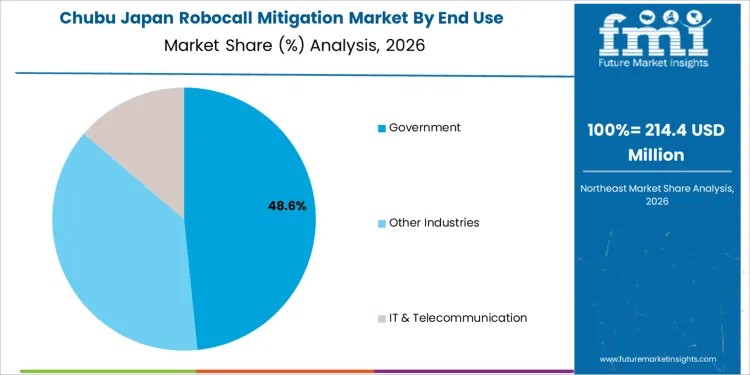
Chubu demand is anchored in manufacturing enterprises, regional offices, and internal communication protection. Region’s CAGR of 8.9% reflects adoption of robocall mitigation to safeguard customer service numbers and supplier communications. Enterprises emphasize reliability, low false-positive rates, and compatibility with existing PBX and VoIP systems. Procurement favors solutions bundled with telecom contracts. Demand remains conservative, driven by replacement of legacy filtering tools and gradual awareness of call-based fraud risks. Growth aligns with enterprise IT upgrade cycles.
- Manufacturing-linked enterprise communication protection
- PBX and VoIP-compatible solutions
- Low false-positive performance focus
- Replacement-driven adoption patterns
How is Tohoku driving demand for Robocall Mitigation in Japan?
Tohoku demand is influenced by consumer protection needs, aging populations, and regional telecom initiatives. Region’s CAGR of 7.8% reflects adoption of basic call-blocking and scam alert services targeted at residential users. Telecom operators promote simplified mitigation features with clear alerts and minimal configuration. Public awareness campaigns support uptake among elderly households. Enterprise adoption remains limited to essential services. Demand growth is cautious and necessity-driven, aligned with consumer safety objectives.
- Elderly-focused scam call protection
- Simplified call-blocking services
- Public awareness-supported adoption
- Consumer safety-driven demand
How is Rest of Japan driving demand for Robocall Mitigation in Japan?
Rest of Japan shows steady demand driven by routine telecom upgrades and replacement of basic call-filtering services. Region’s CAGR of 7.4% reflects continued rollout of default carrier protections and limited enterprise deployment. Buyers prioritize affordability, ease of use, and reliability. Advanced analytics adoption remains limited. Demand growth aligns with gradual network modernization rather than proactive fraud mitigation strategies.
- Default carrier protection rollout
- Cost-sensitive adoption behavior
- Limited advanced analytics usage
- Replacement-driven demand stability
What is the competitive landscape of demand for robocall mitigation in Japan?
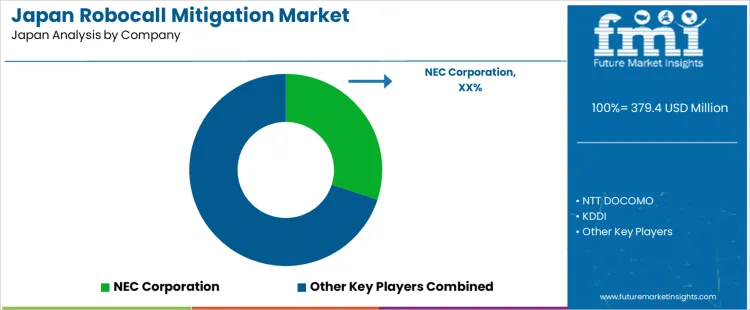
Demand for robocall mitigation in Japan is shaped by rising unwanted automated calls, consumer privacy expectations, and regulatory measures targeting nuisance voice traffic. Applications require call-authentication frameworks, real-time traffic analysis, and network-level filtering integrated with domestic telecom infrastructure. Buyers evaluate local regulation compliance, false-positive suppression, scalability, and analytics accuracy across high-volume carrier networks. Procurement teams prioritize technology partners with Japanese language support, strong integration with mobile and fixed-line operators, and responsiveness to evolving guidelines from the Ministry of Internal Affairs and Communications. Trend in the Japan market reflects increasing deployment of network-based solutions and collaboration among carriers to reduce fraudulent and scam call prevalence while preserving legitimate traffic flow.
NEC Corporation holds a leading position in Japan by offering carrier-grade robocall mitigation solutions tailored to local telecom environments and regulatory expectations. NTT DOCOMO participates with native network filtering and authentication technologies deployed across its mobile subscriber base. KDDI supports demand through integrated call-management systems incorporating blocking and analytics capabilities aligned with domestic quality-of-service standards. SoftBank Corporation maintains visibility with robocall detection and mitigation services embedded within its network operations and subscriber security offerings. Rakuten Mobile contributes with advanced traffic analysis and fraud-blocking features adapted to its rapidly growing 4G/5G network infrastructure. Competitive positioning in Japan reflects carrier integration depth, regulatory alignment, analytics precision, and capacity to mitigate nuisance and fraudulent calls without hindering legitimate communication.
Key Players in Japan Robocall Mitigation Demand
- NEC Corporation
- NTT DOCOMO
- KDDI
- SoftBank Corporation
- Rakuten Mobile
Scope of the Report
| Items | Values |
|---|---|
| Quantitative Units | USD million |
| Solution | Robocall Analytics; Call Authentication; Robocall Prevention |
| End Use | Government; IT & Telecommunication; Other Industries |
| Regions Covered | Kyushu & Okinawa; Kanto; Kansai; Chubu; Tohoku; Rest of Japan |
| Key Companies Profiled | NEC Corporation; NTT DOCOMO; KDDI; SoftBank Corporation; Rakuten Mobile |
| Additional Attributes | Dollar sales by solution type and end-use sector; regional CAGR patterns across Kanto and Kansai; adoption driven by regulatory compliance and network-level authentication; rising deployment by telecom operators; growing demand from government agencies and enterprises to reduce fraud-related call volumes and improve caller trust. |
Japan Robocall Mitigation Demand by Segments
By Solution:
- Robocall Analytics
- Call Authentication
- Robocall Prevention
By End Use:
- Government
- Other Industries
- IT & Telecommunication
By Region:
- Kyushu & Okinawa
- Kanto
- Kansai
- Chubu
- Tohoku
- Rest of Japan
Frequently Asked Questions
How big is the demand for robocall mitigation in Japan in 2026?
The demand for robocall mitigation in Japan is estimated to be valued at USD 379.4 million in 2026.
What will be the size of robocall mitigation in Japan in 2036?
The market size for the robocall mitigation in Japan is projected to reach USD 984.3 million by 2036.
How much will be the demand for robocall mitigation in Japan growth between 2026 and 2036?
The demand for robocall mitigation in Japan is expected to grow at a 10.0% CAGR between 2026 and 2036.
What are the key product types in the robocall mitigation in Japan?
The key product types in robocall mitigation in Japan are robocall analytics, call authentication and robocall prevention.
Which end use segment is expected to contribute significant share in the robocall mitigation in Japan in 2026?
In terms of end use, government segment is expected to command 48.2% share in the robocall mitigation in Japan in 2026.
Preview the report firsthand - request a free sample
Get SampleGet the brochure for pricing and purchase details.
Get PDFTable of Content
- Executive Summary
- Japan Market Outlook
- Demand-side Trends
- Supply-side Trends
- Technology Roadmap Analysis
- Analysis and Recommendations
- Market Overview
- Market Coverage / Taxonomy
- Market Definition / Scope / Limitations
- Market Background
- Market Dynamics
- Drivers
- Restraints
- Opportunity
- Trends
- Scenario Forecast
- Demand in Optimistic Scenario
- Demand in Likely Scenario
- Demand in Conservative Scenario
- Opportunity Map Analysis
- Product Life Cycle Analysis
- Supply Chain Analysis
- Investment Feasibility Matrix
- Value Chain Analysis
- PESTLE and Porter’s Analysis
- Regulatory Landscape
- Regional Parent Market Outlook
- Production and Consumption Statistics
- Import and Export Statistics
- Market Dynamics
- Japan Market Analysis 2021 to 2025 and Forecast, 2026 to 2036
- Historical Market Size Value (USD Million) Analysis, 2021 to 2025
- Current and Future Market Size Value (USD Million) Projections, 2026 to 2036
- Y-o-Y Growth Trend Analysis
- Absolute $ Opportunity Analysis
- Japan Market Pricing Analysis 2021 to 2025 and Forecast 2026 to 2036
- Japan Market Analysis 2021 to 2025 and Forecast 2026 to 2036, By Solution
- Introduction / Key Findings
- Historical Market Size Value (USD Million) Analysis By Solution, 2021 to 2025
- Current and Future Market Size Value (USD Million) Analysis and Forecast By Solution, 2026 to 2036
- Robocall Analytics
- Call Authentication
- Robocall Prevention
- Robocall Analytics
- Y-o-Y Growth Trend Analysis By Solution, 2021 to 2025
- Absolute $ Opportunity Analysis By Solution, 2026 to 2036
- Japan Market Analysis 2021 to 2025 and Forecast 2026 to 2036, By End Use
- Introduction / Key Findings
- Historical Market Size Value (USD Million) Analysis By End Use, 2021 to 2025
- Current and Future Market Size Value (USD Million) Analysis and Forecast By End Use, 2026 to 2036
- Government
- Other Industries
- IT & Telecommunication
- Government
- Y-o-Y Growth Trend Analysis By End Use, 2021 to 2025
- Absolute $ Opportunity Analysis By End Use, 2026 to 2036
- Market Structure Analysis
- Competition Dashboard
- Competition Benchmarking
- Market Share Analysis of Top Players
- By Regional
- By Solution
- By End Use
- Competition Analysis
- Competition Deep Dive
- NEC Corporation
- Overview
- Product Portfolio
- Profitability by Market Segments (Product/Age /Sales Channel/Region)
- Sales Footprint
- Strategy Overview
- Marketing Strategy
- Product Strategy
- Channel Strategy
- NTT DOCOMO
- KDDI
- SoftBank Corporation
- Rakuten Mobile
- NEC Corporation
- Competition Deep Dive
- Assumptions & Acronyms Used
- Research Methodology


