

- Industry Size (2025)
- USD 278.4 Mn
- Forecast (2035)
- USD 414.0 Mn
- CAGR (2025 to 2035)
- 4.1%
Demand for Seam Tapes in Japan Forecast and Outlook 2025 to 2035
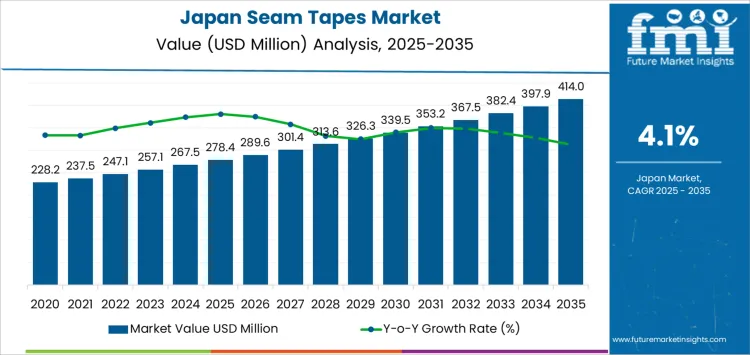
Seam tape demand in Japan stands at USD 278.4 million in 2025 and is projected to reach USD 414.0 million by 2035 at a CAGR of 4.1%. The industry is driven by waterproof apparel, industrial protective clothing, and medical isolation garments. Thermoplastic polyurethane seam tapes dominate functional sportswear, while polyamide tapes retain relevance for high-temperature industrial uniforms. Sportswear, rainwear, safety workwear, and infection-control textiles remain the leading application segments. Kanto, Chubu, and Kinki sustain the highest demand due to concentration of garment exporters, technical textile converters, and OEM apparel units. Hospitals, uniform suppliers, outdoor brands, and disaster-response equipment manufacturers form the core buyer base across both consumer and industrial channels.
Sales expansion is linked to outdoor activity participation, workplace safety compliance, and steady procurement from medical institutions. Import dependence remains moderate, with Japanese processors using both domestic niche grades and performance tapes sourced from East Asia. Pricing follows polymer cost movement, adhesive performance upgrades, and currency-linked import cycles. Distribution is structured around fabric wholesalers, industrial material distributors, and long-term contracts with performance apparel brands. Demand outside major cities holds stability through school uniforms, municipal safety gear procurement, and regional outdoor wear manufacturers. Growth through 2035 is shaped by functional garment replacement cycles, weather resilience requirements, and regulatory reinforcement in occupational safety and medical textile standards.
Quick Stats of the Seam Tapes Industry in Japan
- Seam Tapes Industry in Japan Value (2025): USD 278.4 million
- Seam Tapes Industry in Japan Forecast Value (2035): USD 414.0 million
- Seam Tapes Industry in Japan Forecast CAGR (2025-2035): 4.1%
- Leading Material in Seam Tapes Industry in Japan: Polyurethane (45%)
- Key Growth Regions in Seam Tapes Industry in Japan: Kyushu & Okinawa, Kanto, Kansai
- Top Players in Seam Tapes Industry in Japan: 3M Company, Bemis Associates Inc., Toray Industries Inc., Himel Corp., Sealon Co., Ltd.
What is the Demand Forecast for Seam Tapes in Japan through 2035?
Seam tape demand in Japan stands at USD 278.4 million in 2025 and increases to USD 326.3 million by 2030, creating a USD 47.9 million value build within five years. The rise from USD 228.2 million in 2020 reflects steady expansion across outdoor apparel, rainwear, industrial protective clothing, and sports performance segments where waterproof seam integrity is non negotiable. Domestic garment manufacturers continue to prioritize high tensile bonding and heat activation precision to meet endurance standards set by export buyers. Demand strength during this phase is tied to replacement of stitched sealing with tape-based reinforcement across mid to high performance garments, not fashion cycles alone.
From 2030 to 2035, demand advances from USD 326.3 million to USD 414.0 million, adding USD 87.7 million in new value. Yearly increments widen as seam tape usage extends deeper into medical disposables, firefighting gear, clean room suits, and technical luggage assemblies. Growth also tracks wider use of multilayer laminates in footwear and glove manufacturing where seam failure carries safety implications. Material transitions toward polyolefin and thermoplastic polyurethane based tapes raise average value per meter supplied. Export oriented apparel clusters drive long order runs for certified waterproof construction. By 2035, seam tape demand in Japan reflects structurally higher reliance on bonded fabric engineering across industrial and performance applications rather than seasonal textile output variation.
Seam Tapes Industry in Japan Key Takeaways
| Metric | Value |
|---|---|
| Industry Value (2025) | USD 278.4 million |
| Forecast Value (2035) | USD 414.0 million |
| Forecast CAGR (2025-2035) | 4.1% |
What Is Driving the Demand for Seam Tapes in Japan?
The demand for seam tapes in Japan is closely linked to the country’s long exposure to heavy rainfall, coastal humidity, and strict standards for garment durability. Protective apparel for construction, transportation, and municipal services relied on seam sealing long before technical fashion reached mass consumers. Industrial rainwear, emergency response uniforms, and maritime work clothing required sealed seams to prevent water ingress during extended outdoor exposure. As outdoor recreation expanded into hiking, trail running, and winter sports, seam taped structures became standard in consumer performance apparel. Urban usage followed through commuter outerwear, school rain gear, and reusable rain garments where waterproof reliability is expected rather than optional. The preference for clean interior finishes also supports consistent use since visible seam construction is treated as a quality defect in many Japanese product categories.
Future demand for seam tapes in Japan will be shaped by expansion of lightweight technical fabrics, reuse oriented clothing design, and institutional investment in weather resistant workwear. Growth will continue in disaster response gear, public safety uniforms, and infrastructure maintenance apparel where moisture protection directly affects worker safety. Everyday fashion will also increase adoption as more brands integrate weather protection into daily outerwear without heavy layering. Barriers include bonding challenges with recycled textiles, added production steps that raise garment cost, and slower uptake among small workshops with limited automation. Long term demand will depend on how effectively seam tape performance aligns with sustainable fabric systems, automated garment production, and expectations for long service life across both professional and consumer apparel in Japan.
What Is the Demand for Seam Tapes in Japan by Material and Application?
The demand for seam tapes in Japan is shaped by outdoor apparel production, industrial textile processing, and strict moisture protection standards. Polyurethane leads by material due to its balance of flexibility, adhesion strength, and compatibility with performance fabrics. Waterproofing leads by application because most seam tape usage is tied to rainwear, protective garments, and technical outerwear. Procurement is driven by garment manufacturers, fabric processors, and contract sewing units serving both domestic and export oriented brands. Import reliance remains present for select adhesive films and specialty resins. Substitution pressure exists from liquid seam sealants in limited craft applications. Demand stability is supported by steady production of functional apparel and workwear categories.
Why does polyurethane dominate the demand for seam tapes in Japan by material?
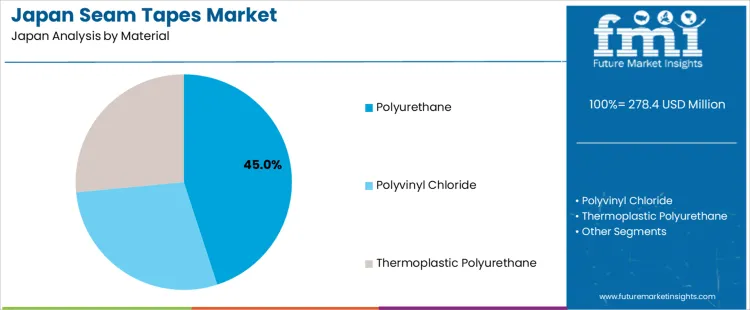
Polyurethane accounts for 45% of the demand for seam tapes in Japan by material, reflecting its suitability for elastic, coated, and laminated fabrics used in performance garments. Consumption intensity is driven by waterproof jackets, sportswear, medical garments, and protective uniforms that require durable sealing without fabric stiffening. Usage remains stable because polyurethane maintains adhesion under flexing, washing, and thermal stress. Procurement is led by garment factories and textile finishing units operating continuous production lines. Price sensitivity remains moderate because tape failure directly affects garment rejection rates. Specification control emphasizes peel strength, heat activation range, elasticity retention, and resistance to hydrolysis during prolonged wear.
Polyurethane seam tapes also generate steady repeat demand through batch based garment production and seasonal style refresh cycles. Repeat utilization remains predictable because each garment requires consistent seam coverage. Buyers favor standardized tape widths and activation temperatures to stabilize machine setup and reduce changeover time. Margin structure remains controlled under competition among domestic and regional tape suppliers. Regulatory exposure centers on chemical migration limits and worker safety during heat application. Import reliance persists for specialty adhesive films and carrier substrates. Substitution pressure from thermoplastic polyurethane exists in niche uses where higher temperature resistance is required.
What drives waterproofing to lead the demand for seam tapes in Japan by application?
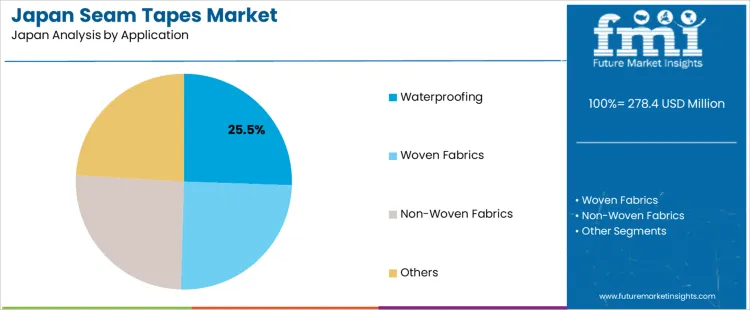
Waterproofing represents the leading application for seam tapes in Japan with 25.5% market share, reflecting sustained demand from outdoor clothing, rainwear, and industrial protective apparel. Consumption intensity is driven by hiking jackets, cycling gear, fishing apparel, and safety garments used in construction and utilities. Usage remains stable because seam sealing is mandatory for moisture protection in coated and laminated fabrics. Procurement is dominated by apparel exporters, uniform suppliers, and branded outdoor wear manufacturers. Price sensitivity remains moderate because waterproof performance is directly tied to product warranty and brand reputation. Specification control emphasizes continuous seal integrity, resistance to water column pressure, and durability through repeated laundering.
Waterproofing applications also generate consistent repeat demand through seasonal outerwear production and uniform contract renewals. Repeat utilization remains predictable as weather driven product categories follow fixed manufacturing calendars. Buyers favor seam tapes that allow high speed application without adhesive bleed or surface marking. Margin structure remains controlled under apparel price competition and sourcing cost discipline. Regulatory exposure remains limited to textile chemical compliance and finished garment safety labeling. Import reliance persists for select coating materials used in laminated shell fabrics. Substitution pressure from non-woven fabric bonding remains limited to disposable protective wear rather than reusable garments.
What Is Driving the Demand for Seam Tapes in Japan?
Demand for seam tapes in Japan is shaped by strict weather performance expectations, advanced garment manufacturing standards, and strong participation in outdoor activity. Heavy rainfall seasons, typhoon exposure, and snowfall in northern regions require reliable waterproofing across apparel and protective gear. Sports brands, uniforms, and workwear producers rely on seam tapes to maintain fabric integrity at needle points. Domestic manufacturers place high weight on uniform bonding quality, heat control during lamination, and visual cleanliness of sealed seams. Demand links closely to functional durability, long service life, and controlled production tolerance across technical textile supply chains.
How Are Outdoor Sports, Workwear, and Uniform Programs Sustaining Seam Tape Consumption in Japan?
Outdoor recreation remains deeply rooted in Japan across hiking, skiing, cycling, and fishing activities. Apparel used in these settings requires sealed seams to protect against moisture penetration across extended exposure. Municipal workwear, emergency response uniforms, and industrial protective clothing also require bonded seam protection under safety procurement rules. Uniform programs across railways, utilities, and facility management drive recurring replacement demand. These institutional and lifestyle driven formats create steady seam tape usage outside seasonal fashion cycles. Procurement follows durability specifications and wash resistance standards rather than visual styling trends across both recreational and professional textile applications nationwide today.
How Do Production Cost, Fabric Diversity, and Bonding Complexity Limit Seam Tape Expansion in Japan?
Seam tape application requires controlled heat, pressure, and bonding time matched to each fabric composition. Japan producers work with wide fabric blends ranging from thin nylon to coated polyesters and laminated membranes. Each construction demands separate tape selection and machine calibration. Smaller factories face higher unit processing cost due to setup labor. Tape weakness at curve seams and high flex zones increases rejection risk. These technical sensitivities slow broad usage in low margin garment categories. Expansion stays concentrated in functional apparel, uniforms, and protective textiles where bonded seam performance justifies processing investment across measured production volumes nationwide.
What is the Demand for Seam Tapes in Japan by Region?
| Region | CAGR (%) |
|---|---|
| Kyushu & Okinawa | 5.1% |
| Kanto | 4.7% |
| Kansai | 4.1% |
| Chubu | 3.6% |
| Tohoku | 3.2% |
| Rest of Japan | 3.0% |
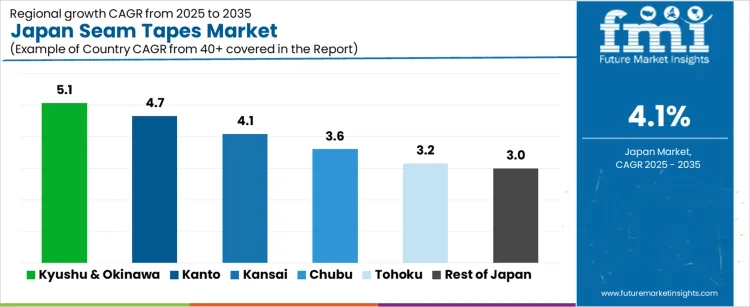
The demand for seam tapes in Japan is rising steadily across apparel, outdoor gear, and industrial textile applications, led by Kyushu and Okinawa at a 5.1% CAGR. Growth in this region is supported by export-oriented garment manufacturing, strong production of protective workwear, and rising output of waterproof outdoor apparel. Kanto follows at 4.7%, driven by dense brand headquarters, design-led product development, and high consumption of technical sportswear. Kansai records 4.1% growth, reflecting steady demand from apparel assembly units and footwear manufacturing. Chubu at 3.6% shows moderate uptake linked to automotive textile components and industrial fabric processing. Tohoku and the Rest of Japan, at 3.2% and 3.0%, reflect slower growth shaped by smaller manufacturing bases, limited technical textile clusters, and longer production upgrade cycles.
How Is Outdoor Apparel and Rainwear Production Driving Seam Tape Demand in Kyushu and Okinawa?
Demand for seam tapes in Kyushu and Okinawa is advancing at a CAGR of 5.1% through 2035, supported by strong production of rainwear, marine apparel, and weather resistant garments linked to humid coastal conditions. Local manufacturers show steady use of waterproof sealing solutions for workwear, fishing gear, and tourism related clothing. This region records consistent replacement demand for bonded seam protection in high moisture environments. Growth reflects expansion of functional apparel manufacturing, steady exports of outdoor garments, and rising quality standards across regional textile production units.
- Marine and fishing apparel support waterproof seam usage
- Functional workwear drives steady industrial demand
- Coastal humidity sustains consistent replacement cycles
- Export oriented garment units strengthen long term volume
Why Is High Fashion and Technical Textile Output Sustaining Seam Tape Growth in Kanto?
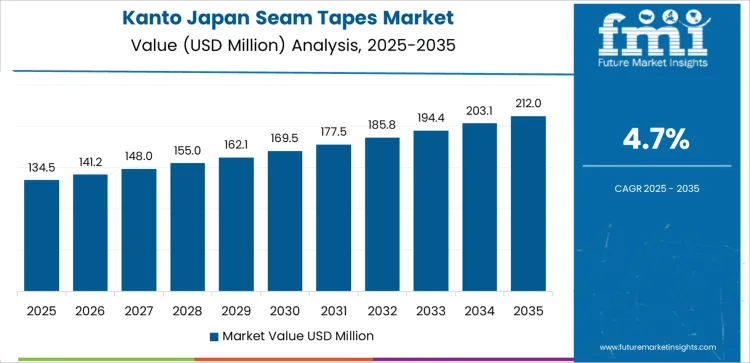
Demand for seam tapes in Kanto is rising at a CAGR of 4.7% through 2035, driven by advanced technical textile manufacturing, high fashion production density, and strong output of sportswear and performance apparel. Kanto leads adoption of heat activated and laser sealed seam bonding solutions. This region records high usage across outerwear, protective uniforms, and specialty medical textiles. Growth reflects strong integration of seam sealing in premium garment lines, steady innovation in lamination technologies, and continuous throughput from high capacity apparel factories.
- Technical textile production anchors premium tape consumption
- Sportswear output drives large scale bonding demand
- Protective uniforms support regulatory driven adoption
- High capacity factories sustain continuous procurement
What Is Supporting Balanced Seam Tape Adoption Across Kansai Apparel Manufacturing?
Demand for seam tapes in Kansai is progressing at a CAGR of 4.1% through 2035, supported by mid scale garment factories, steady output of industrial uniforms, and rising use of bonded seams in lightweight activewear. Kansai records stable demand across footwear manufacturing and bag production where seam sealing supports water resistance. Growth remains consistent with measured capacity expansion across apparel and accessory producers. Demand remains linked to controlled export volumes, steady domestic brand orders, and routine upgrades of garment finishing processes.
- Industrial uniforms sustain base level tape usage
- Footwear and bag manufacturing expand sealing applications
- Domestic brand orders guide stable production flow
- Finishing process upgrades support steady tape demand
How Is Manufacturing Cost Control Shaping Seam Tape Demand in Chubu?
Demand for seam tapes in Chubu is advancing at a CAGR of 3.6% through 2035, supported by value focused garment production, automotive textile applications, and consistent output of protective clothing for industrial use. Chubu shows preference for cost efficient seam sealing solutions rather than high end laminated systems. Automotive interior textiles also contribute to steady consumption of bonding tapes. Growth reflects stable industrial production, workforce clothing demand, and controlled investment in apparel finishing technologies.
- Protective workwear drives regular industrial consumption
- Automotive textiles add stable bonding tape demand
- Cost efficient solutions dominate supplier selection
- Controlled capital spending supports measured growth
Why Is Limited Apparel Output Moderating Seam Tape Growth in Tohoku?
Demand for seam tapes in Tohoku is rising at a CAGR of 3.2% through 2035, supported by small scale garment units, limited industrial textile production, and selective outdoor apparel assembly. Miyagi anchors most regional usage through workwear and utility garment manufacturers. Tohoku records lower fashion garment output and reduced export exposure. Seam tape demand remains focused on essential waterproofing applications for industrial clothing rather than high volume consumer apparel production.
- Workwear manufacturers sustain essential sealing needs
- Small scale garment units limit volume expansion
- Utility clothing dominates application mix
- Limited export exposure moderates growth pace
How Is Small City Manufacturing Influencing Seam Tape Demand in Rest of Japan?
Demand for seam tapes in Rest of Japan is advancing at a CAGR of 3.0% through 2035, supported by dispersed garment workshops, steady school uniform production, and limited but stable output of rain protection clothing. These areas record lower integration of advanced seam sealing systems. Demand remains focused on basic heat bonded tapes used for simple waterproofing and reinforcement. Growth remains steady and guided by local clothing production volumes, school contract orders, and routine maintenance of garment finishing lines.
- School uniform contracts support baseline demand
- Basic heat bonded tapes dominate product usage
- Small factories guide limited but stable consumption
- Routine line maintenance sustains replacement purchases
What Is Driving the Demand for Seam Tapes in Japan and Which Companies Shape Manufacturing Access
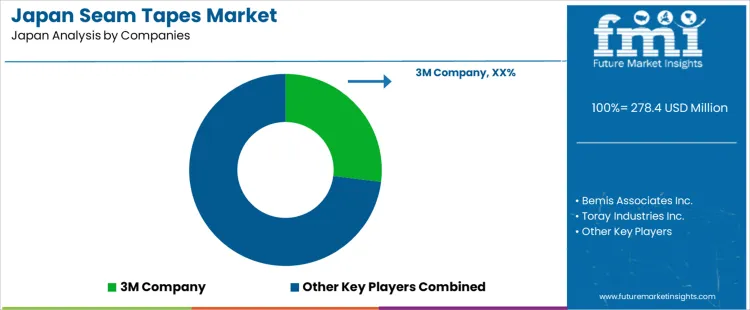
The demand for seam tapes in Japan is shaped by steady output of technical outerwear, growth in sports apparel exports, and continued application in medical protective garments and industrial safety wear. Toray Industries holds a central domestic position through polymer based tape materials integrated into waterproof and breathable fabric systems used by leading Japanese apparel brands. Sealon Co Ltd supports demand through heat activated seam sealing tapes used in rainwear, workwear, and protective clothing assembly. Himel Corp maintains a strong role in adhesive bonding systems used in garment lamination and seam reinforcement across contract apparel factories. These domestic suppliers anchor qualification cycles through close coordination with fabric mills and sewing line operators.
3M Company participates through imported high performance seam sealing solutions used in premium outdoor gear, medical gowns, and industrial protective clothing. Bemis Associates supports demand through specialty thermoplastic adhesive films and tapes supplied to export focused garment manufacturers operating in Japan. Product selection is governed by bonding strength under wash cycles, flexibility during motion, heat activation control, and compatibility with coated and laminated fabrics. Buyer preference favors tapes that maintain seal integrity under humidity and repeated laundering. Demand visibility tracks domestic outdoor apparel sales, inbound tourism linked to seasonal sportswear, expansion of medical protective garment stockpiles, and sustained export orders from European and North American apparel brands sourcing from Japanese technical fabric supply chains.
Key Players in the Seam Tapes Industry in Japan
- 3M Company
- Bemis Associates Inc.
- Toray Industries Inc.
- Himel Corp.
- Sealon Co., Ltd.
Scope of the Report
| Items | Values |
|---|---|
| Quantitative Units (2025) | USD million |
| Material | Polyurethane, Polyvinyl Chloride, Thermoplastic Polyurethane |
| Application | Waterproofing, Woven Fabrics, Non-Woven Fabrics, Others |
| End Use | Apparel & Footwear, Healthcare, Automotive, Packaging, Others |
| Region | Kyushu & Okinawa, Kanto, Kansai, Chubu, Tohoku, Rest of Japan |
| Countries Covered | Japan |
| Key Companies Profiled | 3M Company, Bemis Associates Inc., Toray Industries Inc., Himel Corp., Sealon Co., Ltd. |
| Additional Attributes | Dollar by sales by material, application, and end use; Regional CAGR and growth patterns; Export oriented versus domestic apparel usage; Industrial and consumer segment penetration; Seasonal demand cycles linked to sportswear and rainwear; Institutional procurement from hospitals and municipal services; Product replacement cycles across technical textiles; Material transitions toward TPU and polyolefin tapes; Adhesive and heat activation performance monitoring; Compliance with occupational and medical textile standards; Supply chain reliance on East Asia imports; Domestic processing of niche grades; Integration with multilayer laminates, footwear, and gloves; Repeat usage in uniform and protective clothing; Technical specification control including peel strength, elasticity retention, and hydrolysis resistance; Retail and B2B distribution through wholesalers, industrial distributors, and OEM contracts. |
Seam Tapes Industry in Japan Segmentation
Material:
- Polyurethane
- Polyvinyl Chloride
- Thermoplastic Polyurethane
Application:
- Waterproofing
- Woven Fabrics
- Non-Woven Fabrics
- Others
End Use:
- Apparel & Footwear
- Healthcare
- Automotive
- Packaging
- Others
Region:
- Kyushu & Okinawa
- Kanto
- Kansai
- Chubu
- Tohoku
- Rest of Japan
Frequently Asked Questions
How big is the demand for seam tapes in Japan in 2025?
The demand for seam tapes in Japan is estimated to be valued at USD 278.4 million in 2025.
What will be the size of seam tapes in Japan in 2035?
The market size for the seam tapes in Japan is projected to reach USD 414.0 million by 2035.
How much will be the demand for seam tapes in Japan growth between 2025 and 2035?
The demand for seam tapes in Japan is expected to grow at a 4.1% CAGR between 2025 and 2035.
What are the key product types in the seam tapes in Japan?
The key product types in seam tapes in Japan are polyurethane, polyvinyl chloride and thermoplastic polyurethane.
Which application segment is expected to contribute significant share in the seam tapes in Japan in 2025?
In terms of application, waterproofing segment is expected to command 25.5% share in the seam tapes in Japan in 2025.
Preview the report firsthand - request a free sample
Get SampleGet the brochure for pricing and purchase details.
Get PDFTable of Content
- Executive Summary
- Japan Market Outlook
- Demand-side Trends
- Supply-side Trends
- Technology Roadmap Analysis
- Analysis and Recommendations
- Market Overview
- Market Coverage / Taxonomy
- Market Definition / Scope / Limitations
- Market Background
- Market Dynamics
- Drivers
- Restraints
- Opportunity
- Trends
- Scenario Forecast
- Demand in Optimistic Scenario
- Demand in Likely Scenario
- Demand in Conservative Scenario
- Opportunity Map Analysis
- Product Life Cycle Analysis
- Supply Chain Analysis
- Investment Feasibility Matrix
- Value Chain Analysis
- PESTLE and Porter’s Analysis
- Regulatory Landscape
- Regional Parent Market Outlook
- Production and Consumption Statistics
- Import and Export Statistics
- Market Dynamics
- Japan Market Analysis 2020 to 2024 and Forecast, 2025 to 2035
- Historical Market Size Value (USD Million) Analysis, 2020 to 2024
- Current and Future Market Size Value (USD Million) Projections, 2025 to 2035
- Y-o-Y Growth Trend Analysis
- Absolute $ Opportunity Analysis
- Japan Market Pricing Analysis 2020 to 2024 and Forecast 2025 to 2035
- Japan Market Analysis 2020 to 2024 and Forecast 2025 to 2035, By Material
- Introduction / Key Findings
- Historical Market Size Value (USD Million) Analysis By Material , 2020 to 2024
- Current and Future Market Size Value (USD Million) Analysis and Forecast By Material , 2025 to 2035
- Polyurethane
- Polyvinyl Chloride
- Thermoplastic Polyurethane
- Y-o-Y Growth Trend Analysis By Material , 2020 to 2024
- Absolute $ Opportunity Analysis By Material , 2025 to 2035
- Japan Market Analysis 2020 to 2024 and Forecast 2025 to 2035, By Application
- Introduction / Key Findings
- Historical Market Size Value (USD Million) Analysis By Application, 2020 to 2024
- Current and Future Market Size Value (USD Million) Analysis and Forecast By Application, 2025 to 2035
- Waterproofing
- Woven Fabrics
- Non-Woven Fabrics
- Others
- Y-o-Y Growth Trend Analysis By Application, 2020 to 2024
- Absolute $ Opportunity Analysis By Application, 2025 to 2035
- Japan Market Analysis 2020 to 2024 and Forecast 2025 to 2035, By End Use
- Introduction / Key Findings
- Historical Market Size Value (USD Million) Analysis By End Use, 2020 to 2024
- Current and Future Market Size Value (USD Million) Analysis and Forecast By End Use, 2025 to 2035
- Apparel & Footwear
- Healthcare
- Automotive
- Packaging
- Others
- Y-o-Y Growth Trend Analysis By End Use, 2020 to 2024
- Absolute $ Opportunity Analysis By End Use, 2025 to 2035
- Market Structure Analysis
- Competition Dashboard
- Competition Benchmarking
- Market Share Analysis of Top Players
- By Regional
- By Material
- By Application
- By End Use
- Competition Analysis
- Competition Deep Dive
- 3M Company
- Overview
- Product Portfolio
- Profitability by Market Segments (Product/Age /Sales Channel/Region)
- Sales Footprint
- Strategy Overview
- Marketing Strategy
- Product Strategy
- Channel Strategy
- Bemis Associates Inc.
- Toray Industries Inc.
- Himel Corp.
- Sealon Co., Ltd.
- 3M Company
- Competition Deep Dive
- Assumptions & Acronyms Used
- Research Methodology


