

- Market Size (2026)
- USD 3.1 Bn
- Forecast (2036)
- USD 5.5 Bn
- CAGR (2026 to 2036)
- 5.9%
Lunch Takeout Market Size, Market Forecast and Outlook By FMI
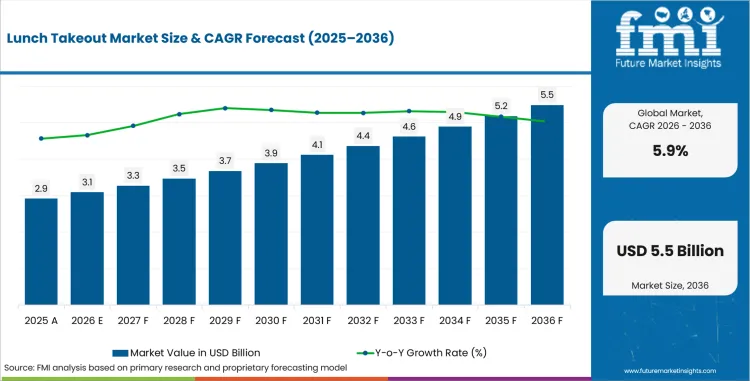
The lunch takeout market was valued at USD 2.9 billion in 2025. The market is set to reach USD 3.1 billion by 2026-end and grow at a CAGR of 5.9% between 2026-2036 to reach USD 5.5 billion by 2036. Main Course Meals will dominate with a 40.0% share, while Local Cuisine will lead with a 50.0% share.
Key Takeaways, Market Size, and Forecast
- 2026 Market Size: USD 3.1 billion
- 2036 Market Size: USD 5.5 billion
- Compound Annual Growth Rate (CAGR): 5.9% from 2026 to 2036
- Absolute $ Opportunity: USD 2.4 billion between 2026 and 2036
- Leading Product Segment: Main Course Meals
- Main Course Meals Share in 2026: 40.0%
- Fastest-growing Country: India
- India CAGR: 6.9% through 2036
| Parameter | Details |
|---|---|
| Market Size in 2026 (Value) | USD 3.1 billion |
| Market Forecast in 2036 (Value) | USD 5.5 billion |
| CAGR (2026 to 2036) | 5.9% from 2026 to 2036 |
| Years Considered | 2021 to 2036 |
| Base Year | 2025 |
| Forecast Period | 2026 to 2036 |
| Units Considered | Value (USD Bn) |
| Leading Sub-Region | India |
Summary of the Lunch Takeout Market
- Demand and Growth Drivers
- Working professional demand for convenient midday meal solutions is expected to sustain growth in lunch takeout services, with online delivery platforms as the primary ordering channel.
- Expansion of quick service restaurant and cloud kitchen capacity is likely to improve delivery speed and menu variety, supporting higher order frequency.
- Corporate meal programs and office catering delivered through digital platforms are expected to generate institutional procurement volumes.
- Product and Segment View
- Main course meals are estimated to account for 40.0% of product demand in 2026, reflecting consumer preference for complete lunch meals over sides or snacks.
- Online delivery platforms are likely to lead ordering at 50.0%, with app-based ordering providing convenience and restaurant discovery for working professionals.
- Working professionals are expected to account for 55.0% of end-use demand, with weekday lunch as the primary consumption occasion.
- Geography and Competitive Outlook
- India is likely to lead country level growth at 6.9% through 2036, driven by rapid food delivery platform expansion, growing urban working population, and increasing adoption of app-based meal ordering.
- East Asia and Western Europe are expected to sustain demand through established delivery infrastructure and growing digital ordering penetration.
- Companies with large restaurant partner networks, efficient delivery logistics, and strong app-based consumer engagement are likely to capture growing lunch delivery demand.
- Analyst Opinion
- Nandini Roy Choudhury, Principal Consultant at FMI says, 'Delivery platforms that can optimize lunch-hour logistics to meet the 30-minute delivery expectation while expanding restaurant partner networks and corporate meal programs are positioned for sustained growth through 2036.'
- The lunch takeout market is expanding as digital ordering platforms transform midday meal procurement for urban working professionals.
- Adoption is increasing due to delivery speed improvements and expanded restaurant selection on aggregator platforms that reduce the friction of lunch ordering.
- The market is also benefiting from cloud kitchen expansion that creates delivery-optimized food preparation capacity without traditional restaurant overhead.
- Demand is further supported by corporate meal benefit programs that subsidize employee lunch ordering through partnered delivery platforms.
Lunch Takeout Market Definition
The lunch takeout market includes food delivery and pickup services specifically serving the midday meal occasion. Services span quick service restaurants, full service restaurant delivery, cloud kitchen operations, and corporate catering delivered through online platforms, phone ordering, and walk-in takeout.
Lunch Takeout Market Inclusions
Market scope encompasses all commercially traded lunch takeout services categorized by product (main course meals, salads and bowls, sandwiches and wraps, soups and sides), cuisine type (local cuisine, international cuisine, fusion cuisine, health cuisine), service type (quick service restaurants, full service delivery, cloud kitchens, corporate catering), order channel (online delivery platforms, restaurant direct ordering, phone ordering, walk-in takeout), and end use (working professionals, students, general consumers). Revenue scope covers 2026 to 2036.
Lunch Takeout Market Exclusions
The scope does not include grocery delivery, meal kit delivery requiring consumer preparation, dinner-specific delivery services, or institutional cafeteria operations serving captive audiences.
Lunch Takeout Market Research Methodology
- Primary Research: FMI analysts conducted interviews with food delivery platform operators, restaurant chain procurement managers, and corporate food service buyers in key urban markets.
- Desk Research: Combined data from food delivery platform transaction data, restaurant industry statistics, and operator revenue disclosures.
- Market Sizing and Forecasting: Bottom-up aggregation across delivery platform, restaurant direct, and corporate catering channels with urban market adoption curves.
- Data Validation: Cross-checked quarterly against platform transaction volumes, restaurant industry reports, and operator financial disclosures.
Why is the Lunch Takeout Market Growing?
- Urban working professional demand for convenient midday meal solutions is generating sustained growth in lunch delivery volumes through digital ordering platforms.
- Cloud kitchen expansion is creating delivery-optimized food preparation capacity that serves the lunch delivery market with lower overhead than traditional restaurant operations.
- India leads country level growth at 6.9% CAGR, driven by rapid food delivery platform expansion across tier-1 and tier-2 cities and growing adoption of app-based lunch ordering among the urban working population.
The lunch takeout market is expanding as digital food delivery platforms transform the midday meal occasion for urban working professionals. The convergence of smartphone penetration, delivery logistics optimization, and expanding restaurant partner networks has reduced ordering friction to the point where delivery competes directly with office cafeterias and walking to restaurants.
Quick service restaurants dominate the lunch delivery segment due to speed advantages, with sub-30-minute delivery expectations driving order allocation toward QSR partners with optimized preparation and packaging processes. Cloud kitchens are gaining share by operating delivery-only facilities designed to maximize preparation efficiency for the lunch rush.
Corporate meal programs represent a growing institutional demand channel. Employers subsidizing employee lunch through partnered delivery platform programs create predictable daily order volumes and higher average order values compared to individual consumer purchasing.
Market Segmentation Analysis
- Main course meals lead at 40.0%, with complete lunch sets including protein, grain, and vegetable components serving the primary working professional demand.
- Local cuisine dominates at 50.0%, with regional food preferences driving lunch selection toward familiar local dishes delivered through platform aggregators.
- Quick service restaurants account for 35.0% of service type demand, with speed-optimized operations meeting lunch-hour delivery time expectations.
The lunch takeout market is segmented by product, cuisine type, service type, order channel, and end use. Main course meals lead product demand while online delivery platforms dominate ordering.
Insights into the Main Course Meals Product Segment
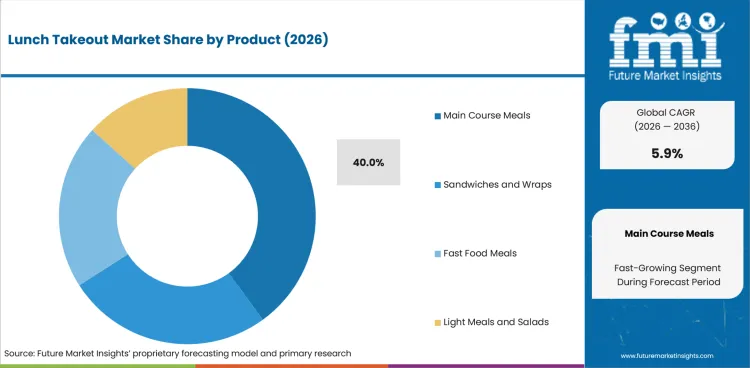
In 2026, main course meals are estimated to account for 40.0% of total product demand. Complete lunch sets featuring rice or grain, protein, and vegetable components serve the primary midday meal requirement. Meal customization through platform interfaces enables consumers to modify standard offerings for dietary preferences.
Value meal bundles combining main course with a drink or side at set pricing attract price-sensitive lunch consumers. Premium lunch options including restaurant-quality meals delivered from higher-end establishments serve the executive and corporate client segment.
Insights into the Online Delivery Platforms Order Channel Segment
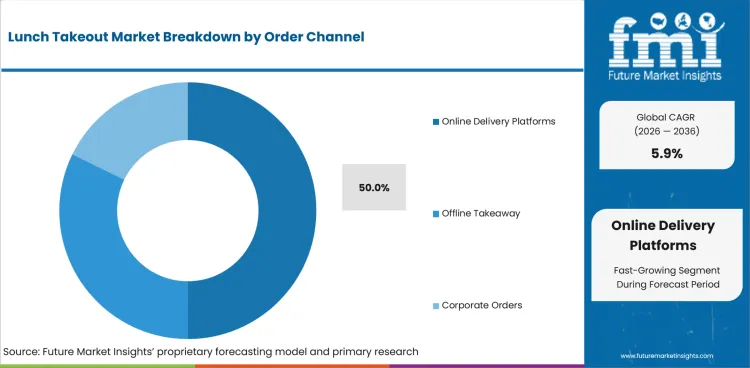
Online delivery platforms are expected to account for 50.0% of order channel demand in 2026, with app-based ordering providing restaurant discovery, menu browsing, order customization, and payment integration in a single interface. Platform recommendation algorithms drive restaurant selection and order frequency.
Platform loyalty programs and subscription services create repeat ordering behavior with reduced delivery fees and exclusive menu access. Corporate platform integrations enable employer-subsidized lunch ordering through dedicated business accounts with centralized billing.
Lunch Takeout Market Drivers, Restraints, and Opportunities
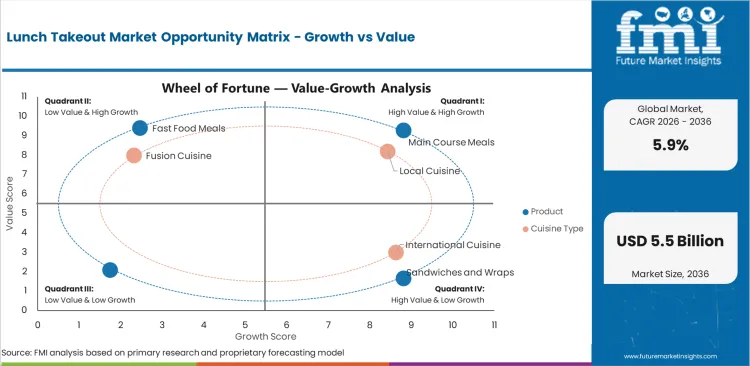
- Working professional lunch convenience demand and digital platform adoption sustain growth in delivery-based midday meal procurement across urban markets.
- Delivery logistics constraints during the concentrated lunch-hour window limit the number of orders platforms can fulfill, creating capacity management challenges.
- Cloud kitchen expansion creates delivery-optimized food preparation that reduces per-order cost and improves lunch-hour throughput.
- Corporate meal programs create institutional demand with predictable daily volumes and higher average order values.
The lunch takeout market continues to grow based on digital ordering adoption, delivery logistics improvement, and corporate program expansion. Capacity constraints and competition shape platform dynamics.
Digital Ordering Convenience
Demand is shaped by the reduction in ordering friction through smartphone app interfaces. One-tap reordering, scheduled delivery, and integrated payment eliminate the time and effort barriers that previously limited lunch delivery adoption among time-pressed working professionals.
Lunch-Hour Logistics Constraints
Growth is constrained by the concentrated nature of lunch demand within a 90-minute window that strains delivery capacity. Platforms and restaurants manage this constraint through pre-ordering incentives, staggered delivery scheduling, and cloud kitchen capacity designed for peak lunch throughput.
Cloud Kitchen Capacity
Adoption is accelerating through cloud kitchen expansion that creates food preparation capacity optimized for delivery. Lower real estate costs, no dining room overhead, and kitchen layouts designed for multi-brand production improve unit economics for lunch delivery operations.
Corporate Meal Programs
Employer-subsidized lunch ordering through platform partnerships creates institutional demand with predictable daily order volumes. Corporate programs provide delivery platforms with guaranteed revenue and higher average order values compared to individual consumer transactions.
Analysis of Lunch Takeout Market By Key Countries
.webp "Top Country Growth Comparison Lunch Takeout Market Cagr (2026 2036)")
| Country | CAGR |
|---|---|
| India | 6.9% |
| Japan | 6.4% |
| Germany | 5.1% |
| USA | 4.2% |
| China | 3.9% |
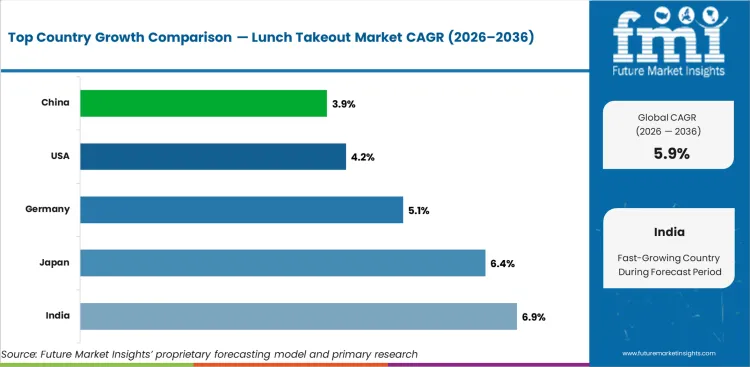
- India at 6.9% leads growth, driven by rapid food delivery platform expansion and growing adoption of app-based lunch ordering among urban working populations.
- Japan at 6.4% reflects established delivery culture and high working professional density in urban centers supporting lunch delivery demand.
- Germany at 5.1% sustains growth through expanding food delivery platform penetration and growing corporate meal program adoption.
- The USA at 4.2% maintains demand through established delivery infrastructure and expanding lunch-specific platform features.
The global lunch takeout market is projected to expand at 5.9% CAGR from 2026 to 2036. The study covers more than 30 countries, and the main markets are listed below.
Demand Outlook for Lunch Takeout Market in India
India is projected to record a 6.9% CAGR through 2036. Rapid food delivery platform expansion across tier-1 and tier-2 cities and growing urban working population adoption of app-based ordering sustain demand growth.
- Swiggy and Zomato platform expansion into tier-2 and tier-3 cities is broadening the addressable lunch delivery market beyond metropolitan areas.
- Cloud kitchen proliferation in major Indian cities creates delivery-optimized capacity serving the concentrated lunch demand window.
- Corporate meal programs through platform partnerships are growing as employers subsidize employee lunch benefits through digital ordering channels.
Sales Analysis of Lunch Takeout Market in Japan
Japan is estimated to grow at 6.4% through 2036. Established delivery culture and high working professional density in urban centers sustain lunch takeout demand. Quality expectations and punctuality standards are high.
- High urban working professional density in Tokyo, Osaka, and other major cities creates concentrated lunch delivery demand supporting efficient logistics.
- Quality and punctuality standards in Japanese delivery culture require platforms to maintain strict time accuracy and food presentation standards.
- Convenience store lunch options create competitive pressure that drives delivery platforms to differentiate on menu variety and speed.
Future Outlook for Lunch Takeout Market in Germany
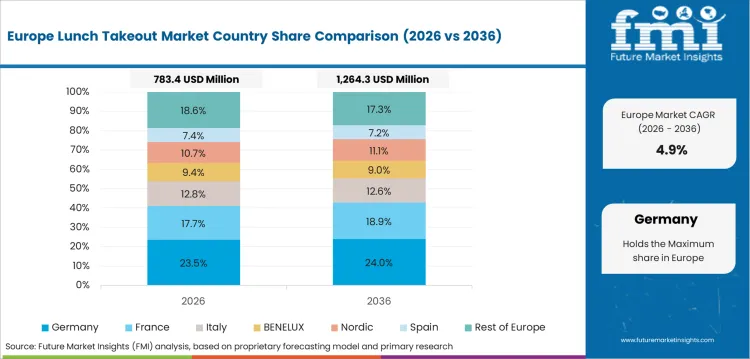
Germany is expected to grow at 5.1% through 2036. Expanding food delivery platform penetration and growing corporate meal adoption sustain lunch takeout demand.
- Delivery Hero and Just Eat platform penetration expansion sustains lunch ordering growth across German urban markets.
- Corporate meal programs are growing as German employers adopt platform-based lunch benefit solutions for office workers.
- EU food safety and delivery hygiene regulations establish standards that influence packaging and temperature maintenance requirements.
Opportunity Analysis of Lunch Takeout Market in USA
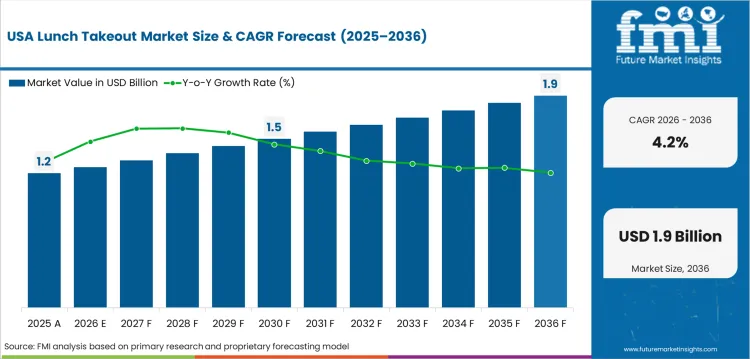
The USA is projected to record a 4.2% CAGR through 2036. Established delivery infrastructure and lunch-specific platform features sustain demand. Competition between DoorDash, Uber Eats, and Grubhub drives service improvement.
- Platform competition between DoorDash, Uber Eats, and Grubhub drives lunch delivery service improvements including speed guarantees and loyalty programs.
- Corporate meal benefit programs create institutional demand with subscription-based employee lunch ordering through platform business accounts.
- Cloud kitchen expansion in major US cities creates lunch-optimized delivery capacity without traditional restaurant overhead costs.
In-depth Analysis of Lunch Takeout Market in China
China is expected to grow at 3.9% through 2036. The mature food delivery market led by Meituan provides established infrastructure for lunch delivery. High urban population density supports efficient delivery logistics.
- Meituan dominance in Chinese food delivery provides established infrastructure and restaurant partner networks serving lunch ordering demand.
- High urban population density enables efficient delivery logistics with short distances between restaurants and office buildings.
- Corporate meal ordering and group lunch programs through platform integrations serve the large Chinese office worker population.
Competitive Landscape and Strategic Positioning
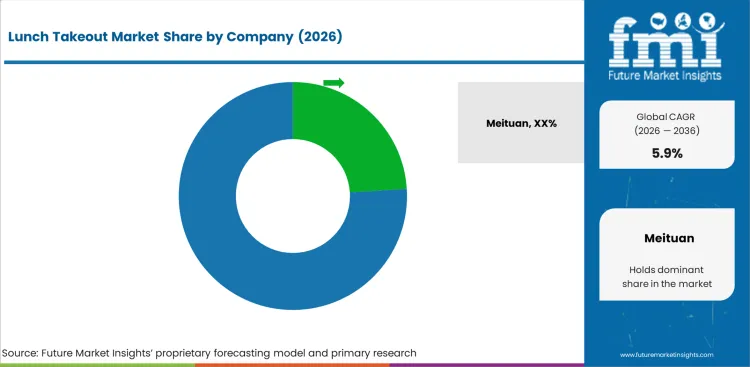
- Meituan and DoorDash lead in their respective regional markets with the largest restaurant partner networks, delivery logistics infrastructure, and consumer platform engagement.
- Zomato and Swiggy dominate the Indian lunch delivery market with expanding geographic coverage and growing corporate meal program capabilities.
- Just Eat Takeaway.com and Deliveroo serve European markets with established delivery infrastructure and restaurant partnerships.
Meituan holds the leading position in the Chinese market with the largest food delivery platform by transaction volume. DoorDash leads the North American market with expanding restaurant network and corporate delivery programs. Both platforms leverage proprietary logistics technology for lunch-hour capacity optimization.
Zomato and Swiggy compete in the Indian market with rapidly expanding geographic coverage and growing restaurant partner networks. Grab Holdings serves Southeast Asian markets. Just Eat Takeaway.com and Deliveroo serve European lunch delivery demand.
Barriers to entry include delivery logistics network establishment, restaurant partner acquisition, and platform technology development. Strategic priorities include lunch-hour capacity optimization, corporate program expansion, and cloud kitchen partnership development.
Key Companies in the Lunch Takeout Market
Key global companies leading the lunch takeout market include:
- Meituan (China), DoorDash (USA), and Just Eat Takeaway.com (Netherlands) maintain the largest food delivery platforms in their respective regions with established logistics and restaurant partner infrastructure.
- Zomato (India), Swiggy (India), Grab Holdings (Singapore), Delivery Hero (Germany), and Deliveroo (UK) serve regional markets with expanding delivery platforms and growing lunch-specific service features.
- Cloud kitchen operators and virtual restaurant brands compete by creating delivery-optimized food preparation capacity specifically designed for lunch-hour demand throughput.
Competitive Benchmarking: Lunch Takeout Market
| Company | Platform Scale | Lunch Focus | Logistics | Geo. Reach |
|---|---|---|---|---|
| Meituan | Very High | Integrated | Advanced | China |
| DoorDash | Very High | Growing | Advanced | N. America |
| Zomato | High | Growing | Developing | India |
| Grab Holdings | High | Integrated | Advanced | SE Asia |
| Swiggy | High | Growing | Developing | India |
| Delivery Hero | High | Growing | Advanced | Europe, Global |
| Just Eat Takeaway | High | Growing | Advanced | Europe |
| Deliveroo | Medium | Growing | Advanced | UK, Europe |
Source: Future Market Insights competitive analysis, 2026.
Key Developments in Lunch Takeout Market
- In 2025, DoorDash launched a dedicated corporate lunch ordering program with employer-subsidized meal benefits for business account customers across North American markets.
- In 2025, Zomato expanded its cloud kitchen partnerships in India, adding lunch-optimized preparation capacity in tier-2 cities to serve growing delivery demand from urban working professionals.
Key Players in the Lunch Takeout Market
Major Global Players
- Meituan
- DoorDash
- Zomato
- Grab Holdings
- Swiggy
- Delivery Hero
Emerging Players/Startups
- Swish
- Foodi
- Wonder
Report Scope and Coverage
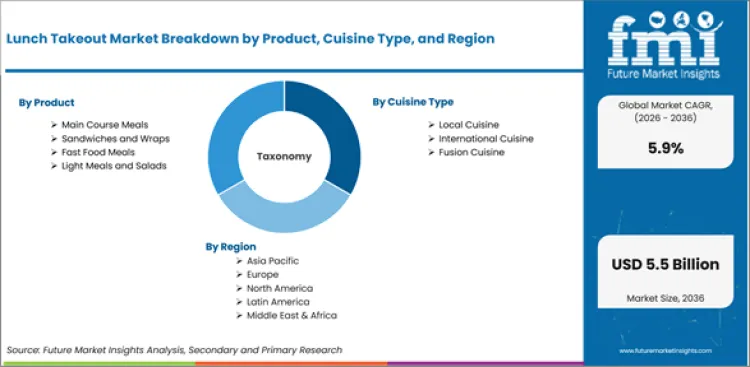
| Parameter | Details |
|---|---|
| Market size by 2036 | USD 5.5 billion |
| Growth rate | 5.9% CAGR (2026 to 2036) |
| Forecast period | 2026 to 2036 |
| Base year value (2025) | USD 2.9 billion |
| Key Segment Covered | Product, Cuisine Type, Service Type, Order Channel, End Use |
| Regions covered | North America, Latin America, Western Europe, Eastern Europe, East Asia, South Asia and Pacific, Middle East and Africa |
| Countries covered | USA, South Korea, UK, Japan, China, India, Germany, 30 plus countries |
| Key companies profiled | Meituan, DoorDash, Zomato, Grab Holdings, Swiggy, Delivery Hero, Just Eat Takeaway.com, Deliveroo |
| Approach | Hybrid bottom-up and top-down methodology starting with verified transaction data, projecting adoption velocity across segments and regions. |
Market Segmentation Analysis
Lunch Takeout Market Segmented by Product:
- Main Course Meals
- Rice Based Meals
- Biryani
- Fried Rice
- Noodle and Pasta Meals
- Hakka Noodles
- Spaghetti and Pasta
- Regional Meals
- Thali Meals
- Combo Meals
- Rice Based Meals
- Sandwiches and Wraps
- Classic Sandwiches
- Veg Sandwich
- Chicken Sandwich
- Wraps and Rolls
- Kathi Rolls
- Tortilla Wraps
- Classic Sandwiches
- Fast Food Meals
- Burgers
- Veg Burgers
- Chicken Burgers
- Pizza
- Individual Pizza
- Slice Pizza
- Burgers
- Light Meals and Salads
- Salads
- Green Salads
- Protein Salads
- Bowls
- Buddha Bowls
- Grain Bowls
- Salads
Lunch Takeout Market Segmented by Cuisine Type:
- Local Cuisine
- Indian Cuisine
- Regional Specialties
- International Cuisine
- Italian
- Chinese
- Mexican
- Fusion Cuisine
- Indo Chinese
- Modern Fusion
Lunch Takeout Market Segmented by Service Type:
- Quick Service Restaurants (QSR)
- Chain Outlets
- Standalone QSR
- Cloud Kitchens
- Delivery Only Kitchens
- Virtual Brands
- Casual Dining Takeout
- Restaurant Takeaway
- Premium Meals
- Street Food Vendors
- Local Vendors
- Quick Bites
Lunch Takeout Market Segmented by Order Channel:
- Online Delivery Platforms
- Food Delivery Apps
- Website Orders
- Offline Takeaway
- Walk In Orders
- Phone Orders
- Corporate Orders
- Bulk Lunch Orders
- Office Catering
Lunch Takeout Market Segmented by End Use:
- Working Professionals
- Office Workers
- Daily Lunch Orders
- Subscription Meals
- Office Workers
- Students
- College Students
- Budget Meals
- Quick Bites
- College Students
- Households
- Family Orders
- Weekend Lunch
- Occasional Orders
- Family Orders
Lunch Takeout Market by Region:
- North America
- USA
- Canada
- Mexico
- Latin America
- Brazil
- Chile
- Rest of Latin America
- Western Europe
- Germany
- UK
- Italy
- Spain
- France
- Nordic
- BENELUX
- Rest of Western Europe
- Eastern Europe
- Russia
- Poland
- Hungary
- Balkan & Baltic
- Rest of Eastern Europe
- East Asia
- China
- Japan
- South Korea
- South Asia and Pacific
- India
- ASEAN
- Australia & New Zealand
- Rest of South Asia and Pacific
- Middle East & Africa
- Kingdom of Saudi Arabia
- Other GCC Countries
- Türkiye
- South Africa
- Other African Union
- Rest of Middle East & Africa
Research Sources and Bibliography
- 1. International Labour Organization. (2025). ILO Global Employment and Urban Workforce Statistics. ILO.
- 2. European Commission. (2025). EU Regulation on Food Delivery and Platform Worker Standards. EC.
- 3. USA Department of Agriculture. (2025). USDA Food Service Industry and Away-From-Home Eating Report. USDA.
- 4. World Health Organization. (2025). WHO Guidelines on Food Safety in Delivery and Takeout Services. WHO.
- 5. National Restaurant Association. (2025). NRA Restaurant Industry and Delivery Market Report. NRA.
This bibliography is provided for reader reference.
This Report Answers
- Estimating the size of the lunch takeout market and projected revenue from 2026 to 2036.
- Segmentation by product, cuisine type, service type, order channel, and end use.
- Insights about more than 30 markets in the region.
- Analysis of service types including quick service restaurants, cloud kitchens, and corporate catering.
- Assessment of the competitive landscape.
- Identifying investment opportunities in cloud kitchen operations, corporate meal programs, and platform technology.
- Tracking the supply chain from food preparation to last-mile delivery logistics.
- Delivery of data in PDF and Excel formats.
Frequently Asked Questions
How big is the lunch takeout market in 2026?
The global lunch takeout market is estimated to be valued at USD 3.1 billion in 2026.
What will be the size of the lunch takeout market in 2036?
The market size for the lunch takeout market is projected to reach USD 5.5 billion by 2036.
How much will the lunch takeout market growth be between 2026 and 2036?
The lunch takeout market is expected to grow at a 5.9% CAGR between 2026 and 2036.
What are the key products in the lunch takeout market?
The key products in the lunch takeout market are Main Course Meals, Sandwiches and Wraps, Fast Food Meals and Light Meals and Salads.
Which cuisine type segment is expected to contribute a significant share in the lunch takeout market in 2026?
In terms of cuisine type, the local cuisine segment is expected to command 50.0% share in the lunch takeout market in 2026.
Preview the report firsthand - request a free sample
Get SampleGet the brochure for pricing and purchase details.
Get PDFTable of Content
- Key Takeaways
- Market Size and CAGR
- Top Growth Driver
- Fastest Growing Segment
- Leading Region
- Key Companies
- Emerging Opportunities
- Executive Summary
- Global Market Outlook
- Demand-side Trends
- Supply-side Trends
- Technology Roadmap Analysis
- Analysis and Recommendations
- Analyst Perspective (What is happening? Why now? What should investors know?)
- Key Questions Answered
- How large is the market?
- What is the CAGR?
- What are key trends?
- Which region dominates?
- Who are the leaders?
- Market Overview
- Market Coverage / Taxonomy
- Market Definition / Scope / Limitations
- Research Methodology
- Chapter Orientation
- Analytical Lens and Working Hypotheses
- Market Structure, Signals, and Trend Drivers
- Benchmarking and Cross-market Comparability
- Market Sizing, Forecasting, and Opportunity Mapping
- Research Design and Evidence Framework
- Desk Research Programme (Secondary Evidence)
- Expert Input and Fieldwork (Primary Evidence)
- Tooling, Models, and Reference Databases
- Data Engineering and Model Build
- Quality Assurance and Audit Trail
- Market Background
- Market Dynamics (Drivers, Restraints, Opportunity, Trends)
- Scenario Forecast (Optimistic, Likely, Conservative)
- Impact Analysis
- AI Impact
- Sustainability Impact
- Regulatory Impact
- Technology Impact
- Consumer / Buyer Analysis
- Purchase Drivers
- Adoption Barriers
- Buyer Journey
- Opportunity Map Analysis
- Product Life Cycle Analysis
- Supply Chain Analysis
- Investment Feasibility Matrix
- Value Chain Analysis
- PESTLE and Porter's Analysis
- Regulatory Landscape
- Regional Parent Market Outlook
- Production and Consumption Statistics
- Import and Export Statistics
- Global Market Analysis and Forecast, 2021 to 2036
- Historical Market Size Value (USD Million) Analysis, 2021 to 2025
- Current and Future Market Size Value (USD Million) Projections, 2026 to 2036
- Y-o-Y Growth Trend Analysis
- Absolute $ Opportunity Analysis
- Global Market Pricing Analysis, 2021 to 2036
- Global Market Analysis and Forecast, By Product, 2021 to 2036
- Introduction / Key Findings
- Historical Market Size Value (USD Million) Analysis By Product, 2021 to 2025
- Current and Future Market Size Value (USD Million) Analysis and Forecast By Product, 2026 to 2036
- Main Course Meals
- Rice Based Meals
- Noodle and Pasta Meals
- Regional Meals
- Sandwiches and Wraps
- Classic Sandwiches
- Wraps and Rolls
- Fast Food Meals
- Burgers
- Pizza
- Light Meals and Salads
- Salads
- Bowls
- Main Course Meals
- Y-o-Y Growth Trend Analysis By Product, 2021 to 2025
- Absolute $ Opportunity Analysis By Product, 2026 to 2036
- Global Market Analysis and Forecast, By Cuisine Type, 2021 to 2036
- Introduction / Key Findings
- Historical Market Size Value (USD Million) Analysis By Cuisine Type, 2021 to 2025
- Current and Future Market Size Value (USD Million) Analysis and Forecast By Cuisine Type, 2026 to 2036
- Local Cuisine
- Indian Cuisine
- Regional Specialties
- International Cuisine
- Italian
- Chinese
- Mexican
- Fusion Cuisine
- Indo Chinese
- Modern Fusion
- Local Cuisine
- Y-o-Y Growth Trend Analysis By Cuisine Type, 2021 to 2025
- Absolute $ Opportunity Analysis By Cuisine Type, 2026 to 2036
- Global Market Analysis and Forecast, By Service Type, 2021 to 2036
- Introduction / Key Findings
- Historical Market Size Value (USD Million) Analysis By Service Type, 2021 to 2025
- Current and Future Market Size Value (USD Million) Analysis and Forecast By Service Type, 2026 to 2036
- Quick Service Restaurants (QSR)
- Chain Outlets
- Standalone QSR
- Cloud Kitchens
- Delivery Only Kitchens
- Virtual Brands
- Casual Dining Takeout
- Restaurant Takeaway
- Premium Meals
- Street Food Vendors
- Local Vendors
- Quick Bites
- Quick Service Restaurants (QSR)
- Y-o-Y Growth Trend Analysis By Service Type, 2021 to 2025
- Absolute $ Opportunity Analysis By Service Type, 2026 to 2036
- Global Market Analysis and Forecast, By Order Channel, 2021 to 2036
- Introduction / Key Findings
- Historical Market Size Value (USD Million) Analysis By Order Channel, 2021 to 2025
- Current and Future Market Size Value (USD Million) Analysis and Forecast By Order Channel, 2026 to 2036
- Online Delivery Platforms
- Food Delivery Apps
- Website Orders
- Offline Takeaway
- Walk In Orders
- Phone Orders
- Corporate Orders
- Bulk Lunch Orders
- Office Catering
- Online Delivery Platforms
- Y-o-Y Growth Trend Analysis By Order Channel, 2021 to 2025
- Absolute $ Opportunity Analysis By Order Channel, 2026 to 2036
- Global Market Analysis and Forecast, By End Use, 2021 to 2036
- Introduction / Key Findings
- Historical Market Size Value (USD Million) Analysis By End Use, 2021 to 2025
- Current and Future Market Size Value (USD Million) Analysis and Forecast By End Use, 2026 to 2036
- Working Professionals
- Office Workers
- Students
- College Students
- Households
- Family Orders
- Working Professionals
- Y-o-Y Growth Trend Analysis By End Use, 2021 to 2025
- Absolute $ Opportunity Analysis By End Use, 2026 to 2036
- Global Market Analysis and Forecast, By Region, 2021 to 2036
- Introduction
- Historical Market Size Value (USD Million) Analysis By Region, 2021 to 2025
- Current Market Size Value (USD Million) Analysis and Forecast By Region, 2026 to 2036
- North America
- Latin America
- Western Europe
- Eastern Europe
- East Asia
- South Asia and Pacific
- Middle East & Africa
- Market Attractiveness Analysis By Region
- North America Market Analysis and Forecast, By Country, 2021 to 2036
- Historical Market Size Value (USD Million) Trend Analysis By Market Taxonomy, 2021 to 2025
- Market Size Value (USD Million) Forecast By Market Taxonomy, 2026 to 2036
- By Country
- USA
- Canada
- Mexico
- By Product
- By Cuisine Type
- By Service Type
- By Order Channel
- By End Use
- By Country
- Market Attractiveness Analysis
- By Country
- By Product
- By Cuisine Type
- By Service Type
- By Order Channel
- By End Use
- Key Takeaways
- Latin America Market Analysis and Forecast, By Country
- Historical Market Size Value (USD Million) Trend Analysis By Market Taxonomy, 2021 to 2025
- Market Size Value (USD Million) Forecast By Market Taxonomy, 2026 to 2036
- By Country
- Brazil
- Chile
- Rest of Latin America
- By Product
- By Cuisine Type
- By Service Type
- By Order Channel
- By End Use
- By Country
- Market Attractiveness Analysis
- By Country
- By Product
- By Cuisine Type
- By Service Type
- By Order Channel
- By End Use
- Key Takeaways
- Western Europe Market Analysis and Forecast, By Country
- Historical Market Size Value (USD Million) Trend Analysis By Market Taxonomy, 2021 to 2025
- Market Size Value (USD Million) Forecast By Market Taxonomy, 2026 to 2036
- By Country
- Germany
- UK
- Italy
- Spain
- France
- Nordic
- BENELUX
- Rest of Western Europe
- By Product
- By Cuisine Type
- By Service Type
- By Order Channel
- By End Use
- By Country
- Market Attractiveness Analysis
- By Country
- By Product
- By Cuisine Type
- By Service Type
- By Order Channel
- By End Use
- Key Takeaways
- Eastern Europe Market Analysis and Forecast, By Country
- Historical Market Size Value (USD Million) Trend Analysis By Market Taxonomy, 2021 to 2025
- Market Size Value (USD Million) Forecast By Market Taxonomy, 2026 to 2036
- By Country
- Russia
- Poland
- Hungary
- Balkan & Baltic
- Rest of Eastern Europe
- By Product
- By Cuisine Type
- By Service Type
- By Order Channel
- By End Use
- By Country
- Market Attractiveness Analysis
- By Country
- By Product
- By Cuisine Type
- By Service Type
- By Order Channel
- By End Use
- Key Takeaways
- East Asia Market Analysis and Forecast, By Country
- Historical Market Size Value (USD Million) Trend Analysis By Market Taxonomy, 2021 to 2025
- Market Size Value (USD Million) Forecast By Market Taxonomy, 2026 to 2036
- By Country
- China
- Japan
- South Korea
- By Product
- By Cuisine Type
- By Service Type
- By Order Channel
- By End Use
- By Country
- Market Attractiveness Analysis
- By Country
- By Product
- By Cuisine Type
- By Service Type
- By Order Channel
- By End Use
- Key Takeaways
- South Asia and Pacific Market Analysis and Forecast, By Country
- Historical Market Size Value (USD Million) Trend Analysis By Market Taxonomy, 2021 to 2025
- Market Size Value (USD Million) Forecast By Market Taxonomy, 2026 to 2036
- By Country
- India
- ASEAN
- Australia & New Zealand
- Rest of South Asia and Pacific
- By Product
- By Cuisine Type
- By Service Type
- By Order Channel
- By End Use
- By Country
- Market Attractiveness Analysis
- By Country
- By Product
- By Cuisine Type
- By Service Type
- By Order Channel
- By End Use
- Key Takeaways
- Middle East & Africa Market Analysis and Forecast, By Country
- Historical Market Size Value (USD Million) Trend Analysis By Market Taxonomy, 2021 to 2025
- Market Size Value (USD Million) Forecast By Market Taxonomy, 2026 to 2036
- By Country
- Kingdom of Saudi Arabia
- Other GCC Countries
- Türkiye
- South Africa
- Other African Union
- Rest of Middle East & Africa
- By Product
- By Cuisine Type
- By Service Type
- By Order Channel
- By End Use
- By Country
- Market Attractiveness Analysis
- By Country
- By Product
- By Cuisine Type
- By Service Type
- By Order Channel
- By End Use
- Key Takeaways
- Key Countries Market Analysis
- USA
- Pricing Analysis
- Market Share Analysis, 2025
- By Product
- By Cuisine Type
- By Service Type
- By Order Channel
- By End Use
- Canada
- Pricing Analysis
- Market Share Analysis, 2025
- By Product
- By Cuisine Type
- By Service Type
- By Order Channel
- By End Use
- Mexico
- Pricing Analysis
- Market Share Analysis, 2025
- By Product
- By Cuisine Type
- By Service Type
- By Order Channel
- By End Use
- Brazil
- Pricing Analysis
- Market Share Analysis, 2025
- By Product
- By Cuisine Type
- By Service Type
- By Order Channel
- By End Use
- Chile
- Pricing Analysis
- Market Share Analysis, 2025
- By Product
- By Cuisine Type
- By Service Type
- By Order Channel
- By End Use
- Germany
- Pricing Analysis
- Market Share Analysis, 2025
- By Product
- By Cuisine Type
- By Service Type
- By Order Channel
- By End Use
- UK
- Pricing Analysis
- Market Share Analysis, 2025
- By Product
- By Cuisine Type
- By Service Type
- By Order Channel
- By End Use
- Italy
- Pricing Analysis
- Market Share Analysis, 2025
- By Product
- By Cuisine Type
- By Service Type
- By Order Channel
- By End Use
- Spain
- Pricing Analysis
- Market Share Analysis, 2025
- By Product
- By Cuisine Type
- By Service Type
- By Order Channel
- By End Use
- France
- Pricing Analysis
- Market Share Analysis, 2025
- By Product
- By Cuisine Type
- By Service Type
- By Order Channel
- By End Use
- India
- Pricing Analysis
- Market Share Analysis, 2025
- By Product
- By Cuisine Type
- By Service Type
- By Order Channel
- By End Use
- ASEAN
- Pricing Analysis
- Market Share Analysis, 2025
- By Product
- By Cuisine Type
- By Service Type
- By Order Channel
- By End Use
- Australia & New Zealand
- Pricing Analysis
- Market Share Analysis, 2025
- By Product
- By Cuisine Type
- By Service Type
- By Order Channel
- By End Use
- China
- Pricing Analysis
- Market Share Analysis, 2025
- By Product
- By Cuisine Type
- By Service Type
- By Order Channel
- By End Use
- Japan
- Pricing Analysis
- Market Share Analysis, 2025
- By Product
- By Cuisine Type
- By Service Type
- By Order Channel
- By End Use
- South Korea
- Pricing Analysis
- Market Share Analysis, 2025
- By Product
- By Cuisine Type
- By Service Type
- By Order Channel
- By End Use
- Russia
- Pricing Analysis
- Market Share Analysis, 2025
- By Product
- By Cuisine Type
- By Service Type
- By Order Channel
- By End Use
- Poland
- Pricing Analysis
- Market Share Analysis, 2025
- By Product
- By Cuisine Type
- By Service Type
- By Order Channel
- By End Use
- Hungary
- Pricing Analysis
- Market Share Analysis, 2025
- By Product
- By Cuisine Type
- By Service Type
- By Order Channel
- By End Use
- Kingdom of Saudi Arabia
- Pricing Analysis
- Market Share Analysis, 2025
- By Product
- By Cuisine Type
- By Service Type
- By Order Channel
- By End Use
- Türkiye
- Pricing Analysis
- Market Share Analysis, 2025
- By Product
- By Cuisine Type
- By Service Type
- By Order Channel
- By End Use
- South Africa
- Pricing Analysis
- Market Share Analysis, 2025
- By Product
- By Cuisine Type
- By Service Type
- By Order Channel
- By End Use
- USA
- Market Structure Analysis
- Competition Dashboard
- Competition Benchmarking
- Market Share Analysis of Top Players
- By Regional
- By Product
- By Cuisine Type
- By Service Type
- By Order Channel
- By End Use
- Emerging Startups
- Innovation Benchmarking
- Competition Analysis
- Competition Deep Dive
- Meituan
- Overview
- Product Portfolio
- Profitability by Market Segments (Product/Region/Sales Channel)
- Sales Footprint
- Strategy Overview
- Marketing Strategy
- Product Strategy
- Channel Strategy
- DoorDash
- Zomato
- Grab Holdings
- Swiggy
- Delivery Hero
- Just Eat Takeaway.com
- Deliveroo
- Uber Eats
- Postmates
- Meituan
- Case Studies
- Success Stories
- Recent Developments
- Competition Deep Dive
- Assumptions & Acronyms Used


