

- Industry Size (2026)
- USD 390 Bn
- Forecast (2036)
- USD 685 Bn
- CAGR (2026 to 2036)
- 5.8%
Restaurant Takeout Market Forecast and Outlook 2026 to 2036
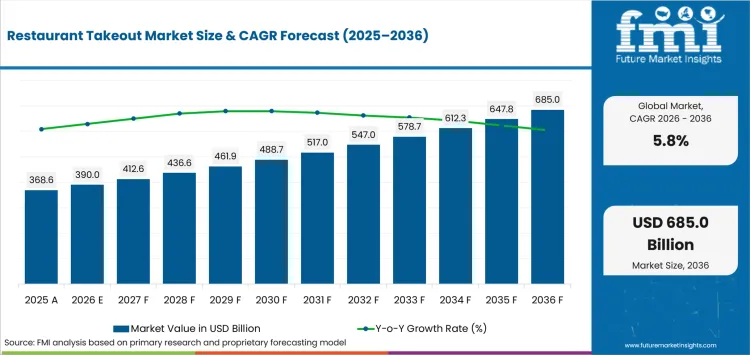
The global restaurant takeout sector is on track to achieve a valuation of USD 685 billion by 2036, accelerating from USD 390 billion in 2026 at a CAGR of 5.8%. As per Future Market Insights, expansion is structurally underpinned by the global proliferation of food delivery aggregator platforms, the integration of AI voice-ordering into QSR drive-through and phone channels, and the scaling of autonomous delivery robots in high-density urban zones.
The National Restaurant Association (USA) reported in its 2024 State of the Industry Report that off-premises dining (takeout and delivery) now accounts for over 60% of restaurant industry traffic, validating the structural shift away from dine-in toward takeout and delivery-first consumption. This off-premises dominance compels restaurant operators and aggregators to invest in AI-powered ordering, autonomous delivery, and larger basket-size incentive strategies. Simultaneously the competitive landscape is consolidating as DoorDash, Uber Eats, and Grubhub (Wonder) control over 95% of the US delivery aggregator market.
In January 2026, DoorDash finalised its integration of Deliveroo (acquired in 2025), expanding its footprint across Europe and the Middle East while debuting proprietary AI-powered discovery apps and in-house delivery robots to lower last-mile costs. FMI analysts are of the opinion that the DoorDash-Deliveroo integration will create a transatlantic aggregator duopoly with Uber Eats, capturing 80%+ of the US-Europe delivery aggregator market by 2028 and fundamentally shifting commission negotiation power away from independent restaurants.
The competitive landscape in 2025 and 2026 is defined by aggregator consolidation and AI automation. Just Eat Takeaway launched an AI voice assistant in January 2026 for conversational meal recommendations on iOS and Android. Grubhub announced a strategic pivot in February 2026 dropping delivery fees on all orders over USD 50 following its Wonder acquisition. Uber Eats reported in February 2026 that over 30% of its global deliveries in high-density urban zones are fulfilled by autonomous robots or e-bikes.
Major QSR chains including Taco Bell and Starbucks moved AI voice-ordering from pilot to system-wide rollout in January 2026 with up to 26% increases in phone order revenue. Restaurant Brands International formed a JV with CPE in November 2025 to accelerate Burger King expansion in China. Jack in the Box completed the USD 115 million sale of Del Taco to Yadav Enterprises in October 2025. As per FMI, this convergence of aggregator mega-consolidation, AI voice-ordering system-wide deployment, and autonomous last-mile delivery confirms that restaurant takeout is transitioning from a fragmented, human-operated channel into a concentrated, AI-orchestrated, autonomous delivery platform.
Summary of Restaurant Takeout Market
What Is Growth Outlook for Restaurant Takeout Market as per Future Market Insights Projection?
Future Market Insights projects the restaurant takeout industry to expand at a CAGR of 5.8% from 2026 to 2036, increasing from USD 390 billion in 2026 to USD 685 billion by 2036.
FMI Research Approach: FMI proprietary forecasting model based on NRA off-premises dining data, aggregator GMV tracking, and QSR AI voice-ordering deployment analysis.
How Do FMI Analysts Perceive Restaurant Takeout Market to Evolve?
FMI analysts perceive the market evolving toward an AI-orchestrated ecosystem where voice-ordering captures phone orders, autonomous robots fulfill urban deliveries, and two to three mega-aggregators control marketplace access globally.
FMI Research Approach: DoorDash-Deliveroo integration and QSR AI voice-ordering rollout analysis.
Which Country Holds Largest Share in Global Restaurant Takeout Market?
The United States holds a significant share of the global restaurant takeout market by value which is supported by the NRA-reported 60%+ off-premises dining share and the concentration of DoorDash, Uber Eats, and Grubhub aggregator dominance.
FMI Research Approach: FMI country-level revenue modeling by NRA off-premises data and aggregator GMV tracking.
How Large Will Restaurant Takeout Market Be by 2036?
The global restaurant takeout market is projected to reach USD 685 billion by 2036.
FMI Research Approach: FMI long-term revenue forecast derived from off-premises dining growth projections and aggregator penetration analysis.
What Is Definition of Restaurant Takeout Market?
The restaurant takeout market includes food orders placed for off-premises consumption through direct restaurant channels (counter, phone, website) and third-party aggregator platforms (DoorDash, Uber Eats, Grubhub), covering QSR, fast casual, casual dining, and fine dining takeout across pick-up and delivery fulfillment modes.
FMI Research Approach: FMI market taxonomy aligned with NRA off-premises dining classification and aggregator platform GMV reporting.
What Are Globally Unique Trends Shaping Restaurant Takeout Market?
Globally unique trends include DoorDash-Deliveroo transatlantic aggregator integration, AI voice-ordering system-wide QSR deployment with 26% phone order revenue increases, and autonomous robot delivery fulfilling 30%+ of urban Uber Eats orders.
FMI Research Approach: DoorDash-Deliveroo integration and Uber Eats autonomous delivery penetration tracking.
Restaurant Takeout Market Key Takeaways
| Metric | Details |
|---|---|
| Industry Size (2026) | USD 390 billion |
| Industry Value (2036) | USD 685 billion |
| CAGR (2026 to 2036) | 5.8% |
Source: Future Market Insights (FMI) analysis, based on proprietary forecasting model and primary research
Key Restaurant Takeout Industry Trends
Demand for Convenience Food is Driving Market Growth
Future growth in the restaurant takeout market is anticipated to be driven by the rising demand for convenience foods. Convenience foods are prepackaged or prepared foods that are meant to be consumed quickly and easily with little preparation time. They are made to accommodate busy lifestyles by providing simple heat-and-serve options or ready-to-eat meals.
Busy lifestyles a lack of time for cooking and the need for quick simple meal solutions are the main causes of the rise in demand for convenience foods. Because restaurant takeout offers quick ready-to-eat meal options saves time and effort for busy people and offers high-quality dining experiences without requiring home cooking it helps meet the growing demand for convenience foods.
Rise in Dual Income is Driving the Market Growth
Over the course of the forecast period it is expected that the market will grow due to the increasing number of dual-income families as well as shifting eating and lifestyle habits. Also propelling the market expansion is the rising need for inexpensive easily accessible food.
Online delivery services have several advantages such as doorstep delivery cashback and reward programs and enticing discounts. To further offer premium food and promote the use of online delivery services food service providers are erecting sizable warehouses to hold fresh produce.
Comparison of Historical vs Future Outlook on Changing Consumer Trends for Restaurant Takeout Market
During the period 2020 to 2024, the sales grew at a CAGR of 5.8%, and it is predicted to continue to grow at a CAGR of 7.5% during the forecast period of 2025 to 2035.
Rapid digital technology adoption and an increase in restaurant takeout service options are two major factors reshaping the market. The availability of a large variety of foods and cuisines online that can be delivered to client’s homes within a predetermined window of time along with the availability of profitable extras and add-ons are propelling market revenue growth and influencing key market trends and opportunities that affect future market trends.
Many people all over the world have lost their jobs as a result of the situation and the need to find a reasonably appealing source of income has caused the number of people working in the market to rise in recent years which has an impact on the adoption trends of the restaurant takeout market as well as future trends.
Furthermore, a growing number of consumers are shopping through apps or platforms in the market as a result of transparency and convenience hectic work schedules and higher disposable income. The popularity of takeout services from restaurants has also been facilitated by technological advancements.
Additionally, the restaurant takeout industry has seen technological advancements that have led to the availability of more innovative and entertaining features and options such as personal virtual assistants that enable users to place orders among other things regulating the markets emerging trends.
Key Restaurant Takeout Market Players and Concentration
Tier 1 companies includes industry leaders acquiring a 60% share in the global business market. These leaders are distinguished by their extensive product portfolio and high production capacity. These industry leaders stand out due to their broad geographic reach, in-depth knowledge of manufacturing and reconditioning across various formats and strong customer base. They offer a variety of services and manufacturing with the newest food technology while adhering to legal requirements for the best quality.
Tier 2 companies comprises of mid-size players having a presence in some regions and highly influencing the local commerce and has a market share of 30%. These are distinguished by their robust global presence and solid business acumen. These industry participants may not have cutting-edge technology or a broad global reach but they do have good technology and guarantee regulatory compliance.
Tier 3 companies includes mostly of small-scale businesses serving niche economies and operating at the local presence having a market share of 10%. Due to their notable focus on meeting local needs these businesses are categorized as belonging to the tier 3 share segment, they are minor players with a constrained geographic scope. As an unorganized ecosystem Tier 3 in this context refers to a sector that in contrast to its organized competitors, lacks extensive structure and formalization.
Analysis of Top Countries Using and Delivering Restaurant Takeout
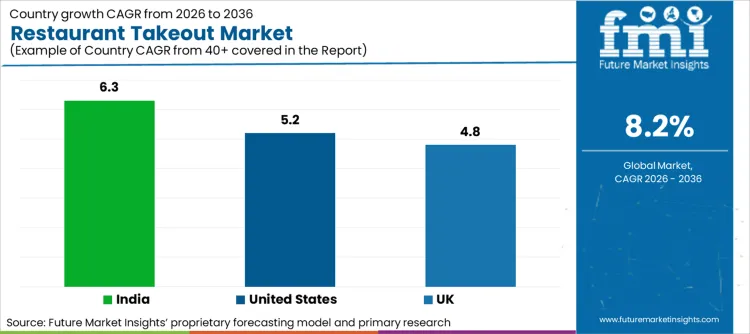
The following table shows the forecasted growth rates of the significant three geographies revenues. USA, UK and India come under the exhibit of high consumption, recording CAGRs of 5.2%, 4.8% and 6.3%, respectively, through 2035.
| Countries | CAGR 2025 to 2035 |
|---|---|
| United States | 5.2% |
| UK | 4.8% |
| India | 6.3% |
USA Dominates the North America Restaurant Takeout Market
With the highest revenue contribution, the United States was the largest restaurant takeout market. This was due to the regions increasing demand for takeout services and a shift in the market toward a more efficient customer experience which increased the number of customers. The growing number of restaurants partnering with delivery platforms and the growing use of food delivery apps across different demographics both contribute to the markets growth.
India Contributes to the Restaurant Takeout Market Growth
Asia Pacific is expanding quickly especially in India. Urbanization and the growing middle class are the main drivers of takeout service demand. Technological developments in the nation are crucial in the areas of delivery logistics and mobile applications. A growing trend toward healthier food options is also evident.
The distinctive food delivery scene in India is being shaped by the emergence of cloud kitchens and the incorporation of regional cuisines into online meal ordering platforms. This growth is also anticipated to be further fuelled by the ongoing enhancement of last-mile food delivery logistics and the extension of services to cities.
UK Emerges in Restaurant Takeout Market
The market is expanding gradually in Europe with the UK at the top. This growth is a result of both the expansion of delivery services and the growing desire for a variety of cuisines. Sustainability is emphasized in the European market as well as evidenced by the widespread use of eco-friendly packaging by takeout companies.
The existence of local and international online food delivery services which give customers a variety of choices further strengthens the UKs dominant position. Additionally, the growing popularity of ghost kitchens and the expansion of food delivery logistics to rural and suburban areas are driving the markets growth.
Market Definition
The restaurant takeout market represents revenue generated from food orders placed for off-premises consumption from restaurant establishments. The market measures the value of takeout orders through direct restaurant channels and third-party aggregator platforms, including pick-up and delivery fulfillment.
Inclusions cover QSR drive-through and counter takeout, fast casual and casual dining takeout orders, third-party aggregator platform delivery commissions and fees, AI voice-ordering system revenues, autonomous last-mile delivery charges, and restaurant digital ordering platform subscriptions.
Exclusions include dine-in restaurant revenue, grocery delivery and meal kit services without restaurant preparation, catering and events with on-site consumption, and general food manufacturing and distribution without restaurant takeout channel attribution.
Restaurant Takeout Industry Analysis by Top Investment Segments
Mobile Application Dominates Restaurant Takeout Market
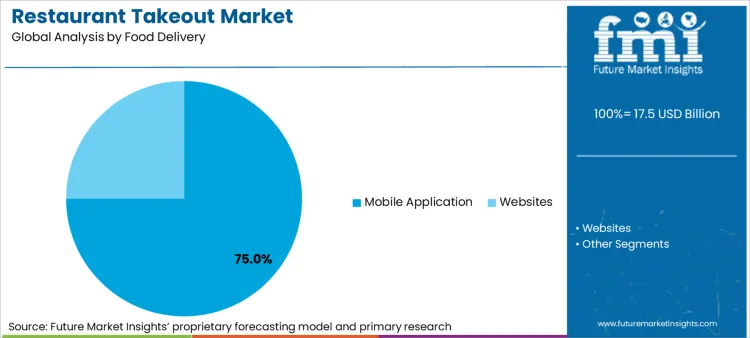
| Segment | Value Share (2025) |
|---|---|
| Mobile Application (Food Delivery) | 75% |
With a 75% market share in 2025 mobile and tablet applications have become the most popular platforms in the online meal delivery industry. One of the main factors contributing to mobile apps popularity is their unparalleled convenience which enables users to order food with a few taps.
These apps improve the user experience by utilizing cutting-edge technologies like GPS tracking push alerts and tailored suggestions. The ordering process has been further simplified becoming quicker and more secure with the integration of digital wallets and mobile payment systems.
Cards Rules Restaurant Takeout Market
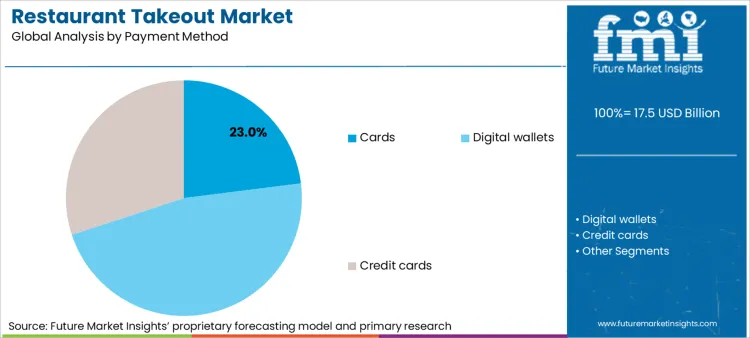
| Segment | Value Share (2025) |
|---|---|
| Cards (Payment Method) | 23% |
With a 23% market share in 2025 cards payment have become the most popular platforms in the online meal delivery industry. Ease of use contributes to it.
Leading Restaurant Takeout Brands by Market Share
According to a recent research report the markets legacy players are focusing on providing solutions that address particular needs like installing different technologies and updating and expanding existing systems which will promote the markets major trends opportunities and forecast.
Recent Developments
- In January 2026, DoorDash finalised Deliveroo integration, expanding across Europe and the Middle East while deploying AI-powered discovery apps and in-house delivery robots.
- In January 2026, Just Eat Takeaway launched an AI voice assistant for conversational meal recommendations on iOS and Android.
- In February 2026, Grubhub dropped delivery fees on all orders over USD 50 as a strategic pivot following its Wonder acquisition.
Key Restaurant Takeout Companies
- Denny’s
- Biscuitville
- Bob Evans
- Another Broken Egg Café
- First Watch
- The Original Pancake House
- Village Inn
- Perkins
- Huddle House
- Manchu Wok
- Mama Fu's
- HuHot Mongolian Grill
- Panda Express
- Fazoli’s appadeaux
- Spaghetti Warehouse
- Seafood Kitchen
Scope of Report
| Items | Values |
|---|---|
| Quantitative Units (2026) | USD 390 billion |
| Order Channel | Direct Restaurant (Counter, Phone, Website, App), Third-Party Aggregator (DoorDash, Uber Eats, Grubhub) |
| Restaurant Type | QSR, Fast Casual, Casual Dining, Fine Dining |
| Regions Covered | North America, Europe, Asia Pacific, Latin America, Middle East and Africa |
| Countries Covered | USA, UK, China, India, Germany, and 40+ countries |
| Key Companies Profiled | DoorDash, Uber Eats, Grubhub (Wonder), Just Eat Takeaway, Swiggy, Restaurant Brands International |
Top Segments Studied in the Restaurant Takeout Market Report
By Payment Method:
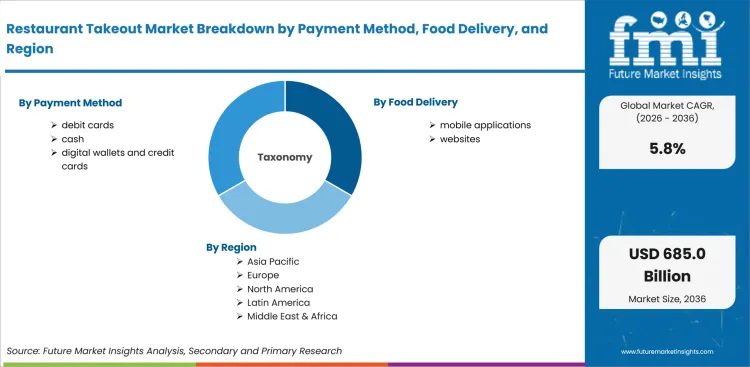
By payment methods industry has been categorized into debit cards, cash, digital wallets and credit cards
By Food Delivery:
By food delivery channel industry has been categorized into websites and mobile applications
By Region:
Industry analysis has been carried out in key countries of North America, Europe, Middle East, Africa, ASEAN, South Asia, Asia, New Zealand and Australia
Bibliography
- National Restaurant Association. (2024). 2024 State of the Restaurant Industry: Off-Premises Dining Exceeds 60% of Traffic. NRA.
- DoorDash Inc. (2026, January). DoorDash completes Deliveroo integration and AI delivery robot deployment. DoorDash Newsroom.
- Just Eat Takeaway.com. (2026, January). AI Voice Assistant launch for conversational meal ordering. Just Eat Takeaway Newsroom.
- Uber Technologies. (2026, February). Uber Eats autonomous delivery: 30%+ urban zone fulfillment by robots and e-bikes. Uber Newsroom.
Frequently Asked Questions
What is the current global market size for Restaurant Takeout?
The global market is valued at USD 390 billion in 2026, driven by aggregator mega-consolidation, AI voice-ordering deployment, and autonomous last-mile delivery scaling.
What is the projected CAGR for the market over the next 10 years?
The market is projected to grow at a CAGR of 5.8% from 2026 to 2036.
Which regions are experiencing the fastest expansion?
Asia Pacific is the fastest-growing region driven by India (Swiggy) and China (Burger King JV expansion), while North America leads by value through DoorDash-Uber Eats duopoly dominance.
What are the primary market drivers?
Aggregator mega-consolidation, AI voice-ordering system-wide QSR deployment, autonomous last-mile delivery, and larger basket-size incentive strategies are the primary growth catalysts.
Who are the leading suppliers in the industry?
DoorDash, Uber Eats, Grubhub (Wonder), and Just Eat Takeaway are key aggregator players, differentiating through Deliveroo integration, AI voice-ordering, and autonomous delivery robot deployment.
Preview the report firsthand - request a free sample
Get SampleGet the brochure for pricing and purchase details.
Get PDFTable of Content
- Executive Summary
- Global Market Outlook
- Demand-side Trends
- Supply-side Trends
- Technology Roadmap Analysis
- Analysis and Recommendations
- Market Overview
- Market Coverage / Taxonomy
- Market Definition / Scope / Limitations
- Research Methodology
- Chapter Orientation
- Analytical Lens and Working Hypotheses
- Market Structure, Signals, and Trend Drivers
- Benchmarking and Cross-market Comparability
- Market Sizing, Forecasting, and Opportunity Mapping
- Research Design and Evidence Framework
- Desk Research Programme (Secondary Evidence)
- Company Annual and Sustainability Reports
- Peer-reviewed Journals and Academic Literature
- Corporate Websites, Product Literature, and Technical Notes
- Earnings Decks and Investor Briefings
- Statutory Filings and Regulatory Disclosures
- Technical White Papers and Standards Notes
- Trade Journals, Industry Magazines, and Analyst Briefs
- Conference Proceedings, Webinars, and Seminar Materials
- Government Statistics Portals and Public Data Releases
- Press Releases and Reputable Media Coverage
- Specialist Newsletters and Curated Briefings
- Sector Databases and Reference Repositories
- FMI Internal Proprietary Databases and Historical Market Datasets
- Subscription Datasets and Paid Sources
- Social Channels, Communities, and Digital Listening Inputs
- Additional Desk Sources
- Expert Input and Fieldwork (Primary Evidence)
- Primary Modes
- Qualitative Interviews and Expert Elicitation
- Quantitative Surveys and Structured Data Capture
- Blended Approach
- Why Primary Evidence is Used
- Field Techniques
- Interviews
- Surveys
- Focus Groups
- Observational and In-context Research
- Social and Community Interactions
- Stakeholder Universe Engaged
- C-suite Leaders
- Board Members
- Presidents and Vice Presidents
- R&D and Innovation Heads
- Technical Specialists
- Domain Subject-matter Experts
- Scientists
- Physicians and Other Healthcare Professionals
- Governance, Ethics, and Data Stewardship
- Research Ethics
- Data Integrity and Handling
- Primary Modes
- Tooling, Models, and Reference Databases
- Desk Research Programme (Secondary Evidence)
- Data Engineering and Model Build
- Data Acquisition and Ingestion
- Cleaning, Normalisation, and Verification
- Synthesis, Triangulation, and Analysis
- Quality Assurance and Audit Trail
- Market Background
- Market Dynamics
- Drivers
- Restraints
- Opportunity
- Trends
- Scenario Forecast
- Demand in Optimistic Scenario
- Demand in Likely Scenario
- Demand in Conservative Scenario
- Opportunity Map Analysis
- Product Life Cycle Analysis
- Supply Chain Analysis
- Investment Feasibility Matrix
- Value Chain Analysis
- PESTLE and Porter’s Analysis
- Regulatory Landscape
- Regional Parent Market Outlook
- Production and Consumption Statistics
- Import and Export Statistics
- Market Dynamics
- Global Market Analysis 2021 to 2025 and Forecast, 2026 to 2036
- Historical Market Size Value (USD Million) Analysis, 2021 to 2025
- Current and Future Market Size Value (USD Million) Projections, 2026 to 2036
- Y-o-Y Growth Trend Analysis
- Absolute $ Opportunity Analysis
- Global Market Pricing Analysis 2021 to 2025 and Forecast 2026 to 2036
- Global Market Analysis 2021 to 2025 and Forecast 2026 to 2036, By Food Delivery
- Introduction / Key Findings
- Historical Market Size Value (USD Million) Analysis By Food Delivery , 2021 to 2025
- Current and Future Market Size Value (USD Million) Analysis and Forecast By Food Delivery , 2026 to 2036
- Mobile Application
- Websites
- Mobile Application
- Y-o-Y Growth Trend Analysis By Food Delivery , 2021 to 2025
- Absolute $ Opportunity Analysis By Food Delivery , 2026 to 2036
- Global Market Analysis 2021 to 2025 and Forecast 2026 to 2036, By Payment Method
- Introduction / Key Findings
- Historical Market Size Value (USD Million) Analysis By Payment Method, 2021 to 2025
- Current and Future Market Size Value (USD Million) Analysis and Forecast By Payment Method, 2026 to 2036
- Cards
- Digital wallets
- Credit cards
- Cards
- Y-o-Y Growth Trend Analysis By Payment Method, 2021 to 2025
- Absolute $ Opportunity Analysis By Payment Method, 2026 to 2036
- Global Market Analysis 2021 to 2025 and Forecast 2026 to 2036, By Region
- Introduction
- Historical Market Size Value (USD Million) Analysis By Region, 2021 to 2025
- Current Market Size Value (USD Million) Analysis and Forecast By Region, 2026 to 2036
- North America
- Latin America
- Western Europe
- Eastern Europe
- East Asia
- South Asia and Pacific
- Middle East & Africa
- Market Attractiveness Analysis By Region
- North America Market Analysis 2021 to 2025 and Forecast 2026 to 2036, By Country
- Historical Market Size Value (USD Million) Trend Analysis By Market Taxonomy, 2021 to 2025
- Market Size Value (USD Million) Forecast By Market Taxonomy, 2026 to 2036
- By Country
- USA
- Canada
- Mexico
- By Food Delivery
- By Payment Method
- By Country
- Market Attractiveness Analysis
- By Country
- By Food Delivery
- By Payment Method
- Key Takeaways
- Latin America Market Analysis 2021 to 2025 and Forecast 2026 to 2036, By Country
- Historical Market Size Value (USD Million) Trend Analysis By Market Taxonomy, 2021 to 2025
- Market Size Value (USD Million) Forecast By Market Taxonomy, 2026 to 2036
- By Country
- Brazil
- Chile
- Rest of Latin America
- By Food Delivery
- By Payment Method
- By Country
- Market Attractiveness Analysis
- By Country
- By Food Delivery
- By Payment Method
- Key Takeaways
- Western Europe Market Analysis 2021 to 2025 and Forecast 2026 to 2036, By Country
- Historical Market Size Value (USD Million) Trend Analysis By Market Taxonomy, 2021 to 2025
- Market Size Value (USD Million) Forecast By Market Taxonomy, 2026 to 2036
- By Country
- Germany
- UK
- Italy
- Spain
- France
- Nordic
- BENELUX
- Rest of Western Europe
- By Food Delivery
- By Payment Method
- By Country
- Market Attractiveness Analysis
- By Country
- By Food Delivery
- By Payment Method
- Key Takeaways
- Eastern Europe Market Analysis 2021 to 2025 and Forecast 2026 to 2036, By Country
- Historical Market Size Value (USD Million) Trend Analysis By Market Taxonomy, 2021 to 2025
- Market Size Value (USD Million) Forecast By Market Taxonomy, 2026 to 2036
- By Country
- Russia
- Poland
- Hungary
- Balkan & Baltic
- Rest of Eastern Europe
- By Food Delivery
- By Payment Method
- By Country
- Market Attractiveness Analysis
- By Country
- By Food Delivery
- By Payment Method
- Key Takeaways
- East Asia Market Analysis 2021 to 2025 and Forecast 2026 to 2036, By Country
- Historical Market Size Value (USD Million) Trend Analysis By Market Taxonomy, 2021 to 2025
- Market Size Value (USD Million) Forecast By Market Taxonomy, 2026 to 2036
- By Country
- China
- Japan
- South Korea
- By Food Delivery
- By Payment Method
- By Country
- Market Attractiveness Analysis
- By Country
- By Food Delivery
- By Payment Method
- Key Takeaways
- South Asia and Pacific Market Analysis 2021 to 2025 and Forecast 2026 to 2036, By Country
- Historical Market Size Value (USD Million) Trend Analysis By Market Taxonomy, 2021 to 2025
- Market Size Value (USD Million) Forecast By Market Taxonomy, 2026 to 2036
- By Country
- India
- ASEAN
- Australia & New Zealand
- Rest of South Asia and Pacific
- By Food Delivery
- By Payment Method
- By Country
- Market Attractiveness Analysis
- By Country
- By Food Delivery
- By Payment Method
- Key Takeaways
- Middle East & Africa Market Analysis 2021 to 2025 and Forecast 2026 to 2036, By Country
- Historical Market Size Value (USD Million) Trend Analysis By Market Taxonomy, 2021 to 2025
- Market Size Value (USD Million) Forecast By Market Taxonomy, 2026 to 2036
- By Country
- Kingdom of Saudi Arabia
- Other GCC Countries
- Turkiye
- South Africa
- Other African Union
- Rest of Middle East & Africa
- By Food Delivery
- By Payment Method
- By Country
- Market Attractiveness Analysis
- By Country
- By Food Delivery
- By Payment Method
- Key Takeaways
- Key Countries Market Analysis
- USA
- Pricing Analysis
- Market Share Analysis, 2025
- By Food Delivery
- By Payment Method
- Canada
- Pricing Analysis
- Market Share Analysis, 2025
- By Food Delivery
- By Payment Method
- Mexico
- Pricing Analysis
- Market Share Analysis, 2025
- By Food Delivery
- By Payment Method
- Brazil
- Pricing Analysis
- Market Share Analysis, 2025
- By Food Delivery
- By Payment Method
- Chile
- Pricing Analysis
- Market Share Analysis, 2025
- By Food Delivery
- By Payment Method
- Germany
- Pricing Analysis
- Market Share Analysis, 2025
- By Food Delivery
- By Payment Method
- UK
- Pricing Analysis
- Market Share Analysis, 2025
- By Food Delivery
- By Payment Method
- Italy
- Pricing Analysis
- Market Share Analysis, 2025
- By Food Delivery
- By Payment Method
- Spain
- Pricing Analysis
- Market Share Analysis, 2025
- By Food Delivery
- By Payment Method
- France
- Pricing Analysis
- Market Share Analysis, 2025
- By Food Delivery
- By Payment Method
- India
- Pricing Analysis
- Market Share Analysis, 2025
- By Food Delivery
- By Payment Method
- ASEAN
- Pricing Analysis
- Market Share Analysis, 2025
- By Food Delivery
- By Payment Method
- Australia & New Zealand
- Pricing Analysis
- Market Share Analysis, 2025
- By Food Delivery
- By Payment Method
- China
- Pricing Analysis
- Market Share Analysis, 2025
- By Food Delivery
- By Payment Method
- Japan
- Pricing Analysis
- Market Share Analysis, 2025
- By Food Delivery
- By Payment Method
- South Korea
- Pricing Analysis
- Market Share Analysis, 2025
- By Food Delivery
- By Payment Method
- Russia
- Pricing Analysis
- Market Share Analysis, 2025
- By Food Delivery
- By Payment Method
- Poland
- Pricing Analysis
- Market Share Analysis, 2025
- By Food Delivery
- By Payment Method
- Hungary
- Pricing Analysis
- Market Share Analysis, 2025
- By Food Delivery
- By Payment Method
- Kingdom of Saudi Arabia
- Pricing Analysis
- Market Share Analysis, 2025
- By Food Delivery
- By Payment Method
- Turkiye
- Pricing Analysis
- Market Share Analysis, 2025
- By Food Delivery
- By Payment Method
- South Africa
- Pricing Analysis
- Market Share Analysis, 2025
- By Food Delivery
- By Payment Method
- USA
- Market Structure Analysis
- Competition Dashboard
- Competition Benchmarking
- Market Share Analysis of Top Players
- By Regional
- By Food Delivery
- By Payment Method
- Competition Analysis
- Competition Deep Dive
- Competition Deep Dive
- Assumptions & Acronyms Used


