

- Industry Size (2026)
- USD 0.8 Bn
- Forecast (2036)
- USD 2.2 Bn
- CAGR (2026 to 2036)
- 10.5%
AI Voice Intelligent Control Bathroom Heater Market Forecast and Outlook 2026 to 2036
A rise from USD 0.8 billion in 2026 to USD 2.2 billion by 2036 places the AI voice intelligent control bathroom heater market on a 10.5% CAGR trajectory. Adoption is concentrated in urban residential markets where smart home ecosystems and higher disposable income support premium appliance purchases. Demand remains uneven because installation depends on bathroom wiring standards, ceiling space, and ventilation layouts, which vary widely by region and building age. Geographic cost advantages favor East Asian manufacturing hubs that combine appliance assembly, control electronics, and voice module integration. As a result, most product development and cost control sit close to these supply clusters rather than near end markets.
Builder specification and renovation cycles play a larger role than direct consumer preference in shaping volumes. Large housing projects and apartment refurbishments adopt in batches, while individual homeowners upgrade selectively. Certification requirements for electrical safety, moisture protection, and electromagnetic compatibility influence product design and limit rapid model turnover. Service network coverage and installer familiarity also affect regional uptake. Market growth therefore follows the pace of residential upgrade programs and the spread of integrated smart home standards, not simple year by year increases in discretionary appliance spending.
Quick Stats for AI Voice Intelligent Control Bathroom Heater Market
- AI Voice Intelligent Control Bathroom Heater Market Value (2026): USD 0.8 billion
- AI Voice Intelligent Control Bathroom Heater Market Forecast Value (2036): USD 2.2 billion
- AI Voice Intelligent Control Bathroom Heater Market Forecast CAGR 2026 to 2036: 10.5%
- Leading Type in AI Voice Intelligent Control Bathroom Heater Market: AI voice-enabled heaters
- Key Growth Regions in AI Voice Intelligent Control Bathroom Heater Market: Asia Pacific, North America, Europe
- Top Players in AI Voice Intelligent Control Bathroom Heater Market: Dyson, Panasonic, Honeywell, Bosch Thermotechnology, Stiebel Eltron, Mitsubishi Electric, Orient Electric
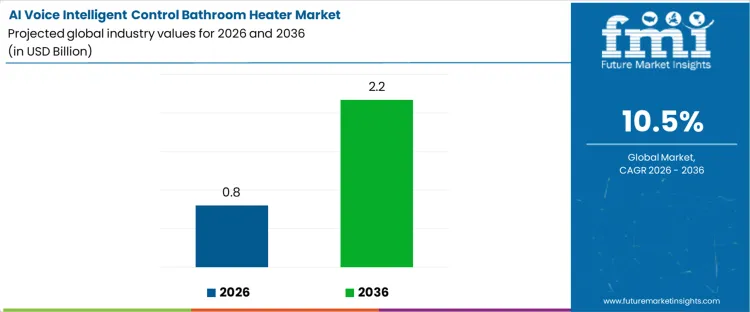
What is the Growth Forecast for AI Voice Intelligent Control Bathroom Heater Market through 2036?
The growth of the AI voice intelligent control bathroom heater market is being driven by a shift in how consumers perceive bathroom appliances, moving from simple comfort devices to integrated parts of the smart home environment. In many households, the bathroom is becoming a daily-use control space where lighting, heating, ventilation, and music are increasingly managed without physical switches. Voice control enters this category not as a novelty, but as a practical interface for wet, hands-busy environments. Product differentiation is therefore moving away from basic heating capacity toward interaction quality, response reliability, and ecosystem compatibility. Once a brand or platform is chosen, entire product lines tend to follow the same control architecture, which creates platform-led volume scaling rather than isolated product sales.
The market’s progression toward USD 2.2 billion by 2036 follows the normalization of voice control as a default interface in mid-range and premium residential equipment. As smart home ecosystems consolidate, bathroom heaters become another node in standardized control networks rather than standalone appliances. This accelerates adoption in renovation projects, new apartments, and mid-to-high specification housing developments where bundled smart packages are specified upfront. Value growth comes from higher feature density and wider inclusion in standard home packages, not from higher heater counts alone. Competitive advantage rests on voice recognition stability, ecosystem integration, and long-term software support, since buyers prioritize reliability and daily usability over marginal differences in heating performance.
AI Voice Intelligent Control Bathroom Heater Market Key Takeaways
| Metric | Value |
|---|---|
| Market Value (2026) | USD 0.8 billion |
| Forecast Value (2036) | USD 2.2 billion |
| Forecast CAGR 2026 to 2036 | 10.5% |
How Is the AI Voice-Enabled Bathroom Heater Market Enhancing User Convenience and Safety?
Bathroom heaters with AI voice control offer hands-free operation and precise temperature management, addressing safety and comfort needs in residential and commercial settings. Traditional manual heaters required physical adjustment, limiting accessibility and precise control, especially in wet environments. Modern AI-integrated solutions combine voice recognition, programmable temperature profiles, and safety mechanisms such as overheat protection and automatic shutoff. Appliance manufacturers, smart home integrators, and facility managers emphasize system reliability, voice responsiveness, and seamless compatibility with home automation platforms. Initial adoption was concentrated in high-end residences, while current deployment extends to hotels, multi-family buildings, and commercial facilities, driven by convenience, safety, and smart ecosystem integration. Sensor accuracy, operational reliability, and compliance with electrical standards influence supplier selection.
Demand for hands-free, energy-efficient heating solutions and user-adaptive operation is shaping market expansion. Compared with conventional heaters, AI voice-controlled models provide automated temperature adjustment, remote accessibility, and integration with smart home controls, reducing user intervention. Cost structures are influenced by AI software integration, sensor precision, and adherence to safety regulations, concentrating margins among suppliers capable of delivering certified, reliable products. Users adopt these heaters to improve comfort, ensure safety, and streamline bathroom heating management. By 2036, AI voice-enabled bathroom heaters are expected to be widely deployed in residential and commercial spaces, supporting intuitive operation, precise temperature control, and enhanced user safety.
What Factors Are Shaping the Demand for AI Voice Intelligent Control Bathroom Heaters Segment wise Analysis by Control Technology and Installation Type in 2026?
The AI voice intelligent control bathroom heater market in 2026 is segmented by control technology and by installation type. By control method, demand is divided into AI voice enabled heaters, app controlled smart heaters, sensor activated intelligent heaters, and remote controlled smart bathroom heaters, each offering different interaction models and levels of automation. By installation type, demand is organized around wall mounted units, ceiling mounted units, portable smart bathroom heaters, and recessed smart heater systems, which differ in space use, installation complexity, and maintenance access. These segments reflect how households balance convenience, safety expectations, and retrofit practicality when upgrading bathroom heating equipment.
Why Do AI Voice Enabled Heaters Represent the Largest Control Technology Segment?
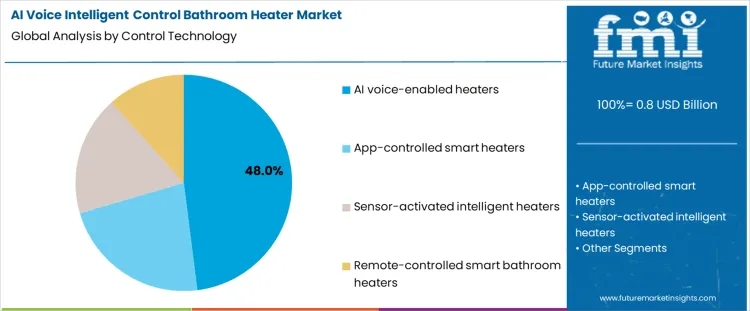
AI voice enabled heaters account for about 48% of demand in 2026, reflecting the appeal of hands free operation in wet and humid environments. Bathrooms limit direct interaction with switches or touchscreens, which makes voice control a practical interface rather than a novelty. Integration with existing smart home ecosystems also encourages adoption, since users can add heater control without learning new apps. Once installed, these systems tend to be used daily, which increases perceived value compared with more basic control methods. Manufacturers also package voice control as a premium feature in mid to high range models, which concentrates sales volume in this category and sustains its leading share.
App based, sensor based, and remote controlled systems serve different usage patterns. App control suits users who prefer scheduled or remote activation, yet it still requires manual interaction. Sensor activated heaters focus on automation, but false triggers and limited user override reduce acceptance in some homes. Remote controlled units offer convenience, though they add another device to manage. These options remain important, but none combines the situational advantage and ecosystem integration that voice control provides in bathroom settings.
Why Do Wall Mounted Units Dominate Installation Demand?
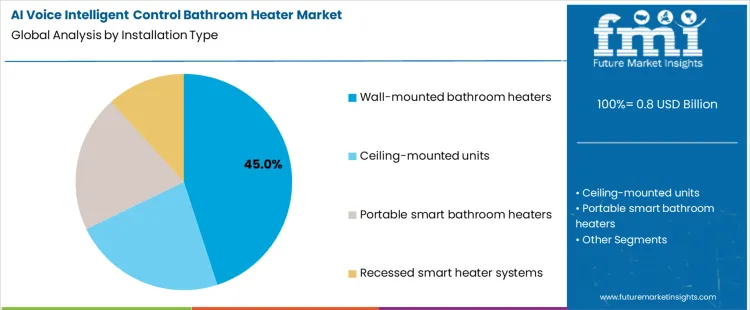
Wall mounted bathroom heaters represent about 45% of demand in 2026 because they fit easily into existing bathroom layouts and renovation practices. Most bathrooms already have wall space allocated for fixtures and ventilation, which makes replacement or upgrade work straightforward. Wall mounting keeps heating elements away from water splash zones while allowing effective air circulation. Installation typically requires less structural modification than ceiling or recessed systems, which reduces labor cost and project time. For property owners and installers, this predictability lowers risk and simplifies planning, which encourages repeat specification of wall mounted formats.
Ceiling mounted, recessed, and portable units address more specific constraints. Ceiling units save wall space but require access above the ceiling and more complex wiring. Recessed systems offer a clean appearance, yet they depend on cavity space and careful waterproofing. Portable heaters serve temporary needs but face safety and storage concerns. These formats grow where design or space limitations demand them, but they do not match the broad retrofit compatibility and ease of installation that keep wall mounted systems as the dominant choice.
How Are the Key Dynamics of Lifecycle Scrutiny, Evidence Gaps, and Performance Guarantees Reshaping the AI Voice Intelligent Control Bathroom Heater Market through 2036?
The category is being shaped less by feature novelty and more by how buyers evaluate risk over time. Voice control and smart functions attract attention, but purchase decisions increasingly hinge on durability, reliability, and total cost of ownership. This creates tension between rising expectations for documented performance and the limited long term field data available for newer integrated systems. At the same time, suppliers see an opening to differentiate through warranties, guarantees, and service commitments that shift risk away from the buyer. The result is a market where trust, proof, and contractual assurance matter as much as design or connectivity, and where adoption speed depends on how convincingly long term performance can be underwritten.
Why Is Increasing Buyer Scrutiny of Lifecycle Performance Driving the AI Voice Intelligent Control Bathroom Heater Market through 2036?
Demand is being pulled by how households and property managers think about replacement cycles and operating cost rather than by voice control features alone. Bathroom heaters are installed in high humidity, high usage environments, where failures quickly become visible and disruptive. Buyers therefore look beyond initial price and ask about service life, energy use, and maintenance exposure. In multi dwelling and rental properties, standardized equipment must survive years of tenant turnover. Once procurement criteria shift toward lifecycle performance, products that can document durability and stable operation gain preference. Volume then follows renovation programs and portfolio upgrades where long term reliability is treated as a core specification, not a marketing extra.
Why Is the Lack of Long Term Performance Data Slowing Wider Adoption?
The main barrier is confidence, not interest. AI controlled heaters combine electronics, sensors, connectivity, and heating elements, all operating in a harsh moisture environment. Many buyers and installers have limited real world evidence on how these systems behave after several years of daily use. Failures in control boards or voice modules can disable the entire unit, not just the smart features. This raises perceived risk compared with simpler, proven heaters. Property managers and contractors are especially cautious because callbacks and replacements erode margins. Without credible long term field data, many projects stay with conventional designs even when smart control features are technically attractive.
How Are Warranties, Guarantees, and Performance Contracts Changing the Structure of Competition?
The opportunity is shifting competition toward risk sharing. Some suppliers are using extended warranties, uptime guarantees, or performance based service terms to overcome buyer hesitation. This reframes the product from a one-time sale into a supported system with defined obligations. For large housing operators and hotels, such contracts simplify budgeting and transfer reliability risk back to the manufacturer. It also favors companies with stronger service networks and balance sheets. Over time, product selection becomes less about feature lists and more about who is willing and able to stand behind long term performance. The market moves toward contract backed propositions rather than purely hardware based differentiation.
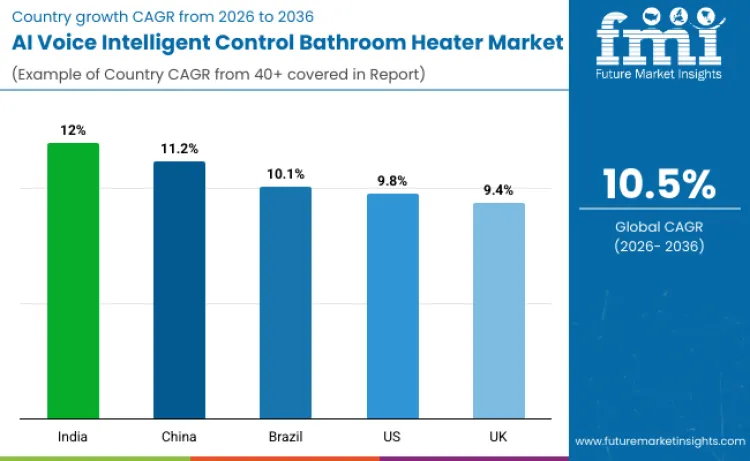
What is the Demand for AI Voice Intelligent Control Bathroom Heaters by Country?
| Country | CAGR (%) |
|---|---|
| USA | 9.8% |
| UK | 9.4% |
| China | 11.2% |
| India | 12.0% |
| Brazil | 10.1% |
Demand for AI voice intelligent control bathroom heaters is rising as consumers and commercial facilities adopt smart heating solutions for convenience, energy efficiency, and precise temperature management. India leads with a 12.0% CAGR, driven by growing adoption of connected home appliances and increasing preference for smart comfort solutions. China follows at 11.2%, supported by residential and commercial adoption of intelligent heating systems. Brazil records 10.1% growth, shaped by rising consumer awareness and integration of voice-controlled devices. The US grows at 9.8%, influenced by smart home upgrades and replacement of conventional heaters. The UK shows 9.4% CAGR, reflecting steady adoption of voice-enabled bathroom heating solutions in residential and commercial properties.
How is the United States experiencing growth in the AI voice intelligent control bathroom heater market?
United States is experiencing growth at a CAGR of 9.8%, driven by premium residential and smart home demand in California, Texas, and New York. Margin pressure and cost optimization focus encourage adoption of efficient, durable AI-controlled heaters that reduce energy use and maintenance. Exposure to export markets and global supply cycles affects component availability and pricing. Currency risk and import cost sensitivity influence procurement of specialized electronic modules. Financing availability and credit conditions support adoption by homeowners and developers, while business confidence encourages investments in modern, connected heating solutions. Sensitivity to downtime emphasizes the importance of reliable, low-maintenance systems.
- Premium residential and smart homes drive adoption.
- Systems enhance energy efficiency and minimize maintenance.
- Component sourcing is sensitive to import costs and global cycles.
- Reliability and low downtime guide investment decisions.
How is the United Kingdom witnessing growth in the AI voice intelligent control bathroom heater market?
United Kingdom is witnessing growth at a CAGR of 9.4%, supported by increasing smart apartment installations in London, Birmingham, and Manchester. Margin pressure and cost optimization shape preferences for energy-efficient and durable AI-enabled heaters. Exposure to European export cycles affects supply of high-performance components. Currency fluctuations and import cost sensitivity influence pricing for imported modules. Financing availability and credit conditions facilitate adoption in both commercial and residential projects. Business confidence in urban infrastructure modernization encourages investment, while operational risk concerns drive demand for systems with low downtime and high reliability.
- Urban smart apartments drive adoption.
- Energy-efficient AI systems optimize operational costs.
- European supply exposure affects component pricing.
- Low downtime and reliability are critical for buyers.
How is China experiencing growth in the AI voice intelligent control bathroom heater market?
China is experiencing growth at a CAGR of 11.2%, fueled by expanding residential and commercial smart building projects in Shanghai, Beijing, and Guangzhou. Margin pressure and cost optimization focus drives local manufacturers to produce efficient, low-maintenance AI heaters. Exposure to global supply chains and export cycles affects production planning and availability of specialized components. Currency risk and import cost sensitivity influence premium product pricing. Financing availability and credit conditions enable developers to integrate advanced systems, while high business confidence supports large-scale urban deployments. Operational risk sensitivity encourages adoption of reliable and resilient AI-enabled heating solutions.
- Residential and commercial smart buildings drive adoption.
- Systems optimize efficiency and maintenance costs.
- Global supply exposure influences component availability.
- Operational reliability reduces downtime risk.
How is India witnessing growth in the AI voice intelligent control bathroom heater market?
India is witnessing growth at a CAGR of 12%, driven by rapid smart home and apartment expansions in Mumbai, Bengaluru, and Delhi. Margin pressure and cost optimization focus encourages deployment of durable, energy-efficient AI heaters suitable for large-scale residential projects. Exposure to global component supply chains and fluctuating import costs affects procurement strategies. Currency risk and import cost sensitivity influence pricing for high-end systems. Financing availability and credit conditions allow developers and homeowners to adopt AI-enabled solutions. Business confidence in urban infrastructure growth and sensitivity to downtime drive preference for reliable and low-maintenance systems.
- Smart home and apartment growth drives adoption.
- Energy-efficient AI systems optimize costs and reliability.
- Import cost sensitivity influences procurement.
- Downtime minimization guides product selection.
How is Brazil experiencing growth in the AI voice intelligent control bathroom heater market?
Brazil is experiencing growth at a CAGR of 10.1%, supported by residential, commercial, and hospitality projects in São Paulo, Rio de Janeiro, and Paraná. Margin pressure and cost optimization focus encourages selection of energy-efficient, long-lasting AI heaters. Exposure to international supply chains and global market cycles affects component sourcing and pricing. Currency fluctuations and import cost sensitivity influence system cost, while financing availability and credit conditions shape adoption in commercial projects. Business confidence supports investment in modern heating solutions, and sensitivity to operational risk drives preference for reliable, low-maintenance AI systems in urban and industrial properties.
- Residential, commercial, and hospitality projects drive adoption.
- Energy-efficient AI systems enhance reliability and cost control.
- Global supply and import costs influence procurement.
- Operational risk sensitivity prioritizes durable systems.
Who Are the Key Competitors in the AI Voice Intelligent Control Bathroom Heater Market and How Do They Compete?
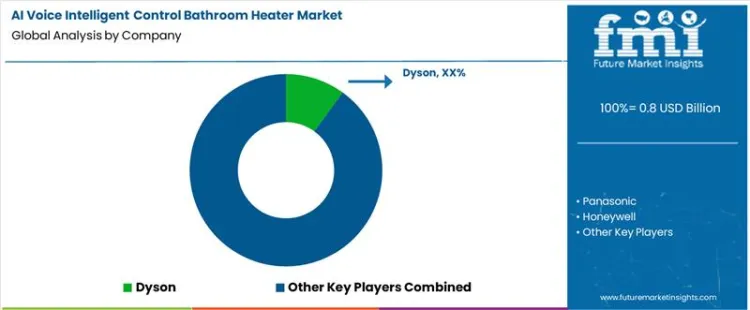
Competition in the AI voice intelligent control bathroom heater market is shaped by integration of voice enabled interfaces, heating efficiency, and user safety features. Dyson supplies heaters with adaptive airflow systems and advanced voice compatibility that adjust warmth based on user commands and environmental feedback. Panasonic offers bathroom heaters with built in voice assistant support and moisture resistant designs tailored for humid environments. Honeywell provides smart heating units that integrate with home automation platforms and respond to AI driven voice inputs for temperature control and scheduling. Bosch Thermotechnology delivers intelligent bathroom heaters with robust safety systems and connectivity to broader smart home controls. Stiebel Eltron supplies compact, efficient heaters engineered for rapid warmth with optional voice integration.
Mitsubishi Electric develops bathroom heaters that combine precise temperature control with voice command interfaces compatible with home networks. Orient Electric offers cost effective smart heaters with voice control support and safety features such as automatic shut off. Other regional and specialty suppliers provide units focused on ease of installation, energy saving modes, and compatibility with popular voice ecosystems. Competitive differentiation arises from effectiveness of voice recognition, heating performance, moisture resistance, integration with existing smart home systems, and compliance with bathroom safety standards. Suppliers that balance reliable heating, intuitive voice control, and robust safety positioning resonate with consumers seeking hands free operation and consistent warmth without compromising user protection. Market relevance is shaped by consumer preference for convenience, energy efficiency, and interoperability with voice assistants across diverse smart home environments.
Key Players in the AI Voice Intelligent Control Bathroom Heater Market
- Dyson
- Panasonic
- Honeywell
- Bosch Thermotechnology
- Stiebel Eltron
- Mitsubishi Electric
- Orient Electric
Scope of the Report
| Items | Values |
|---|---|
| Quantitative Units (2026) | USD billion |
| Control Technology | AI Voice-Enabled Heaters, App-Controlled Smart Heaters, Sensor-Activated Intelligent Heaters, Remote-Controlled Smart Bathroom Heaters |
| Installation Type | Wall-Mounted Bathroom Heaters, Ceiling-Mounted Units, Portable Smart Bathroom Heaters, Recessed Smart Heater Systems |
| Regions Covered | Asia Pacific, Europe, North America, Latin America, Middle East & Africa |
| Countries Covered | China, Japan, South Korea, India, Australia & New Zealand, ASEAN, Germany, United Kingdom, France, Italy, Spain, Nordic, BENELUX, United States, Canada, Mexico, Brazil, Chile, Saudi Arabia, Turkey, South Africa, and other regional markets |
| Key Companies Profiled | Dyson, Panasonic, Honeywell, Bosch Thermotechnology, Stiebel Eltron, Mitsubishi Electric, Orient Electric |
| Additional Attributes | Dollar sales by control technology and installation type; AI voice-enabled heaters as the leading segment; wall-mounted units as the dominant format; demand driven by smart home adoption and renovation cycles; procurement shaped by safety certification, installer familiarity, and lifecycle reliability; adoption constrained by limited long-term field data, moisture exposure risk, and buyer scrutiny of warranties and performance guarantees. |
AI Voice Intelligent Control Bathroom Heater Market Segmentation
Control Technology:
- AI voice-enabled heaters
- App-controlled smart heaters
- Sensor-activated intelligent heaters
- Remote-controlled smart bathroom heaters
Installation Type:
- Wall-mounted bathroom heaters
- Ceiling-mounted units
- Portable smart bathroom heaters
- Recessed smart heater systems
Region
Asia Pacific
- China
- Japan
- South Korea
- India
- Australia & New Zealand
- ASEAN
- Rest of Asia Pacific
Europe
- Germany
- United Kingdom
- France
- Italy
- Spain
- Nordic
- BENELUX
- Rest of Europe
North America
- United States
- Canada
- Mexico
Latin America
- Brazil
- Chile
- Rest of Latin America
Middle East & Africa
- Kingdom of Saudi Arabia
- Other GCC Countries
- Turkey
- South Africa
- Other African Union
- Rest of Middle East & Africa
Bibliography
- National Institute of Standards and Technology. (2023). Smart home and consumer IoT cybersecurity and interoperability framework. U.S. Department of Commerce.
- European Commission. (2024). Ecodesign and energy labelling for space heaters and household electric heating appliances: Consolidated guidance. Publications Office of the European Union.
- European Commission, Joint Research Centre. (2023). Digitalization of home appliances and smart home ecosystems. Publications Office of the European Union.
Frequently Asked Questions
How big is the ai voice intelligent control bathroom heater market in 2026?
The global ai voice intelligent control bathroom heater market is estimated to be valued at USD 0.8 billion in 2026.
What will be the size of ai voice intelligent control bathroom heater market in 2036?
The market size for the ai voice intelligent control bathroom heater market is projected to reach USD 2.2 billion by 2036.
How much will be the ai voice intelligent control bathroom heater market growth between 2026 and 2036?
The ai voice intelligent control bathroom heater market is expected to grow at a 10.5% CAGR between 2026 and 2036.
What are the key product types in the ai voice intelligent control bathroom heater market?
The key product types in ai voice intelligent control bathroom heater market are ai voice‑enabled heaters , app‑controlled smart heaters, sensor‑activated intelligent heaters and remote‑controlled smart bathroom heaters.
Which installation type segment to contribute significant share in the ai voice intelligent control bathroom heater market in 2026?
In terms of installation type, wall‑mounted bathroom heaters segment to command 45.0% share in the ai voice intelligent control bathroom heater market in 2026.
Preview the report firsthand - request a free sample
Get SampleGet the brochure for pricing and purchase details.
Get PDFTable of Content
- Executive Summary
- Global Market Outlook
- Demand-side Trends
- Supply-side Trends
- Technology Roadmap Analysis
- Analysis and Recommendations
- Market Overview
- Market Coverage / Taxonomy
- Market Definition / Scope / Limitations
- Market Background
- Market Dynamics
- Drivers
- Restraints
- Opportunity
- Trends
- Scenario Forecast
- Demand in Optimistic Scenario
- Demand in Likely Scenario
- Demand in Conservative Scenario
- Opportunity Map Analysis
- Product Life Cycle Analysis
- Supply Chain Analysis
- Investment Feasibility Matrix
- Value Chain Analysis
- PESTLE and Porter’s Analysis
- Regulatory Landscape
- Regional Parent Market Outlook
- Production and Consumption Statistics
- Import and Export Statistics
- Market Dynamics
- Global Market Analysis 2021 to 2025 and Forecast, 2026 to 2036
- Historical Market Size Value (USD Million) Analysis, 2021 to 2025
- Current and Future Market Size Value (USD Million) Projections, 2026 to 2036
- Y-o-Y Growth Trend Analysis
- Absolute $ Opportunity Analysis
- Global Market Pricing Analysis 2021 to 2025 and Forecast 2026 to 2036
- Global Market Analysis 2021 to 2025 and Forecast 2026 to 2036, By Control Technology
- Introduction / Key Findings
- Historical Market Size Value (USD Million) Analysis By Control Technology, 2021 to 2025
- Current and Future Market Size Value (USD Million) Analysis and Forecast By Control Technology, 2026 to 2036
- AI voice‑enabled heaters
- App‑controlled smart heaters
- Sensor‑activated intelligent heaters
- Remote‑controlled smart bathroom heaters
- AI voice‑enabled heaters
- Y-o-Y Growth Trend Analysis By Control Technology, 2021 to 2025
- Absolute $ Opportunity Analysis By Control Technology, 2026 to 2036
- Global Market Analysis 2021 to 2025 and Forecast 2026 to 2036, By Installation Type
- Introduction / Key Findings
- Historical Market Size Value (USD Million) Analysis By Installation Type, 2021 to 2025
- Current and Future Market Size Value (USD Million) Analysis and Forecast By Installation Type, 2026 to 2036
- Wall‑mounted bathroom heaters
- Ceiling‑mounted units
- Portable smart bathroom heaters
- Recessed smart heater systems
- Wall‑mounted bathroom heaters
- Y-o-Y Growth Trend Analysis By Installation Type, 2021 to 2025
- Absolute $ Opportunity Analysis By Installation Type, 2026 to 2036
- Global Market Analysis 2021 to 2025 and Forecast 2026 to 2036, By Region
- Introduction
- Historical Market Size Value (USD Million) Analysis By Region, 2021 to 2025
- Current Market Size Value (USD Million) Analysis and Forecast By Region, 2026 to 2036
- North America
- Latin America
- Western Europe
- Eastern Europe
- East Asia
- South Asia and Pacific
- Middle East & Africa
- Market Attractiveness Analysis By Region
- North America Market Analysis 2021 to 2025 and Forecast 2026 to 2036, By Country
- Historical Market Size Value (USD Million) Trend Analysis By Market Taxonomy, 2021 to 2025
- Market Size Value (USD Million) Forecast By Market Taxonomy, 2026 to 2036
- By Country
- USA
- Canada
- Mexico
- By Control Technology
- By Installation Type
- By Country
- Market Attractiveness Analysis
- By Country
- By Control Technology
- By Installation Type
- Key Takeaways
- Latin America Market Analysis 2021 to 2025 and Forecast 2026 to 2036, By Country
- Historical Market Size Value (USD Million) Trend Analysis By Market Taxonomy, 2021 to 2025
- Market Size Value (USD Million) Forecast By Market Taxonomy, 2026 to 2036
- By Country
- Brazil
- Chile
- Rest of Latin America
- By Control Technology
- By Installation Type
- By Country
- Market Attractiveness Analysis
- By Country
- By Control Technology
- By Installation Type
- Key Takeaways
- Western Europe Market Analysis 2021 to 2025 and Forecast 2026 to 2036, By Country
- Historical Market Size Value (USD Million) Trend Analysis By Market Taxonomy, 2021 to 2025
- Market Size Value (USD Million) Forecast By Market Taxonomy, 2026 to 2036
- By Country
- Germany
- UK
- Italy
- Spain
- France
- Nordic
- BENELUX
- Rest of Western Europe
- By Control Technology
- By Installation Type
- By Country
- Market Attractiveness Analysis
- By Country
- By Control Technology
- By Installation Type
- Key Takeaways
- Eastern Europe Market Analysis 2021 to 2025 and Forecast 2026 to 2036, By Country
- Historical Market Size Value (USD Million) Trend Analysis By Market Taxonomy, 2021 to 2025
- Market Size Value (USD Million) Forecast By Market Taxonomy, 2026 to 2036
- By Country
- Russia
- Poland
- Hungary
- Balkan & Baltic
- Rest of Eastern Europe
- By Control Technology
- By Installation Type
- By Country
- Market Attractiveness Analysis
- By Country
- By Control Technology
- By Installation Type
- Key Takeaways
- East Asia Market Analysis 2021 to 2025 and Forecast 2026 to 2036, By Country
- Historical Market Size Value (USD Million) Trend Analysis By Market Taxonomy, 2021 to 2025
- Market Size Value (USD Million) Forecast By Market Taxonomy, 2026 to 2036
- By Country
- China
- Japan
- South Korea
- By Control Technology
- By Installation Type
- By Country
- Market Attractiveness Analysis
- By Country
- By Control Technology
- By Installation Type
- Key Takeaways
- South Asia and Pacific Market Analysis 2021 to 2025 and Forecast 2026 to 2036, By Country
- Historical Market Size Value (USD Million) Trend Analysis By Market Taxonomy, 2021 to 2025
- Market Size Value (USD Million) Forecast By Market Taxonomy, 2026 to 2036
- By Country
- India
- ASEAN
- Australia & New Zealand
- Rest of South Asia and Pacific
- By Control Technology
- By Installation Type
- By Country
- Market Attractiveness Analysis
- By Country
- By Control Technology
- By Installation Type
- Key Takeaways
- Middle East & Africa Market Analysis 2021 to 2025 and Forecast 2026 to 2036, By Country
- Historical Market Size Value (USD Million) Trend Analysis By Market Taxonomy, 2021 to 2025
- Market Size Value (USD Million) Forecast By Market Taxonomy, 2026 to 2036
- By Country
- Kingdom of Saudi Arabia
- Other GCC Countries
- Turkiye
- South Africa
- Other African Union
- Rest of Middle East & Africa
- By Control Technology
- By Installation Type
- By Country
- Market Attractiveness Analysis
- By Country
- By Control Technology
- By Installation Type
- Key Takeaways
- Key Countries Market Analysis
- USA
- Pricing Analysis
- Market Share Analysis, 2025
- By Control Technology
- By Installation Type
- Canada
- Pricing Analysis
- Market Share Analysis, 2025
- By Control Technology
- By Installation Type
- Mexico
- Pricing Analysis
- Market Share Analysis, 2025
- By Control Technology
- By Installation Type
- Brazil
- Pricing Analysis
- Market Share Analysis, 2025
- By Control Technology
- By Installation Type
- Chile
- Pricing Analysis
- Market Share Analysis, 2025
- By Control Technology
- By Installation Type
- Germany
- Pricing Analysis
- Market Share Analysis, 2025
- By Control Technology
- By Installation Type
- UK
- Pricing Analysis
- Market Share Analysis, 2025
- By Control Technology
- By Installation Type
- Italy
- Pricing Analysis
- Market Share Analysis, 2025
- By Control Technology
- By Installation Type
- Spain
- Pricing Analysis
- Market Share Analysis, 2025
- By Control Technology
- By Installation Type
- France
- Pricing Analysis
- Market Share Analysis, 2025
- By Control Technology
- By Installation Type
- India
- Pricing Analysis
- Market Share Analysis, 2025
- By Control Technology
- By Installation Type
- ASEAN
- Pricing Analysis
- Market Share Analysis, 2025
- By Control Technology
- By Installation Type
- Australia & New Zealand
- Pricing Analysis
- Market Share Analysis, 2025
- By Control Technology
- By Installation Type
- China
- Pricing Analysis
- Market Share Analysis, 2025
- By Control Technology
- By Installation Type
- Japan
- Pricing Analysis
- Market Share Analysis, 2025
- By Control Technology
- By Installation Type
- South Korea
- Pricing Analysis
- Market Share Analysis, 2025
- By Control Technology
- By Installation Type
- Russia
- Pricing Analysis
- Market Share Analysis, 2025
- By Control Technology
- By Installation Type
- Poland
- Pricing Analysis
- Market Share Analysis, 2025
- By Control Technology
- By Installation Type
- Hungary
- Pricing Analysis
- Market Share Analysis, 2025
- By Control Technology
- By Installation Type
- Kingdom of Saudi Arabia
- Pricing Analysis
- Market Share Analysis, 2025
- By Control Technology
- By Installation Type
- Turkiye
- Pricing Analysis
- Market Share Analysis, 2025
- By Control Technology
- By Installation Type
- South Africa
- Pricing Analysis
- Market Share Analysis, 2025
- By Control Technology
- By Installation Type
- USA
- Market Structure Analysis
- Competition Dashboard
- Competition Benchmarking
- Market Share Analysis of Top Players
- By Regional
- By Control Technology
- By Installation Type
- Competition Analysis
- Competition Deep Dive
- Competition Deep Dive
- Assumptions & Acronyms Used
- Research Methodology


