

- Industry Size (2026)
- USD 5.3 Bn
- Forecast (2036)
- USD 12.8 Bn
- CAGR (2026 to 2036)
- 9.3%
Voice-Activated Smart Home Cleaning Robots Market Size, Market Forecast and Outlook By FMI
The voice-activated smart home cleaning robots market was valued at USD 4.8 billion in 2025. The industry is set to reach USD 5.3 billion in 2026 at a CAGR of 9.3% during the forecast period. Constant investments by major companies propels the valuation to USD 12.8 billion through 2036 as devices shift from isolated appliances to integrated network nodes, aligning with the voice-activated smart home cleaning robots market forecast.
Consumer purchasing criteria have evolved. Hardware is no longer evaluated strictly on suction power or pathfinding algorithms. Current decision-making centers on how seamlessly a voice-assistant-compatible robot vacuum accepts commands from existing smart speakers, without the need for localized smartphone applications or complex bridge networks. Manufacturers that continue to rely on proprietary communication layers face immediate market resistance from buyers who are unwilling to fragment their daily operational routines. Consequently, operations teams across the sector are sourcing secure microcontrollers capable of track and trace solutions to authenticate device endpoints within these unified ecosystems. Hardware lacking this interoperability rapidly loses retail viability.
Summary of Voice-Activated Smart Home Cleaning Robots Market
- Voice-Activated Smart Home Cleaning Robots Market Definition
- This category tracks autonomous domestic cleaning hardware built explicitly for acoustic command execution. The boundary separates native voice-integrated network nodes from legacy robotic appliances that rely on physical or application-based initiation protocols.
- Demand Drivers in the Market
- Ecosystem unification requirements force consumer electronics buyers to prioritize interoperable hardware over standalone proprietary systems.
- Edge processing capabilities compel semiconductor engineers to compress natural language recognition modules for local hardware deployment, advancing autonomous cleaning robots technology.
- Supply chain traceability mandates push robot cleaning device manufacturers to integrate verifiable component histories, mirroring protocols seen in track and trace packaging.
- Key Segments Analyzed in the FMI Report
- Robotic Vacuum Cleaners: Robotic Vacuum Cleaners is expected to grab 63.5% share in 2026, as dry suction mechanics pair seamlessly with existing navigational algorithms without the fluid payload complexities of mopping units.
- Amazon Alexa Integration: Amazon Alexa Integration is expected to record 46.2% share in 2026, benefiting from the massive installed base of existing Echo network hubs deployed globally.
- Online Retail: Online Retail accounts for 58.1% share in 2026, driven by direct consumer research behaviors and the ability to bundle devices with other smart home node purchases.
- Residential Households: Residential Households command 88.4% share in 2026, as consumer ecosystems scale faster than commercial equivalent architectures.
- India: 11.6% compound growth, reflecting a rapid middle-class transition straight to voice-activated smart home cleaning robots market integration.
- Analyst Opinion at FMI
- Rahul Pandita, Principal Analyst, Technology, at FMI, stated, "The generalist assumption places the adoption bottleneck at cleaning performance. However, actual procurement patterns reveal that buyers will routinely abandon superior vacuum hardware if it fails to sync natively with their preferred voice ecosystem. Hardware companies fighting to keep users inside proprietary apps are misjudging the market entirely: consumers view the robot as a peripheral to the smart speaker, not the other way around."
- Strategic Implications / Executive Takeaways
- Hardware product managers must abandon proprietary voice assistant investments and certify cross-platform compatibility prior to launch.
- Channel marketing directors should bundle robotic units with smart speakers to lower the ecosystem entry barrier for first-time buyers evaluating a robot vacuum vs traditional vacuum.
- Firmware architects face intense pressure to shift command processing from cloud servers to local edge chips to reduce latency, shaping future smart home cleaning technology.
- Methodology
- FMI engaged directly with smart home ecosystem architects and consumer electronics category managers. The baseline anchors to global service robot shipment volumes cross-referenced with regional smart speaker penetration rates. Projections were triangulated using international trade commission electronics logs.
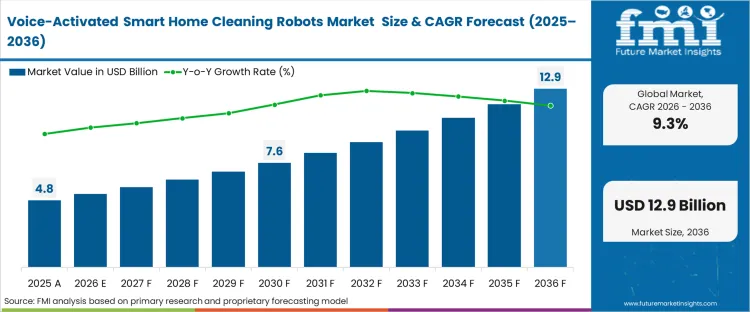
The strategic transition toward edge-based natural language processing removes a primary barrier to mass adoption. Integrating voice logic directly into the physical chassis eliminates cloud latency, allowing localized commands to execute even during external connectivity disruptions. Additionally, facilities are offsetting their carbon footprints by deploying sustainable processes analogous to carbon dioxide synthesis cosmetics within their plastic molding supply chains. This appeals to a demographic that prioritizes ecological transparency alongside technical autonomy, thereby further stimulating voice-activated smart home cleaning robots market growth.
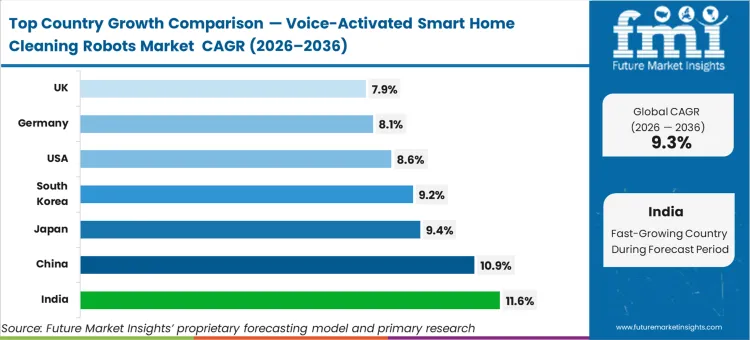
India is poised to expand at 11.6%, followed by China at 10.9%, Japan tracking at 9.4%, and South Korea registering 9.2%. The United States is estimated to garner 8.6%, while Germany records 8.1% and the United Kingdom follows at 7.9%. The divergence between the Asian expansion and Western maturity reflects fundamentally different starting points: tier-1 cities across Asia are leapfrogging basic automated cleaners entirely, driving robust voice-activated smart home cleaning robots demand forecast numbers as they adopt voice-first ecosystem models in a single purchasing cycle rather than transitioning sequentially through app-based intermediates.
Voice-Activated Smart Home Cleaning Robots Market Key Takeaways
| Metric | Details |
|---|---|
| Industry Size (2026) | USD 5.3 billion |
| Industry Value (2036) | USD 12.8 billion |
| CAGR (2026-2036) | 9.3% |
Source: Future Market Insights (FMI) analysis, based on proprietary forecasting model and primary research
Voice-Activated Smart Home Cleaning Robots Market Definition
The category encompasses autonomous floorcare and pool maintenance devices engineered with native hardware and software layers designed specifically for ambient voice command execution, shaping the future of smart cleaning robots. The functional boundary excludes appliances requiring physical button actuation, secondary remote controls, or mandatory smartphone application bridging as the primary initiation method. Qualifying units must process external natural language commands directly or through established smart home network hubs.
Voice-Activated Smart Home Cleaning Robots Market Inclusions
Scope incorporates autonomous dry vacuums, wet mopping robots, hybrid floorcare units, and robotic pool cleaners featuring integrated acoustic sensors or certified interoperability firmware for ambient voice networks, expanding voice-activated smart home cleaning robots market applications. Component validation processes increasingly rely on blockchain technology to secure local command processing and user mapping data against external interception. Subscriptions for advanced navigation algorithms bundled with the initial hardware purchase fall within the designated tracking parameters.
Voice-Activated Smart Home Cleaning Robots Market Exclusions
The analysis specifically excludes manual vacuum cleaners equipped with digital voice alerts, stationary smart home speakers, and commercial ride-on scrubbers. Traditional remote-controlled robots lacking ambient voice integration fail to meet the functional criteria. The valuation also omits external retail boxing applications, a distinction shared with analysts tracking cosmetic packaging, focusing strictly on the functional hardware and integral software value of the robotic unit itself.
Voice-Activated Smart Home Cleaning Robots Market Research Methodology
- Primary Research: FMI conducted interviews with consumer electronics category managers, robot vacuum suppliers, and product procurement directors at leading global appliance retailers to assess voice-activated smart home cleaning robots market analysis.
- Desk Research: Analysts aggregated connected device shipment registries, global robotics association import databases, and standard operating protocols for home automation networks to monitor the robot vacuum adoption rate by country.
- Market-Sizing and Forecasting: The baseline anchors to global service robot shipment volumes cross-referenced with regional smart speaker household penetration rates.
- Data Validation and Update Cycle: Initial unit assumptions were validated against average selling price proxy data extracted from international trade commission electronics logs, ensuring accurate voice-activated smart home cleaning robots market segmentation.
Segmental Analysis
Voice-Activated Smart Home Cleaning Robots Market Analysis by Product Type
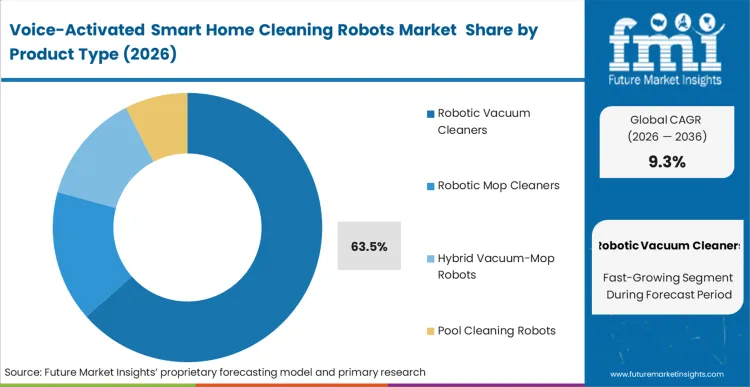
The factor driving dominance of the robotic vacuum cleaners is engineering advantages over fluid-based alternatives. This segment holds 63.5% share of this market. Dry suction systems rely on highly mature pathfinding algorithms and require fewer mechanical redundancies than mops or hybrid units. Water management introduces payload complexities, pump failures, and base-station drainage requirements that frustrate hands-free operational goals. According to FMI's estimates, buyers specifying voice-activated units prioritize absolute autonomy when evaluating robot vacuum alternatives. A robot that requires manual water tank refills defeats the purpose of acoustic initiation. Device manufacturers protect unit integrity against third-party accessories using authentication and brand protection protocols on replacement filters and brushes. When hardware operates entirely without physical intervention, the baseline requirement for reliable dry debris removal dictates segment dominance over more complex, high-maintenance formats.
- Hardware complexity: Vacuum mechanisms avoid fluid management systems. Buyers experience fewer mechanical interruptions during scheduled cleaning cycles.
- Payload limitations: Dry collection bins allow for larger battery capacities. Facilities maintain longer continuous runtime without base-station returns, addressing common robot vacuum battery life problems.
- Ecosystem reliability: Standard pathfinding protocols map dry environments efficiently. Operators execute multi-room commands without risking liquid damage to specific floor types.
Voice-Activated Smart Home Cleaning Robots Market Analysis by Voice Assistant Integration
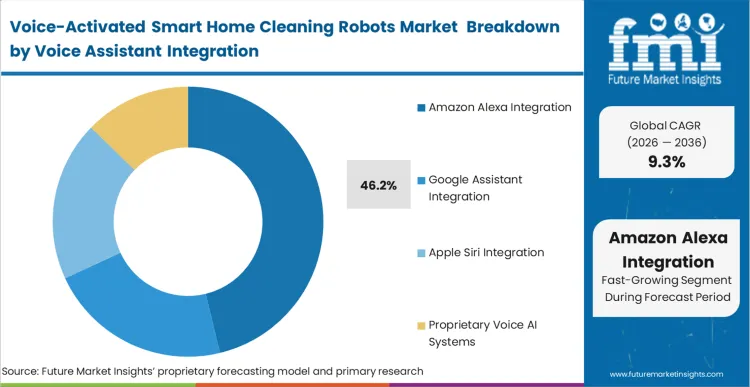
Consumers are currently choosing whether to introduce a new command logic or leverage existing network infrastructure. Amazon Alexa integration commands 46.2% share as it removes the requirement for users to learn secondary syntax structures or install bridging hardware. The massive installed base of Echo devices acts as a Trojan horse, allowing consumers to simply add floorcare peripheral nodes to a pre-configured environment. Based on FMI's assessment, proprietary voice systems attempted by hardware manufacturers consistently fail because they isolate the appliance from the broader home network, an important factor in the voice-activated smart home cleaning robots market. Companies are utilizing anti-counterfeit NFC packaging architectures internally to verify certified integration modules during assembly. Buyers experimenting with closed-loop voice systems invariably return to major ecosystem architectures, realizing that fragmented command structures create more friction than manual operation.
- Onboarding friction: Pre-existing Alexa environments bypass network configuration steps. Users initiate complex routines immediately upon device power-up.
- Interoperability costs: Closed ecosystems require separate hub hardware investments. Households delay purchases when forced to duplicate ambient listening infrastructure.
- Lifecycle valuation: Open integration modules retain utility across multiple home upgrades. Procurement directors specify certified interoperability to prevent hardware obsolescence when searching for the best smart cleaning robots 2026.
Voice-Activated Smart Home Cleaning Robots Market Analysis by Distribution Channel
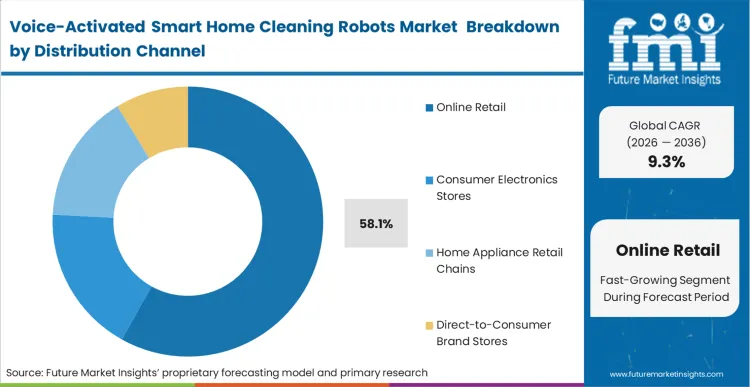
Online retail accounts for 58.1% of share, indicating that technical specifications increasingly outweigh physical hardware demonstrations. Consumers evaluate these robots based on software integration capabilities, mapping precision reviews, and ecosystem compatibility matrices rather than physical aesthetics or tactile material assessments. In FMI's view, physical storefronts struggle to simulate functional smart home environments, making online platforms the superior option for evaluating ambient network capabilities and tracking robot vacuum price trends. Lifecycle tracking platforms utilizing digital product passports provide online buyers with transparent component sourcing and repairability metrics before purchase. Digital channels also allow algorithm-driven bundling, pairing uncertified hardware with required network hubs to seamlessly complete the consumer's ecosystem architecture in a single transaction.
- Demonstration limits: Physical stores fail to replicate functional home network latency. Consumers rely on digital video assessments to verify voice command responsiveness.
- Inventory consolidation: Regional warehouses stock the full range of ecosystem variants. Retail buyers avoid stock-outs common in localized storefront environments.
- Specification parity: Digital comparison matrices clarify exact integration protocols. First-time adopters confidently match hardware sub-models to their specific smart speaker versions using a robust robot vacuum technology comparison.
Voice-Activated Smart Home Cleaning Robots Market Analysis by End User
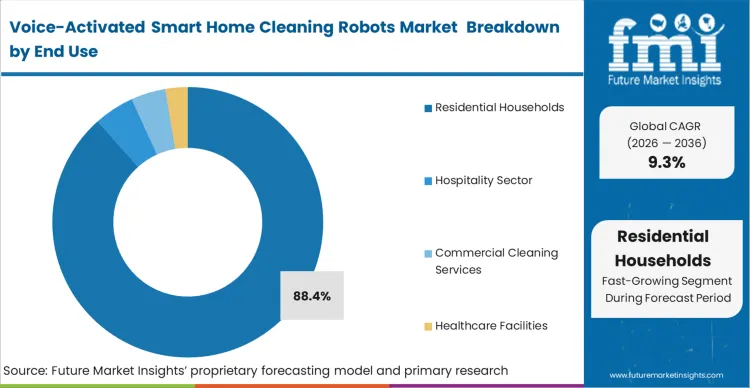
Adoption of voice-initiated hardware is lower in commercial settings, leaving residential households to command 88.4% of the volume. High-traffic hospitality and healthcare facilities operate on rigid, liability-driven cleaning schedules that cannot tolerate the unpredictable initiation vectors of ambient voice commands, limiting the cleaning robots hospitality industry segment. In contrast, residential settings thrive on ad-hoc, localized interventions triggered by immediate observation. FMI analysts opine that household consumers treat the robot as a responsive appliance rather than a scheduled utility, elevating the appeal of a robot vacuum for smart homes. Residential manufacturers focus heavily on quiet operation and aesthetic integration, validating their low-impact materials through sustainable claims substantiation frameworks. As commercial sectors demand predictable, app-scheduled fleets, the voice-activation mechanism remains almost exclusively tool for household convenience and localized spot-cleaning.
- Ad-hoc initiation: Households require immediate response for localized spills. Residents bypass applications to deploy hardware using ambient acoustic commands, a primary driver for AI robots in household cleaning.
- Acoustic interference: Commercial spaces suffer from high background noise profiles. Facilities cannot guarantee accurate natural language processing across crowded environments.
- Security protocols: Enterprise networks restrict ambient listening devices. IT directors disqualify voice-active hardware to prevent unauthorized acoustic data transmission.
Voice-Activated Smart Home Cleaning Robots Market Drivers, Restraints, and Opportunities
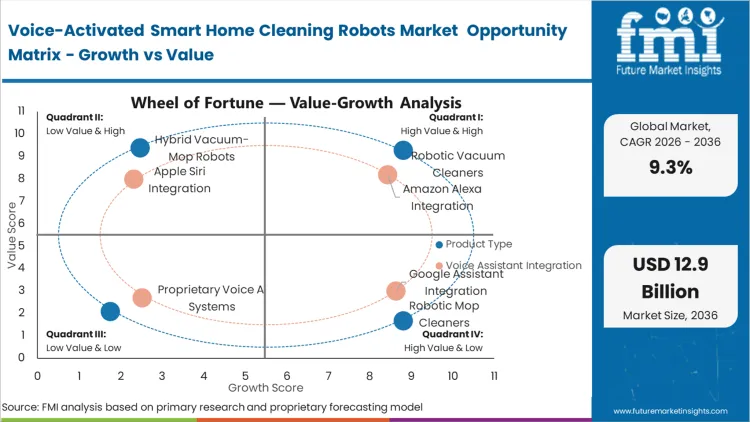
The shift toward unified smart home protocols forces consumer electronics category managers to disqualify proprietary hardware. Buyers refuse to operate separate applications for lighting, security, and floorcare. This network consolidation requires appliance manufacturers to surrender interface control to major ecosystem providers, accelerating the voice-activated smart home cleaning robots market growth. Hardware that cannot natively accept universal commands from existing smart speakers loses its position on approved vendor lists, forcing brands to pivot their R&D away from standalone apps and entirely toward certified integration modules.
Network interoperability barriers stall adoption for households operating mixed smart speaker environments. When a consumer uses both Siri and Alexa interfaces across different rooms, hardware often struggles to parse conflicting authorization protocols, representing one of the core robot vacuum maintenance issues. This friction is structural, rooted in the competing security architectures of the major tech ecosystems rather than the robotic unit itself. While manufacturers attempt to bridge these divides through universal standards like Matter, legacy hardware compatibility remains a severe limiting factor.
Opportunities in the Voice-Activated Smart Home Cleaning Robots Market
- Edge-processing deployment: Cloud latency frustrates immediate command execution. Silicon architects who embed local natural language processing chips directly onto the robot eliminate network delays, driving robot vacuum innovation trends.
- Material reclamation strategies: Sustainable manufacturing requirements penalize virgin plastic usage. Operations managers sourcing reclaimed polymers mirror supply chain tactics seen in upcycled cosmetic ingredients to lower production footprints.
- Acoustic mapping integration: Visual cameras raise severe privacy objections. Firmware developers who utilize existing microphone arrays for spatial echolocation rather than optical tracking bypass consumer surveillance concerns entirely, delivering next generation cleaning robots.
Regional Analysis
Based on the regional analysis, the voice-activated smart home cleaning robots market is segmented into North America, Europe, Asia Pacific, and other regions across 40 plus countries.
.webp "Top Country Growth Comparison Voice Activated Smart Home Cleaning Robots Market Cagr (2026 2036)")
| Country | CAGR (2026 to 2036) |
|---|---|
| India | 11.6% |
| China | 10.9% |
| Japan | 9.4% |
| South Korea | 9.2% |
| United States | 8.6% |
| Germany | 8.1% |
| United Kingdom | 7.9% |
Source: Future Market Insights (FMI) analysis, based on proprietary forecasting model and primary research
North America Voice-Activated Smart Home Cleaning Robots Market Analysis
Federal privacy frameworks and network security standards dictate the adoption timeline across North American households. The emphasis on data localization compels manufacturers to shift acoustic processing from external cloud servers directly to the device edge. According to FMI's estimates, consumers in this region actively disqualify hardware that transmits raw audio files externally, demanding verifiable encryption standards. The aesthetic premiumization of household appliances, mirroring trends tracked in beauty and personal care packaging, forces brands to disguise technical sensors behind refined material finishes.
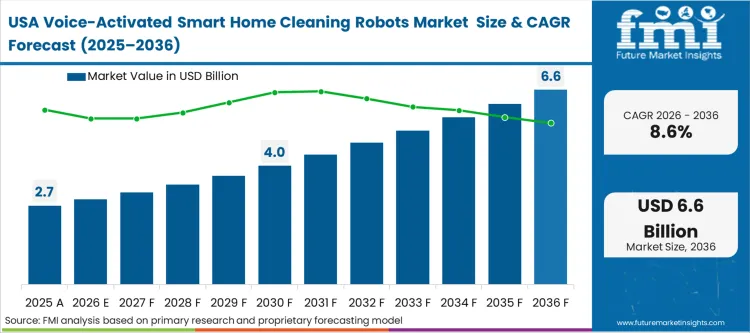
- United States: Strict scrutiny over domestic surveillance hardware defines the United States trajectory. Consumer advocacy groups routinely test hardware for unauthorized data transmission, forcing major brands to physically sever microphone circuits when units are docked. The voice-activated smart home cleaning robots market USA is forecast to register a CAGR of 8.6%. Manufacturers that secure third-party privacy certifications establish an unassailable advantage over budget imports relying on opaque cloud architectures.
FMI's report includes secondary North American markets navigating similar privacy standards. The transition toward universal interoperability protocols allows regional retailers to consolidate their inventory around certified hardware.
Europe Voice-Activated Smart Home Cleaning Robots Market Analysis
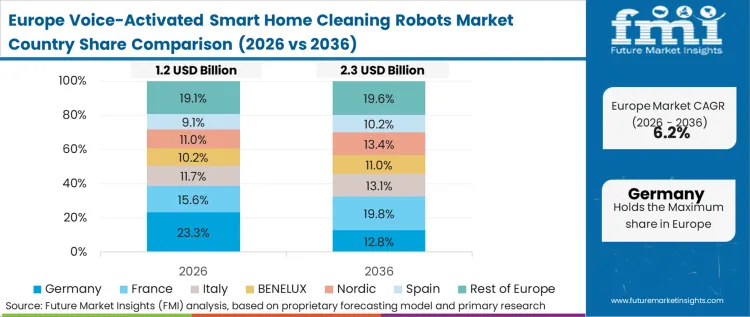
Stringent energy efficiency mandates and circular economy directives force European procurement directors to evaluate total lifecycle costs rather than initial hardware prices, assessing the true smart cleaning robots ROI. High regional energy tariffs make continuous cloud connectivity an operational liability. Based on FMI's assessment, manufacturers must optimize standby power consumption for integrated microphones to meet rigorous regional ecolabel certifications. The demand for verifiable supply chains mirrors regulatory tracking seen in anti-counterfeit cosmetic packaging, requiring component transparency from assembly to end-of-life disposal.
- Germany: Germany's rigid right-to-repair legislation alters how manufacturers design acoustic sensor modules. Firms must ensure that microphone arrays can be replaced without discarding the primary motherboard. Demand for Voice-Activated Smart Home Cleaning Robots in Germany is estimated to expand at a CAGR of 8.1%. Hardware architects achieve significant reductions in warranty service costs by modularizing the voice-integration layer for independent technical servicing.
- United Kingdom: High density urban housing formats in the United Kingdom constrain base station footprints. Consumers evaluate hardware based on its ability to navigate complex, tight floor plans without requiring manual rescue. FMI estimates the Voice-Activated Smart Home Cleaning Robots market in the United Kingdom to expand at an annual growth rate of 7.9%. The reality for hardware developers is that a robot failing to accurately process localized acoustic commands in acoustically reflective, compact rooms will be returned regardless of its suction metrics.
FMI's report includes adjacent European territories operating under identical energy frameworks. The shared regulatory environment allows brands to deploy unified hardware SKUs across multiple national borders without re-engineering standby acoustic power systems.
Asia Pacific Voice-Activated Smart Home Cleaning Robots Market Analysis
Rapid modernization of domestic network infrastructure across major Asian metropolises enables consumers to bypass intermediate technologies entirely, significantly influencing the voice-activated smart home cleaning robots market Asia Pacific. Rather than upgrading legacy appliances, first-time buyers in this region construct comprehensive smart home ecosystems simultaneously. As per FMI's projection, high smartphone penetration and ubiquitous broadband allow manufacturers to deploy highly sophisticated, cloud-dependent voice logic without encountering the latency issues prevalent in less connected regions. Firms increasingly incorporate eco-friendly finishes sourced similarly to renewable biopolymer cosmetics to satisfy younger, urban demographics.
- China: China's aggressive domestic semiconductor production isolates its smart home ecosystems from Western standards. Hardware relies entirely on localized voice architectures, forcing foreign entrants to rebuild their integration modules from scratch. The voice-activated smart home cleaning robots market China growth is expected to see its sector expand at a compound annual rate of 10.9%. The integration of localized AI models directly onto municipal fiber networks indicates an accelerated shift toward hyper-responsive, latency-free ambient computing.
- Japan: Japan's extreme demographic weighting toward elderly populations redefines voice activation from a convenience feature to a critical accessibility requirement. Users with limited mobility rely entirely on acoustic commands rather than physical interfaces. The Voice-Activated Smart Home Cleaning Robots landscape in Japan is set to achieve a CAGR of 9.4%. Firms that optimize natural language processing for regional dialects capture exclusive contracts with assisted living facility procurement networks.
- South Korea: High-rise apartment architecture in South Korea necessitates precise acoustic filtering to isolate internal commands from external urban noise. Hardware lacking sophisticated noise-cancellation matrices routinely misinterprets ambient sounds. Over the forecast period, Voice-Activated Smart Home Cleaning Robots in South Korea is set for a CAGR of 9.2%. Manufacturers bridging this specific acoustic gap secure dominant positions against competitors importing generalized, uncalibrated audio hardware.
- India: India's rapid expansion of first-time smart home device buyers fundamentally alters the regional baseline. As tier-1 urban centers shift away from informal domestic labor, households demand immediate automation solutions. India's Voice-Activated Smart Home Cleaning Robots industry is expected to demonstrate a CAGR of 11.6%. The transition from app-based controls directly to voice-native hardware occurs in a single procurement cycle, skipping intermediate adoption phases entirely.
FMI's report includes emerging Southeast Asian economies experiencing rapid broadband deployment. The deployment of localized data centers across these territories resolves legacy cloud latency bottlenecks, mapping the robot vacuum global demand.
Competitive Aligners for Market Players
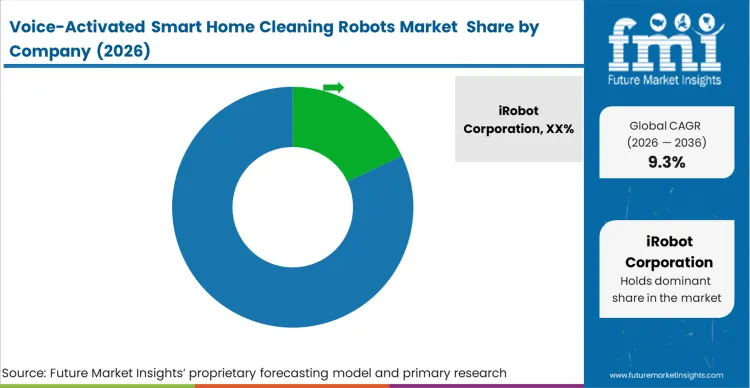
The dominance within this sector relies entirely on the depth of R&D capital available for software integration, creating a highly concentrated top tier when evaluating voice-activated smart home cleaning robots market share by company. Companies like iRobot Corporation and Ecovacs Robotics do not compete primarily on physical brush design or suction parameters. They compete on the seamless certification of their firmware across major smart home architectures. Retail category managers actively disqualify uncertified hardware, regardless of price, because connectivity failures trigger unsustainable return rates. As aesthetic demands shift, similar to trends tracked in organic cosmetics, robot vacuum manufacturers must balance external hardware refinement with internal processing power.
Challengers attempting to displace incumbents must engineer localized edge-processing capabilities that bypass cloud latency. Xiaomi Corporation and Roborock Technology Co., Ltd. leverage massive scale to compress natural language processing algorithms onto physical device chips. This architectural advantage allows commands to execute instantly without an active internet connection. To replicate this, a competitor conducting a robot vacuum supplier comparison must build a dedicated semiconductor supply chain, avoiding the material friction seen in shifting consumer preferences toward clean sourcing, comparable to movements in vegan cosmetics. Integrating ambient acoustic command locally serves as the definitive moat for top voice- activated cleaning robots suppliers.
Large retail buyers actively resist hardware lock-in by demanding adherence to universal interoperability standards like Matter. The tension emerges as dominant vendors attempt to retain user data within proprietary apps, while consumers demand open, agnostic network control. Through 2036, hardware manufacturers that refuse to surrender interface control to broader smart home ecosystems will be relegated to the ultra-budget tier, negatively impacting metrics like the iRobot market share robot vacuum. Sourcing authentic, uncompromised components, much like the verification protocols in natural cosmetics, remains critical as brands construct resilient, future-proof devices.
Key Players in Voice-Activated Smart Home Cleaning Robots Market
- iRobot Corporation
- Ecovacs Robotics
- Roborock Technology Co., Ltd.
- Dyson Ltd.
- Samsung Electronics
- LG Electronics
- Xiaomi Corporation
Scope of the Report

| Metric | Value |
|---|---|
| Quantitative Units | USD 5.3 billion to USD 12.8 billion, at a CAGR of 9.3% |
| Market Definition | This category tracks autonomous domestic cleaning hardware built explicitly for acoustic command execution. The boundary separates native voice-integrated network nodes from legacy robotic appliances that rely on physical or application-based initiation protocols. |
| Product Type Segmentation | Robotic Vacuum Cleaners, Robotic Mop Cleaners, Hybrid Vacuum-Mop Robots, Pool Cleaning Robots |
| Voice Assistant Integration Segmentation | Amazon Alexa Integration, Google Assistant Integration, Apple Siri Integration, Proprietary Voice AI Systems |
| Distribution Channel Segmentation | Online Retail, Consumer Electronics Stores, Home Appliance Retail Chains, Direct-to-Consumer Brand Stores |
| End User Segmentation | Residential Households, Hospitality Sector, Commercial Cleaning Services, Healthcare Facilities |
| Regions Covered | North America, Europe, Asia Pacific |
| Countries Covered | India, China, Japan, South Korea, United States, Germany, United Kingdom, and 40 plus countries |
| Key Companies Profiled | iRobot Corporation, Ecovacs Robotics, Roborock Technology Co., Ltd., Dyson Ltd., Samsung Electronics, LG Electronics, Xiaomi Corporation |
| Forecast Period | 2026 to 2036 |
| Approach | FMI engaged directly with smart home ecosystem architects and consumer electronics category managers. The baseline anchors to global service robot shipment volumes cross-referenced with regional smart speaker penetration rates. Projections were triangulated using international trade commission electronics logs. |
Source: Future Market Insights (FMI) analysis, based on proprietary forecasting model and primary research
Voice-Activated Smart Home Cleaning Robots Market Analysis by Segments
Product Type:
- Robotic Vacuum Cleaners
- Robotic Mop Cleaners
- Hybrid Vacuum-Mop Robots
- Pool Cleaning Robots
Voice Assistant Integration:
- Amazon Alexa Integration
- Google Assistant Integration
- Apple Siri Integration
- Proprietary Voice AI Systems
Distribution Channel:
- Online Retail
- Consumer Electronics Stores
- Home Appliance Retail Chains
- Direct-to-Consumer Brand Stores
End User:
- Residential Households
- Hospitality Sector
- Commercial Cleaning Services
- Healthcare Facilities
Region:
- North America
- United States
- Canada
- Europe
- Germany
- United Kingdom
- France
- Italy
- Spain
- Asia Pacific
- China
- Japan
- South Korea
- Taiwan
- Singapore
- Latin America
- Brazil
- Mexico
- Argentina
- Middle East & Africa
- GCC Countries
- South Africa
- Israel
- Rest of Middle East & Africa
Bibliography
- Hanji, L., Kharat, M. U., & Nagargoje, T. D. (2025, March). Voice-controlled fully automatic vacuum cleaner using IoT. International Journal of Creative Research Thoughts.
- Liu, W., Chen, Z., & Zhang, Y. (2024, October). Design study on commercial cleaning robots based on user requirements. Sustainability.
- Shiokawa, Y., et al. (2025, April). How can we exploit domestic robots’ idle time? ACM Digital Library.
- Nguyen, P., et al. (2025, August). Development and evaluation of a smart vacuum robot using ROS-based autonomous navigation. Engineering, Technology & Applied Science Research.
- Liu, Z., Wang, Y., & Zhao, H. (2024, July). Design of a sweeping robot based on fuzzy QFD and ARIZ theory. Heliyon.
- Vrain, E., et al. (2025, January). How home automation reshapes household time use and energy demand. Energy and Buildings.
- Liu, Z., Chen, X., & Zhang, W. (2024, September). Multifunctional intelligent robotic vacuum cleaners for automated home cleaning systems. Heliyon.
This bibliography is provided for reader reference. The full FMI report contains the complete reference list with primary source documentation.
This Report Addresses
- Market intelligence to support strategic decision making across robotic vacuum cleaners and hybrid vacuum-mop robots
- Market size estimation and 10-year revenue forecasts from 2026 to 2036, supported by global service robot shipment volume baselines
- Growth opportunity mapping across Product Type and Voice Assistant Integration with emphasis on the shift from cloud-dependent voice processing to edge-based local hardware execution
- Segment and regional revenue forecasts covering Apple Siri Integration and Proprietary Voice AI Systems across strict regional data localization environments
- Competition strategy assessment including network interoperability certification, local edge-processing architecture, and third-party privacy auditing
- Capability development tracking including IEEE 2824-2024 standards, universal Matter interoperability protocols, and advanced acoustic echolocation firmware
- Market access analysis covering federal data privacy frameworks, European standby power efficiency mandates, and restricted commercial acoustic transmission policies
- Market report delivery in PDF, Excel, PPT, and interactive dashboard formats for executive strategy, smart home ecosystem architects, and operational benchmarking use
Frequently Asked Questions
what is the market size of voice-activated smart home cleaning robots integrated with voice assistants in 2026?
The sector will reach USD 5.3 billion in 2026. This initial valuation indicates that localized voice integration has shifted from an experimental premium feature to a baseline requirement for major electronics retailers.
What is the projected 10-year voice-activated smart home cleaning robots market forecast valuation by 2036?
The valuation expands to USD 12.8 billion by 2036. This scale reflects the complete obsolescence of application-only hardware and the total absorption of floorcare devices into ambient smart home networks.
What voice-activated smart home cleaning robots market CAGR is projected for this sector?
A compound annual growth rate of 9.3% is projected. This pace maps directly to the replacement cycles of pre-existing smart speaker networks, rather than the mechanical breakdown of legacy vacuum units.
Which product type segment leads in the voice-activated smart home cleaning robots applications?
Robotic vacuum cleaners dominate with 63.5% share. The lack of complex fluid management payloads allows these units to reliably execute hands-free commands without requiring constant physical maintenance.
Which voice assistant integration segment leads the voice-activated smart home cleaning robots market?
Amazon Alexa Integration commands 46.2% of the market. Its massive pre-installed hardware base removes the requirement for consumers to configure secondary bridging hubs or learn proprietary syntax.
Which distribution channel segment leads for voice-activated smart home cleaning robots suppliers?
Online retail captures 58.1% share. Digital procurement paths allow buyers to verify exact technical interoperability specifications and ecosystem compatibility matrices before purchasing.
What drives rapid adoption of home automation cleaning robots?
The absolute demand for ecosystem unification forces buyers to upgrade. Consumers will abandon functionally perfect legacy vacuums specifically to achieve seamless acoustic control within their newly expanded smart home environments.
What is the primary restraint facing voice-activated smart home cleaning robots manufacturers?
Conflicting network security architectures paralyze adoption. Households running mixed hardware ecosystems experience severe friction when attempting to route universal commands through proprietary, siloed communication protocols.
Which country exhibits the fastest voice-activated smart home cleaning robots adoption rate?
India expands at 11.6%, outpacing China's 10.9%. This divergence occurs because Indian tier-1 urban households are entirely bypassing legacy application-based robots and deploying voice-native architectures in their initial purchasing cycle.
How do European energy efficiency mandates alter autonomous cleaning robots technology?
High regional tariffs force manufacturers to strictly limit standby power consumption for integrated microphones. Hardware architects must modularize the acoustic listening systems to pass rigorous ecolabel evaluations without disabling voice readiness.
How do voice-activated smart home cleaning robots work without cloud connectivity?
Migrating natural language recognition chips directly onto the robot chassis bypasses external server routing. This shift allows immediate command execution even when the household's broader broadband connection fails.
Why do proprietary voice systems fail against major robot cleaning device manufacturers?
Retail buyers disqualify closed-loop hardware because it requires users to learn entirely new command syntaxes. Fragmented voice networks introduce operational friction that directly contradicts the premise of ambient home automation.
How does acoustic mapping bypass consumer surveillance objections in the voice-activated smart home cleaning robots market?
Firms utilizing existing microphone arrays for spatial echolocation rather than deploying optical cameras satisfy stringent privacy demands. This mechanism maps floor plans accurately without generating highly regulated visual datasets.
Are robot vacuums worth buying for enterprise or commercial spaces?
High-traffic facilities operate under strict acoustic interference and security protocols. Enterprise IT directors systematically block ambient listening hardware to prevent unauthorized data transmission, making them less viable than app-scheduled fleets for commercial ROI.
What role does right-to-repair legislation play in voice-activated smart home cleaning robots industry trends?
European frameworks require sensor modules to be independently serviceable. Firms achieve compliance by isolating the microphone arrays from the primary motherboard, drastically reducing long-term warranty replacement costs.
Why is physical retail losing ground to digital distribution for the best voice controlled robot vacuum?
Storefronts fundamentally fail to replicate functional home network latency or complex ecosystem bridging. Buyers require exact digital specification matrices to confirm that new hardware matches their specific smart speaker sub-models.
How do demographic shifts in Japan accelerate specialized firmware deployment in the smart home robotics market?
An elderly population heavily reliant on accessibility transforms voice initiation from a convenience into a necessity. Firmware engineers must calibrate acoustic matrices to process regional dialects accurately for users with limited mobility.
What forces United States manufacturers to sever physical microphone circuits, addressing robot vacuum maintenance issues?
Intense scrutiny over domestic surveillance hardware compels brands to secure third-party privacy certifications. Engineering units to physically disconnect acoustic sensors when docked prevents unauthorized background recording.
What are the main robot vacuum benefits and drawbacks regarding fluid payloads?
Robots that require manual water tank refills or complex base-station drainage defeat the core objective of hands-free operation. Dry vacuums dominate because they avoid these persistent mechanical interruptions and maintain longer battery lifespans.
What dictates the failure of standalone hardware applications in the AI powered cleaning robots market?
Consumers treat robotic floorcare as a peripheral to the primary smart speaker network. Attempting to force users into a proprietary scheduling application fractures the unified smart home experience.
How do high-rise architectures in South Korea influence acoustic engineering for a robot vacuum for smart homes?
Dense urban formats generate intense external noise pollution. Hardware lacking sophisticated acoustic cancellation matrices misinterprets ambient city sounds, necessitating precise localized filtering firmware.
Which companies make robot vacuums with certified voice ecosystem integration?
Leading providers include iRobot Corporation, Ecovacs Robotics, and Roborock Technology Co., Ltd. These firms prioritize firmware certification across major smart home architectures to ensure frictionless network interoperability.
Preview the report firsthand - request a free sample
Get SampleGet the brochure for pricing and purchase details.
Get PDFTable of Content
- Executive Summary
- Global Market Outlook
- Demand-side Trends
- Supply-side Trends
- Technology Roadmap Analysis
- Analysis and Recommendations
- Market Overview
- Market Coverage / Taxonomy
- Market Definition / Scope / Limitations
- Research Methodology
- Chapter Orientation
- Analytical Lens and Working Hypotheses
- Market Structure, Signals, and Trend Drivers
- Benchmarking and Cross-market Comparability
- Market Sizing, Forecasting, and Opportunity Mapping
- Research Design and Evidence Framework
- Desk Research Programme (Secondary Evidence)
- Company Annual and Sustainability Reports
- Peer-reviewed Journals and Academic Literature
- Corporate Websites, Product Literature, and Technical Notes
- Earnings Decks and Investor Briefings
- Statutory Filings and Regulatory Disclosures
- Technical White Papers and Standards Notes
- Trade Journals, Industry Magazines, and Analyst Briefs
- Conference Proceedings, Webinars, and Seminar Materials
- Government Statistics Portals and Public Data Releases
- Press Releases and Reputable Media Coverage
- Specialist Newsletters and Curated Briefings
- Sector Databases and Reference Repositories
- FMI Internal Proprietary Databases and Historical Market Datasets
- Subscription Datasets and Paid Sources
- Social Channels, Communities, and Digital Listening Inputs
- Additional Desk Sources
- Expert Input and Fieldwork (Primary Evidence)
- Primary Modes
- Qualitative Interviews and Expert Elicitation
- Quantitative Surveys and Structured Data Capture
- Blended Approach
- Why Primary Evidence is Used
- Field Techniques
- Interviews
- Surveys
- Focus Groups
- Observational and In-context Research
- Social and Community Interactions
- Stakeholder Universe Engaged
- C-suite Leaders
- Board Members
- Presidents and Vice Presidents
- R&D and Innovation Heads
- Technical Specialists
- Domain Subject-matter Experts
- Scientists
- Physicians and Other Healthcare Professionals
- Governance, Ethics, and Data Stewardship
- Research Ethics
- Data Integrity and Handling
- Primary Modes
- Tooling, Models, and Reference Databases
- Desk Research Programme (Secondary Evidence)
- Data Engineering and Model Build
- Data Acquisition and Ingestion
- Cleaning, Normalisation, and Verification
- Synthesis, Triangulation, and Analysis
- Quality Assurance and Audit Trail
- Market Background
- Market Dynamics
- Drivers
- Restraints
- Opportunity
- Trends
- Scenario Forecast
- Demand in Optimistic Scenario
- Demand in Likely Scenario
- Demand in Conservative Scenario
- Opportunity Map Analysis
- Product Life Cycle Analysis
- Supply Chain Analysis
- Investment Feasibility Matrix
- Value Chain Analysis
- PESTLE and Porter’s Analysis
- Regulatory Landscape
- Regional Parent Market Outlook
- Production and Consumption Statistics
- Import and Export Statistics
- Market Dynamics
- Global Market Analysis 2021 to 2025 and Forecast, 2026 to 2036
- Historical Market Size Value (USD Million) Analysis, 2021 to 2025
- Current and Future Market Size Value (USD Million) Projections, 2026 to 2036
- Y-o-Y Growth Trend Analysis
- Absolute $ Opportunity Analysis
- Global Market Pricing Analysis 2021 to 2025 and Forecast 2026 to 2036
- Global Market Analysis 2021 to 2025 and Forecast 2026 to 2036, By Product Type
- Introduction / Key Findings
- Historical Market Size Value (USD Million) Analysis By Product Type , 2021 to 2025
- Current and Future Market Size Value (USD Million) Analysis and Forecast By Product Type , 2026 to 2036
- Robotic Vacuum Cleaners
- Robotic Mop Cleaners
- Hybrid Vacuum-Mop Robots
- Pool Cleaning Robots
- Robotic Vacuum Cleaners
- Y-o-Y Growth Trend Analysis By Product Type , 2021 to 2025
- Absolute $ Opportunity Analysis By Product Type , 2026 to 2036
- Global Market Analysis 2021 to 2025 and Forecast 2026 to 2036, By Voice Assistant Integration
- Introduction / Key Findings
- Historical Market Size Value (USD Million) Analysis By Voice Assistant Integration, 2021 to 2025
- Current and Future Market Size Value (USD Million) Analysis and Forecast By Voice Assistant Integration, 2026 to 2036
- Amazon Alexa Integration
- Google Assistant Integration
- Apple Siri Integration
- Proprietary Voice AI Systems
- Amazon Alexa Integration
- Y-o-Y Growth Trend Analysis By Voice Assistant Integration, 2021 to 2025
- Absolute $ Opportunity Analysis By Voice Assistant Integration, 2026 to 2036
- Global Market Analysis 2021 to 2025 and Forecast 2026 to 2036, By Distribution Channel
- Introduction / Key Findings
- Historical Market Size Value (USD Million) Analysis By Distribution Channel, 2021 to 2025
- Current and Future Market Size Value (USD Million) Analysis and Forecast By Distribution Channel, 2026 to 2036
- Online Retail
- Consumer Electronics Stores
- Home Appliance Retail Chains
- Direct-to-Consumer Brand Stores
- Online Retail
- Y-o-Y Growth Trend Analysis By Distribution Channel, 2021 to 2025
- Absolute $ Opportunity Analysis By Distribution Channel, 2026 to 2036
- Global Market Analysis 2021 to 2025 and Forecast 2026 to 2036, By End Use
- Introduction / Key Findings
- Historical Market Size Value (USD Million) Analysis By End Use, 2021 to 2025
- Current and Future Market Size Value (USD Million) Analysis and Forecast By End Use, 2026 to 2036
- Residential Households
- Hospitality Sector
- Commercial Cleaning Services
- Healthcare Facilities
- Residential Households
- Y-o-Y Growth Trend Analysis By End Use, 2021 to 2025
- Absolute $ Opportunity Analysis By End Use, 2026 to 2036
- Global Market Analysis 2021 to 2025 and Forecast 2026 to 2036, By Region
- Introduction
- Historical Market Size Value (USD Million) Analysis By Region, 2021 to 2025
- Current Market Size Value (USD Million) Analysis and Forecast By Region, 2026 to 2036
- North America
- Latin America
- Western Europe
- Eastern Europe
- East Asia
- South Asia and Pacific
- Middle East & Africa
- Market Attractiveness Analysis By Region
- North America Market Analysis 2021 to 2025 and Forecast 2026 to 2036, By Country
- Historical Market Size Value (USD Million) Trend Analysis By Market Taxonomy, 2021 to 2025
- Market Size Value (USD Million) Forecast By Market Taxonomy, 2026 to 2036
- By Country
- USA
- Canada
- Mexico
- By Product Type
- By Voice Assistant Integration
- By Distribution Channel
- By End Use
- By Country
- Market Attractiveness Analysis
- By Country
- By Product Type
- By Voice Assistant Integration
- By Distribution Channel
- By End Use
- Key Takeaways
- Latin America Market Analysis 2021 to 2025 and Forecast 2026 to 2036, By Country
- Historical Market Size Value (USD Million) Trend Analysis By Market Taxonomy, 2021 to 2025
- Market Size Value (USD Million) Forecast By Market Taxonomy, 2026 to 2036
- By Country
- Brazil
- Chile
- Rest of Latin America
- By Product Type
- By Voice Assistant Integration
- By Distribution Channel
- By End Use
- By Country
- Market Attractiveness Analysis
- By Country
- By Product Type
- By Voice Assistant Integration
- By Distribution Channel
- By End Use
- Key Takeaways
- Western Europe Market Analysis 2021 to 2025 and Forecast 2026 to 2036, By Country
- Historical Market Size Value (USD Million) Trend Analysis By Market Taxonomy, 2021 to 2025
- Market Size Value (USD Million) Forecast By Market Taxonomy, 2026 to 2036
- By Country
- Germany
- UK
- Italy
- Spain
- France
- Nordic
- BENELUX
- Rest of Western Europe
- By Product Type
- By Voice Assistant Integration
- By Distribution Channel
- By End Use
- By Country
- Market Attractiveness Analysis
- By Country
- By Product Type
- By Voice Assistant Integration
- By Distribution Channel
- By End Use
- Key Takeaways
- Eastern Europe Market Analysis 2021 to 2025 and Forecast 2026 to 2036, By Country
- Historical Market Size Value (USD Million) Trend Analysis By Market Taxonomy, 2021 to 2025
- Market Size Value (USD Million) Forecast By Market Taxonomy, 2026 to 2036
- By Country
- Russia
- Poland
- Hungary
- Balkan & Baltic
- Rest of Eastern Europe
- By Product Type
- By Voice Assistant Integration
- By Distribution Channel
- By End Use
- By Country
- Market Attractiveness Analysis
- By Country
- By Product Type
- By Voice Assistant Integration
- By Distribution Channel
- By End Use
- Key Takeaways
- East Asia Market Analysis 2021 to 2025 and Forecast 2026 to 2036, By Country
- Historical Market Size Value (USD Million) Trend Analysis By Market Taxonomy, 2021 to 2025
- Market Size Value (USD Million) Forecast By Market Taxonomy, 2026 to 2036
- By Country
- China
- Japan
- South Korea
- By Product Type
- By Voice Assistant Integration
- By Distribution Channel
- By End Use
- By Country
- Market Attractiveness Analysis
- By Country
- By Product Type
- By Voice Assistant Integration
- By Distribution Channel
- By End Use
- Key Takeaways
- South Asia and Pacific Market Analysis 2021 to 2025 and Forecast 2026 to 2036, By Country
- Historical Market Size Value (USD Million) Trend Analysis By Market Taxonomy, 2021 to 2025
- Market Size Value (USD Million) Forecast By Market Taxonomy, 2026 to 2036
- By Country
- India
- ASEAN
- Australia & New Zealand
- Rest of South Asia and Pacific
- By Product Type
- By Voice Assistant Integration
- By Distribution Channel
- By End Use
- By Country
- Market Attractiveness Analysis
- By Country
- By Product Type
- By Voice Assistant Integration
- By Distribution Channel
- By End Use
- Key Takeaways
- Middle East & Africa Market Analysis 2021 to 2025 and Forecast 2026 to 2036, By Country
- Historical Market Size Value (USD Million) Trend Analysis By Market Taxonomy, 2021 to 2025
- Market Size Value (USD Million) Forecast By Market Taxonomy, 2026 to 2036
- By Country
- Kingdom of Saudi Arabia
- Other GCC Countries
- Turkiye
- South Africa
- Other African Union
- Rest of Middle East & Africa
- By Product Type
- By Voice Assistant Integration
- By Distribution Channel
- By End Use
- By Country
- Market Attractiveness Analysis
- By Country
- By Product Type
- By Voice Assistant Integration
- By Distribution Channel
- By End Use
- Key Takeaways
- Key Countries Market Analysis
- USA
- Pricing Analysis
- Market Share Analysis, 2025
- By Product Type
- By Voice Assistant Integration
- By Distribution Channel
- By End Use
- Canada
- Pricing Analysis
- Market Share Analysis, 2025
- By Product Type
- By Voice Assistant Integration
- By Distribution Channel
- By End Use
- Mexico
- Pricing Analysis
- Market Share Analysis, 2025
- By Product Type
- By Voice Assistant Integration
- By Distribution Channel
- By End Use
- Brazil
- Pricing Analysis
- Market Share Analysis, 2025
- By Product Type
- By Voice Assistant Integration
- By Distribution Channel
- By End Use
- Chile
- Pricing Analysis
- Market Share Analysis, 2025
- By Product Type
- By Voice Assistant Integration
- By Distribution Channel
- By End Use
- Germany
- Pricing Analysis
- Market Share Analysis, 2025
- By Product Type
- By Voice Assistant Integration
- By Distribution Channel
- By End Use
- UK
- Pricing Analysis
- Market Share Analysis, 2025
- By Product Type
- By Voice Assistant Integration
- By Distribution Channel
- By End Use
- Italy
- Pricing Analysis
- Market Share Analysis, 2025
- By Product Type
- By Voice Assistant Integration
- By Distribution Channel
- By End Use
- Spain
- Pricing Analysis
- Market Share Analysis, 2025
- By Product Type
- By Voice Assistant Integration
- By Distribution Channel
- By End Use
- France
- Pricing Analysis
- Market Share Analysis, 2025
- By Product Type
- By Voice Assistant Integration
- By Distribution Channel
- By End Use
- India
- Pricing Analysis
- Market Share Analysis, 2025
- By Product Type
- By Voice Assistant Integration
- By Distribution Channel
- By End Use
- ASEAN
- Pricing Analysis
- Market Share Analysis, 2025
- By Product Type
- By Voice Assistant Integration
- By Distribution Channel
- By End Use
- Australia & New Zealand
- Pricing Analysis
- Market Share Analysis, 2025
- By Product Type
- By Voice Assistant Integration
- By Distribution Channel
- By End Use
- China
- Pricing Analysis
- Market Share Analysis, 2025
- By Product Type
- By Voice Assistant Integration
- By Distribution Channel
- By End Use
- Japan
- Pricing Analysis
- Market Share Analysis, 2025
- By Product Type
- By Voice Assistant Integration
- By Distribution Channel
- By End Use
- South Korea
- Pricing Analysis
- Market Share Analysis, 2025
- By Product Type
- By Voice Assistant Integration
- By Distribution Channel
- By End Use
- Russia
- Pricing Analysis
- Market Share Analysis, 2025
- By Product Type
- By Voice Assistant Integration
- By Distribution Channel
- By End Use
- Poland
- Pricing Analysis
- Market Share Analysis, 2025
- By Product Type
- By Voice Assistant Integration
- By Distribution Channel
- By End Use
- Hungary
- Pricing Analysis
- Market Share Analysis, 2025
- By Product Type
- By Voice Assistant Integration
- By Distribution Channel
- By End Use
- Kingdom of Saudi Arabia
- Pricing Analysis
- Market Share Analysis, 2025
- By Product Type
- By Voice Assistant Integration
- By Distribution Channel
- By End Use
- Turkiye
- Pricing Analysis
- Market Share Analysis, 2025
- By Product Type
- By Voice Assistant Integration
- By Distribution Channel
- By End Use
- South Africa
- Pricing Analysis
- Market Share Analysis, 2025
- By Product Type
- By Voice Assistant Integration
- By Distribution Channel
- By End Use
- USA
- Market Structure Analysis
- Competition Dashboard
- Competition Benchmarking
- Market Share Analysis of Top Players
- By Regional
- By Product Type
- By Voice Assistant Integration
- By Distribution Channel
- By End Use
- Competition Analysis
- Competition Deep Dive
- iRobot Corporation
- Overview
- Product Portfolio
- Profitability by Market Segments (Product/Age /Sales Channel/Region)
- Sales Footprint
- Strategy Overview
- Marketing Strategy
- Product Strategy
- Channel Strategy
- Ecovacs Robotics
- Roborock Technology Co., Ltd.
- Dyson Ltd.
- Samsung Electronics
- LG Electronics
- Xiaomi Corporation
- iRobot Corporation
- Competition Deep Dive
- Assumptions & Acronyms Used


