

- Industry Size (2026)
- USD 0.83 Bn
- Forecast (2036)
- USD 1.51 Bn
- CAGR (2026 to 2036)
- 6.2%
Restaurant Takeout Market Size, Market Forecast and Outlook By FMI
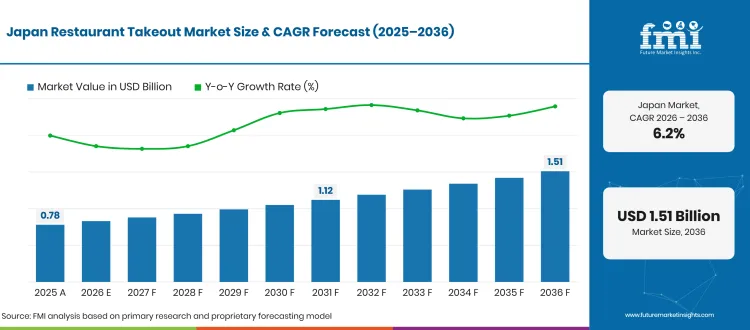
Demand for restaurant takeout in Japan was valued at USD 0.78 Billion in 2025. Based on Future Market Insights' analysis, demand for restaurant takeout is estimated to grow to USD 0.83 Billion in 2026 and USD 1.51 Billion by 2036. FMI projects a CAGR of 6.2% during the forecast period from 2026 to 2036. This translates to an incremental opportunity worth USD 0.68 Billion over the ten-year assessment window.
Summary of Restaurant Takeout Market in Japan
- Market Snapshot
- Demand for restaurant takeout in Japan is valued at USD Billion 0.78 in 2025 and is projected to reach USD Billion 1.51 by 2036.
- The market is expected to grow at a 6.2% CAGR from 2026 to 2036, creating an incremental opportunity of USD Billion 0.68.
- The market is a platform-driven, digitally mediated foodservice category where aggregator algorithm positioning, digital payment integration, and delivery logistics efficiency define operator competitiveness.
- Demand and Growth Drivers
- Mobile application platform penetration has structurally shifted consumer ordering behavior, with aggregator algorithms now determining restaurant visibility and order volume.
- Digital wallet adoption as the leading payment method is accelerating transaction velocity and enabling loyalty program integration that drives repeat ordering.
- Restaurant operators are investing in dedicated takeout kitchen capacity and packaging systems to capture margins from off-premise consumption channels.
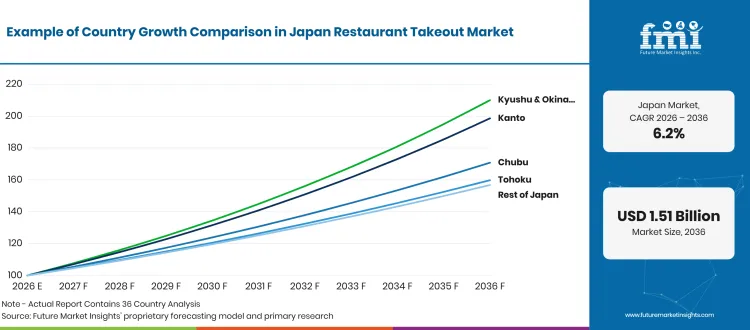
- Among key regions, Kyushu & Okinawa leads at 7.7% CAGR, followed by Kanto at 7.1%, Kansai at 6.2%, Chubu at 5.5%, Tohoku at 4.8%, and Rest of Japan at 4.6%.
- Product and Segment View
- Restaurant takeout in Japan encompasses mobile-app-ordered and website-ordered prepared food for off-premise consumption across all restaurant formats.
- Payment processing spans digital wallets, cash, debit cards, and credit cards, with digital wallet penetration leading in metropolitan prefectures.
- Digital wallets leads by Payment Method with 45% share in 2026, driven by smartphone penetration and platform loyalty program integration.
- Mobile Applications leads by Food Delivery with 75% share in 2026, reflecting the dominance of aggregator application interfaces in consumer ordering behavior.
- Scope includes restaurant takeout ordering and fulfillment. Excluded are dine-in revenue, grocery delivery, meal kits, and catering services.
- Geography and Competitive Outlook
- Kyushu & Okinawa and Kanto are the fastest-growing regional clusters, driven by concentrated processing, distribution, and consumption infrastructure.
- Demand in Tohoku and Rest of Japan follows steadier, replacement-driven procurement cycles in established networks.
- Competition is shaped by platform algorithm positioning, digital payment integration breadth, delivery logistics efficiency, and the ability to maintain food quality consistency across off-premise fulfillment operations.
- Key players include Denny's, Biscuitville, Bob Evans, Another Broken Egg Cafe, First Watch.
- Analyst Opinion at FMI
- Nandini Roy Choudhury, Principal Consultant for Food & Beverage analysts observe that: 'In my analysis, I have observed that the restaurant takeout market in Japan is being redefined by mobile application platform economics rather than by food quality differentiation. Digital wallet integration and loyalty program interoperability have become the primary factors determining consumer ordering frequency, while the restaurants themselves are increasingly commoditized as fulfillment nodes within aggregator platforms. Operators who invest in kitchen efficiency and delivery packaging without securing preferential algorithmic placement on ordering platforms will find their customer acquisition costs rising faster than their takeout revenue.'
- Strategic Implications / Executive Takeaways
- Restaurant operators should invest in algorithmic placement optimization on aggregator platforms, treating platform visibility as a primary customer acquisition channel rather than a supplementary order source.
- Technology teams should prioritize digital wallet payment integration and loyalty program interoperability to increase ordering frequency and average transaction value.
- Operations directors should develop dedicated takeout kitchen capacity and packaging specifications to protect off-premise margins from delivery logistics cost inflation.
Restaurant Takeout Market Key Takeaways
| Metric | Details |
|---|---|
| Industry Size (2026) | USD 0.83 Billion |
| Industry Value (2036) | USD 1.51 Billion |
| CAGR (2026 to 2036) | 6.2% |
Source: Future Market Insights, 2026
Japan's restaurant takeout market is evolving within a digitally integrated ordering ecosystem where mobile application platforms and digital wallet payment systems define consumer access and ordering frequency. The COVID-19 period accelerated structural adoption of takeout services among restaurant operators who previously operated dine-in-only models, and this shift has proven durable as consumer convenience expectations have reset. As per FMI, the competitive landscape is shaped by platform economics: aggregator applications control customer traffic, and restaurants compete for algorithmic visibility through commission structures, delivery speed metrics, and promotional pricing. Payment method preferences are shifting toward digital wallets, which now account for the largest share of takeout transaction value in metropolitan prefectures.
Across Japanese prefectural clusters, growth trajectories vary based on industrial concentration and end-use demand density. Kyushu & Okinawa is projected to expand at 7.7% CAGR. Kanto is projected to expand at 7.1% CAGR. Kansai is projected to expand at 6.2% CAGR. Chubu is projected to expand at 5.5% CAGR. Tohoku is projected to expand at 4.8% CAGR. Rest of Japan is projected to expand at 4.6% CAGR. Kyushu & Okinawa leads the growth ranking, supported by concentrated processing and distribution infrastructure. Kanto, anchoring the Tokyo metropolitan consumption base, follows closely. Mature clusters such as Tohoku and Rest of Japan register steadier, replacement-driven demand patterns.
Restaurant Takeout Market Definition
Restaurant takeout refers to the service model where consumers order prepared food from restaurants for off-premise consumption, facilitated through mobile applications, websites, or direct counter ordering. In the Japanese market, this category encompasses food delivery and pickup services across all restaurant formats, with payment processed through digital wallets, cash, debit cards, and credit cards.
Restaurant Takeout Market Inclusions
Market scope includes restaurant takeout ordering and fulfillment services conducted through mobile applications, websites, and direct ordering across all restaurant formats in Japan. The assessment covers market sizes by payment method, food delivery platform type, and Japanese prefectural region for 2026 to 2036.
Restaurant Takeout Market Exclusions
The scope excludes dine-in restaurant revenue, grocery delivery services, meal kit subscriptions, and vending machine food sales. It also omits catering services for corporate and event orders.
Restaurant Takeout Market Research Methodology
- Primary Research: Analysts engaged with procurement managers, brand directors, and distribution leads at restaurant takeout manufacturing and distribution operations across Japan to map decision triggers and specification requirements.
- Desk Research: Data collection aggregated regulatory filings from the Ministry of Health, Labour and Welfare, trade statistics from Japan Customs, and published industry standards relevant to restaurant takeout production and distribution in Japan.
- Market-Sizing and Forecasting: Baseline values derive from a bottom-up aggregation of manufacturer shipments and import volumes, applying region-specific consumption curves to project demand velocity through 2036.
- Data Validation and Update Cycle: Projections are cross-checked against publicly reported production volumes, trade data, and downstream procurement disclosures from major producers and distributors operating in Japan.
Why is the Demand for Restaurant Takeout in Japan Growing?
The demand for restaurant takeout in Japan is growing as consumer preferences increasingly shift toward convenience and flexibility in dining. Takeout services allow consumers to enjoy restaurant-quality meals at home or on-the-go, providing a quick and efficient solution for time-constrained individuals. With the rise of busy lifestyles, particularly in urban areas, takeout has become a popular alternative to home cooking or dining out. The wide range of cuisines and menu options available through takeout services further fuels this demand, offering something for everyone, from traditional Japanese dishes to international flavors.
A major driver behind the growth of restaurant takeout is the rising consumer preference for convenience. As Japan’s population continues to lead fast-paced lives, particularly in metropolitan areas, takeout offers an easy way for individuals and families to access meals without the need for preparation or dining at a restaurant. This trend is especially evident in dual-income households, where both time and energy are limited, and the need for efficient dining solutions is at an all-time high. Consumers appreciate the ability to enjoy restaurant-quality food in the comfort of their own homes, without the hassle of cooking or leaving home.
Innovations in delivery platforms and mobile ordering technologies are making it even easier for consumers to access takeout services. With the rise of food delivery apps, ordering takeout has become more convenient, enabling consumers to quickly and easily browse menus, place orders, and have meals delivered right to their doorstep. As the demand for convenience and variety continues to grow, the restaurant takeout sector in Japan is expected to see sustained growth through 2035.
What is the Segment-Wise Analysis of Demand for Restaurant Takeout in Japan?
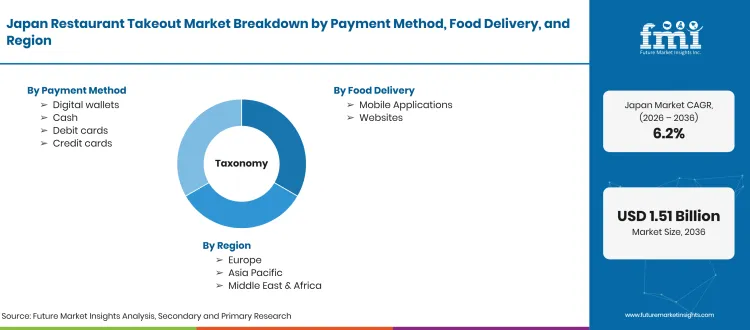
Demand for restaurant takeout in Japan is segmented by payment method, food delivery channel, and region. By payment method, demand is divided into digital wallets, cash, debit cards, and credit cards, with digital wallets leading at 45%. The demand is also segmented by food delivery channel, including mobile applications and websites, with mobile applications leading at 75%. Regionally, demand is spread across Kyushu & Okinawa, Kanto, Kansai, Chubu, Tohoku, and the rest of Japan.
How Do Digital Wallets Lead the Payment Method for Restaurant Takeout in Japan?
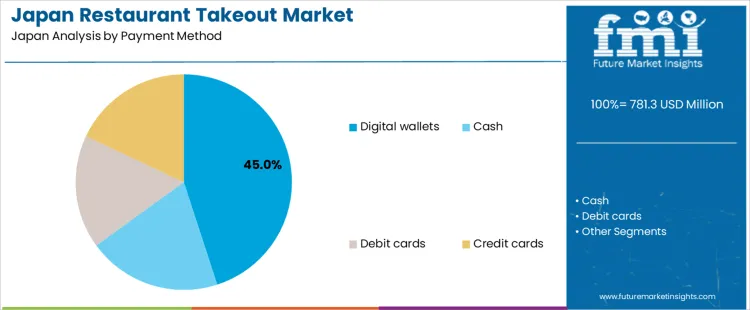
Digital wallets account for 45% of the demand for payment methods in restaurant takeout in Japan, driven by their convenience and security. Platforms like Apple Pay and LINE Pay have become popular as they enable quick, seamless payments without the need for cash or physical cards. These wallets also offer added benefits, such as loyalty points or rewards for using digital payment methods, further increasing their appeal.
As mobile payments continue to grow in popularity, digital wallets are becoming the preferred payment method for takeout, providing a secure, touchless experience that aligns with consumers’ preference for convenience. With their ease of use and enhanced security features, digital wallets are likely to remain the dominant payment method, offering a smooth and efficient transaction experience for consumers who prioritize speed and security in their dining experiences.
Why Do Mobile Applications Lead the Demand for Food Delivery in Japan?
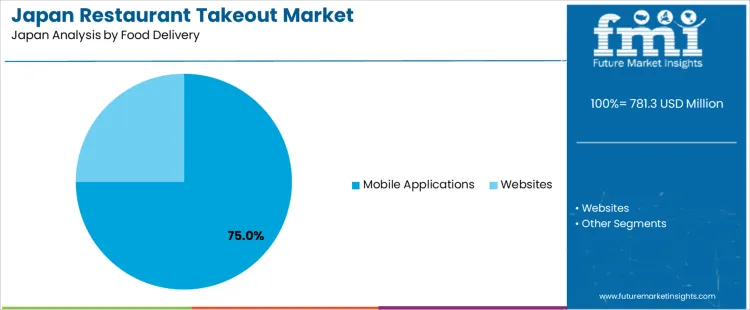
Mobile applications account for 75% of the demand for food delivery in Japan, primarily due to their ease of use and the convenience they provide. Apps like UberEats, Demae-can, and Rakuten Delivery allow consumers to browse menus, place orders, and track deliveries seamlessly from their smartphones. The user-friendly interface makes ordering food faster and more efficient, catering to the growing demand for convenience in today’s fast-paced lifestyle.
Mobile apps offer a wide variety of restaurant options and enable quick, reliable service, contributing to their growing popularity, particularly in urban areas. As consumers continue to prioritize convenience and a seamless ordering experience, mobile applications are expected to remain the preferred channel for food delivery in Japan, ensuring a diverse selection of meals at the fingertips of consumers.
What are the Key Trends, Drivers, and Restraints in Demand for Restaurant Takeout in Japan?
Off premise consumption, including takeout, delivery, and ready meals from restaurants, is growing rapidly, reflecting changing lifestyles in urban and suburban areas. Takeout services are increasingly offered by a wide variety of eateries, from fast food chains to family style restaurants and casual dining. The growth of digital food ordering platforms and mobile apps supports this trend, making ordering and home delivery easy and fast. Rising costs of labour and food ingredients, along with the pressure to maintain food quality and packaging standards for takeout, present challenges. Some consumers still prefer freshly cooked meals or dining out for ambience and experience, limiting how much takeout can replace traditional dining.
Why is Demand for Restaurant Takeout Growing in Japan?
Demand for restaurant takeout is growing because many Japanese households and individuals are under increasing time pressure due to long work hours, commuting, and busy daily schedules. Takeout meals offer a quick, ready eat solution that avoids the need for cooking or meal planning at home. Younger people, dual‑income families, and single person households especially value convenience. The expansion of smartphone uses and online ordering platforms makes it easier to order takeout from restaurants or convenience stores. Evolving consumer lifestyles shifting toward convenience, efficiency, and flexible eating habits supports takeout consumption. As more restaurants and shops adapt their menus and services to takeout and delivery, the accessibility and appeal of restaurant takeout continue to increase.
How are Technological & Industry Innovations Driving Restaurant Takeout Demand in Japan?
Advances in delivery logistics, digital ordering platforms, and packaging technologies are boosting the attractiveness of restaurant takeout in Japan. Mobile apps and integrated delivery services enable quick and convenient ordering, payment, and delivery to home or workplace. Restaurants and chains are expanding their takeout ‘friendly menus and designing packaging suitable for transport while preserving food quality and safety. Improvements in cold chain logistics, efficient dispatch systems, and use of third party delivery services make takeout practical even for perishable or prepared meal items. As these innovations reduce friction and improve reliability of takeout services, more consumers rely on takeout for regular meals rather than just occasional convenience, driving sustained demand growth.
What are the Key Challenges and Risks That Could Limit Restaurant Takeout Demand in Japan?
Despite growth, some factors could limit how far takeout demand expands in Japan. Cost pressures, including rising labour, ingredient, and delivery costs, may raise prices for takeout meals, deterring price sensitive consumers. Maintaining food quality, freshness, and proper temperature during delivery and transport remains a challenge, especially for delicate dishes or meals that require immediate consumption. Increased environmental and packaging waste from single use containers can also generate consumer concern. Some consumers continue to prefer dining out for atmosphere, social interaction, and freshly prepared meals, which takeout cannot replicate. Competition from in home cooking, ready-to-eat meals, and meal kits may limit takeout’s share among mealtime options.
What is the Regional Demand Outlook for Restaurant Takeout in Japan?
| Region | CAGR (%) |
|---|---|
| Kyushu & Okinawa | 7.7% |
| Kanto | 7.1% |
| Kansai | 6.2% |
| Chubu | 5.5% |
| Tohoku | 4.8% |
| Rest of Japan | 4.6% |
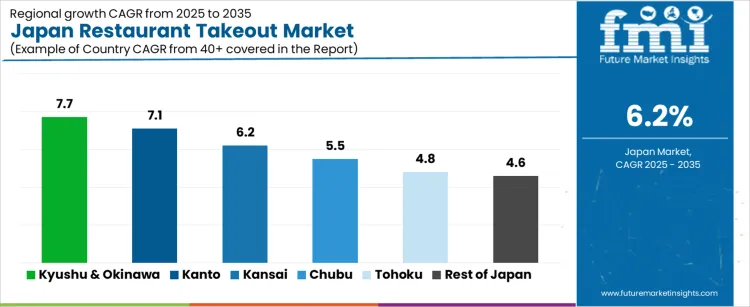
Demand for restaurant takeout in Japan is increasing across all regions, with Kyushu & Okinawa leading at a 7.7% CAGR, driven by rising consumer preference for convenient meal options. Kanto follows with a 7.1% CAGR, fueled by its large urban population and busy lifestyles. Kansai shows a 6.2% CAGR, supported by strong food culture and growing demand for takeout in urban areas. Chubu experiences a 5.5% CAGR, with demand increasing as foodservice options become more diverse. Tohoku and the Rest of Japan see moderate growth at 4.8% and 4.6%, respectively, as consumers in smaller cities and rural areas embrace the convenience of takeout services.
How is Demand for Restaurant Takeout Growing in Kyushu & Okinawa?
Kyushu & Okinawa leads the demand for restaurant takeout, growing at a 7.7% CAGR. The region’s increasing focus on convenience, especially in Okinawa, is contributing significantly to this growth. As tourism continues to rise, both locals and visitors are seeking quick, ready-to-eat meals. Restaurants and foodservice providers in Okinawa are meeting this demand by offering a variety of takeout options, from traditional Japanese dishes to international cuisine. Local residents are also embracing takeout as a convenient option due to busy lifestyles.
The increasing use of mobile apps and online delivery services has made ordering takeout easier than ever. The region’s growing urbanization and the expansion of food delivery services further fuel this trend. As consumer preferences shift toward time-saving, high-quality meal solutions, the demand for restaurant takeout in Kyushu & Okinawa is expected to continue growing at a steady pace.
Why is Demand for Restaurant Takeout Rising in Kanto?
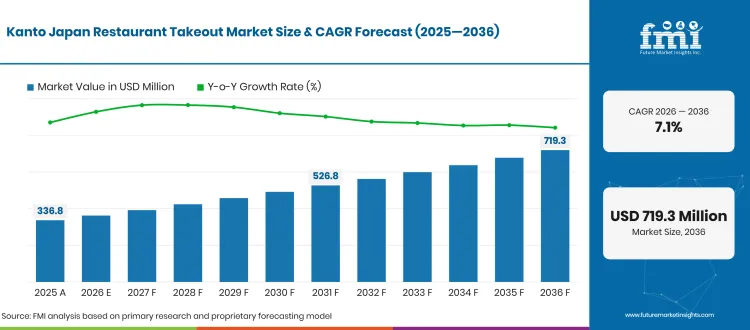
Kanto is experiencing strong demand for restaurant takeout, with a 7.1% CAGR. The region’s large urban population, particularly in Tokyo, is a key factor in driving this demand. As consumers in Kanto become busier and increasingly time-pressed, takeout has become a convenient solution for busy professionals, students, and families. The rise of food delivery apps has made ordering from a wide range of restaurants easier, further contributing to the popularity of takeout.
The growing trend of smaller households in Kanto has also led to an increase in demand for single-serving or small-sized takeout meals. Health-conscious consumers are looking for nutritious takeout options, further fueling the demand for healthier, high-quality meals. As the region continues to be a hub of innovation and health trends, the demand for restaurant takeout will likely remain strong, driven by both convenience and the desire for diverse meal choices.
How is Demand for Restaurant Takeout Expanding in Kansai?
Kansai shows steady demand for restaurant takeout, growing at a 6.2% CAGR. The region, known for its rich food culture, particularly in cities like Osaka, is experiencing an increasing demand for takeout options. Urbanization and busy lifestyles in Kansai are pushing consumers to seek more convenient meal solutions, with takeout becoming a popular choice for busy professionals, families, and young people. As consumers become more health-conscious, there is also a growing demand for nutritious and balanced takeout meals.
The rise of food delivery services has made it easier for people to access a wide variety of options from local restaurants, further driving demand. Kansai’s foodservice industry is adapting to these trends by expanding takeout menus to include both traditional and modern dishes. With an increasing focus on quality, convenience, and health, Kansai is expected to continue seeing steady growth in restaurant takeout demand in the coming years.
Why is Demand for Restaurant Takeout Growing in Chubu?
Chubu is experiencing steady demand for restaurant takeout, growing at a 5.5% CAGR. The region’s large urban areas, particularly in Nagoya, are driving this growth as more consumers seek convenient meal solutions to match their busy schedules. The increasing availability of food delivery services and takeout options from local restaurants has made it easier for consumers in Chubu to access a variety of meals. As consumers demand healthier and more diverse meal options, Chubu’s foodservice industry is expanding its takeout offerings to include more nutritious and gourmet options.
The rise in smaller households and dual-income families in the region has led to greater reliance on takeout for both convenience and quality. The growth of mobile apps and online ordering services is also helping to fuel demand, as consumers prefer the ease of ordering from a variety of local eateries. With these trends, demand for takeout is expected to continue growing steadily in Chubu.
How is Demand for Restaurant Takeout Expanding in Tohoku?
Tohoku is seeing moderate demand for restaurant takeout, with a 4.8% CAGR. While the demand is not as high as in urban regions, there is steady growth as consumer preferences shift toward convenience. The increasing availability of food delivery apps and online ordering services has made it easier for people in Tohoku to access a variety of meals from local restaurants. Busy working individuals, small households, and families are increasingly turning to takeout for time-saving meal solutions.
The region’s growing focus on health-conscious dining is also influencing the demand for nutritious and convenient takeout options. Local restaurants and foodservice providers are responding to these changes by offering diverse menus that cater to both traditional and modern tastes. As Tohoku’s foodservice industry continues to evolve, the adoption of takeout is expected to grow, driven by the region’s increasing access to delivery services and a greater focus on convenience and healthier eating.
Why is Demand for Restaurant Takeout Steady in the Rest of Japan?
The Rest of Japan is experiencing steady demand for restaurant takeout, with a 4.6% CAGR. Although demand is lower compared to urban centers, there is a growing shift toward convenience as more consumers in rural areas and smaller cities embrace takeout options. The rise of food delivery apps has made it easier for people in the Rest of Japan to access meals from a variety of local eateries. As busy lifestyles and smaller households become more common in these areas, takeout is becoming a popular choice for time-pressed consumers.
Local restaurants are expanding their takeout offerings to include both traditional Japanese dishes and more modern, convenient meal options. As consumer interest in health-conscious meals grows, the Rest of Japan is also seeing an increase in demand for nutritious and balanced takeout meals. As the region’s foodservice industry continues to adapt, takeout demand is expected to continue rising steadily.
What is Driving the Demand for Restaurant Takeout in Japan and Who Are the Key Players Shaping the Industry?
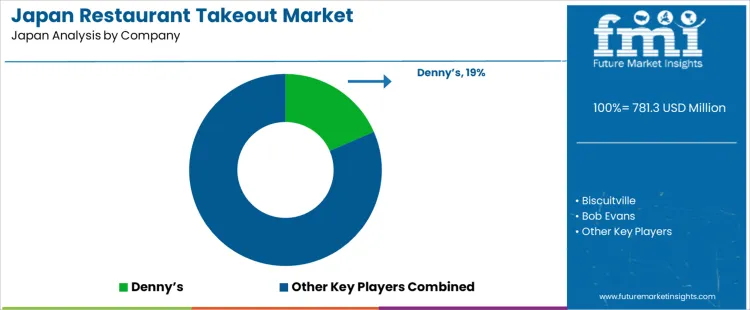
The demand for restaurant takeout in Japan is increasing due to a combination of convenience, changing consumer lifestyles, and the growing popularity of dining options that fit busy schedules. With urbanization and a high-paced lifestyle, many consumers in Japan are opting for takeout meals as an easy solution to enjoy restaurant-quality food at home or on the go. A shift in consumer preferences towards ready-to-eat meals, as well as advancements in delivery platforms, has made takeout more accessible than ever, further driving the industry growth.
Key players shaping the restaurant takeout industry in Japan include Denny’s, Biscuitville, Bob Evans, Another Broken Egg Café, and First Watch. Denny’s leads the industry with a notable share of 18.5%, offering a wide range of convenient takeout options that cater to the tastes of Japanese consumers. These companies are capitalizing on the demand for convenient and affordable dining options by providing takeout services that offer a diverse selection of food, ranging from traditional dishes to international cuisine. By embracing digital ordering systems and expanding their delivery networks, these players are enhancing the customer experience and improving accessibility.
The growth of the restaurant takeout industry in Japan is also supported by technological advancements in food delivery apps, which allow consumers to easily browse, order, and track their meals. As consumers continue to prioritize convenience, flexibility, and quality, the demand for takeout services is expected to expand. The industry will likely continue to thrive as more restaurants adopt takeout and delivery models to meet the evolving preferences of Japan's busy and health-conscious population.
Key Players in Japan Restaurant Takeout Demand
- Denny’s
- Biscuitville
- Bob Evans
- Another Broken Egg Café
- First Watch
Scope of the Report
| Metric | Value |
|---|---|
| Quantitative Units | USD Billion 0.83 to USD Billion 1.51, at a CAGR of 6.2% |
| Market Definition | Restaurant takeout refers to the service model where consumers order prepared food from restaurants for off-premise consumption, facilitated through mobile applications, websites, or direct counter ordering. In the Japanese market, this category encompasses food delivery and pickup services across all restaurant formats, with payment processed through digital wallets, cash, debit cards, and credit cards. |
| Segmentation | Payment Method: Digital wallets, Cash, Debit cards, Credit cards; Food Delivery: Mobile Applications, Websites |
| Regions Covered | Kyushu & Okinawa, Kanto, Kansai, Chubu, Tohoku, Rest of Japan |
| Key Companies Profiled | Denny's, Biscuitville, Bob Evans, Another Broken Egg Cafe, First Watch |
| Forecast Period | 2026 to 2036 |
| Approach | Forecasting models apply a bottom-up methodology starting with manufacturer shipment metrics and import volume data, cross-validated against downstream consumption patterns and regulatory compliance filings. |
Japan Restaurant Takeout Demand by Key Segments
Payment Method:
- Digital wallets
- Cash
- Debit cards
- Credit cards
Food Delivery:
- Mobile Applications
- Websites
Region:
- Kyushu & Okinawa
- Kanto
- Kansai
- Chubu
- Tohoku
- Rest of Japan
Bibliography
- 1. Japan Foodservice Association. (2025). Foodservice Industry Market Trend Report. JF.
- 2. Ministry of Economy, Trade and Industry. (2024). E-Commerce and Digital Service Market Survey. METI.
- 3. Japan External Trade Organization. (2025). Foodservice Market Access and Digital Ordering Trends. JETRO.
- 4. Consumer Affairs Agency, Government of Japan. (2024). Digital Payment and Consumer Protection Framework. CAA.
- 5. Organisation for Economic Co-operation and Development. (2024). Japan Digital Economy Outlook. OECD.
This bibliography is provided for reader reference. The full Future Market Insights report contains the complete reference list with primary research documentation.
Frequently Asked Questions
How large is the demand for Restaurant Takeout in Japan in 2026?
Demand for restaurant takeout in Japan is estimated to be valued at USD Billion 0.83 in 2026.
What will be the market size of Restaurant Takeout in Japan by 2036?
Market size for restaurant takeout in Japan is projected to reach USD Billion 1.51 by 2036.
What is the expected demand growth for Restaurant Takeout in Japan between 2026 and 2036?
Demand for restaurant takeout in Japan is expected to grow at a CAGR of 6.2% between 2026 and 2036.
Which Payment Method is poised to lead sales in 2026?
Digital wallets accounts for 45% share in 2026, driven by established procurement preferences and compatibility across primary end-use applications.
Which region is growing fastest for Restaurant Takeout in Japan?
Kyushu & Okinawa is projected to grow at a CAGR of 7.7% during 2026 to 2036, leading all regional clusters in Japan.
What is included in the scope of this Restaurant Takeout report?
Market scope includes restaurant takeout ordering and fulfillment services conducted through mobile applications, websites, and direct ordering across all restaurant formats in Japan. The assessment covers market sizes by payment method, food delivery platform type, and Japanese prefectural region for 2026 to 2036.
What is excluded from the scope of this report?
The scope excludes dine-in restaurant revenue, grocery delivery services, meal kit subscriptions, and vending machine food sales. It also omits catering services for corporate and event orders.
How does FMI build and validate the Restaurant Takeout forecast?
Forecasting models apply a bottom-up methodology starting with manufacturer shipment data and import volumes, cross-validated against downstream consumption patterns and regulatory compliance filings.
Preview the report firsthand - request a free sample
Get SampleGet the brochure for pricing and purchase details.
Get PDFTable of Content
- Executive Summary
- Japan Market Outlook
- Demand-side Trends
- Supply-side Trends
- Technology Roadmap Analysis
- Analysis and Recommendations
- Market Overview
- Market Coverage / Taxonomy
- Market Definition / Scope / Limitations
- Research Methodology
- Chapter Orientation
- Analytical Lens and Working Hypotheses
- Market Structure, Signals, and Trend Drivers
- Benchmarking and Cross-market Comparability
- Market Sizing, Forecasting, and Opportunity Mapping
- Research Design and Evidence Framework
- Desk Research Programme (Secondary Evidence)
- Company Annual and Sustainability Reports
- Peer-reviewed Journals and Academic Literature
- Corporate Websites, Product Literature, and Technical Notes
- Earnings Decks and Investor Briefings
- Statutory Filings and Regulatory Disclosures
- Technical White Papers and Standards Notes
- Trade Journals, Industry Magazines, and Analyst Briefs
- Conference Proceedings, Webinars, and Seminar Materials
- Government Statistics Portals and Public Data Releases
- Press Releases and Reputable Media Coverage
- Specialist Newsletters and Curated Briefings
- Sector Databases and Reference Repositories
- FMI Internal Proprietary Databases and Historical Market Datasets
- Subscription Datasets and Paid Sources
- Social Channels, Communities, and Digital Listening Inputs
- Additional Desk Sources
- Expert Input and Fieldwork (Primary Evidence)
- Primary Modes
- Qualitative Interviews and Expert Elicitation
- Quantitative Surveys and Structured Data Capture
- Blended Approach
- Why Primary Evidence is Used
- Field Techniques
- Interviews
- Surveys
- Focus Groups
- Observational and In-context Research
- Social and Community Interactions
- Stakeholder Universe Engaged
- C-suite Leaders
- Board Members
- Presidents and Vice Presidents
- R&D and Innovation Heads
- Technical Specialists
- Domain Subject-matter Experts
- Scientists
- Physicians and Other Healthcare Professionals
- Governance, Ethics, and Data Stewardship
- Research Ethics
- Data Integrity and Handling
- Primary Modes
- Tooling, Models, and Reference Databases
- Desk Research Programme (Secondary Evidence)
- Data Engineering and Model Build
- Data Acquisition and Ingestion
- Cleaning, Normalisation, and Verification
- Synthesis, Triangulation, and Analysis
- Quality Assurance and Audit Trail
- Market Background
- Market Dynamics
- Drivers
- Restraints
- Opportunity
- Trends
- Scenario Forecast
- Demand in Optimistic Scenario
- Demand in Likely Scenario
- Demand in Conservative Scenario
- Opportunity Map Analysis
- Product Life Cycle Analysis
- Supply Chain Analysis
- Investment Feasibility Matrix
- Value Chain Analysis
- PESTLE and Porter’s Analysis
- Regulatory Landscape
- Regional Parent Market Outlook
- Production and Consumption Statistics
- Import and Export Statistics
- Market Dynamics
- Japan Market Analysis 2021 to 2025 and Forecast, 2026 to 2036
- Historical Market Size Value (USD Billion) Analysis, 2021 to 2025
- Current and Future Market Size Value (USD Billion) Projections, 2026 to 2036
- Y-o-Y Growth Trend Analysis
- Absolute $ Opportunity Analysis
- Japan Market Pricing Analysis 2021 to 2025 and Forecast 2026 to 2036
- Japan Market Analysis 2021 to 2025 and Forecast 2026 to 2036, By Payment Method
- Introduction / Key Findings
- Historical Market Size Value (USD Billion) Analysis By Payment Method , 2021 to 2025
- Current and Future Market Size Value (USD Billion) Analysis and Forecast By Payment Method , 2026 to 2036
- Digital wallets
- Cash
- Debit cards
- Credit cards
- Digital wallets
- Y-o-Y Growth Trend Analysis By Payment Method , 2021 to 2025
- Absolute $ Opportunity Analysis By Payment Method , 2026 to 2036
- Japan Market Analysis 2021 to 2025 and Forecast 2026 to 2036, By Food Delivery
- Introduction / Key Findings
- Historical Market Size Value (USD Billion) Analysis By Food Delivery, 2021 to 2025
- Current and Future Market Size Value (USD Billion) Analysis and Forecast By Food Delivery, 2026 to 2036
- Mobile Applications
- Websites
- Mobile Applications
- Y-o-Y Growth Trend Analysis By Food Delivery, 2021 to 2025
- Absolute $ Opportunity Analysis By Food Delivery, 2026 to 2036
- Japan Market Analysis 2021 to 2025 and Forecast 2026 to 2036, By Region
- Introduction
- Historical Market Size Value (USD Billion) Analysis By Region, 2021 to 2025
- Current Market Size Value (USD Billion) Analysis and Forecast By Region, 2026 to 2036
- Kyushu & Okinawa
- Kanto
- Kinki
- Chubu
- Tohoku
- Rest of Japan
- Market Attractiveness Analysis By Region
- Kyushu & Okinawa Market Analysis 2021 to 2025 and Forecast 2026 to 2036, By Country
- Historical Market Size Value (USD Billion) Trend Analysis By Market Taxonomy, 2021 to 2025
- Market Size Value (USD Billion) Forecast By Market Taxonomy, 2026 to 2036
- By Country
- By Payment Method
- By Food Delivery
- By Country
- Market Attractiveness Analysis
- By Country
- By Payment Method
- By Food Delivery
- Key Takeaways
- Kanto Market Analysis 2021 to 2025 and Forecast 2026 to 2036, By Country
- Historical Market Size Value (USD Billion) Trend Analysis By Market Taxonomy, 2021 to 2025
- Market Size Value (USD Billion) Forecast By Market Taxonomy, 2026 to 2036
- By Country
- By Payment Method
- By Food Delivery
- By Country
- Market Attractiveness Analysis
- By Country
- By Payment Method
- By Food Delivery
- Key Takeaways
- Kinki Market Analysis 2021 to 2025 and Forecast 2026 to 2036, By Country
- Historical Market Size Value (USD Billion) Trend Analysis By Market Taxonomy, 2021 to 2025
- Market Size Value (USD Billion) Forecast By Market Taxonomy, 2026 to 2036
- By Country
- By Payment Method
- By Food Delivery
- By Country
- Market Attractiveness Analysis
- By Country
- By Payment Method
- By Food Delivery
- Key Takeaways
- Chubu Market Analysis 2021 to 2025 and Forecast 2026 to 2036, By Country
- Historical Market Size Value (USD Billion) Trend Analysis By Market Taxonomy, 2021 to 2025
- Market Size Value (USD Billion) Forecast By Market Taxonomy, 2026 to 2036
- By Country
- By Payment Method
- By Food Delivery
- By Country
- Market Attractiveness Analysis
- By Country
- By Payment Method
- By Food Delivery
- Key Takeaways
- Tohoku Market Analysis 2021 to 2025 and Forecast 2026 to 2036, By Country
- Historical Market Size Value (USD Billion) Trend Analysis By Market Taxonomy, 2021 to 2025
- Market Size Value (USD Billion) Forecast By Market Taxonomy, 2026 to 2036
- By Country
- By Payment Method
- By Food Delivery
- By Country
- Market Attractiveness Analysis
- By Country
- By Payment Method
- By Food Delivery
- Key Takeaways
- Rest of Japan Market Analysis 2021 to 2025 and Forecast 2026 to 2036, By Country
- Historical Market Size Value (USD Billion) Trend Analysis By Market Taxonomy, 2021 to 2025
- Market Size Value (USD Billion) Forecast By Market Taxonomy, 2026 to 2036
- By Country
- By Payment Method
- By Food Delivery
- By Country
- Market Attractiveness Analysis
- By Country
- By Payment Method
- By Food Delivery
- Key Takeaways
- Key Countries Market Analysis
- Kyushu & Okinawa
- Pricing Analysis
- Market Share Analysis, 2025
- By Payment Method
- By Food Delivery
- Kanto
- Pricing Analysis
- Market Share Analysis, 2025
- By Payment Method
- By Food Delivery
- Kinki
- Pricing Analysis
- Market Share Analysis, 2025
- By Payment Method
- By Food Delivery
- Chubu
- Pricing Analysis
- Market Share Analysis, 2025
- By Payment Method
- By Food Delivery
- Tohoku
- Pricing Analysis
- Market Share Analysis, 2025
- By Payment Method
- By Food Delivery
- Rest of Japan
- Pricing Analysis
- Market Share Analysis, 2025
- By Payment Method
- By Food Delivery
- Kyushu & Okinawa
- Market Structure Analysis
- Competition Dashboard
- Competition Benchmarking
- Market Share Analysis of Top Players
- By Regional
- By Payment Method
- By Food Delivery
- Competition Analysis
- Competition Deep Dive
- Denny’s
- Overview
- Product Portfolio
- Profitability by Market Segments (Product/Age /Sales Channel/Region)
- Sales Footprint
- Strategy Overview
- Marketing Strategy
- Product Strategy
- Channel Strategy
- Biscuitville
- Bob Evans
- Another Broken Egg Café
- First Watch
- Denny’s
- Competition Deep Dive
- Assumptions & Acronyms Used


