

- Industry Size (2025)
- USD 432.2 Mn
- Forecast (2035)
- USD 675.0 Mn
- CAGR (2025 to 2035)
- 4.6%
Orthokeratology Market Size and Share Forecast Outlook 2025 to 2035
The Orthokeratology Market is estimated to be valued at USD 432.2 million in 2025 and is projected to reach USD 675.0 million by 2035, registering a compound annual growth rate (CAGR) of 4.6% over the forecast period.
The orthokeratology market is expanding steadily due to rising prevalence of refractive vision disorders, increasing preference for non-surgical corrective treatments, and growing awareness of myopia management. Market momentum is being supported by advances in lens design, improved material quality, and greater clinical validation of orthokeratology’s long-term safety and efficacy. The current landscape reflects a growing patient inclination toward reversible and non-invasive options for vision correction.
Regulatory approvals and wider practitioner training programs are contributing to stronger adoption rates across developed and emerging regions. The future outlook is reinforced by the rising incidence of myopia among younger populations and expanding optometric infrastructure.
Product innovation focused on oxygen permeability, comfort, and durability is further enhancing acceptance Overall growth rationale is underpinned by technological refinement, improved access to specialized fitting services, and the proven potential of orthokeratology to delay the progression of myopia, establishing it as a sustainable segment within the global eye care market.
Quick Stats for Orthokeratology Market
- Orthokeratology Market Industry Value (2025): USD 432.2 million
- Orthokeratology Market Forecast Value (2035): USD 675.0 million
- Orthokeratology Market Forecast CAGR: 4.6%
- Leading Segment in Orthokeratology Market in 2025: Overnight Ortho-K Lenses (61.7%)
- Key Growth Region in Orthokeratology Market: North America, Asia-Pacific, Europe
- Top Key Players in Orthokeratology Market: Bausch + Lomb, Paragon Vision Sciences, Euclid Systems Corporation, GP Specialists, Art Optical Contact Lens, Inc., Menicon Co., Ltd., CooperVision, Visionary Optics, LLC, E&E Optics, Brighten Optix
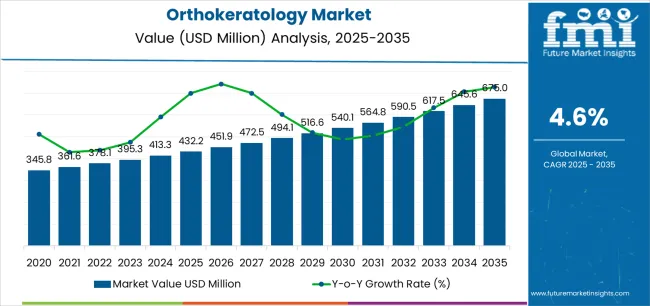
| Metric | Value |
|---|---|
| Orthokeratology Market Estimated Value in (2025 E) | USD 432.2 million |
| Orthokeratology Market Forecast Value in (2035 F) | USD 675.0 million |
| Forecast CAGR (2025 to 2035) | 4.6% |
Segmental Analysis
The market is segmented by Product Type, Application, and End User and region. By Product Type, the market is divided into Overnight Ortho-K Lenses and Day-Time Ortho-K Lenses. In terms of Application, the market is classified into Myopia, Presbyopia, Hypermetropia, and Astigmatism. Based on End User, the market is segmented into Optometry Clinics, Hospitals, Ophthalmology Clinics, and Others. Regionally, the market is classified into North America, Latin America, Western Europe, Eastern Europe, Balkan & Baltic Countries, Russia & Belarus, Central Asia, East Asia, South Asia & Pacific, and the Middle East & Africa.
Insights into the Product Type Segment
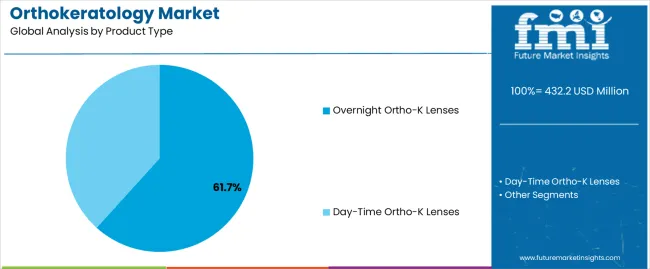
The overnight ortho-k lenses segment, accounting for 61.70% of the product type category, has maintained dominance owing to its convenience, therapeutic efficacy, and widespread clinical recommendation. The segment’s leadership is driven by the ability of overnight lenses to temporarily reshape the cornea and provide clear daytime vision without corrective eyewear.
Adoption has been bolstered by advancements in lens design and material technology that enhance oxygen permeability and comfort. Regulatory approvals in major markets and increased practitioner expertise in lens fitting have further expanded usage.
The preference for overnight lenses among pediatric and adolescent populations, where myopia progression control is critical, has reinforced segment stability Continued innovation in precision manufacturing and patient-specific customization is expected to sustain market share and drive future adoption across both established and emerging optometric markets.
Insights into the Application Segment
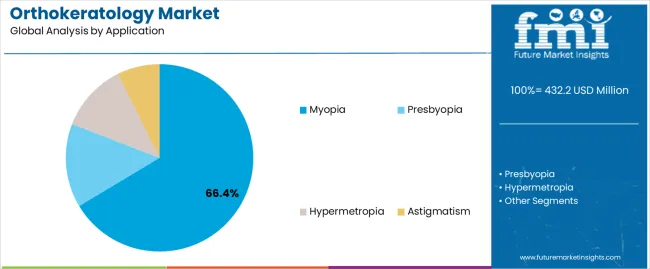
The myopia segment, representing 66.40% of the application category, has emerged as the dominant application area due to rising global prevalence of nearsightedness and increasing awareness of its long-term implications. Orthokeratology’s proven ability to slow myopia progression has strengthened its clinical acceptance and patient adoption.
Expanding screening initiatives and inclusion in pediatric vision care programs are further accelerating growth. The segment’s leadership is supported by the efficacy of customized ortho-k lenses in managing myopia across varying age groups.
Manufacturers are investing in research to refine lens geometry and material composition to achieve improved optical outcomes and patient comfort As myopia continues to rise globally, particularly in urban populations, this segment is expected to remain the primary revenue contributor, driving sustained growth across the orthokeratology market.
Insights into the End User Segment
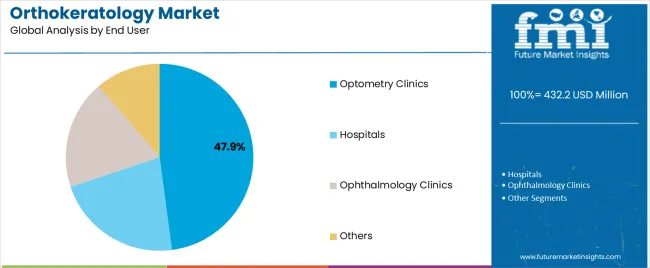
The optometry clinics segment, holding 47.90% of the end user category, has maintained its leading position as the primary point of care for orthokeratology lens fitting and follow-up services. Its dominance is supported by availability of specialized diagnostic equipment, trained practitioners, and personalized care essential for successful ortho-k therapy.
Clinics are increasingly adopting advanced corneal topography and digital imaging systems that enable precise lens customization and monitoring. Patient trust and the ability to provide comprehensive eye health management have reinforced clinic-based adoption.
The segment also benefits from strategic collaborations with lens manufacturers for clinical training and product trials As awareness of non-surgical vision correction continues to grow, optometry clinics are expected to remain central to market expansion, offering tailored services that ensure safety, compliance, and long-term patient satisfaction.
Key Market Highlights
Telemedicine Integration Surges in the Market
The integration of telemedicine with orthokeratology services improves patient accessibility and operational efficacy. Practitioners can optimally utilize their time and resources while addressing a larger patient group through remote consultations and monitoring.
This trend places ortho-k providers as leaders in the delivery of virtual care and corresponds with the increasing need for easy-to-use healthcare solutions. Additionally, by integrating telemedicine, practitioners can provide continual follow-up and assistance, which increases patient loyalty and engagement. In the end, this tendency helps practices become more competitive and scalable in a quickly changing healthcare environment.
Expanding Age Demographics Unlocks Opportunities for Market Players
Ortho-k's evolution from a pediatric-focused product to a feasible adult alternative highlight its adaptability and sales potential for a wide range of age groups. With a rising demand from adult populations looking for vision correction options that fit their lifestyles, ortho-k manufacturers and practitioners are deliberately adapting their solutions to address this growing market group.
This demographic expansion highlights the need of focused marketing tactics and product diversification activities in capitalizing on growing possibilities and driving long-term market success.
Increasing Myopia Prevalence Boosts Demand for Ortho-k
The spike in myopia cases worldwide, especially in the younger population, offers a great chance for the orthokeratology industry to grow. Due to its efficacy in slowing down the advancement of myopia, ortho-k is becoming an increasingly popular option among the myopia management options that eye care specialists are strategically utilizing.
The need for orthokeratology products and services is being driven by this trend, which highlights the vital role that proactive myopia treatment solutions have in addressing the rising public health problem of myopia.
Orthokeratology Market Trends Analysis
| Attribute | Details |
|---|---|
| Trends |
|
| Opportunities |
|
| Challenges |
|
Category-wise Insights
Myopia Dominates as the Top Application for Orthokeratology
| Segment | Myopia (Application) |
|---|---|
| Value Share (2025) | 72% |
Based on application, the myopia segment holds 72% of the orthokeratology market shares in 2025.
- Ortho-K lenses are now more effective and more comfortable to use due to ongoing improvements in lens design, material science, and production. The best corneal reshaping is achieved with modern ortho-k lenses, improving visual results. Orthokeratology is becoming more widely recognized as a practical and successful myopia control option due to advancements in technology.
- Children and adolescents are increasingly being diagnosed with myopia at a younger age, with myopic progression occurring in these age groups. Due to this tendency, the emphasis has shifted from ordinary contact lenses and glasses as corrective measures to therapies that attempt to slow down the growth of myopia but also correct it when it already exists.
Optometry Clinics Continue to be the Leading End User
| Segment | Optometry Clinics (End User) |
|---|---|
| Value Share (2025) | 48% |
Based on end user, the optometry clinics segment captured 48% of orthokeratology market shares in 2025.
- The demand for orthokeratology treatments is rising in optometry clinics as more individuals recognize and embrace this non-surgical approach to vision correction. People are actively looking for optometry clinics that provide these specialized treatments since more information on ortho-k's efficacy in treating myopia is readily available.
- Patients looking for individualized solutions for their visual concerns are drawn to optometry clinics because of their reputation for offering individualized and patient-centered treatment. Demand for orthokeratology treatments is driven by its capacity to deliver personalized corneal reshaping for each patient, which aligns with the patient-centered care philosophy of optometry clinics.
Country-wise Insights
| Countries | Value CAGR (2025 to 2035) |
|---|---|
| United States | 5.8% |
| Germany | 4.20% |
| Italy | 3.24% |
| India | 9.23% |
| Taiwan | 7.1% |
Rising Shift toward Non-invasive Vision Correction Solutions Surges Demand in the United States
The demand for orthokeratology in the United States is anticipated to rise at a 5.8% CAGR through 2035.
- A growing number of individuals are looking for more affordable options in light of the rising costs of healthcare services and vision correction treatments, such as refractive surgery and LASIK. Because orthokeratology provides a reversible, non-surgical option for vision correction, it appeals to customers on a budget. Demand for ortho-k in the United States market is driven by its affordability and the possibility of long-term savings as compared to alternative therapies.
- Combining augmented reality and wearable technologies with orthokeratology offers novel prospects for industry growth. Ortho-K providers can differentiate themselves from the competition and improve patient education and simulation through collaborations with tech firms to create AR applications or smart glasses. Orthokeratology is positioned as a cutting-edge option in the vision correction market by these technical breakthroughs, which also appeal to tech-savvy consumers.
Government Support for Research and Development Bolsters Market Growth in Germany
The orthokeratology market growth in Germany is estimated at a 4.20% CAGR through 2035.
- The expansion of the orthokeratology market is encouraged by government programs that raise awareness of visual health issues and encourage routine eye exams. Providers of orthokeratology can proactively collaborate in awareness campaigns, providing instructional materials and promoting ortho-k as a preventative treatment within the larger framework of preserving eye health.
- The German industry is witnessing an increase in corporate wellness initiatives. Orthokeratology providers can consider forming alliances with businesses to provide ortho-k treatments as a component of employee wellness programs. Ortho-K becomes a useful part of corporate wellness efforts by meeting the unique vision demands of working professionals, which can increase market demand.
Integration with Luxury Eye Care Services Boosts Expansion in Italy
The demand for ortho-k solutions in Italy is predicted to rise at a 3.24% CAGR through 2035.
- Orthokeratology providers have a chance to offer their services as superior eye care options in Italy's luxury-focused market. Appealing to the affluent audience, businesses can provide customized and concierge-style ortho-k services in addition to premium lens styles and packaging. This strategy takes advantage of the Italian market's preference for upscale and personalized services.
- The large aging population in Italy presents prospects for orthokeratology in the treatment of presbyopia and other age-related vision issues. Providers can position ortho-k as a comprehensive therapy that addresses both myopia control and presbyopia management. This method contributes to a diverse market presence by meeting the unique visual demands of the aging population.
Rising Middle-class Aspirations for Advanced Eye Care Fuel Demand in India
The orthokeratology market growth in India is projected at a 9.23% CAGR through 2035.
- The growing Indian middle class has higher expectations for more sophisticated and individualized medical treatment. Appealing to this group, orthokeratology is promoted as a cutting-edge, non-invasive approach to vision correction. By positioning ortho-k as a cutting-edge, lifestyle-friendly product, providers can capitalize on this desire and encourage market acceptance.
- Although there is potential in urban areas, orthokeratology providers should strategically concentrate on non-urban markets and Tier II/Tier III cities that have an increasing middle-class population. Adapting marketing tactics to these groups' unique requirements and preferences helps suppliers enter less crowded marketplaces and increases market penetration.
Integration with E-commerce Platforms for Accessibility Surges Demand in Taiwan
The demand for orthokeratology in Taiwan is expected to amplify at a 7.1% CAGR through 2035.
- Taiwan boasts a thriving e-commerce industry. By maximizing their online presence, orthokeratology providers can improve accessibility and reach a wider audience. Providing direct-to-consumer business models, easy buying procedures, and online consultations can help grow the industry and satisfy local demand for digital services.
- Taiwan is acknowledged as a center for technical innovation. Providers of orthokeratology can take advantage of this by including new technologies in their packages. Smart lenses, digital monitoring tools, and patient interaction mobile applications are examples of innovations that can set ortho-k services apart in Taiwan's tech-savvy market and appeal to customers who value state-of-the-art solutions.
Competitive Landscape
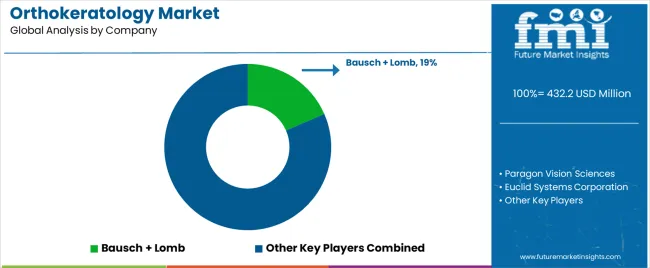
The orthokeratology market is competitive, with numerous significant competitors vying for market share and distinction. Leading companies in the industry, like Bausch + Lomb, Euclid Systems Corporation, and Paragon Vision Sciences, are renowned for their technological acumen and provide cutting-edge ortho-k solutions that meet the changing needs of consumers and practitioners. These businesses frequently carry out intensive R&D to create cutting-edge lens designs, materials, and production processes, fostering a vibrant and forward-thinking marketplace.
Recent Developments
- In May 2025, Menicon Co. Ltd., launched orthokeratology lenses “Menicon Z Night” in China. The product is popular in Southeast Asia, Australia, and Europe.
- In January 2025, CooperVision Specialty EyeCare announced the introduction of VisavyTM, a groundbreaking digital fitting tool pronounced by Vee-SAH-vee, at the 2025 Global Specialty Lens Symposium (GSLS). Topography-guided algorithms aid Paragon CRT® orthokeratology contact lens design and selection in the user-friendly web-based fitting program. This helps with myopia control.
Key Players in the Orthokeratology Market
- Paragon Vision Sciences
- Bausch + Lomb
- Euclid Systems Corporation
- GP Specialists
- Art Optical Contact Lens, Inc.
- Menicon Co., Ltd.
- CooperVision
- Visionary Optics, LLC
- E&E Optics
- Brighten Optix
Key Coverage in the Orthokeratology Market Report
- Adjacent Study on the Orthokeratology Lens Market, Orthokeratology Contact Lens Market, and Overnight Orthokeratology Lenses Market
- Demand Analysis of the Orthokeratology Market in the United States
- Consumption Insights of Rigid Gas Permeable Contact Lenses for Orthokeratology
- Sales Analysis of the Asia Pacific Orthokeratology Market
Orthokeratology Market Segmentation
Product Type:
- Day-time Ortho-K Lenses
- Overnight Ortho-K Lenses
By Application:
- Myopia
- Presbyopia
- Hypermetropia
- Astigmatism
By End User:
- Hospitals
- Optometry Clinics
- Ophthalmology Clinics
- Others
By Region:
- North America
- Latin America
- Western Europe
- Eastern Europe
- Asia Pacific (APAC)
- Middle East & Africa (MEA)
- Japan
Frequently Asked Questions
How big is the orthokeratology market in 2025?
The global orthokeratology market is estimated to be valued at USD 432.2 million in 2025.
What will be the size of orthokeratology market in 2035?
The market size for the orthokeratology market is projected to reach USD 675.0 million by 2035.
How much will be the orthokeratology market growth between 2025 and 2035?
The orthokeratology market is expected to grow at a 4.6% CAGR between 2025 and 2035.
What are the key product types in the orthokeratology market?
The key product types in orthokeratology market are overnight ortho-k lenses and day-time ortho-k lenses.
Which application segment to contribute significant share in the orthokeratology market in 2025?
In terms of application, myopia segment to command 66.4% share in the orthokeratology market in 2025.
Preview the report firsthand - request a free sample
Get SampleGet the brochure for pricing and purchase details.
Get PDFTable of Content
- Executive Summary
- Global Market Outlook
- Demand-side Trends
- Supply-side Trends
- Technology Roadmap Analysis
- Analysis and Recommendations
- Market Overview
- Market Coverage / Taxonomy
- Market Definition / Scope / Limitations
- Market Background
- Market Dynamics
- Drivers
- Restraints
- Opportunity
- Trends
- Scenario Forecast
- Demand in Optimistic Scenario
- Demand in Likely Scenario
- Demand in Conservative Scenario
- Opportunity Map Analysis
- Product Life Cycle Analysis
- Supply Chain Analysis
- Investment Feasibility Matrix
- Value Chain Analysis
- PESTLE and Porter’s Analysis
- Regulatory Landscape
- Regional Parent Market Outlook
- Production and Consumption Statistics
- Import and Export Statistics
- Market Dynamics
- Global Market Analysis 2020 to 2024 and Forecast, 2025 to 2035
- Historical Market Size Value (USD Million) Analysis, 2020 to 2024
- Current and Future Market Size Value (USD Million) Projections, 2025 to 2035
- Y-o-Y Growth Trend Analysis
- Absolute $ Opportunity Analysis
- Global Market Pricing Analysis 2020 to 2024 and Forecast 2025 to 2035
- Global Market Analysis 2020 to 2024 and Forecast 2025 to 2035, By Product Type
- Introduction / Key Findings
- Historical Market Size Value (USD Million) Analysis By Product Type , 2020 to 2024
- Current and Future Market Size Value (USD Million) Analysis and Forecast By Product Type , 2025 to 2035
- Overnight Ortho-K Lenses
- Day-Time Ortho-K Lenses
- Y-o-Y Growth Trend Analysis By Product Type , 2020 to 2024
- Absolute $ Opportunity Analysis By Product Type , 2025 to 2035
- Global Market Analysis 2020 to 2024 and Forecast 2025 to 2035, By Application
- Introduction / Key Findings
- Historical Market Size Value (USD Million) Analysis By Application, 2020 to 2024
- Current and Future Market Size Value (USD Million) Analysis and Forecast By Application, 2025 to 2035
- Myopia
- Presbyopia
- Hypermetropia
- Astigmatism
- Y-o-Y Growth Trend Analysis By Application, 2020 to 2024
- Absolute $ Opportunity Analysis By Application, 2025 to 2035
- Global Market Analysis 2020 to 2024 and Forecast 2025 to 2035, By End User
- Introduction / Key Findings
- Historical Market Size Value (USD Million) Analysis By End User, 2020 to 2024
- Current and Future Market Size Value (USD Million) Analysis and Forecast By End User, 2025 to 2035
- Optometry Clinics
- Hospitals
- Ophthalmology Clinics
- Others
- Y-o-Y Growth Trend Analysis By End User, 2020 to 2024
- Absolute $ Opportunity Analysis By End User, 2025 to 2035
- Global Market Analysis 2020 to 2024 and Forecast 2025 to 2035, By Region
- Introduction
- Historical Market Size Value (USD Million) Analysis By Region, 2020 to 2024
- Current Market Size Value (USD Million) Analysis and Forecast By Region, 2025 to 2035
- North America
- Latin America
- Western Europe
- Eastern Europe
- East Asia
- South Asia and Pacific
- Middle East & Africa
- Market Attractiveness Analysis By Region
- North America Market Analysis 2020 to 2024 and Forecast 2025 to 2035, By Country
- Historical Market Size Value (USD Million) Trend Analysis By Market Taxonomy, 2020 to 2024
- Market Size Value (USD Million) Forecast By Market Taxonomy, 2025 to 2035
- By Country
- USA
- Canada
- Mexico
- By Product Type
- By Application
- By End User
- By Country
- Market Attractiveness Analysis
- By Country
- By Product Type
- By Application
- By End User
- Key Takeaways
- Latin America Market Analysis 2020 to 2024 and Forecast 2025 to 2035, By Country
- Historical Market Size Value (USD Million) Trend Analysis By Market Taxonomy, 2020 to 2024
- Market Size Value (USD Million) Forecast By Market Taxonomy, 2025 to 2035
- By Country
- Brazil
- Chile
- Rest of Latin America
- By Product Type
- By Application
- By End User
- By Country
- Market Attractiveness Analysis
- By Country
- By Product Type
- By Application
- By End User
- Key Takeaways
- Western Europe Market Analysis 2020 to 2024 and Forecast 2025 to 2035, By Country
- Historical Market Size Value (USD Million) Trend Analysis By Market Taxonomy, 2020 to 2024
- Market Size Value (USD Million) Forecast By Market Taxonomy, 2025 to 2035
- By Country
- Germany
- UK
- Italy
- Spain
- France
- Nordic
- BENELUX
- Rest of Western Europe
- By Product Type
- By Application
- By End User
- By Country
- Market Attractiveness Analysis
- By Country
- By Product Type
- By Application
- By End User
- Key Takeaways
- Eastern Europe Market Analysis 2020 to 2024 and Forecast 2025 to 2035, By Country
- Historical Market Size Value (USD Million) Trend Analysis By Market Taxonomy, 2020 to 2024
- Market Size Value (USD Million) Forecast By Market Taxonomy, 2025 to 2035
- By Country
- Russia
- Poland
- Hungary
- Balkan & Baltic
- Rest of Eastern Europe
- By Product Type
- By Application
- By End User
- By Country
- Market Attractiveness Analysis
- By Country
- By Product Type
- By Application
- By End User
- Key Takeaways
- East Asia Market Analysis 2020 to 2024 and Forecast 2025 to 2035, By Country
- Historical Market Size Value (USD Million) Trend Analysis By Market Taxonomy, 2020 to 2024
- Market Size Value (USD Million) Forecast By Market Taxonomy, 2025 to 2035
- By Country
- China
- Japan
- South Korea
- By Product Type
- By Application
- By End User
- By Country
- Market Attractiveness Analysis
- By Country
- By Product Type
- By Application
- By End User
- Key Takeaways
- South Asia and Pacific Market Analysis 2020 to 2024 and Forecast 2025 to 2035, By Country
- Historical Market Size Value (USD Million) Trend Analysis By Market Taxonomy, 2020 to 2024
- Market Size Value (USD Million) Forecast By Market Taxonomy, 2025 to 2035
- By Country
- India
- ASEAN
- Australia & New Zealand
- Rest of South Asia and Pacific
- By Product Type
- By Application
- By End User
- By Country
- Market Attractiveness Analysis
- By Country
- By Product Type
- By Application
- By End User
- Key Takeaways
- Middle East & Africa Market Analysis 2020 to 2024 and Forecast 2025 to 2035, By Country
- Historical Market Size Value (USD Million) Trend Analysis By Market Taxonomy, 2020 to 2024
- Market Size Value (USD Million) Forecast By Market Taxonomy, 2025 to 2035
- By Country
- Kingdom of Saudi Arabia
- Other GCC Countries
- Turkiye
- South Africa
- Other African Union
- Rest of Middle East & Africa
- By Product Type
- By Application
- By End User
- By Country
- Market Attractiveness Analysis
- By Country
- By Product Type
- By Application
- By End User
- Key Takeaways
- Key Countries Market Analysis
- USA
- Pricing Analysis
- Market Share Analysis, 2024
- By Product Type
- By Application
- By End User
- Canada
- Pricing Analysis
- Market Share Analysis, 2024
- By Product Type
- By Application
- By End User
- Mexico
- Pricing Analysis
- Market Share Analysis, 2024
- By Product Type
- By Application
- By End User
- Brazil
- Pricing Analysis
- Market Share Analysis, 2024
- By Product Type
- By Application
- By End User
- Chile
- Pricing Analysis
- Market Share Analysis, 2024
- By Product Type
- By Application
- By End User
- Germany
- Pricing Analysis
- Market Share Analysis, 2024
- By Product Type
- By Application
- By End User
- UK
- Pricing Analysis
- Market Share Analysis, 2024
- By Product Type
- By Application
- By End User
- Italy
- Pricing Analysis
- Market Share Analysis, 2024
- By Product Type
- By Application
- By End User
- Spain
- Pricing Analysis
- Market Share Analysis, 2024
- By Product Type
- By Application
- By End User
- France
- Pricing Analysis
- Market Share Analysis, 2024
- By Product Type
- By Application
- By End User
- India
- Pricing Analysis
- Market Share Analysis, 2024
- By Product Type
- By Application
- By End User
- ASEAN
- Pricing Analysis
- Market Share Analysis, 2024
- By Product Type
- By Application
- By End User
- Australia & New Zealand
- Pricing Analysis
- Market Share Analysis, 2024
- By Product Type
- By Application
- By End User
- China
- Pricing Analysis
- Market Share Analysis, 2024
- By Product Type
- By Application
- By End User
- Japan
- Pricing Analysis
- Market Share Analysis, 2024
- By Product Type
- By Application
- By End User
- South Korea
- Pricing Analysis
- Market Share Analysis, 2024
- By Product Type
- By Application
- By End User
- Russia
- Pricing Analysis
- Market Share Analysis, 2024
- By Product Type
- By Application
- By End User
- Poland
- Pricing Analysis
- Market Share Analysis, 2024
- By Product Type
- By Application
- By End User
- Hungary
- Pricing Analysis
- Market Share Analysis, 2024
- By Product Type
- By Application
- By End User
- Kingdom of Saudi Arabia
- Pricing Analysis
- Market Share Analysis, 2024
- By Product Type
- By Application
- By End User
- Turkiye
- Pricing Analysis
- Market Share Analysis, 2024
- By Product Type
- By Application
- By End User
- South Africa
- Pricing Analysis
- Market Share Analysis, 2024
- By Product Type
- By Application
- By End User
- USA
- Market Structure Analysis
- Competition Dashboard
- Competition Benchmarking
- Market Share Analysis of Top Players
- By Regional
- By Product Type
- By Application
- By End User
- Competition Analysis
- Competition Deep Dive
- Bausch + Lomb
- Overview
- Product Portfolio
- Profitability by Market Segments (Product/Age /Sales Channel/Region)
- Sales Footprint
- Strategy Overview
- Marketing Strategy
- Product Strategy
- Channel Strategy
- Paragon Vision Sciences
- Euclid Systems Corporation
- GP Specialists
- Art Optical Contact Lens, Inc.
- Menicon Co., Ltd.
- CooperVision
- Visionary Optics, LLC
- E&E Optics
- Brighten Optix
- Bausch + Lomb
- Competition Deep Dive
- Assumptions & Acronyms Used
- Research Methodology


