

- Industry Size (2026):
- USD 0.8 Bn
- Forecast (2036):
- USD 1.6 Bn
- CAGR (2026 to 2036)
- 6.9%
Paper Perforation Machine Market Forecast and Outlook 2026 to 2036
In 2026, the paper perforation machine market is likely to be valued at USD 0.8 billion and is expected to reach USD 1.6 billion by 2036, implying a CAGR of 6.9%. The economic role of these machines sits inside finishing and converting operations rather than in primary printing. Their value comes from enabling controlled tear lines in tickets, labels, packaging inserts, manuals, and transactional documents, where downstream handling and user interaction depend on consistent separation. Demand concentrates in regions with large commercial printing, packaging conversion, and security document production bases. Investment decisions are often linked to product format changes, compliance requirements, or contract wins rather than to general print volume growth.
Production managers and converters, rather than print buyers, usually drive equipment selection because perforation accuracy affects waste rates, binding performance, and downstream automation. Once a machine is integrated into a finishing line, it becomes part of a tuned process sequence, which raises the cost of later substitution. Setup time, blade life, and registration stability matter as much as nominal speed. Smaller shops rely on multifunction finishing units, while high volume converters standardize dedicated lines. The market grows through packaging and document format complexity and through efficiency driven line upgrades, not through broad expansion of traditional commercial printing activity.
Quick Stats for Paper Perforation Machine Market
- Paper Perforation Machine Market Value (2026): USD 0.8 billion
- Paper Perforation Machine Market Forecast Value (2036): USD 1.6 billion
- Paper Perforation Machine Market Forecast CAGR 2026 to 2036: 6.9%
- Leading Type in Paper Perforation Machine Market: Automatic paper perforation machines
- Key Growth Regions in Paper Perforation Machine Market: Asia Pacific, North America, Europe
- Top Players in Paper Perforation Machine Market: Kolbus GmbH & Co. KG, Muller Martini, Horizon International, Polar Mohr Maschinenvertrieb (Heidelberg), Duplo International
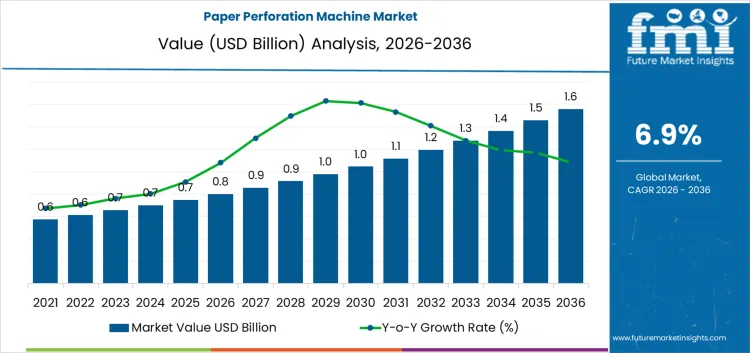
What is the Growth Forecast for Paper Perforation Machine Market through 2036?
The paper perforation machine industry follows the steady economics of packaging, printing, and converting rather than rapid technology cycles. In the early phase, demand remains stable due to a mature installed base and limited new plant additions. Growth during this stage is mainly supported by incremental upgrades in packaging, ticketing, and label converting lines, with investments focused more on improving existing operations than expanding capacity. Over time, perforation systems increasingly get replaced as part of modernization programs or integrated directly into higher-speed finishing and converting equipment instead of being purchased as standalone machines.
In the later stage, growth continues to be shaped primarily by replacement cycles and equipment modernization rather than structural demand expansion. Printers and converters invest in faster, more automated finishing lines to improve productivity and reduce labor dependency. Packaging format diversification, the rise of e-commerce shipping requirements, and greater automation in print finishing further support demand. Overall, value growth remains moderate and predictable, driven by higher machine value per converting line and periodic renewal of equipment. This category remains a stable, utility-type capital equipment segment where reliability, ease of integration, and strong service support carry more weight than aggressive performance differentiation.
Paper Perforation Machine Market Key Takeaways
| Metric | Value |
|---|---|
| Market Value (2026) | USD 0.8 billion |
| Forecast Value (2036) | USD 1.6 billion |
| Forecast CAGR 2026 to 2036 | 6.9% |
How Is the Paper Perforation Machine Market Enhancing Printing and Finishing Operations?
Paper perforation machines are increasingly adopted to create precise, uniform perforations in sheets, rolls, and finished products for printing, packaging, and document handling applications. Historically, perforation relied on manual punching or basic mechanical devices, which limited speed, consistency, and scalability. Modern perforation machines integrate automated feeding systems, precision cutting dies, and programmable control units to achieve high-speed, accurate perforations while minimizing paper waste and operational errors. Printing houses, packaging manufacturers, and office supply producers prioritize machine reliability, perforation precision, and compatibility with varying paper thicknesses. Early adoption focused on industrial printing and ticket production, while current demand spans commercial packaging, document processing, and specialty paper products, driven by operational efficiency, production consistency, and product quality standards. Die quality, feed mechanism accuracy, and throughput speed influence supplier selection.
Operational precision, high throughput, and waste reduction are shaping market growth. Compared with manual or semi-automated solutions, modern perforation machines emphasize consistent perforation quality, minimal downtime, and adaptability to different paper types and formats. Cost structures depend on mechanical precision, automation level, and maintenance requirements, concentrating margins among suppliers capable of delivering robust, high-performance equipment. Printing and packaging operators adopt these machines to enhance production efficiency, reduce material waste, and ensure consistent product standards. By 2036, paper perforation machines are expected to support highly accurate, scalable perforation processes, enabling improved product finishing, faster production cycles, and reliable output across industrial and commercial paper applications.
Which Factors Influence Demand for Paper Perforation Machines Across Machine and End-Use Segments in 2026?
The Paper Perforation Machine Market is structured around how much variability, operator dependence, and schedule pressure a production environment can absorb before quality and delivery performance begin to degrade. By machine type, the Paper Perforation Machine Market includes automatic paper perforation machines, semi-automatic paper perforators, hand-operated perforation machines, and CNC or servo-controlled perforation systems. By end-use, the Paper Perforation Machine Market serves printing and publishing, packaging and labels, office and stationery, and commercial printing services. These categories reflect fundamentally different production behaviors rather than simple differences in output volume.
How Does Production Discipline, Not Just Speed, Drive Machine Type Selection in the Paper Perforation Machine Market?
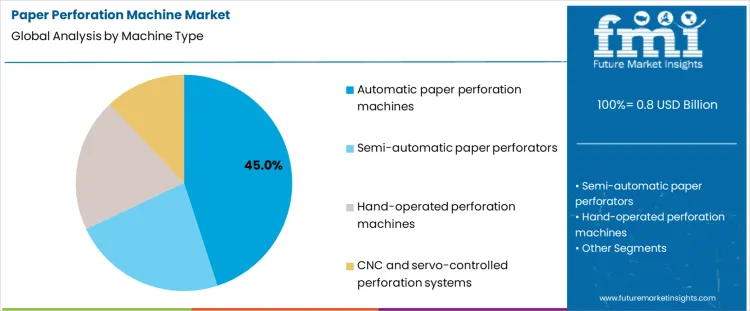
Automatic paper perforation machines account for about 45% of demand in the Paper Perforation Machine Market, but their role is not primarily about achieving the highest possible speed. Their real value is removing human variability from a process that sits late in the production chain, where delays are expensive and rework is visible. In many print and packaging operations, perforation is not the main process step, yet it often becomes a bottleneck because it depends on operator consistency, setup accuracy, and fatigue. Automation is introduced to stabilize this weak point rather than to maximize throughput.
CNC and servo-controlled systems sit further along this logic, but they only deliver value where job data, formats, and scheduling are already disciplined. In environments where formats change unpredictably and planning remains informal, these systems become underutilized. Semi-automatic and hand-operated machines therefore remain common, not because they are preferred, but because organizational readiness lags behind technical capability. Many workshops still rely on experienced operators to compensate for unstable upstream processes. The Paper Perforation Machine Market is therefore split less by technology level and more by how much operational structure a business can sustain over time.
Why Does Printing and Publishing Continue to Absorb the Largest Share of Demand in the Paper Perforation Machine Market?
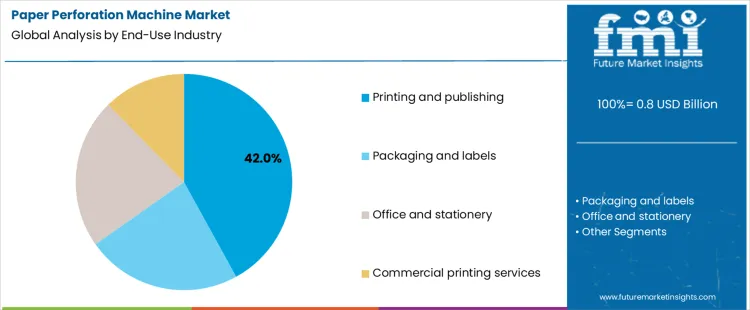
Printing and publishing represent about 42% of demand in the Paper Perforation Machine Market because perforation in this sector is not an occasional feature, but a routine structural requirement. Tickets, forms, vouchers, manuals, book inserts, and transactional documents depend on perforation as part of their basic function. This means perforation equipment is used daily, across many jobs, and under constant schedule pressure. Wear, alignment drift, and format changes create continuous replacement and upgrade demand even when overall print volumes are not expanding.
Packaging and label applications use perforation more selectively, usually tied to specific product programs or tear-open features. Office and stationery relies heavily on manual or low-duty equipment, which limits capital intensity. Commercial printing services often invest in higher capability machines, but their purchasing is project driven rather than continuous. In contrast, printing and publishing operations treat perforation as infrastructure, not as a value-added option. Because this function is embedded into core workflows, investment decisions in this segment are driven by reliability and scheduling risk rather than by pure cost or novelty. That is why this segment continues to anchor volume demand in the Paper Perforation Machine Market.
How Are the Key Dynamics Reshaping the Paper Perforation Machine Market?
This market is governed by production efficiency targets, cautious capital cycles, and the quiet push toward standardized finishing lines. Perforation is rarely a standalone investment; it is justified when it removes downstream handling, reduces waste, or stabilizes output quality. At the same time, printers and converters prefer fewer machine variants to simplify spares, training, and changeovers. These forces make growth lumpy and program driven. Scale comes from being specified into repeatable line layouts and OEM packages rather than from frequent one off purchases, and success depends on uptime, setup speed, and fit within standardized finishing workflows.
Why Is Throughput Efficiency Driving the Paper Perforation Machine Market?
Finishing often sets the pace for print and converting lines. Tickets, labels, forms, packaging inserts, and tear off documents require precise, repeatable perforation at line speed. When perforation is integrated and reliable, it removes manual handling and secondary passes, which shortens cycle time and protects margins. As order profiles shift toward shorter runs and faster turnaround, setup time and consistency matter more than peak speed alone. Once a line is balanced around an in line perforation step, the machine becomes part of the capacity equation and is replicated across similar lines and plants.
What Is Slowing the Paper Perforation Machine Market?
Investment decisions are conservative. Many plants already have workable equipment, and perforation rarely wins budget against core printing or cutting assets. Retrofitting can disrupt layouts, web paths, and tension control, which raises commissioning risk. In mixed job environments, frequent format changes also increase setup complexity. Some products can be outsourced or perforated off line, reducing urgency. These factors stretch replacement cycles and keep new purchases tied to line expansions, major upgrades, or new product formats rather than routine refresh. As a result, demand arrives in waves aligned with broader capital programs.
How Are Platforms Changing the Paper Perforation Machine Market?
Converters and OEMs are standardizing finishing modules. Perforation units are increasingly selected as part of defined line architectures alongside slitters, cutters, and folders. This favors suppliers that offer compatible interfaces, quick change tooling, and predictable spare support. Once a module is approved in a reference line, it is reused across sites without requalification. Procurement shifts to framework agreements covering families of machines and services. Over time, competition moves from single machine features to inclusion in standardized line packages, documentation quality, and ability to support multi-site rollout programs.
What is the Demand for Paper Perforation Machines by Country?
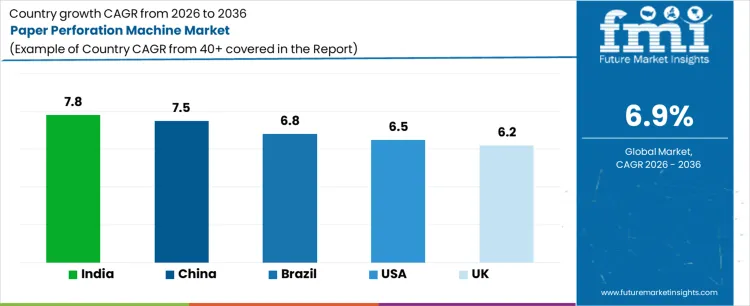
| Country | CAGR (%) |
|---|---|
| USA | 6.5 |
| UK | 6.2 |
| China | 7.5 |
| India | 7.8 |
| Brazil | 6.8 |
Demand for paper perforation machines is rising as printing, packaging, and stationery manufacturers adopt automated solutions to improve production efficiency, precision, and product quality. India leads with a 7.8% CAGR, driven by growing demand for printed materials, packaging innovation, and adoption of automated machinery. China follows at 7.5%, supported by high-volume printing operations and packaging industry expansion. Brazil records 6.8% growth, shaped by industrial and commercial printing requirements. The USA grows at 6.5%, influenced by replacement demand and integration in modern printing facilities. The UK shows 6.2% CAGR, reflecting steady adoption across commercial printing and packaging sectors.
How is the United States experiencing growth in the Paper Perforation Machine Market?
United States is recording a CAGR of 6.5%, with steady orders coming from packaging converters, security printing units, and document processing service providers using paper perforation machine systems. Demand concentrates in logistics labels, ticketing stock, pharmaceutical inserts, and multipart business forms where controlled tear performance matters. Equipment selection focuses on cutting accuracy, blade life, and throughput stability across long production runs. Mid-sized printing plants upgrade older mechanical units toward digitally controlled models to reduce setup time and waste. Supply chains favor domestic service coverage and fast spare availability. Production volumes remain tied to commercial print activity rather than consumer publishing cycles. Regional clusters of packaging and compliance printing support repeat orders. Purchasing decisions follow capital budgeting cycles and plant level productivity targets rather than short term volume spikes.
How is the United Kingdom experiencing growth in the Paper Perforation Machine Market?
United Kingdom is recording a CAGR of 6.2% in printing. Commercial packaging plants, ticket producers, compliance printers drive equipment orders. Investment priorities center on accuracy, blade durability, stable continuous throughput. Replacement cycles follow maintenance records, operator availability, planned capacity utilization. Vendors compete through service coverage, training programs, predictable spare supply. Regional printing clusters support repeat purchases across regulated document categories. Production planning teams prefer machines supporting quick format changeovers cycles. Energy usage and noise control influence factory level equipment selection. Capital budgets favor predictable payback periods over speculative capability expansion. Import dependence remains limited through domestic manufacturing partnerships, service networks. Operators value predictable maintenance intervals over extreme peak speed capability. Procurement reviews include safety compliance, operator training, documentation requirements check. Adoption progresses through incremental upgrades across existing press lines floors.
How is China experiencing growth in the Paper Perforation Machine Market?
China is recording a CAGR of 7.5% in printing operations. Large packaging plants and security printers account for substantial equipment demand. Equipment selection emphasizes throughput stability, tooling life, consistent perforation depth. Factory managers prioritize integration with folding, cutting, binding production lines. Local manufacturers expand component supply, service coverage, application engineering resources. Import brands retain roles within high specification compliance printing environments. Regional clusters in coastal manufacturing zones concentrate most new installations. Procurement teams evaluate machines through long trial runs and acceptance testing. Cost control programs influence configuration choices and optional automation features. Maintenance planning favors designs supporting fast blade replacement procedures. Workforce training programs accompany most new equipment deployments. Production scheduling benefits from predictable cycle times and reduced setup losses. Capacity expansion follows export packaging output growth across multiple industrial sectors.
How is India experiencing growth in the Paper Perforation Machine Market?
India is recording a CAGR of 7.8% in printing equipment demand. Commercial printers, packaging converters, exam material producers drive steady purchases. Equipment buyers focus on durability, simple maintenance, stable operating tolerance. Many plants upgrade manual units toward semi-automatic perforation systems. Regional distributors play strong roles in installation, training, service support. Import machines serve high volume security printing and pharmaceutical packaging. Domestic manufacturers compete through pricing, spare availability, local service response. Production managers track waste reduction and sheet handling accuracy metrics. Power stability and workshop conditions influence equipment specification decisions. Capital planning links purchases to confirmed customer contracts and renewals. Educational publishing and logistics documentation sustain baseline equipment utilization. Operator skill development remains part of most installation programs. Expansion follows printing capacity growth across multiple regional industrial centers.
How is Brazil experiencing growth in the Paper Perforation Machine Market?
Brazil is recording a CAGR of 6.8% in printing machinery usage. Demand comes from packaging printers, ticket producers, compliance documentation contractors. Equipment selection emphasizes mechanical robustness, stable calibration, manageable maintenance routines. Import dependence shapes pricing, delivery schedules, long term service planning. Local integrators provide installation, operator training, periodic performance verification services. Usage concentrates in food packaging, transport ticketing, regulated business forms. Production planners value consistent tear quality across mixed paper grades. Capital spending decisions align with packaging contract volumes and renewal cycles. Warehouse labeling projects create additional equipment utilization opportunities. Maintenance teams favor designs with accessible blade change procedures. Regional printing hubs account for most new system deployments. Financial planning favors predictable ownership cost profiles. Adoption progresses through targeted upgrades within existing press rooms.
What Distinguishes Manufacturers in the Paper Perforation Machine Market?
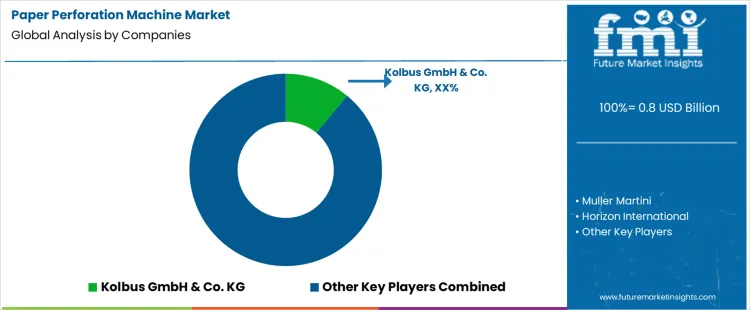
Manufacturers in the paper perforation machine market differentiate through precision, throughput capability, and adaptability to print finishing workflows. Kolbus GmbH & Co. KG supplies perforation systems engineered for consistent hole quality across a wide range of paper weights, supporting binding and booklet production environments. Muller Martini delivers equipment that integrates perforation with feeding and stacking modules, enabling continuous operation in mid to high volume print shops. Horizon International offers perforators designed for compact footprints and straightforward adjustment settings, appealing to small commercial print facilities. Polar Mohr Maschinenvertrieb aligns perforation units with large format cutting tables, targeting industrial finishing operations with heavy duty requirements. Duplo International provides perforation solutions that integrate with multifunction finishing lines, with emphasis on ease of setup for varied job specifications.
Other regional and specialty suppliers contribute machines tailored for niche applications such as ticket booklet finishing or security document perforation. Performance differences arise from feed accuracy, platen stability, and ability to maintain hole uniformity at scale. Integration with digital workflows and quick changeover supports operational flexibility when switching between perforation patterns or paper grades. Supplier relevance is influenced by service networks and availability of spare parts, especially where uptime directly affects print delivery schedules. Adoption reflects demand from commercial printers, binders, and in plant finishing departments that require reliable, repeatable perforation without compromising throughput or paper integrity under continuous use. Quality documentation and user training can affect specification decisions where precision finishing impacts product acceptance and overall production efficiency.
Key Players in the Paper Perforation Machine Market
- Kolbus GmbH & Co. KG
- Muller Martini
- Horizon International
- Polar Mohr Maschinenvertrieb (Heidelberg)
- Duplo International
Scope of the Report
| Items | Values |
|---|---|
| Quantitative Units (2026) | USD billion |
| Machine Type | Automatic paper perforation machines, Semi-automatic paper perforators, Hand-operated perforation machines, CNC and servo-controlled perforation systems |
| End-Use Industry | Printing and publishing, Packaging and labels, Office and stationery, Commercial printing services |
| Region | Asia Pacific, Europe, North America, Latin America, Middle East & Africa |
| Countries Covered | China, Japan, South Korea, India, Australia & New Zealand, ASEAN, Germany, United Kingdom, France, Italy, Spain, Nordic, BENELUX, United States, Canada, Mexico, Brazil, Chile, Saudi Arabia, Turkey, South Africa, and other regional markets |
| Key Companies Profiled | Kolbus GmbH & Co. KG, Muller Martini, Horizon International, Polar Mohr Maschinenvertrieb (Heidelberg), Duplo International |
| Additional Attributes | Dollar sales by machine type and end-use; demand anchored in printing and publishing and automatic systems; growth driven by line modernization, packaging format diversification, and finishing automation; purchasing shaped by integration needs, setup time, blade life, and service support; replacement cycles dominate over greenfield capacity additions. |
Paper Perforation Machine Market Segmentation
Machine Type:
- Automatic paper perforation machines
- Semi-automatic paper perforators
- Hand-operated perforation machines
- CNC and servo-controlled perforation systems
End-Use Industry:
- Printing and publishing
- Packaging and labels
- Office and stationery
- Commercial printing services
Region
- Asia Pacific
- China
- Japan
- South Korea
- India
- Australia & New Zealand
- ASEAN
- Rest of Asia Pacific
- Europe
- Germany
- United Kingdom
- France
- Italy
- Spain
- Nordic
- BENELUX
- Rest of Europe
- North America
- United States
- Canada
- Mexico
- Latin America
- Brazil
- Chile
- Rest of Latin America
- Middle East & Africa
- Kingdom of Saudi Arabia
- Other GCC Countries
- Turkey
- South Africa
- Other African Union
- Rest of Middle East & Africa
Bibliography
- American Forest & Paper Association. (2025). Printing-writing paper industry statistics and production update 2025. AF&PA.
- International Organization for Standardization. (2024). Guidelines for using print production standards (Version 2). ISO.
- United Nations Industrial Development Organization. (2025). Global manufacturing and industrial performance review 2025. UNIDO.
Frequently Asked Questions
How big is the paper perforation machine market in 2026?
The global paper perforation machine market is estimated to be valued at USD 0.8 billion in 2026.
What will be the size of paper perforation machine market in 2036?
The market size for the paper perforation machine market is projected to reach USD 1.6 billion by 2036.
How much will be the paper perforation machine market growth between 2026 and 2036?
The paper perforation machine market is expected to grow at a 6.9% CAGR between 2026 and 2036.
What are the key product types in the paper perforation machine market?
The key product types in paper perforation machine market are automatic paper perforation machines , semi‑automatic paper perforators, hand‑operated perforation machines and cnc and servo‑controlled perforation systems.
Which end‑use industry segment to contribute significant share in the paper perforation machine market in 2026?
In terms of end‑use industry, printing and publishing segment to command 42.0% share in the paper perforation machine market in 2026.
Preview the report firsthand - request a free sample
Get SampleGet the brochure for pricing and purchase details.
Get PDFTable of Content
- Executive Summary
- Global Market Outlook
- Demand-side Trends
- Supply-side Trends
- Technology Roadmap Analysis
- Analysis and Recommendations
- Market Overview
- Market Coverage / Taxonomy
- Market Definition / Scope / Limitations
- Market Background
- Market Dynamics
- Drivers
- Restraints
- Opportunity
- Trends
- Scenario Forecast
- Demand in Optimistic Scenario
- Demand in Likely Scenario
- Demand in Conservative Scenario
- Opportunity Map Analysis
- Product Life Cycle Analysis
- Supply Chain Analysis
- Investment Feasibility Matrix
- Value Chain Analysis
- PESTLE and Porter’s Analysis
- Regulatory Landscape
- Regional Parent Market Outlook
- Production and Consumption Statistics
- Import and Export Statistics
- Market Dynamics
- Global Market Analysis 2021 to 2025 and Forecast, 2026 to 2036
- Historical Market Size Value (USD Million) Analysis, 2021 to 2025
- Current and Future Market Size Value (USD Million) Projections, 2026 to 2036
- Y-o-Y Growth Trend Analysis
- Absolute $ Opportunity Analysis
- Global Market Pricing Analysis 2021 to 2025 and Forecast 2026 to 2036
- Global Market Analysis 2021 to 2025 and Forecast 2026 to 2036, By Machine Type
- Introduction / Key Findings
- Historical Market Size Value (USD Million) Analysis By Machine Type , 2021 to 2025
- Current and Future Market Size Value (USD Million) Analysis and Forecast By Machine Type , 2026 to 2036
- Automatic paper perforation machines
- Semi‑automatic paper perforators
- Hand‑operated perforation machines
- CNC and servo‑controlled perforation systems
- Automatic paper perforation machines
- Y-o-Y Growth Trend Analysis By Machine Type , 2021 to 2025
- Absolute $ Opportunity Analysis By Machine Type , 2026 to 2036
- Global Market Analysis 2021 to 2025 and Forecast 2026 to 2036, By End‑Use Industry
- Introduction / Key Findings
- Historical Market Size Value (USD Million) Analysis By End‑Use Industry, 2021 to 2025
- Current and Future Market Size Value (USD Million) Analysis and Forecast By End‑Use Industry, 2026 to 2036
- Printing and publishing
- Packaging and labels
- Office and stationery
- Commercial printing services
- Printing and publishing
- Y-o-Y Growth Trend Analysis By End‑Use Industry, 2021 to 2025
- Absolute $ Opportunity Analysis By End‑Use Industry, 2026 to 2036
- Global Market Analysis 2021 to 2025 and Forecast 2026 to 2036, By Region
- Introduction
- Historical Market Size Value (USD Million) Analysis By Region, 2021 to 2025
- Current Market Size Value (USD Million) Analysis and Forecast By Region, 2026 to 2036
- North America
- Latin America
- Western Europe
- Eastern Europe
- East Asia
- South Asia and Pacific
- Middle East & Africa
- Market Attractiveness Analysis By Region
- North America Market Analysis 2021 to 2025 and Forecast 2026 to 2036, By Country
- Historical Market Size Value (USD Million) Trend Analysis By Market Taxonomy, 2021 to 2025
- Market Size Value (USD Million) Forecast By Market Taxonomy, 2026 to 2036
- By Country
- USA
- Canada
- Mexico
- By Machine Type
- By End‑Use Industry
- By Country
- Market Attractiveness Analysis
- By Country
- By Machine Type
- By End‑Use Industry
- Key Takeaways
- Latin America Market Analysis 2021 to 2025 and Forecast 2026 to 2036, By Country
- Historical Market Size Value (USD Million) Trend Analysis By Market Taxonomy, 2021 to 2025
- Market Size Value (USD Million) Forecast By Market Taxonomy, 2026 to 2036
- By Country
- Brazil
- Chile
- Rest of Latin America
- By Machine Type
- By End‑Use Industry
- By Country
- Market Attractiveness Analysis
- By Country
- By Machine Type
- By End‑Use Industry
- Key Takeaways
- Western Europe Market Analysis 2021 to 2025 and Forecast 2026 to 2036, By Country
- Historical Market Size Value (USD Million) Trend Analysis By Market Taxonomy, 2021 to 2025
- Market Size Value (USD Million) Forecast By Market Taxonomy, 2026 to 2036
- By Country
- Germany
- UK
- Italy
- Spain
- France
- Nordic
- BENELUX
- Rest of Western Europe
- By Machine Type
- By End‑Use Industry
- By Country
- Market Attractiveness Analysis
- By Country
- By Machine Type
- By End‑Use Industry
- Key Takeaways
- Eastern Europe Market Analysis 2021 to 2025 and Forecast 2026 to 2036, By Country
- Historical Market Size Value (USD Million) Trend Analysis By Market Taxonomy, 2021 to 2025
- Market Size Value (USD Million) Forecast By Market Taxonomy, 2026 to 2036
- By Country
- Russia
- Poland
- Hungary
- Balkan & Baltic
- Rest of Eastern Europe
- By Machine Type
- By End‑Use Industry
- By Country
- Market Attractiveness Analysis
- By Country
- By Machine Type
- By End‑Use Industry
- Key Takeaways
- East Asia Market Analysis 2021 to 2025 and Forecast 2026 to 2036, By Country
- Historical Market Size Value (USD Million) Trend Analysis By Market Taxonomy, 2021 to 2025
- Market Size Value (USD Million) Forecast By Market Taxonomy, 2026 to 2036
- By Country
- China
- Japan
- South Korea
- By Machine Type
- By End‑Use Industry
- By Country
- Market Attractiveness Analysis
- By Country
- By Machine Type
- By End‑Use Industry
- Key Takeaways
- South Asia and Pacific Market Analysis 2021 to 2025 and Forecast 2026 to 2036, By Country
- Historical Market Size Value (USD Million) Trend Analysis By Market Taxonomy, 2021 to 2025
- Market Size Value (USD Million) Forecast By Market Taxonomy, 2026 to 2036
- By Country
- India
- ASEAN
- Australia & New Zealand
- Rest of South Asia and Pacific
- By Machine Type
- By End‑Use Industry
- By Country
- Market Attractiveness Analysis
- By Country
- By Machine Type
- By End‑Use Industry
- Key Takeaways
- Middle East & Africa Market Analysis 2021 to 2025 and Forecast 2026 to 2036, By Country
- Historical Market Size Value (USD Million) Trend Analysis By Market Taxonomy, 2021 to 2025
- Market Size Value (USD Million) Forecast By Market Taxonomy, 2026 to 2036
- By Country
- Kingdom of Saudi Arabia
- Other GCC Countries
- Turkiye
- South Africa
- Other African Union
- Rest of Middle East & Africa
- By Machine Type
- By End‑Use Industry
- By Country
- Market Attractiveness Analysis
- By Country
- By Machine Type
- By End‑Use Industry
- Key Takeaways
- Key Countries Market Analysis
- USA
- Pricing Analysis
- Market Share Analysis, 2025
- By Machine Type
- By End‑Use Industry
- Canada
- Pricing Analysis
- Market Share Analysis, 2025
- By Machine Type
- By End‑Use Industry
- Mexico
- Pricing Analysis
- Market Share Analysis, 2025
- By Machine Type
- By End‑Use Industry
- Brazil
- Pricing Analysis
- Market Share Analysis, 2025
- By Machine Type
- By End‑Use Industry
- Chile
- Pricing Analysis
- Market Share Analysis, 2025
- By Machine Type
- By End‑Use Industry
- Germany
- Pricing Analysis
- Market Share Analysis, 2025
- By Machine Type
- By End‑Use Industry
- UK
- Pricing Analysis
- Market Share Analysis, 2025
- By Machine Type
- By End‑Use Industry
- Italy
- Pricing Analysis
- Market Share Analysis, 2025
- By Machine Type
- By End‑Use Industry
- Spain
- Pricing Analysis
- Market Share Analysis, 2025
- By Machine Type
- By End‑Use Industry
- France
- Pricing Analysis
- Market Share Analysis, 2025
- By Machine Type
- By End‑Use Industry
- India
- Pricing Analysis
- Market Share Analysis, 2025
- By Machine Type
- By End‑Use Industry
- ASEAN
- Pricing Analysis
- Market Share Analysis, 2025
- By Machine Type
- By End‑Use Industry
- Australia & New Zealand
- Pricing Analysis
- Market Share Analysis, 2025
- By Machine Type
- By End‑Use Industry
- China
- Pricing Analysis
- Market Share Analysis, 2025
- By Machine Type
- By End‑Use Industry
- Japan
- Pricing Analysis
- Market Share Analysis, 2025
- By Machine Type
- By End‑Use Industry
- South Korea
- Pricing Analysis
- Market Share Analysis, 2025
- By Machine Type
- By End‑Use Industry
- Russia
- Pricing Analysis
- Market Share Analysis, 2025
- By Machine Type
- By End‑Use Industry
- Poland
- Pricing Analysis
- Market Share Analysis, 2025
- By Machine Type
- By End‑Use Industry
- Hungary
- Pricing Analysis
- Market Share Analysis, 2025
- By Machine Type
- By End‑Use Industry
- Kingdom of Saudi Arabia
- Pricing Analysis
- Market Share Analysis, 2025
- By Machine Type
- By End‑Use Industry
- Turkiye
- Pricing Analysis
- Market Share Analysis, 2025
- By Machine Type
- By End‑Use Industry
- South Africa
- Pricing Analysis
- Market Share Analysis, 2025
- By Machine Type
- By End‑Use Industry
- USA
- Market Structure Analysis
- Competition Dashboard
- Competition Benchmarking
- Market Share Analysis of Top Players
- By Regional
- By Machine Type
- By End‑Use Industry
- Competition Analysis
- Competition Deep Dive
- Kolbus GmbH & Co. KG
- Overview
- Product Portfolio
- Profitability by Market Segments (Product/Age /Sales Channel/Region)
- Sales Footprint
- Strategy Overview
- Marketing Strategy
- Product Strategy
- Channel Strategy
- Muller Martini
- Horizon International
- Polar‑Mohr Maschinenvertrieb (Heidelberg)
- Duplo International
- Kolbus GmbH & Co. KG
- Competition Deep Dive
- Assumptions & Acronyms Used
- Research Methodology


