

- Market Size (2026)
- USD 414.8 Mn
- Forecast (2036)
- USD 612.7 Mn
- CAGR (2026 to 2036)
- 4.0%
Para-aminophenol Market size, market forecast and outlook by FMI
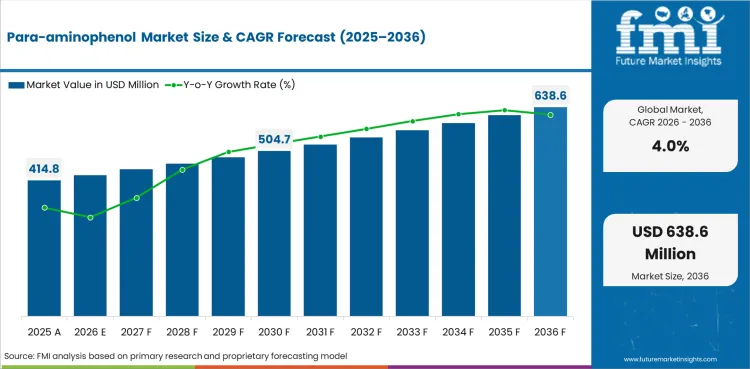
The para-aminophenol market was valued at an estimated USD 392.4 million in 2025, is projected to reach USD 414.8 million in 2026, and is forecast to expand to USD 612.7 million by 2036 at a CAGR of 4.0%.
Summary of Para-aminophenol Market
- The market is forecast to reach USD 612.7 million by 2036.
- The market is expected to grow at a CAGR of 4.0% from 2026 to 2036.
- The market was estimated at USD 392.4 million in 2025.
- The forecast period represents an incremental opportunity of USD 197.9 million.
- Pharmaceutical-grade para-aminophenol accounts for 54.6% of the product segment in 2026, reflecting stronger demand from regulated API and impurity-controlled applications.
- Acetaminophen intermediates hold 63.8% of the application segment, supported by the scale and resilience of paracetamol demand.
- Pharmaceutical manufacturers represent 58.2% of the end use segment, indicating concentration in regulated intermediate supply chains.
Para-aminophenol Market key Takeaways
| Parameter | Details |
|---|---|
| Market value (2026) | USD 414.8 million |
| Forecast value (2036) | USD 612.7 million |
| CAGR (2026 to 2036) | 4.0% |
| Estimated market value (2025) | USD 392.4 million |
| Incremental opportunity | USD 197.9 million |
| Leading product | Pharmaceutical-grade para-aminophenol, 54.6% of product revenue |
| Leading application | Acetaminophen intermediates, 63.8% of application revenue |
| Leading end use | Pharmaceutical manufacturers, 58.2% of end-use revenue |
| Key players | Thermo Fisher Scientific, Merck, USP, specialty intermediate manufacturers in China and India |
Source: Analyst synthesis from authoritative sources, 2026.
Key Takeaways, Market Size, and Forecast
- Para-aminophenol Market is projected to grow from USD 414.8 million in 2026 to USD 612.7 million by 2036, at a CAGR of 4.0%.
- The para-aminophenol market was valued at USD 392.4 million in 2025.
- By 2036, the Para-aminophenol Market is expected to be worth USD 612.7 million.
- From 2026 to 2036, the market is anticipated to expand at a CAGR of 4.0%.
- The market is predicted to create an incremental opportunity of USD 197.9 million between 2026 and 2036.
- In 2026, Pharmaceutical-grade Para-aminophenol is expected to account for 54.6% of the product segment.
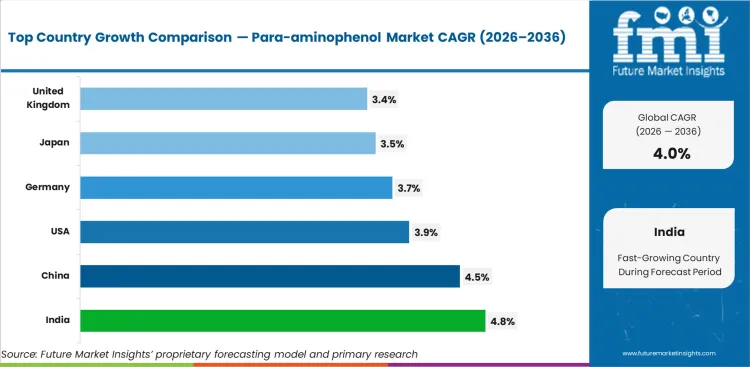
- India (4.8%) and China (4.5%) are projected to be two of the fastest growing markets.
Three factors keep market demand intact. Para-aminophenol remains directly tied to acetaminophen manufacturing economics, and paracetamol remains a globally essential medicine according to WHO. Pharmacopeial and USP controls maintain the relevance of 4-aminophenol in regulated quality systems because it is both an intermediate and a monitored impurity or degradation product. The market also retains a smaller but stable base in dye, photographic, and specialty chemical use, which supports baseline industrial demand even when pharmaceutical orders fluctuate.
Across tracked geographies, India sets the pace at 4.8% CAGR. China follows at 4.5%. United States follows at 3.9%. Germany follows at 3.7%. Japan follows at 3.5%. United Kingdom follows at 3.4%.
Para-aminophenol Market Definition
The para-aminophenol market covers commercial production and sale of para-aminophenol, also known as 4-aminophenol, used as a chemical intermediate in pharmaceuticals, dyes, photographic chemicals, and specialty synthesis. The market includes regulated and industrial grades sold for downstream manufacturing rather than finished dosage-form pharmaceutical revenue.
Para-aminophenol Market Inclusions
Market scope includes pharmaceutical-grade para-aminophenol, industrial-grade para-aminophenol, and specialty-grade material supplied for acetaminophen synthesis, dyestuff chemistry, photographic applications, and research or specialty synthesis. Revenue sizing spans direct chemical sales and intermediate use within regulated manufacturing chains where para-aminophenol is sold as a commercial input.
Para-aminophenol Market Exclusions
The scope excludes finished acetaminophen revenue, downstream formulated analgesics, unrelated aniline derivatives, and internal captive intermediate production not sold in the merchant market. It also excludes generic analytical testing revenue not tied to para-aminophenol sales.
Para-aminophenol Market Research Methodology
- Primary Research: FMI analysts reviewed official chemical references, pharmacopeial materials, supplier listings, and public end-use demand signals tied to acetaminophen and related chemical applications.
- Desk Research: Data collection consolidated materials from PubChem, WHO, USP, official supplier product pages from Merck and Thermo Fisher Scientific, and technical references on para-aminophenol handling and application to establish verifiable baseline parameters.
- Market Sizing and Forecasting: Baseline values were derived from pharmaceutical intermediate demand for acetaminophen, and then cross-checked against reagent and industrial pricing references, supplier availability, specialty chemical usage, analgesic demand, grade differentiation, and merchant-supply assumptions in regulated and industrial channels through 2036.
- Data validation and update cycle: Projections were tested against official reference materials, supplier pricing signals, and end-use demand in pharmaceutical and specialty chemical applications, with periodic review to keep the forecast aligned with changes in supply conditions and end-market demand.
Why is the Para-aminophenol Market Growing?
The main driver is its role as a core intermediate in acetaminophen production. Acetaminophen remains one of the most widely used analgesic and antipyretic molecules globally, which keeps the para-aminophenol demand base structurally intact.
Quality controls also support market relevance. Para-aminophenol is not only an intermediate but also a monitored impurity in regulated pharmaceutical systems, which increases the need for reliable analytical standards and high-purity supply.
Industrial demand remains narrower than pharmaceutical demand, but it still contributes a useful floor through dye and specialty chemical applications.
The market is growing because para-aminophenol sits in a stable part of the pharmaceutical value chain. It does not depend on consumer branding or finished-dose promotion. Instead, it depends on the persistence of high-volume acetaminophen production and the continued need for controlled intermediates in regulated manufacturing.
Another source of resilience is that the material has multiple purity and application tiers. Pharmaceutical-grade supply benefits from impurity controls and process traceability. Industrial-grade material serves smaller non-pharma applications where pricing sensitivity is higher but demand remains recurring.
This combination creates moderate but steady growth rather than explosive expansion. The market benefits from durable pharmaceutical consumption, while regulatory requirements help preserve value in higher-purity grades.
Segmental Analysis
- Pharmaceutical-grade para-aminophenol commands 54.6% of product revenue in 2026. This segment leads because regulated downstream synthesis of acetaminophen requires tighter quality controls than industrial applications.
- Acetaminophen intermediates account for 63.8% of application revenue in 2026. This segment dominates because paracetamol synthesis remains the main commercial outlet for para-aminophenol worldwide.
- Pharmaceutical manufacturers hold 58.2% of end-use revenue in 2026. Their lead reflects the concentration of merchant demand in API and finished-drug manufacturing chains.
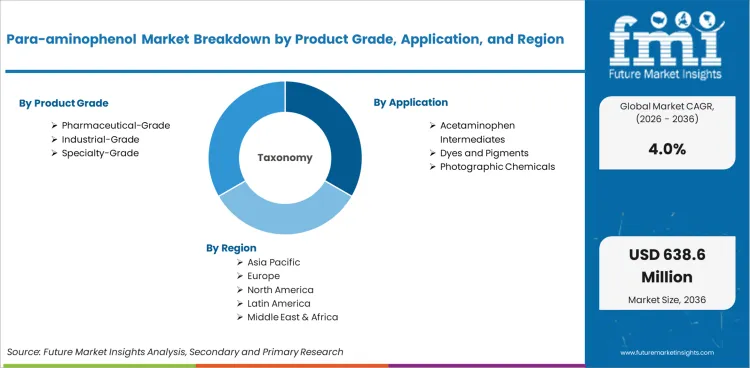
The market is segmented by product grade, application, end use, distribution channel, and region. By product grade, the market includes pharmaceutical-grade para-aminophenol, industrial-grade para-aminophenol, and specialty-grade material. By application, the market includes acetaminophen intermediates, dyes and pigments, photographic chemicals, and specialty synthesis.
Insights into the Pharmaceutical-grade Para-aminophenol Segment
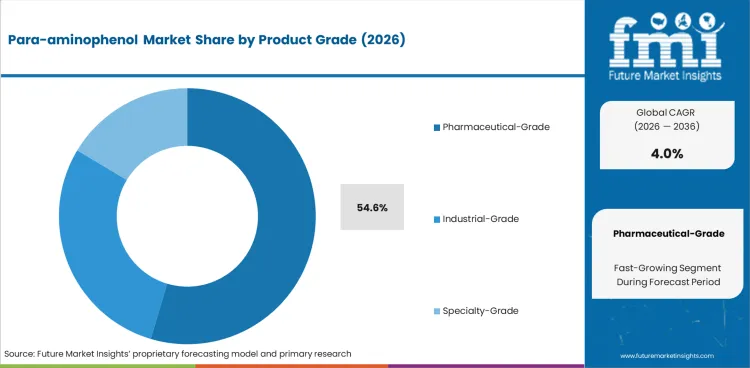
Pharmaceutical-grade para-aminophenol is projected to hold 54.6% of product revenue in 2026. This lead is supported by high-volume analgesic demand, stronger margin capture in regulated supply chains, and more stringent impurity and traceability requirements.
Insights into the Acetaminophen Intermediates Segment
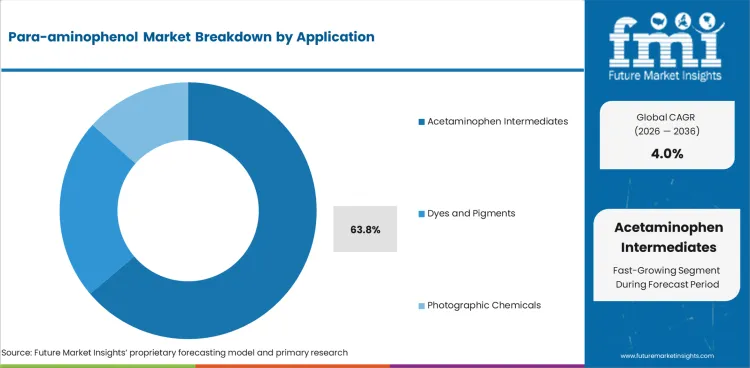
Acetaminophen intermediates are expected to capture 63.8% of application revenue in 2026. The segment leads because para-aminophenol remains directly linked to one of the most established and widely consumed analgesic API pathways in the world.
Insights into the Pharmaceutical Manufacturers Segment
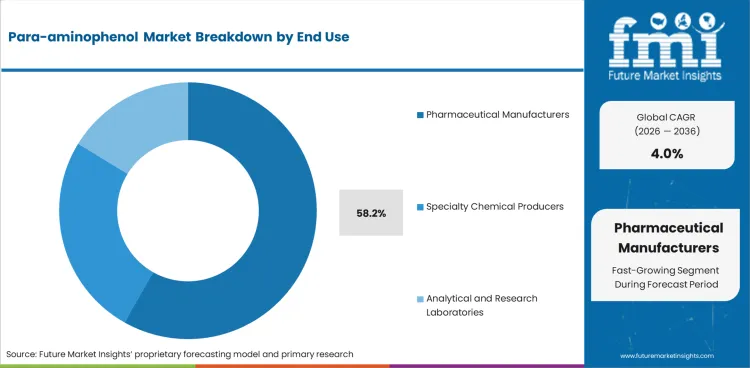
Pharmaceutical manufacturers are projected to account for 58.2% of end-use revenue in 2026. Merchant purchases are concentrated among regulated producers that require reliable intermediate quality, reproducibility, and documentation support.
What are the Drivers, Restraints, and Key Trends of the Para-aminophenol Market?
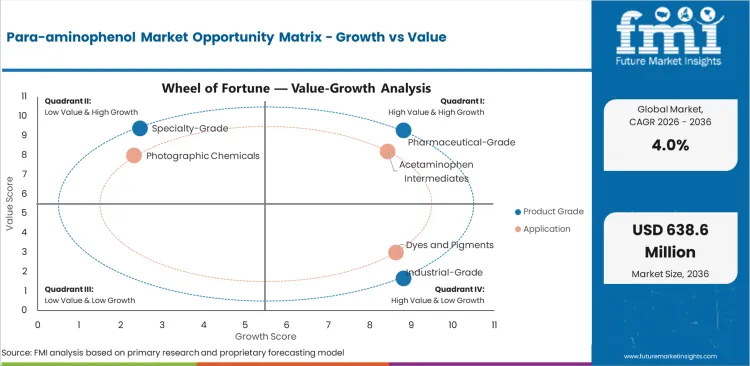
Driver: stable global acetaminophen demand continues to support the core intermediate market.
Restraint: price sensitivity and feedstock volatility can compress margins in industrial and lower-purity supply tiers.
Trend: regulated buyers are placing greater weight on impurity control, documentation quality, and traceable supply.
The market is expanding steadily. Pharmaceutical supply chains remain the main growth driver because quality and continuity carry more weight than spot pricing. Industrial demand provides diversification and a stable secondary revenue base.
Acetaminophen-linked Intermediate Demand
Growth is supported by the persistent scale of acetaminophen consumption. Because para-aminophenol is structurally tied to that value chain, its demand base remains more durable than many specialty chemical intermediates that depend on narrower end markets.
Feedstock and Margin Pressure
Cost pressure across chemical intermediates remains the main market constraint. Producers face margin compression when aromatic feedstock conditions tighten or when lower-cost industrial supply competes aggressively on price. This pressure is strongest in industrial-grade material.
Traceability and Quality as Differentiators
Quality-led differentiation is strengthening. Buyers in regulated pharmaceutical chains place greater weight on impurity control, analytical support, and supply continuity, which supports suppliers with stronger documentation and quality systems.
Analysis of Para-aminophenol Market By Key Countries
.webp "Top Country Growth Comparison — Para Aminophenol Market CAGR (2026–2036)")
Asia remains the center of market growth because pharmaceutical intermediate manufacturing and chemical processing capacity are concentrated there. India and China are the most important demand and supply anchors.
The United States and Europe remain important through pharmaceutical consumption, analytical standards demand, and specialty chemical applications, but growth is slower than in Asia.
Japan supports a smaller but stable market through quality-intensive applications and specialty chemical use.
| Country | CAGR |
|---|---|
| India | 4.8% |
| China | 4.5% |
| United States | 3.9% |
| Germany | 3.7% |
| Japan | 3.5% |
| United Kingdom | 3.4% |
Demand Outlook for Para-aminophenol Market in the United States
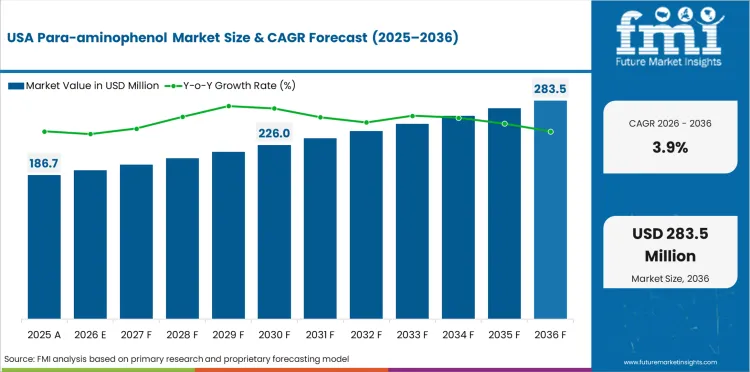
The United States is projected to grow at a CAGR of 3.9% through 2036. Growth is supported by persistent analgesic demand, strong analytical standards usage, and specialty chemical purchases.
- Pharmaceutical demand keeps the market structurally stable.
- Analytical and standards demand supports higher-purity sales.
- Growth is moderate because the market is mature.
Future Outlook for Para-aminophenol Market in the United Kingdom
The United Kingdom is projected to grow at a CAGR of 3.4% through 2036. Demand is supported by pharmaceutical manufacturing links and specialty chemical use, but scale remains smaller than major Asian markets.
- The market is quality-sensitive rather than volume-led.
- Analytical use remains relevant.
- Growth is steady but limited by market size.
Opportunity Analysis of Para-aminophenol Market in Germany
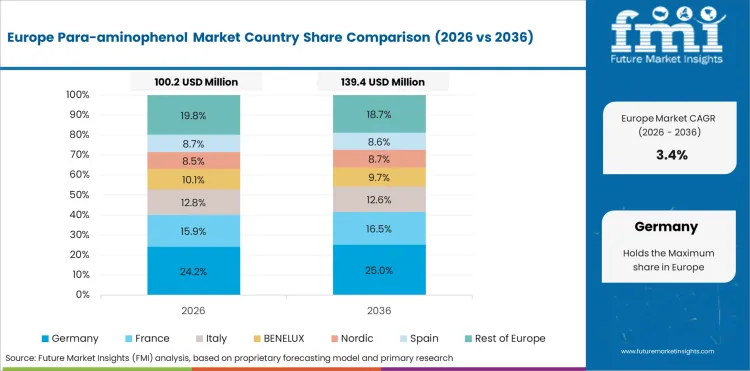
Germany is expected to grow at a CAGR of 3.7% through 2036. The market benefits from specialty chemical capability and pharmaceutical quality requirements.
- Industrial chemistry supports baseline demand.
- Regulated quality expectations support higher-value grades.
- Growth remains moderate rather than rapid.
In-depth Analysis of Para-aminophenol Market in Japan
Japan is projected to grow at a CAGR of 3.5% through 2036. The country supports steady demand in quality-intensive chemical and pharmaceutical applications.
- High-quality product requirements support specialty-grade demand.
- The market remains stable but not large.
- Pharmaceutical-linked use is the core driver.
Sales Analysis of Para-aminophenol Market in China
China is expected to grow at a CAGR of 4.5% through 2036. The market benefits from chemical manufacturing scale, broad intermediate processing capability, and persistent pharmaceutical demand.
- Manufacturing scale supports merchant intermediate supply.
- Cost competitiveness remains important.
- Pharmaceutical and industrial channels both matter.
In-depth Analysis of Para-aminophenol Market in India
India is projected to grow at a CAGR of 4.8% through 2036. Growth is driven by strong API manufacturing capability and sustained demand from acetaminophen and related pharmaceutical value chains.
- API manufacturing scale supports intermediate demand.
- The pharmaceutical channel dominates the market structure.
- Growth is faster than in mature western markets.
Competitive Landscape of Para-aminophenol Market
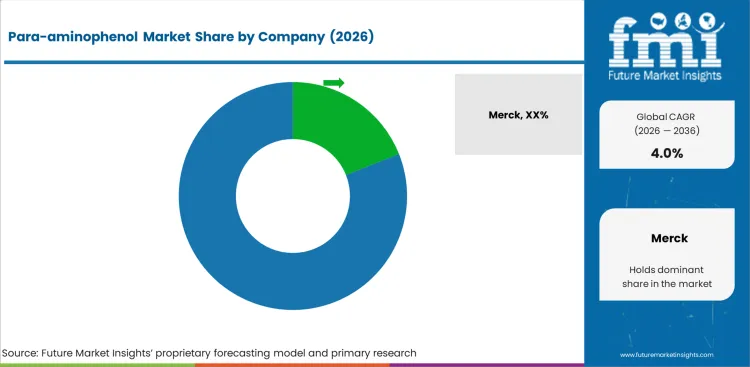
The competitive landscape combines global analytical and specialty chemical suppliers with regional intermediate manufacturers. Competitive strength depends on purity, documentation, batch consistency, and the ability to serve regulated pharmaceutical channels.
Merck, Thermo Fisher Scientific, and USP are important reference points in higher-purity and analytical supply. Merchant industrial and pharmaceutical intermediate supply is more fragmented and includes regional chemical producers, especially in Asia.
The market remains less brand-driven than many specialty chemicals. Buyers focus more on reliability, assay quality, impurity control, and supply continuity than on broad commercial marketing.
Competition is strongest in regulated supply chains, where differentiation depends on quality systems and analytical support. Lower-grade industrial supply remains more price-sensitive and fragmented.
Major Industry Players
Merck and Thermo Fisher Scientific are prominent in analytical and research supply because they offer reference-grade and catalog chemistry with broad global reach.
USP is relevant because it anchors pharmacopeial standards and quality control reference use around acetaminophen and 4-aminophenol-related systems.
Regional intermediate manufacturers in India and China remain important in merchant pharmaceutical and industrial supply because they are closer to API production chains and cost-competitive manufacturing bases.
Competitive Benchmarking: Para-aminophenol Market
| Company | Quality Positioning | Pharma Relevance | Industrial Supply Strength | Geographic Reach |
|---|---|---|---|---|
| Merck | High | High | Medium | Strong |
| Thermo Fisher Scientific | High | High | Medium | Strong |
| USP | High | High | Low | Strong |
| Regional Asian manufacturers | Medium | High | High | Moderate |
Source: Analyst synthesis from authoritative sources, 2026. Ratings reflect relative positioning based on disclosed capabilities and market presence.
Key Players in the Para-aminophenol Market:
Major Global Players:
- Merck
- Thermo Fisher Scientific
- USP
- regional pharmaceutical intermediate manufacturers
Emerging Players/Startups
- specialty intermediate suppliers in Asia
- small-batch regulated chemical suppliers
- pharma-linked merchant intermediate producers
Scope of the report
| Metric | Value |
|---|---|
| Quantitative Units | USD 414.8 million to USD 612.7 million, at a CAGR of 4.0% |
| Market Definition | Commercial production and sale of para-aminophenol used as a chemical intermediate in pharmaceuticals, dyes, photographic chemicals, and specialty synthesis. |
| Segmentation | Product grade: pharmaceutical-grade para-aminophenol, industrial-grade para-aminophenol, specialty-grade para-aminophenol. Application: acetaminophen intermediates, dyes and pigments, photographic chemicals, specialty synthesis. End use: pharmaceutical manufacturers, specialty chemical producers, analytical and research laboratories. Distribution channel: direct industrial sales, chemical distributors, catalog and laboratory supply channels. |
| Regions Covered | North America, Europe, Asia-Pacific, Latin America, Middle East and Africa |
| Countries Covered | United States, United Kingdom, Germany, Japan, China, India and others |
| Key Companies Profiled | Merck, Thermo Fisher Scientific, USP, regional Asian manufacturers |
| Forecast Period | 2026 to 2036 |
| Approach | Analyst-built hybrid top-down and bottom-up model using official chemical references, supplier pricing signals, and downstream pharmaceutical intermediate demand logic. |
| Historical Period | 2020 to 2025 |
Para-aminophenol Market Segments Analysis
Para-aminophenol Market segmented as Product Grade:
- Pharmaceutical-grade Para-aminophenol
- Industrial-grade Para-aminophenol
- Specialty-grade Para-aminophenol
Para-aminophenol Market classified by Application:
- Acetaminophen Intermediates
- Dyes and Pigments
- Photographic Chemicals
- Specialty Synthesis
Para-aminophenol Market analysed by End Use:
- Pharmaceutical Manufacturers
- Specialty Chemical Producers
- Analytical and Research Laboratories
Para-aminophenol Market segmented as Distribution Channel:
- Direct Industrial Sales
- Chemical Distributors
- Catalog and Laboratory Supply Channels
Para-aminophenol Market by Region and Country:
- North America
- United States
- Canada
- Europe
- United Kingdom
- Germany
- France
- Rest of Europe
- Asia-Pacific
- India
- China
- Japan
- Rest of Asia-Pacific
- Latin America
- Middle East and Africa
Bibliography
- PubChem. 4-Aminophenol compound entry.
- World Health Organization. Model List of Essential Medicines, paracetamol listing.
- United States Pharmacopeia. Acetaminophen-related impurity and reference standard materials.
- Merck official product page for 4-Aminophenol.
- Thermo Fisher Scientific official product page for 4-Aminophenol.
- Official technical and safety reference materials covering 4-aminophenol handling and use.
This Report Addresses
- Market sizing and revenue forecasting for para-aminophenol through 2036.
- Segmentation by grade, application, end use, and distribution channel.
- Country-level growth outlook for key markets.
- Competitive landscape across analytical suppliers and merchant intermediate manufacturers.
- The role of acetaminophen demand in shaping the market.
- Quality, impurity, and traceability requirements affecting high-purity supply.
Frequently Asked Questions
How large is the demand for Para-aminophenol in the global market in 2026?
Demand for para-aminophenol in the global market is estimated at USD 414.8 million in 2026.
What will be the market size by 2036?
Market size is projected to reach USD 612.7 million by 2036.
What is the expected demand growth between 2026 and 2036?
Demand is expected to grow at a CAGR of 4.0% between 2026 and 2036.
Which product grade is poised to lead by 2026?
Pharmaceutical-grade para-aminophenol leads the market in 2026 with 54.6% of product revenue.
How are pharmaceutical manufacturers driving adoption?
Pharmaceutical manufacturers account for 58.2% of end-use revenue because para-aminophenol remains directly tied to acetaminophen intermediate demand and regulated supply chains.
What is driving demand in the United States?
The United States is projected to grow at a CAGR of 3.9% through 2036, supported by persistent analgesic demand, analytical standards use, and specialty chemical purchases.
What does the market definition mean?
The market covers commercial production and sale of para-aminophenol used as a chemical intermediate in pharmaceuticals, dyes, photographic chemicals, and specialty synthesis.
How does the analyst validate the forecast?
The forecast is validated through a hybrid model using official chemical references, supplier pricing signals, and downstream pharmaceutical intermediate demand logic.
Preview the report firsthand - request a free sample
Get SampleGet the brochure for pricing and purchase details.
Get PDFTable of Content
- Executive Summary
- Global Market Outlook
- Demand-side Trends
- Supply-side Trends
- Technology Roadmap Analysis
- Analysis and Recommendations
- Market Overview
- Market Coverage / Taxonomy
- Market Definition / Scope / Limitations
- Research Methodology
- Chapter Orientation
- Analytical Lens and Working Hypotheses
- Market Structure, Signals, and Trend Drivers
- Benchmarking and Cross-market Comparability
- Market Sizing, Forecasting, and Opportunity Mapping
- Research Design and Evidence Framework
- Desk Research Programme (Secondary Evidence)
- Company Annual and Sustainability Reports
- Peer-reviewed Journals and Academic Literature
- Corporate Websites, Product Literature, and Technical Notes
- Earnings Decks and Investor Briefings
- Statutory Filings and Regulatory Disclosures
- Technical White Papers and Standards Notes
- Trade Journals, Industry Magazines, and Analyst Briefs
- Conference Proceedings, Webinars, and Seminar Materials
- Government Statistics Portals and Public Data Releases
- Press Releases and Reputable Media Coverage
- Specialist Newsletters and Curated Briefings
- Sector Databases and Reference Repositories
- FMI Internal Proprietary Databases and Historical Market Datasets
- Subscription Datasets and Paid Sources
- Social Channels, Communities, and Digital Listening Inputs
- Additional Desk Sources
- Expert Input and Fieldwork (Primary Evidence)
- Primary Modes
- Qualitative Interviews and Expert Elicitation
- Quantitative Surveys and Structured Data Capture
- Blended Approach
- Why Primary Evidence is Used
- Field Techniques
- Interviews
- Surveys
- Focus Groups
- Observational and In-context Research
- Social and Community Interactions
- Stakeholder Universe Engaged
- C-suite Leaders
- Board Members
- Presidents and Vice Presidents
- R&D and Innovation Heads
- Technical Specialists
- Domain Subject-matter Experts
- Scientists
- Physicians and Other Healthcare Professionals
- Governance, Ethics, and Data Stewardship
- Research Ethics
- Data Integrity and Handling
- Primary Modes
- Tooling, Models, and Reference Databases
- Desk Research Programme (Secondary Evidence)
- Data Engineering and Model Build
- Data Acquisition and Ingestion
- Cleaning, Normalisation, and Verification
- Synthesis, Triangulation, and Analysis
- Quality Assurance and Audit Trail
- Market Background
- Market Dynamics
- Drivers
- Restraints
- Opportunity
- Trends
- Scenario Forecast
- Demand in Optimistic Scenario
- Demand in Likely Scenario
- Demand in Conservative Scenario
- Opportunity Map Analysis
- Product Life Cycle Analysis
- Supply Chain Analysis
- Investment Feasibility Matrix
- Value Chain Analysis
- PESTLE and Porter’s Analysis
- Regulatory Landscape
- Regional Parent Market Outlook
- Production and Consumption Statistics
- Import and Export Statistics
- Market Dynamics
- Global Market Analysis 2021 to 2025 and Forecast, 2026 to 2036
- Historical Market Size Value (USD Million) Analysis, 2021 to 2025
- Current and Future Market Size Value (USD Million) Projections, 2026 to 2036
- Y-o-Y Growth Trend Analysis
- Absolute $ Opportunity Analysis
- Global Market Pricing Analysis 2021 to 2025 and Forecast 2026 to 2036
- Global Market Analysis 2021 to 2025 and Forecast 2026 to 2036, By Product Grade
- Introduction / Key Findings
- Historical Market Size Value (USD Million) Analysis By Product Grade , 2021 to 2025
- Current and Future Market Size Value (USD Million) Analysis and Forecast By Product Grade , 2026 to 2036
- Pharmaceutical-Grade
- Industrial-Grade
- Specialty-Grade
- Pharmaceutical-Grade
- Y-o-Y Growth Trend Analysis By Product Grade , 2021 to 2025
- Absolute $ Opportunity Analysis By Product Grade , 2026 to 2036
- Global Market Analysis 2021 to 2025 and Forecast 2026 to 2036, By Application
- Introduction / Key Findings
- Historical Market Size Value (USD Million) Analysis By Application, 2021 to 2025
- Current and Future Market Size Value (USD Million) Analysis and Forecast By Application, 2026 to 2036
- Acetaminophen Intermediates
- Dyes and Pigments
- Photographic Chemicals
- Acetaminophen Intermediates
- Y-o-Y Growth Trend Analysis By Application, 2021 to 2025
- Absolute $ Opportunity Analysis By Application, 2026 to 2036
- Global Market Analysis 2021 to 2025 and Forecast 2026 to 2036, By End Use
- Introduction / Key Findings
- Historical Market Size Value (USD Million) Analysis By End Use, 2021 to 2025
- Current and Future Market Size Value (USD Million) Analysis and Forecast By End Use, 2026 to 2036
- Pharmaceutical Manufacturers
- Specialty Chemical Producers
- Analytical and Research Laboratories
- Pharmaceutical Manufacturers
- Y-o-Y Growth Trend Analysis By End Use, 2021 to 2025
- Absolute $ Opportunity Analysis By End Use, 2026 to 2036
- Global Market Analysis 2021 to 2025 and Forecast 2026 to 2036, By Region
- Introduction
- Historical Market Size Value (USD Million) Analysis By Region, 2021 to 2025
- Current Market Size Value (USD Million) Analysis and Forecast By Region, 2026 to 2036
- North America
- Latin America
- Western Europe
- Eastern Europe
- East Asia
- South Asia and Pacific
- Middle East & Africa
- Market Attractiveness Analysis By Region
- North America Market Analysis 2021 to 2025 and Forecast 2026 to 2036, By Country
- Historical Market Size Value (USD Million) Trend Analysis By Market Taxonomy, 2021 to 2025
- Market Size Value (USD Million) Forecast By Market Taxonomy, 2026 to 2036
- By Country
- USA
- Canada
- Mexico
- By Product Grade
- By Application
- By End Use
- By Country
- Market Attractiveness Analysis
- By Country
- By Product Grade
- By Application
- By End Use
- Key Takeaways
- Latin America Market Analysis 2021 to 2025 and Forecast 2026 to 2036, By Country
- Historical Market Size Value (USD Million) Trend Analysis By Market Taxonomy, 2021 to 2025
- Market Size Value (USD Million) Forecast By Market Taxonomy, 2026 to 2036
- By Country
- Brazil
- Chile
- Rest of Latin America
- By Product Grade
- By Application
- By End Use
- By Country
- Market Attractiveness Analysis
- By Country
- By Product Grade
- By Application
- By End Use
- Key Takeaways
- Western Europe Market Analysis 2021 to 2025 and Forecast 2026 to 2036, By Country
- Historical Market Size Value (USD Million) Trend Analysis By Market Taxonomy, 2021 to 2025
- Market Size Value (USD Million) Forecast By Market Taxonomy, 2026 to 2036
- By Country
- Germany
- UK
- Italy
- Spain
- France
- Nordic
- BENELUX
- Rest of Western Europe
- By Product Grade
- By Application
- By End Use
- By Country
- Market Attractiveness Analysis
- By Country
- By Product Grade
- By Application
- By End Use
- Key Takeaways
- Eastern Europe Market Analysis 2021 to 2025 and Forecast 2026 to 2036, By Country
- Historical Market Size Value (USD Million) Trend Analysis By Market Taxonomy, 2021 to 2025
- Market Size Value (USD Million) Forecast By Market Taxonomy, 2026 to 2036
- By Country
- Russia
- Poland
- Hungary
- Balkan & Baltic
- Rest of Eastern Europe
- By Product Grade
- By Application
- By End Use
- By Country
- Market Attractiveness Analysis
- By Country
- By Product Grade
- By Application
- By End Use
- Key Takeaways
- East Asia Market Analysis 2021 to 2025 and Forecast 2026 to 2036, By Country
- Historical Market Size Value (USD Million) Trend Analysis By Market Taxonomy, 2021 to 2025
- Market Size Value (USD Million) Forecast By Market Taxonomy, 2026 to 2036
- By Country
- China
- Japan
- South Korea
- By Product Grade
- By Application
- By End Use
- By Country
- Market Attractiveness Analysis
- By Country
- By Product Grade
- By Application
- By End Use
- Key Takeaways
- South Asia and Pacific Market Analysis 2021 to 2025 and Forecast 2026 to 2036, By Country
- Historical Market Size Value (USD Million) Trend Analysis By Market Taxonomy, 2021 to 2025
- Market Size Value (USD Million) Forecast By Market Taxonomy, 2026 to 2036
- By Country
- India
- ASEAN
- Australia & New Zealand
- Rest of South Asia and Pacific
- By Product Grade
- By Application
- By End Use
- By Country
- Market Attractiveness Analysis
- By Country
- By Product Grade
- By Application
- By End Use
- Key Takeaways
- Middle East & Africa Market Analysis 2021 to 2025 and Forecast 2026 to 2036, By Country
- Historical Market Size Value (USD Million) Trend Analysis By Market Taxonomy, 2021 to 2025
- Market Size Value (USD Million) Forecast By Market Taxonomy, 2026 to 2036
- By Country
- Kingdom of Saudi Arabia
- Other GCC Countries
- Turkiye
- South Africa
- Other African Union
- Rest of Middle East & Africa
- By Product Grade
- By Application
- By End Use
- By Country
- Market Attractiveness Analysis
- By Country
- By Product Grade
- By Application
- By End Use
- Key Takeaways
- Key Countries Market Analysis
- USA
- Pricing Analysis
- Market Share Analysis, 2025
- By Product Grade
- By Application
- By End Use
- Canada
- Pricing Analysis
- Market Share Analysis, 2025
- By Product Grade
- By Application
- By End Use
- Mexico
- Pricing Analysis
- Market Share Analysis, 2025
- By Product Grade
- By Application
- By End Use
- Brazil
- Pricing Analysis
- Market Share Analysis, 2025
- By Product Grade
- By Application
- By End Use
- Chile
- Pricing Analysis
- Market Share Analysis, 2025
- By Product Grade
- By Application
- By End Use
- Germany
- Pricing Analysis
- Market Share Analysis, 2025
- By Product Grade
- By Application
- By End Use
- UK
- Pricing Analysis
- Market Share Analysis, 2025
- By Product Grade
- By Application
- By End Use
- Italy
- Pricing Analysis
- Market Share Analysis, 2025
- By Product Grade
- By Application
- By End Use
- Spain
- Pricing Analysis
- Market Share Analysis, 2025
- By Product Grade
- By Application
- By End Use
- France
- Pricing Analysis
- Market Share Analysis, 2025
- By Product Grade
- By Application
- By End Use
- India
- Pricing Analysis
- Market Share Analysis, 2025
- By Product Grade
- By Application
- By End Use
- ASEAN
- Pricing Analysis
- Market Share Analysis, 2025
- By Product Grade
- By Application
- By End Use
- Australia & New Zealand
- Pricing Analysis
- Market Share Analysis, 2025
- By Product Grade
- By Application
- By End Use
- China
- Pricing Analysis
- Market Share Analysis, 2025
- By Product Grade
- By Application
- By End Use
- Japan
- Pricing Analysis
- Market Share Analysis, 2025
- By Product Grade
- By Application
- By End Use
- South Korea
- Pricing Analysis
- Market Share Analysis, 2025
- By Product Grade
- By Application
- By End Use
- Russia
- Pricing Analysis
- Market Share Analysis, 2025
- By Product Grade
- By Application
- By End Use
- Poland
- Pricing Analysis
- Market Share Analysis, 2025
- By Product Grade
- By Application
- By End Use
- Hungary
- Pricing Analysis
- Market Share Analysis, 2025
- By Product Grade
- By Application
- By End Use
- Kingdom of Saudi Arabia
- Pricing Analysis
- Market Share Analysis, 2025
- By Product Grade
- By Application
- By End Use
- Turkiye
- Pricing Analysis
- Market Share Analysis, 2025
- By Product Grade
- By Application
- By End Use
- South Africa
- Pricing Analysis
- Market Share Analysis, 2025
- By Product Grade
- By Application
- By End Use
- USA
- Market Structure Analysis
- Competition Dashboard
- Competition Benchmarking
- Market Share Analysis of Top Players
- By Regional
- By Product Grade
- By Application
- By End Use
- Competition Analysis
- Competition Deep Dive
- Merck
- Overview
- Product Portfolio
- Profitability by Market Segments (Product/Age /Sales Channel/Region)
- Sales Footprint
- Strategy Overview
- Marketing Strategy
- Product Strategy
- Channel Strategy
- Thermo Fisher Scientific
- USP
- Other Key Players
- Merck
- Competition Deep Dive
- Assumptions & Acronyms Used


