

- Market Size (2026)
- USD 496.5 Mn
- Forecast (2036)
- USD 824.3 Mn
- CAGR (2026 to 2036)
- 5.2%
Raspberry Ketones Market Size, Market Forecast and Outlook By FMI
Summary of the Raspberry Ketones Market
- Demand and Growth Drivers
- Food and beverage flavors are projected to account for 41.0% share in 2026 as berry, jam, and fruit notes remain core formulation needs.
- Fragrance and personal care are expected to represent 28.0% share in 2026 as raspberry ketone adds sweet fruity depth to body care and fine fragrance blends.
- Dietary supplements are projected to hold 19.0% share in 2026, but this channel faces higher scrutiny due to limited human evidence for weight management.
- Synthetic source material is expected to retain 63.0% share in 2026 since industrial buyers need consistent assay, batch documents, and predictable cost.
- Product and Segment View
- Synthetic raspberry ketones are expected to lead source demand with 63.0% share in 2026 as large buyers value repeatable odor quality and lower cost.
- Powder and crystals are projected to account for 56.0% of form demand in 2026 since dry handling suits flavor houses and chemical distributors.
- Above 99% purity grade is anticipated to hold 46.0% share in 2026 as fragrance and food users compare assay strength before approval.
- Direct B2B supply is expected to account for 38.0% share in 2026 with large flavor houses preferring documented supplier relationships.
- Geography and Competitive Outlook
- China is projected to remain the largest production-linked country due to aroma chemical manufacturing scale and export supply.
- The United States is expected to remain a key value market because food flavoring, supplements, and personal care create multiple demand routes.
- Germany and France are expected to track below India and China as mature flavor houses buy higher-grade material through controlled channels.
- Competition is strongest among suppliers that combine high-purity material, flavor-grade documentation, and regulatory coverage across major end markets.
- Analyst Opinion
- Nandini Roy Choudhury, Principal Consultant at FMI says, “Raspberry ketones sit in an unusual position. Supplement buyers care about claim language and dosage form. The risk comes from that second channel because the evidence base for weight-loss positioning is not as strong as the consumer story around the ingredient.”
Key Takeaways, Market Size, and Forecast
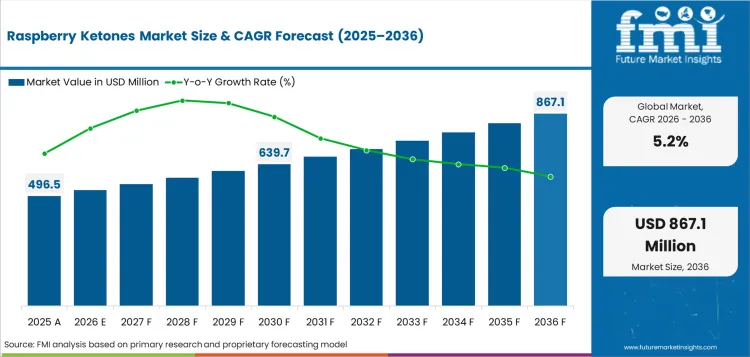
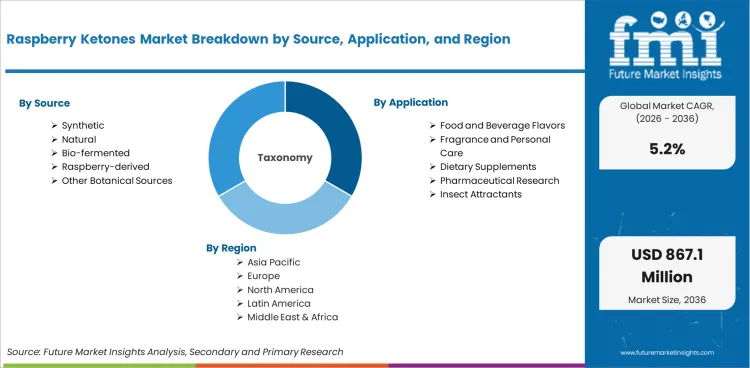
- The raspberry ketones market is expected to be valued at USD 496.5 million in 2026.
- By 2036, the raspberry ketones market is forecast to reach USD 824.3 million.
- From 2026 to 2036, the market is projected to expand at a CAGR of 5.2%.
- The market is expected to create an incremental opportunity of USD 327.8 million over the forecast period.
- Synthetic raspberry ketones are expected to lead by source with 63.0% share in 2026 as price and supply reliability matter in large flavor systems.
- Food and beverage flavors are projected to remain the largest application with 41.0% share in 2026 as berry notes stay common in beverages and confectionery.
- The United States and China are expected to remain important value markets, while India is projected to record faster growth as aroma chemical distribution widens.
- Natural grade demand is expected to grow faster than the average, but availability and price keep it smaller than synthetic material.
Raspberry ketones remain a mixed-use aroma chemical. The strongest validated demand sits in flavor and fragrance use, where the compound has recognized identifiers such as FEMA 2588, JECFA 728, and CAS 5471-51-2. FEMA lists 4-(p-hydroxyphenyl)-2-butanone with a raspberry and citrus flavor profile, while the FDA food-substance database identifies it as a flavoring agent or adjuvant. The supplement channel gives the category visibility, but it also creates regulatory and evidence risk. That split is important because long-term volume is more defensible in formulation channels than in weight-loss claims.
Raspberry Ketones Market Definition
The raspberry ketones market covers commercially traded 4-(4-hydroxyphenyl)-2-butanone used as a flavor, fragrance, cosmetic, supplement, and research ingredient. The scope includes synthetic raspberry ketone, natural-origin material, bio-fermented grades, and diluted forms used by formulators. The market excludes fresh raspberries, raspberry fruit powder, raspberry seed oil, finished weight-loss pills sold only at retail, and generic berry flavor blends where raspberry ketone is not separately traded.
Raspberry Ketones Market Inclusions
Market scope covers synthetic and natural raspberry ketones used in food and beverage flavors, fragrance compounds, personal care formulations, dietary supplement blends, research supply, insect attractant applications, specialty chemical distribution, and B2B ingredient supply across major regions for the period 2026 to 2036.
Raspberry Ketones Market Exclusions
The scope does not include fresh raspberry fruit, raspberry puree, raspberry juice concentrate, raspberry seed oil, mixed berry flavor systems, finished slimming supplements sold as consumer brands, or unrelated ketone supplements such as exogenous ketone salts.
Raspberry Ketones Market Research Methodology
- Primary Research: FMI analysts reviewed demand behavior across flavor houses, aroma chemical distributors, dietary supplement formulators, personal care ingredient buyers, and specialty chemical suppliers. Inputs focused on purity grade, source preference, batch documentation, claim risk, and channel buying behavior.
- Desk Research: Desk research assessed food additive identifiers, flavor-library records, supplier specifications, safety databases, and recent scientific literature. Public sources were used to separate validated flavor use from higher-risk supplement positioning.
- Market sizing and forecasting: Revenue modeling used traded ingredient volume, average selling price bands, application split, purity mix, and country-level distribution patterns. Forecast values were adjusted for natural-grade price premiums and supplement-channel compliance risk.
- Data validation: Forecasts were checked against supplier catalog coverage, flavor regulatory identifiers, category demand in food flavors, and visible participation by aroma chemical suppliers. Country growth was tested against manufacturing scale and application demand.
Why is the Raspberry Ketones Market Growing?
- Food flavor houses continue to use raspberry ketone where berry and jam notes need persistence in finished formulations.
- Fragrance and personal care buyers use the compound where sweet fruit notes need a crystalline aroma chemical with recognized documentation.
- Supplement demand keeps visibility high, but regulatory caution limits aggressive claim-led expansion in mature markets.
- Natural and bio-fermented grades attract premium interest when brands want cleaner origin stories with stronger paperwork.
The market is growing because raspberry ketone has a practical function in flavor and fragrance systems. It is not only a consumer supplement story. The FAO JECFA specification identifies 4-(4-hydroxyphenyl)butan-2-one as JECFA number 728, with FEMA number 2588 and CAS number 5471-51-2. This gives formulators a recognized identity for technical and regulatory files. That recognition matters in B2B buying because suppliers must support approval, labeling, and quality checks before material moves into commercial recipes.
Supplement demand creates a different growth layer with a weaker evidence base. Operation Supplement Safety states that there is not enough research to say raspberry ketone supplements are safe and warns service members to use caution with products at 100 mg or higher. This does not remove supplement demand. It changes how responsible suppliers position the ingredient. The practical result is a market where flavor-grade demand is steadier, while high-dose supplement demand is more exposed to claim review and retailer policy.
Market Segmentation Analysis
- Synthetic raspberry ketones are expected to account for 63.0% of source demand in 2026 as industrial users need stable price and repeatable quality.
- Food and beverage flavors are projected to represent 41.0% of application demand in 2026 with fruit systems creating steady use.
- With an estimated 56.0% share in 2026, powder and crystals are expected to lead form demand due to easier storage and dosing.
- Above 99% purity grade is anticipated to hold 46.0% share in 2026 as premium users compare assay and odor strength.
- Direct B2B supply is projected to direct 38.0% of channel demand in 2026 with large buyers requiring batch documents and contracts.
The market is segmented by how buyers specify the ingredient, not only by where it is used. Source affects price and natural-claim eligibility. Application affects regulatory review and dose expectations. Form matters because many buyers need dry material for blending, while liquid dilutions suit fragrance compounding. Purity grade is commercially important because odor quality and impurity control change how easily a supplier passes customer approval.
Insights into the Synthetic Source Segment
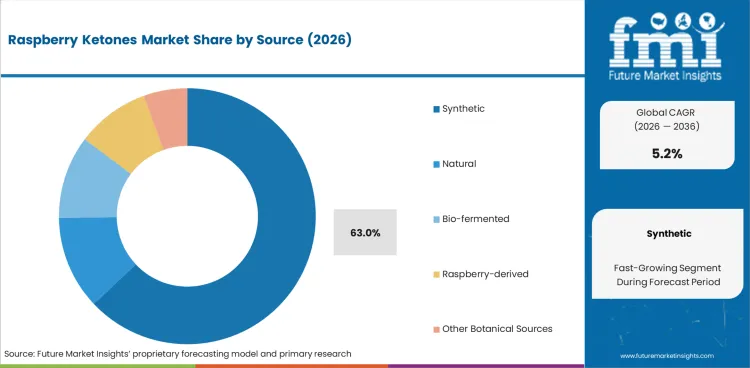
- Synthetic raspberry ketones are expected to account for 63.0% of source demand in 2026 as flavor and fragrance buyers need stable supply across repeat production cycles.
- The natural-origin segment carries a premium because fruit extraction is constrained by low abundance and higher processing cost. Bio-fermentation is gaining interest but remains smaller than chemical synthesis.
Insights into the Food and Beverage Flavors Application Segment
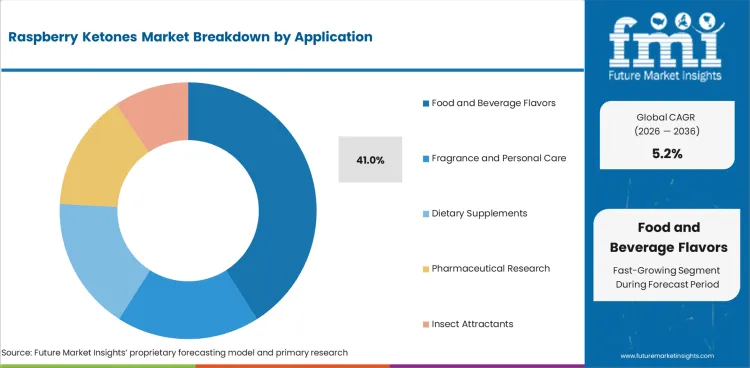
- Food and beverage flavors are projected to account for 41.0% of application demand in 2026 as the compound supports raspberry, strawberry, and mixed fruit profiles.
- The FDA food-substance database lists raspberry ketone as a flavoring agent or adjuvant, which supports its use in formulation channels. That formal identity matters more than supplement buzz.
Insights into the Powder and Crystals Form Segment
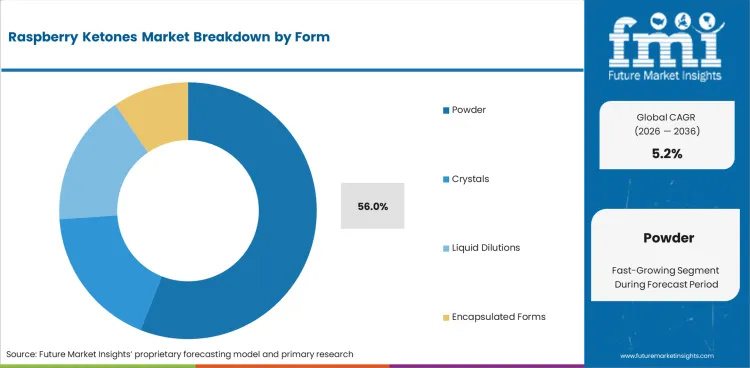
- Powder and crystals are anticipated to represent 56.0% of form demand in 2026 as dry handling suits compounding, repacking, and warehouse storage.
- Ventos lists raspberry ketone as a white crystalline solid with assay above 99% by gas chromatography. It also states that the material is insoluble in water and soluble in ethanol.
Insights into the Above 99% Purity Grade Segment
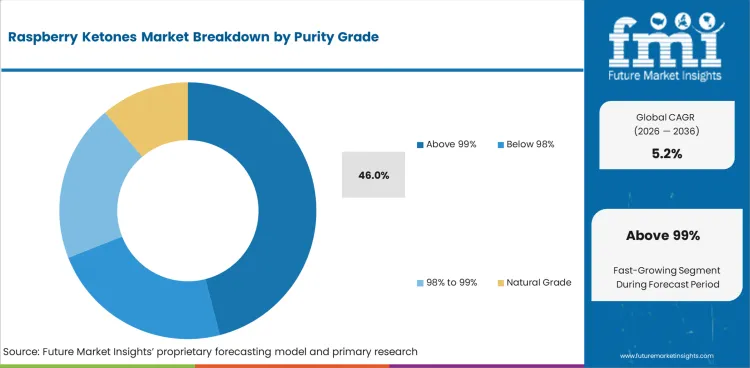
- Above 99% purity grade is estimated to hold 46.0% share in 2026 as food and fragrance users screen impurity levels before approval.
- Zhejiang NHU lists raspberry ketone product code XLRK01 with purity of at least 99.5%. This supports the premium grade expectation in industrial aroma chemical supply.
Insights into the Direct B2B Supply Segment
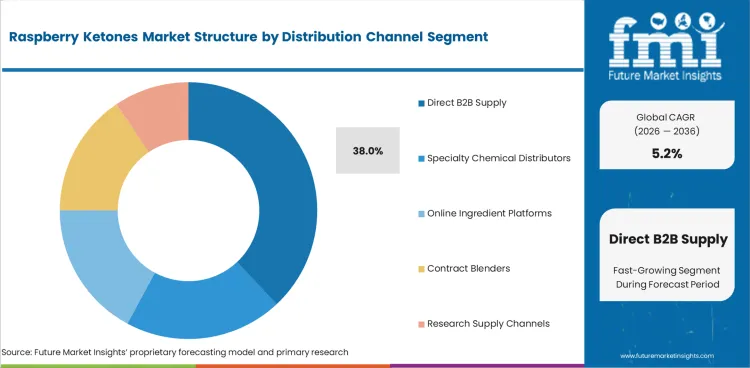
- Direct B2B supply is projected to account for 38.0% share in 2026 as larger buyers need documents, technical support, and repeatable lots.
- Vigon lists raspberry ketone Oxyphenylon with food grade, kosher, halal, TSCA, US natural, and EU natural compliance markers. This shows why documentation changes channel choice.
Raspberry Ketones Market Drivers and Restraints, along with Opportunities
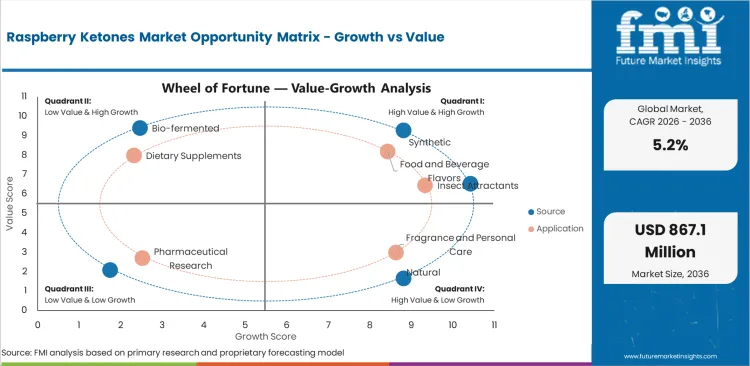
- Flavor documentation supports recurring industrial demand where buyers need recognized identifiers and food-grade paperwork.
- Supplement claim risk restrains high-dose demand where safety evidence and retailer review become purchase barriers.
- Natural and bio-fermented grades create upside where brands pay for origin claims and cleaner label positioning.
- Fragrance use supports stable demand because raspberry ketone adds sweet fruit depth in body care and fine fragrance blends.
Flavor-grade approval demand
Flavor-grade demand is the most stable part of the raspberry ketones market. Buyers in this channel do not buy the ingredient as a trend. They buy it because it performs a known aroma function and carries recognized flavor identifiers. WHO’s JECFA database states no safety concern at current intake levels when used as a flavoring agent. That status supports conventional flavor use but does not automatically justify high-dose supplement claims. Suppliers gain ground when they separate flavor documentation from wellness marketing.
Supplement claim exposure
The supplement channel gives raspberry ketones consumer visibility, but it also creates the highest risk. A 2015 safety review noted that raspberry ketone supplement intakes were marketed between 100 mg and 1,400 mg per day and that toxicity data were limited. This issue still frames the category because high-dose wellness products need a different safety argument than flavor use. The market will grow more cleanly when brands avoid weak slimming claims and position the ingredient within compliant formulations.
Bio-based production upside
Bio-based production is becoming an opportunity because natural raspberry ketone is expensive and scarce. A 2025 review described microbial production through precision fermentation as an alternative to fruit extraction and petrochemical synthesis. This route matters because customers want natural positioning without the supply limits of raspberry fruit extraction. The commercial upside sits with suppliers that can prove scale, purity, and regulatory fit.
Regional Market Analysis
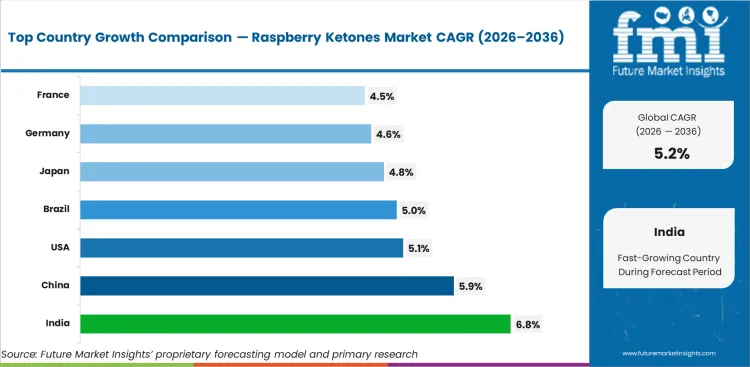
- India is expected to grow at 6.8% CAGR from 2026 to 2036, making it one of the fastest-growing country markets in the study.
- China is forecast to expand at 5.9% CAGR, supported by aroma chemical manufacturing and export supply.
- The United States is projected to grow at 5.1%, while Germany and France are expected to record 4.6% and 4.5%, respectively.
The global raspberry ketones market is forecast to expand at 5.2% CAGR from 2026 to 2036. The study covers more than thirty countries, with the strongest growth concentrated in countries that combine flavor manufacturing, personal care formulation, and supplement blending.
.webp "Top Country Growth Comparison Raspberry Ketones Market Cagr (2026 2036)")
| Country | CAGR |
|---|---|
| India | 6.8% |
| China | 5.9% |
| United States | 5.1% |
| Brazil | 5.0% |
| Japan | 4.8% |
| Germany | 4.6% |
| France | 4.5% |
Source: FMI analysis based on primary research and proprietary forecasting model.
How is India Shaping the Raspberry Ketones Market?
India is gaining share as flavor, nutraceutical, and personal care manufacturing broadens. Local buyers are price-sensitive, but they also need documentation for export-oriented finished products. Ingredient distributors are likely to expand the market by offering smaller packs and faster delivery to mid-sized formulators. India is projected to record 6.8% CAGR from 2026 to 2036 as domestic flavor demand and supplement blending expand together.
- Food and beverage processors in Maharashtra and Gujarat support flavor ingredient demand across confectionery and beverage systems.
- Nutraceutical contract manufacturers in Himachal Pradesh and Uttarakhand create demand for documented supplement-grade ingredients.
- Personal care clusters around Mumbai and Ahmedabad support fragrance use in lotions, creams, and body-care products.
How is China Contributing to the Raspberry Ketones Market?
China remains central to the supply side because many aroma chemicals move through Chinese manufacturing and export networks. Zhejiang NHU lists raspberry ketone with a purity specification of at least 99.5%, which reflects the country’s role in high-purity aroma chemical supply. China is forecast to expand at 5.9% CAGR from 2026 to 2036 as exports and domestic flavor use continue to support volume.
- Zhejiang remains important for aroma chemical supply due to established fine chemical manufacturing clusters.
- Shanghai and Guangzhou support demand through flavor houses and personal care formulation activity.
- Export buyers compare Chinese suppliers on assay, documentation speed, and delivery reliability.
How is Demand in the United States Impacting the Raspberry Ketones Market?
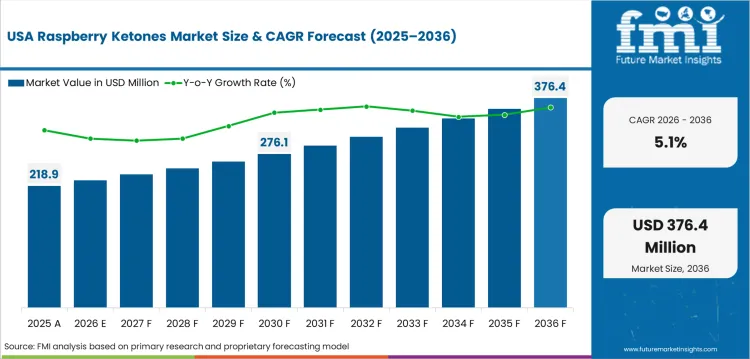
The United States remains a major value market because the ingredient serves food flavor and supplement channels. The FDA database identifies raspberry ketone as a flavoring agent or adjuvant under its food-substance records. The United States is projected to grow at 5.1% CAGR from 2026 to 2036 as food-grade demand holds steady and supplement claims face more scrutiny.
- California food and beverage innovation supports demand for fruit flavor systems across beverage and confectionery formats.
- New Jersey and Pennsylvania remain important for fragrance and specialty ingredient distribution.
- Supplement buyers face higher claim review as retailers and compliance teams assess weight-management wording.
What is the Role of Brazil in the Raspberry Ketones Market?
Brazil is a smaller but relevant growth market due to its personal care scale and flavor demand. The country’s buyer base is shaped by fragrance-heavy beauty products and fruit-forward food applications. Brazil is expected to grow at 5.0% CAGR from 2026 to 2036 as local distributors widen aroma chemical access. Price sensitivity will keep synthetic material ahead of natural grade.
- São Paulo remains the main commercial center for flavor and fragrance distribution.
- Brazilian beauty brands create demand for fruity fragrance notes in body care and hair care products.
- Beverage and confectionery manufacturers support raspberry and mixed berry flavor applications.
How is Japan Advancing in the Raspberry Ketones Market?
Japan is a quality-sensitive market where buyers place strong weight on purity, odor profile, and supplier documents. Raspberry ketone demand is linked to flavor systems, cosmetics, and research supply rather than broad mass-market supplements. Japan is expected to advance at 4.8% CAGR from 2026 to 2036 as premium food and personal care formulations support steady use.
- Tokyo and Osaka support demand through flavor houses and personal care ingredient distributors.
- Japanese buyers often prefer smaller verified lots for specialty food and cosmetics applications.
- Research supply demand persists because raspberry ketone remains active in metabolic and biological studies.
Why Does Germany Remain Important in the Raspberry Ketones Market?
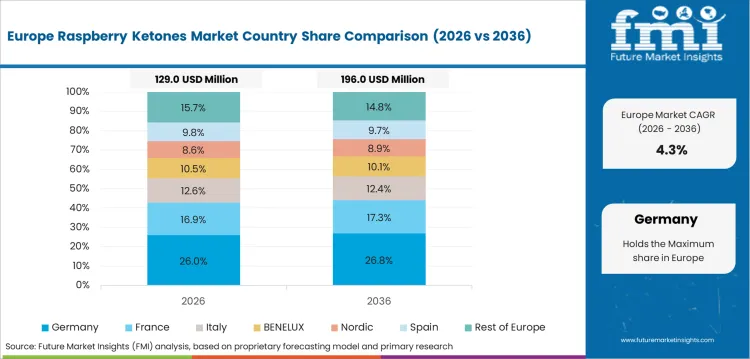
Germany remains an important specification-led market because buyers expect strong compliance and technical documentation. Merck lists raspberry ketone products with assay, safety, and regulatory details, including FCC and food-grade positioning for selected material. Germany is forecast at 4.6% CAGR from 2026 to 2036 as mature users continue to buy high-grade ingredients for controlled applications.
- German flavor buyers compare assay and allergen documentation before formulation approval.
- Cosmetic formulators face strict ingredient review under European product safety practice.
- Research and laboratory users create steady demand for reference and analytical grades.
Why Does France Remain Relevant in the Raspberry Ketones Market?
France remains relevant due to its fragrance and cosmetics industry depth. Demand is tied to sweet fruity notes in fine fragrance, personal care, and premium body care products. France is expected to post 4.5% CAGR from 2026 to 2036 as fragrance applications support value growth. The market is not the fastest by volume, but it influences higher-value formulation choices.
- Grasse remains a symbolic and technical center for fragrance creation.
- Paris-based beauty brands support demand for fragrance compounds in premium personal care formats.
- French buyers place strong weight on odor profile and supplier traceability.
Competitive Landscape and Strategic Positioning
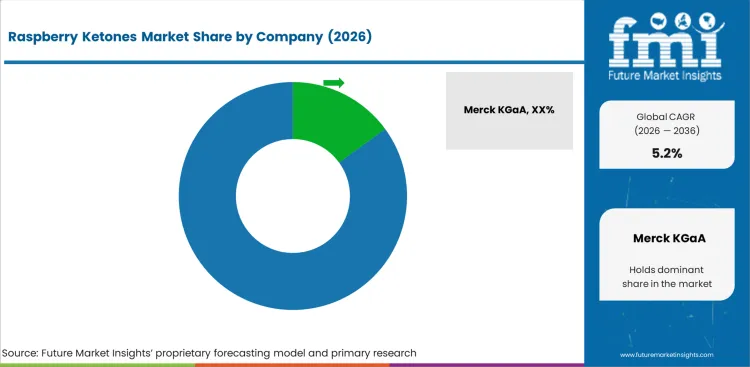
- The market is moderately fragmented with aroma chemical makers, distributors, and research suppliers competing across different buyer groups.
- Large suppliers win on purity consistency, documentation depth, and the ability to serve food or fragrance customers across regions.
- Specialist distributors compete by offering smaller pack sizes, faster sampling, and product files for mid-sized formulators.
- Entry barriers include assay control, odor consistency, flavor-grade compliance, and the ability to support customer audits.
Competition is built around reliability more than novelty. Raspberry ketone is a known molecule, so buyers rarely need education on its basic function. They need proof that each lot matches the expected odor, assay, and regulatory file. Merck’s Sigma-Aldrich listings show both natural food-grade material and high-purity laboratory material, which reflects how the same molecule serves different buyer needs. Suppliers with multiple grades can defend broader accounts.
Chinese and global aroma suppliers compete strongly on high-purity supply. Zhejiang NHU lists raspberry ketone with at least 99.5% purity and a defined product code, which suits buyers seeking repeat supply from established chemical manufacturers. Ventos lists assay above 99% and provides physical data such as crystalline solid form and flash point. These details matter because technical files reduce approval friction for industrial buyers.
Distribution strength is another advantage. Vigon’s raspberry ketone Oxyphenylon page lists compliance markers covering food grade, kosher, halal, TSCA, and selected country approvals. Treatt lists natural raspberry ketone of plant origin and positions it for food flavoring and cosmetic fragrance use. This split shows how distributors serve buyers that need either cost-effective material or natural-positioned grades.
Key Companies in the Raspberry Ketones Market
Key companies active in the market include Merck KGaA, Zhejiang NHU Co. Ltd., Vigon International, Treatt Plc, Ernesto Ventós S.A., Advanced Biotech, Tokyo Chemical Industry, Cayman Chemical, and Takasago International Corporation.
Global Leaders
Merck KGaA, Zhejiang NHU, Treatt, and Takasago hold stronger positions through high-purity material, broad ingredient portfolios, and technical documentation. Their advantage lies in serving food, fragrance, research, and specialty chemical buyers with clearer quality files.
Regional and Specialist Suppliers
Vigon International, Ernesto Ventós, Advanced Biotech, and Tokyo Chemical Industry compete through distribution access, specialty catalog coverage, and smaller-volume supply. These companies are important where customers need samples, certificates, or faster technical support before approving new suppliers.
Research and Niche Suppliers
Cayman Chemical and laboratory suppliers serve research buyers that need smaller quantities and analytical documentation. This part of the market is not the largest by volume, but it supports scientific work and product testing.
Competitive Benchmarking: Raspberry Ketones Market
| Company | Purity Grade Coverage | Flavor and Fragrance Documentation | Specialty Distribution Reach | Geographic Footprint |
|---|---|---|---|---|
| Merck KGaA | High | Strong | Strong | Global |
| Zhejiang NHU | High | Medium | Strong | China and exports |
| Vigon International | High | Strong | Strong | North America and exports |
| Treatt Plc | Medium to High | Strong | Strong | Global |
| Ernesto Ventós | High | Strong | Strong | Europe and exports |
| Advanced Biotech | Medium | Strong | Medium | North America and exports |
| Tokyo Chemical Industry | High | Medium | Strong | Global research supply |
| Cayman Chemical | Medium | Low | Medium | Global research supply |
Source: Future Market Insights competitive analysis, 2026. Ratings reflect relative positioning based on purity grade coverage, flavor and fragrance documentation, and specialty distribution reach.
Key Developments in Raspberry Ketones Market
- In 2024, Vigon listed raspberry ketone Oxyphenylon with food grade, kosher, halal, TSCA, US natural, and EU natural compliance markers. This supports broader B2B use in regulated ingredient channels.
- In 2024, Merck’s Sigma-Aldrich listed natural 4-(4-hydroxyphenyl)-2-butanone with at least 98% assay, FCC and food-grade positioning. This strengthens availability for premium formulation and laboratory buyers.
- In 2025, academic work on bioproduction described precision fermentation as a route to address fruit-extraction limits and chemical-synthesis concerns. This supports longer-term interest in bio-based grades.
- In 2026, Ventos technical documentation listed raspberry ketone with assay above 99% and a 24-month quality-check recommendation after storage. This reinforces the role of technical files in supplier approval.
Key Players in the Raspberry Ketones Market
Global Leaders
- Merck KGaA
- Zhejiang NHU Co. Ltd.
- Treatt Plc
- Takasago International Corporation
Regional and Specialist Suppliers
- Vigon International
- Ernesto Ventós S.A.
- Advanced Biotech
- Tokyo Chemical Industry
Research and Niche Suppliers
- Cayman Chemical
- Laboratory ingredient suppliers
Report Scope and Coverage
| Attribute | Details |
|---|---|
| Estimated market size in 2026 | USD 496.5 million |
| Projected market size in 2036 | USD 824.3 million |
| CAGR from 2026 to 2036 | 5.2% |
| Historical period | 2021 to 2025 |
| Forecast period | 2026 to 2036 |
| Quantitative units | USD million |
| Key segment coverage | Source, Application, Form, Purity Grade, Distribution Channel, and Region |
| Regions covered | North America, Latin America, Western Europe, Eastern Europe, East Asia, South Asia and Pacific, Middle East and Africa |
Segment Analysis by Source, Application, Form, Purity Grade, Distribution Channel, and Region
By Source
- Synthetic
- Natural
- Bio-fermented
- Raspberry-derived
- Other Botanical Sources
By Application
- Food and Beverage Flavors
- Fragrance and Personal Care
- Dietary Supplements
- Pharmaceutical Research
- Insect Attractants
By Form
- Powder
- Crystals
- Liquid Dilutions
- Encapsulated Forms
By Purity Grade
- Below 98%
- 98% to 99%
- Above 99%
- Natural Grade
By Distribution Channel
- Direct B2B Supply
- Specialty Chemical Distributors
- Online Ingredient Platforms
- Contract Blenders
- Research Supply Channels
By Region
- North America
- Latin America
- Western Europe
- Eastern Europe
- East Asia
- South Asia and Pacific
- Middle East and Africa
Research Sources and Bibliography
- Flavor and Extract Manufacturers Association. 4-(P-Hydroxyphenyl)-2-butanone. FEMA Flavor Library.
- USA Food and Drug Administration. 4-(P-Hydroxyphenyl)-2-butanone. Food Substance Database.
- FAO JECFA. 4-(4-Hydroxyphenyl)butan-2-one. Online Edition: Specifications for Flavourings.
- World Health Organization. Raspberry ketone. JECFA database.
- Operation Supplement Safety. Raspberry ketone: Dietary supplements for weight loss.
- Merck KGaA. 4-(4-Hydroxyphenyl)-2-butanone natural, ≥98%, FCC, FG.
- Zhejiang NHU Co. Ltd. Raspberry ketone product information.
- Vigon International. Raspberry Ketone Oxyphenylon product information and food grade certification.
- Treatt Plc. Raspberry Ketone Natural 99% Plant Origin.
- Ernesto Ventós S.A. Raspberry Ketone technical data.
- Gao, P. et al. 2025. Advancements and challenges in the bioproduction of raspberry ketone.
This Report Answers
- What is the current and future size of the raspberry ketones market?
- How fast is the raspberry ketones market expected to grow between 2026 and 2036?
- Which source segment is expected to lead the raspberry ketones market in 2026?
- Which application area is expected to create the largest demand for raspberry ketones?
- How do food flavoring and supplement uses differ in the raspberry ketones market?
- What factors restrain high-dose raspberry ketone supplement demand?
- Which countries are expected to shape raspberry ketone supply and demand?
- Which companies are active in raspberry ketone supply and distribution?
- How does FMI define the raspberry ketones market scope?
Frequently Asked Questions
How big is the raspberry ketones market in 2026?
The global raspberry ketones market is expected to be worth USD 496.5 million in 2026.
What will be the size of the raspberry ketones market in 2036?
The raspberry ketones market is projected to reach USD 824.3 million by 2036.
How much will the raspberry ketones market grow between 2026 and 2036?
The raspberry ketones market is expected to grow at a CAGR of 5.2% from 2026 to 2036.
Which source segment is expected to contribute the largest share in 2026?
Synthetic raspberry ketones are expected to lead the source segment with 63.0% share in 2026.
Which application is expected to lead the raspberry ketones market in 2026?
Food and beverage flavors are projected to lead application demand with 41.0% share in 2026.
Which country is expected to grow fastest in the raspberry ketones market?
India is projected to record the fastest growth at 6.8% CAGR from 2026 to 2036.
What are raspberry ketones used for?
Raspberry ketones are used mainly in flavor systems, fragrance compounds, personal care products, supplements, and research applications.
Are raspberry ketones the same as fresh raspberries?
No. Raspberry ketone is a specific aroma compound, while fresh raspberries are fruit products outside this market scope.
Are raspberry ketones safe in supplements?
Flavoring use has recognized regulatory references, but high-dose supplement use faces caution because human safety evidence remains limited.
Why do buyers prefer synthetic raspberry ketones?
Buyers prefer synthetic grades when they need stable supply, lower cost, consistent assay, and repeatable odor quality.
What is the difference between natural and synthetic raspberry ketones?
Natural grades support origin claims and premium positioning, while synthetic grades usually offer lower cost and better supply consistency.
Which form of raspberry ketone is easiest for industrial buyers to handle?
Powder and crystal forms are often easiest for storage and dosing, especially in flavor compounding and specialty chemical distribution.
Preview the report firsthand - request a free sample
Get SampleGet the brochure for pricing and purchase details.
Get PDFTable of Content
- Executive Summary
- Global Market Outlook
- Demand-side Trends
- Supply-side Trends
- Technology Roadmap Analysis
- Analysis and Recommendations
- Market Overview
- Market Coverage / Taxonomy
- Market Definition / Scope / Limitations
- Research Methodology
- Chapter Orientation
- Analytical Lens and Working Hypotheses
- Market Structure, Signals, and Trend Drivers
- Benchmarking and Cross-market Comparability
- Market Sizing, Forecasting, and Opportunity Mapping
- Research Design and Evidence Framework
- Desk Research Programme (Secondary Evidence)
- Company Annual and Sustainability Reports
- Peer-reviewed Journals and Academic Literature
- Corporate Websites, Product Literature, and Technical Notes
- Earnings Decks and Investor Briefings
- Statutory Filings and Regulatory Disclosures
- Technical White Papers and Standards Notes
- Trade Journals, Industry Magazines, and Analyst Briefs
- Conference Proceedings, Webinars, and Seminar Materials
- Government Statistics Portals and Public Data Releases
- Press Releases and Reputable Media Coverage
- Specialist Newsletters and Curated Briefings
- Sector Databases and Reference Repositories
- FMI Internal Proprietary Databases and Historical Market Datasets
- Subscription Datasets and Paid Sources
- Social Channels, Communities, and Digital Listening Inputs
- Additional Desk Sources
- Expert Input and Fieldwork (Primary Evidence)
- Primary Modes
- Qualitative Interviews and Expert Elicitation
- Quantitative Surveys and Structured Data Capture
- Blended Approach
- Why Primary Evidence is Used
- Field Techniques
- Interviews
- Surveys
- Focus Groups
- Observational and In-context Research
- Social and Community Interactions
- Stakeholder Universe Engaged
- C-suite Leaders
- Board Members
- Presidents and Vice Presidents
- R&D and Innovation Heads
- Technical Specialists
- Domain Subject-matter Experts
- Scientists
- Physicians and Other Healthcare Professionals
- Governance, Ethics, and Data Stewardship
- Research Ethics
- Data Integrity and Handling
- Primary Modes
- Tooling, Models, and Reference Databases
- Desk Research Programme (Secondary Evidence)
- Data Engineering and Model Build
- Data Acquisition and Ingestion
- Cleaning, Normalisation, and Verification
- Synthesis, Triangulation, and Analysis
- Quality Assurance and Audit Trail
- Market Background
- Demand in Conservative Scenario
- Opportunity Map Analysis
- Product Life Cycle Analysis
- Supply Chain Analysis
- Investment Feasibility Matrix
- Value Chain Analysis
- PESTLE and Porter’s Analysis
- Regulatory Landscape
- Regional Parent Market Outlook
- Production and Consumption Statistics
- Import and Export Statistics
- Global Market Analysis 2021 to 2025 and Forecast, 2026 to 2036
- Historical Market Size Value (USD Million) Analysis, 2021 to 2025
- Current and Future Market Size Value (USD Million) Projections, 2026 to 2036
- Y-o-Y Growth Trend Analysis
- Absolute $ Opportunity Analysis
- Global Market Pricing Analysis 2021 to 2025 and Forecast 2026 to 2036
- Global Market Analysis 2021 to 2025 and Forecast 2026 to 2036, By Source
- Introduction / Key Findings
- Historical Market Size Value (USD Million) Analysis By Source , 2021 to 2025
- Current and Future Market Size Value (USD Million) Analysis and Forecast By Source , 2026 to 2036
- Synthetic
- Natural
- Bio-fermented
- Raspberry-derived
- Other Botanical Sources
- Synthetic
- Y-o-Y Growth Trend Analysis By Source , 2021 to 2025
- Absolute $ Opportunity Analysis By Source , 2026 to 2036
- Global Market Analysis 2021 to 2025 and Forecast 2026 to 2036, By Application
- Introduction / Key Findings
- Historical Market Size Value (USD Million) Analysis By Application, 2021 to 2025
- Current and Future Market Size Value (USD Million) Analysis and Forecast By Application, 2026 to 2036
- Food and Beverage Flavors
- Fragrance and Personal Care
- Dietary Supplements
- Pharmaceutical Research
- Insect Attractants
- Food and Beverage Flavors
- Y-o-Y Growth Trend Analysis By Application, 2021 to 2025
- Absolute $ Opportunity Analysis By Application, 2026 to 2036
- Global Market Analysis 2021 to 2025 and Forecast 2026 to 2036, By Form
- Introduction / Key Findings
- Historical Market Size Value (USD Million) Analysis By Form, 2021 to 2025
- Current and Future Market Size Value (USD Million) Analysis and Forecast By Form, 2026 to 2036
- Powder
- Crystals
- Liquid Dilutions
- Encapsulated Forms
- Powder
- Y-o-Y Growth Trend Analysis By Form, 2021 to 2025
- Absolute $ Opportunity Analysis By Form, 2026 to 2036
- Global Market Analysis 2021 to 2025 and Forecast 2026 to 2036, By Purity Grade
- Introduction / Key Findings
- Historical Market Size Value (USD Million) Analysis By Purity Grade, 2021 to 2025
- Current and Future Market Size Value (USD Million) Analysis and Forecast By Purity Grade, 2026 to 2036
- Above 99%
- Below 98%
- 98% to 99%
- Natural Grade
- Above 99%
- Y-o-Y Growth Trend Analysis By Purity Grade, 2021 to 2025
- Absolute $ Opportunity Analysis By Purity Grade, 2026 to 2036
- Global Market Analysis 2021 to 2025 and Forecast 2026 to 2036, By Distribution Channel
- Introduction / Key Findings
- Historical Market Size Value (USD Million) Analysis By Distribution Channel, 2021 to 2025
- Current and Future Market Size Value (USD Million) Analysis and Forecast By Distribution Channel, 2026 to 2036
- Direct B2B Supply
- Specialty Chemical Distributors
- Online Ingredient Platforms
- Contract Blenders
- Research Supply Channels
- Direct B2B Supply
- Y-o-Y Growth Trend Analysis By Distribution Channel, 2021 to 2025
- Absolute $ Opportunity Analysis By Distribution Channel, 2026 to 2036
- Global Market Analysis 2021 to 2025 and Forecast 2026 to 2036, By Region
- Introduction
- Historical Market Size Value (USD Million) Analysis By Region, 2021 to 2025
- Current Market Size Value (USD Million) Analysis and Forecast By Region, 2026 to 2036
- North America
- Latin America
- Western Europe
- Eastern Europe
- East Asia
- South Asia and Pacific
- Middle East & Africa
- Market Attractiveness Analysis By Region
- North America Market Analysis 2021 to 2025 and Forecast 2026 to 2036, By Country
- Historical Market Size Value (USD Million) Trend Analysis By Market Taxonomy, 2021 to 2025
- Market Size Value (USD Million) Forecast By Market Taxonomy, 2026 to 2036
- By Country
- USA
- Canada
- Mexico
- By Source
- By Application
- By Form
- By Purity Grade
- By Distribution Channel
- By Country
- Market Attractiveness Analysis
- By Country
- By Source
- By Application
- By Form
- By Purity Grade
- By Distribution Channel
- Key Takeaways
- Latin America Market Analysis 2021 to 2025 and Forecast 2026 to 2036, By Country
- Historical Market Size Value (USD Million) Trend Analysis By Market Taxonomy, 2021 to 2025
- Market Size Value (USD Million) Forecast By Market Taxonomy, 2026 to 2036
- By Country
- Brazil
- Chile
- Rest of Latin America
- By Source
- By Application
- By Form
- By Purity Grade
- By Distribution Channel
- By Country
- Market Attractiveness Analysis
- By Country
- By Source
- By Application
- By Form
- By Purity Grade
- By Distribution Channel
- Key Takeaways
- Western Europe Market Analysis 2021 to 2025 and Forecast 2026 to 2036, By Country
- Historical Market Size Value (USD Million) Trend Analysis By Market Taxonomy, 2021 to 2025
- Market Size Value (USD Million) Forecast By Market Taxonomy, 2026 to 2036
- By Country
- Germany
- UK
- Italy
- Spain
- France
- Nordic
- BENELUX
- Rest of Western Europe
- By Source
- By Application
- By Form
- By Purity Grade
- By Distribution Channel
- By Country
- Market Attractiveness Analysis
- By Country
- By Source
- By Application
- By Form
- By Purity Grade
- By Distribution Channel
- Key Takeaways
- Eastern Europe Market Analysis 2021 to 2025 and Forecast 2026 to 2036, By Country
- Historical Market Size Value (USD Million) Trend Analysis By Market Taxonomy, 2021 to 2025
- Market Size Value (USD Million) Forecast By Market Taxonomy, 2026 to 2036
- By Country
- Russia
- Poland
- Hungary
- Balkan & Baltic
- Rest of Eastern Europe
- By Source
- By Application
- By Form
- By Purity Grade
- By Distribution Channel
- By Country
- Market Attractiveness Analysis
- By Country
- By Source
- By Application
- By Form
- By Purity Grade
- By Distribution Channel
- Key Takeaways
- East Asia Market Analysis 2021 to 2025 and Forecast 2026 to 2036, By Country
- Historical Market Size Value (USD Million) Trend Analysis By Market Taxonomy, 2021 to 2025
- Market Size Value (USD Million) Forecast By Market Taxonomy, 2026 to 2036
- By Country
- China
- Japan
- South Korea
- By Source
- By Application
- By Form
- By Purity Grade
- By Distribution Channel
- By Country
- Market Attractiveness Analysis
- By Country
- By Source
- By Application
- By Form
- By Purity Grade
- By Distribution Channel
- Key Takeaways
- South Asia and Pacific Market Analysis 2021 to 2025 and Forecast 2026 to 2036, By Country
- Historical Market Size Value (USD Million) Trend Analysis By Market Taxonomy, 2021 to 2025
- Market Size Value (USD Million) Forecast By Market Taxonomy, 2026 to 2036
- By Country
- India
- ASEAN
- Australia & New Zealand
- Rest of South Asia and Pacific
- By Source
- By Application
- By Form
- By Purity Grade
- By Distribution Channel
- By Country
- Market Attractiveness Analysis
- By Country
- By Source
- By Application
- By Form
- By Purity Grade
- By Distribution Channel
- Key Takeaways
- Middle East & Africa Market Analysis 2021 to 2025 and Forecast 2026 to 2036, By Country
- Historical Market Size Value (USD Million) Trend Analysis By Market Taxonomy, 2021 to 2025
- Market Size Value (USD Million) Forecast By Market Taxonomy, 2026 to 2036
- By Country
- Kingdom of Saudi Arabia
- Other GCC Countries
- Turkiye
- South Africa
- Other African Union
- Rest of Middle East & Africa
- By Source
- By Application
- By Form
- By Purity Grade
- By Distribution Channel
- By Country
- Market Attractiveness Analysis
- By Country
- By Source
- By Application
- By Form
- By Purity Grade
- By Distribution Channel
- Key Takeaways
- Key Countries Market Analysis
- USA
- Pricing Analysis
- Market Share Analysis, 2025
- By Source
- By Application
- By Form
- By Purity Grade
- By Distribution Channel
- Canada
- Pricing Analysis
- Market Share Analysis, 2025
- By Source
- By Application
- By Form
- By Purity Grade
- By Distribution Channel
- Mexico
- Pricing Analysis
- Market Share Analysis, 2025
- By Source
- By Application
- By Form
- By Purity Grade
- By Distribution Channel
- Brazil
- Pricing Analysis
- Market Share Analysis, 2025
- By Source
- By Application
- By Form
- By Purity Grade
- By Distribution Channel
- Chile
- Pricing Analysis
- Market Share Analysis, 2025
- By Source
- By Application
- By Form
- By Purity Grade
- By Distribution Channel
- Germany
- Pricing Analysis
- Market Share Analysis, 2025
- By Source
- By Application
- By Form
- By Purity Grade
- By Distribution Channel
- UK
- Pricing Analysis
- Market Share Analysis, 2025
- By Source
- By Application
- By Form
- By Purity Grade
- By Distribution Channel
- Italy
- Pricing Analysis
- Market Share Analysis, 2025
- By Source
- By Application
- By Form
- By Purity Grade
- By Distribution Channel
- Spain
- Pricing Analysis
- Market Share Analysis, 2025
- By Source
- By Application
- By Form
- By Purity Grade
- By Distribution Channel
- France
- Pricing Analysis
- Market Share Analysis, 2025
- By Source
- By Application
- By Form
- By Purity Grade
- By Distribution Channel
- India
- Pricing Analysis
- Market Share Analysis, 2025
- By Source
- By Application
- By Form
- By Purity Grade
- By Distribution Channel
- ASEAN
- Pricing Analysis
- Market Share Analysis, 2025
- By Source
- By Application
- By Form
- By Purity Grade
- By Distribution Channel
- Australia & New Zealand
- Pricing Analysis
- Market Share Analysis, 2025
- By Source
- By Application
- By Form
- By Purity Grade
- By Distribution Channel
- China
- Pricing Analysis
- Market Share Analysis, 2025
- By Source
- By Application
- By Form
- By Purity Grade
- By Distribution Channel
- Japan
- Pricing Analysis
- Market Share Analysis, 2025
- By Source
- By Application
- By Form
- By Purity Grade
- By Distribution Channel
- South Korea
- Pricing Analysis
- Market Share Analysis, 2025
- By Source
- By Application
- By Form
- By Purity Grade
- By Distribution Channel
- Russia
- Pricing Analysis
- Market Share Analysis, 2025
- By Source
- By Application
- By Form
- By Purity Grade
- By Distribution Channel
- Poland
- Pricing Analysis
- Market Share Analysis, 2025
- By Source
- By Application
- By Form
- By Purity Grade
- By Distribution Channel
- Hungary
- Pricing Analysis
- Market Share Analysis, 2025
- By Source
- By Application
- By Form
- By Purity Grade
- By Distribution Channel
- Kingdom of Saudi Arabia
- Pricing Analysis
- Market Share Analysis, 2025
- By Source
- By Application
- By Form
- By Purity Grade
- By Distribution Channel
- Turkiye
- Pricing Analysis
- Market Share Analysis, 2025
- By Source
- By Application
- By Form
- By Purity Grade
- By Distribution Channel
- South Africa
- Pricing Analysis
- Market Share Analysis, 2025
- By Source
- By Application
- By Form
- By Purity Grade
- By Distribution Channel
- USA
- Market Structure Analysis
- Competition Dashboard
- Competition Benchmarking
- Market Share Analysis of Top Players
- By Regional
- By Source
- By Application
- By Form
- By Purity Grade
- By Distribution Channel
- Competition Analysis
- Competition Deep Dive
- Merck KGaA
- Overview
- Product Portfolio
- Profitability by Market Segments (Product/Age /Sales Channel/Region)
- Sales Footprint
- Strategy Overview
- Marketing Strategy
- Product Strategy
- Channel Strategy
- Zhejiang NHU
- Vigon International
- Treatt Plc
- Ernesto Ventós
- Advanced Biotech
- Tokyo Chemical Industry
- Cayman Chemical
- Merck KGaA
- Competition Deep Dive
- Assumptions & Acronyms Used


