

- Industry Size (2025)
- USD 77.2 Mn
- Forecast (2035)
- USD 135.2 Mn
- CAGR (2025 to 2035)
- 5.8%
Ultramarines Market Forecast and Outlook 2025 to 2035
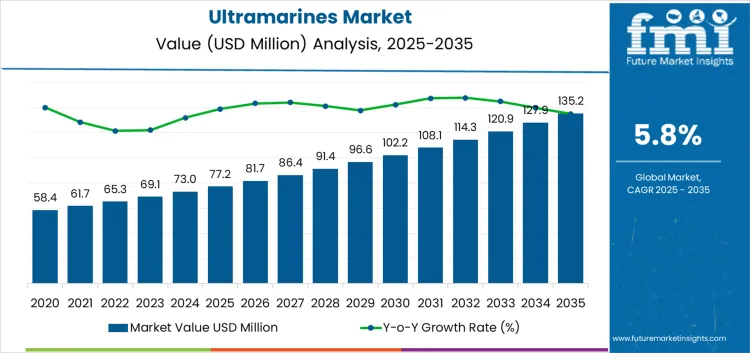
Global ultramarines market is valued at USD 77.2 million in 2025 and is expected to reach USD 135.2 million by 2035 at a CAGR of 5.8%, reflecting a widening revenue growth spread between traditional industrial pigments and rising specialty cosmetic usage. Unlike iron oxides, revenue expansion is more evenly distributed between plastics, detergents, rubber, and color cosmetics, reducing dependence on a single end-use cycle. Color cosmetics and skin care together form a growing specialty block, with skin care holding about a 10.2% share through tinted creams and corrective formulations. Powder remains the dominant commercial form at 16.3% due to stability in dry blending. China and India lead volume demand, while the United States, Germany, and Japan anchor higher-margin cosmetic consumption.
After 2030, revenue growth spread becomes more pronounced as detergent bluing, polymer coloration, and specialty cosmetic pigments expand at different pace levels. Detergent and plastics contribute steady baseline revenue, while cosmetics deliver faster value growth through premium pricing per unit. Baby and kids care adds controlled incremental demand due to safety-limited pigmentation needs. Asia Pacific continues to widen its revenue base through large-scale polymer processing, while Europe maintains consistent cosmetic uptake under regulated pigment use. Competitive positioning shifts toward shade precision, sulfur control in synthesis, and long-term supply reliability for detergent and polymer producers rather than reliance on cosmetic demand alone.
Quick Stats of the Ultramarines Market:
- Ultramarines Market Value (2025): USD 77.2 million
- Ultramarines Market Forecast Value (2035): USD 135.2 million
- Ultramarines Market Forecast CAGR (2025–2035): 5.8%
- Leading Product Form in Ultramarines Market: Powder (16.3%)
- Key Growth Regions in Ultramarines Market: Asia Pacific, United States, Germany, Japan
- Top Players in Ultramarines Market: BASF SE; Croda International; Evonik Industries; Symrise (incl. IFF/Givaudan actives); Dow / Dow Inc.; Ashland; Clariant; Seppic
What is the Growth Forecast for the Ultramarines Market through 2035?
The global ultramarines market grows from USD 77.2 million in 2025 to USD 96.6 million by 2030, registering an absolute increase of USD 19.4 million in the first half of the forecast period. This phase is shaped by ultramarines holding a narrow but technically irreplaceable role in plastics, detergents, paper whitening, coatings, and specialty inks where blue toning and heat stability are structurally required. Annual value additions rise steadily from roughly USD 4.5 million to over USD 5.2 million, reflecting consistent industrial off-take rather than discretionary demand. Growth is closely linked to detergent optical brightener systems, rigid and flexible plastics coloration, and paper processing applications, where ultramarines counter yellowing during high-temperature manufacturing.
From 2030 to 2035, market advances from USD 96.6 million to USD 135.2 million, adding a larger USD 38.6 million in the second half of the decade. Annual value gains widen from about USD 5.6 million to over USD 7.3 million by 2034–2035, indicating a more accelerated late-stage expansion. This back-weighted growth reflects stronger penetration into premium plastics, advanced coatings, specialty polymers, and export-oriented detergent manufacturing, where color consistency and chemical resistance remain critical. As optical durability and thermal performance become stricter selection criteria across downstream industries, ultramarines evolve from a commoditized pigment into a precision color control material, structurally lifting global market value through 2035.
Ultramarines MarketKey Takeaways
| Metric | Value |
|---|---|
| Industry Value (2025) | USD 77.2 million |
| Forecast Value (2035) | USD 135.2 million |
| Forecast CAGR (2025–2035) | 5.8% |
How Is Structural Color Stability Demand Shaping the Ultramarines Market Across Plastics, Coatings, and Specialty Applications?
The ultramarines market is being shaped by consistent demand for inorganic blue and violet pigments that deliver high thermal stability, lightfastness, and chemical resistance where organic dyes fail. In plastics, ultramarines are widely used for coloration of packaging materials, household goods, pipes, and films that undergo high temperature processing. Their resistance to heat deformation and fading under UV exposure secures steady consumption in mass production polymer systems. In paints and coatings, ultramarines support architectural, decorative, and industrial finishes that require stable blue tonality without color drift over time. Paper whitening, rubber compounding, and detergent formulations also contribute baseline demand through optical brightness control and masking of yellow undertones in finished products.
Future growth of the ultramarines market will be shaped by infrastructure investment cycles, expansion of durable plastic goods, and steady output of consumer packaging and construction materials. Demand will continue in polymers used for outdoor applications where color retention under sunlight and weather exposure is critical. Growth is also expected in specialty inks, artist materials, and niche cosmetics where ultramarines provide stable blue shading with low reactivity. Barriers include environmental scrutiny around sulfur based pigment manufacturing, competition from alternative inorganic blue pigments, and cost sensitivity in low margin plastic goods. Long term market direction will depend on how effectively ultramarines maintain their cost stability, supply reliability, and performance advantage in heat and light intensive downstream applications.
How Do Chromatic Stability and Physical Handling Define Ultramarines Demand Across Formulation Systems?
Ultramarines demand is structured by end use application and product form based on how blue and violet shade control is engineered into finished products. By application, usage spans skin care, body care, hair care, sun care, color cosmetics, men grooming, baby and kids care, and dermocosmetic or professional care. By physical format, supply moves through powder, granules or agglomerates, flakes, pellets or prills, liquid solution, concentrate, dispersion or suspension, emulsion, paste, gel, wax or solid block, and oil. These divisions reflect variation in chroma intensity control, lightfastness requirements, dispersion route selection, and compliance scrutiny across decorative cosmetics, corrective skin care, and professional makeup manufacturing systems.
Why Do Tone Correction Products Secure Ultramarines a Stable Role in Skin Care?
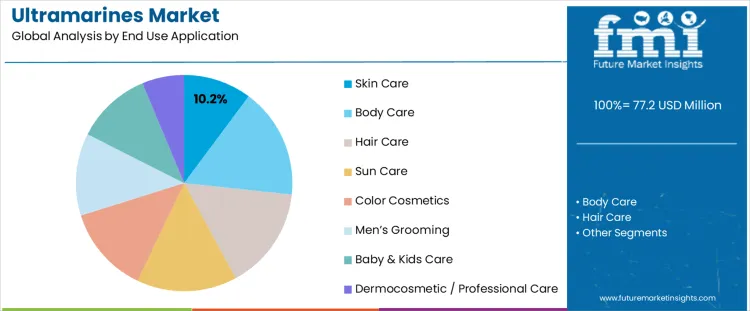
The skin care segment represents 10.2% of total ultramarines demand in 2025, reflecting its revenue role within tone balancing and visual correction formulations. Consumption per unit output is defined by fixed pigment loading ranges used in redness neutralizing creams, brightening bases, and tinted daily protection products. Usage remains steady across seasons because complexion correction is linked to routine facial care rather than episodic cosmetic use. Procurement is anchored in long term contracts to preserve shade consistency across production cycles. Price sensitivity remains moderate because pigment cost directly affects color accuracy and visual uniformity. Specification control is strict due to sulfur content limits, heavy metal thresholds, and batch to batch chromatic variance tolerance. Process integration occurs during premix dispersion and slurry preparation, supporting both batch compounding and continuous emulsification across large cosmetic manufacturing operations.
Skin care contributes steady incremental ultramarines growth through expansion of color correcting moisturizers and primer hybrids. Repeat purchase frequency remains high due to daily usage and short product shelf cycles. Buyers favor bulk procurement to stabilize colored base consistency and reduce formulation drift. Margin structure remains tight under sustained pricing pressure from mass retail and private label programs. Certification dependence increases for baby care and sensitive skin positioning, extending documentation requirements. Import reliance persists for specialty refined grades with controlled sulfur chemistry. Lead time exposure is managed through warehouse buffering near blending sites. Competitive pressure from synthetic organic pigments remains limited due to light stability and regulatory acceptance advantages.
What Processing Realities Keep Powder as the Dominant Ultramarines Format?
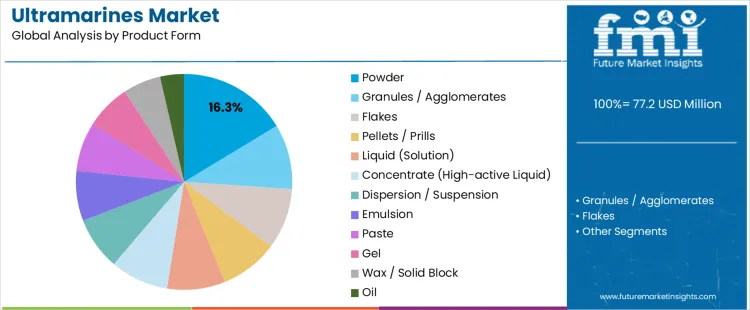
The powder format accounts for 16.3% of total ultramarines demand in 2025, reflecting its combined volume concentration and revenue contribution across delivery forms. Consumption per unit output aligns with dry pigment premix preparation for foundations, pressed powders, and corrective tint bases. Dosage accuracy is maintained through volumetric and gravimetric feeding systems that regulate shade depth and opacity. Procurement favors long term bulk supply contracts to minimize freight volatility and moisture driven agglomeration. Price elasticity remains low because pigment substitution requires full color matching and stability requalification. Quality sensitivity centers on particle morphology, sulfur stability, and flow behavior. Process compatibility favors early stage blending into dry bases or carrier oils prior to emulsification, supporting high conversion efficiency across automated production environments.
The powder segment supports incremental growth through repeat usage across decorative and hybrid complexion care portfolios rather than narrow seasonal demand cycles. Buyer switching tendency remains low due to shade validation and dispersion behavior locked into approved formulations. Margin spread remains narrow under indexed annual supply agreements. Cost pass through is achievable only within scheduled contract adjustment windows. Impurity tolerance remains tight because trace sulfur or metallic variation alters hue and oxidative stability. Equipment dependence centers on sealed feeders, micronization screens, and humidity controlled storage rooms. Asia led consumption reflects large scale pigment processing and export oriented cosmetic manufacturing hubs. Competitive exposure from low cost producers persists, though qualification timelines restrict rapid entry into regulated ultramarines supply chains.
How Are Ultramarines Sustaining Their Role as Chemically Stable Blue Pigments Across Demanding Industrial Systems?
Ultramarines remain structurally important as sulfur-based inorganic pigments valued for color stability, alkali resistance, and thermal durability rather than for decorative appeal alone. Their core demand comes from plastics, rubber, detergents, coatings, paper, and specialty inks where color consistency must endure heat, alkaline environments, and prolonged processing. In detergents, they serve optical correction functions by neutralizing yellowing rather than acting as visible colorants. Unlike many organic blues, ultramarines maintain chromatic integrity under severe chemical stress. The market is shaped by industrial color engineering needs, regulatory acceptance in non-toxic applications, and cost-effective performance in bulk production systems.
How Is Functional Color Correction Driving the Core Market Trend for Ultramarines?
The defining market trend for ultramarines is their growing use in functional color correction rather than decorative coloring. Detergent manufacturers rely on ultramarine blue to counter fabric yellowing and improve visual whiteness during wash cycles. In plastics, they stabilize blue tonality in polyethylene, polypropylene, and PVC exposed to heat and UV during extrusion. Paper producers use them to control brightness perception without destabilizing fiber chemistry. This functional deployment distinguishes ultramarines from fashion-driven pigments. The trend reflects the pigment transition from simple coloration to optical performance control across chemically aggressive, high-temperature, and alkalinity-intensive industrial processing environments.
Why Is Polymer and Detergent Manufacturing Expansion Creating a Growth Opportunity?
Growth opportunity for ultramarines is directly tied to the continued expansion of polymer processing and detergent manufacturing in emerging and industrializing regions. Rising demand for packaged goods, consumer appliances, construction plastics, and household cleaning products sustains large-volume pigment consumption. Ultramarines offer strong alkali resistance and thermal stability at lower cost compared with cobalt and organic alternatives. Detergent volume growth, driven by urban population expansion and hygiene consumption, directly supports demand. Opportunity is rooted in structural growth of high-volume manufacturing infrastructure rather than in premium color innovation or branding-driven pigment transitions.
How Do Sulfur Chemistry Constraints and Environmental Oversight Act as Market Restraints?
Ultramarine production depends on sulfur-based reactions conducted under controlled reducing conditions, which introduce handling risk and strict environmental oversight. Emissions control, waste sulfur management, and alkaline effluent treatment raise compliance and operating costs. Regulatory pressure on sulfur emissions and industrial effluents continues to tighten across major producing regions. In addition, ultramarines lack acid resistance, restricting use in acidic polymer systems and coatings. These technical and regulatory limits constrain application flexibility and slow capacity expansion. As a result, environmental compliance cost and chemistry-specific performance boundaries remain persistent structural restraints on broader ultramarine market scalability.
What Is the Global Growth Outlook for the Ultramarines Marketby Country?
| Country | CAGR (%) |
|---|---|
| India | 7.8 |
| China | 7.2 |
| Japan | 6.6 |
| UK | 6.0 |
| Germany | 5.5 |
| USA | 4.9 |
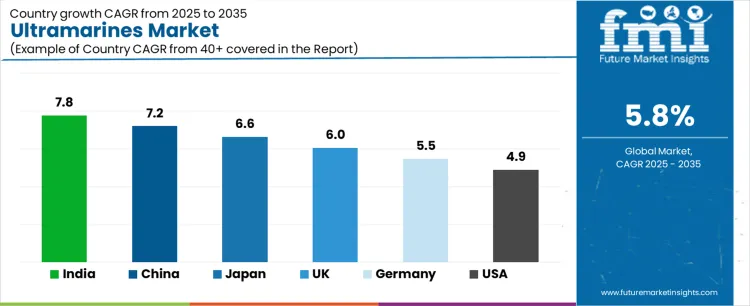
The ultramarines market is expanding steadily across global plastics, coatings, paper, detergents, and cosmetic colorant applications, with India at a 7.8% CAGR. Growth in India is supported by rising demand from plastics processing, packaging films, detergent manufacturing, and decorative coatings for construction activity. China follows at 7.2%, driven by large scale pigment production capacity, strong export supply to plastics and coatings sectors, and growing domestic consumption. Japan at 6.6% reflects stable demand from high quality plastics, specialty papers, and regulated cosmetic applications. The UK and Germany record 6.0% and 5.5% growth, supported by architectural coatings, polymer processing, and industrial pigment usage. The USA at 4.9% reflects a mature but steadily advancing market driven by replacement demand in plastics, detergents, and packaging materials.
What Is Driving Ultramarines Demand Expansion in India Plastics, Detergents, and Packaging?
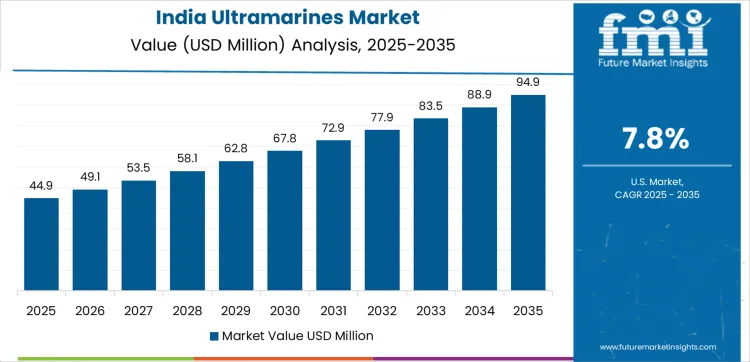
Growth in India is advancing at a CAGR of 7.8% through 2035 for ultramarines demand, driven by rising plastic packaging output, detergent manufacturing, and textile processing. India contrasts with Japan by showing higher reliance on volume driven industrial applications rather than controlled specialty uses. Ultramarines are widely used in polymer masterbatches, laundry detergents, woven sacks, and white cement products. Domestic pigment producers supply most industrial volumes, while higher purity grades still rely on imports. Key suppliers active in India include Ultramarine and Pigments Ltd, Lanxess distributors, and regional inorganic pigment producers.
- Plastic masterbatches anchor bulk pigment demand
- Detergents sustain steady recurring consumption
- Import reliance remains higher for refined grades
- Ultramarine and Pigments Ltd serves leading processors
How Is China Structuring Large Scale Ultramarines Production for Export Markets?
Expansion in China reflects a CAGR of 7.2% through 2035 for ultramarines utilization, supported by strong plastics compounding, detergent exports, and large scale coatings production. China contrasts with India by operating high capacity pigment plants with significant export orientation. Ultramarines are used in polymer coloration, synthetic fiber processing, soap manufacturing, and paint applications. Large inorganic pigment clusters provide cost efficient scale supply. Key producers include Hunan Ultramarine, Yipin Pigments, and several export focused provincial manufacturers supplying Asia, Europe, and North America.
- Export oriented pigment production drives continuous demand
- Plastics and detergents dominate volume usage
- Cost scale shapes global pricing structure
- Hunan Ultramarine and Yipin lead export supply
Why Does Japan Maintain Controlled Ultramarines Usage in Specialty Industrial Applications?
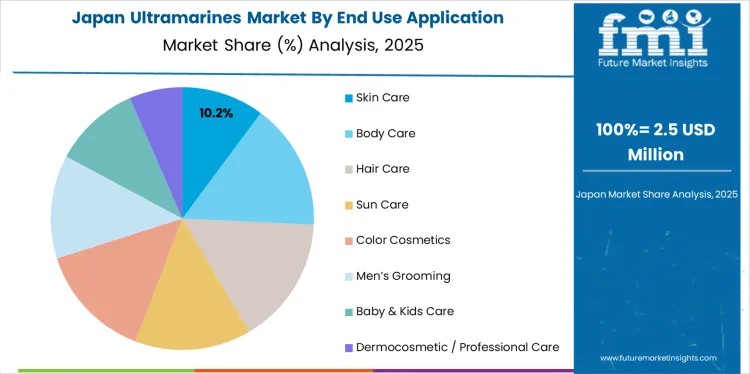
Demand in Japan is increasing at a CAGR of 6.6% through 2035 for ultramarines usage, supported by specialty plastics, precision molded parts, and regulated consumer product manufacturing. Japan contrasts with China by prioritizing tight particle control, low contamination risk, and consistent chromatic stability. Ultramarines are applied in precision polymers, electronic casings, technical fibers, and selected detergent formulations. Imports dominate supply for high specification grades, while limited domestic blending supports niche segments. Key suppliers active in Japan include Lanxess Japan, BASF Japan, and specialty inorganic pigment distributors.
- Precision plastics drive premium pigment demand
- Technical fibers support controlled usage
- Tight particle standards differentiate Japan from China
- Lanxess and BASF Japan lead regulated supply
What Is Supporting Ultramarines Market Expansion in the United Kingdom?
Growth in the UK is advancing at a CAGR of 6.0% through 2035 for ultramarines demand, supported by detergents production, plastic packaging, and decorative coatings manufacturing. The UK contrasts with Germany through greater reliance on consumer goods and household chemical applications rather than heavy industrial coatings. Ultramarines appear in laundry powders, plastic films, household paints, and rubber goods. Imports dominate supply from European pigment producers. Key suppliers serving the UK include Lanxess, Venator distributors, and regional specialty pigment importers.
- Detergents drive steady recurring pigment demand
- Plastic packaging supports consistent industrial usage
- Import dependence remains higher than Germany
- Lanxess supplies major household product manufacturers
How Is Germany Applying Ultramarines Under Regulated Industrial and Automotive Systems?
Growth in Germany reflects a CAGR of 5.5% through 2035 for ultramarines consumption, driven by automotive plastics, engineered polymers, and regulated coatings manufacturing. Germany contrasts with the UK and India through stronger dominance of OEM driven industrial demand and stricter pigment certification. Ultramarines are used in automotive interior plastics, industrial coatings, molded components, and specialty rubber goods. Domestic and EU based production reduces import reliance. Key manufacturers include Lanxess, BASF, and select inorganic pigment processors integrated into national industrial supply networks.
- Automotive plastics anchor industrial pigment demand
- Engineered polymers support technical application growth
- Domestic supply lowers import dependence
- Lanxess and BASF dominate regulated production
What Is Driving More Measured Ultramarines Growth in the United States?
Expansion in the United States is progressing at a CAGR of 4.9% through 2035 for ultramarines demand, supported by plastics manufacturing, detergent production, and construction related coatings. The United States contrasts with India and China through slower growth due to mature plastics markets and high existing pigment penetration. Ultramarines appear in polymer resins, laundry products, construction plastics, and rubber compounds. Large chemical and consumer goods firms dominate procurement. Key suppliers include Lanxess, Huntsman affiliates, and regional inorganic pigment distributors serving national manufacturers.
- Plastics processing sustains baseline pigment demand
- Detergents support steady non-cyclical usage
- Mature markets moderate overall growth pace
- Lanxess and regional suppliers lead commercial supply
Which Companies Control Supply Positioning and Color Stability in the Ultramarines Market?
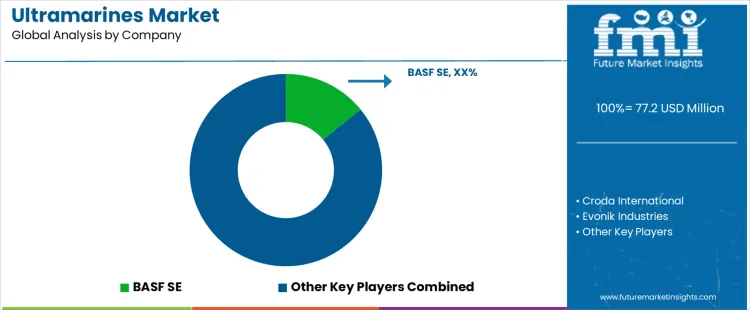
BASF SE holds a central production and formulation facing role in the ultramarines Marketthrough large scale inorganic pigment manufacturing and multi region capacity across Europe North America and Asia. The company supplies cosmetic grade and industrial grade material to personal care plastics detergents and coatings manufacturers under long term procurement programs. Croda International participates through dispersion systems and surface treated pigment platforms used in regulated skin care and color cosmetic formulations. Evonik Industries supports demand through high purity grades used in specialty coatings medical devices and controlled formulation systems. Symrise with actives platforms associated with IFF and Givaudan supplies formulation compatible grades for decorative cosmetics skin care emulsions and fragrance integrated color systems where shade precision and dispersion behavior govern supplier selection.
Dow and Ashland participate through downstream intermediates used in coatings polymer systems plastic masterbatches and detergent coloration that rely on ultramarine pigments. Clariant supports regional demand across Europe Southeast Asia and the Middle East through formulation led buyer programs and distributor aligned supply networks. Seppic operates within regulated dermatology and cosmetic formulation environments where documentation depth and batch traceability define supplier access. Other suppliers serve localized demand through smaller scale pigment processing and toll manufacturing models. These suppliers compete on particle size control chromatic stability sulfur content limits audit compliance and traceability rather than pricing leverage. Competitive positioning reflects access to calcination capacity surface treatment technology formulation support scope and regulatory file maintenance. Buyer preference favors suppliers with consistent technical files multi region manufacturing coverage and validated long cycle supply continuity.
Key Players in the Ultramarines Market
- BASF SE
- Croda International
- Evonik Industries
- Symrise (incl. IFF/Givaudan actives)
- Dow / Dow Inc.
- Ashland
- Clariant
- Seppic
- Others
Scope of the report
| Items | Values |
|---|---|
| Quantitative Units (2025) | USD million |
| End-Use Applications | Skin Care, Body Care, Hair Care, Sun Care, Color Cosmetics, Men’s Grooming, Baby & Kids Care, Dermocosmetic / Professional Care |
| Product Forms | Powder, Granules/Agglomerates, Flakes, Pellets/Prills, Liquid (Solution), Concentrate (High-active Liquid), Dispersion/Suspension, Emulsion, Paste, Gel, Wax / Solid Block, Oil |
| Regions Covered | Asia Pacific, Europe, North America, Latin America, Middle East & Africa |
| Countries Covered | China, Japan, South Korea, India, Australia & New Zealand, ASEAN, Germany, United Kingdom, France, Italy, Spain, Nordic, BENELUX, USA, Canada, Mexico, Brazil, Chile, Saudi Arabia, Turkey, South Africa, plus 40+ additional countries globally |
| Key Companies Profiled | BASF SE, Croda International, Evonik Industries, Symrise (incl. IFF/Givaudan actives), Dow Inc., Ashland, Clariant, Seppic, Lubrizol, Lonza, Inolex |
| Additional Attributes | Dollar by sales breakdown by region, country, end-use, and product form; global growth projections; multi-sector adoption (cosmetic, nutraceutical, functional food); extract bioactivity profiling; iodine and polyphenol standardization; contract harvesting; vertical integration; supply chain stability; regulatory compliance; sensory and bioavailability performance |
Ultramarines Market Segmentation
End Use Application:
- Skin Care
- Body Care
- Hair Care
- Sun Care
- Color Cosmetics
- Men’s Grooming
- Baby & Kids Care
- Dermocosmetic / Professional Care
Product Form:
- Powder
- Granules / Agglomerates
- Flakes
- Pellets / Prills
- Liquid (Solution)
- Concentrate (High-active Liquid)
- Dispersion / Suspension
- Emulsion
- Paste
- Gel
- Wax / Solid Block
- Oil
Region
Asia Pacific
- China
- Japan
- South Korea
- India
- Australia & New Zealand
- ASEAN
- Rest of Asia Pacific
Europe
- Germany
- United Kingdom
- France
- Italy
- Spain
- Nordic
- BENELUX
- Rest of Europe
North America
- United States
- Canada
- Mexico
Latin America
- Brazil
- Chile
- Rest of Latin America
Middle East & Africa
- Kingdom of Saudi Arabia
- Other GCC Countries
- Turkey
- South Africa
- Other African Union
- Rest of Middle East & Africa
Frequently Asked Questions
How big is the ultramarines market in 2025?
The global ultramarines market is estimated to be valued at USD 77.2 million in 2025.
What will be the size of ultramarines market in 2035?
The market size for the ultramarines market is projected to reach USD 135.2 million by 2035.
How much will be the ultramarines market growth between 2025 and 2035?
The ultramarines market is expected to grow at a 5.8% CAGR between 2025 and 2035.
What are the key product types in the ultramarines market?
The key product types in ultramarines market are skin care, body care, hair care, sun care, color cosmetics, men’s grooming, baby & kids care and dermocosmetic / professional care.
Which product form segment to contribute significant share in the ultramarines market in 2025?
In terms of product form , powder segment to command 16.3% share in the ultramarines market in 2025.
Preview the report firsthand - request a free sample
Get SampleGet the brochure for pricing and purchase details.
Get PDFTable of Content
- Executive Summary
- Global Market Outlook
- Demand-side Trends
- Supply-side Trends
- Technology Roadmap Analysis
- Analysis and Recommendations
- Market Overview
- Market Coverage / Taxonomy
- Market Definition / Scope / Limitations
- Market Background
- Market Dynamics
- Drivers
- Restraints
- Opportunity
- Trends
- Scenario Forecast
- Demand in Optimistic Scenario
- Demand in Likely Scenario
- Demand in Conservative Scenario
- Opportunity Map Analysis
- Product Life Cycle Analysis
- Supply Chain Analysis
- Investment Feasibility Matrix
- Value Chain Analysis
- PESTLE and Porter’s Analysis
- Regulatory Landscape
- Regional Parent Market Outlook
- Production and Consumption Statistics
- Import and Export Statistics
- Market Dynamics
- Global Market Analysis 2020 to 2024 and Forecast, 2025 to 2035
- Historical Market Size Value (USD Million) Analysis, 2020 to 2024
- Current and Future Market Size Value (USD Million) Projections, 2025 to 2035
- Y-o-Y Growth Trend Analysis
- Absolute $ Opportunity Analysis
- Global Market Pricing Analysis 2020 to 2024 and Forecast 2025 to 2035
- Global Market Analysis 2020 to 2024 and Forecast 2025 to 2035, By End Use Application
- Introduction / Key Findings
- Historical Market Size Value (USD Million) Analysis By End Use Application , 2020 to 2024
- Current and Future Market Size Value (USD Million) Analysis and Forecast By End Use Application , 2025 to 2035
- Skin Care
- Body Care
- Hair Care
- Sun Care
- Color Cosmetics
- Men’s Grooming
- Baby & Kids Care
- Dermocosmetic / Professional Care
- Y-o-Y Growth Trend Analysis By End Use Application , 2020 to 2024
- Absolute $ Opportunity Analysis By End Use Application , 2025 to 2035
- Global Market Analysis 2020 to 2024 and Forecast 2025 to 2035, By Product Form
- Introduction / Key Findings
- Historical Market Size Value (USD Million) Analysis By Product Form, 2020 to 2024
- Current and Future Market Size Value (USD Million) Analysis and Forecast By Product Form, 2025 to 2035
- Powder
- Granules / Agglomerates
- Flakes
- Pellets / Prills
- Liquid (Solution)
- Concentrate (High-active Liquid)
- Dispersion / Suspension
- Emulsion
- Paste
- Gel
- Wax / Solid Block
- Y-o-Y Growth Trend Analysis By Product Form, 2020 to 2024
- Absolute $ Opportunity Analysis By Product Form, 2025 to 2035
- Global Market Analysis 2020 to 2024 and Forecast 2025 to 2035, By Region
- Introduction
- Historical Market Size Value (USD Million) Analysis By Region, 2020 to 2024
- Current Market Size Value (USD Million) Analysis and Forecast By Region, 2025 to 2035
- North America
- Latin America
- Western Europe
- Eastern Europe
- East Asia
- South Asia and Pacific
- Middle East & Africa
- Market Attractiveness Analysis By Region
- North America Market Analysis 2020 to 2024 and Forecast 2025 to 2035, By Country
- Historical Market Size Value (USD Million) Trend Analysis By Market Taxonomy, 2020 to 2024
- Market Size Value (USD Million) Forecast By Market Taxonomy, 2025 to 2035
- By Country
- USA
- Canada
- Mexico
- By End Use Application
- By Product Form
- By Country
- Market Attractiveness Analysis
- By Country
- By End Use Application
- By Product Form
- Key Takeaways
- Latin America Market Analysis 2020 to 2024 and Forecast 2025 to 2035, By Country
- Historical Market Size Value (USD Million) Trend Analysis By Market Taxonomy, 2020 to 2024
- Market Size Value (USD Million) Forecast By Market Taxonomy, 2025 to 2035
- By Country
- Brazil
- Chile
- Rest of Latin America
- By End Use Application
- By Product Form
- By Country
- Market Attractiveness Analysis
- By Country
- By End Use Application
- By Product Form
- Key Takeaways
- Western Europe Market Analysis 2020 to 2024 and Forecast 2025 to 2035, By Country
- Historical Market Size Value (USD Million) Trend Analysis By Market Taxonomy, 2020 to 2024
- Market Size Value (USD Million) Forecast By Market Taxonomy, 2025 to 2035
- By Country
- Germany
- UK
- Italy
- Spain
- France
- Nordic
- BENELUX
- Rest of Western Europe
- By End Use Application
- By Product Form
- By Country
- Market Attractiveness Analysis
- By Country
- By End Use Application
- By Product Form
- Key Takeaways
- Eastern Europe Market Analysis 2020 to 2024 and Forecast 2025 to 2035, By Country
- Historical Market Size Value (USD Million) Trend Analysis By Market Taxonomy, 2020 to 2024
- Market Size Value (USD Million) Forecast By Market Taxonomy, 2025 to 2035
- By Country
- Russia
- Poland
- Hungary
- Balkan & Baltic
- Rest of Eastern Europe
- By End Use Application
- By Product Form
- By Country
- Market Attractiveness Analysis
- By Country
- By End Use Application
- By Product Form
- Key Takeaways
- East Asia Market Analysis 2020 to 2024 and Forecast 2025 to 2035, By Country
- Historical Market Size Value (USD Million) Trend Analysis By Market Taxonomy, 2020 to 2024
- Market Size Value (USD Million) Forecast By Market Taxonomy, 2025 to 2035
- By Country
- China
- Japan
- South Korea
- By End Use Application
- By Product Form
- By Country
- Market Attractiveness Analysis
- By Country
- By End Use Application
- By Product Form
- Key Takeaways
- South Asia and Pacific Market Analysis 2020 to 2024 and Forecast 2025 to 2035, By Country
- Historical Market Size Value (USD Million) Trend Analysis By Market Taxonomy, 2020 to 2024
- Market Size Value (USD Million) Forecast By Market Taxonomy, 2025 to 2035
- By Country
- India
- ASEAN
- Australia & New Zealand
- Rest of South Asia and Pacific
- By End Use Application
- By Product Form
- By Country
- Market Attractiveness Analysis
- By Country
- By End Use Application
- By Product Form
- Key Takeaways
- Middle East & Africa Market Analysis 2020 to 2024 and Forecast 2025 to 2035, By Country
- Historical Market Size Value (USD Million) Trend Analysis By Market Taxonomy, 2020 to 2024
- Market Size Value (USD Million) Forecast By Market Taxonomy, 2025 to 2035
- By Country
- Kingdom of Saudi Arabia
- Other GCC Countries
- Turkiye
- South Africa
- Other African Union
- Rest of Middle East & Africa
- By End Use Application
- By Product Form
- By Country
- Market Attractiveness Analysis
- By Country
- By End Use Application
- By Product Form
- Key Takeaways
- Key Countries Market Analysis
- USA
- Pricing Analysis
- Market Share Analysis, 2024
- By End Use Application
- By Product Form
- Canada
- Pricing Analysis
- Market Share Analysis, 2024
- By End Use Application
- By Product Form
- Mexico
- Pricing Analysis
- Market Share Analysis, 2024
- By End Use Application
- By Product Form
- Brazil
- Pricing Analysis
- Market Share Analysis, 2024
- By End Use Application
- By Product Form
- Chile
- Pricing Analysis
- Market Share Analysis, 2024
- By End Use Application
- By Product Form
- Germany
- Pricing Analysis
- Market Share Analysis, 2024
- By End Use Application
- By Product Form
- UK
- Pricing Analysis
- Market Share Analysis, 2024
- By End Use Application
- By Product Form
- Italy
- Pricing Analysis
- Market Share Analysis, 2024
- By End Use Application
- By Product Form
- Spain
- Pricing Analysis
- Market Share Analysis, 2024
- By End Use Application
- By Product Form
- France
- Pricing Analysis
- Market Share Analysis, 2024
- By End Use Application
- By Product Form
- India
- Pricing Analysis
- Market Share Analysis, 2024
- By End Use Application
- By Product Form
- ASEAN
- Pricing Analysis
- Market Share Analysis, 2024
- By End Use Application
- By Product Form
- Australia & New Zealand
- Pricing Analysis
- Market Share Analysis, 2024
- By End Use Application
- By Product Form
- China
- Pricing Analysis
- Market Share Analysis, 2024
- By End Use Application
- By Product Form
- Japan
- Pricing Analysis
- Market Share Analysis, 2024
- By End Use Application
- By Product Form
- South Korea
- Pricing Analysis
- Market Share Analysis, 2024
- By End Use Application
- By Product Form
- Russia
- Pricing Analysis
- Market Share Analysis, 2024
- By End Use Application
- By Product Form
- Poland
- Pricing Analysis
- Market Share Analysis, 2024
- By End Use Application
- By Product Form
- Hungary
- Pricing Analysis
- Market Share Analysis, 2024
- By End Use Application
- By Product Form
- Kingdom of Saudi Arabia
- Pricing Analysis
- Market Share Analysis, 2024
- By End Use Application
- By Product Form
- Turkiye
- Pricing Analysis
- Market Share Analysis, 2024
- By End Use Application
- By Product Form
- South Africa
- Pricing Analysis
- Market Share Analysis, 2024
- By End Use Application
- By Product Form
- USA
- Market Structure Analysis
- Competition Dashboard
- Competition Benchmarking
- Market Share Analysis of Top Players
- By Regional
- By End Use Application
- By Product Form
- Competition Analysis
- Competition Deep Dive
- BASF SE
- Overview
- Product Portfolio
- Profitability by Market Segments (Product/Age /Sales Channel/Region)
- Sales Footprint
- Strategy Overview
- Marketing Strategy
- Product Strategy
- Channel Strategy
- Croda International
- Evonik Industries
- Symrise (incl. IFF/Givaudan actives)
- Dow / Dow Inc.
- Ashland
- Clariant
- Seppic
- Others
- BASF SE
- Competition Deep Dive
- Assumptions & Acronyms Used
- Research Methodology


