

- Industry Size (2026)
- USD 6.3 Bn
- Forecast (2036)
- USD 11.8 Bn
- CAGR (2026 to 2036)
- 6.5%
Demand for High-Performance Insulation Materials in USA 2026 to 2036
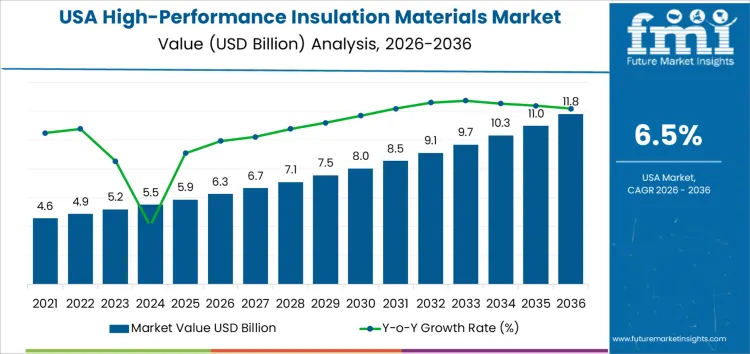
Demand for high-performance insulation materials in USA is valued at USD 6.3 billion in 2026 and is projected to reach USD 11.8 billion by 2036, expanding at a CAGR of 6.5%. Demand growth is supported by stricter building energy codes, retrofit activity in aging infrastructure, and focus on thermal efficiency across residential, commercial, and industrial construction.
Quick Stats for Demand for High-Performance Insulation Materials in USA
- USA High-Performance Insulation Materials Sales Value (2026): USD 6.3 billion
- USA High-Performance Insulation Materials Forecast Value (2036): USD 11.8 billion
- USA High-Performance Insulation Materials Forecast CAGR (2026 to 2036): 6.5%
- Leading Material Type in USA: Polyurethane (PUR) Insulation
- Key Growth Regions in USA: West USA, South USA, Northeast USA, Midwest USA
- Top Players in USA: Owens Corning, Rockwool Inc., Johns Manville, Aspen Aerogels, CertainTeed
Polyurethane insulation represents the leading material type due to high thermal resistance, lightweight properties, and suitability for walls, roofs, and cold-chain applications. Adoption is reinforced by performance advantages in space-constrained buildings and compatibility with modern prefabricated construction methods.
West USA, South USA, Northeast USA, and Midwest USA remain key growth regions, driven by climate variability, urban redevelopment, and large-scale infrastructure investments. Owens Corning, Rockwool Inc., Johns Manville, Aspen Aerogels, and CertainTeed maintain strong positions through diversified insulation portfolios, manufacturing scale, and established distribution networks across the USA construction ecosystem.
USA High-Performance Insulation Materials Key Takeaways
| Metric | Value |
|---|---|
| USA High-Performance Insulation Materials Sales Value (2026) | USD 6.3 billion |
| USA High-Performance Insulation Materials Forecast Value (2036) | USD 11.8 billion |
| USA High-Performance Insulation Materials Forecast CAGR (2026-2036) | 6.5% |
Why is the Demand for High-Performance Insulation Materials in USA Growing?
Demand for high performance insulation materials in the United States grows due to tightening building energy codes, infrastructure renewal, and rising efficiency requirements across residential, commercial, and industrial construction. Federal and state regulations emphasize reduced energy consumption, which increases adoption of insulation materials with superior thermal resistance and long service life. Expansion of data centers, cold storage facilities, and advanced manufacturing sites increases need for insulation that maintains temperature stability under continuous operation. Retrofit activity across aging housing stock drives replacement of conventional insulation with advanced foams, aerogels, and vacuum insulated panels.
Climate variability across regions increases focus on materials that perform consistently under extreme heat and cold conditions. Electric vehicle manufacturing and battery production facilities adopt high performance insulation to support thermal management and fire safety requirements. Growth in green building certification programs encourages use of materials with documented performance and durability characteristics. Industrial users apply advanced insulation to reduce heat loss, improve process efficiency, and lower operating costs. Supply chain localization supports domestic production of insulation materials tailored to regulatory and application specific needs. Insurance and risk management considerations strengthen demand for insulation systems that enhance building resilience and long term asset protection.
How Are the Segments Classified in the Demand for High-Performance Insulation Materials in USA?
Demand for high-performance insulation materials in USA is shaped by energy-efficiency regulations, thermal management requirements, and expansion of advanced infrastructure. Buyers assess thermal resistance, material stability, space efficiency, and performance across extreme temperature conditions. Adoption patterns reflect diversified usage across construction, industrial processing, transportation, and specialized environments, supported by focus on operational efficiency, safety compliance, and long-term performance reliability.
Which Material Type Represents the Largest Share of High-Performance Insulation Demand in USA?
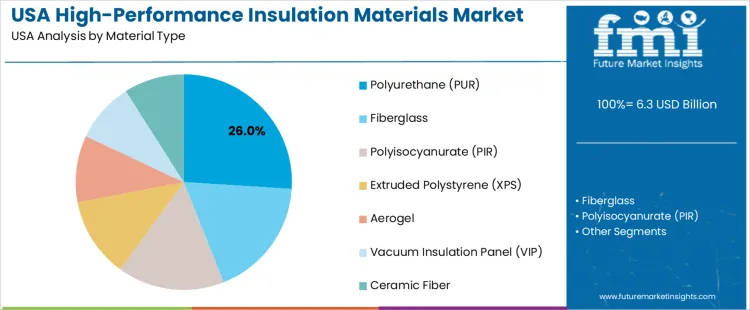
Polyurethane insulation materials hold 26.0%, representing the largest material-type share in USA demand. Polyurethane offers high thermal resistance, lightweight structure, and flexibility across building envelopes and industrial insulation systems. Fiberglass holds 18.0%, supporting cost-effective insulation for residential and commercial applications requiring moderate performance. Polyisocyanurate accounts for 16.0%, favored for roofing and wall systems requiring higher fire resistance. Extruded polystyrene holds 12.0%, applied in moisture-prone environments. Aerogel, vacuum insulation panels, and ceramic fiber together account for 28.0%, serving space-constrained and high-temperature applications. Material distribution reflects balance between performance efficiency and installation practicality.
Key Points
- Polyurethane leads due to high insulation efficiency.
- Fiberglass and PIR support mainstream construction usage.
- Advanced materials serve specialized thermal requirements.
Which Temperature Range Drives the Highest Demand for High-Performance Insulation in USA?
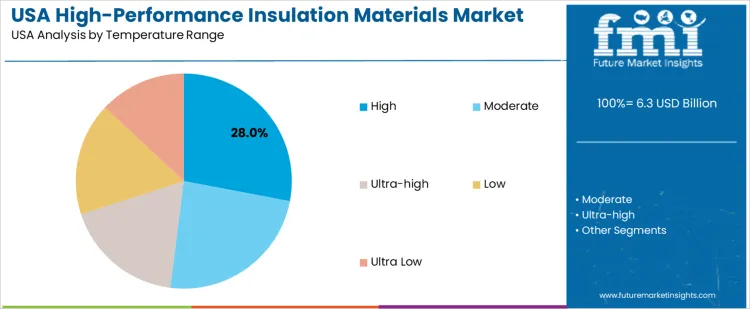
High-temperature applications hold 28.0%, driving the highest temperature-range demand in USA. These applications require insulation capable of maintaining stability under elevated thermal loads in industrial and energy systems. Moderate temperature ranges hold 24.0%, supporting building and commercial infrastructure needs. Ultra-high temperature applications account for 18.0%, covering aerospace and heavy industrial processes. Low temperature ranges hold 17.0%, supporting refrigeration and controlled environments. Ultra-low temperature applications hold 13.0%, serving cryogenic storage and specialized research facilities. Temperature-range distribution reflects dominance of industrial and infrastructure-driven insulation requirements.
Key Points
- High-temperature insulation leads due to industrial demand.
- Moderate ranges support building infrastructure.
- Ultra-low ranges address cryogenic and research needs.
Which End-Use Sector Accounts for the Largest Share of High-Performance Insulation Demand in USA?
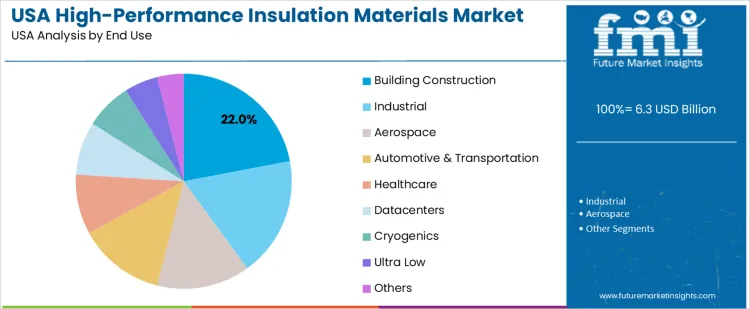
Building construction holds 22.0%, accounting for the largest end-use share in USA demand. Insulation supports energy efficiency targets, thermal comfort, and compliance with building codes. Industrial applications hold 18.0%, requiring insulation for process stability and equipment protection. Aerospace accounts for 14.0%, emphasizing lightweight and high-temperature materials. Automotive and transportation hold 13.0%, supporting thermal management and noise control. Healthcare, datacenters, cryogenics, and other uses together account for 33.0%. End-use distribution reflects diversified adoption across infrastructure and technology-intensive sectors.
Key Points
- Building construction leads due to energy-efficiency standards.
- Industrial use supports process and equipment protection.
- Specialized sectors require advanced insulation solutions.
What are the Key Dynamics in the High-Performance Insulation Materials Industry?
Demand rises as residential, commercial, and industrial sectors in USA adopt high-performance insulation materials to meet energy efficiency goals, building code requirements, and thermal performance expectations. Usage spans construction, retrofits, HVAC systems, and industrial process insulation. Adoption aligns with federal and state energy standards, decarbonization initiatives, and consumer preference for reduced utility costs. Market activity concentrates in regions with extreme climates, aging building stock, and sustainability-driven construction practices.
How do building energy codes and efficiency incentives drive demand in USA?
Stringent building energy codes at federal, state, and local levels require enhanced thermal performance to reduce energy consumption. High-performance insulation materials such as spray foam, rigid board, aerogels, and advanced fibrous products support compliance with code requirements for envelope R-values. Retrofit activity in older residential and commercial buildings leverages insulation upgrades to improve comfort and reduce heating and cooling loads. Utility rebate programs and tax incentives motivate homeowners and developers to invest in premium insulation. Industrial facilities adopt advanced insulation for process efficiency and heat recovery in manufacturing, power, and petrochemical sectors. Strong emphasis on lifecycle energy savings reinforces specification of high-performance systems across design and construction workflows.
How do material costs, installation complexity, and supply chain variability influence demand stability in USA?
Elevated costs for advanced insulation materials affect adoption in price-sensitive residential and small commercial projects, where lower-cost traditional options remain competitive. Installation complexity requires skilled labor, particularly for spray and specialty products, influencing project timelines and labor availability. Variability in raw material prices, including polyiso, mineral wool, and closed-cell foam components, affects procurement planning for contractors and distributors. Retrofit environments present logistical challenges when accessing confined spaces and coordinating with other trades. Regional differences in climate, energy costs, and incentive availability shape adoption patterns. Demand remains robust where energy savings justify investment, while expansion depends on cost management, workforce capability, and continued alignment of efficiency policies within USA construction and industrial sectors.
How Is Demand for High-Performance Insulation Materials in the USA Evolving by Region?
Demand for high-performance insulation materials in the USA is rising due to energy efficiency standards, building electrification, and retrofit activity. West USA leads with a 7.4% CAGR, supported by stringent energy codes and wildfire resilience requirements. South USA follows at 6.7%, driven by cooling efficiency needs, residential construction, and moisture control. Northeast USA records a 5.9% CAGR, shaped by cold-climate performance requirements and retrofit-focused policy incentives. Midwest USA posts 5.2%, reflecting balanced heating efficiency needs and cost-managed upgrades. Regional variation reflects climate exposure, building stock age, regulatory rigor, and adoption of advanced materials across residential, commercial, and industrial applications in the USA.
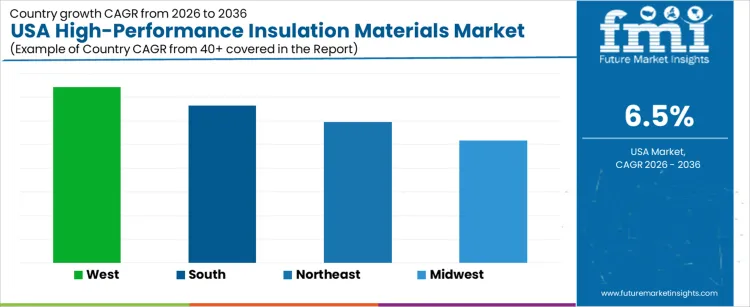
| Region | CAGR (2026 to 2036) |
|---|---|
| West USA | 7.4% |
| South USA | 6.7% |
| Northeast USA | 5.9% |
| Midwest USA | 5.2% |
What dynamics are elevating use of high-performance insulation materials in West USA?
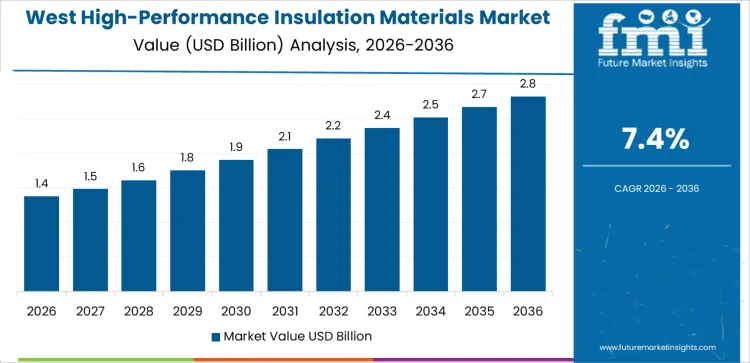
West USA demand benefits from strict building energy codes, decarbonization targets, and climate resilience priorities. Region’s CAGR of 7.4% reflects adoption of advanced insulation for residential retrofits, commercial buildings, and industrial facilities. Builders emphasize materials offering high R-values, fire resistance, and thermal stability under temperature swings. Wildfire risk influences preference for non-combustible insulation in exterior assemblies. Technology sector construction supports demand for controlled indoor environments and noise attenuation. Procurement favors products with verified performance data and compliance documentation. Growth remains policy-aligned and retrofit-driven, supported by incentives for energy-efficient upgrades and resilience-focused construction practices.
- Stringent energy codes and resilience standards
- Retrofit-led residential and commercial demand
- Preference for non-combustible, high R-value materials
- Verified performance and compliance requirements
Why does South USA show strong growth in advanced insulation adoption?
South USA demand is shaped by cooling load reduction, humidity management, and ongoing residential construction. Region’s CAGR of 6.7% reflects use of high-performance insulation in attics, walls, and roofing systems to improve thermal comfort and reduce HVAC loads. Builders prioritize moisture resistance, air sealing compatibility, and durability under high temperatures. Warehouse and logistics facilities add demand for large-area insulation solutions. Cost sensitivity influences material selection toward scalable products with proven lifecycle savings. Growth remains construction-led and efficiency-focused, aligned with cooling-dominant climates and steady housing development.
- Cooling efficiency and humidity control needs
- Residential construction and warehouse expansion
- Focus on air sealing and moisture resistance
- Lifecycle cost and scalability considerations
How do cold-climate requirements influence insulation demand in Northeast USA?
Northeast USA demand reflects cold-weather performance requirements, aging building stock, and retrofit incentives. Region’s CAGR of 5.9% is supported by upgrades to reduce heat loss in residential and commercial properties. Materials with superior thermal resistance and vapor control gain preference. Public programs encourage envelope improvements to meet energy targets. Historic building renovations require insulation solutions compatible with existing structures. Procurement emphasizes compliance with local codes and documented energy savings. Growth remains retrofit-centric and regulation-aligned, supported by winter heating cost management and long-term efficiency goals.
- Cold-climate thermal performance priorities
- Retrofit incentives and aging buildings
- Vapor control and envelope compatibility
- Code-compliant and documented savings
What factors underpin steady insulation material demand across Midwest USA?
Midwest USA demand is anchored in balanced heating and cooling needs, industrial facilities, and cost-managed upgrades. Region’s CAGR of 5.2% reflects adoption of high-performance insulation in manufacturing plants, warehouses, and residential retrofits. Builders and facility managers prioritize durability, ease of installation, and predictable performance. Agricultural and food processing facilities add demand for temperature-controlled environments. Investment decisions align with maintenance cycles and incremental efficiency improvements. Growth remains steady and practical, reflecting mixed climate exposure and disciplined capital planning.
- Balanced climate-driven insulation requirements
- Industrial and agricultural facility usage
- Durability and installation efficiency focus
- Incremental, maintenance-aligned upgrades
What is the competitive landscape of demand for high-performance insulation materials in the USA?
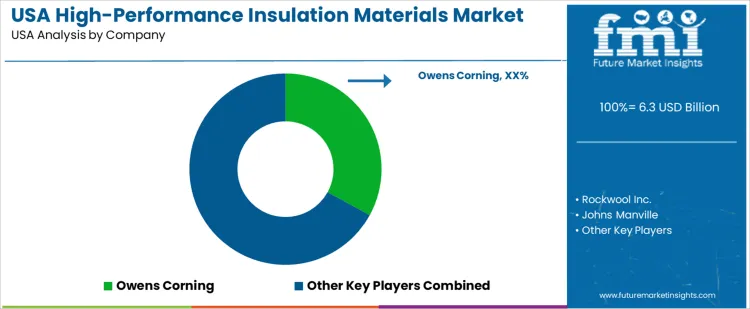
Demand for high-performance insulation materials in the USA is shaped by energy efficiency standards, building code upgrades, electrification and decarbonization goals, and industrial thermal management requirements. Applications span residential and commercial construction, industrial process insulation, HVAC systems, and transportation sectors including aerospace and automotive. Buyers evaluate thermal conductivity, fire resistance, moisture tolerance, compressive strength, and life-cycle performance under varied climatic conditions. Procurement teams prioritize suppliers with domestic manufacturing, material safety compliance, and long-term supply reliability. Trend in the USA market reflects increased adoption of advanced polymers, aerogels, vacuum insulation panels, and engineered mineral fibers aligned with sustainability and performance targets.
Owens Corning operates extensive USA production and distribution of fiberglass and engineered insulation systems used across residential, commercial, and industrial applications supported by technical specification services. Rockwool Inc. participates with stone wool high-performance insulation tailored to fire resistance, acoustics, and thermal performance across building and industrial markets. Johns Manville maintains visibility through mineral wool and advanced synthetic insulation materials deployed in demanding thermal and fire-safety environments. Aspen Aerogels USA supports demand with aerogel-based insulation products offering low thermal conductivity for industrial process and energy infrastructure applications. CertainTeed, part of Saint-Gobain, contributes with high-efficiency insulation materials used in building envelopes and mechanical systems. Competitive positioning in the USA reflects material performance, code compliance, domestic support networks, and ability to meet stringent energy and safety requirements across diverse sectors.
Key Players in USA High-Performance Insulation Materials Demand
- Owens Corning
- Rockwool Inc.
- Johns Manville
- Aspen Aerogels
- CertainTeed
Scope of the Report
| Items | Details |
|---|---|
| Quantitative Units | USD billion |
| Material Type | Polyurethane (PUR); Fiberglass; Polyisocyanurate (PIR); Extruded Polystyrene (XPS); Aerogel; Vacuum Insulation Panel (VIP); Ceramic Fiber |
| Temperature Range | High; Moderate; Ultra-high; Low; Ultra-low |
| End Use | Building Construction; Industrial; Aerospace; Automotive & Transportation; Healthcare; Datacenters; Cryogenics; Others |
| Regions Covered | West USA; South USA; Northeast USA; Midwest USA |
| Key Companies Profiled | Owens Corning; Rockwool Inc.; Johns Manville; Aspen Aerogels; CertainTeed |
| Additional Attributes | Demand is supported by energy-efficiency regulations, data center expansion, and advanced thermal management needs in aerospace and industrial applications. Aerogel and VIP adoption is rising in space-constrained and ultra-low temperature environments, while PUR, PIR, and fiberglass maintain volume dominance in construction and industrial insulation. |
USA High-Performance Insulation Materials Demand by Segments
Material Type:
- Polyurethane (PUR)
- Fiberglass
- Polyisocyanurate (PIR)
- Extruded Polystyrene (XPS)
- Aerogel
- Vacuum Insulation Panel (VIP)
- Ceramic Fiber
Temperature Range:
- High
- Moderate
- Ultra-high
- Low
- Ultra Low
End Use:
- Building Construction
- Industrial
- Aerospace
- Automotive & Transportation
- Healthcare
- Datacenters
- Cryogenics
- Ultra Low
- Others
Region:
- West USA
- South USA
- Northeast USA
- Midwest USA
Frequently Asked Questions
How big is the demand for high-performance insulation materials in USA in 2026?
The demand for high-performance insulation materials in USA is estimated to be valued at USD 6.3 billion in 2026.
What will be the size of high-performance insulation materials in USA in 2036?
The market size for the high-performance insulation materials in USA is projected to reach USD 11.8 billion by 2036.
How much will be the demand for high-performance insulation materials in USA growth between 2026 and 2036?
The demand for high-performance insulation materials in USA is expected to grow at a 6.5% CAGR between 2026 and 2036.
What are the key material types in the high-performance insulation materials in USA?
The key material types in high-performance insulation materials in USA are polyurethane (PUR), fiberglass, polyisocyanurate (PIR), extruded polystyrene (XPS), aerogel, vacuum insulation panel (VIP), and ceramic fiber.
Which temperature range segment is expected to contribute significant share in the high-performance insulation materials in USA in 2026?
In terms of temperature range, high segment is expected to command 28.0% share in the high-performance insulation materials in USA in 2026.
Preview the report firsthand - request a free sample
Get SampleGet the brochure for pricing and purchase details.
Get PDFTable of Content
- Executive Summary
- USA Market Outlook
- Demand-side Trends
- Supply-side Trends
- Technology Roadmap Analysis
- Analysis and Recommendations
- Market Overview
- Market Coverage / Taxonomy
- Market Definition / Scope / Limitations
- Market Background
- Market Dynamics
- Drivers
- Restraints
- Opportunity
- Trends
- Scenario Forecast
- Demand in Optimistic Scenario
- Demand in Likely Scenario
- Demand in Conservative Scenario
- Opportunity Map Analysis
- Product Life Cycle Analysis
- Supply Chain Analysis
- Investment Feasibility Matrix
- Value Chain Analysis
- PESTLE and Porter’s Analysis
- Regulatory Landscape
- Regional Parent Market Outlook
- Production and Consumption Statistics
- Import and Export Statistics
- Market Dynamics
- USA Market Analysis 2021 to 2025 and Forecast, 2026 to 2036
- Historical Market Size Value (USD Million) Analysis, 2021 to 2025
- Current and Future Market Size Value (USD Million) Projections, 2026 to 2036
- Y-o-Y Growth Trend Analysis
- Absolute $ Opportunity Analysis
- USA Market Pricing Analysis 2021 to 2025 and Forecast 2026 to 2036
- USA Market Analysis 2021 to 2025 and Forecast 2026 to 2036, By Material Type
- Introduction / Key Findings
- Historical Market Size Value (USD Million) Analysis By Material Type , 2021 to 2025
- Current and Future Market Size Value (USD Million) Analysis and Forecast By Material Type , 2026 to 2036
- Polyurethane (PUR)
- Fiberglass
- Polyisocyanurate (PIR)
- Extruded Polystyrene (XPS)
- Aerogel
- Vacuum Insulation Panel (VIP)
- Ceramic Fiber
- Polyurethane (PUR)
- Y-o-Y Growth Trend Analysis By Material Type , 2021 to 2025
- Absolute $ Opportunity Analysis By Material Type , 2026 to 2036
- USA Market Analysis 2021 to 2025 and Forecast 2026 to 2036, By Temperature Range
- Introduction / Key Findings
- Historical Market Size Value (USD Million) Analysis By Temperature Range, 2021 to 2025
- Current and Future Market Size Value (USD Million) Analysis and Forecast By Temperature Range, 2026 to 2036
- High
- Moderate
- Ultra-high
- Low
- Ultra Low
- High
- Y-o-Y Growth Trend Analysis By Temperature Range, 2021 to 2025
- Absolute $ Opportunity Analysis By Temperature Range, 2026 to 2036
- USA Market Analysis 2021 to 2025 and Forecast 2026 to 2036, By End Use
- Introduction / Key Findings
- Historical Market Size Value (USD Million) Analysis By End Use, 2021 to 2025
- Current and Future Market Size Value (USD Million) Analysis and Forecast By End Use, 2026 to 2036
- Building Construction
- Industrial
- Aerospace
- Automotive & Transportation
- Healthcare
- Datacenters
- Cryogenics
- Ultra Low
- Others
- Building Construction
- Y-o-Y Growth Trend Analysis By End Use, 2021 to 2025
- Absolute $ Opportunity Analysis By End Use, 2026 to 2036
- Market Structure Analysis
- Competition Dashboard
- Competition Benchmarking
- Market Share Analysis of Top Players
- By Regional
- By Material Type
- By Temperature Range
- By End Use
- Competition Analysis
- Competition Deep Dive
- Owens Corning
- Overview
- Product Portfolio
- Profitability by Market Segments (Product/Age /Sales Channel/Region)
- Sales Footprint
- Strategy Overview
- Marketing Strategy
- Product Strategy
- Channel Strategy
- Rockwool Inc.
- Johns Manville
- Aspen Aerogels
- CertainTeed
- Owens Corning
- Competition Deep Dive
- Assumptions & Acronyms Used
- Research Methodology


