

- Industry Size (2025)
- USD 0.5 Bn
- Forecast (2035)
- USD 0.8 Bn
- CAGR (2025 to 2035)
- 4.8%
Demand for Magnetic Separator in USA 2026 to 2036
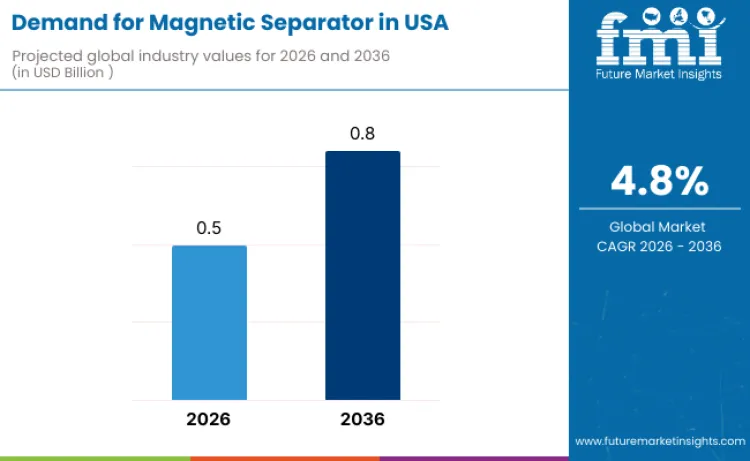
Demand for Magnetic Separator in USA is valued at USD 0.5 billion in 2026 and is projected to reach USD 0.8 billion by 2036, reflecting a CAGR of 4.8%. Demand expands due to increased deployment across mining, recycling, food processing, and bulk material handling operations where metal contamination control and material purity remain critical. Infrastructure upgrades, higher recycling throughput, and stricter quality standards reinforce adoption across industrial processing environments.
Over band and cross belt separators lead product-type usage because these systems enable continuous removal of ferrous contaminants from conveyor-fed material streams without interrupting operations. High magnetic strength, adjustable suspension height, and suitability for high-capacity conveying lines support use in aggregates, scrap processing, and cement handling. Improvements in magnet design, belt durability, and automated discharge mechanisms enhance operational reliability.
West USA, South USA, Northeast USA, and Midwest USA represent key growth regions supported by mining activity, metals recycling clusters, and large-scale manufacturing bases. Eriez, Bunting, Metso, Walker Magnetics, and Master Magnets anchor competitive activity through high-intensity magnetic systems, application-specific separator designs, and service networks focused on uptime optimization and contamination control across diverse industrial applications.
Quick Stats for Demand for Magnetic Separator in USA
- USA Magnetic Separator Sales Value (2026): USD 0.5 billion
- USA Magnetic Separator Forecast Value (2036): USD 0.8 billion
- USA Magnetic Separator Forecast CAGR (2026 to 2036): 4.8%
- Leading Product Type in USA Demand: Over band / cross belt separators
- Key Growth Regions in USA Demand: West USA, South USA, Northeast USA, Midwest USA
- Top Players in USA Demand: Eriez, Bunting, Metso, Walker Magnetics, Master Magnets
USA Magnetic Separator Key Takeaways
| Metric | Value |
| USA Magnetic Separator Sales Value (2026) | USD 0.5 b illion |
| USA Magnetic Separator Forecast Value (2036) | USD 0.8 b illion |
| USA Magnetic Separator Forecast CAGR (2026 to 2036) | 4.8 % |
How Are the Segments Classified in the Demand for Magnetic Separators in the USA?
Demand for magnetic separators in the USA is shaped by requirements for material purity, process efficiency, and compliance with industrial quality standards. Buyers evaluate separation strength, throughput capacity, installation flexibility, and suitability for dry or wet processing environments. Adoption patterns reflect usage across mining, recycling, metal processing, and manufacturing operations where contamination control and recovery of ferrous materials are operational priorities.
Which Product Type Accounts for the Largest Share of Demand in the USA?
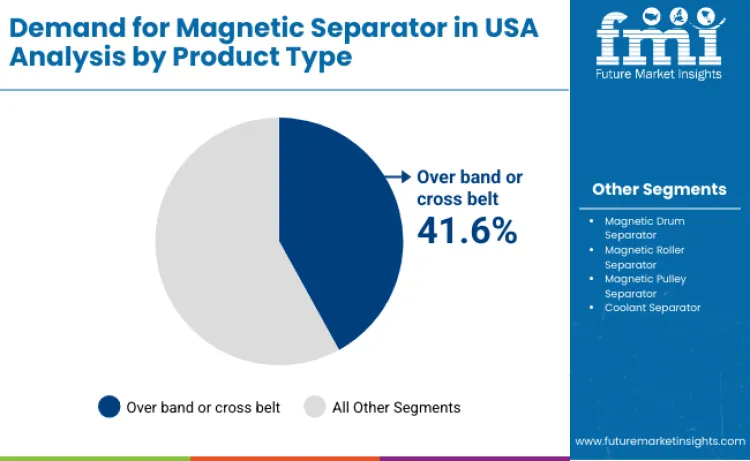
Over band or cross belt separators hold 41.6%, making them the leading product-type segment in USA demand. These systems enable continuous removal of ferrous contaminants from conveyor belts in bulk material handling operations. Magnetic drum separators hold 15.4%, supporting high-volume separation in recycling and mineral processing lines. Magnetic roller separators account for 19.5%, enabling fine-particle separation and high-gradient applications. Magnetic pulley separators hold 12.4%, integrating separation directly into conveyor head pulleys. Coolant separators hold 11.1%, supporting metalworking fluid filtration. Product-type distribution reflects preference for over band systems in continuous USA industrial operations.
Key Points:
- Over band separators support continuous bulk-material separation.
- Roller separators enable fine-particle magnetic recovery.
- Drum and pulley systems integrate into high-throughput lines.
Which Material Type Accounts for the Largest Share of Demand in the USA?
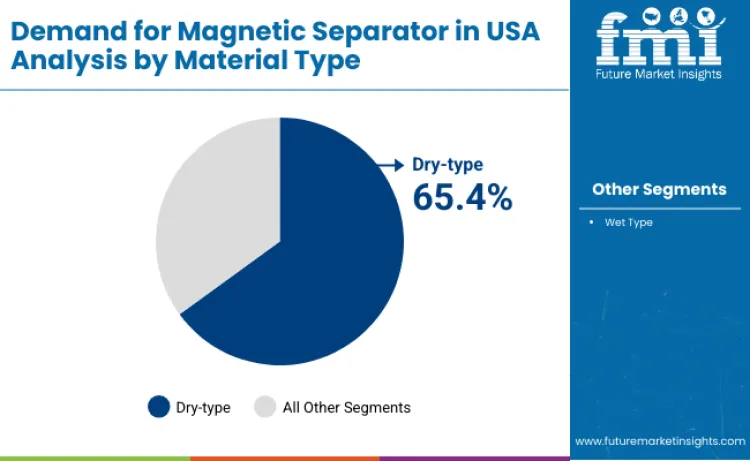
Dry-type magnetic separators hold 65.4%, making them the dominant material-type segment in the USA. Dry systems are widely used in mining, recycling, and aggregate processing where moisture control is limited. These systems reduce operational complexity and water usage, aligning with efficiency objectives in USA facilities. Wet-type separators hold 34.6%, supporting slurry-based processing in mineral beneficiation and wastewater-linked applications. Material-type distribution reflects stronger reliance on dry separation methods across USA industrial infrastructure.
Key Points:
- Dry-type systems dominate due to operational simplicity.
- Wet-type separators support slurry-based processing needs.
- Distribution reflects lower water dependency in USA operations.
What are the Key Dynamics in the Magnetic Separator Industryin USA?
Demand increases across mining, recycling, food processing, and industrial manufacturing sectors in the USA. Magnetic separators support metal recovery, contamination control, and material purity across regulated production environments. Adoption aligns with safety standards, quality compliance, and operational efficiency requirements. Usage remains concentrated in regions with strong manufacturing bases, advanced recycling infrastructure, and established mineral processing activity.
How do industrial quality control need and material recovery requirements drive demand in USA?
US mining operations use magnetic separators to recover ferrous minerals and remove tramp metal during ore processing. Recycling facilities deploy separators to improve recovery of steel and iron from municipal solid waste, electronic scrap, and construction debris. Food and beverage processors rely on magnetic separation to meet FDA and FSMA contamination control standards. Plastics and rubber manufacturers integrate separators to protect downstream equipment and improve product consistency. Steel mills and foundries use high-intensity systems for slag processing and metal reclamation. Growth in domestic recycling capacity and reshoring of manufacturing activity reinforces demand across industrial corridors in the Midwest, South, and Western USA.
How do capital investment levels, maintenance demands, and process limitations influence adoption?
Equipment procurement requires capital allocation influenced by separator strength, automation level, and throughput capacity. Smaller processors face budget constraints when upgrading from basic magnetic systems to high-gradient or rare-earth configurations. Performance depends on feed material composition, moisture content, and particle size, requiring process-specific calibration. Maintenance involves periodic magnet replacement and cleaning to sustain efficiency. Energy consumption considerations influence selection in continuous processing environments. Integration challenges arise when retrofitting separators into existing lines. Regulatory inspections require documented performance consistency, increasing operational oversight. Adoption remains strongest where compliance, recovery value, and equipment protection justify long-term investment within US industrial operations.
How Is Demand for Magnetic Separator in USA Evolving by Region?
Demand for magnetic separators in the USA is increasing due to continued emphasis on material purity, recycling efficiency, and contamination control across mining, recycling, food processing, and manufacturing operations. West USA leads with a 5.5% CAGR, supported by mining activity, metals recycling, and advanced manufacturing requirements. South USA follows at 4.9%, driven by bulk material handling, aggregates, and food processing industries. Northeast USA records a 4.4% CAGR, shaped by recycling regulations, industrial automation, and specialty manufacturing. Midwest USA posts a 3.8% CAGR, reflecting stable demand from automotive manufacturing, grain processing, and heavy industry. Regional growth reflects differences in industrial mix, recycling intensity, and capital investment patterns.
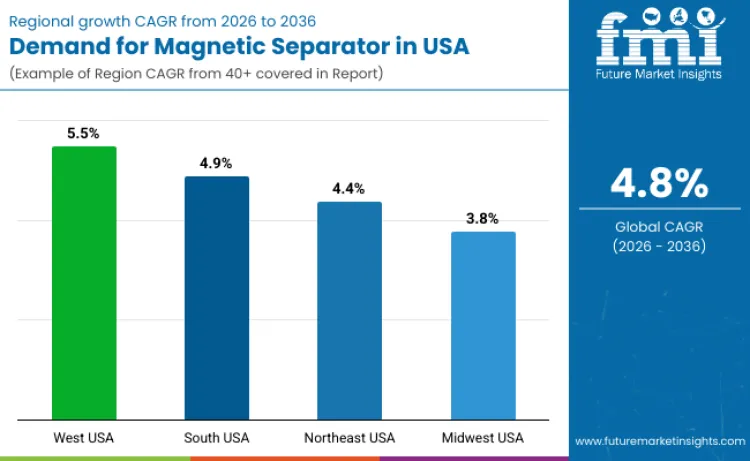
| Region | CAGR (2026 to 2036) |
|---|---|
| West USA | 5.5% |
| South USA | 4.9% |
| Northeast USA | 4.4% |
| Midwest USA | 3.8% |
How is West USA driving demand for Magnetic Separators?
West USA demand is influenced by resource extraction, recycling infrastructure, and high-precision manufacturing. The region’s CAGR of 5.5% reflects strong use of magnetic separators in mining operations for iron ore concentration, rare earth processing, and industrial mineral purification. Recycling facilities deploy high-intensity drum, overband, and eddy-current separators to improve ferrous recovery from construction and electronic waste streams. Advanced manufacturing plants apply magnetic separation to protect downstream equipment and ensure material consistency. Demand favors high-gradient and rare-earth magnetic systems designed for abrasive materials and high throughput. Capital investment remains aligned with mining modernization and recycling expansion.
- Mining and mineral-processing applications
- Metals and electronic-waste recycling systems
- Equipment protection in advanced manufacturing
- Preference for high-intensity and rare-earth magnets
How is South USA driving demand for Magnetic Separators?
South USA demand is shaped by bulk material industries, food processing, and infrastructure development. The region’s CAGR of 4.9% reflects widespread use of magnetic separators in aggregate processing, cement plants, and grain-handling facilities. Food and beverage processors rely on magnetic grids, plates, and traps to meet contamination-control standards. Recycling operators deploy separators to recover ferrous metals from municipal solid waste and construction debris. Systems emphasizing durability, ease of maintenance, and continuous operation dominate procurement decisions. Demand growth aligns with industrial expansion and compliance-driven upgrades.
- Aggregate, cement, and bulk material processing
- Food and grain contamination control
- Municipal and construction-waste recycling
- Emphasis on rugged, low-maintenance designs
How is Northeast USA driving demand for Magnetic Separators?
Northeast USA demand reflects regulatory pressure, automation, and recycling intensity. The region’s CAGR of 4.4% is driven by adoption of magnetic separators in material recovery facilities, specialty manufacturing, and precision fabrication. Recycling plants install advanced magnetic systems to meet stricter recovery targets and purity standards. Manufacturers use magnetic separation to prevent metal contamination in high-value production lines. Demand favors compact, automated separators compatible with space-constrained facilities. Procurement decisions prioritize performance validation, traceability, and compliance documentation.
- Material recovery facility upgrades
- Specialty and precision manufacturing use
- Automation-compatible magnetic separation systems
- Compliance-driven equipment replacement
How is Midwest USA driving demand for Magnetic Separators?
Midwest USA demand is anchored in traditional manufacturing, automotive supply chains, and agricultural processing. The region’s CAGR of 3.8% reflects steady use of magnetic separators in steel processing, machining operations, grain handling, and feed production. Automotive and machinery plants deploy separators to protect milling and forming equipment. Agricultural processors apply magnetic traps and drums to ensure product safety and equipment reliability. Purchasing decisions emphasize cost efficiency, reliability, and compatibility with existing lines. Growth remains moderate, supported by replacement demand and incremental capacity expansion.
- Automotive and machinery manufacturing protection
- Grain, feed, and agricultural processing
- Stable replacement-driven demand
- Cost-focused procurement preferences
What is the competitive landscape of demand for magnetic separators in the USA?
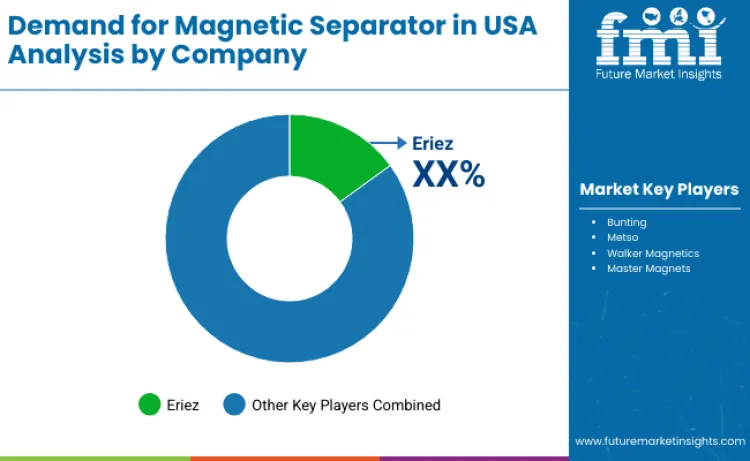
Demand for magnetic separators in the USA is driven by metal contamination control across mining, recycling, food processing, aggregates, and advanced manufacturing operations. Applications require reliable ferrous and non-ferrous separation, stable magnetic field strength, and compatibility with high-throughput material flows. Buyers assess separator configuration, magnetic intensity, wear resistance, and ease of integration into existing conveyor, chute, or slurry systems. Procurement teams prioritize domestic manufacturing support, application engineering capability, and compliance with USA food safety and industrial standards. Trend in the USA market reflects growth in recycling throughput, stricter food contamination controls, and wider automation across material handling lines.
Eriez maintains a strong position through USA-based manufacturing and broad portfolios covering drum, overband, grate, and high-intensity separators. Bunting operates extensive USA facilities supplying magnetic and eddy current systems used across recycling, plastics, and food sectors. Metso supports large-scale industrial demand through magnetic separation equipment integrated into mineral processing and aggregates operations. Walker Magnetics serves industrial customers with custom-engineered magnetic solutions for lifting, separation, and material control. Master Magnets USA supplies high-performance magnetic separators supporting recycling plants, bulk processing, and specialist industrial applications. Competitive positioning in the USA reflects separation efficiency, engineering support depth, product durability, and service responsiveness across varied industrial end users.
Key Players in USA Magnetic Separator Demand
- Eriez
- Bunting
- Metso
- Walker Magnetics
- Master Magnets
Scope of the Report
| Items | Values |
|---|---|
| Quantitative Units | USD billion |
| Product Type | Over band / Cross Belt Separator; Magnetic Drum Separator; Magnetic Roller Separator; Magnetic Pulley Separator; Coolant Separator |
| Material Type | Dry Type; Wet Type |
| Cleaning Type | Self-Cleaning; Manual Cleaning |
| End-Use Industry | Recycling; Processing Industries; Metal & Mineral Mining |
| Regions Covered | West USA; South USA; Northeast USA; Midwest USA |
| Key Companies Profiled | Eriez ; Bunting; Metso ; Walker Magnetics; Master Magnets |
| Additional Attributes | Dollar sales by product type and material configuration across West USA, South USA, Northeast USA, and Midwest USA; deployment trends in scrap recycling facilities, aggregate processing plants, and metal beneficiation operations; adoption driven by regulatory pressure on recycling efficiency, contamination control, and material recovery rates; preference for self-cleaning systems in high-throughput industrial environments; demand influenced by mining activity levels, expansion of secondary metal recovery, and automation upgrades in USA processing industries; competitive positioning based on magnetic strength, separator durability, system customization, and integration with existing conveyor and processing lines. |
USA Magnetic Separator Demand by Segments
By Product Type:
- Over band/Cross Belt Separator
- Magnetic Drum Separator
- Magnetic Roller Separator
- Magnetic Pulley Separator
- Coolant Separator
By Material Type:
- Dry Type
- Wet Type
By Cleaning Type:
- Self-Cleaning
- Manual Cleaning
By End-Use Industry:
- Recycling
- Processing Industries
- Metal & Mineral Mining
By Region:
- West USA
- South USA
- Northeast USA
- Midwest USA
Frequently Asked Questions
How big is the demand for magnetic separator in USA in 2026?
The demand for magnetic separator in USA is estimated to be valued at USD 0.5 billion in 2026.
What will be the size of magnetic separator demand in USA in 2036?
The demand size for magnetic separator in USA is projected to reach USD 0.8 billion by 2036.
How much will the demand for magnetic separator in USA grow between 2026 and 2036?
The demand for magnetic separator in USA is expected to grow at a 4.8% CAGR between 2026 and 2036.
What are the key product types in the magnetic separator demand in USA?
The key product types in magnetic separator demand in USA include over band separators, cross belt separators, drum separators, and pulley separators.
Which material-type segment is expected to contribute a significant share in the magnetic separator demand in USA in 2026?
In terms of material type, dry type magnetic separators are expected to command 65.4% share in the magnetic separator demand in USA in 2026.
Preview the report firsthand - request a free sample
Get SampleGet the brochure for pricing and purchase details.
Get PDFTable of Content
- Executive Summary
- USA Market Outlook
- Demand Side Trends
- Supply Side Trends
- Technology Roadmap Analysis
- Analysis and Recommendations
- Market Overview
- Market Coverage and Taxonomy
- Market Definition, Scope, and Limitations
- Market Background
- Market Dynamics
- Drivers
- Restraints
- Opportunities
- Trends
- Scenario Forecast
- Demand in Optimistic Scenario
- Demand in Likely Scenario
- Demand in Conservative Scenario
- Opportunity Map Analysis
- Product Life Cycle Analysis
- Supply Chain Analysis
- Investment Feasibility Matrix
- Value Chain Analysis
- PESTLE and Porter Analysis
- Regulatory Landscape
- Regional Parent Market Outlook
- Production and Consumption Statistics
- Import and Export Statistics
- USA Magnetic Separator Demand Analysis 2020 to 2024 and Forecast 2025 to 2035
- Historical Market Size Value (USD Billion) Analysis 2020 to 2024
- Current and Future Market Size Value (USD Billion) Projections 2025 to 2035
- Year to Year Growth Trend Analysis
- Absolute Dollar Opportunity Analysis
- USA Magnetic Separator Pricing Analysis 2020 to 2024 and Forecast 2025 to 2035
- USA Magnetic Separator Demand Analysis 2020 to 2024 and Forecast 2025 to 2035, By Product Type
- Introduction and Key Findings
- Historical Market Size Value (USD Billion) Analysis By Product Type 2020 to 2024
- Current and Future Market Size Value (USD Billion) Analysis and Forecast By Product Type 2025 to 2035
- Over Band and Cross Belt Separators
- Magnetic Drum Separators
- Magnetic Roller Separators
- Magnetic Pulley Separators
- Coolant Separators
- Year to Year Growth Trend Analysis By Product Type 2020 to 2024
- Absolute Dollar Opportunity Analysis By Product Type 2025 to 2035
- USA Magnetic Separator Demand Analysis 2020 to 2024 and Forecast 2025 to 2035, By Material Type
- Introduction and Key Findings
- Historical Market Size Value (USD Billion) Analysis By Material Type 2020 to 2024
- Current and Future Market Size Value (USD Billion) Analysis and Forecast By Material Type 2025 to 2035
- Dry Type
- Wet Type
- Year to Year Growth Trend Analysis By Material Type 2020 to 2024
- Absolute Dollar Opportunity Analysis By Material Type 2025 to 2035
- USA Magnetic Separator Demand Analysis 2020 to 2024 and Forecast 2025 to 2035, By Cleaning Type
- Introduction and Key Findings
- Historical Market Size Value (USD Billion) Analysis By Cleaning Type 2020 to 2024
- Current and Future Market Size Value (USD Billion) Analysis and Forecast By Cleaning Type 2025 to 2035
- Self-Cleaning
- Manual Cleaning
- Year to Year Growth Trend Analysis By Cleaning Type 2020 to 2024
- Absolute Dollar Opportunity Analysis By Cleaning Type 2025 to 2035
- USA Magnetic Separator Demand Analysis 2020 to 2024 and Forecast 2025 to 2035, By End-Use Industry
- Introduction and Key Findings
- Historical Market Size Value (USD Billion) Analysis By End-Use Industry 2020 to 2024
- Current and Future Market Size Value (USD Billion) Analysis and Forecast By End-Use Industry 2025 to 2035
- Recycling
- Processing Industries
- Metal and Mineral Mining
- Year to Year Growth Trend Analysis By End-Use Industry 2020 to 2024
- Absolute Dollar Opportunity Analysis By End-Use Industry 2025 to 2035
- Market Structure Analysis
- Competition Dashboard
- Competition Benchmarking
- Market Share Analysis of Key Players
- By Product Type
- By Material Type
- By End-Use Industry
- By Region
- Competition Analysis
- Competition Deep Dive
- Eriez
- Bunting
- Metso
- Walker Magnetics
- Master Magnets
- Assumptions and Acronyms Used
- Research Methodology


