

- Industry Size (2025)
- USD 178.2 Mn
- Forecast (2035)
- USD 313.1 Mn
- CAGR (2025 to 2035)
- 5.8%
Demand for Nutmeg Oil in USA 2025 to 2035
The USA nutmeg oil demand is valued at USD 178.2 million in 2025 and is expected to reach USD 313.1 million by 2035, reflecting a CAGR of 5.8%. Growth is supported by increasing usage of essential oils in therapeutic formulations, rising consumer preference for natural active ingredients, and expanding applications in personal care and wellness products. Pharmaceutical adoption strengthens due to interest in plant-derived analgesics and antimicrobial compounds.
Pharmaceuticals represent the leading application because nutmeg oil offers functional attributes suitable for topical pain relief, digestive health products, and respiratory care. Suppliers focus on standardized extraction methods and quality control that maintain consistent potency for regulated healthcare channels. Continued product development around inflammation reduction and sensory aromatics supports broader pharmaceutical integration.
The West, South, and Northeast regions lead consumption based on strong demand for herbal wellness products and well-developed retail and e-commerce availability. Green Health, Sun Essential Oils, Pure Body Naturals, Healing Solutions, and LorAnn Oils are major suppliers. Their growth strategies include certified sourcing from traditional cultivation regions, expanding portfolios into clinical-grade essential oils, and strengthening brand presence across therapeutic and high-value aromatherapy segments.
Quick Stats for USA Nutmeg Oil Demand
- USA Nutmeg Oil Sales Value (2025): USD 178.2 million
- USA Nutmeg Oil Forecast Value (2035): USD 313.1 million
- USA Nutmeg Oil Forecast CAGR (2025–2035): 5.8%
- Leading Application in USA Nutmeg Oil Demand: Pharmaceuticals
- Key Growth Regions in USA Nutmeg Oil Demand: West USA, South USA, Northeast USA
- Top Players in USA Nutmeg Oil Demand: Green Health, Sun Essential Oils, Pure Body Naturals, Healing Solutions, LorAnn Oils
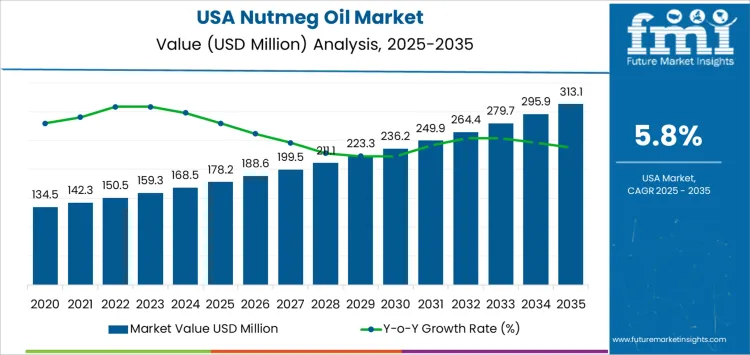
What is the Growth Forecast for Nutmeg Oil Industry in USA through 2035?
Demand for nutmeg oil in the United States shows a steady rise when comparing the upcoming decade to the previous one. Growth from 2015 to 2025 was driven by adoption in flavoring and fragrance categories, including bakery goods, beverages, aromatherapy products, and topical personal care. Clean-label product development supported continual replacement of synthetic flavoring ingredients.
Demand between 2025 and 2035 displays a stronger pace. New opportunities emerge in pharmaceuticals, nutraceuticals, and premium cosmetic formulations. Broader wellness preferences improve acceptance of essential oils within both retail and professional channels. Home-use diffusers and therapeutic lifestyle products widen the application base. Supply remains sensitive to production dynamics in key spice-growing countries. Safety regulations and pricing variability create challenges that limit rapid expansion. The forward outlook still indicates more substantial annual gains than in the earlier decade. The transition to multipurpose utilization shifts growth momentum toward a more durable long-term path in the United States.
USA Nutmeg Oil Key Takeaways
| Metric | Value |
|---|---|
| USA Nutmeg Oil Sales Value (2025) | USD 178.2 million |
| USA Nutmeg Oil Forecast Value (2035) | USD 313.1 million |
| USA Nutmeg Oil Forecast CAGR (2025-2035) | 5.8% |
Why is the Demand for Nutmeg Oil in the USA Growing?
Demand for nutmeg oil in the USA is increasing because food, beverage, fragrance and personal care industries use it as a natural flavoring and aromatic ingredient. It’s warm, spicy aroma suits baked goods, confectionery, sauces and seasonal beverages such as holiday drinks. Food producers and craft beverage makers incorporate nutmeg oil to add depth and spice without the complexity of whole spice processing. Bakeries, confectioners and artisanal producers rely on nutmeg oil for consistent flavor strength and easier blending compared with ground spice. Natural and clean-label trends support use in organic or minimally processed products. Demand also rises from fragrance and cosmetic manufacturers that use nutmeg oil in soaps, lotions and essential-oil blends for its scent profile.
The spice oil is small in volume but high in potency, so formulators appreciate concentrated flavor which reduces packaging size and simplifies logistics for both food and non-food applications. Constraints include regulatory restrictions on maximum permissible concentrations in foods and fragrances because nutmeg oil contains compounds that may cause irritation at high doses. Supply fluctuations due to crop yield variability and global spice industry volatility can also affect price and availability.
Which Applications and Distribution Channels Lead Demand for Nutmeg Oil in the USA?
Demand for nutmeg oil in the United States is supported by its expanding use in therapeutic, cosmetic, and wellness formulations. Consumers seek natural aromatic compounds for pain relief, topical healing, and flavor enhancement across household and industrial applications. Regulatory-compliant and pure essential oils are preferred, particularly among pharmaceutical and personal care manufacturers. Retail access, product traceability, and clean-label positioning shape purchasing behavior.
By Application, Pharmaceuticals Account for the Largest Share
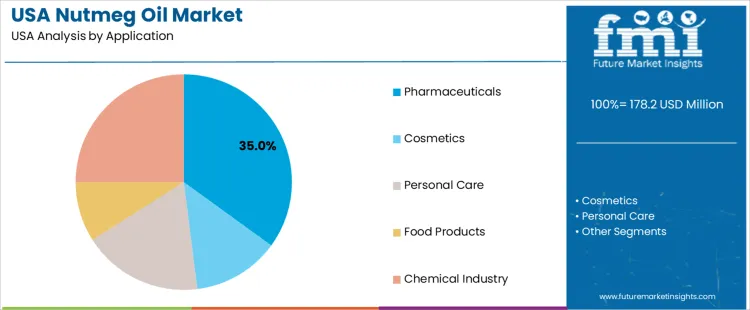
Pharmaceutical applications hold 35.0%, driven by adoption in analgesics, anti-inflammatory topicals, and digestive health remedies. Chemical industry applications represent 25.0%, supported by solvent extraction, fragrances, and formulation intermediates. Personal care accounts for 18.0%, where nutmeg oil is used in aromatherapy, massage blends, and deodorizing products. Cosmetics represent 13.0%, particularly in skincare items requiring warming properties and fragrance compatibility. Food products hold 9.0%, retained in concentrated flavorings for confectionery and bakery uses. Application distribution reflects functional versatility, safety screening, and integration into regulated healthcare and lifestyle product categories.
Key Points:
- Pharmaceuticals lead due to validated therapeutic roles in pain and digestion relief
- Chemical sector supports industrial fragrance and solvent usage
- Personal care and cosmetics reflect continued clean-beauty preferences
By Distribution Channel, Supermarkets Lead Demand
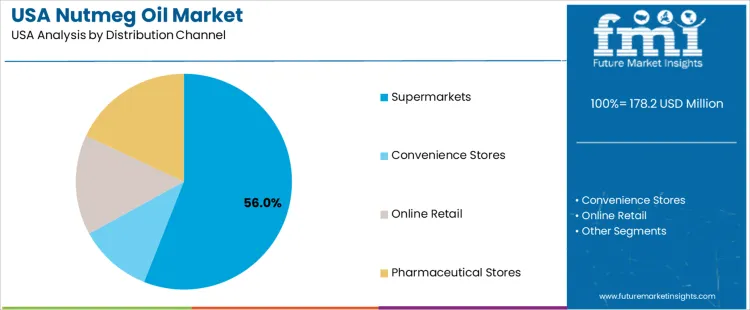
Supermarkets account for 56.0%, providing mass-market availability and branded packaged oil products positioned for general consumer use. Pharmaceutical stores represent 18.0%, supplying medical-grade formulations and prescribed topical blends. Online retail channels hold 15.0%, expanding through direct-to-consumer aromatherapy and wellness product sales. Convenience stores account for 11.0%, serving limited-assortment demand and impulse purchasing. Channel distribution aligns with routine replenishment habits, brand familiarity, and widening consumer access to essential oils across national retail networks.
Key Points:
- Supermarkets dominate due to mainstream product accessibility
- Pharmaceutical stores support clinical-grade procurement
- Online platforms expand availability for wellness-oriented buyers
What are the Key Dynamics in the Nutmeg Oil Industry?
Growth of natural flavor and fragrance applications, rising interest in clean-label wellness products and expanding use in personal care drive demand.
In the United States, nutmeg oil is used in bakery, confectionery and ready-to-eat products where warm spice flavors enhance seasonal and everyday recipes. Beverage manufacturers incorporate nutmeg oil into flavored coffees, spiced teas and holiday formulations. Consumer preference for botanical ingredients supports increased use in aromatherapy oils and topical products associated with relaxation and massage. Personal care and cosmetics companies adopt nutmeg oil for its aroma and perceived skin-conditioning benefits, supporting demand in premium soaps, lotions and fragrance blends. Retailers expand essential-oil assortments in wellness aisles, improving visibility and access for household diffusers and DIY applications. These diverse end uses maintain steady procurement across food, beverage and personal care channels.
Supply variability, regulatory compliance in ingestible products and sensitivities regarding potency restrain demand.
Nutmeg oil production depends on crop outcomes in exporting countries, which may experience climate-related fluctuations affecting pricing and consistent availability. Food manufacturers must comply with flavor-use limitations and labeling rules to ensure safe dosage levels in edible products, creating additional regulatory oversight. Some consumers’ express sensitivity to strong spice oils on skin or in aromatherapy, leading brands to apply cautious positioning and precise formulation. Competition from alternative spice oils such as cinnamon and clove also limits rapid expansion where flavor substitution provides lower cost or milder profile. These considerations slow adoption outside applications with established flavor or sensory roles.
Shift toward organic and traceable sourcing, increased use in premium seasonal beverages and growing integration in wellness positioning define key trends.
Brands highlight organic certification and country-of-origin details to appeal to shoppers who value authenticity and responsible sourcing. Coffee chains and packaged beverage brands expand limited-time seasonal products featuring spiced flavor profiles, increasing procurement of nutmeg oil for fall and winter launches. Wellness-focused marketing promotes nutmeg oil in blends designed for relaxation, joint comfort and sensory experience enhancement. Small-batch personal care and artisanal candle makers adopt nutmeg oil for warmer aromatic finishes that support gifting and home ambiance categories. These developments indicate steady, lifestyle-driven demand for nutmeg oil across the United States, supported by natural flavor preferences and multifunctional product innovation.
Analysis of the Demand for Nutmeg Oil in the USA by Region
Demand for nutmeg oil in the United States is increasing as food, personal-care, and aromatherapy brands expand the use of natural spice oils offering warming flavor, fragrance, and potential wellness associations. Growth is supported by clean-label food seasonings, essential-oil blends for stress relief, and topical formulations used in massage and sports-recovery routines. Import dependence continues due to limited domestic production, with sourcing concentrated in Indonesia, India, and Sri Lanka. Regional expansion differs according to industrial presence and consumer preferences. West USA leads with 6.7% CAGR, followed by South USA at 6.0%, Northeast USA at 5.3%, and Midwest USA at 4.6%, reflecting variable manufacturing clusters, spa-wellness activity, and distribution intensity.
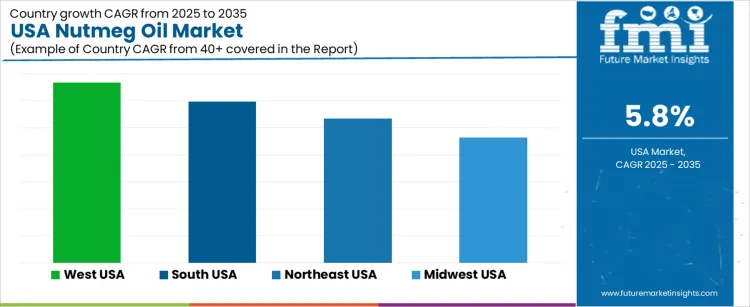
| Region | CAGR (2025-2035) |
|---|---|
| West USA | 6.7% |
| South USA | 6.0% |
| Northeast USA | 5.3% |
| Midwest USA | 4.6% |
How is the West USA driving demand for nutmeg oil?
West USA posts 6.7% CAGR, supported by strong natural-product retail channels and essential-oil consumer adoption across California, Oregon, and Washington. Food processors incorporate nutmeg oil in beverage syrups, confectionery items, and dairy-based seasonal offerings. Spa and wellness centers rely on nutmeg-infused aromatherapy blends for muscle-relaxation treatments, reinforcing B2B procurement. Port infrastructure in Los Angeles and Seattle ensures smoother import handling and reduced lead-time variability for bulk oil buyers. Product developers request certified-quality grades with verified purity standards under recognized natural-ingredient programs.
- Natural-product retail and wellness adoption shaping volumes
- Seasonal food applications supporting formulation demand
- Maritime logistics ensuring consistent inventory replenishment
- Verified-purity requirements influencing supplier selection
How is the South USA shaping demand for nutmeg oil?
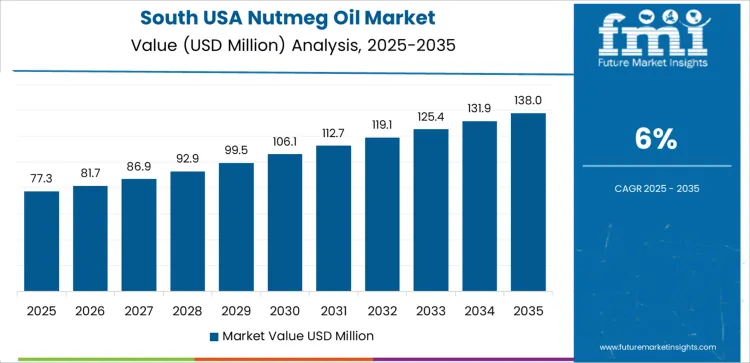
South USA grows at 6.0% CAGR, driven by rising use in flavor houses and regional baking industries across Texas and Florida. Holiday-season consumption patterns maintain strong demand for spice-forward processed foods. Nutraceutical firms include nutmeg oil in topical liniments used for localized comfort support. Expanding e-commerce channels enable small aromatherapy brands to access broader consumer bases without scale constraints. Buyers evaluate packaging compatibility with volatile-oil characteristics to prevent leakage and preserve aroma intensity.
- Baking industry needs reinforcing recurring consumption
- Nutraceutical lines promoting essential-oil-based therapies
- E-commerce improving distribution reach for small producers
- Packaging performance supporting product stability
How is the Northeast USA contributing to growth?
Northeast USA records 5.3% CAGR, driven by high aromatherapy and specialty-retail penetration in New York and Massachusetts. Formulators integrate nutmeg oil into premium personal-care products marketed through boutique brands and apothecary chains. Beverage manufacturers test spice-oil infusions for limited-edition winter lines. Pharmaceutical-adjacent companies review potential integration in topical soothing products. Distributors maintain inventory in coastal hubs for rapid delivery to dense metro retail networks.
- Boutique personal-care brands boosting niche ingredient use
- Seasonal beverages fostering exploratory sourcing
- Spa-and-wellness retail concentrating premium demand
- Coastal warehousing sustaining supply responsiveness
How is the Midwest USA sustaining expansion?
Midwest USA posts 4.6% CAGR, reflecting stable but gradual adoption in food manufacturing and regional aromatherapy outlets across Illinois, Ohio, and Michigan. Bulk spice-processing operations rely more heavily on traditional ground nutmeg, limiting immediate oil substitution rates. Formulated convenience foods integrate natural flavor oils into sauces and ready-meals aligned with cleaner-label expectations. Procurement focuses on cost control and standardization for scalable product rollout. Inland logistics operations distribute imported oils from East and West entry points into key retail industries.
- Packaged-food producers testing natural flavor-oil alternatives
- Cleaner-label positioning supporting measured adoption
- Cost-focused purchasing limiting rapid formulation shifts
- Distribution networks maintaining baseline availability
What is the competitive landscape of the demand for nutmeg oil in the United States?
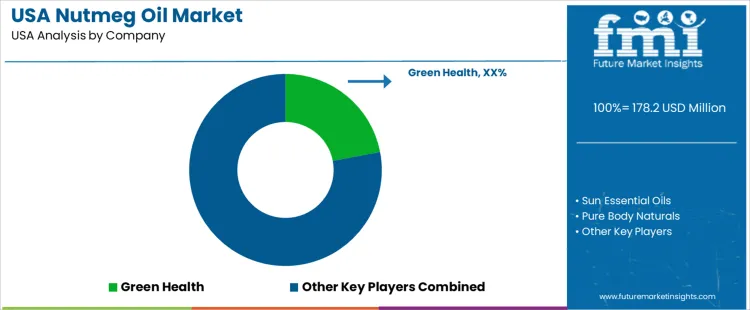
Demand for nutmeg oil in the United States aligns with food flavoring, aromatherapy, cosmetics, and personal-care uses. Procurement criteria focus on purity, documented quality, and matching aromatic profiles to product requirements. Regulatory compliance and supply reliability shape competitive positions inside the country. Green Health holds an estimated 22.0% share supported by consistent supply and technical documentation suitable for both bulk industrial and retail channels. Sun Essential Oils competes on pricing flexibility and broad distribution that appeals to small and midsize manufacturers. Pure Body Naturals concentrates on topical wellness and direct-to-consumer retail, enabling traction in personal-care segments.
Healing Solutions supplies certified natural inputs preferred by brands targeting clean formulations with specific composition controls. LorAnn Oils operates in culinary and specialty flavoring with relationships in bakery, confectionery, and food-service channels that require precise sensory consistency. Competitive factors include stability of ingredient sourcing, validated chemical analysis, and packaging formats that match handling needs across production environments. Companies capable of reliable distribution, clear traceability records, and adaptable format offerings remain well positioned to meet United States demand for nutmeg oil.
Key Players in USA Nutmeg Oil Demand
- Green Health
- Sun Essential Oils
- Pure Body Naturals
- Healing Solutions
- LorAnn Oils
Scope of the Report
| Items | Values |
|---|---|
| Quantitative Units | USD million |
| Application | Pharmaceuticals, Cosmetics, Personal Care, Food Products, Chemical Industry |
| Distribution Channel | Supermarkets, Convenience Stores, Online Retail, Pharmaceutical Stores |
| Type | Liquid Nutmeg Oil, Nutmeg Oil Capsules |
| Regions Covered | West USA, South USA, Northeast USA, Midwest USA |
| Key Companies Profiled | Green Health, Sun Essential Oils, Pure Body Naturals, Healing Solutions, LorAnn Oils |
| Additional Attributes | Dollar sales by type and application categories; demand growth in cosmetics and aromatherapy blends; usage expansion in functional foods and nutraceutical capsules; sourcing compliance with FDA and essential oil purity standards; penetration across e-commerce wellness segments; product differentiation with organic and therapeutic-grade formulations. |
USA Nutmeg Oil Demand by Segments
Application:
- Pharmaceuticals
- Cosmetics
- Personal Care
- Food Products
- Chemical Industry
Distribution Channel:
- Supermarkets
- Convenience Stores
- Online Retail
- Pharmaceutical Stores
Type:
- Liquid Nutmeg Oil
- Nutmeg Oil Capsules
Region:
- West USA
- South USA
- Northeast USA
- Midwest USA
Frequently Asked Questions
How big is the demand for nutmeg oil in USA in 2025?
The demand for nutmeg oil in USA is estimated to be valued at USD 178.2 million in 2025.
What will be the size of nutmeg oil in USA in 2035?
The market size for the nutmeg oil in USA is projected to reach USD 313.1 million by 2035.
How much will be the demand for nutmeg oil in USA growth between 2025 and 2035?
The demand for nutmeg oil in USA is expected to grow at a 5.8% CAGR between 2025 and 2035.
What are the key product types in the nutmeg oil in USA?
The key product types in nutmeg oil in USA are pharmaceuticals, cosmetics, personal care, food products and chemical industry.
Which distribution channel segment is expected to contribute significant share in the nutmeg oil in USA in 2025?
In terms of distribution channel, supermarkets segment is expected to command 56.0% share in the nutmeg oil in USA in 2025.
Preview the report firsthand - request a free sample
Get SampleGet the brochure for pricing and purchase details.
Get PDFTable of Content
- Executive Summary
- USA Market Outlook
- Demand-side Trends
- Supply-side Trends
- Technology Roadmap Analysis
- Analysis and Recommendations
- Market Overview
- Market Coverage / Taxonomy
- Market Definition / Scope / Limitations
- Market Background
- Market Dynamics
- Drivers
- Restraints
- Opportunity
- Trends
- Scenario Forecast
- Demand in Optimistic Scenario
- Demand in Likely Scenario
- Demand in Conservative Scenario
- Opportunity Map Analysis
- Product Life Cycle Analysis
- Supply Chain Analysis
- Investment Feasibility Matrix
- Value Chain Analysis
- PESTLE and Porter’s Analysis
- Regulatory Landscape
- Regional Parent Market Outlook
- Production and Consumption Statistics
- Import and Export Statistics
- Market Dynamics
- USA Market Analysis 2020 to 2024 and Forecast, 2025 to 2035
- Historical Market Size Value (USD Million) Analysis, 2020 to 2024
- Current and Future Market Size Value (USD Million) Projections, 2025 to 2035
- Y-o-Y Growth Trend Analysis
- Absolute $ Opportunity Analysis
- USA Market Pricing Analysis 2020 to 2024 and Forecast 2025 to 2035
- USA Market Analysis 2020 to 2024 and Forecast 2025 to 2035, By Application
- Introduction / Key Findings
- Historical Market Size Value (USD Million) Analysis By Application , 2020 to 2024
- Current and Future Market Size Value (USD Million) Analysis and Forecast By Application , 2025 to 2035
- Pharmaceuticals
- Cosmetics
- Personal Care
- Food Products
- Chemical Industry
- Y-o-Y Growth Trend Analysis By Application , 2020 to 2024
- Absolute $ Opportunity Analysis By Application , 2025 to 2035
- USA Market Analysis 2020 to 2024 and Forecast 2025 to 2035, By Distribution Channel
- Introduction / Key Findings
- Historical Market Size Value (USD Million) Analysis By Distribution Channel, 2020 to 2024
- Current and Future Market Size Value (USD Million) Analysis and Forecast By Distribution Channel, 2025 to 2035
- Supermarkets
- Convenience Stores
- Online Retail
- Pharmaceutical Stores
- Y-o-Y Growth Trend Analysis By Distribution Channel, 2020 to 2024
- Absolute $ Opportunity Analysis By Distribution Channel, 2025 to 2035
- USA Market Analysis 2020 to 2024 and Forecast 2025 to 2035, By Type
- Introduction / Key Findings
- Historical Market Size Value (USD Million) Analysis By Type, 2020 to 2024
- Current and Future Market Size Value (USD Million) Analysis and Forecast By Type, 2025 to 2035
- Liquid Nutmeg Oil
- Nutmeg Oil Capsules
- Y-o-Y Growth Trend Analysis By Type, 2020 to 2024
- Absolute $ Opportunity Analysis By Type, 2025 to 2035
- Market Structure Analysis
- Competition Dashboard
- Competition Benchmarking
- Market Share Analysis of Top Players
- By Regional
- By Application
- By Distribution Channel
- By Type
- Competition Analysis
- Competition Deep Dive
- Green Health
- Overview
- Product Portfolio
- Profitability by Market Segments (Product/Age /Sales Channel/Region)
- Sales Footprint
- Strategy Overview
- Marketing Strategy
- Product Strategy
- Channel Strategy
- Sun Essential Oils
- Pure Body Naturals
- Healing Solutions
- LorAnn Oils
- Green Health
- Competition Deep Dive
- Assumptions & Acronyms Used
- Research Methodology


