


Key Takeaways
- Price in commercial vehicles is the translation of emissions compliance, safety system integration, and powertrain regulation into a widening gap between regulatory cost and market readiness.
- Euro 7 compliance increases manufacturing costs by approximately 2,000 euros for cars and vans with combustion engines, and close to 12,000 euros for diesel trucks and buses, representing 4 to 10 times higher than initial Commission estimates.
- BSVI implementation in India adds 175,000 to 225,000 rupees to medium and heavy commercial vehicles, with SCR and DPF systems accounting for up to 80 percent of the cost increase.
- CARB Advanced Clean Trucks regulation requires manufacturers to sell zero-emission trucks as 5 to 9 percent of annual California sales starting 2024, rising progressively to 2035.
- Tata Motors commercial vehicles segment reported underlying EBITDA margin of 13.1 percent in 2024, down from 14.1 percent in 2023. Ashok Leyland achieved EBITDA margin of 12 percent in fiscal year 2023.
- Volvo Group invested over 26 billion Swedish kronor in research and development in 2023, with primary focus on zero-emission commercial vehicles as regulatory timelines compress development cycles.
How do feedstock costs for emissions compliance and safety systems shape ex-factory pricing?
After-treatment systems dominate material cost escalation. SCR systems for NOx reduction and DPF units for particulate matter control represent 30 to 45 percent of BSVI compliance costs. Euro 7 could make trucks more expensive by around 12,000 euros per unit due to advanced control systems, including low-wear brake components, longer-lasting catalytic converters, and telematics control systems.
ADAS hardware adds further layers. Sensors, ECUs, and connectivity modules required for Euro VII on-board monitoring systems increase SKU complexity. Stricter lifetime requirements extend to 200,000 km or 10 years for cars and vans, forcing OEMs to engineer for durability across expanded operational windows.
Telematics and connectivity mandates create recurring cost structures. On-board self-diagnostic devices for real-time driving emission monitoring add hardware costs while necessitating backend infrastructure investments. Indian OEMs transitioning to BSVI Phase 2 reported marginal to moderate material cost impacts on both gasoline and diesel engines, with development efforts involving engine optimization and advanced aftertreatment technology.
Where does energy intensity create regional cost floors and compliance asymmetry?
Energy manifests across manufacturing stages from paint shops to forging and machining operations. PLA production for biopolymer components involves high heat and vacuum processes. Volvo Group invested over 26 billion Swedish kronor in research and development in 2023, with primary focus directed toward zero-emission commercial vehicles.
Regional energy cost asymmetry creates competitive positioning differences. EU industrial electricity tariffs significantly exceed those in China, India and Southeast Asia. Chinese and Indian manufacturers benefit from power tariffs while EU processors face rates often double or triple Asian levels. This asymmetry affects not just production costs but localization strategies for emissions-critical components.
Energy shapes utilization economics for capital-intensive compliance infrastructure. Testing facilities for emissions validation, battery durability certification, and ADAS calibration require continuous operation. Plants running at 85 to 90 percent utilization compress cost per unit by 15 to 25 percent versus those at 60 percent capacity.
How do logistics and supply chain complexity impact FOB competitiveness across regulatory regimes?
Supply chain length for emissions-related parts creates vulnerability. India imports significant volumes of Euro VI components including sensors and catalytic substrates. Implementation of BSVI dramatically influenced the automobile market in India, especially commercial vehicles, as transportation costs dictate vehicle cost, depreciation, and operational expenses.
Import dependence creates pricing floors. Duty treatment varies by HS classification with plastic components under HS 3924 facing different tariff structures than metal assemblies. Proper classification ensures correct duty assessment but adds complexity to landed cost calculations.
Localization incentives reshape supply networks. OEMs pursuing compliance-driven cost reduction establish regional manufacturing for high-volume components. BharatBenz and other Indian manufacturers invested in domestic BSVI component production to reduce forex exposure and logistics lead times.
What compliance requirements create pricing floors and market access barriers across EU, US, India, China, and Japan?
Euro 7 was formally approved by EU countries in April 2024 with stages including 30 months for new types of cars and vans, 48 months for new types of buses, trucks and trailers. Implementation dates create inventory risk as OEMs manage legacy stock transitions while ramping compliant production.
India's BSVI implementation bypassed BSV standards, creating discontinuous cost shock. BSVI standards follow Euro VI specifications for heavy-duty vehicles estimated to be the largest on-road source of PM and NOx emissions in India. The leapfrog approach compressed development timelines while multiplying compliance costs.
US EPA Phase 3 greenhouse gas standards for heavy-duty vehicles from model year 2027 layer onto CARB ACT zero-emission sales mandates. ACT regulation requires manufacturers to sell zero-emission trucks as an increasing percentage with deficits generated by selling vehicles and credits earned by selling ZEVs or near-ZEVs.
China VI emissions regulations preceded provisional Euro 7 standards. Since July 2023, all new vehicles in China must comply with China 6b which is more strict than provisional Euro 7. This regulatory leadership positions Chinese OEMs advantageously for export markets adopting similar standards.
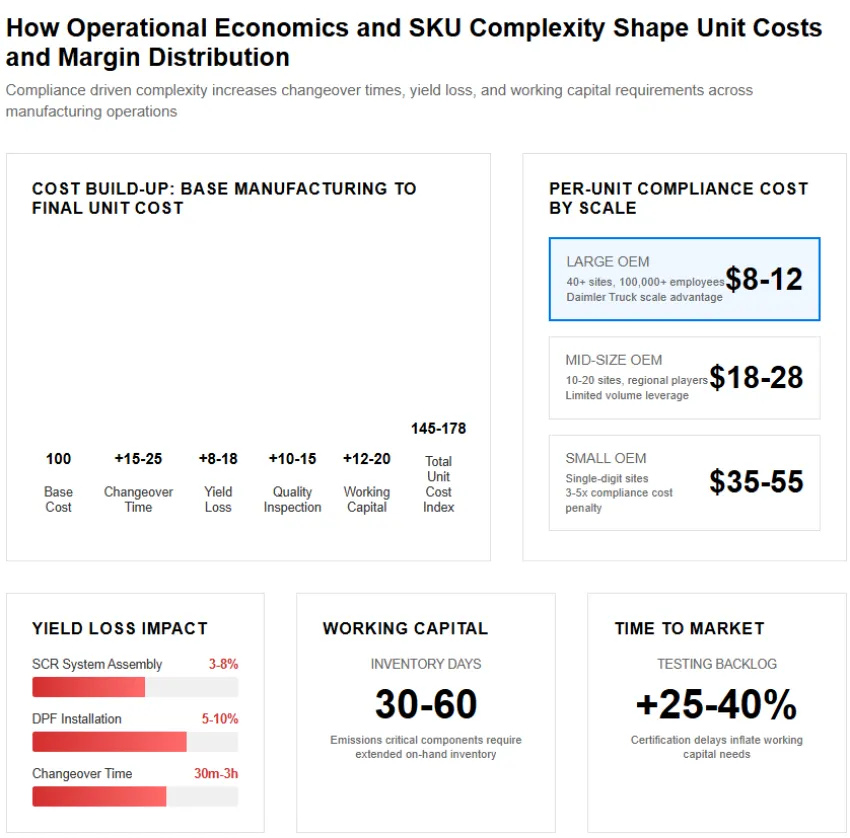
Daimler Truck operates over 40 production sites globally with more than 100,000 employees, creating scale advantages in spreading compliance R&D costs. Smaller OEMs face proportionally higher per-unit compliance burdens.
Utilization rates directly impact unit economics. Compliance-driven complexity increases changeover times for variant production. Mold changeovers for different axle configurations and GVW ratings extend from 30 minutes to several hours, affecting throughput.
Yield loss occurs at after-treatment integration stages. SCR system assembly generates scrap rates of 3 to 8 percent. DPF installation creates yield loss of 5 to 10 percent. Quality control for emissions certification adds inspection costs.
Working capital ties up cash in compliance inventory. Emissions-critical components require 30 to 60 days inventory. Testing and certification backlogs extend time-to-market, inflating working capital needs during regulatory transitions.
What margin profiles emerge across premium European OEMs, mid-tier Indian manufacturers, and cost-driven Chinese players?
Tata Motors underlying EBITDA margin stood at 13.1 percent in 2024, slightly lower than 14.1 percent in 2023, influenced by higher input costs and strategic investments in new technologies. The commercial vehicles segment generated revenue of 75,055 crore rupees in 2024 compared to 78,791 crore rupees in 2023.
Ashok Leyland EBITDA margin reached 12 percent at the end of fiscal year 2023. The company became the first Indian commercial vehicle manufacturer to receive certification for the latest emission standards across its full range of heavy duty trucks.
Premium OEMs maintain higher margins through technology differentiation. Volvo Group and Daimler Truck leverage global scale and advanced engineering capabilities. Volvo Group currency-adjusted net sales grew by 11 percent to 552.8 billion Swedish kronor in 2023, with sales of vehicles and machines increasing by 12 percent.
Chinese manufacturers benefit from vertical integration and lower input costs. Domestic battery manufacturing advantages and localized supply chains enable aggressive pricing in export markets while maintaining viable margins.
What role do distributor and channel margins play in final fleet operator pricing?
Direct sales to fleet operators represent the highest-volume, lowest-margin channel. Large fleet contracts command negotiating power, compressing distributor margins to low single digits. Government fleet tenders create additional downward pricing pressure.
Dealer networks for SME fleet operators operate at intermediate margin levels of 5 to 8 percent. These channels require parts inventory support, service capabilities, and financing facilitation, justifying higher margins than direct channels.
Leasing companies introduce financing layer margins. Operating leases bundle vehicle cost, maintenance, and compliance risk, creating 8 to 12 percent margin structures. Regulatory uncertainty around residual values increases leasing costs during compliance transitions.
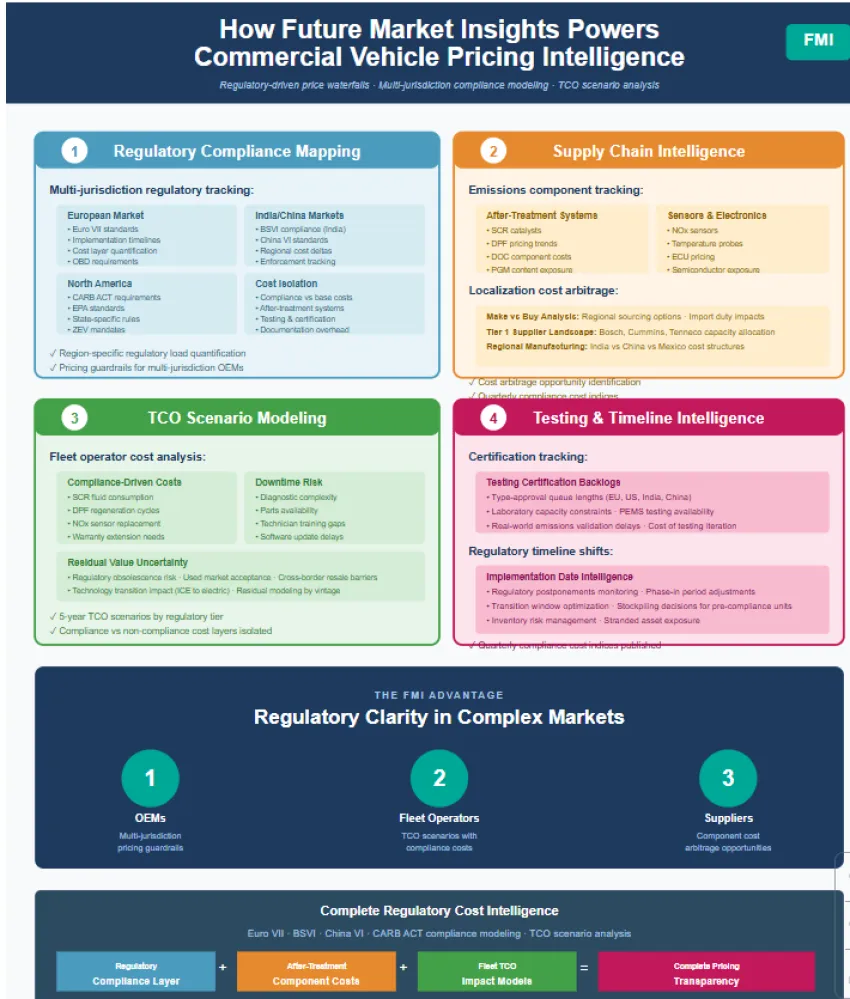
How can Future Market Insights help on pricing in commercial vehicles?
Sources
- ACEA Euro 7 cost impact study commissioned from Frontier Economics calculating per vehicle compliance costs for cars, vans, trucks and buses across EU implementation scenarios
- India ICCT policy brief on Bharat Stage VI emission standards covering heavy-duty diesel vehicle PM and NOx limits, DPF requirements, and fuel quality specifications
- CARB Advanced Clean Trucks Regulation fact sheets detailing manufacturer sales requirements, zero-emission vehicle percentages by class, and credit trading mechanisms
- Tata Motors 79th Integrated Annual Report 2023-24 disclosing commercial vehicles segment revenue, EBITDA margins, and BSVI compliance investment details
- Volvo Group Annual Report 2023 reporting research and development expenditure, net sales by region, and zero-emission vehicle development programs

