


Key Takeaways
- NDK built leadership by owning material growth and device manufacturing for synthetic quartz.
- Historical process data improves yield, purity and lattice precision compared with newer producers.
- Vertical control enables performance differentiation in high-reliability sectors such as telecom, industrial and automotive.
- Long customer relationships create qualification stickiness and replacement cost barriers.
- Hard-to-duplicate expertise sustains NDK's pricing power in specific grades and use cases.
How did NDK build its early advantage in synthetic quartz crystal growth dedicated to timing applications?
Nihon Dempa Kogyo (NDK) established operations in 1948, positioning itself among the earliest commercial producers of quartz crystal devices in Japan during the post-war electronics industrialization period. The company developed expertise in synthetic quartz crystal growth using hydrothermal autoclave methods, where silicon dioxide dissolves in alkaline solution under high temperature and pressure before crystallizing onto seed plates with controlled orientation. This process, borrowed from wartime developments in precision frequency control, became central to NDK's product architecture as demand for stable frequency references expanded across radio communications, telecommunications infrastructure and electronic instrumentation.
Early adoption waves in telecommunications infrastructure during Japan's economic expansion created sustained demand for high-precision frequency standards. NDK supplied quartz crystal units to telephone exchanges, radio broadcasting equipment and later to consumer electronics requiring stable timing references. This positioning allowed the company to accumulate production data on crystal quality, defect patterns and performance relationships that competitors entering the business decades later would need to redevelop independently.
The company's decision to maintain in-house synthetic quartz growth rather than sourcing from material suppliers created proprietary learning loops. Each autoclave run generated data on growth rate, inclusion formation, twinning defects and lattice purity variations with temperature, pressure and solution chemistry. Accumulating these observations across thousands of growth cycles built institutional knowledge that informed subsequent process refinements, gradually improving yield and consistency in ways difficult to replicate through shorter experience bases.
How does vertical integration from crystal to oscillator enable control over performance and yield?

NDK operates an integrated value chain spanning synthetic quartz crystal growth, orientation-specific wafering, precision cutting to crystallographic planes, electrode deposition, hermetic packaging and oscillator circuit integration. This vertical structure differs from business models where material suppliers sell synthetic quartz blanks to device assemblers who lack direct influence over crystal properties. By controlling the complete chain, NDK aligns material characteristics with device requirements from the earliest growth stages.
Crystal growth parameters directly affect frequency stability and aging characteristics in finished timing devices. Alkali ion concentration, hydroxyl content and structural defects within the quartz lattice influence how resonance frequency shifts with temperature and time. NDK's ability to specify and verify these properties during growth, rather than accepting external material as given, enables tighter device performance distributions and higher yields through reduced rework and scrap from material-related failures.
Orientation cutting represents a critical integration point. Quartz crystals exhibit different temperature-frequency relationships depending on cut angle relative to crystallographic axes. AT-cut crystals (35°15' from the Z-axis) provide zero temperature coefficient at room temperature and dominate commercial applications. SC-cut (stress-compensated) devices offer superior performance under vibration and thermal stress, valuable in automotive and aerospace contexts. BT-cut crystals serve high-temperature applications. NDK's accumulated expertise in precision angle control and surface finishing for these orientations stems from decades of iterative refinement across millions of devices, creating process knowledge difficult to acquire without equivalent production history.
Vertical integration protects differentiation by preventing diffusion of process knowledge through material supply relationships. Independent crystal growers serving multiple device manufacturers cannot optimize growth parameters for specific customer requirements without revealing proprietary information to competitors. NDK's closed-loop structure maintains separation between its material science advances and external visibility, sustaining performance advantages that purely assembly-focused competitors cannot easily replicate.
Which technical capabilities have evolved through decades of proprietary learning curves?
Lattice purity improvements represent one area where long experience cycles deliver measurable advantages. Synthetic quartz quality depends on minimizing unwanted ion incorporation during hydrothermal growth. Aluminum, sodium, lithium and hydroxyl ions substitute into the silicon-oxygen lattice, creating defects that degrade electrical performance and thermal stability. NDK has progressively refined autoclave materials, solution chemistry and growth kinetics to reduce these impurities, with improvements accumulating gradually as each generation of process equipment incorporates lessons from predecessor systems.
Thermal stability optimization exemplifies cumulative technical advancement. Quartz resonators in telecommunications base stations, automotive engine control units and industrial sensors must maintain frequency accuracy across temperature ranges from negative 40°C to positive 85°C or wider. Achieving this requires precise control of crystal orientation, stress-free mounting techniques and electrode design that compensates for material property variations. NDK's technical literature documents temperature coefficient specifications meeting telecommunications standards such as ITU-T G.811 and G.812, performance levels requiring integration of material quality, mechanical design and decades of field failure analysis feeding back into design iterations.
Radiation hardness capabilities serve aerospace and satellite applications where timing devices face ionizing radiation exposure. Radiation creates defects in synthetic quartz that shift resonance frequency, particularly problematic for satellite communication systems and space-based positioning infrastructure. NDK developed radiation-tolerant crystal grades and mounting configurations through programs supporting Japanese and international satellite missions, building expertise that newer producers lack unless they independently invest in radiation test facilities and multi-year space qualification programs.
Alkali defect management connects material growth to long-term aging performance. Alkali ions migrate within the quartz lattice under applied electric fields, causing resonance frequency drift over device lifetime. NDK reduced this effect through multiple approaches: lowering initial alkali concentration during growth, optimizing electrode materials to minimize ion injection, and designing drive circuits that reduce electric field stress. These improvements emerged incrementally through correlation of field failure data with manufacturing parameters, analysis possible only with large installed bases and long customer relationships providing reliability feedback.
How does long-term qualification in telecom and industrial customers translate into pricing resilience?
Telecommunications infrastructure equipment undergoes extensive qualification testing before network operators approve devices for deployment. Oscillator components must demonstrate frequency stability, phase noise performance and reliability over temperature, humidity and voltage variations through testing protocols that can require 12 to 24 months. Once a manufacturer's devices pass qualification and enter production equipment, network operators strongly prefer maintaining the same component source for replacement parts and new installations to avoid re-qualification costs and potential compatibility issues.
NDK maintains qualification status with major telecommunications equipment manufacturers and network operators across multiple device generations, creating supply relationship continuity extending decades. This installed-base dependency means that price negotiations occur within boundaries set by switching costs. Alternative suppliers offering lower prices must overcome not just the price differential but also the time, engineering effort and risk associated with re-qualifying network timing equipment, a barrier that insulates NDK from purely commodity competition.
Industrial applications present similar dynamics. Factory automation systems, precision instrumentation and test equipment incorporating NDK timing devices have design lives of 10 to 20 years, with replacement part availability expected throughout this period. Equipment manufacturers designing NDK components into products create implicit long-term purchase commitments, as switching suppliers mid-product-life requires redesign, testing and potential field retrofit complications. This commitment structure provides revenue visibility and pricing stability unavailable to suppliers serving shorter product cycles with lower switching barriers.
Automotive electronics add safety-critical qualification requirements. Engine control units, advanced driver assistance systems and vehicle communication networks depend on timing accuracy for proper operation. Automotive qualification standards such as AEC-Q200 impose extensive reliability testing including temperature cycling, mechanical shock, humidity exposure and electromagnetic compatibility verification. Achieving automotive qualification requires substantial investment in testing infrastructure and documentation systems, with successful qualification creating multi-year supply agreements that justify premium pricing relative to consumer electronics applications.
How do global electronics transitions extend the relevance of NDK's historical expertise?
Fifth-generation mobile telecommunications (5G) infrastructure increases precision timing requirements compared to previous cellular generations. 5G base stations require frequency references with phase noise performance and temperature stability specifications tighter than 4G systems to support higher data rates, massive MIMO antenna arrays and carrier aggregation across multiple frequency bands. These requirements favor suppliers with proven ultra-stable oscillator capabilities and qualification heritage in telecommunications infrastructure, positioning NDK to serve 5G deployment cycles extending through the next decade.
Global navigation satellite systems (GNSS) including GPS, Galileo, BeiDou and GLONASS depend on receivers with stable timing references to calculate position from satellite signals. Automotive navigation, precision agriculture, surveying equipment and mobile devices all require GNSS receivers, creating ongoing demand for temperature-compensated crystal oscillators (TCXOs) and oven-controlled crystal oscillators (OCXOs) meeting positioning accuracy requirements. NDK's experience in GNSS timing applications since early GPS adoption provides competitive positioning as location-based services proliferate.
Electric vehicle (EV) control electronics introduce timing device requirements combining automotive qualification, wide temperature range operation and electromagnetic interference resistance. Battery management systems, motor inverters and vehicle communication networks require synchronized timing for proper operation, with safety implications creating strong preference for proven reliability. NDK's automotive qualification status and high-temperature device capabilities position the company to capture timing content increases as EV production scales globally.
Factory automation and industrial Internet of Things (IoT) deployments depend on synchronized timing across distributed sensors, controllers and communication networks. Industrial Ethernet protocols including EtherCAT, PROFINET and TSN (Time-Sensitive Networking) require precise timing references to coordinate real-time control loops with sub-microsecond accuracy. These applications favor suppliers with industrial qualification heritage and reliability track records supporting multi-decade equipment life, domains where NDK's historical positioning provides advantages over consumer-focused competitors.
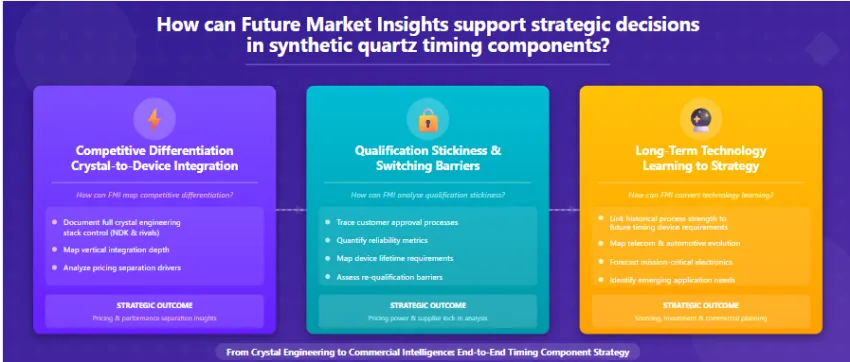
How can Future Market Insights help
Sources
- Nihon Dempa Kogyo corporate and product disclosures: History, product categories and synthetic quartz capabilities from company documentation and technical literature
- Annual reports and investor information from timing device OEMs: Reliability, qualification and end-use needs disclosed in financial and technical communications
- Telecommunications and automotive electronics standards bodies: Oscillator performance requirements from ITU-T, AEC-Q200 and related specification documents
- Technical papers on synthetic quartz growth and orientation cutting: Purity, stability and defect management insights from materials science and crystal growth literature
- Reputable business media: Electronics industry demand drivers relevant to precision timing from Reuters, Nikkei and industry trade publications

