


Key Takeaways
- Zinc and energy indices shape the floor of the cost structure, but regulatory and ESG compliance shape the ceiling.
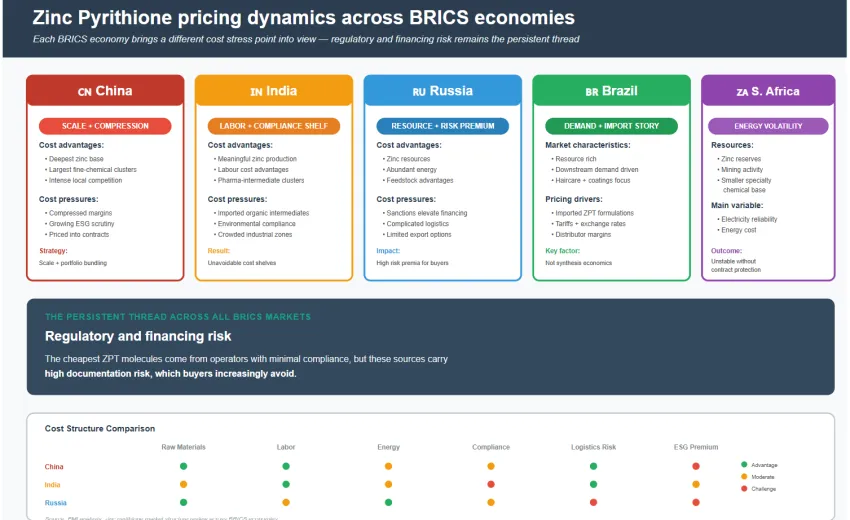
- BRICS producers sit on different cost stresses: China on scale and scrutiny, India on intermediates and compliance, Russia on sanctions and logistics, Brazil on import dependence, South Africa on energy reliability.
- Buyers increasingly pay for documentation, safety files and traceability rather than only molecules.
- Price spreads are driven more by regulatory risk and financing conditions than feedstock advantages alone.
What does the zinc pyrithione value chain look like from ore to anti-dandruff bottle?
Zinc pyrithione sits at the intersection of metals, fine chemicals and regulated personal-care actives. Public technical literature is clear on its chemistry and on how regulators treat it. Zinc ores are mined and refined into metal across BRICS, with China leading global mine output and India, Russia and South Africa holding significant positions. Pyrithione intermediates are produced in fine-chemical clusters, then reacted with zinc salts in dedicated plants to create the final active. After synthesis, producers refine, dry and mill the product to cosmetic or industrial quality before formulators blend it into haircare or coating systems.
The chain is simple on paper but complex in practice. At each step, prices are negotiated, opaque and often bundled with other biocides or actives. Without transparent benchmark prices, the only defensible way to talk about zinc pyrithione costs is by reconstructing the cost structure node by node.
Which cost buckets actually drive zinc pyrithione pricing in BRICS?
The cost structure has five observable anchors.
Raw materials. Zinc metal is the only input with transparent reference prices. Global indices have moved within a broad band in recent years, influenced by mine decisions, demand cycles and energy costs. Organics and solvents follow petrochemical chains, so they move with aromatics and oil-derived feedstocks rather than with zinc.
Energy and utilities. Synthesis and drying require more energy than simple blending. Electricity, steam and natural gas tariffs materially affect ex-works costs and can vary sharply across BRICS markets.
Labour, overhead and plant costs. Personnel and asset upkeep matter less than raw materials or energy, but compliance-driven capex and the cost of emission controls can alter long-term minimum viable prices.
Compliance and testing. Toxicology files, regulatory dossiers and ongoing batch-testing are significant cost lines for any producer selling into regulated personal-care markets. These are recurring, unavoidable expenditures.
Logistics and trade. Zinc ores, intermediates and finished ZPT all incur freight and handling charges. Exporters also face tariffs, non-tariff barriers and variable transit costs, which feed directly into delivered prices.
Margins sit on top of these physical costs. Their size depends on buyer concentration, supplier scale and the perceived regulatory risk of a given source.
How do zinc and energy markets feed into zinc pyrithione costs for BRICS?
Zinc indices offer the cleanest external signal. When zinc prices fall, producers gain room to either reduce prices, defend margins or trade discount for volume. When zinc tightens because of smelter cuts, mine constraints or policy decisions, producers with domestic access to zinc or secure long-term contracts hold a relative advantage.
Energy markets can exert an even sharper influence. In economies facing volatile or expensive electricity and natural gas, the cost of drying and finishing ZPT can swing sufficiently to erode margins unless contracts allow for pass-through. Conversely, stable or subsidised energy environments partially offset regulatory or financing burdens.
The point is not that ZPT prices track zinc or gas one to one. They do not. These indices set the floor trend. Compliance obligations and negotiation dynamics decide the invoice.
How pricing dynamics differ across Brazil, Russia, India, China and South Africa?
Where do ESG and regulatory risks show up in pricing?
Regulatory bodies have scrutinised zinc pyrithione for years, setting concentration limits and requiring extensive toxicological data. This scrutiny cascades through BRICS supply chains in several ways. Compliance premium. Producers with full dossiers, traceability systems and documented alignment with major cosmetic rules command higher prices. Buyers pay for reduced regulatory exposure. Reformulation exposure. If regulators tighten limits or move toward phase-downs, brands face heavy costs to reformulate and re-register products. This risk shapes medium-term supply contracts and is embedded in pricing. Environmental footprint.
ZPT is persistent and hazardous to aquatic systems. Producers that invest in effluent treatment and waste handling increase their operating costs but protect their licence to operate. Those that do not face restrictions and reputational risk, both of which influence prices. Data burden. Maintaining and updating safety files is expensive. Larger producers absorb these costs across wider portfolios; smaller players either raise prices or exit regulated markets. In practice, ESG risk is not a layer above economics. It is a core determinant of price stability and supplier credibility.
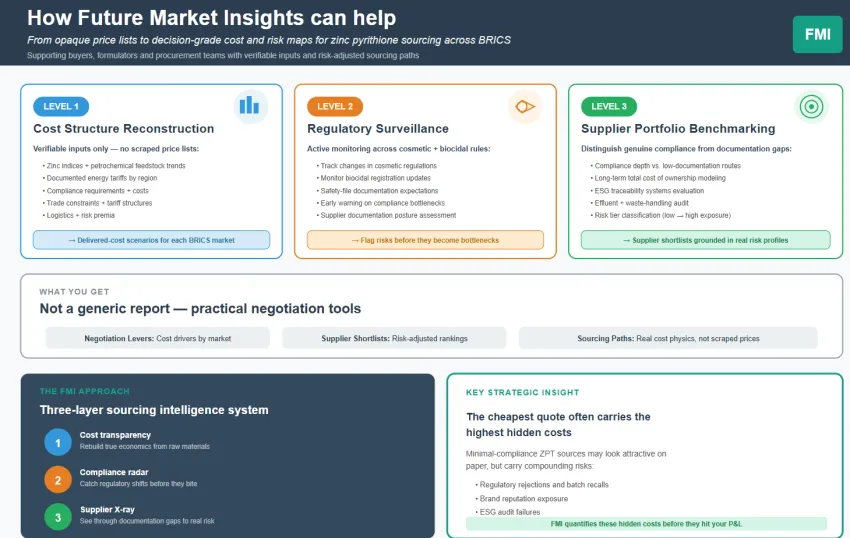
How FMI Can Help
Sources
- European Commission. "Commission Regulation (EU) 2021/1902 amending Annex VI to Regulation (EC) No 1272/2008 as regards classification of zinc pyrithione." Official Journal of the European Union, 2021.
- European Chemicals Agency (ECHA). "Zinc pyrithione - Substance information and regulatory status under the EU Cosmetics and Biocidal Products Regulations." ECHA Substance Database. "Biocides in Facades - State of Knowledge." HSR University of Applied Sciences Rapperswil / ETH Zürich, 2012.
- Umweltbundesamt (German Environment Agency). "Groundwater discharges of biocides from façades in urban regions." UBA Texte 133/2025. Identifies zinc pyrithione as a widely used in-can preservative in interior paints and assesses its release to water. Reiß, F. et al. "Application, release, ecotoxicological assessment of biocides used in building materials." Journal of Hazardous Materials, 2021. Reviews leaching and environmental fate of several façade biocides, including zinc pyrithione, with implications for regulatory pressure and compliance cost.
- Danish Environmental Protection Agency. "Transport and transformation of biocides in construction materials." Environmental Project 2018. Documents zinc pyrithione use in renders and modelled leaching scenarios relevant for regulatory risk assessment. California Stormwater Quality Association (CASQA). "Zinc Sources in California Urban Runoff." 2015. Includes zinc pyrithione as a common paint additive and quantifies national sales volumes, providing a reference point for upstream volume and cost drivers.
- Wikipedia"Zinc pyrithione." Updated 2025. Overview of uses, legal status (including EU cosmetic ban since 2021) and basic properties, useful as a starting point but not a primary analytical source.

