


Key Takeaways
- Global oil and gas operations flared about 151 billion cubic metres of gas in 2024, the highest level since 2007, with nine countries responsible for roughly three quarters of all flaring.
- Ending routine flaring worldwide would require around USD 100 billion in capital investment, excluding any revenues from selling or using recovered gas.
- About 70% of methane emissions from fossil fuel operations can be reduced with existing technologies, and roughly 40% of those reductions are available at no net cost once the captured gas is monetised.
- On an operator’s cost curve, the most economic projects involve large, stable flares near pipelines or demand centres, while small, remote, or sour flares sit at the expensive end. IEA Non-technical barriers unclear gas ownership, weak penalties, low regulated gas prices, and short licence terms-often outweigh engineering feasibility. OECD, World Bank
- New methane regulations, import standards and disclosure frameworks will increasingly move assets from the "optional" to the "must-abate" side of the curve, particularly for exporters to OECD markets.
What the cost curve for flare gas recovery actually shows

Cost-curve modelling by the IEA and OECD places most flare-gas and methane-abatement opportunities in negative or low-cost zones once gas value is counted. Around 70 percent of emissions from fossil operations could be cut with available technology, and about 40 percent of those cuts are profitable at prevailing gas prices.
The curve steepens rapidly once large, accessible flares are addressed. Smaller, remote, or sour flares show sharply higher marginal costs per tonne of CO₂ equivalent abated. Technical work for the European Commission and the IEA GHG Programme finds that abatement costs differ by orders of magnitude across basins and facility types.
In short: global cost curves describe total potential elegantly but conceal field-level variability. Whether a specific asset sits below or above zero cost depends on infrastructure, gas quality, regulation, and contract design.
What drives an operator up or down the cost curve
Costs in flare-gas recovery shift with a handful of structural drivers rather than any universal benchmark. Operators with large, steady flare volumes sit lower on the cost curve because fixed assets are fully utilised; small or intermittent flares push costs up as the same hardware stands idle for long periods. Distance to existing infrastructure matters just as much. When pipelines, processing capacity or power demand are close by, projects can monetise gas quickly. In remote basins, long tie-ins or the need for modular gas-to-power or mini-LNG systems drive costs sharply higher.
Gas quality adds another layer: sweet, dry gas is straightforward to process, while high levels of sulphur or carbon dioxide require specialised treating and more expensive materials. Local price signals and policy shape the economics too. Weak domestic gas prices, unclear ownership of associated gas and soft enforcement of flaring limits dilute incentives. Even when the engineering is simple, short licence terms or missing rights to sell recovered gas deter investment because the payback horizon becomes uncertain.
How the main recovery options line up economically?
Recovery options fall along a similarly wide economic spectrum. At the bottom end of the cost curve are operational improvements such as better process control, vapour-recovery units or diverting flare gas into onsite power systems. These tend to be low-capex, rapid-payback steps that operators can implement without major redesign. Where pipeline networks or reinjection systems already exist, capturing gas for sale or for pressure maintenance typically offers the strongest economics, often generating savings rather than net costs.
Once projects move into remote or infrastructure-poor areas, modular technologies become the only practical route. Small-scale gas-to-power, compressed natural gas, micro-LNG or gas-to-liquids systems can handle dispersed flares, but they require higher upfront capital and depend on reliable local demand to justify deployment. At the top end of the curve sit bespoke systems designed for tiny, sour or highly variable flares. These installations frequently overshoot what carbon pricing or fuel savings alone can justify and therefore depend on concessional finance or strategic motivations.
How policy and market forces are reshaping the curve
The World Bank’s Zero Routine Flaring by 2030 pledge and the EU Methane Regulation are shifting norms. New rules link market access to methane intensity, while financiers now screen portfolios for flaring exposure. The OECD notes that combining stricter limits with mechanisms to recover abatement costs or earn carbon credits accelerates deployment. The result is a re-rating of projects once considered discretionary: flare-reduction economics are now intertwined with market access and financing risk. Firms focusing only on today’s weak enforcement are anchoring to a past baseline. The real cost curve increasingly includes reputational and trade penalties invisible in current gas economics.
How Future Market Insights can help
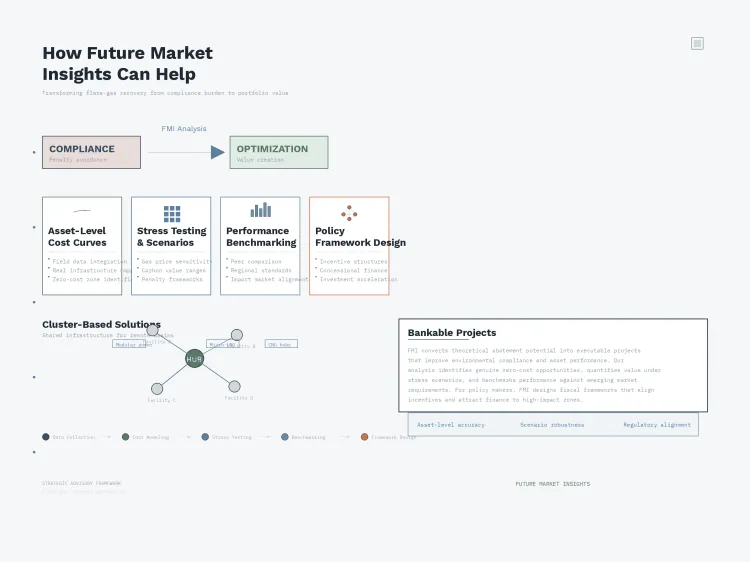
Future Market Insights helps operators, investors and regulators shift flare-gas recovery from a compliance burden to a portfolio optimisation challenge. FMI builds asset-level cost curves using real field data such as flare size and stability, gas quality, distance to infrastructure and the surrounding regulatory environment. This allows clients to identify which opportunities fall in the genuine zero-cost or low-cost zones. These curves are then stress-tested under different gas prices, carbon values and penalty scenarios to show where economics move from profitable to marginal. FMI also benchmarks each operator’s flaring intensity and methane performance against regional and global peers and maps these results to emerging import-market requirements.
For operators working in remote basins, FMI evaluates cluster-based solutions such as shared modular power, micro-LNG or CNG hubs that lower unit costs compared to isolated projects. At the policy level, FMI supports governments and regulators in designing fiscal and regulatory frameworks that align incentives, attract concessional finance and accelerate investment in high-impact zones. The aim is to turn theoretical abatement potential into executable and bankable projects that improve both environmental compliance and asset performance.
Sources
- World Bank - Global Gas Flaring Reduction Partnership, Global Gas Flaring Tracker Reports 2024 and 2025
- World Bank - Global Gas Flaring Reduction Program: What Is Gas Flaring?
- World Bank - Zero Routine Flaring by 2030 Initiative background papers
- International Energy Agency - Global Methane Tracker 2023 - 2025 and Methane Abatement Model
- OECD - Methane Abatement in Developing Countries (2024)
- IEA Greenhouse Gas R&D Programme - Flaring Emissions: Quantification and Mitigation (2018)
- European Commission - Impact Assessment: Reduction of Upstream GHG Emissions from Flaring and Venting
- Peer-reviewed studies on small-scale GTL and flare-gas utilisation technologies (ScienceDirect, Elsevier, Energy Procedia)

