


Key Takeaways
- RFID leadership is anchored in tag IC volume, not just reader hardware
- Control over standards and interoperability shapes long term pricing power
- Large deployments favour vendors with end-to-end platforms
- Software and data integration increasingly define switching costs
- Manufacturing scale enables cost leadership while platforms protect margins
Why is leadership in Radio Frequency Identification concentrated among a few global companies?
Radio Frequency Identification leadership concentrates among a limited group of companies due to capital intensity, standards participation barriers and deployment complexity. Tag integrated circuit fabrication requires semiconductor manufacturing facilities with investments exceeding $500 million for volume production. Reader development demands radio frequency engineering expertise, regulatory certification across multiple geographies and integration with diverse enterprise systems. Standards participation through EPCglobal and ISO working groups requires sustained technical resources and long term commitment.
Global enterprise deployments expect consistent performance across continents, multilingual support and integration with existing warehouse management, enterprise resource planning and supply chain visibility platforms. Only companies with substantial scale can maintain these capabilities while continuing to invest in protocol evolution and next generation silicon. This combination of capital requirements, technical depth and operational reach creates durable barriers that protect established leaders from new competition.
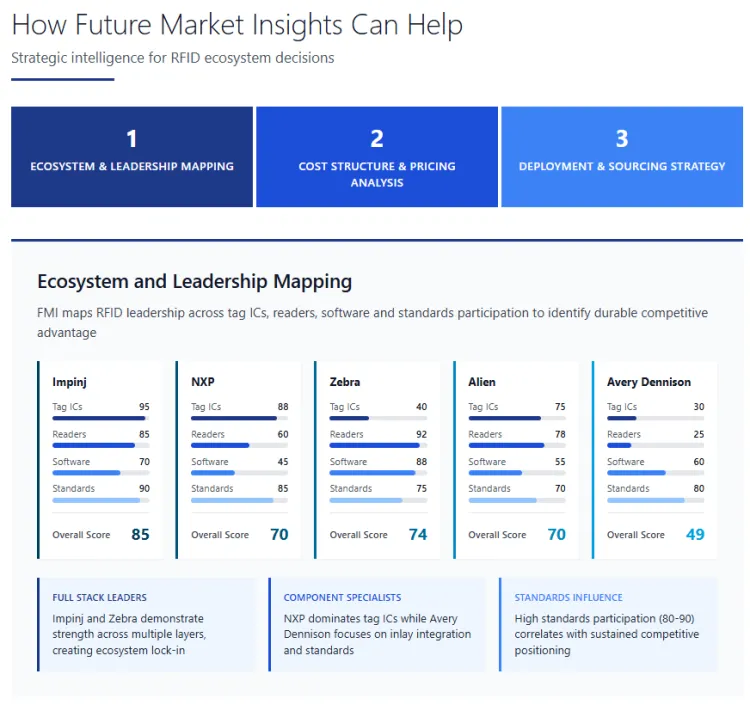
NXP Semiconductors, Impinj, Zebra Technologies, Honeywell and Alien Technology have built leadership through different but complementary positions. NXP and Impinj dominate tag IC volume. Zebra and Honeywell lead reader infrastructure and enterprise integration. These companies participate actively in standards development, ensuring their technology choices influence protocol evolution and certification requirements. Ecosystem control across silicon, infrastructure and software creates switching costs that reinforce leadership positions across deployment cycles.
How does tag IC scale establish leadership for companies such as NXP Semiconductors and Impinj?
Tag integrated circuit manufacturing exhibits steep learning curves and volume driven cost advantages. NXP Semiconductors ships billions of RFID ICs annually, leveraging automotive and payment chip fabrication scale to amortise fixed costs. Impinj focuses exclusively on RAIN RFID technology, achieving cost leadership through process optimisation and yield improvement. At volumes exceeding 10 billion units annually, per tag silicon cost drops below two cents for passive UHF designs. Smaller competitors without comparable scale cannot match these economics.
Protocol optimisation at the silicon level requires deep expertise in radio frequency analog design, power management and digital logic integration. Impinj develops proprietary extensions to EPCglobal Gen2 protocols that improve read rates and inventory accuracy. NXP maintains broad protocol support across UHF, HF and NFC standards, serving retail, logistics and payment applications. This protocol flexibility and performance optimisation create technical differentiation beyond pure manufacturing cost.
Yield learning curves compound over time as fabrication processes mature. Impinj reports tag IC gross margins above 50 percent despite aggressive pricing, reflecting manufacturing efficiency gained through billions of units produced. These margins fund continued research investment in next generation silicon with enhanced sensitivity, memory capacity and authentication features. Competitors entering tag IC manufacturing face years of yield learning before achieving comparable unit economics, during which incumbents continue advancing.
Why do reader and infrastructure leaders such as Zebra Technologies and Honeywell remain central to enterprise RFID adoption?
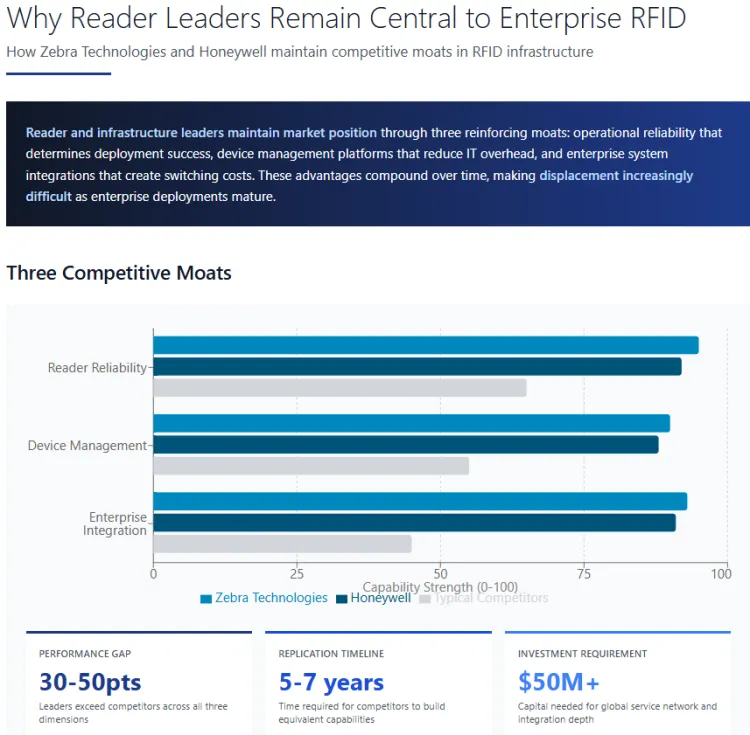
Reader reliability in harsh industrial environments determines deployment success. Zebra Technologies offers fixed and handheld readers certified for cold storage, outdoor exposure and high radio frequency interference environments. Honeywell provides ruggedised mobile computers with integrated RFID scanning for warehouse and retail operations. Both companies maintain global service networks capable of supporting 24 hour operations across multiple continents. This operational reliability cannot be replicated quickly by smaller competitors.
Device management software transforms RFID readers from standalone hardware into managed infrastructure. Zebra offers cloud based platforms that monitor reader health, update firmware remotely and aggregate read data for analytics. Honeywell integrates RFID readers with broader device management systems covering barcode scanners, mobile computers and voice picking solutions. These platforms reduce IT overhead for enterprises managing hundreds or thousands of readers across distributed facilities.
Enterprise system integration represents the deepest moat for infrastructure leaders. SAP, Oracle and Manhattan Associates warehouse management systems require validated integration with RFID middleware and reader management platforms. Zebra and Honeywell invest engineering resources to maintain certified connectors and provide technical support during deployment. Once these integrations are operational, switching reader vendors means recertifying connections, retraining staff and accepting deployment risk that most enterprises avoid.
How does standards influence and ecosystem participation reinforce leadership positions?
EPCglobal Gen2 protocol development involved substantial participation from NXP, Impinj and Alien Technology during the mid 2000s standardisation process. Early influence over protocol design ensured these companies could optimise silicon and reader designs for certification compliance. ISO 18000-63, which harmonises with EPCglobal Gen2, carries forward this technical direction. Companies absent from standards development must engineer products to specifications shaped by competitors, creating inherent disadvantage.
Certification programmes administered by standards bodies create compliance barriers that favour established vendors. RAIN Alliance certification requires testing against reference readers and tags from leading vendors. AIM Global provides test protocols that assume EPCglobal Gen2 compliance. These certification processes reinforce technology choices made during standards development, limiting the viability of alternative protocol approaches. New entrants must conform to incumbent defined specifications rather than competing on differentiated technical approaches.
Standards participation provides visibility into protocol roadmap evolution years before public release. Working group members influence timing, feature prioritisation and backward compatibility decisions. This advance knowledge enables leaders to align product development with emerging standards, achieving first mover advantage when new protocols launch. Companies outside standards processes react to specifications after publication, perpetually following rather than shaping technology direction.
How do software platforms and data services complete the leadership equation in RFID?
RFID middleware transforms raw read events into actionable business intelligence. Impinj offers ItemSense software that filters duplicate reads, associates tag data with business context and integrates with enterprise applications. Zebra provides Zatar cloud platform for asset tracking and inventory visibility. These software layers capture read data, apply business rules and deliver insights that justify RFID investment. Hardware sales become platform entry points rather than standalone transactions.
Analytics and machine learning capabilities extend RFID value beyond basic identification. Software platforms detect inventory anomalies, predict stockouts and optimise replenishment cycles. Zebra uses historical read data to recommend optimal reader placement and antenna configuration. Impinj provides partner ecosystem access through application programming interfaces that enable custom analytics development. This software differentiation protects margins as tag and reader hardware commoditise.
Cloud integration enables new business models based on data services rather than equipment sales. Subscription pricing for software platforms creates recurring revenue streams independent of hardware refresh cycles. Zebra reports growing software and services revenue as a percentage of total RFID sales. This shift toward platform monetisation rewards companies that control both infrastructure and software, reinforcing the advantage of end to end ecosystem ownership over point solution hardware sales.
How Future Market Insights Can Help
Sources
- Impinj, Inc. (2024). RAIN RFID tag IC product portfolio and technical specifications. Impinj, Inc.
- NXP Semiconductors. (2023). UCODE 8 and UCODE 9 tag IC technical documentation: Performance characteristics and protocol support. NXP Semiconductors N.V.
- RAIN Alliance. (2024). RAIN RFID certification program: Testing procedures and compliance standards. RAIN Alliance.

