


Key Takeaways
- A majority of global power tool manufacturing is concentrated in China and Southeast Asia, with estimates suggesting 70 to 80 percent of worldwide production occurs in these regions regardless of brand ownership location.
- Contract manufacturing and ODM models limit margin capture for production locations, as factory economics typically generate 8 to 15 percent gross margins while brand owners realize 35 to 50 percent margins on identical products.
- Global brands control pricing through battery platforms, software features and distribution relationships, leveraging proprietary ecosystems that manufacturing contractors cannot replicate or compete against.
- Retail and professional channel access determines realised pricing more than factory cost, as brands control shelf space, contractor relationships and fleet programs that set end customer pricing regardless of manufacturing origin.
- Value creation is driven by brand trust, ecosystem lock in and aftermarket sales, with batteries, chargers and accessories generating margin pools that dwarf initial tool sales and remain exclusively controlled by brand owners.
Why is power tool manufacturing concentrated in China and Southeast Asia?
Labour economics provide the foundational cost advantage driving power tool production to China and Southeast Asia. Assembly intensive manufacturing processes for cordless drills, circular saws, impact drivers and grinders require substantial manual labour for component insertion, wiring, quality inspection and packaging. Chinese factory labour costs range from 3 to 5 dollars per hour fully loaded, compared to 25 to 35 dollars in the United States or 30 to 40 dollars in Western Europe. This labour differential creates 40 to 60 percent production cost advantages even after accounting for logistics and quality control expenses.
Supplier clustering in the Pearl River Delta, Yangtze River Delta and increasingly in Vietnam and Thailand creates ecosystem advantages that isolated facilities cannot match. Power tool manufacturing requires motors, gearboxes, battery management systems, electronic switches, plastic housings and metal components sourced from specialized suppliers. Chinese manufacturing regions host hundreds of component suppliers within 50 to 100 kilometer radius, enabling just in time delivery, rapid design iteration and cost optimization through competitive sourcing. Establishing comparable supplier density elsewhere requires decades of industrial development and coordinated investment.
Component availability extends beyond basic suppliers to specialized inputs like brushless motor controllers, lithium battery cells and precision gearing systems. Chinese electronics manufacturing infrastructure produces the microcontrollers, power transistors and circuit boards that enable modern cordless tools at volumes and costs unattainable in other regions. Battery cell production concentration in China, South Korea and increasingly Southeast Asia means power tool assembly naturally gravitates toward battery supply to minimize logistics cost and supply chain complexity.
Logistics infrastructure supporting high volume manufacturing and global distribution favors established Asian production hubs. Shenzhen, Shanghai and Ho Chi Minh City ports handle container volumes and maintain shipping frequency that enable weekly production cycles and inventory flexibility. Manufacturing relocated to alternative regions faces reduced shipping options, higher freight costs and longer lead times that increase working capital requirements and reduce responsiveness to demand shifts.
Scalability advantages allow Asian manufacturers to rapidly expand or contract production in response to demand variability. Chinese contract manufacturers operate facilities capable of producing millions of tools monthly, with workforce flexibility through temporary labour that American or European factories cannot replicate due to employment regulations. This scalability proves essential for power tool brands facing seasonal demand peaks during construction seasons and holiday retail periods.
Why does manufacturing location fail to confer pricing power in Power Tools?
Manufacturing margin and brand margin represent fundamentally different economic positions in power tool value chains. Contract manufacturers producing tools for global brands typically earn 8 to 15 percent gross margins on factory gate prices, operating in highly competitive environments where brand owners continuously pressure costs and maintain multiple qualified suppliers. Brand owners selling identical tools under their trademarks realize 35 to 50 percent gross margins at wholesale, with retail prices reflecting additional markup controlled by distribution partners the brand owners’ influence.
OEM and ODM models restrict upstream value capture by design. Original Equipment Manufacturer relationships involve brands providing complete specifications, tooling and quality requirements to contract manufacturers who earn fees for production services but gain no ownership of design, intellectual property or customer relationships. Original Design Manufacturer arrangements grant factories slightly more design input but still leave brand ownership, distribution access and customer data exclusively with brand companies. Both models structurally prevent manufacturing contractors from capturing value beyond production efficiency gains.
Commoditization of manufacturing capability limits pricing power even for sophisticated production. Multiple Chinese and Southeast Asian contract manufacturers possess equivalent technical capability to produce cordless drills, impact wrenches or reciprocating saws meeting identical specifications. TTI, Positec, Chervon and dozens of smaller manufacturers compete for brand owner contracts, creating buyer leverage that prevents any single manufacturer from commanding premium pricing. Manufacturing excellence becomes table stakes rather than differentiation enabling margin expansion.
Brand switching costs for manufacturers prove minimal while brand switching costs for end customers remain substantial. A brand owner like Milwaukee, DeWalt or Makita can shift production between qualified contract manufacturers within 6 to 12 months, leveraging competition to maintain cost pressure. Conversely, professional contractors invested in battery platforms face thousands of dollars in switching costs to change brands, creating customer captivity that benefits brand owners rather than manufacturing contractors.
Intellectual property concentration with brand owners prevents manufacturers from commercializing production capabilities independently. Patents on motor designs, battery management systems, ergonomic features and control algorithms remain owned by brand companies who designed the products. Contract manufacturers gain manufacturing process knowledge but cannot legally produce competing products incorporating protected technologies. This IP barrier prevents manufacturing expertise from translating into independent brand building that could capture higher margins.
How do USA, European and Japanese brands retain control over pricing and margins?
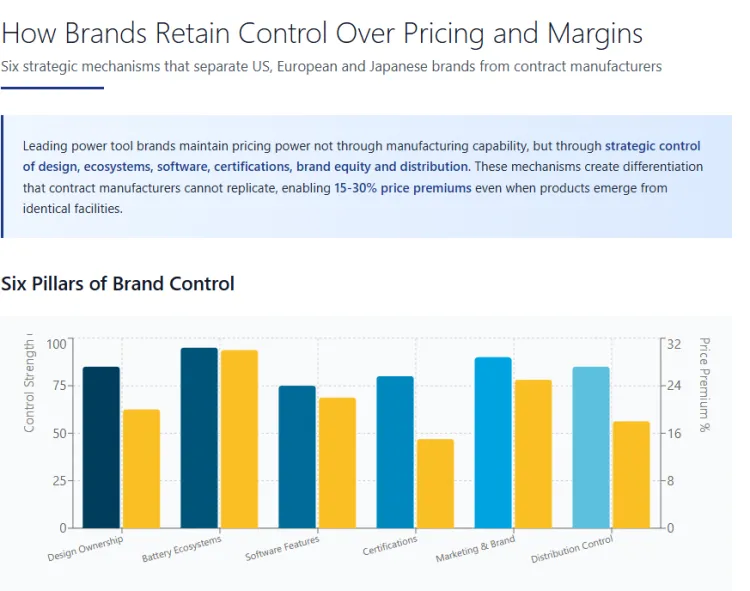
Design ownership allows brand companies to control product differentiation and feature positioning that justify price premiums. Milwaukee, owned by TTI but managed with design autonomy, develops proprietary motor technologies, anti vibration systems and electronic controls that manufacturing contractors implement but do not own. DeWalt, owned by Stanley Black & Decker, invests heavily in ergonomic research and user interface design that creates perceived value independent of manufacturing location. This design control enables brands to segment offerings across price tiers while using identical contract manufacturers.
Battery platform ecosystems represent the most powerful value capture mechanism in modern power tools. Milwaukee M18, DeWalt FlexVolt, Makita LXT and Bosch Professional 18V platforms create customer lock in through battery and charger investments that exceed initial tool costs. A contractor purchasing a drill commits to a battery platform serving dozens of tools across drilling, cutting, fastening, lighting and outdoor applications. This ecosystem lock in allows brands to maintain premium pricing on individual tools while capturing sustained revenue through battery and accessory sales over 5 to 10 year customer relationships.
Software features and connectivity increasingly differentiate premium brands despite identical manufacturing capabilities. Milwaukee ONE-KEY, DeWalt Tool Connect and Bosch Toolbox applications provide inventory management, usage tracking and theft prevention through Bluetooth connectivity. These software capabilities require ongoing development investment and cloud infrastructure that contract manufacturers cannot replicate, creating differentiation that justifies price premiums of 15 to 25 percent over comparable non connected alternatives.
Certification ownership and regulatory compliance management remain brand responsibilities generating customer confidence that generic alternatives cannot match. UL certification, OSHA compliance documentation, warranty administration and product liability insurance require brand level investment and expertise beyond manufacturing capability. Professional buyers and institutional purchasers prioritize certified, warranty backed tools from established brands over lower cost alternatives lacking comparable support infrastructure.
Marketing investment and brand equity development create customer preference independent of product performance or manufacturing quality. DeWalt associates itself with professional construction, Milwaukee targets skilled trades through sponsored athletes and content marketing, Makita emphasizes reliability through decades of brand building. These marketing driven associations influence purchase decisions even when independent testing shows comparable performance across brands manufactured in identical facilities.
Distribution relationships controlled by brand owners determine channel access that manufacturing capability cannot replicate. Brands maintain exclusive partnerships with Home Depot, Lowe's, professional distributors like HD Supply and national rental chains like United Rentals. These channel relationships require vendor compliance programs, merchandising support, co-op advertising and inventory management that only established brands provide. Contract manufacturers lack access to these distribution channels regardless of production capability.
How do battery ecosystems and accessory lock in reinforce brand country control?
Proprietary batteries create technical lock in preventing cross brand compatibility. Each major brand employs unique cell configurations, battery management system protocols and physical connector designs ensuring that Milwaukee M18 batteries cannot power DeWalt tools and vice versa. While lithium cell technology remains largely commoditized, the integration architecture and control software differ sufficiently to prevent interoperability. This technical incompatibility forces customers expanding tool collections to remain within their chosen ecosystem.
Charger investments amplify switching costs beyond battery expenses alone. Professional contractors operate multiple charging stations across work vehicles, shops and job sites, representing hundreds to thousands of dollars in infrastructure dedicated to specific battery platforms. Switching brands requires replacing not only batteries but entire charging infrastructure, creating economic barriers that brands exploit through aggressive tool pricing subsidized by battery and accessory margins.
Cross tool compatibility within platforms drives platform scale advantages. A contractor owning five Milwaukee M18 tools benefits from battery interchangeability, justifying additional Milwaukee purchases to maximize battery utilization. Brands continuously expand platform breadth, releasing new tools compatible with existing batteries to deepen customer lock in. Milwaukee offers over 200 M18 platform tools, DeWalt exceeds 200 FlexVolt compatible products, and Makita maintains similar platform breadth, creating network effects that strengthen with each purchase.
Accessory and consumable sales generate recurring revenue streams controlled exclusively by brand owners. Drill bits, saw blades, sanding pads, batteries and chargers produce gross margins of 50 to 70 percent, far exceeding tool margins of 35 to 45 percent. Brands design tools to optimize performance with proprietary accessories, creating quality and warranty incentives for customers to purchase branded consumables despite generic availability. This aftermarket capture represents significant profit pool inaccessible to contract manufacturers.
Fleet program lock in at institutional level creates enterprise wide platform standardization. Construction firms, utilities and maintenance operations standardize on single battery platforms to minimize inventory complexity, training requirements and warranty administration. Once established, these fleet decisions prove extremely sticky, with switching costs including retraining, tooling replacement and operational disruption far exceeding any savings from alternative brands. Brand companies cultivate these relationships through fleet pricing, service programs and dedicated account management that cement long term loyalty.
How does channel control shape realised pricing across professional and DIY segments?
Trade distributors serving professional contractors operate under brand controlled pricing and allocation policies. Distributors like HD Supply, Grainger and regional electrical and plumbing wholesalers maintain franchise like relationships with tool brands, receiving territory protection, co op marketing funds and training support in exchange for pricing discipline and inventory commitments. These distributor agreements prevent price competition that would erode brand margins, ensuring contractors pay manufacturer suggested pricing regardless of manufacturing cost basis.
Big box retail merchandising creates brand visibility and pricing transparency that benefits established players. Home Depot and Lowe's dedicate aisle space, end caps and promotional placement to major brands like Milwaukee, DeWalt, Makita and Ryobi, creating consumer awareness that justifies premium pricing. Store layouts position premium professional brands separately from value DIY brands, reinforcing price tier separation despite similar manufacturing origins. Retail partnerships require substantial co op advertising and vendor compliance investments that only major brands afford.
eCommerce platforms introduce pricing pressure but brands maintain control through minimum advertised pricing policies and authorized reseller restrictions. Amazon, which represents growing power tool sales channel, hosts both brand direct selling and authorized third party resellers operating under brand pricing guidelines. Brands threaten to revoke authorization for sellers violating MAP policies, limiting price competition even in online channels. Direct to consumer e commerce allows brands to capture retail margin previously shared with distribution partners, improving profitability without reducing end customer pricing.
Fleet programs and national account relationships bypass distribution channels entirely, allowing brands to capture full value chain margins. Rental companies like United Rentals, Sunbelt and Herc purchase directly from manufacturers under national contracts specifying pricing, service terms and warranty administration. These high volume buyers receive discounts of 20 to 30 percent off retail pricing but still generate margins for brands far exceeding contract manufacturing fees, demonstrating that manufacturing location contributes minimally to final value capture.
Professional loyalty programs and contractor rewards reinforce channel control by creating direct brand to customer relationships. Milwaukee Tool rewards, DeWalt Contractor Club and Makita Pro programs offer rebates, exclusive products and training in exchange for purchase commitment and data sharing. These direct relationships allow brands to understand buying patterns, target marketing and cultivate loyalty independent of distribution partners, centralizing pricing power regardless of where tools are manufactured.
How Can Future Market Insights Help?
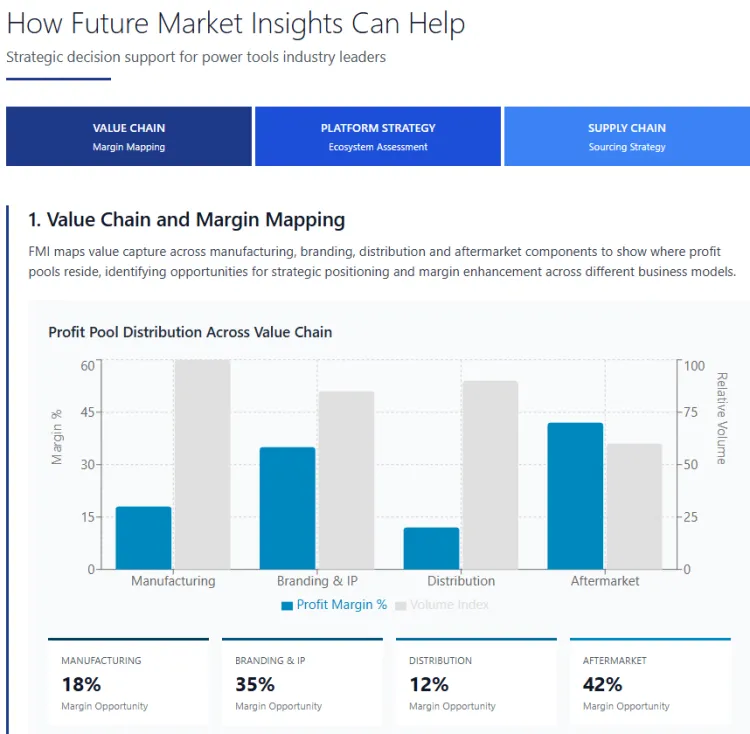
Value chain and margin mapping
FMI can map value capture across manufacturing, branding, distribution and aftermarket components to show where profit pools reside in power tools, identifying opportunities for strategic positioning and margin enhancement across different business models.
Brand and platform strategy assessment
FMI can analyse battery ecosystems, accessory lock in and software differentiation to evaluate sustainable pricing power and competitive positioning, supporting decisions on platform investment and feature prioritization.
Supply chain and sourcing strategy support
FMI can support decisions on outsourcing, dual sourcing and nearshoring without eroding brand pricing control, evaluating trade offs between cost optimization and supply chain resilience while maintaining customer value perception.
Sources
- Power tool brand annual reports and investor presentations
- Used to assess margin structure, brand strategy and platform economics from companies including Stanley Black & Decker, TTI, Makita, Bosch and other major brand owners.
- Contract manufacturing and ODM disclosures
- Used to understand manufacturing economics and supplier margin limitations through analysis of Chinese and Southeast Asian manufacturing company reports and industry disclosure.
- Battery and motor technology technical literature
- Used to explain ecosystem lock in and differentiation drivers through analysis of lithium battery management systems, brushless motor controllers and proprietary charging protocols.
- Retail and professional distribution industry publications
- Used to analyse channel control and pricing discipline through reporting on hardware retail, professional distribution and e commerce platform dynamics.
- Reputable industrial equipment and consumer durables media
- Used for reporting on sourcing shifts, brand competition and pricing behaviour in power tools industry from trade publications and business media covering tools and equipment sectors.

