


Key Takeaways
- A majority of global citric acid capacity is located in China due to low cost fermentation economics, with estimates suggesting 60 to 70 percent of worldwide production originates from Chinese facilities.
- Corn based glucose availability and integrated wet milling support large scale production, allowing Chinese manufacturers to achieve fermentation yields and cost structures that non-Chinese producers cannot match economically.
- Capacity concentration creates global dependence on Chinese exports for food, beverage and industrial applications, with major importing regions having limited domestic production alternatives.
- Environmental controls and energy cost shifts in China directly affect global availability, as periodic plant inspections and compliance enforcement reduce operating rates and exportable volumes.
- Trade policy and logistics disruptions translate quickly into supply and pricing volatility, as buyers lack sufficient alternative sourcing options to absorb sudden Chinese supply contractions.
How is global citric acid production capacity distributed across regions?
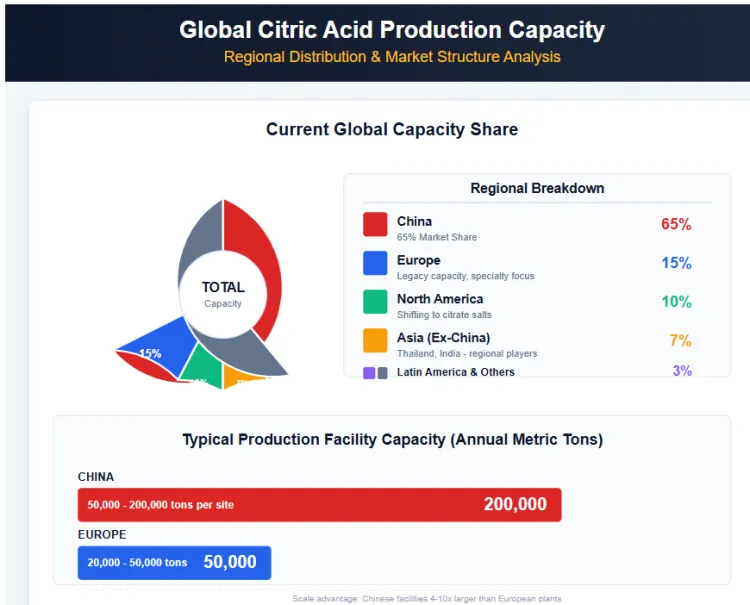
Global citric acid production capacity displays extreme geographic concentration, with China accounting for an estimated 60 to 70 percent of total worldwide manufacturing capability. This concentration represents a structural shift from the 1990s, when European and North American producers maintained more balanced global capacity shares. Companies like Jungbunzlauer in Switzerland, Archer Daniels Midland in the United States and Cargill operating facilities across multiple regions once represented significant capacity bases outside China.
Chinese capacity expansion accelerated during the 2000s and 2010s as producers such as COFCO Biochemical, Weifang Ensign Industry and TTCA developed large scale fermentation complexes in Shandong, Jiangsu and Anhui provinces. These facilities range from 50,000 to 200,000 metric tons of annual capacity per site, dwarfing typical European plants of 20,000 to 50,000 tons. The scale differential reflects both feedstock economics and willingness to concentrate production risk in pursuit of cost leadership.
Outside China, residual capacity exists primarily in Europe, where Jungbunzlauer maintains facilities in Austria and France, and in North America, where ADM and Cargill operate smaller production units. Thailand and India host modest capacity serving regional buyers, but these facilities compete primarily on logistics proximity rather than cost competitiveness. Latin American capacity remains limited despite regional corn availability, as fermentation expertise and downstream integration have not developed sufficiently to challenge Chinese or multinational producers.
Historical consolidation trends reveal systematic capacity rationalization outside China. European producers closed higher cost plants in response to Chinese competition, while North American manufacturers shifted toward specialty citrate salts rather than commodity citric acid monohydrate. This contraction left global buyers increasingly dependent on Chinese supply, particularly for food and beverage applications where cost sensitivity drives sourcing decisions.
Why does fermentation based citric acid production favour large scale Chinese manufacturers?
Fermentation based citric acid production requires substantial inputs of glucose feedstock, energy, water and fermentation expertise, all areas where Chinese manufacturers enjoy structural advantages. Chinese producers source corn glucose from integrated wet milling operations that convert corn into starch, glucose syrup and fermentation feedstock within unified facilities or through adjacent supplier relationships. This integration reduces feedstock costs by 15 to 25 percent compared to producers purchasing glucose on merchant terms.
Corn availability in northeastern China provides abundant, low cost carbohydrate supply for fermentation. Chinese corn production exceeds 270 million metric tons annually, with substantial volumes directed toward starch processing and glucose extraction. Fermentation facilities located near corn wet milling hubs benefit from shortened logistics, reduced working capital requirements and supply reliability that offshore producers cannot replicate. Feedstock cost represents 40 to 50 percent of total citric acid production expense, making sourcing efficiency the primary determinant of competitive position.
Fermentation yield optimization depends on Aspergillus niger strain development, process control precision and contamination prevention. Chinese producers have invested heavily in fermentation technology, achieving conversion efficiencies of 90 to 95 percent glucose to citric acid on a molar basis. These yields, combined with high volume fermentation vessels of 200 to 400 cubic meters, enable production costs that European and North American facilities struggle to match even with superior automation or quality control systems.
Energy consumption in fermentation, particularly for heating, agitation and downstream crystallization, creates another cost differential favouring China. Industrial electricity prices in coastal Chinese provinces range from 5 to 7 US cents per kilowatt hour, whereas European rates often exceed 12 to 15 cents. Natural gas used for process heating follows similar price patterns. Energy represents 12 to 18 percent of citric acid production cost, amplifying the cumulative advantage Chinese producers achieve through feedstock, scale and energy access.
Wastewater treatment requirements create scale economies that benefit large Chinese fermentation complexes. Citric acid production generates substantial organic waste streams requiring biological treatment before discharge. Facilities processing 100,000 tons annually can invest in advanced treatment systems that smaller plants cannot economically justify. Chinese environmental regulations have tightened considerably since 2015, but large producers demonstrate greater ability to absorb compliance costs through volume amortization than smaller competitors.
Byproduct utilization provides additional economic benefit. Fermentation residues contain mycelial biomass suitable for animal feed production, gypsum suitable for construction materials and concentrated nutrients recoverable for fertilizer application. Integrated Chinese facilities capture these revenue streams, offsetting primary production costs by 3 to 5 percent and improving overall economic returns.
How do environmental regulation and operating cost changes in China influence effective citric acid capacity?
Chinese environmental regulation enforcement exhibits cyclical intensity that directly impacts citric acid production availability. During periods of heightened regulatory scrutiny, such as the 2017 to 2018 environmental inspection campaigns and COVID era pollution control measures, fermentation plants faced temporary or permanent closures if wastewater treatment, air emissions or hazardous waste handling failed compliance standards. These enforcement waves reduced effective operating capacity by 10 to 20 percent even when installed capacity remained nominally unchanged.
Wastewater treatment compliance represents the primary regulatory pressure point for citric acid producers. Fermentation effluent contains high biochemical oxygen demand, suspended solids and residual organic acids requiring multi stage treatment before discharge. Plants lacking adequate treatment infrastructure receive production curtailment orders or face outright closure until upgrades are completed. Smaller producers with limited capital access have been disproportionately affected, accelerating capacity consolidation toward larger, better capitalized manufacturers.
Energy pricing policy in China influences production economics and plant operating rates. When coal fired electricity prices rise due to fuel cost inflation or carbon pricing measures, fermentation plants face margin compression that may lead to voluntary production cuts. Conversely, government efforts to stabilize industrial electricity costs through subsidies or price controls can encourage higher capacity utilization. These policy oscillations create supply variability that buyers outside China experience as unpredictable availability and pricing shifts.
Regional environmental quality targets drive production location decisions and capacity distribution. Provinces designated as pollution control priority zones, particularly in eastern coastal regions, impose stricter permitting requirements and higher compliance costs. Some citric acid capacity has migrated to inland provinces where environmental enforcement remains less stringent and operating costs are lower. This geographic redistribution affects logistics efficiency and export port access, adding complexity to global supply chains.
Plant consolidation and modernization initiatives periodically remove obsolete capacity while adding more efficient production units. Chinese government programs encouraging industrial upgrading have prompted older fermentation plants to close while newer facilities with superior environmental controls and energy efficiency come online. Net capacity additions have slowed compared to the 2000s expansion period, but quality improvements in remaining facilities have enhanced supply reliability.
How does capacity concentration affect trade flows and regional import dependence?
African regions demonstrate near total dependence on citric acid imports, with domestic production effectively absent. South Africa, Egypt and Kenya rely entirely on Chinese exports or transshipments through European distributors for food, beverage and industrial acid applications. This dependence creates vulnerability to shipping disruptions, port congestion and trade policy changes that immediately affect input availability for beverage manufacturers and food processors.
Middle Eastern buyers similarly lack meaningful domestic citric acid production despite substantial food and beverage industries. Turkey, Saudi Arabia and the United Arab Emirates import the majority of their citric acid requirements from China, supplemented by European supplies for specialized applications requiring particular quality certifications. The absence of regional fermentation capacity reflects both feedstock limitations and insufficient industrial ecosystem depth to support competitive production.
European citric acid demand exceeds domestic production capacity by a substantial margin, necessitating continuous imports from China. While Jungbunzlauer, Cargill and other European based producers maintain quality focused production for premium applications, commodity volumes destined for soft drinks, confectionery and detergent applications increasingly originate from Chinese suppliers. European buyers balance cost optimization against supply security, with many maintaining dual sourcing strategies that combine Chinese imports with higher priced domestic supply.
Southeast Asian regions exhibit mixed import dependence. Thailand hosts domestic fermentation capacity serving local and regional buyers, while Vietnam, Indonesia and the Philippines rely predominantly on imports. Logistics proximity to southern Chinese ports provides these regions with shorter lead times and lower freight costs compared to African or Middle Eastern buyers, but does not reduce fundamental supply concentration risk.
Latin American regions possess theoretical capability for citric acid self sufficiency given abundant corn resources, but actual domestic production remains limited. Brazil and Argentina import substantial volumes from China despite possessing the agricultural and industrial base required for fermentation. This import dependence reflects historical investment patterns and the difficulty of achieving cost parity with established Chinese producers operating at significantly larger scale.
Supplier diversification challenges confront all major importing regions. Building alternative citric acid capacity requires capital investment of 50 to 100 million dollars for a minimally efficient 50,000 ton plant, extended construction timelines of 24 to 36 months and access to corn glucose supply chains that may not exist outside established production regions. These barriers prevent rapid supply reconfiguration when Chinese exports contract.
How do capacity expansions or shutdowns in China shape forward pricing and supply risk?
Incremental capacity changes in China exert disproportionate influence on global citric acid supply balance due to the dominant market share Chinese producers control. When major manufacturers such as COFCO Biochemical or Weifang Ensign announce expansion projects of 30,000 to 50,000 tons, forward price expectations shift downward as buyers anticipate increased availability. Conversely, plant closure announcements or environmental compliance driven shutdowns trigger immediate price increases as importers compete for reduced supply.
Plant consolidation within China has created larger but fewer production entities with enhanced pricing coordination capability. The shift from dozens of small fermentation facilities to a concentration of production among fewer than ten major players has altered competitive dynamics. Larger producers demonstrate greater discipline in capacity utilization management, reducing the price volatility that characterized earlier periods when numerous small producers dumped inventory during demand downturns.
Policy driven closures create supply shocks that reverberate through global supply chains. When Chinese environmental authorities order production suspensions during pollution control campaigns or inspection failures, available citric acid volumes contract sharply within weeks. Buyers lacking inventory buffers face allocation risk and price spikes, as alternative suppliers cannot rapidly increase production to fill gaps. These episodic supply disruptions have prompted some food and beverage companies to increase safety stock levels, raising working capital requirements.
Forward pricing negotiations reflect buyer assessment of Chinese capacity utilization rates and inventory levels. When Chinese producers operate at 70 to 80 percent capacity utilization, indicative of soft demand or excess supply, buyers gain leverage to negotiate lower contract prices. Conversely, when utilization approaches 90 percent or inventory levels decline, producers resist price concessions and may implement allocation protocols for existing customers. This utilization rate sensitivity creates information asymmetry challenges for buyers attempting to time purchase decisions.
New capacity announcements require careful interpretation, as many proposed expansions never reach full production or experience substantial delays. Chinese fermentation projects face permitting uncertainty, financing constraints and technology integration challenges that can extend timelines or reduce ultimate output below initial projections. Buyers relying on anticipated new capacity to pressure incumbent suppliers risk miscalculating supply balance if expansions fail to materialize on schedule.
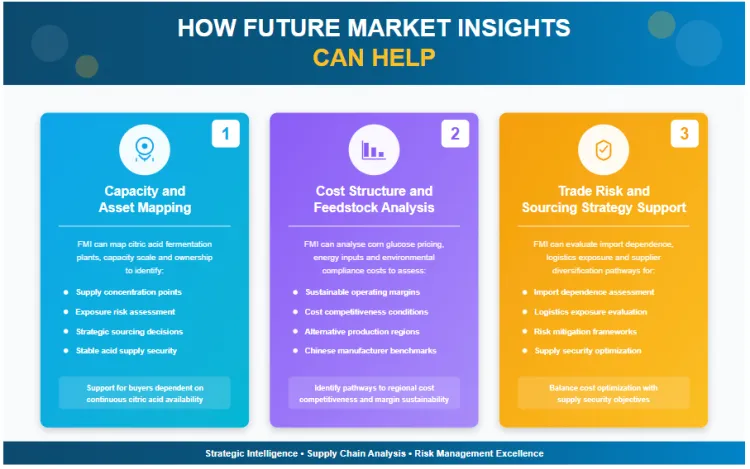
How Future Market Insights Can Help
SOURCES
- Company annual reports and fermentation plant disclosures
- Used for capacity size, production footprint and consolidation trends among major citric acid producers in China, Europe and North America.
- Chinese industrial and environmental regulatory publications
- Used to assess compliance requirements affecting fermentation plants, including wastewater treatment standards, emissions controls and enforcement campaign intensity.
- FAO and agricultural feedstock statistics
- Used for corn production, glucose availability and feedstock economics that determine citric acid production cost structures across regions.
- International trade and customs databases
- Used for export flows, regional import dependence and supplier concentration patterns that reveal global supply chain exposure to Chinese production dominance.
- Reputable food ingredients and chemical industry media
- Used for reporting on capacity changes, plant shutdowns, environmental compliance actions and pricing impact across the citric acid supply chain.

