

- Market Size (2026)
- USD 277.6 Mn
- Forecast (2036)
- USD 484.2 Mn
- CAGR (2026 to 2036)
- 5.7%
How big is 2-Ethylhexyl Acetate Market in 2026?
USD 277.6 million in 2026 and USD 484.2 million by 2036 at a 5.7% CAGR.
The 2-ethylhexyl acetate market is projected to rise from USD 277.6 million in 2026 to USD 484.2 million by 2036 at a 5.7% CAGR. Formulators use the ester where slower solvent release protects open time and film flow in industrial solvents applications. PPG started a 2,000-ton annual waterborne automotive coatings plant in Thailand in March 2025. The new capacity increases regional finishing work that requires tightly controlled formulation behavior without proving direct 2-ethylhexyl acetate consumption.
Country demand diverges as finishing capacity and change-control requirements alter the cost of adopting a solvent grade. Germany is closely linked to automotive paints and coatings, yet mature specifications can slow substitutions. VDA’s August 2025 data put German passenger-car production at 2.5 million units during the first seven months and 12% below the comparable 2019 level. That combination supports substantial solvent use while rewarding companies that document consistent performance through customer approval.
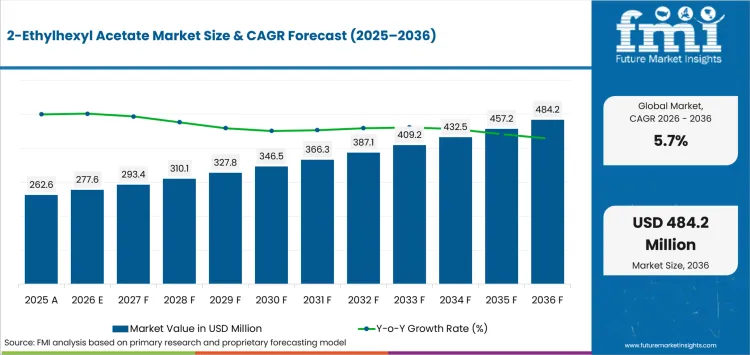
Key Takeaways of 2-Ethylhexyl Acetate Market
- Controlled evaporation supports demand as coating and finishing lines use slow solvent release to protect flow during early film formation.
- Based on purity, high purity is projected to account for 76.6% in 2026 due to industrial qualification requiring reproducible composition without ultra-high analytical specifications.
- By application, industrial solvents are estimated to hold 75.3% in 2026 owing to direct solvent use reaching the broadest set of commercial formulations.
- In 2026, paints & coatings are expected to lead end use with 34.1% share because evaporation control directly affects flow and surface appearance.
- VOC controls and customer change procedures extend qualification cycles whenever a replacement grade alters emissions calculations or established drying conditions.
- Some of the key players in this market include Eastman Chemical Company, BASF SE, Chemoxy International Ltd. (SEQENS), Polynt SpA, OXEA (formerly OQ Chemicals), Merck KGaA (Sigma-Aldrich), TCI Chemicals, and Thermo Fisher Scientific.
Analyst Perspective
"2-ethylhexyl acetate earns repeat orders once its evaporation profile fits the customer's existing drying window and resin package without reopening process risk. Producers protect conversion economics by holding ester and water specifications steady while maintaining regional stock that prevents avoidable sourcing changes following customer approval."
- Nikhil Kaitwade, Principal Consultant, Future Market Insights
How is the 2-Ethylhexyl Acetate Market segmented?
The 2-ethylhexyl acetate market is segmented by purity, application, end use, and region.
Purity covers high purity and ultra high purity grades. Application comprises industrial solvents and performance chemicals. End use includes paints & coatings, automotive & aerospace, cleaners & paint stripping system, leather industry, and others. Region provides the geographic assessment used in the full report.
Why do Industrial Solvents lead the Application category?
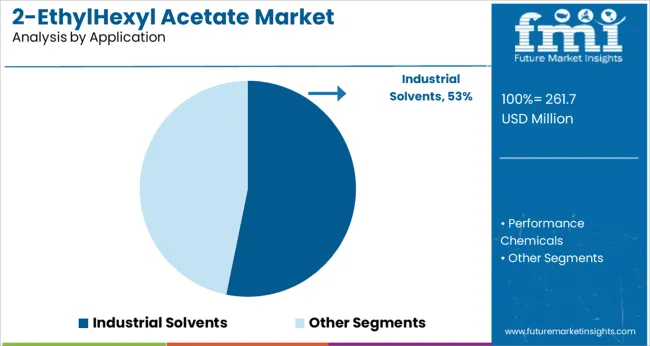
Industrial solvents lead through direct use of 2-ethylhexyl acetate for physical solvent behavior without downstream chemical conversion. A TÜV NORD certificate issued in May 2026 lists BASF's 2-ethylhexylacetate among the ISCC PLUS-certified esters handled at Ludwigshafen. The certificate gives industrial accounts a documented sourcing route when specialty chemicals purchasing requires formal plant records.
- Industrial solvents are projected to hold 75.3% share in 2026 owing to direct slow-evaporating use in coatings and formulated products.
- Formulators evaluate evaporation rate against process temperature and resin compatibility as they approve the ester for existing production recipes or solvent blends.
What makes High Purity central to the Purity category?
High purity serves industrial and laboratory work that needs documented ester composition without ultra-high analytical controls. TCI India's May 2026 Quarterly Update states that certificates of analysis now include Quality Release and Recommended Retest dates. The change gives laboratory accounts lot-age records during qualification and reinforces documentation expected in high purity solvents purchasing.
- High purity is set to lead the purity category with 76.6% share in 2026 due to routine industrial users requiring repeatable solvent specifications.
- Purchasers compare ester content, water, acidity, color, and lot records as part of approval for repeated formulation or analytical work.
How do Paints & Coatings hold the End Use lead?
Paints & coatings use slower ester evaporation to preserve wet-film flow during application and early curing. PPG renewed its Indian joint venture with Asian Paints in August 2025 for another fifteen years. The agreement keeps formulation support close to automotive and industrial customers evaluating coating additives and solvent changes.
- By end use, paints & coatings are forecast to represent 34.1% in 2026 driven by evaporation control during film formation.
- Automotive finishing demand persists as solvent behavior must survive line speed, cure conditions, customer appearance specifications, and repeated production runs.
What are the drivers, restraints and opportunities in the 2-ethylhexyl acetate market?
Coatings output sustains solvent demand, while emissions controls and qualification work slow substitution and reformulation directs revenue toward solvent packages that meet process and safety requirements.
- Driver: New coating capacity increases the number of formulations that require controlled evaporation during automated application and curing.
- Restraint: VOC rules and plant change controls extend approval timelines whenever a new solvent changes emissions calculations or production behavior.
- Opportunity: Cleaning and paint-removal reformulation gives solvent blends a route to replace restricted ingredients after application-specific validation.
Automotive coating capacity keeps solvent performance commercially relevant as automated lines need predictable flow during deposition and cure. In May 2025, Tianjin Economic-Technological Development Area documented Nippon Paint's largest global automotive coatings base with annual capacity estimated at 133,000 tons. The facility does not establish direct 2-ethylhexyl acetate use, but it expands qualification work for solvent systems serving automotive refinish coatings and OEM finishing.
Qualification becomes harder as emissions rules change formulation limits and reporting duties for commercial coating operations. EPA amended national aerosol-coating VOC standards in January 2025 with revised reactivity factors, test methods, and electronic reporting requirements. Companies selling into USA n-propyl acetate and related ester channels therefore need current regulatory files before a replacement solvent enters formal customer change control procedures.
Reformulation work is most attractive for uses in which an incumbent solvent faces a defined restriction and alternative blends can be tested in the finished product. EPA extended selected methylene chloride compliance dates in November 2025 once the rule prohibited most industrial and commercial uses including paint removers. EPA does not designate 2-ethylhexyl acetate as a one-for-one paint-removal substitute, so revenue depends on blend validation and solvent recovery systems that control plant handling economics.
Which country CAGRs are profiled in the 2-ethylhexyl acetate market?
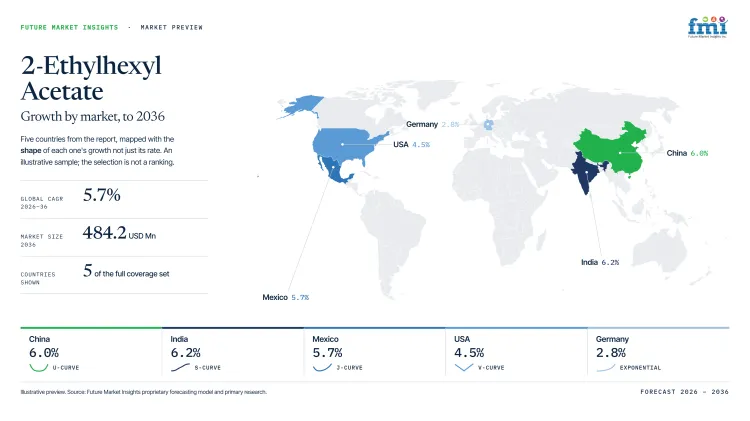
| Country | CAGR |
|---|---|
| India | 6.2% |
| China | 6.0% |
| Mexico | 5.7% |
| United States | 4.5% |
| Germany | 2.8% |
How do country-level CAGRs compare in the 2-ethylhexyl acetate market?
The country outlooks span 3.4 percentage points, from India at 6.2% to Germany at 2.8% during 2026–2036. India and China form the upper-growth group, followed by Mexico, while the United States shows moderate expansion. Germany forms a separate lower tier as its mature automotive and coatings base slows specification changes.
- India's specialty-chemical producers require detailed documentation for formulation changes.
- China's industrial and automotive sectors support specialty-solvent demand.
- Mexico's export vehicle plants favor grades with consistent regional approvals.
- United States coatings plants require environmental records for solvent substitutions.
- Germany's mature automotive base slows changes to established coating specifications.
Qualification effort and local inventory needs separate entry economics between these countries. The full report provides country-level CAGR analysis across North America, Latin America, Europe, East Asia, South Asia, Oceania and the Middle East and Africa.
Country-wise Analysis
- India's automotive and industrial coating programs increasingly require consistent solvent specifications, documentation, and responsive local technical support as manufacturers balance quality, compliance, and production continuity. India is projected to grow at a 6.2% CAGR through 2036, supported by expanding vehicle production, industrial coatings demand, and specialty chemical consumption. Local inventory and formulation support can reduce qualification delays and supply risks as manufacturers scale production and introduce new coating systems.
- China's large automotive and industrial manufacturing base supports sustained demand for 2-ethylhexyl acetate in coating and finishing applications. The market is forecast to expand at a 6.0% CAGR, driven by high-volume vehicle production, industrial output, and continued demand for specialty coating formulations. Established local chemical supply networks and consistent product specifications remain important for manufacturers managing large-scale production and formulation changes.
- Mexico's export-oriented vehicle plants require coating inputs that retain customer approval as production programs move between domestic factories and North American customers under linked specifications. INEGI recorded 354,221 light vehicles produced and 301,009 exported in June 2026, confirming the scale of finishing operations tied to cross-border schedules. 2-ethylhexyl acetate demand in Mexico is forecast to rise at a 5.7% CAGR through 2036, supported by vehicle manufacturing and the need for nearby inventory and disciplined change notification during routine replenishment.
- United States coating plants require production and environmental approval for a new solvent grade to enter routine manufacturing on automotive and industrial finishing lines. Federal Reserve data released in June 2026 put the 2025 average motor-vehicle assembly rate at 10.16 million units and document a large downstream finishing base without measuring exact 2-ethylhexyl acetate consumption. Demand for 2-ethylhexyl acetate in the United States is projected to grow at a 4.5% CAGR through 2036, supported by deep coatings channels while compliance work slows substitution and domestic inventory limits sourcing disruption following qualification during scheduled production programs at high-volume plants each year.
- Germany's established automotive coating specifications make solvent substitution deliberate because formal change control protects validated production recipes across mature vehicle programs. VDA reported in September 2025 that nearly 2.8 million passenger cars were produced during the first eight months, while output remained 12% below the same 2019 period. Germany is estimated to post a 2.8% CAGR through 2036, reflecting steady solvent use within an established manufacturing base while slower conversion increases the importance of documented formulation value and consistent regional supply.
Who are the notable companies in the 2-ethylhexyl acetate market?
Eastman Chemical Company, BASF SE, Chemoxy International Ltd. (SEQENS), Polynt SpA, OXEA (formerly OQ Chemicals), Merck KGaA (Sigma-Aldrich), TCI Chemicals, and Thermo Fisher Scientific are the notable companies serving this market.
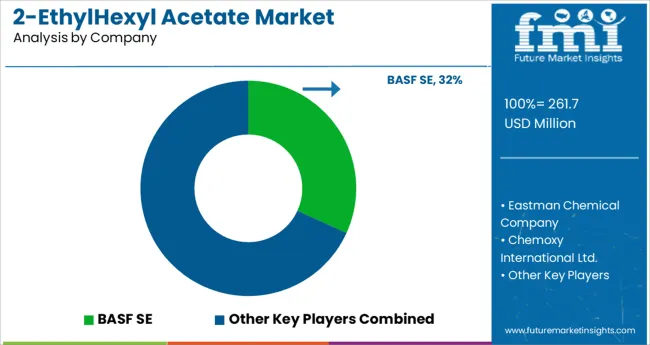
Competitive outlook separates into bulk ester producers, specialty-chemical platforms, and laboratory channels. Direct manufacturers protect positions through distillation control and formulation support, while laboratory brands compete on pack-level traceability. Once a grade is embedded in customer specifications, substitution requires new safety review and application testing. Regional chemical distribution affects conversion economics, while broader ester chemistry exposure can improve feedstock and formulation support for industrial accounts.
- Eastman Chemical Company, BASF SE, Chemoxy International Ltd. (SEQENS), Polynt SpA, and OXEA (formerly OQ Chemicals) serve industrial ester or broader specialty-solvent routes.
- Merck KGaA (Sigma-Aldrich), TCI Chemicals, and Thermo Fisher Scientific address laboratory and specification-led purchasing, with documentation and small-pack availability carrying greater weight.
Competitive Benchmarking: 2-Ethylhexyl Acetate Market
| Company | Ester Production Breadth | Quality Documentation Depth | Distribution Reach | Geographic Reach |
|---|---|---|---|---|
| Eastman Chemical Company | High | High | High | Global |
| BASF SE | High | High | High | Global |
| Chemoxy International Ltd. (SEQENS) | High | High | Medium | Europe and international sales |
| Polynt SpA | High | Medium | Medium | Europe, Americas and Asia |
| OXEA (formerly OQ Chemicals) | High | Medium | High | Europe, Americas and 60+ countries |
| Merck KGaA (Sigma-Aldrich) | Medium | High | High | Global laboratory channel |
| TCI Chemicals | Medium | High | High | Global laboratory channel |
| Thermo Fisher Scientific | Medium | High | High | Global |
Scoring basis: High ester production breadth requires several documented ester or adjacent oxo routes with industrial manufacturing evidence, while Medium identifies a narrower exact-grade or laboratory route. High quality documentation requires current certifications or regulated quality records, while Medium reflects a smaller public documentation set. High distribution reach requires documented multi-region channels, while Medium reflects regional or specialist coverage that serves fewer active markets. Geographic reach states the verified service footprint and is descriptive rather than a separate score in this table.
Key Developments in the 2-Ethylhexyl Acetate Market
- In April 2026, Eastman Chemical Company announced price increases of USD 0.10 per pound for Eastman™ PM solvent, PM Acetate, and IBIB across applicable package types in North America and Latin America.
- In August 2026, Merck KGaA (Sigma-Aldrich) received renewed IFANCA halal certification covering its 99% 2-ethylhexyl acetate grade produced by Aldrich Chemical Company.
- In April 2025, Strategic Value Partners and Blantyre Capital acquired OQ Chemicals and announced restoration of the OXEA name for its oxo intermediates and specialty-esters business.
Key Players in the 2-Ethylhexyl Acetate Market
Industrial Ester and Specialty-Solvent Producers
- Eastman Chemical Company
- BASF SE
- Chemoxy International Ltd. (SEQENS)
- Polynt SpA
- OXEA (formerly OQ Chemicals)
Laboratory and Specification-Led Channels
- Merck KGaA (Sigma-Aldrich)
- TCI Chemicals
- Thermo Fisher Scientific
2-Ethylhexyl Acetate Market - Report Scope
| Coverage field | Report scope |
|---|---|
| Market breakdown | By purity, application, end use, and region. |
| Quantitative Units | USD Million. |
| Market Definition | Commercial 2-ethylhexyl acetate supplied for solvent, formulation, synthesis, and related qualified uses within the stated segmentation. |
| Regions Covered | North America, Latin America, Europe, East Asia, South Asia and Pacific, and Middle East and Africa. |
| Countries Covered | Japan, Mexico, Saudi Arabia, United States, Germany, and 20+ countries included in the full report. |
| Key Companies Profiled | Eastman Chemical Company, BASF SE, Chemoxy International Ltd. (SEQENS), Polynt SpA, OXEA (formerly OQ Chemicals), Merck KGaA (Sigma-Aldrich), TCI Chemicals, and Thermo Fisher Scientific. |
| Forecast Period | 2026 to 2036. |
| Approach | Primary and secondary research with market triangulation. |
2-Ethylhexyl Acetate Market - Research Methodology
| Method | Approach |
|---|---|
| Primary Research | FMI analysts gathered input from manufacturers, service providers, technology developers, distributors, end users, procurement teams, and subject-matter experts. Interviews examined purchasing decisions, product or service evaluation, adoption barriers, approval requirements, pricing considerations, and expectations for technical or commercial support. Respondents were also asked what evidence is required before a trial, pilot, or initial order develops into regular purchasing. |
| Desk Research | Desk research covered government statistics, regulatory publications, trade data, industry associations, technical literature, standards, company filings, product information, and official corporate announcements. Sources were reviewed for relevance, publication date, geographic coverage, and consistency with the defined market scope. Claims relating to performance, applications, approvals, capacity, investment, and commercial activity were retained only when supported by credible public evidence. |
| Market Sizing and Forecasting | The market model combined the baseline value with historical performance, segment structure, pricing and volume indicators, adoption levels, company participation, and country-level demand conditions. Forecast assumptions considered economic activity, investment trends, regulatory developments, technology adoption, purchasing cycles, supply availability, and barriers to wider market use. Segment and regional estimates were reconciled before the final market total was calculated. |
| Data Validation | Estimates were checked against multiple independent indicators, including public data, company activity, trade patterns, industry developments, and findings from primary interviews. Validation also tested whether products, services, applications, and company revenues fell within the defined market boundaries. Adjacent categories, unsupported claims, overlapping revenues, and activities without direct market relevance were excluded to reduce double counting and maintain consistency across segments and countries. |
2-Ethylhexyl Acetate Market by Segments
Purity
- High Purity
- Ultra High Purity
Application
- Industrial Solvents
- Performance Chemicals
End Use
- Paints & Coatings
- Automotive & Aerospace
- Cleaners & Paint Stripping System
- Leather Industry
- Others
By Region:
- North America
- United States
- Canada
- Latin America
- Brazil
- Mexico
- Chile
- Rest of Latin America
- Western Europe
- Germany
- United Kingdom
- Italy
- Spain
- France
- Nordics
- Benelux
- Rest of Western Europe
- Eastern Europe
- Russia
- Poland
- Hungary
- Balkan and Baltic States
- Rest of Eastern Europe
- East Asia
- China
- Japan
- South Korea
- South Asia and Pacific
- India
- ASEAN
- Australia and New Zealand
- Rest of South Asia and Pacific
- Middle East and Africa
- Kingdom of Saudi Arabia
- Other GCC Countries
- Türkiye
- South Africa
- Other African Union Countries
- Rest of Middle East and Africa
Research Sources and Bibliography
- PPG. (2025, March 26). PPG starts up waterborne automotive coatings plant in Thailand.
- German Association of the Automotive Industry. (2025, August 4). Production and Market in July 2025.
- Tokyo Chemical Industry (India) Pvt. Ltd. (2026, May). Quarterly Update, Issue 7.
- TÜV NORD CERT GmbH. (2026, May 29). ISCC PLUS Certificate: BASF SE.
- PPG. (2025, August 4). PPG, Asian Paints renew India joint venture in 15-year agreement.
- Tianjin Economic-Technological Development Area. (2025, May 23). Nippon Paint launches its largest global automotive coatings production base in TEDA.
- USA Environmental Protection Agency. (2025, January 17). Aerosol Coatings: National Volatile Organic Compound Emission Standards.
- USA Environmental Protection Agency. (2025, November 10). EPA extends compliance deadlines for methylene chloride rule, easing challenges for non-federal laboratories.
- Ministry of Economy, Trade and Industry, Japan. (2026, March 23).
- Instituto Nacional de Estadística y Geografía. (2026, July 7). Administrative record of the light vehicle automotive industry.
- General Authority for Statistics. (2025, May 26). Non-oil exports grow by 13.4% in Q1 and 10.7% in March 2025.
- Federal Reserve Board. (2026, June 15). Industrial Production and Capacity Utilization: Motor Vehicle Assemblies.
- German Association of the Automotive Industry. (2025, September 2). Production and Market in August 2025.
- Eastman Chemical Company. (2026, April 2). Eastman increases Esters prices.
- Strategic Value Partners. (2025, April 9). SVP and Blantyre Capital Acquire OQ Chemicals.
- Thermo Fisher Scientific. (2026, March). Manufacturing site ISO certifications.
- Merck KGaA. (2026, April). ISO 9001:2015 Quality Self-Assessment, Version 8.0.
- Eastman Chemical Company. (2025, December 17). Eastman increases Esters prices on January 1, 2026.
- BASF SE. (2026, March 9). BASF introduces BDO, THF, PolyTHF and NMP product variants with reduced product carbon footprint.
- OQ Chemicals. (2025, April 8). OQ Chemicals to implement charges due to executive order effective April 9, 2025.
- Thermo Fisher Scientific Inc. (2025, December 2). Thermo Fisher Scientific deepens investment in Asia’s biopharma ecosystem with expansion of Bioprocess Design Centers.
- SEQENS. (2026, January 20). SEQENS new antiwear additive ROSCAN 6253NV is registered on the LUSC list.
- Eastman Chemical Company. (2025, March 1). Eastman increases Esters prices on March 1, 2025.
- BASF SE. (2025, June 10). BASF’s Rheovis range transitions to bio-based Ethyl Acrylate (EA).
- SEQENS. (2025, December 16). Brenntag and SEQENS partner for the commercialization of non-GMP pharmaceutical intermediates in Europe.
- AFNOR Certification. (2025, March 3). ISO 9001:2015 Certificate No. 1994/2521.20: Polynt Composites France.
- OQ Chemicals. (2025, March 20). Investment in Growth: OQ Chemicals to Launch Heptanoic Acid Production in Germany.
- Islamic Food and Nutrition Council of America. (2026, August 4). IFANCA Halal Product Certificate: Sigma-Aldrich Corporation.
- Thermo Fisher Scientific Inc. (2025, September 2). Thermo Fisher Scientific Completes Acquisition of Sanofi’s Ridgefield, New Jersey Site.
- EarthKosher. (2025, April 16). Kosher Certificate: WholeChem Blends LLC.
This bibliography is provided for reader reference and is not exhaustive. The full report contains the complete reference list and detailed citations.
This Report Answers
- How large is the 2-ethylhexyl acetate market in 2026 and 2036?
- Which formulation conditions sustain demand for slow-evaporating ester solvents?
- Why does high purity account for 76.6% of the purity category in 2026?
- Why do industrial solvents represent 75.3% of application demand in 2026?
- Why do paints & coatings account for 34.1% of end-use demand in 2026?
- How do Japan, Mexico, Saudi Arabia, the United States, and Germany differ in forecast growth?
- Which conditions slow customer qualification of a replacement ester grade?
- Which companies supply industrial or specification-led 2-ethylhexyl acetate channels?
- How do verified supplier capabilities compare on production, documentation, and distribution reach?
Frequently Asked Questions
How big is the 2-Ethylhexyl Acetate Market in 2026?
The 2-ethylhexyl acetate market is valued at USD 277.6 million in 2026 and is projected to reach USD 484.2 million by 2036. Growth comes from coating and finishing formulations that require controlled solvent evaporation during commercial application and curing.
What is the CAGR of the 2-Ethylhexyl Acetate Market from 2026 to 2036?
The 2-ethylhexyl acetate market is projected to grow at a CAGR of 5.7% between 2026 and 2036. Expansion depends on industrial solvent demand and repeat purchasing once formulation compatibility is established at qualified production sites.
Which purity segment leads the 2-ethylhexyl acetate market?
The high purity segment is expected to hold 76.6% of the 2-ethylhexyl acetate market in 2026, attributable to reproducible composition needed for routine industrial qualification. Ultra high purity serves narrower analytical and synthesis work requiring tighter grade documentation.
Which application segment leads the 2-ethylhexyl acetate market?
The industrial solvents segment is expected to hold 75.3% of the 2-ethylhexyl acetate market in 2026, driven by direct solvent use in commercial formulations. Performance chemicals require a narrower synthesis or functional-ingredient case for routine purchasing to begin.
Which countries are projected to record the highest growth in the 2-ethylhexyl acetate market?
Japan is projected to grow at 7.1% CAGR, followed by Mexico at 5.7% and Saudi Arabia at 4.6% through 2036. Growth differs with local finishing activity, qualification requirements, and the availability of nearby technical and inventory support.
Which companies are active in the 2-ethylhexyl acetate market?
Key companies operating in the market include Eastman Chemical Company, BASF SE, Chemoxy International Ltd. (SEQENS), Polynt SpA, OXEA (formerly OQ Chemicals), Merck KGaA (Sigma-Aldrich), TCI Chemicals, and Thermo Fisher Scientific. Industrial producers compete through ester manufacturing, while laboratory channels emphasize documentation and pack availability.
Preview the report firsthand - request a free sample
Get SampleGet the brochure for pricing and purchase details.
Get PDFTable of Content
- Key Takeaways
- Market Size and CAGR
- Top Growth Driver
- Fastest Growing Segment
- Leading Region
- Key Companies
- Emerging Opportunities
- Executive Summary
- Global Market Outlook
- Demand-side Trends
- Supply-side Trends
- Technology Roadmap Analysis
- Analysis and Recommendations
- Analyst Perspective (What is happening? Why now? What should investors know?)
- Key Questions Answered
- How large is the market?
- What is the CAGR?
- What are key trends?
- Which region dominates?
- Who are the leaders?
- Market Overview
- Market Coverage / Taxonomy
- Market Definition / Scope / Limitations
- Research Methodology
- Chapter Orientation
- Analytical Lens and Working Hypotheses
- Market Structure, Signals, and Trend Drivers
- Benchmarking and Cross-market Comparability
- Market Sizing, Forecasting, and Opportunity Mapping
- Research Design and Evidence Framework
- Desk Research Programme (Secondary Evidence)
- Expert Input and Fieldwork (Primary Evidence)
- Tooling, Models, and Reference Databases
- Data Engineering and Model Build
- Quality Assurance and Audit Trail
- Market Background
- Market Dynamics (Drivers, Restraints, Opportunity, Trends)
- Scenario Forecast (Optimistic, Likely, Conservative)
- Impact Analysis
- AI Impact
- Sustainability Impact
- Regulatory Impact
- Technology Impact
- Consumer / Buyer Analysis
- Purchase Drivers
- Adoption Barriers
- Buyer Journey
- Opportunity Map Analysis
- Product Life Cycle Analysis
- Supply Chain Analysis
- Investment Feasibility Matrix
- Value Chain Analysis
- PESTLE and Porter's Analysis
- Regulatory Landscape
- Regional Parent Market Outlook
- Production and Consumption Statistics
- Import and Export Statistics
- Global Market Analysis and Forecast, 2021 to 2036
- Historical Market Size Value (USD Million) Analysis, 2021 to 2025
- Current and Future Market Size Value (USD Million) Projections, 2026 to 2036
- Y-o-Y Growth Trend Analysis
- Absolute $ Opportunity Analysis
- Global Market Pricing Analysis, 2021 to 2036
- Global Market Analysis and Forecast, By Purity, 2021 to 2036
- Introduction / Key Findings
- Historical Market Size Value (USD Million) Analysis By Purity, 2021 to 2025
- Current and Future Market Size Value (USD Million) Analysis and Forecast By Purity, 2026 to 2036
- High Purity
- Ultra High Purity
- High Purity
- Y-o-Y Growth Trend Analysis By Purity, 2021 to 2025
- Absolute $ Opportunity Analysis By Purity, 2026 to 2036
- Global Market Analysis and Forecast, By Application, 2021 to 2036
- Introduction / Key Findings
- Historical Market Size Value (USD Million) Analysis By Application, 2021 to 2025
- Current and Future Market Size Value (USD Million) Analysis and Forecast By Application, 2026 to 2036
- Industrial Solvents
- Performance Chemicals
- Industrial Solvents
- Y-o-Y Growth Trend Analysis By Application, 2021 to 2025
- Absolute $ Opportunity Analysis By Application, 2026 to 2036
- Global Market Analysis and Forecast, By End Use, 2021 to 2036
- Introduction / Key Findings
- Historical Market Size Value (USD Million) Analysis By End Use, 2021 to 2025
- Current and Future Market Size Value (USD Million) Analysis and Forecast By End Use, 2026 to 2036
- Paints & Coatings
- Automotive & Aerospace
- Cleaners & Paint Stripping System
- Leather Industry
- Others
- Paints & Coatings
- Y-o-Y Growth Trend Analysis By End Use, 2021 to 2025
- Absolute $ Opportunity Analysis By End Use, 2026 to 2036
- Global Market Analysis and Forecast, By Region, 2021 to 2036
- Introduction
- Historical Market Size Value (USD Million) Analysis By Region, 2021 to 2025
- Current Market Size Value (USD Million) Analysis and Forecast By Region, 2026 to 2036
- North America
- Latin America
- Western Europe
- Eastern Europe
- East Asia
- South Asia and Pacific
- Middle East & Africa
- Market Attractiveness Analysis By Region
- North America Market Analysis and Forecast, By Country, 2021 to 2036
- Historical Market Size Value (USD Million) Trend Analysis By Market Taxonomy, 2021 to 2025
- Market Size Value (USD Million) Forecast By Market Taxonomy, 2026 to 2036
- By Country
- USA
- Canada
- By Purity
- By Application
- By End Use
- By Country
- Market Attractiveness Analysis
- By Country
- By Purity
- By Application
- By End Use
- Key Takeaways
- Latin America Market Analysis and Forecast, By Country
- Historical Market Size Value (USD Million) Trend Analysis By Market Taxonomy, 2021 to 2025
- Market Size Value (USD Million) Forecast By Market Taxonomy, 2026 to 2036
- By Country
- Brazil
- Mexico
- Chile
- Rest of Latin America
- By Purity
- By Application
- By End Use
- By Country
- Market Attractiveness Analysis
- By Country
- By Purity
- By Application
- By End Use
- Key Takeaways
- Western Europe Market Analysis and Forecast, By Country
- Historical Market Size Value (USD Million) Trend Analysis By Market Taxonomy, 2021 to 2025
- Market Size Value (USD Million) Forecast By Market Taxonomy, 2026 to 2036
- By Country
- Germany
- UK
- Italy
- Spain
- France
- Nordic
- BENELUX
- Rest of Western Europe
- By Purity
- By Application
- By End Use
- By Country
- Market Attractiveness Analysis
- By Country
- By Purity
- By Application
- By End Use
- Key Takeaways
- Eastern Europe Market Analysis and Forecast, By Country
- Historical Market Size Value (USD Million) Trend Analysis By Market Taxonomy, 2021 to 2025
- Market Size Value (USD Million) Forecast By Market Taxonomy, 2026 to 2036
- By Country
- Russia
- Poland
- Hungary
- Balkan & Baltic
- Rest of Eastern Europe
- By Purity
- By Application
- By End Use
- By Country
- Market Attractiveness Analysis
- By Country
- By Purity
- By Application
- By End Use
- Key Takeaways
- East Asia Market Analysis and Forecast, By Country
- Historical Market Size Value (USD Million) Trend Analysis By Market Taxonomy, 2021 to 2025
- Market Size Value (USD Million) Forecast By Market Taxonomy, 2026 to 2036
- By Country
- China
- Japan
- South Korea
- By Purity
- By Application
- By End Use
- By Country
- Market Attractiveness Analysis
- By Country
- By Purity
- By Application
- By End Use
- Key Takeaways
- South Asia and Pacific Market Analysis and Forecast, By Country
- Historical Market Size Value (USD Million) Trend Analysis By Market Taxonomy, 2021 to 2025
- Market Size Value (USD Million) Forecast By Market Taxonomy, 2026 to 2036
- By Country
- India
- ASEAN
- Australia & New Zealand
- Rest of South Asia and Pacific
- By Purity
- By Application
- By End Use
- By Country
- Market Attractiveness Analysis
- By Country
- By Purity
- By Application
- By End Use
- Key Takeaways
- Middle East & Africa Market Analysis and Forecast, By Country
- Historical Market Size Value (USD Million) Trend Analysis By Market Taxonomy, 2021 to 2025
- Market Size Value (USD Million) Forecast By Market Taxonomy, 2026 to 2036
- By Country
- Kingdom of Saudi Arabia
- Other GCC Countries
- Türkiye
- South Africa
- Other African Union
- Rest of Middle East & Africa
- By Purity
- By Application
- By End Use
- By Country
- Market Attractiveness Analysis
- By Country
- By Purity
- By Application
- By End Use
- Key Takeaways
- Key Countries Market Analysis
- USA
- Pricing Analysis
- Market Share Analysis, 2025
- By Purity
- By Application
- By End Use
- Canada
- Pricing Analysis
- Market Share Analysis, 2025
- By Purity
- By Application
- By End Use
- Mexico
- Pricing Analysis
- Market Share Analysis, 2025
- By Purity
- By Application
- By End Use
- Brazil
- Pricing Analysis
- Market Share Analysis, 2025
- By Purity
- By Application
- By End Use
- Chile
- Pricing Analysis
- Market Share Analysis, 2025
- By Purity
- By Application
- By End Use
- Germany
- Pricing Analysis
- Market Share Analysis, 2025
- By Purity
- By Application
- By End Use
- UK
- Pricing Analysis
- Market Share Analysis, 2025
- By Purity
- By Application
- By End Use
- Italy
- Pricing Analysis
- Market Share Analysis, 2025
- By Purity
- By Application
- By End Use
- Spain
- Pricing Analysis
- Market Share Analysis, 2025
- By Purity
- By Application
- By End Use
- France
- Pricing Analysis
- Market Share Analysis, 2025
- By Purity
- By Application
- By End Use
- India
- Pricing Analysis
- Market Share Analysis, 2025
- By Purity
- By Application
- By End Use
- ASEAN
- Pricing Analysis
- Market Share Analysis, 2025
- By Purity
- By Application
- By End Use
- Australia & New Zealand
- Pricing Analysis
- Market Share Analysis, 2025
- By Purity
- By Application
- By End Use
- China
- Pricing Analysis
- Market Share Analysis, 2025
- By Purity
- By Application
- By End Use
- Japan
- Pricing Analysis
- Market Share Analysis, 2025
- By Purity
- By Application
- By End Use
- South Korea
- Pricing Analysis
- Market Share Analysis, 2025
- By Purity
- By Application
- By End Use
- Russia
- Pricing Analysis
- Market Share Analysis, 2025
- By Purity
- By Application
- By End Use
- Poland
- Pricing Analysis
- Market Share Analysis, 2025
- By Purity
- By Application
- By End Use
- Hungary
- Pricing Analysis
- Market Share Analysis, 2025
- By Purity
- By Application
- By End Use
- Kingdom of Saudi Arabia
- Pricing Analysis
- Market Share Analysis, 2025
- By Purity
- By Application
- By End Use
- Türkiye
- Pricing Analysis
- Market Share Analysis, 2025
- By Purity
- By Application
- By End Use
- South Africa
- Pricing Analysis
- Market Share Analysis, 2025
- By Purity
- By Application
- By End Use
- USA
- Market Structure Analysis
- Competition Dashboard
- Competition Benchmarking
- Market Share Analysis of Top Players
- By Regional
- By Purity
- By Application
- By End Use
- Emerging Startups
- Innovation Benchmarking
- Competition Analysis
- Competition Deep Dive
- BASF SE
- Overview
- Product Portfolio
- Profitability by Market Segments
- Sales Footprint
- Strategy Overview
- Marketing Strategy
- Product Strategy
- Channel Strategy
- Eastman Chemical Company
- Chemoxy International Ltd.
- Polynt SpA
- OQ Chemicals
- Sasol Limited
- Merck KGaA (Sigma-Aldrich)
- TCI Chemicals
- Thermo Fisher Scientific (Alfa Aesar)
- Dow Inc.
- BASF SE
- Case Studies
- Success Stories
- Recent Developments
- Competition Deep Dive
- Assumptions & Acronyms Used


