

- Industry Size (2026)
- USD 10.75 Bn
- Forecast (2036)
- USD 17.50 Bn
- CAGR (2026 to 2036)
- 5.0%
Acacia Fiber Powder Market size, market forecast and outlook by FMI
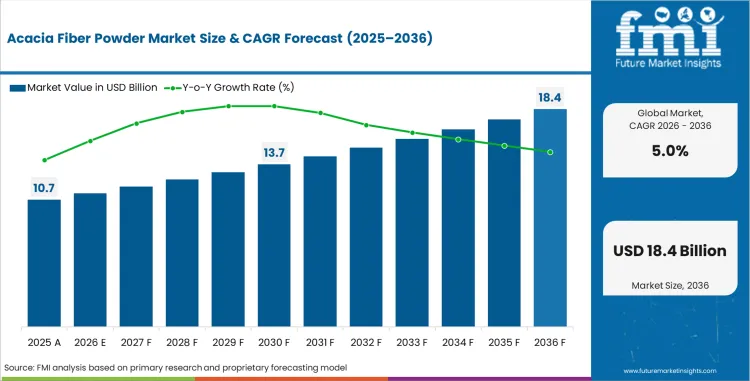
The acacia fiber powder market was worth USD 10.23 billion in 2025 and is expected to be worth USD 10.75 billion in 2026. By 2036, it is expected to grow to USD 17.50 billion at a rate of 5.0% per year. According to Future Market Insights, the market is going to add an extra chance worth USD 6.76 billion. According to FMI, prebiotic fiber fortification, clean-label food formulation, and new pharmaceutical excipients are changing demand.
Summary of Acacia Fiber Powder Market
- By 2036, the market is expected to be worth $17.50 billion.
- From 2026 to 2036, the market is expected to grow at a rate of 5.0% per year.
- In 2025, the market was thought to be worth $10.23 billion.
- The forecast period gives you an extra chance to make $6.76 billion.
- 57.8% of the market is for Organic Acacia Fiber Powder, which shows the demand for clean-label and organic certification.
- Senegal Acacia Fiber Powder makes up 61.4% of the powder type, which shows that there is a lot of demand for high-quality African gum arabic.
- Food and drink make up 33.6% of end use, thanks to functional food and prebiotic fiber fortification.
Acacia Fiber Powder Market key Takeaways
| Parameter | Details |
|---|---|
| Market value (2026) | USD 10.75 billion |
| Forecast value (2036) | USD 17.50 billion |
| CAGR (2026 to 2036) | 5.0% |
| Estimated market value (2025) | USD 10.23 billion |
| Incremental opportunity | USD 6.76 billion |
| Leading nature | Organic Acacia Fiber Powder (57.8%) |
| Leading powder type | Senegal Acacia Fiber Powder (61.4%) |
| Leading end use | Food and Beverage (33.6%) |
| Key players | Nexira, Ingredion Inc., Kerry Group, Gum Arabic Company, Alland |
Source: Future Market Insights, 2026
There are three things that shape the market for acacia fiber powder. First, the need for prebiotic fiber in functional foods and dietary supplements is making gum arabic a popular choice as a natural, clean-label fiber source. Second, pharmaceutical excipient uses for tablet binding and drug delivery are making demand channels that are worth more. Third, the addressable market is growing as more uses are found in candy, dairy, drinks, cosmetics, adhesives, and textiles.
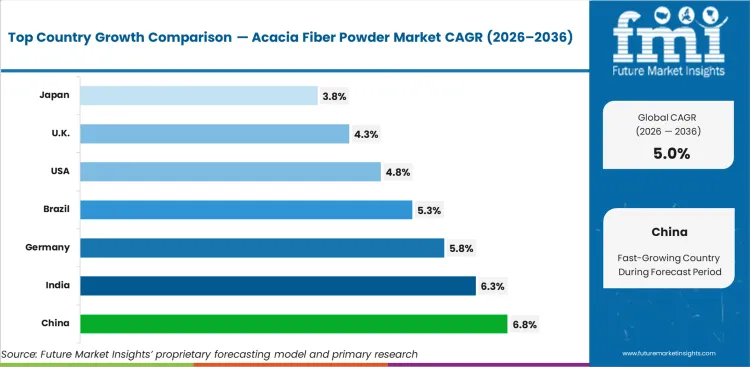
China leads the way with a 6.8% CAGR across all tracked areas. Next is India, which is at 6.3%. Next is Germany with 5.8%. Brazil comes in next with 5.3%. The USA comes next at 4.8%. 4.3% of the UK follows. Japan follows with a 3.8% CAGR.
Acacia Fiber Powder Market Definition
The acacia fiber powder market includes powdered gum arabic from Acacia Senegal and Acacia Seyal trees. It comes in organic and conventional grades and is used as a prebiotic fiber source, food stabilizer, pharmaceutical excipient, cosmetic ingredient, and industrial binder in food, drinks, pharmaceuticals, dietary supplements, cosmetics, adhesives, and textiles.
Acacia Fiber Powder Market Inclusions
The market includes all types of acacia fiber powder that are sold commercially, broken down by type, end use, and distribution. The range of revenue sizes is from 2026 to 2036.
Acacia Fiber Powder Market Exclusions
Does not include unprocessed lumps of raw gum arabic or synthetic fiber additives.
Acacia Fiber Powder Market Research Methodology
- Primary Research: FMI analysts talked to people who buy gum arabic, food ingredient formulators, and pharmaceutical excipient buyers.
- Desk Research: Combined trade data for gum arabic, fiber ingredient statistics, and reports from manufacturers.
- Market sizing and forecasting: adding up all the different uses of food, drugs, supplements, and industrial products from the bottom up.
- Data validation: checked quarterly against gum arabic trade statistics from different sources.
Why is the Acacia Fiber Powder Market Growing?
- The need for prebiotic fiber in functional foods and supplements is what makes gum arabic a popular natural, soluble fiber source that is good for gut health.
- As a natural stabilizer, emulsifier, and texture modifier, acacia fiber is becoming more popular in clean-label foods instead of synthetic additives.
- China is in the lead with a CAGR of 6.8%, which shows that demand for functional foods and pharmaceutical excipients is growing.
The market for acacia fiber powder is growing steadily because of the need for prebiotic fiber, clean-label formulations, and new pharmaceutical excipients. Gum arabic is one of the oldest known natural food additives. Today, it is used in a wide range of industries, including functional food, pharmaceuticals, cosmetics, and industry.
Food and drink applications make up 33.6% of end use, with prebiotic fiber enrichment, stabilization, and sugar reduction applications in dairy, drinks, and candy. Pharmaceutical uses like tablet binding and controlled-release drug delivery make the demand for higher-value goods.
Sourcing concentration in sub-Saharan Africa (mostly Sudan, Chad, and Senegal) makes the supply chain more risky, but it also gives origin-certified products a better chance of being sold at a higher price. More and more people are buying organic and clean-label products.
Segmental Analysis
- 57.8% of Organic Acacia Fiber Powder is made up of certified clean-label fiber ingredients, which shows that both consumers and manufacturers want them.
- Senegal Acacia Fiber Powder makes up 61.4% of the powder type, but high-purity African-origin gum arabic is better for food and drug uses.
- Food and drink make up 33.6% of the end use, with prebiotic enrichment and stabilization being used in processed foods and drinks.
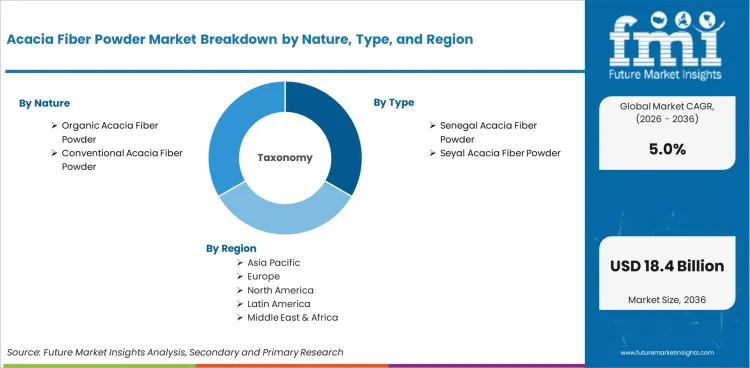
Divided by type of powder (Senegal, Seyal), type of end use (food and drink, candy, dairy, soft drinks, pharmaceuticals, dietary supplements, veterinary, cosmetics, adhesive, textile), and type of distribution (indirect, direct, wholesale, online, supermarkets, specialty).
Insights into the Organic Acacia Fiber Powder Nature Segment
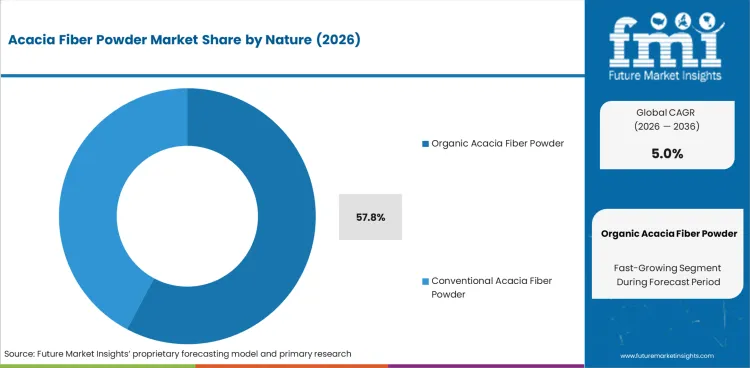
Organic Acacia Fiber Powder has a 57.8% market share because health-conscious consumers and food manufacturers want clean-label and organic certification.
Conventional grade is used in industrial applications that care about price, such as adhesives, textiles, and food processing for the mass market.
Insights into the Food and Beverage End Use Segment
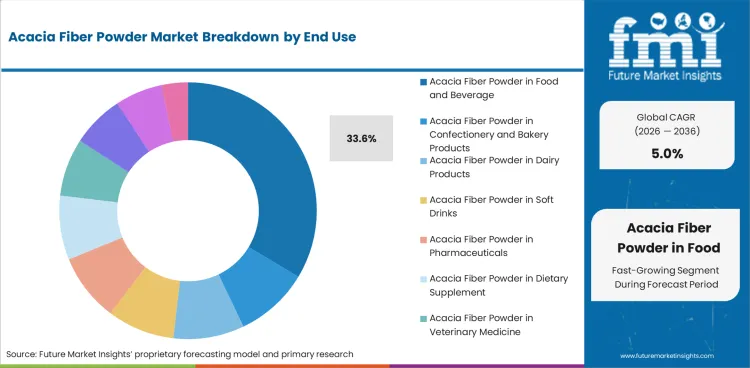
Food and drink make up 33.6% of the end use. Functional food fiber enrichment, beverage stabilization, and dairy texturization create the main demand.
Pharmaceutical uses like tablet binding and controlled-release excipient use create a higher-value secondary demand.
What are the Drivers, Restraints, and Key Trends of the Acacia Fiber Powder Market?
- The main drivers are the need for prebiotic fiber and clean labels.
- The concentration of supply in sub-Saharan Africa makes sourcing risky and prices unstable.
- Applications for pharmaceutical excipients create demand channels with more value.
The market is steadily growing because of trends in gut health, demand for clean labels, and a wider range of uses. Even though there are risks to concentrating supply, there are chances for growth in the food, pharmaceutical, and industrial sectors.
Prebiotic Fiber Demand
People want to improve their gut health and digestion, which is why gum arabic is becoming popular as a natural prebiotic fiber source. Clinical evidence shows that it has bifidogenic properties.
Supply Concentration Risk
The fact that most of the gum arabic comes from Sudan, Chad, and Senegal makes the supply chain weak. Political instability, climate events, and changes in the harvest affect prices and availability.
Clean-Label Food Formulation
For clean-label compliance and consumer transparency, food makers use gum arabic instead of synthetic stabilizers, emulsifiers, and thickeners.
Pharmaceutical Excipient Innovation
Tablet binding, controlled-release drug delivery, and microencapsulation applications create a high demand for pharmaceutical-grade products at high prices.
Analysis of Acacia Fiber Powder Market By Key Countries
.webp "Top Country Growth Comparison Acacia Fiber Powder Market Cagr (2026 2036)")
| Country | CAGR |
|---|---|
| China | 6.8% |
| India | 6.3% |
| Germany | 5.8% |
| Brazil | 5.3% |
| USA | 4.8% |
| UK | 4.3% |
| Japan | 3.8% |
- China is in the lead with a 6.8% CAGR, thanks to the growth of functional foods and the production of drugs.
- India's 6.3% growth rate shows that the food processing and pharmaceutical industries are growing.
- Germany's economy is growing at 5.8% thanks to demand for food and pharmaceutical ingredients that meet EU rules.
- The USA (4.8%) and the UK (4.3%) are both mature markets with steady demand for clean-label products and supplements.
The global market for acacia fiber powder is expected to grow at a rate of 5.0% per year from 2026 to 2036.
Demand Outlook in the United States
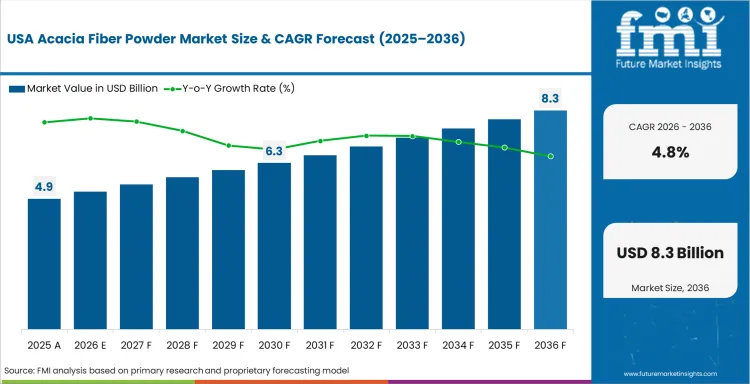
The US economy will grow at 4.8% through 2036, thanks to the demand for clean-label foods and fiber-fortified dietary supplements.
- Clean-label demand is what makes people want to use it.
- The need for fiber supplements is growing.
- The sourcing of pharmaceutical excipients is growing.
Future Outlook in the United Kingdom
The UK will grow by 4.3% a year until 2036, thanks to the rise of functional foods and the need for drugs.
- Trends in functional foods drive demand.
- The pharmaceutical sector keeps buying.
- Supports clean-label positioning.
Opportunity Analysis in Germany
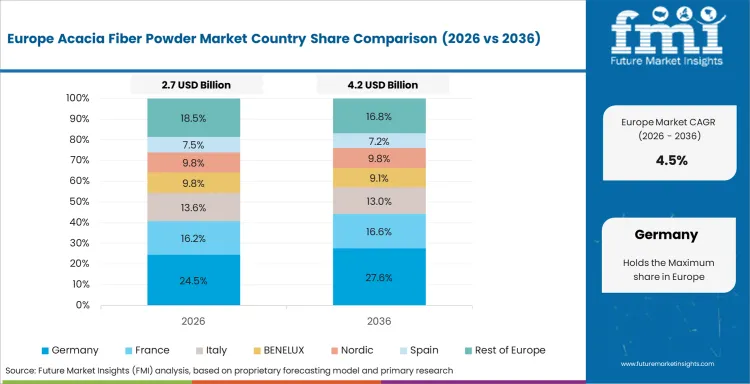
Germany's economy will grow by 5.8% through 2036 because of the demand for food processing and drug manufacturing.
- The food processing industry keeps demand high.
- Excipients are needed to make drugs.
- EU rules shape what specifications are.
In-depth Analysis in Japan
Japan's economy will grow by 3.8% every year until 2036, thanks to new functional foods and the need for pharmaceutical excipients.
- Innovation in functional foods drives demand.
- Pharmaceutical excipients support procurement.
- People who care about their health support growth.
Sales Analysis in China
China is in the lead with 6.8% through 2036, thanks to growing demand for functional food, food processing, and pharmaceutical manufacturing.
- Demand is driven by the growth of food processing.
- People are eating more functional foods.
- Pharmaceutical production continues.
In-depth Analysis in India
India's economy will grow by 6.3% each year until 2036, thanks to more people using dietary supplements, making medicines, and processing food.
- The growth of food processing drives demand.
- The pharmaceutical industry is growing.
- The use of supplements is growing.
Competitive Landscape of Acacia Fiber Powder Market
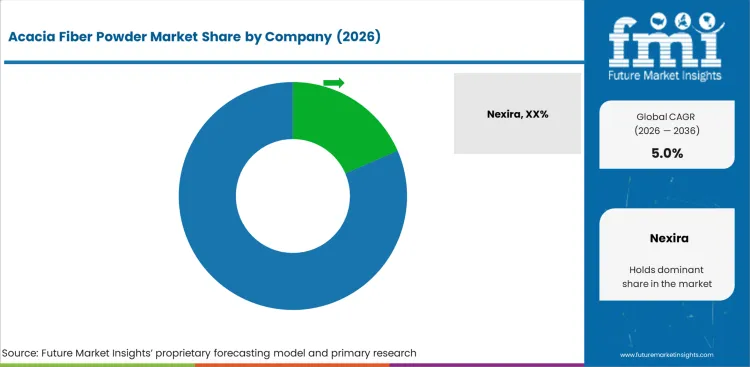
- Nexira is the leader in sourcing and processing gum arabic through vertical integration.
- Kerry Group and Ingredion use different platforms for food ingredients.
- Processors from Africa supply raw materials.
Nexira is in charge of direct sourcing from Africa and shipping around the world. Ingredion Inc. sells a wide range of food ingredients, including gum arabic. Kerry Group sells food and drugs to customers.
Gum Arabic Company sells gum arabic from Africa that has been certified as coming from that region. Alland & Robert sells gum arabic and related ingredients in Europe and Asia.
Some of the problems are getting raw materials from Africa, getting quality certifications, and following the rules for food and drugs.
Major Industry Players
Key global companies leading the acacia fiber powder market include:
- Nexira (France), Ingredion Inc. (USA), Kerry Group (Ireland), and Gum Arabic Company (multiple origins) were named as the best companies.
- Alland (France) and Robert Bosch (Germany) have solidified their positions.
- New gum arabic processors in Africa have set themselves apart by offering origin-certified supply.
Competitive Benchmarking: Acacia Fiber Powder Market
| Company | Gum Arabic Sourcing | Processing Scale | Food Mfr Access | Geographic Footprint |
|---|---|---|---|---|
| Nexira | High | High | Strong | Global |
| Ingredion Inc. | High | High | Strong | Global |
| Kerry Group | Medium | High | Strong | Global |
| Gum Arabic Company | High | Medium | Moderate | Global |
| Alland | High | Medium | Moderate | Europe |
| Robert Bosch | Medium | Medium | Moderate | Asia, Europe |
Source: Future Market Insights competitive analysis, 2026.
Key Developments in Acacia Fiber Powder Market
- In November 2025, Nexira launched Fair For Life certification for selected organic and conventional acacia gum references (including inavea™ and Fibregum™), reinforcing full-chain traceability, ethical sourcing, and clean-label appeal for food makers.
.
- Ingredion (via TIC Gums) continues to offer established acacia gum products positioned as prebiotic soluble fibers for functional foods, beverages, and dietary supplements; no new dedicated prebiotic fiber line from acacia gum was launched in 2025
Key Players in the Acacia Fiber Powder Market:
Major Global Players:
- Nexira
- Ingredion Inc.
- Kerry Group
- Gum Arabic Company
- Alland
- Robert Bosch
Emerging Players/Startups
- Emerging African gum arabic processors
Scope of the report
| Parameter | Details |
|---|---|
| Quantitative Units | USD 10.75 billion to USD 17.50 billion, at a CAGR of 5.0% |
| Market Definition | Encompasses powdered gum arabic from Acacia trees for food, pharma, cosmetic, and industrial applications. |
| Regions Covered | North America, Latin America, Europe, East Asia, South Asia and Pacific, Middle East and Africa |
| Countries Covered | China, India, Germany, Brazil, USA, UK, Japan, 30 plus countries |
| Key Companies Profiled | Nexira, Ingredion Inc., Kerry Group, Gum Arabic Company, and Alland & Robert. |
| Forecast Period | 2026 to 2036 |
| Approach | Hybrid bottom-up and top-down methodology. |
Acacia Fiber Powder Market by Segments
Acacia Fiber Powder Market Market Segmented by Nature:
- Organic Acacia Fiber Powder
- Conventional Acacia Fiber Powder
Acacia Fiber Powder Market Market Segmented by Type:
- Senegal Acacia Fiber Powder
- Seyal Acacia Fiber Powder
Acacia Fiber Powder Market Market Segmented by End Use:
- Acacia Fiber Powder in Food and Beverage
- Acacia Fiber Powder in Confectionery and Bakery Products
- Acacia Fiber Powder in Dairy Products
- Acacia Fiber Powder in Soft Drinks
- Acacia Fiber Powder in Pharmaceuticals
- Acacia Fiber Powder in Dietary Supplement
- Acacia Fiber Powder in Veterinary Medicine
- Acacia Fiber Powder in Cosmetic
- Acacia Fiber Powder in Adhesive
- Acacia Fiber Powder in Textile
Acacia Fiber Powder Market Market Segmented by Distribution:
- Indirect Acacia Fiber Powder Sales
- Direct Acacia Fiber Powder Sales
- Wholesale Acacia Fiber Powder Sales
- Acacia Fiber Powder Sales via Online Retailers
- Acacia Fiber Powder Sales via Supermarkets
- Acacia Fiber Powder Sales via Specialty Stores
Acacia Fiber Powder Market Market by Region:
- North America
- USA
- Canada
- Mexico
- Latin America
- Brazil
- Chile
- Rest of Latin America
- Western Europe
- Germany
- UK
- Italy
- Spain
- France
- Nordic
- BENELUX
- Rest of Western Europe
- Eastern Europe
- Russia
- Poland
- Hungary
- Balkan & Baltic
- Rest of Eastern Europe
- East Asia
- China
- Japan
- South Korea
- South Asia and Pacific
- India
- ASEAN
- Australia & New Zealand
- Rest of South Asia and Pacific
- Middle East & Africa
- Kingdom of Saudi Arabia
- Other GCC Countries
- Turkiye
- South Africa
- Other African Union
- Rest of Middle East & Africa
Bibliography
- 1. Food and Agriculture Organization. (2025). FAO Gum Arabic Production and Trade Report. FAO.
- 2. European Food Safety Authority. (2024). EFSA Assessment of Gum Arabic as Food Additive. EFSA.
- 3. USA Pharmacopeia. (2024). USP Monograph: Acacia (Gum Arabic). USP.
- 4. Codex Alimentarius. (2024). Codex Standard for Gum Arabic. FAO/WHO.
- 5. International Tree Gum and Resin Association. (2025). Market Report on Natural Gums. ITGRA.
This bibliography is provided for reader reference.
Frequently Asked Questions
What is the global market demand for Acacia Fiber Powder in 2026?
In 2026, the global market for acacia fiber powder is expected to be worth $10.75 billion.
How big will the market for Acacia Fiber Powder be in 2036?
By 2036, the market for acacia fiber powder is expected to be worth USD 17.50 billion.
How much do you think demand for Acacia Fiber Powder will grow between 2026 and 2036?
Between 2026 and 2036, the demand for acacia fiber powder is expected to grow at a CAGR of 5.0%.
Which Nature segment is likely to be the best seller in the world by 2026?
Organic Acacia Fiber Powder will make up 57.8% of the market in 2026. This shows that consumers and manufacturers prefer organically certified fiber ingredients for clean-label food and supplement products.
How is the use of Acacia Fiber Powder in food and drink driving its adoption?
Food and drink account for 33.6% of end-use demand because acacia fiber powder serves as a natural prebiotic and soluble fiber ingredient in functional food and beverage formulations.
What is causing demand to rise in China?
China's economy will grow at a rate of 6.8% per year through 2036, thanks to the growth of functional food and pharmaceutical applications and increasing consumer health awareness.
What does this report mean by "Acacia Fiber Powder Market definition"?
The acacia fiber powder market includes powdered gum arabic products processed for use in food, medicine, cosmetics, and industrial applications as a natural fiber and stabilizing agent.
How does FMI make the Acacia Fiber Powder forecast and check it?
Forecasting models use a mix of bottom-up and top-down methods, starting with verified transaction data and checking it against functional ingredient market statistics and manufacturer disclosures.
Preview the report firsthand - request a free sample
Get SampleGet the brochure for pricing and purchase details.
Get PDFTable of Content
- Executive Summary
- Global Market Outlook
- Demand-side Trends
- Supply-side Trends
- Technology Roadmap Analysis
- Analysis and Recommendations
- Market Overview
- Market Coverage / Taxonomy
- Market Definition / Scope / Limitations
- Research Methodology
- Chapter Orientation
- Analytical Lens and Working Hypotheses
- Market Structure, Signals, and Trend Drivers
- Benchmarking and Cross-market Comparability
- Market Sizing, Forecasting, and Opportunity Mapping
- Research Design and Evidence Framework
- Desk Research Programme (Secondary Evidence)
- Company Annual and Sustainability Reports
- Peer-reviewed Journals and Academic Literature
- Corporate Websites, Product Literature, and Technical Notes
- Earnings Decks and Investor Briefings
- Statutory Filings and Regulatory Disclosures
- Technical White Papers and Standards Notes
- Trade Journals, Industry Magazines, and Analyst Briefs
- Conference Proceedings, Webinars, and Seminar Materials
- Government Statistics Portals and Public Data Releases
- Press Releases and Reputable Media Coverage
- Specialist Newsletters and Curated Briefings
- Sector Databases and Reference Repositories
- FMI Internal Proprietary Databases and Historical Market Datasets
- Subscription Datasets and Paid Sources
- Social Channels, Communities, and Digital Listening Inputs
- Additional Desk Sources
- Expert Input and Fieldwork (Primary Evidence)
- Primary Modes
- Qualitative Interviews and Expert Elicitation
- Quantitative Surveys and Structured Data Capture
- Blended Approach
- Why Primary Evidence is Used
- Field Techniques
- Interviews
- Surveys
- Focus Groups
- Observational and In-context Research
- Social and Community Interactions
- Stakeholder Universe Engaged
- C-suite Leaders
- Board Members
- Presidents and Vice Presidents
- R&D and Innovation Heads
- Technical Specialists
- Domain Subject-matter Experts
- Scientists
- Physicians and Other Healthcare Professionals
- Governance, Ethics, and Data Stewardship
- Research Ethics
- Data Integrity and Handling
- Primary Modes
- Tooling, Models, and Reference Databases
- Desk Research Programme (Secondary Evidence)
- Data Engineering and Model Build
- Data Acquisition and Ingestion
- Cleaning, Normalisation, and Verification
- Synthesis, Triangulation, and Analysis
- Quality Assurance and Audit Trail
- Market Background
- Market Dynamics
- Drivers
- Restraints
- Opportunity
- Trends
- Scenario Forecast
- Demand in Optimistic Scenario
- Demand in Likely Scenario
- Demand in Conservative Scenario
- Opportunity Map Analysis
- Product Life Cycle Analysis
- Supply Chain Analysis
- Investment Feasibility Matrix
- Value Chain Analysis
- PESTLE and Porter’s Analysis
- Regulatory Landscape
- Regional Parent Market Outlook
- Production and Consumption Statistics
- Import and Export Statistics
- Market Dynamics
- Global Market Analysis 2021 to 2025 and Forecast, 2026 to 2036
- Historical Market Size Value (USD Million) Analysis, 2021 to 2025
- Current and Future Market Size Value (USD Million) Projections, 2026 to 2036
- Y-o-Y Growth Trend Analysis
- Absolute $ Opportunity Analysis
- Global Market Pricing Analysis 2021 to 2025 and Forecast 2026 to 2036
- Global Market Analysis 2021 to 2025 and Forecast 2026 to 2036, By Nature
- Introduction / Key Findings
- Historical Market Size Value (USD Million) Analysis By Nature , 2021 to 2025
- Current and Future Market Size Value (USD Million) Analysis and Forecast By Nature , 2026 to 2036
- Organic Acacia Fiber Powder
- Conventional Acacia Fiber Powder
- Organic Acacia Fiber Powder
- Y-o-Y Growth Trend Analysis By Nature , 2021 to 2025
- Absolute $ Opportunity Analysis By Nature , 2026 to 2036
- Global Market Analysis 2021 to 2025 and Forecast 2026 to 2036, By Type
- Introduction / Key Findings
- Historical Market Size Value (USD Million) Analysis By Type, 2021 to 2025
- Current and Future Market Size Value (USD Million) Analysis and Forecast By Type, 2026 to 2036
- Senegal Acacia Fiber Powder
- Seyal Acacia Fiber Powder
- Senegal Acacia Fiber Powder
- Y-o-Y Growth Trend Analysis By Type, 2021 to 2025
- Absolute $ Opportunity Analysis By Type, 2026 to 2036
- Global Market Analysis 2021 to 2025 and Forecast 2026 to 2036, By End Use
- Introduction / Key Findings
- Historical Market Size Value (USD Million) Analysis By End Use, 2021 to 2025
- Current and Future Market Size Value (USD Million) Analysis and Forecast By End Use, 2026 to 2036
- Acacia Fiber Powder in Food and Beverage
- Acacia Fiber Powder in Confectionery and Bakery Products
- Acacia Fiber Powder in Dairy Products
- Acacia Fiber Powder in Soft Drinks
- Acacia Fiber Powder in Pharmaceuticals
- Acacia Fiber Powder in Dietary Supplement
- Acacia Fiber Powder in Veterinary Medicine
- Acacia Fiber Powder in Cosmetic
- Acacia Fiber Powder in Adhesive
- Acacia Fiber Powder in Textile
- Acacia Fiber Powder in Food and Beverage
- Y-o-Y Growth Trend Analysis By End Use, 2021 to 2025
- Absolute $ Opportunity Analysis By End Use, 2026 to 2036
- Global Market Analysis 2021 to 2025 and Forecast 2026 to 2036, By Distribution
- Introduction / Key Findings
- Historical Market Size Value (USD Million) Analysis By Distribution, 2021 to 2025
- Current and Future Market Size Value (USD Million) Analysis and Forecast By Distribution, 2026 to 2036
- Indirect Acacia Fiber Powder Sales
- Direct Acacia Fiber Powder Sales
- Wholesale Acacia Fiber Powder Sales
- Acacia Fiber Powder Sales via Online Retailers
- Acacia Fiber Powder Sales via Supermarkets
- Acacia Fiber Powder Sales via Specialty Stores
- Indirect Acacia Fiber Powder Sales
- Y-o-Y Growth Trend Analysis By Distribution, 2021 to 2025
- Absolute $ Opportunity Analysis By Distribution, 2026 to 2036
- Global Market Analysis 2021 to 2025 and Forecast 2026 to 2036, By Region
- Introduction
- Historical Market Size Value (USD Million) Analysis By Region, 2021 to 2025
- Current Market Size Value (USD Million) Analysis and Forecast By Region, 2026 to 2036
- North America
- Latin America
- Western Europe
- Eastern Europe
- East Asia
- South Asia and Pacific
- Middle East & Africa
- Market Attractiveness Analysis By Region
- North America Market Analysis 2021 to 2025 and Forecast 2026 to 2036, By Country
- Historical Market Size Value (USD Million) Trend Analysis By Market Taxonomy, 2021 to 2025
- Market Size Value (USD Million) Forecast By Market Taxonomy, 2026 to 2036
- By Country
- USA
- Canada
- Mexico
- By Nature
- By Type
- By End Use
- By Distribution
- By Country
- Market Attractiveness Analysis
- By Country
- By Nature
- By Type
- By End Use
- By Distribution
- Key Takeaways
- Latin America Market Analysis 2021 to 2025 and Forecast 2026 to 2036, By Country
- Historical Market Size Value (USD Million) Trend Analysis By Market Taxonomy, 2021 to 2025
- Market Size Value (USD Million) Forecast By Market Taxonomy, 2026 to 2036
- By Country
- Brazil
- Chile
- Rest of Latin America
- By Nature
- By Type
- By End Use
- By Distribution
- By Country
- Market Attractiveness Analysis
- By Country
- By Nature
- By Type
- By End Use
- By Distribution
- Key Takeaways
- Western Europe Market Analysis 2021 to 2025 and Forecast 2026 to 2036, By Country
- Historical Market Size Value (USD Million) Trend Analysis By Market Taxonomy, 2021 to 2025
- Market Size Value (USD Million) Forecast By Market Taxonomy, 2026 to 2036
- By Country
- Germany
- UK
- Italy
- Spain
- France
- Nordic
- BENELUX
- Rest of Western Europe
- By Nature
- By Type
- By End Use
- By Distribution
- By Country
- Market Attractiveness Analysis
- By Country
- By Nature
- By Type
- By End Use
- By Distribution
- Key Takeaways
- Eastern Europe Market Analysis 2021 to 2025 and Forecast 2026 to 2036, By Country
- Historical Market Size Value (USD Million) Trend Analysis By Market Taxonomy, 2021 to 2025
- Market Size Value (USD Million) Forecast By Market Taxonomy, 2026 to 2036
- By Country
- Russia
- Poland
- Hungary
- Balkan & Baltic
- Rest of Eastern Europe
- By Nature
- By Type
- By End Use
- By Distribution
- By Country
- Market Attractiveness Analysis
- By Country
- By Nature
- By Type
- By End Use
- By Distribution
- Key Takeaways
- East Asia Market Analysis 2021 to 2025 and Forecast 2026 to 2036, By Country
- Historical Market Size Value (USD Million) Trend Analysis By Market Taxonomy, 2021 to 2025
- Market Size Value (USD Million) Forecast By Market Taxonomy, 2026 to 2036
- By Country
- China
- Japan
- South Korea
- By Nature
- By Type
- By End Use
- By Distribution
- By Country
- Market Attractiveness Analysis
- By Country
- By Nature
- By Type
- By End Use
- By Distribution
- Key Takeaways
- South Asia and Pacific Market Analysis 2021 to 2025 and Forecast 2026 to 2036, By Country
- Historical Market Size Value (USD Million) Trend Analysis By Market Taxonomy, 2021 to 2025
- Market Size Value (USD Million) Forecast By Market Taxonomy, 2026 to 2036
- By Country
- India
- ASEAN
- Australia & New Zealand
- Rest of South Asia and Pacific
- By Nature
- By Type
- By End Use
- By Distribution
- By Country
- Market Attractiveness Analysis
- By Country
- By Nature
- By Type
- By End Use
- By Distribution
- Key Takeaways
- Middle East & Africa Market Analysis 2021 to 2025 and Forecast 2026 to 2036, By Country
- Historical Market Size Value (USD Million) Trend Analysis By Market Taxonomy, 2021 to 2025
- Market Size Value (USD Million) Forecast By Market Taxonomy, 2026 to 2036
- By Country
- Kingdom of Saudi Arabia
- Other GCC Countries
- Turkiye
- South Africa
- Other African Union
- Rest of Middle East & Africa
- By Nature
- By Type
- By End Use
- By Distribution
- By Country
- Market Attractiveness Analysis
- By Country
- By Nature
- By Type
- By End Use
- By Distribution
- Key Takeaways
- Key Countries Market Analysis
- USA
- Pricing Analysis
- Market Share Analysis, 2025
- By Nature
- By Type
- By End Use
- By Distribution
- Canada
- Pricing Analysis
- Market Share Analysis, 2025
- By Nature
- By Type
- By End Use
- By Distribution
- Mexico
- Pricing Analysis
- Market Share Analysis, 2025
- By Nature
- By Type
- By End Use
- By Distribution
- Brazil
- Pricing Analysis
- Market Share Analysis, 2025
- By Nature
- By Type
- By End Use
- By Distribution
- Chile
- Pricing Analysis
- Market Share Analysis, 2025
- By Nature
- By Type
- By End Use
- By Distribution
- Germany
- Pricing Analysis
- Market Share Analysis, 2025
- By Nature
- By Type
- By End Use
- By Distribution
- UK
- Pricing Analysis
- Market Share Analysis, 2025
- By Nature
- By Type
- By End Use
- By Distribution
- Italy
- Pricing Analysis
- Market Share Analysis, 2025
- By Nature
- By Type
- By End Use
- By Distribution
- Spain
- Pricing Analysis
- Market Share Analysis, 2025
- By Nature
- By Type
- By End Use
- By Distribution
- France
- Pricing Analysis
- Market Share Analysis, 2025
- By Nature
- By Type
- By End Use
- By Distribution
- India
- Pricing Analysis
- Market Share Analysis, 2025
- By Nature
- By Type
- By End Use
- By Distribution
- ASEAN
- Pricing Analysis
- Market Share Analysis, 2025
- By Nature
- By Type
- By End Use
- By Distribution
- Australia & New Zealand
- Pricing Analysis
- Market Share Analysis, 2025
- By Nature
- By Type
- By End Use
- By Distribution
- China
- Pricing Analysis
- Market Share Analysis, 2025
- By Nature
- By Type
- By End Use
- By Distribution
- Japan
- Pricing Analysis
- Market Share Analysis, 2025
- By Nature
- By Type
- By End Use
- By Distribution
- South Korea
- Pricing Analysis
- Market Share Analysis, 2025
- By Nature
- By Type
- By End Use
- By Distribution
- Russia
- Pricing Analysis
- Market Share Analysis, 2025
- By Nature
- By Type
- By End Use
- By Distribution
- Poland
- Pricing Analysis
- Market Share Analysis, 2025
- By Nature
- By Type
- By End Use
- By Distribution
- Hungary
- Pricing Analysis
- Market Share Analysis, 2025
- By Nature
- By Type
- By End Use
- By Distribution
- Kingdom of Saudi Arabia
- Pricing Analysis
- Market Share Analysis, 2025
- By Nature
- By Type
- By End Use
- By Distribution
- Turkiye
- Pricing Analysis
- Market Share Analysis, 2025
- By Nature
- By Type
- By End Use
- By Distribution
- South Africa
- Pricing Analysis
- Market Share Analysis, 2025
- By Nature
- By Type
- By End Use
- By Distribution
- USA
- Market Structure Analysis
- Competition Dashboard
- Competition Benchmarking
- Market Share Analysis of Top Players
- By Regional
- By Nature
- By Type
- By End Use
- By Distribution
- Competition Analysis
- Competition Deep Dive
- Nexira
- Overview
- Product Portfolio
- Profitability by Market Segments (Product/Age /Sales Channel/Region)
- Sales Footprint
- Strategy Overview
- Marketing Strategy
- Product Strategy
- Channel Strategy
- Ingredion Inc.
- Kerry Group
- Gum Arabic Company
- Alland
- Robert Bosch
- Nexira
- Competition Deep Dive
- Assumptions & Acronyms Used


