

- Market Size (2026)
- USD 879.3 Mn
- Forecast (2036)
- USD 2100.8 Mn
- CAGR (2026 to 2036)
- 9.1%
How big is the advanced driver monitoring camera modules market in 2026?
USD 879.3 million in 2026 and USD 2,100.8 million by 2036 at a 9.1% CAGR.
The advanced driver monitoring camera modules industry value is forecast to grow from USD 806.0 million in 2025 to USD 2,100.8 million by 2036 at 9.1% CAGR as driver attention sensing shifts from optional cockpit electronics into regulated safety content. OEM sales channels are projected to represent 76.0% share in 2026 because factory validation, warranty control, and type approval timing shape module sourcing. Passenger cars are expected to secure 63.0% share in 2026, led by high-volume platforms adding gaze tracking, drowsiness detection, and in-cabin safety sensing.
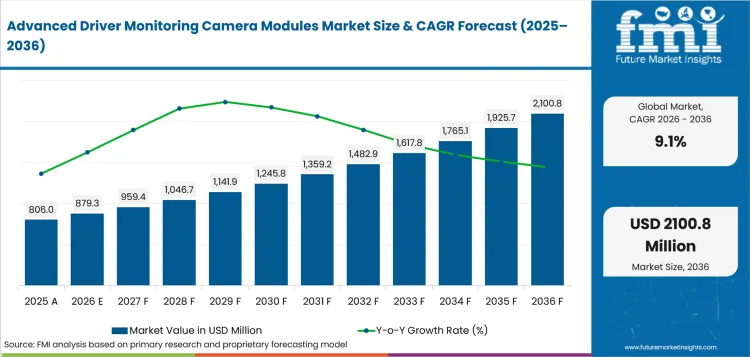
Advanced Driver Monitoring Camera Modules Market Overview: Size and Forecast
- 2026 Market Size: USD 879.3 million
- 2036 Market Size: USD 2,100.8 million
- Forecast CAGR: 9.1% from 2026 to 2036
- Leading Sales Channel: OEM
- OEM Share in 2026: 76.0%
- Leading Vehicle Type: Passenger Car
- Passenger Car Share in 2026: 63.0%
- Fastest-growing Country: China
- China CAGR: 10.2% by 2036
Summary of the Advanced Driver Monitoring Camera Modules MarketDemand and Growth Drivers
- Demand and Growth Drivers
- Camera-based driver state sensing is moving into vehicle programs as regulators and safety rating bodies give more weight to drowsiness and distraction monitoring.
- Assisted-driving systems are increasing demand for gaze tracking because steering-wheel contact alone cannot confirm driver attention.
- Electric vehicle cockpit programs are supporting richer in-cabin electronics, centralized compute, and software-updatable driver monitoring features.
- Product and Segment View
- OEM sales channels are forecast to represent 76.0% share in 2026, led by factory validation requirements and platform-level safety integration.
- Passenger cars are projected to hold 63.0% share in 2026, supported by high-volume vehicle launches and wider cabin-sensing adoption.
- Battery electric platforms are expected to secure 41.0% share in 2026, influenced by smart cockpit design and higher software content.
- Geography and Competitive Outlook
- China is projected to record 10.2% CAGR by 2036, backed by smart EV programs and fast cabin-technology adoption.
- India is expected to expand at 9.6% CAGR by 2036 through premium vehicle demand and fleet retrofit interest.
- Bosch, Denso, Continental, Magna, and Valeo compete through camera systems and cockpit integration depth.
- Mobileye, Seeing Machines, Smart Eye, and Cipia influence software buying decisions when gaze algorithms shape module performance.
- Analyst Opinion
- Nikhil Kaitwade, Principal Consultant for Automotive at FMI, observes, “Advanced driver monitoring camera modules are becoming a platform-level safety decision rather than a simple camera purchase. OEMs now need systems that recognize gaze direction, eyelid movement, head pose, and driver readiness under real cabin lighting. Suppliers with optics, near-infrared lighting, embedded perception software, and validation evidence should gain stronger sourcing positions. The next competitive step will come from modules that combine driver monitoring and occupant monitoring without adding visible cockpit hardware.”
Market outlook is being shaped by regulated cabin safety, electrified cockpit programs, and broader vehicle production recovery. IEA reported in 2026 that electric car sales exceeded 20 million units in 2025 and reached 25% of all new car sales. OICA stated in April 2026 that global vehicle production increased from 92.7 million units in 2024 to 96.4 million units in 2025. Euro NCAP’s 2025 safe-driving protocol places occupant monitoring within the rating framework, creating a more visible benchmark for camera-based driver and occupant monitoring modules.
The advanced driver monitoring camera modules market is expected to witness steady expansion through 2036, driven by regulatory pressure, assisted-driving supervision, and digital cockpit integration. Market expansion is further supported by OEM preference for camera modules that combine optics, near-infrared illumination, embedded software, and automotive-grade validation.
Which factors support expansion in the advanced driver monitoring camera modules market?
Finished in-cabin camera module revenue and validated driver-state sensing support market value across regulated vehicle programs.
- Market value is supported by camera modules sold into OEM platforms before aftermarket fleet retrofit adds incremental revenue.
- Supplier pricing reflects image sensors, near-infrared emitters, connectors, embedded software, and thermal design before cockpit integration affects margins.
- Revenue improves as vehicle makers convert driver monitoring from a premium safety feature into a launch-timing requirement.
- Buyer confidence rises as modules provide validated outputs for gaze tracking, drowsiness detection, distraction warnings, and driver handover readiness.
Why is the advanced driver monitoring camera modules market growing?
Driver monitoring demand is increasing as safety systems move from road-facing collision avoidance toward cabin supervision and driver readiness checks. NHTSA reported in April 2026 that distraction-affected crashes in 2024 caused 3,208 deaths in the United States, giving OEMs and fleet operators a measurable safety case for attention monitoring.
IIHS reported in March 2024 that only one of 14 partial automation systems earned an acceptable safeguard rating, which shows why automakers need stronger driver engagement checks. Mobileye announced in March 2026 that a leading USA automaker will integrate Mobileye DMS into future EyeQ6L-equipped vehicles, with start of production targeted for 2027.
How is the advanced driver monitoring camera modules market segmented?
The advanced driver monitoring camera modules industry is segmented by sales channel, vehicle type, propulsion, region, and component type.
- OEM is forecast to represent 76.0% share in 2026, guided by factory validation, warranty accountability, and safety-system integration across vehicle platforms.
- Passenger car is projected to account for 63.0% share in 2026, supported by high-volume platform deployment and stronger fitment economics across premium and mass-market models.
- Battery electric is expected to capture 41.0% share in 2026, led by smart cockpit programs that combine camera sensing with centralized compute and software updates.
- East Asia is anticipated to hold 37.5% share in 2026, shaped by China, Japan, and South Korea linking cabin sensing with EV and smart cockpit programs.
- Module is projected to secure 34.5% share in 2026, supported by OEM preference for supplier-qualified assemblies rather than separate image sensors and software blocks.
Which sales channel leads the advanced driver monitoring camera modules market?
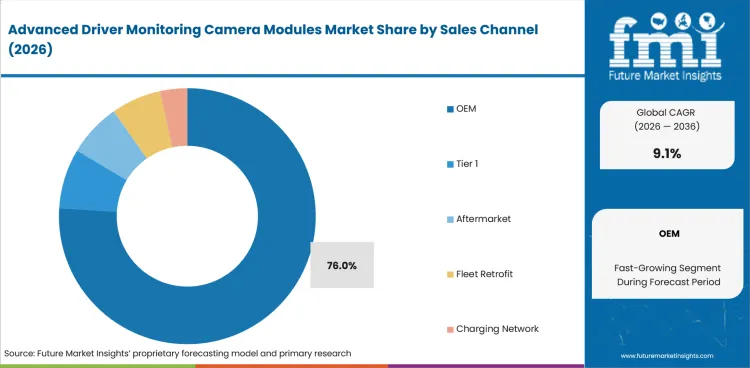
- OEM is forecast to account for 76.0% share in 2026, influenced by type approval requirements, vehicle warranty control, and integrated safety validation before launch.
- Fleet retrofit gains importance in heavy trucks and buses, although retrofit units face calibration challenges and stronger driver-acceptance hurdles compared with embedded factory modules.
Which vehicle type leads the advanced driver monitoring camera modules market?
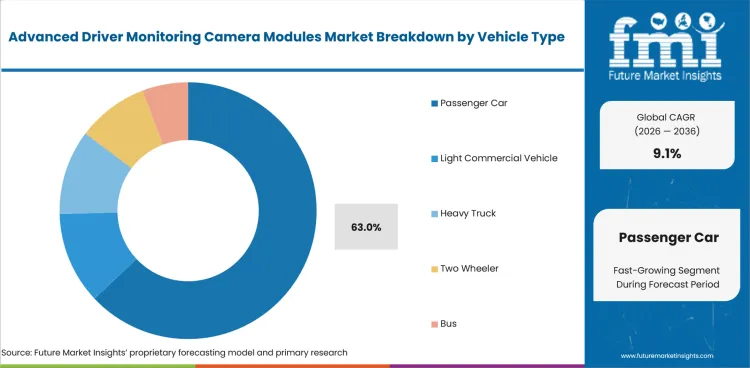
- Passenger car is expected to hold 63.0% share in 2026, reflected by high production scale and faster adoption of interior camera modules across premium and upper-mass platforms.
- Heavy trucks and buses build a smaller but valuable demand pool as commercial fleets evaluate fatigue alerts, distraction detection, and incident-risk reduction tools.
Which propulsion segment leads the advanced driver monitoring camera modules market?
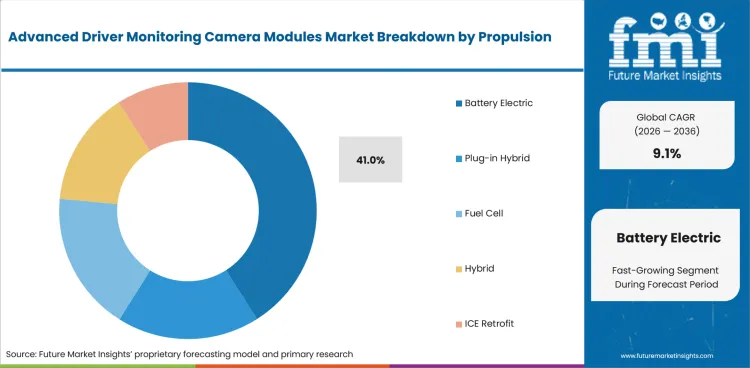
- Battery electric is anticipated to represent 41.0% share in 2026, supported by digital cabins, centralized electronics, and stronger acceptance of software-defined safety features.
- Hybrid and plug-in hybrid platforms create added demand as OEMs use shared cockpit electronics across electrified vehicle families and export programs.
Which regional segment leads the advanced driver monitoring camera modules market?
- East Asia is projected to hold 37.5% share in 2026, driven by China’s smart EV programs, Japan’s reliability-led safety systems, and South Korea’s export-oriented vehicle platforms.
- Europe remains highly influential because safety regulation and rating protocols shape how global OEMs specify driver monitoring functions for new models.
Which component type leads the advanced driver monitoring camera modules market?
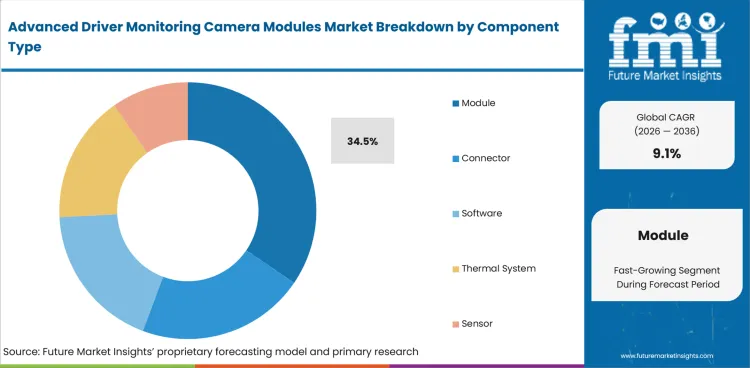
- Module is expected to account for 34.5% share in 2026, led by integrated optics, infrared illumination, connectors, embedded processing, and supplier-qualified assemblies.
- Software demand gains strategic value as gaze algorithms, driver-state interpretation, and occupant monitoring features define the performance difference between competing module suppliers.
What are the driver, restraints, and opportunities in the advanced driver monitoring camera modules market?
Regulation and assisted-driving needs support demand while cockpit packaging, privacy expectations, and validation complexity limit faster adoption.
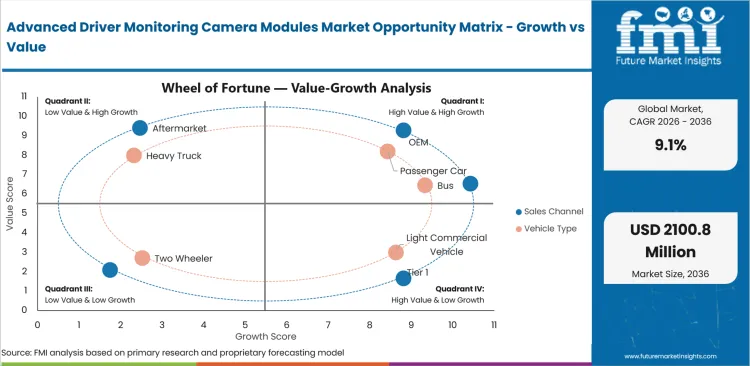
- Driver: Safety regulation is moving driver attention and distraction sensing into new vehicle design programs.
- Restraint: Cockpit packaging and privacy concerns can slow always-on interior camera acceptance.
- Opportunity: Driver and occupant monitoring convergence can create higher-value modules for software-defined vehicle platforms.
Advanced Driver Monitoring Camera Modules Market Demand Outlook
Demand outlook is strengthening as vehicle safety rules require more direct evidence of driver attention and readiness. The European Commission stated that the General Safety Regulation rules apply from 7 July 2024 for all new cars sold in the European Union, including attention warning for driver drowsiness and advanced driver distraction warning. This changes procurement because OEMs must compare camera placement, gaze accuracy, warning timing, and validation support before awarding programs. Suppliers with qualified modules can therefore move from component sales into platform-level safety content.
Camera Placement and Validation Restraint Analysis
Validation remains a restraint because in-cabin camera modules must work across lighting, seating position, sunglasses, reflections, and driver variation. IIHS reported in August 2025 that 87% of surveyed Subaru DriverFocus owners drove with the system on most or every time, while 97% of users had received at least one distraction alert in the previous 30 days. This shows user familiarity can build, yet false-positive perception and alert quality still affect acceptance. Module suppliers must therefore reduce nuisance alerts before fleet and consumer trust can scale.
Software-defined Vehicle Opportunity Analysis
Opportunity is expanding as driver monitoring, occupant monitoring, and assisted-driving context begin to share compute. IEA reported that around 1,000 electric car models were available globally in 2025, and around 150 new electric models were announced for release in 2026. These model cycles create openings for camera modules that support over-the-air updates, occupant safety functions, and driver engagement checks through shared cockpit electronics.
Which countries are growing fastest in the advanced driver monitoring camera modules market?
United States 9.4% CAGR, United Kingdom 8.2% CAGR, Germany 8.8% CAGR, France 8.4% CAGR, Japan 8.1% CAGR, China 10.2% CAGR, South Korea 9.0% CAGR, and India 9.6% CAGR through 2036.
.webp "Top Country Growth Comparison Advanced Driver Monitoring Camera Modules Market Cagr (2026 2036)")
| Country | CAGR |
|---|---|
| United States | 9.4% |
| United Kingdom | 8.2% |
| Germany | 8.8% |
| France | 8.4% |
| Japan | 8.1% |
| China | 10.2% |
| South Korea | 9.0% |
| India | 9.6% |
Source: Future Market Insights, 2026.
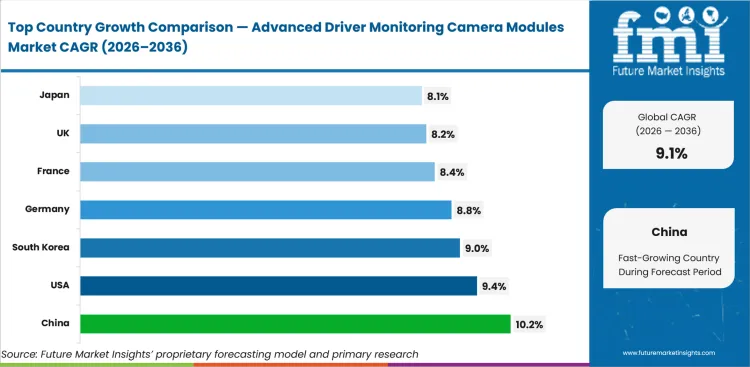
How do country-level CAGRs compare in the advanced driver monitoring camera modules market?
China leads country growth while Japan records the most measured expansion outlook among profiled markets.
- United States is expected to expand at 9.4% CAGR from 2026 to 2036 as assisted-driving supervision and fleet safety programs widen.
- United Kingdom is projected to grow at 8.2% CAGR through 2036 as fleet telematics and European-aligned safety expectations shape demand.
- Germany is forecast to record 8.8% CAGR by 2036 as EU rules and premium cockpit integration guide sourcing.
- France is expected to advance at 8.4% CAGR over the forecast period as perception software partnerships support regulated cabin sensing.
- Japan is forecast to grow at 8.1% CAGR through 2036 as reliability-led OEM programs add camera-based driver status monitoring.
- China is projected to post 10.2% CAGR by 2036 as smart EV and cockpit programs adopt driver and occupant monitoring at scale.
- South Korea is estimated to rise at 9.0% CAGR by 2036 with export-oriented vehicle programs adding regulated cabin safety content.
- India is expected to expand at 9.6% CAGR through 2036 through premium vehicle demand and fleet retrofit interest.
What is the advanced driver monitoring camera modules market outlook in the United States?
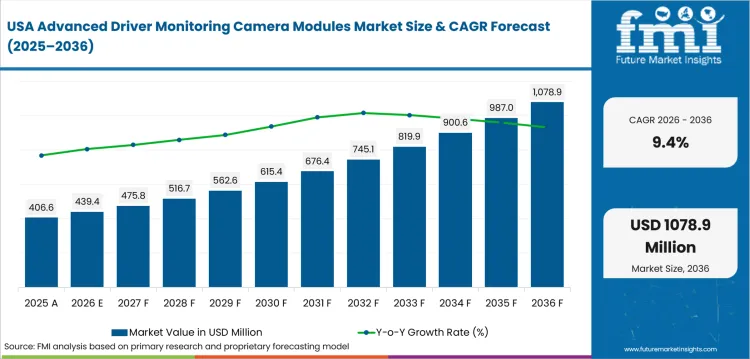
A 9.4% CAGR through 2036 is supported by assisted-driving supervision, distracted-driving risk, and fleet safety programs.
Country Market Snapshot Table
| Parameter | Value |
|---|---|
| Market Size in 2025 (Value) | USD 165.0 million |
| Market Size in 2026 (Value) | USD 180.0 million |
| Market Forecast in 2036 (Value) | USD 442.0 million |
| CAGR (2026 to 2036) | 9.4% |
| Years Considered | 2021 to 2036 |
| Base Year | 2025 |
| Forecast Period | 2026 to 2036 |
| Units Considered | Value (USD million) |
| Leading Sub-Region | Michigan, California, and Sun Belt vehicle technology corridors |
United States Advanced Driver Monitoring Camera Modules Market Outlook
- United States demand is shaped by assisted-driving supervision and liability concerns. OEMs need driver engagement checks as hands-free highway systems expand across premium and mass-market platforms.
- Fleet buyers also evaluate monitoring systems for commercial vans, long-haul trucks, and risk-managed operations. Modules that balance driver privacy, event evidence, and accurate attention detection should see wider acceptance.
Key Growth Drivers
- Safety pressure supports driver monitoring, with NHTSA estimating 315,167 injuries in distraction-affected crashes in 2024.
- Large vehicles support bigger cockpit electronics packages, as IEA reported that large cars and SUVs accounted for over 80% of United States car sales in 2025.
- Assisted-driving programs in Michigan and California need reliable gaze and readiness confirmation before wider hands-free feature deployment.
- Fleet operators can use driver monitoring alongside telematics to reduce fatigue risk, phone-use exposure, and incident investigation friction.
Key Restraints
- Privacy concerns can slow always-on interior camera acceptance among consumers and commercial drivers.
- Retrofit channels face driver resistance when monitoring is viewed as workplace surveillance rather than safety support.
- Partial automation still faces safeguard gaps, as IIHS found only one of 14 evaluated systems earned an acceptable rating in 2024.
What makes United States unique
The United States is unique because driver monitoring demand is linked strongly with hands-free highway systems and fleet liability management.
Key Companies
- Magna
- Aptiv
- Bosch
- Mobileye
- Seeing Machines
- Smart Eye
- Continental
- Valeo
Sales & Marketing Channels
- OEM platform awards
- Tier 1 integration programs
- Fleet safety integrators
- Insurance-linked fleet programs
- Commercial vehicle retrofit dealers
- ADAS software partnerships
Country Segment Breakdown Table
| Segment | Sub-Segments |
|---|---|
| By Sales Channel | OEM · Tier 1 · Aftermarket · Fleet Retrofit · Charging Network |
| By Vehicle Type | Passenger Car · Light Commercial Vehicle · Heavy Truck · Two Wheeler · Bus |
| By Propulsion | Battery Electric · Plug-in Hybrid · Fuel Cell · Hybrid · ICE Retrofit |
| By Region | North America · Europe · East Asia · South Asia · Latin America |
| By Component Type | Sensor · Module · Connector · Software · Thermal System |
| Key Sub-Regions Covered, Automotive and Fleet Corridors | Michigan · California · Texas · Ohio · Tennessee · Georgia |
Frequently Asked Questions
How fast is United States advanced driver monitoring camera modules market growing?
Sector in the United States is anticipated to grow at 9.4% CAGR from 2026 to 2036 reflecting assisted-driving supervision.
Who leads United States advanced driver monitoring camera modules market?
Magna, Aptiv, Bosch, Mobileye, Seeing Machines, Smart Eye, Continental, and Valeo compete through OEM programs and software depth.
What is driving adoption in United States advanced driver monitoring camera modules market?
Assisted-driving systems, distracted-driving risk, and fleet safety programs are moving camera modules into vehicle platforms.
How is the advanced driver monitoring camera modules market performing in the United Kingdom?
An 8.2% CAGR through 2036 is supported by fleet telematics, European-aligned safety expectations, and EV-linked cockpit demand.
Country Market Snapshot Table
| Parameter | Value |
|---|---|
| Market Size in 2025 (Value) | USD 41.2 million |
| Market Size in 2026 (Value) | USD 45.0 million |
| Market Forecast in 2036 (Value) | USD 99.0 million |
| CAGR (2026 to 2036) | 8.2% |
| Years Considered | 2021 to 2036 |
| Base Year | 2025 |
| Forecast Period | 2026 to 2036 |
| Units Considered | Value (USD million) |
| Leading Sub-Region | Midlands, London, and national fleet corridors |
United Kingdom Advanced Driver Monitoring Camera Modules Market Outlook
- United Kingdom demand is smaller than Germany or China, but fleet behavior gives it a clear role. Leasing companies, telematics providers, and bus operators shape retrofit evaluation for fatigue and distraction monitoring.
- OEM demand is tied to vehicles sold under European safety expectations, especially models sharing platforms with EU launches. Suppliers must prove driver acceptance and data governance before fleet-wide deployment.
Key Growth Drivers
- EV-linked cockpit demand is widening, with IEA reporting that United Kingdom electric car sales increased by more than 25% in 2025.
- Domestic vehicle programs keep a production base for module integration, as SMMT reported 717,371 cars were built in the United Kingdom during 2025.
- London and national logistics fleets create demand for driver fatigue alerts where urban routes and delivery schedules increase monitoring needs.
- Leasing companies influence module adoption by bundling driver safety, telematics, incident analytics, and residual-value protection.
Key Restraints
- Domestic vehicle output limits direct OEM module volume compared with larger manufacturing markets.
- Workplace monitoring concerns can slow driver-facing camera acceptance in fleets where unions and operators review data use.
- Manufacturing weakness remains a restraint, as ONS released June 2026 production data using SMMT inputs after a year when output fell 15.5%.
What makes United Kingdom unique
The United Kingdom is unique as a fleet-led market where telematics buyers influence driver monitoring choices.
Key Companies
- Seeing Machines
- Smart Eye
- Cipia
- Bosch
- Continental
- Magna
- Valeo
- Aptiv
Sales & Marketing Channels
- Fleet telematics providers
- Leasing company safety packages
- Commercial vehicle dealers
- Bus operator procurement
- Insurance risk programs
- OEM safety-platform sourcing
Country Segment Breakdown Table
| Segment | Sub-Segments |
|---|---|
| By Sales Channel | OEM · Tier 1 · Aftermarket · Fleet Retrofit · Charging Network |
| By Vehicle Type | Passenger Car · Light Commercial Vehicle · Heavy Truck · Two Wheeler · Bus |
| By Propulsion | Battery Electric · Plug-in Hybrid · Fuel Cell · Hybrid · ICE Retrofit |
| By Region | North America · Europe · East Asia · South Asia · Latin America |
| By Component Type | Sensor · Module · Connector · Software · Thermal System |
| Key Sub-Regions Covered, Automotive and Fleet Corridors | London · West Midlands · North West England · South East England · Scotland · Wales |
Frequently Asked Questions
How fast is United Kingdom advanced driver monitoring camera modules market growing?
Industry in the United Kingdom is projected to increase at 8.2% CAGR from 2026 to 2036 through fleet-led adoption.
Who leads United Kingdom advanced driver monitoring camera modules market?
Seeing Machines, Smart Eye, Cipia, Bosch, Continental, Magna, Valeo, and Aptiv compete through software and system integration.
What is driving adoption in United Kingdom advanced driver monitoring camera modules market?
Fleet telematics and European-aligned safety expectations are moving driver monitoring modules toward wider use.
What is the advanced driver monitoring camera modules market forecast for Germany?
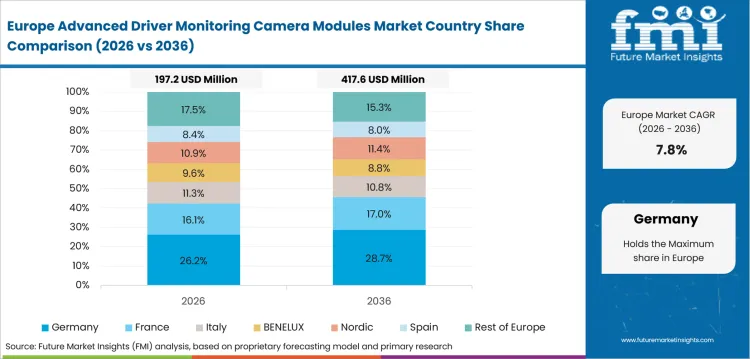
An 8.8% CAGR through 2036 reflects EU safety regulation, premium cockpit integration, and Tier 1 validation depth.
Country Market Snapshot Table
| Parameter | Value |
|---|---|
| Market Size in 2025 (Value) | USD 71.5 million |
| Market Size in 2026 (Value) | USD 78.0 million |
| Market Forecast in 2036 (Value) | USD 181.3 million |
| CAGR (2026 to 2036) | 8.8% |
| Years Considered | 2021 to 2036 |
| Base Year | 2025 |
| Forecast Period | 2026 to 2036 |
| Units Considered | Value (USD million) |
| Leading Sub-Region | Bavaria, Baden-Wurttemberg, and Lower Saxony OEM corridors |
Germany Advanced Driver Monitoring Camera Modules Market Outlook
- Germany demand is driven by premium OEM programs and European safety regulation. Domestic suppliers are strong in camera electronics, cockpit systems, restraints, and validation support.
- OEM buyers evaluate driver monitoring modules alongside styling, software update control, and platform reuse. Hidden, mirror-integrated, or display-adjacent designs should gain stronger preference in premium interiors.
Key Growth Drivers
- German EV production supports camera-module opportunities, with VDA stating that Germany produced 1.67 million electric passenger cars in 2025.
- Premium platform demand is supported by electric adoption, as IEA reported German electric car sales reached 850,000 in 2025.
- Bosch, Continental, ZF, Magna, and Valeo provide local engineering depth for camera validation and cockpit integration.
- Premium interiors favor hidden camera locations and mirror-integrated module designs that reduce visible hardware inside the cabin.
Key Restraints
- High labor and validation costs raise module qualification expense across advanced vehicle electronics programs.
- Long OEM launch cycles slow adoption by smaller camera-module suppliers without existing platform access.
- European production pressure remains a restraint, as ACEA reported EU commercial vehicle registrations weakened across vans and trucks in 2025.
What makes Germany unique
Germany is unique due to premium cockpit integration, EU type approval pressure, and strong Tier 1 validation capabilities.
Key Companies
- Bosch
- Continental
- ZF
- Magna
- Valeo
- Aptiv
- Denso
- Smart Eye
Sales & Marketing Channels
- OEM sourcing teams
- Tier 1 camera programs
- Engineering validation centers
- Premium cockpit design teams
- Authorized workshop networks
- Software validation partners
Country Segment Breakdown Table
| Segment | Sub-Segments |
|---|---|
| By Sales Channel | OEM · Tier 1 · Aftermarket · Fleet Retrofit · Charging Network |
| By Vehicle Type | Passenger Car · Light Commercial Vehicle · Heavy Truck · Two Wheeler · Bus |
| By Propulsion | Battery Electric · Plug-in Hybrid · Fuel Cell · Hybrid · ICE Retrofit |
| By Region | North America · Europe · East Asia · South Asia · Latin America |
| By Component Type | Sensor · Module · Connector · Software · Thermal System |
| Key Sub-Regions Covered, Automotive and Fleet Corridors | Bavaria · Baden-Wurttemberg · Lower Saxony · North Rhine-Westphalia · Hesse · Saxony |
Frequently Asked Questions
How fast is Germany advanced driver monitoring camera modules market growing?
Sales in Germany are set to rise at 8.8% CAGR from 2026 to 2036, led by premium OEM safety programs.
Who leads Germany advanced driver monitoring camera modules market?
Bosch, Continental, ZF, Magna, Valeo, Aptiv, Denso, and Smart Eye compete through camera and cockpit systems.
What is driving adoption in Germany advanced driver monitoring camera modules market?
EU safety rules and premium cockpit design are moving driver monitoring modules into German vehicle programs.
How fast is France advanced driver monitoring camera modules market growing?
An 8.4% CAGR through 2036 reflects EU safety rules, Valeo’s interior sensing relevance, and regulated cockpit programs.
Country Market Snapshot Table
| Parameter | Value |
|---|---|
| Market Size in 2025 (Value) | USD 39.4 million |
| Market Size in 2026 (Value) | USD 43.0 million |
| Market Forecast in 2036 (Value) | USD 96.3 million |
| CAGR (2026 to 2036) | 8.4% |
| Years Considered | 2021 to 2036 |
| Base Year | 2025 |
| Forecast Period | 2026 to 2036 |
| Units Considered | Value (USD million) |
| Leading Sub-Region | Paris region and northern automotive manufacturing corridors |
France Advanced Driver Monitoring Camera Modules Market Outlook
- France demand is closely linked to European regulation and Valeo’s role in interior sensing. French OEM platforms need camera modules that support distraction warnings, driver engagement, and future occupant monitoring.
- The market is less volume-heavy than China or Germany, but it matters for perception software and system integration. Suppliers that combine hardware with perception software can gain stronger standing in regulated cabin sensing.
Key Growth Drivers
- French manufacturing recovery supports local module demand, with PFA reporting vehicle production in France at 1.464 million units in 2025.
- EV cockpit adoption supports safety electronics, as IEA reported France’s electric sales share represented around 25% of total car sales in 2025.
- Valeo’s collaboration with Seeing Machines strengthens driver and occupant monitoring perception software access for French-linked vehicle programs.
- Light commercial vehicle programs create demand for fatigue and attention alerts where urban delivery and service fleets need safer operation.
Key Restraints
- Domestic vehicle output remains lower than Germany and China, limiting direct OEM module volume.
- Price pressure in compact vehicles can delay camera module fitment when suppliers cannot meet cost targets.
- European fleet weakness can slow retrofit expansion, with ACEA reporting that van and truck registrations declined in 2025.
What makes France unique
France is unique due to supplier-side perception software activity and interior sensing partnerships tied to European safety regulation.
Key Companies
- Valeo
- Seeing Machines
- Bosch
- Continental
- Magna
- Aptiv
- Renault Group suppliers
- Stellantis supplier networks
Sales & Marketing Channels
- French OEM platform sourcing
- Tier 1 system sales
- Software licensing partnerships
- Fleet retrofit integrators
- Dealer service channels
- Engineering validation programs
Country Segment Breakdown Table
| Segment | Sub-Segments |
|---|---|
| By Sales Channel | OEM · Tier 1 · Aftermarket · Fleet Retrofit · Charging Network |
| By Vehicle Type | Passenger Car · Light Commercial Vehicle · Heavy Truck · Two Wheeler · Bus |
| By Propulsion | Battery Electric · Plug-in Hybrid · Fuel Cell · Hybrid · ICE Retrofit |
| By Region | North America · Europe · East Asia · South Asia · Latin America |
| By Component Type | Sensor · Module · Connector · Software · Thermal System |
| Key Sub-Regions Covered, Automotive and Fleet Corridors | Paris Region · Hauts-de-France · Grand Est · Auvergne-Rhone-Alpes · Normandy · Occitanie |
Frequently Asked Questions
How fast is France advanced driver monitoring camera modules market growing?
Demand in France is ready to rise at 8.4% CAGR from 2026 to 2036 with regulated cabin sensing adoption.
Who leads France advanced driver monitoring camera modules market?
Valeo, Seeing Machines, Bosch, Continental, Magna, Aptiv, Renault-linked suppliers, and Stellantis networks influence demand.
What is driving adoption in France advanced driver monitoring camera modules market?
EU safety rules and perception software partnerships are moving driver monitoring modules into French-linked platforms.
What is the advanced driver monitoring camera modules market forecast for Japan?
An 8.1% CAGR through 2036 reflects reliability-led safety electronics, Denso’s driver status monitoring base, and premium platform adoption.
Country Market Snapshot Table
| Parameter | Value |
|---|---|
| Market Size in 2025 (Value) | USD 64.2 million |
| Market Size in 2026 (Value) | USD 70.0 million |
| Market Forecast in 2036 (Value) | USD 152.5 million |
| CAGR (2026 to 2036) | 8.1% |
| Years Considered | 2021 to 2036 |
| Base Year | 2025 |
| Forecast Period | 2026 to 2036 |
| Units Considered | Value (USD million) |
| Leading Sub-Region | Aichi, Tokyo, and Kansai vehicle technology corridors |
Japan Advanced Driver Monitoring Camera Modules Market Outlook
- Japan demand is shaped by reliability expectations and long qualification cycles. OEMs favor proven camera modules that work across lighting conditions, driver profiles, and long service lives.
- The country links module demand with automotive HUDs, cockpit alerts, and safety electronics because warnings must support the driver without creating distraction. Supplier continuity remains important for Japanese OEM programs.
Key Growth Drivers
- Japan remains a major vehicle platform market, with JAMA’s 2025 review covering 2024 motor vehicle production, registrations, exports, and global operations.
- Automotive depth supports advanced cockpit sourcing, with USA trade guidance identifying Japan as the fourth-largest automotive market in the world in 2024.
- Denso’s driver status monitor gives Japan direct camera-module relevance through facial image analysis for carelessness, distraction, and drowsiness.
- Toyota, Honda, Nissan, and export platforms offer scale for factory-fit safety electronics once modules pass reliability and validation standards.
Key Restraints
- Long validation cycles limit rapid supplier switching because OEMs prioritize qualification history and stable field performance.
- Smaller retrofit demand reduces aftermarket scale compared with fleet-heavy markets such as the United States and the United Kingdom.
- Domestic sales weakness can slow near-term rollout, as official trade guidance stated that new passenger vehicle sales in Japan declined in 2024.
What makes Japan unique
Japan is unique due to reliability-led sourcing, long qualification cycles, and strong domestic supplier continuity.
Key Companies
- Denso
- Toyota Group suppliers
- Honda supplier networks
- Nissan supplier networks
- Bosch
- Continental
- Valeo
- Magna
Sales & Marketing Channels
- OEM supplier nominations
- Tier 1 safety electronics channels
- Dealer service networks
- Export platform programs
- Commercial fleet retrofit specialists
- Cockpit electronics partners
Country Segment Breakdown Table
| Segment | Sub-Segments |
|---|---|
| By Sales Channel | OEM · Tier 1 · Aftermarket · Fleet Retrofit · Charging Network |
| By Vehicle Type | Passenger Car · Light Commercial Vehicle · Heavy Truck · Two Wheeler · Bus |
| By Propulsion | Battery Electric · Plug-in Hybrid · Fuel Cell · Hybrid · ICE Retrofit |
| By Region | North America · Europe · East Asia · South Asia · Latin America |
| By Component Type | Sensor · Module · Connector · Software · Thermal System |
| Key Sub-Regions Covered, Automotive and Fleet Corridors | Aichi · Tokyo · Kanagawa · Shizuoka · Osaka · Fukuoka |
Frequently Asked Questions
How fast is Japan advanced driver monitoring camera modules market growing?
Sector in Japan is projected at 8.1% CAGR from 2026 to 2036 as reliability-led OEM programs add driver monitoring.
Who leads Japan advanced driver monitoring camera modules market?
Denso, Toyota Group suppliers, Honda networks, Nissan networks, Bosch, Continental, Valeo, and Magna are relevant participants.
What is driving adoption in Japan advanced driver monitoring camera modules market?
Reliability requirements and camera-based driver status monitoring are moving in-cabin sensing into Japanese platforms.
How fast is the advanced driver monitoring camera modules market growing in China?
A 10.2% CAGR through 2036 reflects smart EV scale, fast model cycles, and wider cabin-sensing integration.
Country Market Snapshot Table
| Parameter | Value |
|---|---|
| Market Size in 2025 (Value) | USD 210.8 million |
| Market Size in 2026 (Value) | USD 230.0 million |
| Market Forecast in 2036 (Value) | USD 607.5 million |
| CAGR (2026 to 2036) | 10.2% |
| Years Considered | 2021 to 2036 |
| Base Year | 2025 |
| Forecast Period | 2026 to 2036 |
| Units Considered | Value (USD million) |
| Leading Sub-Region | Yangtze River Delta and Greater Bay Area smart vehicle corridors |
China Advanced Driver Monitoring Camera Modules Market Outlook
- China demand is shaped by smart EV platforms and fast cockpit feature refresh cycles. Domestic OEMs use driver monitoring, occupant sensing, identity recognition, and comfort functions to differentiate vehicles in a highly competitive market.
- Local sourcing pressure is strong, so suppliers must combine cost discipline with fast software tuning and local engineering support. Modules with mirror-integrated or display-adjacent packaging should gain attention where automakers want safer cabins without visible hardware additions.
Key Growth Drivers
- China’s NEV platform scale gives camera modules a wide route into smart cockpits, with official reporting stating that NEV production reached nearly 13.02 million units in the first ten months of 2025.
- Smart vehicle model refresh cycles support faster feature testing because China.org.cn reported that total auto output topped 27.69 million units during the same period.
- Domestic OEMs are pushing cabin sensing into brand differentiation as driver monitoring becomes connected with personalization, occupant safety, and assisted-driving supervision.
- Local electronics and camera-module supply helps reduce bill-of-material pressure for mass EV programs and supports faster vehicle-program changes.
Key Restraints
- EV price competition can reduce camera-module content in entry trims when automakers prioritize visible infotainment features over hidden safety hardware.
- Data and privacy rules can slow cloud-connected in-cabin functions because driver monitoring may involve sensitive biometric and behavioral signals.
- Policy shifts can affect near-term EV demand, as preferential NEV purchase tax treatment entered a new phase with full exemption replaced by a 50% reduction in 2026.
What makes China unique
China is unique due to its large EV production base, rapid model cycles, and strong local supplier ecosystem for smart cockpit technologies.
Key Companies
- Magna
- Bosch
- Continental
- Valeo
- Mobileye
- Smart Eye
- Desay SV
- Huawei Intelligent Automotive Solution
Sales & Marketing Channels
- Domestic OEM platform awards
- Tier 1 joint development programs
- EV brand sourcing teams
- Local electronics distributors
- Smart cockpit integrators
- Validation and engineering centers
Country Segment Breakdown Table
| Segment | Sub-Segments |
|---|---|
| By Sales Channel | OEM · Tier 1 · Aftermarket · Fleet Retrofit · Charging Network |
| By Vehicle Type | Passenger Car · Light Commercial Vehicle · Heavy Truck · Two Wheeler · Bus |
| By Propulsion | Battery Electric · Plug-in Hybrid · Fuel Cell · Hybrid · ICE Retrofit |
| By Region | North America · Europe · East Asia · South Asia · Latin America |
| By Component Type | Sensor · Module · Connector · Software · Thermal System |
| Key Sub-Regions Covered, Automotive and Fleet Corridors | Shanghai · Jiangsu · Zhejiang · Guangdong · Chongqing · Beijing-Tianjin-Hebei |
Frequently Asked Questions
How fast is China advanced driver monitoring camera modules market growing?
Sales in China are ready to scale at 10.2% CAGR from 2026 to 2036, guided by smart EV and cockpit programs.
Who leads China advanced driver monitoring camera modules market?
Magna, Bosch, Continental, Valeo, Mobileye, Smart Eye, Desay SV, and Huawei influence China’s module ecosystem.
What is driving adoption in China advanced driver monitoring camera modules market?
Smart EV launches and fast model refresh cycles are moving driver and occupant monitoring into mainstream cabin programs.
How is the advanced driver monitoring camera modules market performing in South Korea?
A 9.0% CAGR through 2036 reflects export-platform compliance and strong automotive electronics integration.
Country Market Snapshot Table
| Parameter | Value |
|---|---|
| Market Size in 2025 (Value) | USD 47.7 million |
| Market Size in 2026 (Value) | USD 52.0 million |
| Market Forecast in 2036 (Value) | USD 123.1 million |
| CAGR (2026 to 2036) | 9.0% |
| Years Considered | 2021 to 2036 |
| Base Year | 2025 |
| Forecast Period | 2026 to 2036 |
| Units Considered | Value (USD million) |
| Leading Sub-Region | Ulsan, Gyeonggi, and Seoul-connected vehicle electronics corridors |
South Korea Advanced Driver Monitoring Camera Modules Market Outlook
- South Korea demand is tied to export vehicle platforms and electronics integration. Vehicle programs must meet safety expectations across Europe, North America, and other destination markets.
- Korean OEMs connect driver monitoring with digital cockpit design and brand-specific safety packages. Suppliers with compact modules, camera software, and electronics integration support should benefit from export-compliance pressure.
Key Growth Drivers
- Export platform scale supports driver monitoring demand, with Korea reporting vehicle exports above USD 70 billion for a second straight year in 2024.
- Domestic production supports sourcing continuity, with Invest Korea reporting domestic automobile production at 4.1 million units in 2025.
- Hyundai and Kia export platforms need safety content accepted in Europe and North America, supporting DMS integration across global launch programs.
- Korean electronics suppliers support compact camera, display, and cockpit integration for driver and occupant monitoring systems.
Key Restraints
- Export market swings can affect production schedules and reduce visibility for module order timing.
- Local aftermarket demand is smaller than OEM factory-fit demand, limiting retrofit scale outside commercial fleets.
- Production softness can pressure component orders, as official reporting placed 2025 automobile production down 0.6% year on year.
What makes South Korea unique
South Korea is unique because export compliance and electronics integration jointly influence domestic module sourcing.
Key Companies
- Hyundai Mobis
- Bosch
- Continental
- Valeo
- Mobileye
- Magna
- Smart Eye
- LG Electronics
Sales & Marketing Channels
- OEM platform sourcing
- Hyundai and Kia supplier channels
- Electronics module manufacturers
- Tier 1 integration programs
- Export vehicle engineering teams
- Cockpit electronics partnerships
Country Segment Breakdown Table
| Segment | Sub-Segments |
|---|---|
| By Sales Channel | OEM · Tier 1 · Aftermarket · Fleet Retrofit · Charging Network |
| By Vehicle Type | Passenger Car · Light Commercial Vehicle · Heavy Truck · Two Wheeler · Bus |
| By Propulsion | Battery Electric · Plug-in Hybrid · Fuel Cell · Hybrid · ICE Retrofit |
| By Region | North America · Europe · East Asia · South Asia · Latin America |
| By Component Type | Sensor · Module · Connector · Software · Thermal System |
| Key Sub-Regions Covered, Automotive and Fleet Corridors | Ulsan · Seoul · Gyeonggi · Incheon · Gwangju · Busan |
Frequently Asked Questions
How fast is South Korea advanced driver monitoring camera modules market growing?
Industry in South Korea is projected to increase at 9.0% CAGR from 2026 to 2036 through export-oriented safety programs.
Who leads South Korea advanced driver monitoring camera modules market?
Hyundai Mobis, Bosch, Continental, Valeo, Mobileye, Magna, Smart Eye, and LG Electronics influence the market.
What is driving adoption in South Korea advanced driver monitoring camera modules market?
Export safety compliance and compact cockpit electronics are moving driver monitoring modules into Korean vehicle platforms.
What is driving advanced driver monitoring camera modules growth in India?
A 9.6% CAGR through 2036 is supported by premium vehicle demand, fleet retrofit interest, and staged safety-electronics adoption.
Country Market Snapshot Table
| Parameter | Value |
|---|---|
| Market Size in 2025 (Value) | USD 31.2 million |
| Market Size in 2026 (Value) | USD 34.0 million |
| Market Forecast in 2036 (Value) | USD 85.0 million |
| CAGR (2026 to 2036) | 9.6% |
| Years Considered | 2021 to 2036 |
| Base Year | 2025 |
| Forecast Period | 2026 to 2036 |
| Units Considered | Value (USD million) |
| Leading Sub-Region | Western and southern automotive manufacturing corridors |
India Advanced Driver Monitoring Camera Modules Market Outlook
- India demand is developing through two routes. Premium SUVs create OEM fitment opportunities, while commercial fleets evaluate retrofit monitoring for fatigue and route-safety management.
- Suppliers must balance cost, heat tolerance, dust performance, and local serviceability. Camera modules that work reliably across Indian driving conditions should gain stronger placement in both OEM and fleet channels.
Key Growth Drivers
- Premium SUV demand gives OEMs a better price window for cabin safety modules, with SIAM reporting passenger vehicle sales at a record 4.3 million units in FY 2024-25.
- Public support for electrified mobility improves cockpit electronics readiness, with India’s PM E-DRIVE program carrying an outlay of INR 10,900 crore.
- Bus and trucking fleets create retrofit demand for fatigue alerts where long driving hours and mixed road conditions raise operational risk.
- Local electronics assembly can support lower-cost camera-module integration as Indian OEMs expand connected cockpit and safety-electronics programs.
Key Restraints
- Small-car price sensitivity limits broad standard fitment because entry trims must absorb safety content without reducing affordability.
- Heat, dust, vibration, and service access raise validation demands for interior cameras across regional driving conditions.
- Commercial vehicle demand remains uneven, as SIAM reported a 1.2% decline in commercial vehicle sales during FY 2024-25.
What makes India unique
India is unique because premium OEM fitment and fleet retrofit can grow at different speeds in the same market.
Key Companies
- Bosch
- Continental
- Valeo
- Aptiv
- Denso
- Magna
- Tata Elxsi
- KPIT Technologies
Sales & Marketing Channels
- OEM sourcing teams
- Fleet retrofit dealers
- Bus operator tenders
- Commercial vehicle workshops
- Telematics platform partners
- Local system integrators
Country Segment Breakdown Table
| Segment | Sub-Segments |
|---|---|
| By Sales Channel | OEM · Tier 1 · Aftermarket · Fleet Retrofit · Charging Network |
| By Vehicle Type | Passenger Car · Light Commercial Vehicle · Heavy Truck · Two Wheeler · Bus |
| By Propulsion | Battery Electric · Plug-in Hybrid · Fuel Cell · Hybrid · ICE Retrofit |
| By Region | North America · Europe · East Asia · South Asia · Latin America |
| By Component Type | Sensor · Module · Connector · Software · Thermal System |
| Key Sub-Regions Covered, Automotive and Fleet Corridors | Pune · Chennai · Bengaluru · Gurugram-Manesar · Sanand · Hyderabad |
Frequently Asked Questions
How fast is India advanced driver monitoring camera modules market growing?
Demand in India is ready to rise at 9.6% CAGR from 2026 to 2036 with premium SUV and fleet retrofit adoption.
Who leads India advanced driver monitoring camera modules market?
Bosch, Continental, Valeo, Aptiv, Denso, Magna, Tata Elxsi, and KPIT Technologies support India’s cabin electronics ecosystem.
What is driving adoption in India advanced driver monitoring camera modules market?
Premium vehicle demand and fleet safety programs are moving driver monitoring modules toward staged adoption.
Who are the leading companies in the advanced driver monitoring camera modules market?
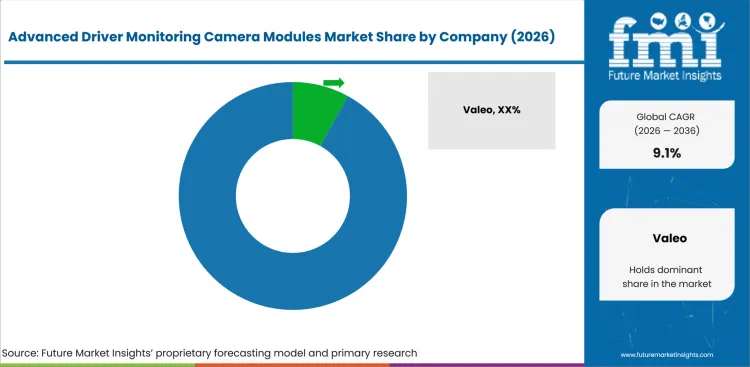
Bosch, Denso, Continental, Magna, and Valeo lead through camera-system integration, while Mobileye, Seeing Machines, Smart Eye, and Cipia influence software selection.
- Established Tier 1 suppliers hold an advantage through OEM platform access and automotive-grade validation history.
- Software specialists gain influence when gaze tracking, drowsiness detection, and occupant monitoring algorithms define system performance.
- Mirror-integrated and display-adjacent modules gain stronger acceptance where cockpit styling teams avoid visible sensor additions.
- Fleet-facing suppliers build value through fatigue alerts, event evidence, and telematics integration for commercial vehicles.
Tier 1 suppliers in the market compete by combining camera packaging with vehicle electronics integration. Bosch, Denso, and Continental stand out through automotive camera systems, electronic control experience, and long qualification records. Magna and Valeo compete where mirror integration, perception software, and occupant monitoring converge. Software specialists influence buying decisions when gaze algorithms and driver engagement scoring shape module performance.
Packaging depth has become a competitive separator as driver monitoring moves into premium and mass-market cabins. Magna’s May 2026 European OEM award highlights this point because its mirror-integrated DMS and OMS uses a behind-the-glass camera architecture. Suppliers that reduce visible hardware while supporting software-defined vehicle architecture should gain better platform access.
Software capability is becoming a stronger differentiator. Mobileye’s March 2026 DMS program links driver gaze and attention with real-time road context on EyeQ6L-equipped vehicles. The companies best positioned to win are those that combine camera-module packaging, perception software, validation evidence, and platform-level OEM access.
How do top advanced driver monitoring camera modules companies compare?
Bosch and Continental score strongest on validation depth while Magna leads mirror-integrated packaging and Mobileye leads compute-aligned DMS software.
| Company | Relevance to Market Title | Gaze and Drowsiness Sensing Depth | Cockpit Packaging Integration | Software and Compute Alignment | Channel Reach | Geographic Footprint |
|---|---|---|---|---|---|---|
| Bosch | Very High | Very Strong | Strong | Strong | Very Strong | Global |
| Denso | Very High | Very Strong | Medium | Strong | Strong | Japan and global |
| Continental | Very High | Very Strong | Very Strong | Strong | Very Strong | Global |
| Magna | Very High | Very Strong | Very Strong | Strong | Very Strong | North America, Europe, and China |
| Valeo | Very High | Very Strong | Strong | Strong | Strong | Europe and global |
| ZF | High | Medium | Strong | Medium | Strong | Europe and global |
| Aptiv | High | Medium | Strong | Very Strong | Strong | Global |
| Mobileye | High | Very Strong | Medium | Very Strong | Strong | Global |
| Seeing Machines | High | Very Strong | Medium | Very Strong | Strong | Europe, Australia, and global |
| Smart Eye | High | Very Strong | Medium | Strong | Medium | Europe and Asia |
Source: Future Market Insights competitive analysis, 2026.
Who are the key players in the advanced driver monitoring camera modules market?
Bosch, Denso, Continental, Magna, Valeo, ZF, Aptiv, Mobileye, Seeing Machines, Smart Eye, and Cipia are listed among major suppliers and software specialists.
Key global companies leading the advanced driver monitoring camera modules market include:
- Bosch
- Denso
- Continental
- Magna
- Valeo
- ZF
- Aptiv
- Mobileye
- Seeing Machines
- Smart Eye
- Cipia
Key Developments in Advanced Driver Monitoring Camera Modules Market
- In May 2026, Magna was awarded a driver and occupant monitoring system program with a European OEM, positioning its mirror-integrated DMS and OMS as a platform-level solution for next-generation vehicle architecture.
- In March 2026, Mobileye secured a major DMS production program with a leading USA automaker, targeting start of production in 2027 across future EyeQ6L-equipped vehicles.
- In October 2025, Magna expanded deployment of its mirror-integrated driver and occupant monitoring system in China with a Germany-based OEM, marking its first full year of scaled global production.
Key Players in the Advanced Driver Monitoring Camera Modules Market
Global Leaders
-
Bosch
- Denso
- Continental
System Integrators
- Magna
- ZF
- Valeo
Architecture and Software Specialists
- Aptiv
- Mobileye
- Seeing Machines
- Smart Eye
- Cipia
Advanced Driver Monitoring Camera Modules Market - Scope & Definition
| Attribute | Detail |
|---|---|
| Market Definition | Camera-based modules used inside vehicles to monitor driver attention, drowsiness, distraction, and readiness to take control. |
| Functions Covered | Gaze tracking, eyelid monitoring, head-pose detection, driver engagement checks, drowsiness alerts, distraction warnings, and occupant-safety inputs. |
| Applications Covered | OEM driver monitoring, assisted-driving handover, fleet fatigue detection, occupant monitoring, smart cockpit alerts, and platform-level safety validation. |
| Revenue Included | Camera modules, sensors, connectors, embedded software, thermal elements, and validated in-cabin module assemblies sold into vehicle programs. |
| Revenue Excluded | Exterior ADAS cameras, reversing cameras, general dashcams, telematics-only driver scoring, full vehicle sales, and unrelated road-sensing systems. |
| End Users | Passenger car OEMs, commercial vehicle OEMs, fleet operators, Tier 1 suppliers, telematics integrators, and aftermarket safety providers. |
| Geographic Scope | North America, Europe, East Asia, South Asia, and Latin America. |
Advanced Driver Monitoring Camera Modules Market - Research Methodology
| Method | Description |
|---|---|
| Primary Research | FMI analyst interviews with automotive safety suppliers, Tier 1 system integrators, OEM platform teams, and fleet retrofit buyers. |
| Desk Research | Review of vehicle safety regulations, type approval documents, official road safety data, company product pages, and automotive production statistics. |
| Market Sizing & Forecasting | Bottom-up model using vehicle production, likely DMS fitment, module pricing, channel mix, regional safety rules, and country adoption patterns. |
| Data Validation | Forecasts were checked against parent driver monitoring systems, in-cabin sensing portfolios, safety camera developments, and supplier program announcements. |
Advanced Driver Monitoring Camera Modules Market - Report Scope
| Item | Value |
|---|---|
| Market size by 2036 | USD 2,100.8 million |
| Growth rate | 9.1% CAGR from 2026 to 2036 |
| Forecast period | 2026 to 2036 |
| Base year | 2025 |
| Historical period | 2021 to 2025 |
| Quantitative unit | Revenue in USD million |
| Segmentation | Sales Channel, Vehicle Type, Propulsion, Region, and Component Type |
| Countries covered | United States, United Kingdom, Germany, France, Japan, China, South Korea, and India |
| Companies covered | Bosch, Denso, Continental, Magna, Valeo, ZF, Aptiv, Mobileye, Seeing Machines, Smart Eye, and Cipia |
| Report delivery | PDF and Excel formats |
| Primary audience | OEMs, Tier 1 suppliers, fleet integrators, software providers, investors, and automotive safety stakeholders |
| Customization | Available on request |
Source: Future Market Insights, 2026.
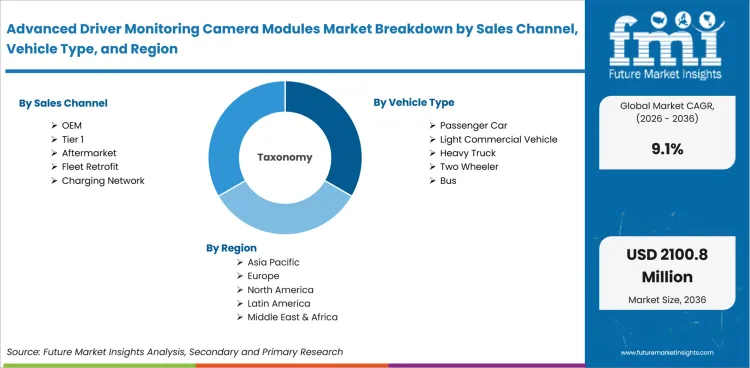
Advanced Driver Monitoring Camera Modules Market Breakdown by Sales Channel, Vehicle Type, Propulsion, Region, Component Type, and Country
Advanced Driver Monitoring Camera Modules Market Segmented by Sales Channel
- OEM
- Tier 1
- Aftermarket
- Fleet Retrofit
- Charging Network
Advanced Driver Monitoring Camera Modules Market Segmented by Vehicle Type
- Passenger Car
- Light Commercial Vehicle
- Heavy Truck
- Two Wheeler
- Bus
Advanced Driver Monitoring Camera Modules Market Segmented by Propulsion
- Battery Electric
- Plug-in Hybrid
- Fuel Cell
- Hybrid
- ICE Retrofit
Advanced Driver Monitoring Camera Modules Market by Region
- North America
- Europe
- East Asia
- South Asia
- Latin America
Advanced Driver Monitoring Camera Modules Market Segmented by Component Type
- Sensor
- Module
- Connector
- Software
- Thermal System
Research Sources and Bibliography
- ACEA. (2026, April 1). Economic and market report: Global and EU auto industry, full-year 2025.
- China.org.cn. (2025, November 11). China’s NEV output, sales surge in first 10 months of 2025.
- European Commission. (2024, July 5). New rules on vehicle safety and automated mobility.
- Euro NCAP. (2025, June). Overall assessment protocol, Version 10.0.
- Euro NCAP. (2025, November). Safe Driving: Occupant Monitoring, Version 1.1.
- German Association of the Automotive Industry. (2026, February 4). Car production in Germany in January 2026.
- Insurance Institute for Highway Safety. (2024, March 12). First partial driving automation safeguard ratings show industry has work to do.
- Insurance Institute for Highway Safety. (2025, August). Subaru drivers’ experiences with the DriverFocus driver monitoring system.
- International Energy Agency. (2026). Global EV Outlook 2026: Trends in electric cars.
- International Organization of Motor Vehicle Manufacturers. (2026, April 23). Auto industry growth shifted east in 2025 amid global repositioning.
- Japan Automobile Manufacturers Association. (2025, September 26). The motor industry of Japan 2025.
- Korea Trade-Investment Promotion Agency. (2026, January 15). South Korea’s auto exports hit record USD 72 billion in 2025.
- Korea.net. (2025, January 16). Korea’s auto exports enter USD 70 billion threshold for second year.
- Magna International. (2025, October 29). Magna ramps up driver and occupant monitoring system deployment in China with Germany-based OEM.
- Magna International. (2026, May 19). Magna awarded driver and occupant monitoring system program with European OEM.
- Ministry of Heavy Industries. (2026, January 13). Year End Review 2025: Ministry of Heavy Industries. Press Information Bureau, Government of India.
- Mobileye. (2026, March 23). Mobileye secures major DMS production program with leading USA automaker.
- National Highway Traffic Safety Administration. (2026, April). Distracted driving in 2024.
- Office for National Statistics. (2026, June 11). UK new vehicle registrations and production.
- OICA. (2026). PFA, France’s automotive platform, market analysis letter.
- Society of Indian Automobile Manufacturers. (2025, April 15). Monthly performance: March 2025.
- Society of Motor Manufacturers and Traders. (2026, January 29). Tough year for auto but new models and Industrial Strategy can deliver growth.
- USA nternational Trade Administration. (2025, November 20). Japan - Automotive.
- Valeo. (2024, July 8). Valeo and Seeing Machines announce strategic collaboration to offer Advanced Driver and Occupant Monitoring Solutions.
This bibliography is provided for reader reference and is not exhaustive. The full report contains the complete reference list and detailed citations.
This Report Answers
- Market size estimates for 2026 and forecasts through 2036 for the advanced driver monitoring camera modules market.
- Insights across regional and country-level markets covering vehicle regulation, EV adoption, and fleet behavior.
- Analysis of demand drivers, cockpit packaging restraints, safety-rating pressure, and software-defined vehicle opportunities.
- Evaluation of key sales channels, vehicle types, propulsion categories, regional segments, and component types.
- Assessment of regulatory frameworks and safety expectations influencing camera-based driver monitoring adoption.
- Identification of opportunities across OEM fitment, fleet retrofit, smart cockpits, and occupant monitoring convergence.
- Evaluation of supplier positioning across camera integration, perception software, validation support, and platform access.
- Country-level growth analysis covering the United States, United Kingdom, Germany, France, Japan, China, South Korea, and India.
- Assessment of the competitive landscape, including leading camera-module suppliers and software specialists.
- Analysis of company developments from Magna, Mobileye, and Valeo-linked driver and occupant monitoring programs.
- Delivery of market data, forecasts, and supporting analysis in PDF and Excel formats.
Frequently Asked Questions
What is the advanced driver monitoring camera modules market size in 2026?
The advanced driver monitoring camera modules market size is anticipated to reach USD 879.3 million in 2026.
What is the advanced driver monitoring camera modules market forecast for 2036?
The advanced driver monitoring camera modules industry revenue is predicted to reach USD 2,100.8 million by 2036 as regulated cabin safety expands.
What is the advanced driver monitoring camera modules market CAGR?
The advanced driver monitoring camera modules sector is projected to expand at 9.1% CAGR from 2026 to 2036.
What segment leads the advanced driver monitoring camera modules market?
OEM is likely to capture 76.0% share in 2026 due to factory validation and vehicle platform integration.
What vehicle type leads advanced driver monitoring camera modules demand?
Passenger cars are expected to hold 63.0% share in 2026 as high-volume vehicle platforms add cabin sensing.
What country grows fastest in the advanced driver monitoring camera modules market?
China is set to record 10.2% CAGR by 2036, driven by smart EV programs and faster cockpit feature adoption.
Preview the report firsthand - request a free sample
Get SampleGet the brochure for pricing and purchase details.
Get PDFTable of Content
- Executive Summary
- Global Market Outlook
- Demand to side Trends
- Supply to side Trends
- Technology Roadmap Analysis
- Analysis and Recommendations
- Market Overview
- Market Coverage / Taxonomy
- Market Definition / Scope / Limitations
- Research Methodology
- Chapter Orientation
- Analytical Lens and Working Hypotheses
- Market Structure, Signals, and Trend Drivers
- Benchmarking and Cross-market Comparability
- Market Sizing, Forecasting, and Opportunity Mapping
- Research Design and Evidence Framework
- Desk Research Programme (Secondary Evidence)
- Company Annual and Sustainability Reports
- Peer-reviewed Journals and Academic Literature
- Corporate Websites, Product Literature, and Technical Notes
- Earnings Decks and Investor Briefings
- Statutory Filings and Regulatory Disclosures
- Technical White Papers and Standards Notes
- Trade Journals, Industry Magazines, and Analyst Briefs
- Conference Proceedings, Webinars, and Seminar Materials
- Government Statistics Portals and Public Data Releases
- Press Releases and Reputable Media Coverage
- Specialist Newsletters and Curated Briefings
- Sector Databases and Reference Repositories
- FMI Internal Proprietary Databases and Historical Market Datasets
- Subscription Datasets and Paid Sources
- Social Channels, Communities, and Digital Listening Inputs
- Additional Desk Sources
- Expert Input and Fieldwork (Primary Evidence)
- Primary Modes
- Qualitative Interviews and Expert Elicitation
- Quantitative Surveys and Structured Data Capture
- Blended Approach
- Why Primary Evidence is Used
- Field Techniques
- Interviews
- Surveys
- Focus Groups
- Observational and In-context Research
- Social and Community Interactions
- Stakeholder Universe Engaged
- C-suite Leaders
- Board Members
- Presidents and Vice Presidents
- R&D and Innovation Heads
- Technical Specialists
- Domain Subject-matter Experts
- Scientists
- Physicians and Other Healthcare Professionals
- Governance, Ethics, and Data Stewardship
- Research Ethics
- Data Integrity and Handling
- Primary Modes
- Tooling, Models, and Reference Databases
- Desk Research Programme (Secondary Evidence)
- Data Engineering and Model Build
- Data Acquisition and Ingestion
- Cleaning, Normalisation, and Verification
- Synthesis, Triangulation, and Analysis
- Quality Assurance and Audit Trail
- Market Background
- Market Dynamics
- Drivers
- Restraints
- Opportunity
- Trends
- Scenario Forecast
- Demand in Optimistic Scenario
- Demand in Likely Scenario
- Demand in Conservative Scenario
- Opportunity Map Analysis
- Product Life Cycle Analysis
- Supply Chain Analysis
- Investment Feasibility Matrix
- Value Chain Analysis
- PESTLE and Porter’s Analysis
- Regulatory Landscape
- Regional Parent Market Outlook
- Production and Consumption Statistics
- Import and Export Statistics
- Market Dynamics
- Global Market Analysis 2021 to 2025 and Forecast, 2026 to 2036
- Historical Market Size Value (USD Million) Analysis, 2021 to 2025
- Current and Future Market Size Value (USD Million) Projections, 2026 to 2036
- Y to o to Y Growth Trend Analysis
- Absolute $ Opportunity Analysis
- Global Market Pricing Analysis 2021 to 2025 and Forecast 2026 to 2036
- Global Market Analysis 2021 to 2025 and Forecast 2026 to 2036, By Sales Channel
- Introduction / Key Findings
- Historical Market Size Value (USD Million) Analysis By Sales Channel , 2021 to 2025
- Current and Future Market Size Value (USD Million) Analysis and Forecast By Sales Channel , 2026 to 2036
- OEM
- Tier 1
- Aftermarket
- Fleet Retrofit
- Charging Network
- OEM
- Y to o to Y Growth Trend Analysis By Sales Channel , 2021 to 2025
- Absolute $ Opportunity Analysis By Sales Channel , 2026 to 2036
- Global Market Analysis 2021 to 2025 and Forecast 2026 to 2036, By Vehicle Type
- Introduction / Key Findings
- Historical Market Size Value (USD Million) Analysis By Vehicle Type, 2021 to 2025
- Current and Future Market Size Value (USD Million) Analysis and Forecast By Vehicle Type, 2026 to 2036
- Passenger Car
- Light Commercial Vehicle
- Heavy Truck
- Two Wheeler
- Bus
- Passenger Car
- Y to o to Y Growth Trend Analysis By Vehicle Type, 2021 to 2025
- Absolute $ Opportunity Analysis By Vehicle Type, 2026 to 2036
- Global Market Analysis 2021 to 2025 and Forecast 2026 to 2036, By Propulsion
- Introduction / Key Findings
- Historical Market Size Value (USD Million) Analysis By Propulsion, 2021 to 2025
- Current and Future Market Size Value (USD Million) Analysis and Forecast By Propulsion, 2026 to 2036
- Battery Electric
- Plug-in Hybrid
- Fuel Cell
- Hybrid
- ICE Retrofit
- Battery Electric
- Y to o to Y Growth Trend Analysis By Propulsion, 2021 to 2025
- Absolute $ Opportunity Analysis By Propulsion, 2026 to 2036
- Global Market Analysis 2021 to 2025 and Forecast 2026 to 2036, By Component Type
- Introduction / Key Findings
- Historical Market Size Value (USD Million) Analysis By Component Type, 2021 to 2025
- Current and Future Market Size Value (USD Million) Analysis and Forecast By Component Type, 2026 to 2036
- Module
- Connector
- Software
- Thermal System
- Sensor
- Module
- Y to o to Y Growth Trend Analysis By Component Type, 2021 to 2025
- Absolute $ Opportunity Analysis By Component Type, 2026 to 2036
- Global Market Analysis 2021 to 2025 and Forecast 2026 to 2036, By Region
- Introduction
- Historical Market Size Value (USD Million) Analysis By Region, 2021 to 2025
- Current Market Size Value (USD Million) Analysis and Forecast By Region, 2026 to 2036
- North America
- Latin America
- Western Europe
- Eastern Europe
- East Asia
- South Asia and Pacific
- Middle East & Africa
- Market Attractiveness Analysis By Region
- North America Market Analysis 2021 to 2025 and Forecast 2026 to 2036, By Country
- Historical Market Size Value (USD Million) Trend Analysis By Market Taxonomy, 2021 to 2025
- Market Size Value (USD Million) Forecast By Market Taxonomy, 2026 to 2036
- By Country
- USA
- Canada
- Mexico
- By Sales Channel
- By Vehicle Type
- By Propulsion
- By Component Type
- By Country
- Market Attractiveness Analysis
- By Country
- By Sales Channel
- By Vehicle Type
- By Propulsion
- By Component Type
- Key Takeaways
- Latin America Market Analysis 2021 to 2025 and Forecast 2026 to 2036, By Country
- Historical Market Size Value (USD Million) Trend Analysis By Market Taxonomy, 2021 to 2025
- Market Size Value (USD Million) Forecast By Market Taxonomy, 2026 to 2036
- By Country
- Brazil
- Chile
- Rest of Latin America
- By Sales Channel
- By Vehicle Type
- By Propulsion
- By Component Type
- By Country
- Market Attractiveness Analysis
- By Country
- By Sales Channel
- By Vehicle Type
- By Propulsion
- By Component Type
- Key Takeaways
- Western Europe Market Analysis 2021 to 2025 and Forecast 2026 to 2036, By Country
- Historical Market Size Value (USD Million) Trend Analysis By Market Taxonomy, 2021 to 2025
- Market Size Value (USD Million) Forecast By Market Taxonomy, 2026 to 2036
- By Country
- Germany
- UK
- Italy
- Spain
- France
- Nordic
- BENELUX
- Rest of Western Europe
- By Sales Channel
- By Vehicle Type
- By Propulsion
- By Component Type
- By Country
- Market Attractiveness Analysis
- By Country
- By Sales Channel
- By Vehicle Type
- By Propulsion
- By Component Type
- Key Takeaways
- Eastern Europe Market Analysis 2021 to 2025 and Forecast 2026 to 2036, By Country
- Historical Market Size Value (USD Million) Trend Analysis By Market Taxonomy, 2021 to 2025
- Market Size Value (USD Million) Forecast By Market Taxonomy, 2026 to 2036
- By Country
- Russia
- Poland
- Hungary
- Balkan & Baltic
- Rest of Eastern Europe
- By Sales Channel
- By Vehicle Type
- By Propulsion
- By Component Type
- By Country
- Market Attractiveness Analysis
- By Country
- By Sales Channel
- By Vehicle Type
- By Propulsion
- By Component Type
- Key Takeaways
- East Asia Market Analysis 2021 to 2025 and Forecast 2026 to 2036, By Country
- Historical Market Size Value (USD Million) Trend Analysis By Market Taxonomy, 2021 to 2025
- Market Size Value (USD Million) Forecast By Market Taxonomy, 2026 to 2036
- By Country
- China
- Japan
- South Korea
- By Sales Channel
- By Vehicle Type
- By Propulsion
- By Component Type
- By Country
- Market Attractiveness Analysis
- By Country
- By Sales Channel
- By Vehicle Type
- By Propulsion
- By Component Type
- Key Takeaways
- South Asia and Pacific Market Analysis 2021 to 2025 and Forecast 2026 to 2036, By Country
- Historical Market Size Value (USD Million) Trend Analysis By Market Taxonomy, 2021 to 2025
- Market Size Value (USD Million) Forecast By Market Taxonomy, 2026 to 2036
- By Country
- India
- ASEAN
- Australia & New Zealand
- Rest of South Asia and Pacific
- By Sales Channel
- By Vehicle Type
- By Propulsion
- By Component Type
- By Country
- Market Attractiveness Analysis
- By Country
- By Sales Channel
- By Vehicle Type
- By Propulsion
- By Component Type
- Key Takeaways
- Middle East & Africa Market Analysis 2021 to 2025 and Forecast 2026 to 2036, By Country
- Historical Market Size Value (USD Million) Trend Analysis By Market Taxonomy, 2021 to 2025
- Market Size Value (USD Million) Forecast By Market Taxonomy, 2026 to 2036
- By Country
- Kingdom of Saudi Arabia
- Other GCC Countries
- Turkiye
- South Africa
- Other African Union
- Rest of Middle East & Africa
- By Sales Channel
- By Vehicle Type
- By Propulsion
- By Component Type
- By Country
- Market Attractiveness Analysis
- By Country
- By Sales Channel
- By Vehicle Type
- By Propulsion
- By Component Type
- Key Takeaways
- Key Countries Market Analysis
- USA
- Pricing Analysis
- Market Share Analysis, 2025
- By Sales Channel
- By Vehicle Type
- By Propulsion
- By Component Type
- Canada
- Pricing Analysis
- Market Share Analysis, 2025
- By Sales Channel
- By Vehicle Type
- By Propulsion
- By Component Type
- Mexico
- Pricing Analysis
- Market Share Analysis, 2025
- By Sales Channel
- By Vehicle Type
- By Propulsion
- By Component Type
- Brazil
- Pricing Analysis
- Market Share Analysis, 2025
- By Sales Channel
- By Vehicle Type
- By Propulsion
- By Component Type
- Chile
- Pricing Analysis
- Market Share Analysis, 2025
- By Sales Channel
- By Vehicle Type
- By Propulsion
- By Component Type
- Germany
- Pricing Analysis
- Market Share Analysis, 2025
- By Sales Channel
- By Vehicle Type
- By Propulsion
- By Component Type
- UK
- Pricing Analysis
- Market Share Analysis, 2025
- By Sales Channel
- By Vehicle Type
- By Propulsion
- By Component Type
- Italy
- Pricing Analysis
- Market Share Analysis, 2025
- By Sales Channel
- By Vehicle Type
- By Propulsion
- By Component Type
- Spain
- Pricing Analysis
- Market Share Analysis, 2025
- By Sales Channel
- By Vehicle Type
- By Propulsion
- By Component Type
- France
- Pricing Analysis
- Market Share Analysis, 2025
- By Sales Channel
- By Vehicle Type
- By Propulsion
- By Component Type
- India
- Pricing Analysis
- Market Share Analysis, 2025
- By Sales Channel
- By Vehicle Type
- By Propulsion
- By Component Type
- ASEAN
- Pricing Analysis
- Market Share Analysis, 2025
- By Sales Channel
- By Vehicle Type
- By Propulsion
- By Component Type
- Australia & New Zealand
- Pricing Analysis
- Market Share Analysis, 2025
- By Sales Channel
- By Vehicle Type
- By Propulsion
- By Component Type
- China
- Pricing Analysis
- Market Share Analysis, 2025
- By Sales Channel
- By Vehicle Type
- By Propulsion
- By Component Type
- Japan
- Pricing Analysis
- Market Share Analysis, 2025
- By Sales Channel
- By Vehicle Type
- By Propulsion
- By Component Type
- South Korea
- Pricing Analysis
- Market Share Analysis, 2025
- By Sales Channel
- By Vehicle Type
- By Propulsion
- By Component Type
- Russia
- Pricing Analysis
- Market Share Analysis, 2025
- By Sales Channel
- By Vehicle Type
- By Propulsion
- By Component Type
- Poland
- Pricing Analysis
- Market Share Analysis, 2025
- By Sales Channel
- By Vehicle Type
- By Propulsion
- By Component Type
- Hungary
- Pricing Analysis
- Market Share Analysis, 2025
- By Sales Channel
- By Vehicle Type
- By Propulsion
- By Component Type
- Kingdom of Saudi Arabia
- Pricing Analysis
- Market Share Analysis, 2025
- By Sales Channel
- By Vehicle Type
- By Propulsion
- By Component Type
- Turkiye
- Pricing Analysis
- Market Share Analysis, 2025
- By Sales Channel
- By Vehicle Type
- By Propulsion
- By Component Type
- South Africa
- Pricing Analysis
- Market Share Analysis, 2025
- By Sales Channel
- By Vehicle Type
- By Propulsion
- By Component Type
- USA
- Market Structure Analysis
- Competition Dashboard
- Competition Benchmarking
- Market Share Analysis of Top Players
- By Regional
- By Sales Channel
- By Vehicle Type
- By Propulsion
- By Component Type
- Competition Analysis
- Competition Deep Dive
- Valeo
- Overview
- Product Portfolio
- Profitability by Market Segments (Product/Age /Sales Channel/Region)
- Sales Footprint
- Strategy Overview
- Marketing Strategy
- Product Strategy
- Channel Strategy
- Seeing Machines
- Bosch
- Continental
- Magna
- Aptiv
- Renault Group suppliers
- Stellantis supplier networks
- Valeo
- Competition Deep Dive
- Assumptions & Acronyms Used


