

- Industry Size (2026)
- USD 1.1 Bn
- Forecast (2036)
- USD 2.0 Bn
- CAGR (2026 to 2036)
- 6.00%
Anti-Fogging Masterbatches for Packaging Films Market Forecast and Outlook 2026 to 2036
The anti-fogging masterbatches for packaging films market is forecasted to reach from USD 1.1 billion in 2026 to USD 2.0 billion by 2036, posting a 6.00% CAGR. Supply chain structure plays a decisive role in how anti-fogging masterbatches are specified, sourced, and scaled across packaging film applications. Production is concentrated among a limited group of global and regional masterbatch producers with controlled access to specialty surfactants and food-contact compliant additives.
Quick Stats for Anti-Fogging Masterbatches for Packaging Films Market
- Anti-Fogging Masterbatches for Packaging Films Market Value (2026): USD 1.1 Billion
- Anti-Fogging Masterbatches for Packaging Films Market Forecast Value (2036): USD 2.0 Billion
- Anti-Fogging Masterbatches for Packaging Films Market Forecast CAGR 2026 to 2036: 6.00%
- Leading Polymer Carrier in Anti-Fogging Masterbatches for Packaging Films Market: PE-Based Masterbatches (44% share)
- Key Growth Regions in Anti-Fogging Masterbatches for Packaging Films Market: Asia Pacific, Europe, North America, Latin America, Middle East & Africa
- Top Key Players in Anti-Fogging Masterbatches for Packaging Films Market: Clariant, Avient Corporation, Ampacet Corporation, LyondellBasell, Ravago, Gabriel-Chemie, PolyOne (legacy operations), Plastiblends India, BASF, Americhem
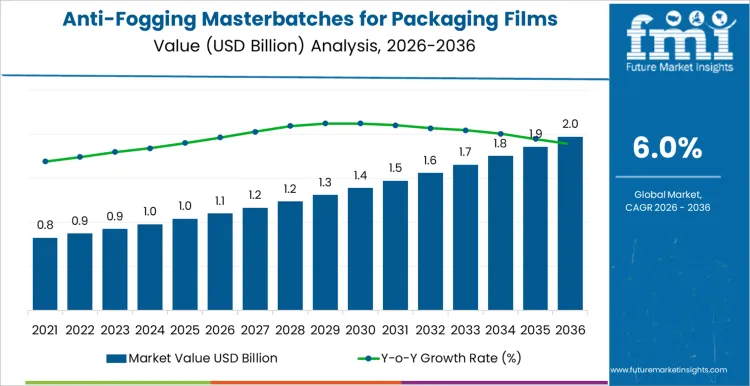
Dependence on consistent additive quality, precise dosing, and stable dispersion creates tight manufacturing tolerances, making production reliability as critical as formulation performance. Regional manufacturing footprints influence lead times and risk exposure, particularly for converters operating high-speed extrusion lines with minimal inventory buffers. Any disruption in additive sourcing, compounding capacity, or regulatory-approved raw materials can directly affect film output and customer commitments. As a result, buyers prioritize suppliers with redundant production sites, secure raw material sourcing, and proven batch-to-batch consistency. Supply assurance, not pricing flexibility, increasingly defines supplier preference in this market.
Anti-Fogging Masterbatches for Packaging Films Market Key Takeaways
| Metric | Value |
|---|---|
| Anti-Fogging Masterbatches for Packaging Films Market Value (2026) | USD 1.1 Billion |
| Anti-Fogging Masterbatches for Packaging Films Market Forecast Value (2036) | USD 2.0 Billion |
| Anti-Fogging Masterbatches for Packaging Films Market Forecast CAGR 2026 to 2036 | 6.00% |
How are Food Visibility, Shelf-Life Protection, and Packaging Performance Requirements Driving the Anti-Fogging Masterbatches Market?
The anti-fogging masterbatches for packaging films market is expanding as food and consumer goods brands prioritize product visibility and quality preservation throughout distribution and retail. Condensation on packaging films can obscure product appearance, reduce consumer appeal, and accelerate spoilage by trapping moisture on film surfaces. Anti-fogging additives modify surface tension, allowing moisture to spread into a transparent layer rather than forming droplets, ensuring clear visibility in fresh produce, meat, dairy, and refrigerated food packaging applications.
Performance longevity and compatibility with packaging materials are central to purchasing decisions. End users evaluate anti-fogging masterbatches based on migration control, durability under temperature fluctuations, and effectiveness in both cold and high-humidity environments. In polyethylene, polypropylene, and multilayer films, masterbatches must deliver consistent anti-fog performance without compromising sealability, mechanical strength, or food-contact compliance. The ability to tailor additive concentrations for specific film structures and processing conditions is enabling packaging converters to meet diverse application requirements.
Expansion of modern food retail and regulatory focus on packaging safety are further supporting market growth. Increased demand for fresh and minimally processed foods is driving adoption of functional packaging that enhances shelf-life and reduces food waste. At the same time, compliance with food safety regulations and sustainability targets is encouraging the development of efficient, low-dosage anti-fog solutions. For additive suppliers, competitive advantage increasingly depends on formulation expertise, regulatory compliance support, and close collaboration with film producers positioning anti-fogging masterbatches as a key value-adding component in advanced packaging films.
How Is The Anti-Fogging Masterbatches For Packaging Films Market Structured By Polymer Carrier And Application?
The anti-fogging masterbatches for packaging films market is structured by polymer carrier and application, reflecting how carrier compatibility and end-use moisture exposure determine formulation demand. By polymer carrier, PE-based masterbatches represent the leading segment, as polyethylene films dominate flexible food packaging formats. Other carriers include PP-based masterbatches and formulations designed for additional polymer systems used in specialty films. By application, fresh produce and food packaging account for the largest share, followed by meat, dairy and bakery films, and industrial and other film applications where condensation control is required to maintain product visibility and quality.
Why Do PE-Based Masterbatches Lead Polymer Carrier Adoption In The Anti-Fogging Masterbatches For Packaging Films Market?
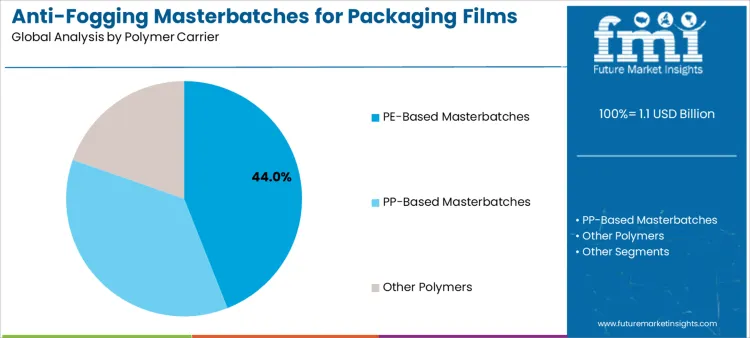
PE-based masterbatches account for 44% share of the anti-fogging masterbatches for packaging films market because polyethylene is the most widely used polymer in flexible food packaging. PE films are commonly used for fresh produce, bakery items, and chilled foods where condensation formation is frequent. Anti-fog additives disperse effectively in PE matrices, ensuring uniform surface activity and long-lasting fog control. Film processors prefer PE-based systems due to ease of processing, stable extrusion behavior, and compatibility with existing film lines. High-volume PE film production and predictable additive performance explain why PE-based masterbatches remain the dominant carrier type.
Why Does Fresh Produce And Food Packaging Dominate Application Demand In The Anti-Fogging Masterbatches For Packaging Films Market?
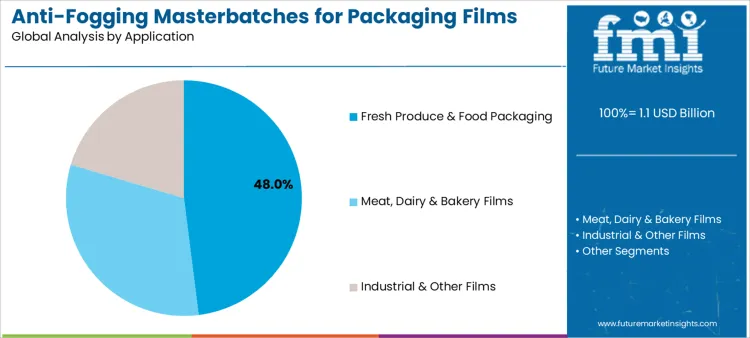
Fresh produce and food packaging hold 48% share of the anti-fogging masterbatches for packaging films market because temperature fluctuations during storage and transport frequently cause moisture condensation inside packages. Fogging reduces product visibility and can affect consumer perception at retail. Anti-fog masterbatches help maintain clear film surfaces, improving shelf presentation and monitoring of product condition. High packaging volumes for fruits, vegetables, and ready-to-eat foods drive consistent additive demand. Packaging converters prioritize reliable fog control without affecting sealability or film strength. These high-volume usage patterns and performance requirements explain why fresh produce and food packaging remains the leading application segment.
What Are the Key Dynamics of the Anti-Fogging Masterbatches for Packaging Films Market?
The anti-fogging masterbatches for packaging films market is driven by growing demand for high-performance packaging that enhances product visibility, shelf appeal, and consumer convenience. Anti-fogging masterbatches improve condensation control on film surfaces, making them essential in food, pharmaceutical, and fresh produce packaging. Rising consumer expectations for transparent, hygienic packaging, combined with stricter food safety and shelf-life regulations, boosts adoption of anti-fogging solutions. Material suppliers focus on additive efficacy, regulatory compliance (especially food contact approvals), and compatibility with a range of polymer resins including PE, PP, and biodegradable films.
How Do Application Trends and Industry Requirements Shape This Market?
Application trends and industry requirements are shaping the anti-fogging masterbatches market as packaging converters and brand owners demand tailored performance without compromising processability. In food and fresh produce packaging, anti-fogging masterbatches maintain clear visibility by managing moisture condensation across varying temperatures and humidity conditions. In medical and pharmaceutical films, regulatory compliance, consistent anti-fog performance, and low extractables are vital. Compatibility with advanced film structures (e.g., co-extruded multilayer films) and performance consistency during high-speed processing further influence masterbatch selection. Surface activity, additive migration behavior, and low odor are key performance considerations.
Why Do Cost, Processing, and Performance Limitations Restrain Market Growth?
Cost, processing, and performance limitations restrain market growth for anti-fogging masterbatches, especially in commodity-sensitive segments. High-performance additives that deliver long-lasting anti-fog effects can be more expensive than standard masterbatches, limiting their use in low-margin packaging. Achieving uniform dispersion of anti-fog agents without affecting film clarity or mechanical properties presents formulation challenges. High additive loading levels may also influence film extrusion behavior, requiring processor adjustments and extended run-time qualification. In price-driven markets, alternatives such as surface coatings or simpler resin blends sometimes compete, slowing broader adoption.
How is the Anti-Fogging Masterbatches for Packaging Films Market Growing across Key Countries?
The anti-fogging masterbatches for packaging films market is expanding steadily as food and consumer goods producers focus on improving product visibility, shelf appeal, and functional performance of flexible packaging. Anti-fog additives are incorporated into films to prevent condensation, ensuring clarity in chilled, frozen, and high-moisture packaging applications. Country-wise growth varies based on packaged food consumption, cold-chain expansion, and adoption of functional film technologies. High-growth markets are driven by large food packaging volumes and rapid modernization of packaging lines, while mature regions emphasize formulation efficiency, regulatory compliance, and consistency in optical performance.
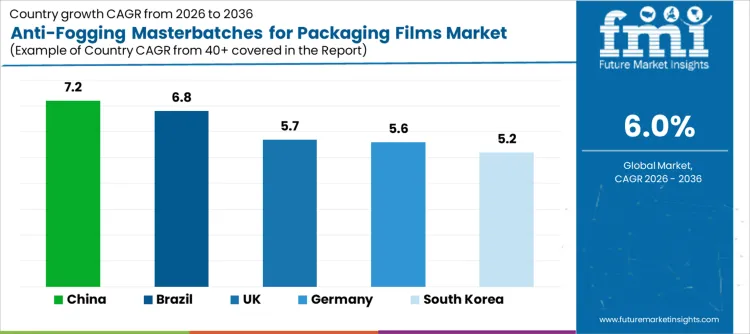
| Country | CAGR (%) |
|---|---|
| China | 7.2 |
| Brazil | 6.8 |
| United Kingdom | 5.7 |
| Germany | 5.6 |
| South Korea | 5.2 |
Why is China Leading the Anti-Fogging Masterbatches for Packaging Films Market?
China’s anti-fogging masterbatches for packaging films market is expanding at a CAGR of 7.2% during 2026-2036, driven by the country’s massive flexible packaging industry and growing demand for fresh and chilled food packaging. Anti-fog additives are widely used in films for fresh produce, meat, seafood, and ready-to-eat foods, where visibility and moisture control are critical. Rapid growth in supermarkets, food delivery services, and cold-chain logistics continues to support demand. Chinese film producers prioritize anti-fog masterbatches that offer fast activation, long-lasting performance, and compatibility with polyethylene and polypropylene film structures. Domestic additive suppliers benefit from scale, competitive pricing, and close proximity to film extrusion facilities, enabling quick customization. Procurement decisions emphasize cost efficiency, batch consistency, and performance under high humidity and temperature variation. As packaged food consumption continues to rise, demand for anti-fogging masterbatches is expected to remain strong across China’s packaging value chain.
Why Is Brazil Emerging as a High-Growth Market for Anti-Fogging Masterbatches?
Brazil’s anti-fogging masterbatches for packaging films market is growing at a CAGR of 6.8% during 2026-2036, supported by increasing consumption of packaged fresh foods and expansion of refrigerated distribution. Anti-fog films are increasingly used in produce packaging, dairy products, and meat applications to improve product presentation and reduce spoilage perception. Brazilian converters value anti-fog masterbatches that perform reliably in warm and humid climates while maintaining film clarity and seal integrity. Adoption is strong among food processors and retailers focused on extending shelf presentation quality. Procurement decisions often favor suppliers offering local availability, technical support, and compatibility with existing extrusion lines. Market growth is supported by expanding retail food chains and gradual upgrades in flexible packaging performance standards.
What Is Driving Demand for Anti-Fogging Masterbatches in the United Kingdom?
The United Kingdom anti-fogging masterbatches for packaging films market is expanding at a CAGR of 5.7% during 2026-2036, driven by demand from fresh food packaging, convenience foods, and chilled retail products. Anti-fog films are widely used to maintain product visibility in refrigerated environments and reduce condensation during temperature changes. UK converters emphasize consistency, compliance with food-contact regulations, and predictable performance across different film thicknesses. Demand is strongest in premium food packaging and retailer-specified packaging formats. Procurement decisions prioritize supplier reliability, regulatory documentation, and long-term performance data. Market growth is reinforced by steady consumption of packaged foods and continued emphasis on packaging functionality and presentation quality.
How Is Germany Supporting Growth in the Anti-Fogging Masterbatches Market?
Germany’s anti-fogging masterbatches for packaging films market is growing at a CAGR of 5.6% during 2026-2036, supported by strong demand from food processing, meat packaging, and dairy segments. German packaging producers focus on precision film performance, optical clarity, and reproducibility. Buyers prioritize masterbatches that deliver uniform dispersion, long-term anti-fog action, and compatibility with advanced multilayer film structures. Adoption is driven by quality and performance requirements rather than volume growth. Procurement decisions favor suppliers with certified quality systems and the ability to support customized formulations. Market growth is reinforced by Germany’s focus on high-quality food packaging and advanced film manufacturing.
How Is South Korea Expanding Use of Anti-Fogging Masterbatches?
South Korea’s anti-fogging masterbatches for packaging films market is expanding at a CAGR of 5.2% during 2026-2036, driven by demand from fresh food packaging, ready-meal products, and export-oriented food processing. Anti-fog additives are increasingly used to maintain packaging clarity during refrigeration and long-distance transport. South Korean converters emphasize masterbatch stability, compatibility with high-speed extrusion, and consistent optical performance. Adoption is strongest in premium and export-focused packaging formats.
Procurement decisions are influenced by supplier technical capability, consistent quality, and alignment with international food-packaging standards. Market growth is supported by steady expansion of packaged food production and increasing focus on packaging functionality.
How Are Companies Competing in the Anti-Fogging Masterbatches for Packaging Films Market?
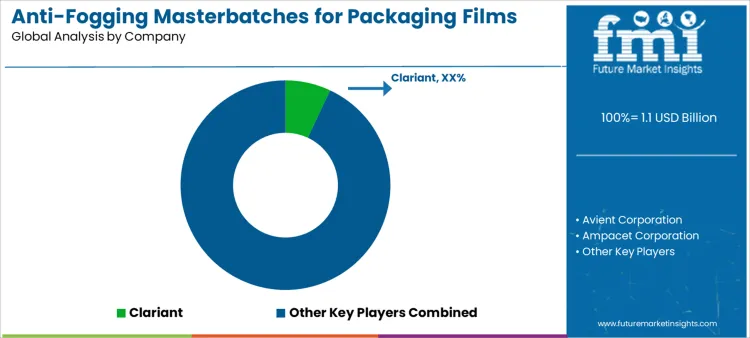
Competition in the anti-fogging masterbatches for packaging films market is driven by additive performance, compatibility with high-speed film extrusion/blown film lines, and reliable clarity under cold-chain and high-humidity conditions. Anti-fog masterbatches must deliver uniform droplet dispersion, minimal haze, and robust processing without compromising mechanical film properties. Clariant positions its anti-fog masterbatches with product materials emphasizing rapid fog dissipation, excellent clarity, and stable performance in chilled and frozen food packaging. Its portfolio focuses on solutions that integrate easily with polyethylene and polypropylene film formulations used in retail and industrial packaging.
Global material and masterbatch specialists differentiate through formulation breadth and application support. Avient Corporation competes by offering tailored anti-fog masterbatches developed for specific resin systems and film processing conditions, with technical documentation that highlights haze control and additive dispersion. Ampacet Corporation reinforces its market presence through customizable anti-fog solutions designed for high-output lines and demanding end-use clarity requirements. LyondellBasell, via its masterbatch operations or partners, leverages polymer expertise to position anti-fog additives that balance processability and performance.
Regional and niche players add competitive depth with cost-effective and localized support. Ravago and Gabriel-Chemie offer anti-fog masterbatches tuned to European and global film applications. Legacy operations from PolyOne and offerings from Plastiblends India and Americhem emphasize customizable additive packages that support local packaging markets. BASF contributes through additive collaborations that enhance base resin and masterbatch performance. Across the market, competitive advantage is defined by verified anti-fog efficacy, film clarity, and ease of processing rather than masterbatch pricing alone.
Key Players in Anti-Fogging Masterbatches for Packaging Films Market
- Clariant
- Avient Corporation
- Ampacet Corporation
- LyondellBasell (masterbatch operations/partners)
- Ravago
- Gabriel-Chemie
- PolyOne legacy operations
- Plastiblends India
- BASF (film additives via MB partners)
- Americhem
Scope of Report
| Attribute | Details |
|---|---|
| Market Size Unit | USD Billion |
| Polymer Carrier Covered | PE-Based Masterbatches, PP-Based Masterbatches, Other Polymers |
| Application Covered | Fresh Produce & Food Packaging, Meat, Dairy & Bakery Films, Industrial & Other Films |
| Countries Covered | China, Japan, South Korea, India, Australia & New Zealand, ASEAN, Rest of Asia Pacific, Germany, United Kingdom, France, Italy, Spain, Nordic, BENELUX, Rest of Europe, United States, Canada, Mexico, Brazil, Chile, Rest of Latin America, Kingdom of Saudi Arabia, Other GCC Countries, Turkey, South Africa, Other African Union, Rest of Middle East & Africa |
| Regions Covered | Asia Pacific, Europe, North America, Latin America, Middle East & Africa |
| Key Companies Profiled | Clariant, Avient Corporation, Ampacet Corporation, LyondellBasell, Ravago, Gabriel-Chemie, PolyOne (legacy operations), Plastiblends India, BASF, Americhem |
| Additional Attributes | Dollar sales of anti-fogging masterbatches are analyzed by polymer carrier and packaging film application across flexible food and industrial packaging formats. The scope evaluates anti-fog performance duration, migration behavior, optical clarity retention, food-contact compliance, and compatibility with mono-material and downgauged films. Country-level analysis reflects growth in fresh food packaging demand, expansion of cold-chain infrastructure, tightening food safety and visibility requirements, and increasing adoption of functional additive masterbatches in high-performance packaging films. |
Anti-Fogging Masterbatches for Packaging Films Market by Key Segments
Polymer Carrier :
- PE-Based Masterbatches
- PP-Based Masterbatches
- Other Polymers
Application :
- Fresh Produce & Food Packaging
- Meat, Dairy & Bakery Films
- Industrial & Other Films
Region :
- Asia Pacific
- China
- Japan
- South Korea
- India
- Australia & New Zealand
- ASEAN
- Rest of Asia Pacific
- Europe
- Germany
- United Kingdom
- France
- Italy
- Spain
- Nordic
- BENELUX
- Rest of Europe
- North America
- United States
- Canada
- Mexico
- Latin America
- Brazil
- Chile
- Rest of Latin America
- Middle East & Africa
- Kingdom of Saudi Arabia
- Other GCC Countries
- Turkey
- South Africa
- Other African Union
- Rest of Middle East & Africa
Bibliography
- European Commission, Joint Research Centre. (2024). Food contact materials: Migration, surface activity, and functional additives in plastic packaging. Publications Office of the European Union.
- International Organization for Standardization. (2024). ISO 22000‑4: Packaging materials-Functional performance requirements for food packaging applications. ISO.
- Organisation for Economic Co‑operation and Development. (2023). Safety evaluation and regulatory oversight of additives used in food packaging plastics. OECD Publishing.
- USA. Food and Drug Administration. (2023). Guidance for industry: Use of functional additives in food‑contact polymer films. USA. Department of Health and Human Services.
- Zhang, Y., Liu, H., Wang, S., & Chen, J. (2024). Surface‑active additives for condensation control in polymer packaging films: Mechanisms and performance durability. Food Packaging and Shelf Life, 39, 101145.
Frequently Asked Questions
How big is the anti-fogging masterbatches for packaging films market in 2026?
The global anti-fogging masterbatches for packaging films market is estimated to be valued at USD 1.1 billion in 2026.
What will be the size of anti-fogging masterbatches for packaging films market in 2036?
The market size for the anti-fogging masterbatches for packaging films market is projected to reach USD 2.0 billion by 2036.
How much will be the anti-fogging masterbatches for packaging films market growth between 2026 and 2036?
The anti-fogging masterbatches for packaging films market is expected to grow at a 6.0% CAGR between 2026 and 2036.
What are the key product types in the anti-fogging masterbatches for packaging films market?
The key product types in anti-fogging masterbatches for packaging films market are pe-based masterbatches, pp-based masterbatches and other polymers.
Which application segment to contribute significant share in the anti-fogging masterbatches for packaging films market in 2026?
In terms of application, fresh produce & food packaging segment to command 48.0% share in the anti-fogging masterbatches for packaging films market in 2026.
Preview the report firsthand - request a free sample
Get SampleGet the brochure for pricing and purchase details.
Get PDFTable of Content
- Executive Summary
- Global Market Outlook
- Demand-side Trends
- Supply-side Trends
- Technology Roadmap Analysis
- Analysis and Recommendations
- Market Overview
- Market Coverage / Taxonomy
- Market Definition / Scope / Limitations
- Market Background
- Market Dynamics
- Drivers
- Restraints
- Opportunity
- Trends
- Scenario Forecast
- Demand in Optimistic Scenario
- Demand in Likely Scenario
- Demand in Conservative Scenario
- Opportunity Map Analysis
- Product Life Cycle Analysis
- Supply Chain Analysis
- Investment Feasibility Matrix
- Value Chain Analysis
- PESTLE and Porter’s Analysis
- Regulatory Landscape
- Regional Parent Market Outlook
- Production and Consumption Statistics
- Import and Export Statistics
- Market Dynamics
- Global Market Analysis 2021 to 2025 and Forecast, 2026 to 2036
- Historical Market Size Value (USD Million) Analysis, 2021 to 2025
- Current and Future Market Size Value (USD Million) Projections, 2026 to 2036
- Y-o-Y Growth Trend Analysis
- Absolute $ Opportunity Analysis
- Global Market Pricing Analysis 2021 to 2025 and Forecast 2026 to 2036
- Global Market Analysis 2021 to 2025 and Forecast 2026 to 2036, By Polymer Carrier
- Introduction / Key Findings
- Historical Market Size Value (USD Million) Analysis By Polymer Carrier , 2021 to 2025
- Current and Future Market Size Value (USD Million) Analysis and Forecast By Polymer Carrier , 2026 to 2036
- PE-Based Masterbatches
- PP-Based Masterbatches
- Other Polymers
- PE-Based Masterbatches
- Y-o-Y Growth Trend Analysis By Polymer Carrier , 2021 to 2025
- Absolute $ Opportunity Analysis By Polymer Carrier , 2026 to 2036
- Global Market Analysis 2021 to 2025 and Forecast 2026 to 2036, By Application
- Introduction / Key Findings
- Historical Market Size Value (USD Million) Analysis By Application, 2021 to 2025
- Current and Future Market Size Value (USD Million) Analysis and Forecast By Application, 2026 to 2036
- Fresh Produce & Food Packaging
- Meat, Dairy & Bakery Films
- Industrial & Other Films
- Fresh Produce & Food Packaging
- Y-o-Y Growth Trend Analysis By Application, 2021 to 2025
- Absolute $ Opportunity Analysis By Application, 2026 to 2036
- Global Market Analysis 2021 to 2025 and Forecast 2026 to 2036, By Region
- Introduction
- Historical Market Size Value (USD Million) Analysis By Region, 2021 to 2025
- Current Market Size Value (USD Million) Analysis and Forecast By Region, 2026 to 2036
- North America
- Latin America
- Western Europe
- Eastern Europe
- East Asia
- South Asia and Pacific
- Middle East & Africa
- Market Attractiveness Analysis By Region
- North America Market Analysis 2021 to 2025 and Forecast 2026 to 2036, By Country
- Historical Market Size Value (USD Million) Trend Analysis By Market Taxonomy, 2021 to 2025
- Market Size Value (USD Million) Forecast By Market Taxonomy, 2026 to 2036
- By Country
- USA
- Canada
- Mexico
- By Polymer Carrier
- By Application
- By Country
- Market Attractiveness Analysis
- By Country
- By Polymer Carrier
- By Application
- Key Takeaways
- Latin America Market Analysis 2021 to 2025 and Forecast 2026 to 2036, By Country
- Historical Market Size Value (USD Million) Trend Analysis By Market Taxonomy, 2021 to 2025
- Market Size Value (USD Million) Forecast By Market Taxonomy, 2026 to 2036
- By Country
- Brazil
- Chile
- Rest of Latin America
- By Polymer Carrier
- By Application
- By Country
- Market Attractiveness Analysis
- By Country
- By Polymer Carrier
- By Application
- Key Takeaways
- Western Europe Market Analysis 2021 to 2025 and Forecast 2026 to 2036, By Country
- Historical Market Size Value (USD Million) Trend Analysis By Market Taxonomy, 2021 to 2025
- Market Size Value (USD Million) Forecast By Market Taxonomy, 2026 to 2036
- By Country
- Germany
- UK
- Italy
- Spain
- France
- Nordic
- BENELUX
- Rest of Western Europe
- By Polymer Carrier
- By Application
- By Country
- Market Attractiveness Analysis
- By Country
- By Polymer Carrier
- By Application
- Key Takeaways
- Eastern Europe Market Analysis 2021 to 2025 and Forecast 2026 to 2036, By Country
- Historical Market Size Value (USD Million) Trend Analysis By Market Taxonomy, 2021 to 2025
- Market Size Value (USD Million) Forecast By Market Taxonomy, 2026 to 2036
- By Country
- Russia
- Poland
- Hungary
- Balkan & Baltic
- Rest of Eastern Europe
- By Polymer Carrier
- By Application
- By Country
- Market Attractiveness Analysis
- By Country
- By Polymer Carrier
- By Application
- Key Takeaways
- East Asia Market Analysis 2021 to 2025 and Forecast 2026 to 2036, By Country
- Historical Market Size Value (USD Million) Trend Analysis By Market Taxonomy, 2021 to 2025
- Market Size Value (USD Million) Forecast By Market Taxonomy, 2026 to 2036
- By Country
- China
- Japan
- South Korea
- By Polymer Carrier
- By Application
- By Country
- Market Attractiveness Analysis
- By Country
- By Polymer Carrier
- By Application
- Key Takeaways
- South Asia and Pacific Market Analysis 2021 to 2025 and Forecast 2026 to 2036, By Country
- Historical Market Size Value (USD Million) Trend Analysis By Market Taxonomy, 2021 to 2025
- Market Size Value (USD Million) Forecast By Market Taxonomy, 2026 to 2036
- By Country
- India
- ASEAN
- Australia & New Zealand
- Rest of South Asia and Pacific
- By Polymer Carrier
- By Application
- By Country
- Market Attractiveness Analysis
- By Country
- By Polymer Carrier
- By Application
- Key Takeaways
- Middle East & Africa Market Analysis 2021 to 2025 and Forecast 2026 to 2036, By Country
- Historical Market Size Value (USD Million) Trend Analysis By Market Taxonomy, 2021 to 2025
- Market Size Value (USD Million) Forecast By Market Taxonomy, 2026 to 2036
- By Country
- Kingdom of Saudi Arabia
- Other GCC Countries
- Turkiye
- South Africa
- Other African Union
- Rest of Middle East & Africa
- By Polymer Carrier
- By Application
- By Country
- Market Attractiveness Analysis
- By Country
- By Polymer Carrier
- By Application
- Key Takeaways
- Key Countries Market Analysis
- USA
- Pricing Analysis
- Market Share Analysis, 2025
- By Polymer Carrier
- By Application
- Canada
- Pricing Analysis
- Market Share Analysis, 2025
- By Polymer Carrier
- By Application
- Mexico
- Pricing Analysis
- Market Share Analysis, 2025
- By Polymer Carrier
- By Application
- Brazil
- Pricing Analysis
- Market Share Analysis, 2025
- By Polymer Carrier
- By Application
- Chile
- Pricing Analysis
- Market Share Analysis, 2025
- By Polymer Carrier
- By Application
- Germany
- Pricing Analysis
- Market Share Analysis, 2025
- By Polymer Carrier
- By Application
- UK
- Pricing Analysis
- Market Share Analysis, 2025
- By Polymer Carrier
- By Application
- Italy
- Pricing Analysis
- Market Share Analysis, 2025
- By Polymer Carrier
- By Application
- Spain
- Pricing Analysis
- Market Share Analysis, 2025
- By Polymer Carrier
- By Application
- France
- Pricing Analysis
- Market Share Analysis, 2025
- By Polymer Carrier
- By Application
- India
- Pricing Analysis
- Market Share Analysis, 2025
- By Polymer Carrier
- By Application
- ASEAN
- Pricing Analysis
- Market Share Analysis, 2025
- By Polymer Carrier
- By Application
- Australia & New Zealand
- Pricing Analysis
- Market Share Analysis, 2025
- By Polymer Carrier
- By Application
- China
- Pricing Analysis
- Market Share Analysis, 2025
- By Polymer Carrier
- By Application
- Japan
- Pricing Analysis
- Market Share Analysis, 2025
- By Polymer Carrier
- By Application
- South Korea
- Pricing Analysis
- Market Share Analysis, 2025
- By Polymer Carrier
- By Application
- Russia
- Pricing Analysis
- Market Share Analysis, 2025
- By Polymer Carrier
- By Application
- Poland
- Pricing Analysis
- Market Share Analysis, 2025
- By Polymer Carrier
- By Application
- Hungary
- Pricing Analysis
- Market Share Analysis, 2025
- By Polymer Carrier
- By Application
- Kingdom of Saudi Arabia
- Pricing Analysis
- Market Share Analysis, 2025
- By Polymer Carrier
- By Application
- Turkiye
- Pricing Analysis
- Market Share Analysis, 2025
- By Polymer Carrier
- By Application
- South Africa
- Pricing Analysis
- Market Share Analysis, 2025
- By Polymer Carrier
- By Application
- USA
- Market Structure Analysis
- Competition Dashboard
- Competition Benchmarking
- Market Share Analysis of Top Players
- By Regional
- By Polymer Carrier
- By Application
- Competition Analysis
- Competition Deep Dive
- Clariant
- Overview
- Product Portfolio
- Profitability by Market Segments (Product/Age /Sales Channel/Region)
- Sales Footprint
- Strategy Overview
- Marketing Strategy
- Product Strategy
- Channel Strategy
- Avient Corporation
- Ampacet Corporation
- LyondellBasell (masterbatch operations/partners)
- Ravago
- Gabriel-Chemie
- PolyOne legacy operations
- Plastiblends India
- BASF (film additives via MB partners)
- Americhem
- Clariant
- Competition Deep Dive
- Assumptions & Acronyms Used
- Research Methodology


