

- Market Size (2026)
- USD 4.5 Bn
- Forecast (2036)
- USD 8.1 Bn
- CAGR (2026 to 2036)
- 6.2%
Beach Towels Market Size, Market Forecast and Outlook By FMI
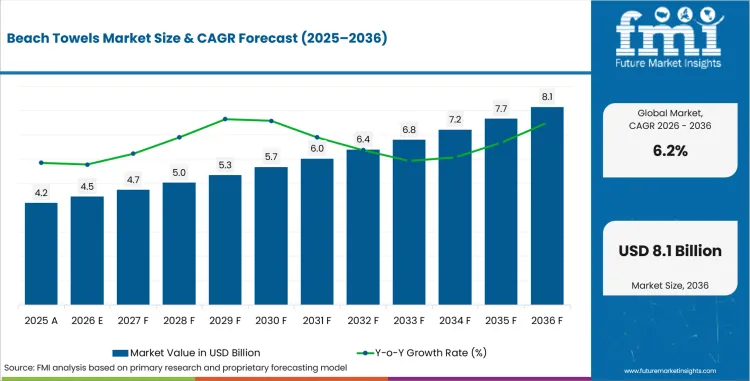
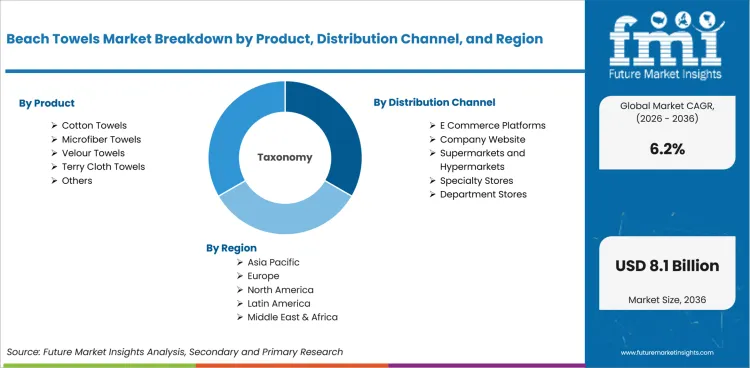
The beach towels market was valued at USD 4.2 billion in 2025. The market is set to reach USD 4.5 billion by 2026-end and grow at a CAGR of 6.2% between 2026-2036 to reach USD 8.1 billion by 2036. Cotton Towels will dominate with a 38.0% share, while E Commerce Platforms will lead with a 34.0% share.
Key Takeaways, Market Size, and Forecast
- The Beach Towels market was valued at USD 4.20 billion in 2025.
- By 2036, the Beach Towels Market is expected to be worth USD 8.14 billion.
- From 2026 to 2036, the market is projected to expand at a CAGR of 6.2%.
- The market is projected to create an incremental opportunity of USD 3.68 billion between 2026 and 2036.
- In 2026, Cotton Towels is expected to account for 38.0% of the Product, driven by the broad consumer preference for cotton terry cloth towels that deliver absorbency, softness, and durability for bath, beach, and pool use across residential and hospitality applications.
- China (7.5%) and India (7.2%) are two of the fastest growing markets in the world.
Summary of the Beach Towels Market
- Demand and Growth Drivers
- Sustained global tourism growth and the expansion of beach and pool leisure activities are maintaining demand for beach towels across residential consumer purchasing and hospitality industry procurement.
- Consumer premiumization driven by preference for oversized, quick-dry, and sand-resistant towel technologies is creating value growth beyond basic cotton terry towel commodity purchasing.
- The growth of direct-to-consumer beach towel brands with distinctive designs, sustainable materials, and social media marketing is expanding product awareness and consumer willingness to pay for branded towel products.
- Product and Segment View
- Cotton towels account for 38.0% of the product segment, supported by the established consumer preference for natural fiber absorbency, softness, and durability in bath and beach towel applications.
- By distribution, e-commerce platforms hold 34.0% share, reflecting the shift toward online purchasing where visual design selection, customer reviews, and brand discovery drive beach towel procurement decisions.
- Mass-priced products account for 61.0% of the price tier segment, confirming that affordable, durable towels for everyday bath and seasonal beach use represent the procurement majority.
- Geography and Competitive Outlook
- China is projected to grow at 7.5% through 2036, supported by the scale of textile manufacturing, competitive pricing from domestic production, and growing domestic consumer demand for quality bath and beach towel products.
- India follows at 7.2%, reflecting rising consumer willingness to invest in quality beach and bath towels, combined with the expansion of direct-to-consumer brands through online retail.
- Companies that combine design distinctiveness, material quality, brand positioning in the lifestyle and leisure category, and distribution across online, department store, and specialty retail channels are positioned to gain traction during the forecast period.
- Analyst Opinion
- The beach towels market is undergoing a brand transformation from commodity textile to lifestyle accessory as direct-to-consumer brands invest in distinctive designs, sustainable materials, and community-driven marketing. Traditional towels competed on thread count and GSM weight, while emerging brands compete on visual design, sand-resistance technology, and brand identity that consumers want to display on beaches and poolsides. Companies that can build recognizable design languages and loyal customer communities through social media engagement are commanding premiums that commodity textile manufacturers cannot achieve. The competitive advantage is shifting from production scale to brand storytelling.
- The Beach Towels Market is moving from a supply driven model toward a demand responsive structure where end user requirements shape product development.
- Adoption is increasing due to evolving consumer expectations and expanding distribution channel accessibility across online and retail formats.
- Growth reflects the structural shift toward higher specification products and more informed purchasing behavior driven by online research and reviews.
- Demand is further supported by changing lifestyle preferences and growing awareness of product quality and performance differences across brands.
Beach Towels Market Definition
The beach towels market covers textile products designed for beach, pool, bath, and outdoor leisure use including cotton, microfiber, and blend fabric towels. Products are distributed through e-commerce, department stores, supermarkets, specialty stores, and hospitality supply channels.
Beach Towels Market Inclusions
Market scope encompasses all commercially traded products categorized by Product (Cotton Towels, Microfiber Towels, Velour Towels, Terry Cloth Towels, Others); Distribution Channel (E Commerce Platforms, Company Website, Supermarkets and Hypermarkets, Specialty Stores, Department Stores); End User (Residential, Commercial, Hospitality); Application (Bath Use, Sports and Fitness, Travel Use); Price Tier (Mass, Premium). Revenue estimates cover the forecast period from 2026 to 2036.
Beach Towels Market Exclusions
The scope does not include bath towels marketed exclusively for indoor bathroom use, industrial cleaning towels, spa and salon professional towels, or microfiber cloths marketed as cleaning supplies rather than personal towels.
Beach Towels Market Research Methodology
- Primary Research: FMI analysts conducted interviews with textile brand managers, hospitality procurement officers, department store home category buyers, and cotton and microfiber fabric suppliers across key markets to validate demand patterns, pricing structures, and procurement dynamics.
- Desk Research: Research combined data from textile industry production statistics, tourism expenditure databases, and hospitality procurement reports, with cross referencing against publicly available industry databases and regulatory filings.
- Market Sizing and Forecasting: Market sizing uses a hybrid bottom up and top down approach, aggregating demand across product, distribution channel, end user, application, price tier with regional adoption curves.
- Data Validation: Data was validated quarterly against production statistics, trade data, and manufacturer disclosures to maintain forecast accuracy.
Why is the Beach Towels Market Growing?
- Global tourism recovery and the sustained expansion of beach and pool leisure activities are maintaining demand for beach towels across residential consumer purchasing and hospitality industry procurement channels.
- Consumer premiumization toward oversized, quick-dry, sand-resistant, and design-distinctive towels is driving value growth beyond commodity cotton terry cloth purchasing at basic retail price points.
- China leads growth at 7.5%, supported by the scale of textile manufacturing, competitive pricing from domestic production, and growing domestic consumer demand for quality bath and beach towel products.
The beach towels market is expanding as global travel recovery, growing beach and pool leisure participation, and the emergence of branded direct-to-consumer towel companies sustain demand across consumer and hospitality channels. The market has evolved from a commodity textile category into a lifestyle accessory segment where design distinctiveness, material technology, and brand identity command meaningful premiums over basic department store offerings.
Cotton towels lead the product segment at 38.0% share, with Turkish and Egyptian cotton long-staple varieties serving the premium sub-segment. E-commerce leads distribution at 34.0%. Mass-priced products hold 61.0% of price tier share, confirming that affordable towels for everyday use remain the volume base while premium brands capture disproportionate value growth.
Dock & Bay holds an estimated 20.0% market share through its microfiber quick-dry towels with distinctive designs marketed through direct-to-consumer and Amazon channels. Pendleton, Tesalate, and Sand Cloud compete on design heritage, material technology, and purpose-driven brand positioning respectively.
Market Segmentation Analysis
- Cotton Towels accounts for 38.0% of the Product segment, supported by established procurement patterns and application requirements.
- E Commerce Platforms holds 34.0% of the Distribution Channel segment, reflecting concentrated demand in core use cases.
The Beach Towels market is segmented by product, distribution channel, end user, application, price tier. Demand patterns reflect the concentration of procurement in established application areas and the growing diversification of end use requirements.
Insights into the Product Segment
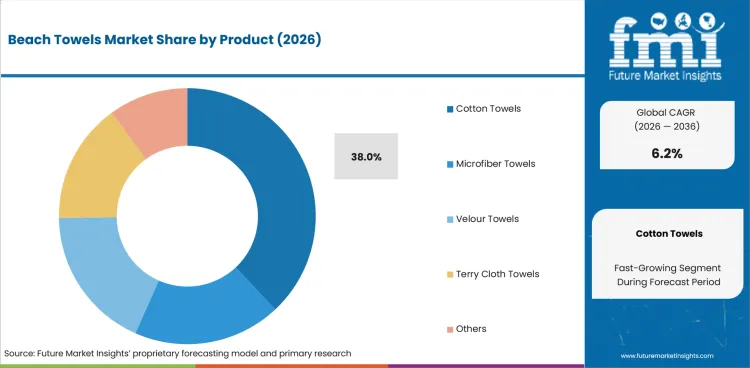
Cotton towels account for 38.0% of the product segment, supported by the established consumer preference for natural fiber absorbency, softness, and durability in bath and beach towel applications.
Insights into the Distribution Channel Segment
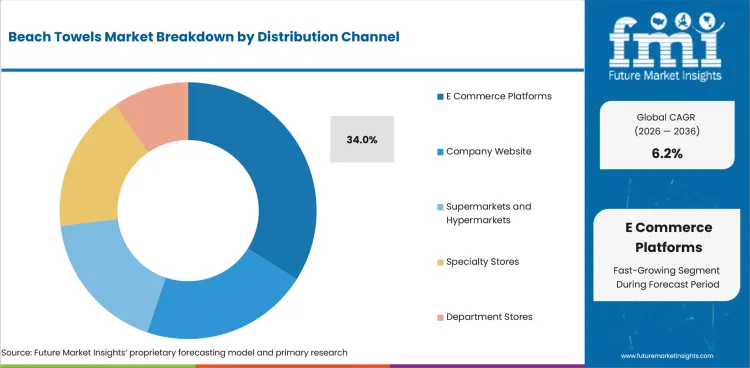
By distribution, e-commerce platforms hold 34.0% share, reflecting the shift toward online purchasing where visual design selection, customer reviews, and brand discovery drive beach towel procurement decisions.
Beach Towels Market Drivers, Restraints, and Opportunities
- Dock & Bay holds an estimated 20.0% market share through its distinctive microfiber quick-dry towel designs marketed through direct-to-consumer and online retail channels.
- Pendleton, Tesalate, and Sand Cloud compete on design heritage, material technology, and purpose-driven brand positioning with distinct target consumer segments.
- The competitive landscape is shaped by the tension between commodity cotton towel manufacturers competing on price and branded lifestyle towel companies competing on design and community.
The Beach Towels market is shaped by demand drivers, supply constraints, and emerging opportunities. Growth is supported by expanding application requirements, while cost pressures and competitive dynamics influence adoption rates.
Primary Demand Drivers
Sustained global tourism growth and the expansion of beach and pool leisure activities are maintaining demand for beach towels across residential consumer purchasing and hospitality industry procurement.
Supply and Cost Dynamics
Consumer premiumization driven by preference for oversized, quick-dry, and sand-resistant towel technologies is creating value growth beyond basic cotton terry towel commodity purchasing.
Emerging Growth Opportunities
The growth of direct-to-consumer beach towel brands with distinctive designs, sustainable materials, and social media marketing is expanding product awareness and consumer willingness to pay for branded towel products.
Analysis of Beach Towels Market By Key Countries
.webp "Top Country Growth Comparison Beach Towels Market Cagr (2026 2036)")
| Country | CAGR |
|---|---|
| China | 7.5% |
| India | 7.2% |
| USA | 6.7% |
| Germany | 6.6% |
| UK | 6.4% |
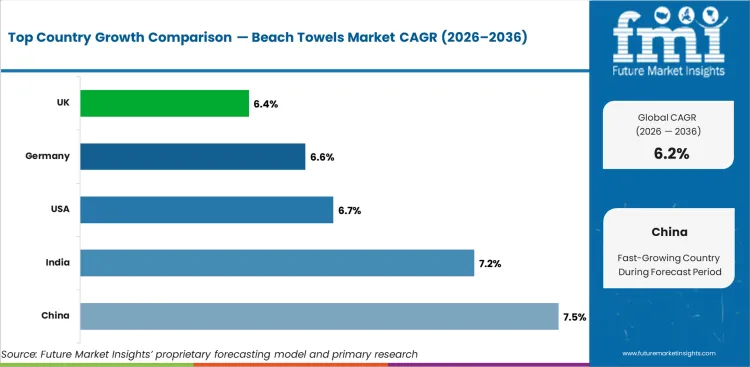
- China at 7.5%: supported by local market conditions and sector investment.
- India at 7.2%: supported by local market conditions and sector investment.
- USA at 6.7%: supported by local market conditions and sector investment.
- Germany at 6.6%: supported by local market conditions and sector investment.
The global beach towels market is expected to grow at a rate of 6.2% per year from 2026 to 2036. The study covers more than 30 countries, and the main markets are listed below.
Demand Outlook for Beach Towels Market in China
China is projected to grow at 7.5% through 2036. The scale of domestic textile manufacturing, combined with growing domestic consumer demand for quality bath and beach towels and the expansion of branded towel products through e-commerce platforms including Tmall and JD.com, creates the largest growth opportunity.
- Textile manufacturing scale provides cost advantages for both domestic branded towels and international private label production, creating competitive pricing across mass and premium segments.
- Growing domestic consumer demand for quality bath and beach products, influenced by rising disposable income and social media lifestyle content, is expanding the branded towel market beyond commodity purchasing.
- E-commerce platforms enable direct-to-consumer distribution for emerging towel brands, bypassing traditional department store and wholesale channels that historically dominated textile retail.
Future Outlook for Beach Towels Market in India
India is projected to grow at 7.2% through 2036. Growing domestic tourism, rising consumer spending on household textiles, and the expansion of organized retail for home furnishing products are sustaining demand for quality bath and beach towels across mass and premium price segments.
- Growing domestic tourism and rising household spending on textiles sustain demand for quality towels across the mass market, with premium cotton varieties gaining share as consumer expectations increase.
- The scale of cotton production in India provides natural material sourcing advantages for domestic towel manufacturers, supporting competitive pricing in both domestic and export market production.
- Online retail expansion through Amazon India and Flipkart is improving branded towel accessibility and enabling consumer product comparison beyond the traditional unbranded bazaar purchasing model.
Opportunity Analysis of Beach Towels Market in the United States
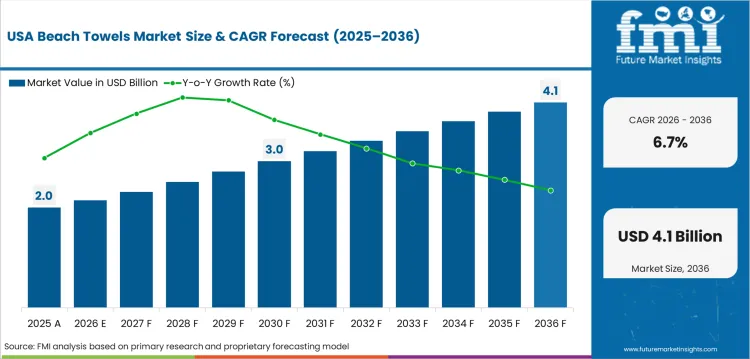
The United States is projected to grow at 6.7% through 2036. Beach and pool culture, the scale of domestic tourism, and the growth of direct-to-consumer branded towel companies through online retail sustain demand across mass market, premium, and hospitality procurement channels.
- Beach and pool culture across coastal and resort destinations creates sustained seasonal demand peaks that complement year-round bath towel purchasing through department store and online retail channels.
- Direct-to-consumer beach towel brands have established meaningful market positions through social media marketing and design differentiation that commands premiums over commodity department store offerings.
- Hospitality industry procurement for hotels, resorts, and vacation rental properties provides a stable institutional demand channel with volume contracts that complement consumer retail purchasing.
In-depth Analysis of Beach Towels Market in Germany
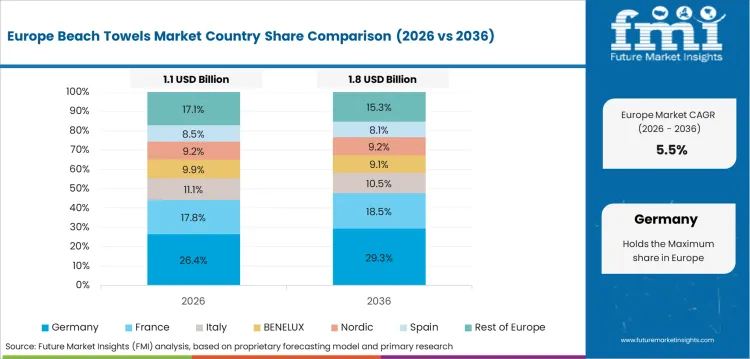
Germany is projected to grow at 6.6% through 2036. Consumer preference for durable, quality household textiles and the strength of home furnishing retail distribution sustain demand for beach and bath towels across cotton and microfiber material categories.
- Consumer preference for durable, high-quality household textiles sustains demand for towels constructed from quality cotton and microfiber materials with long service life expectations.
- Home furnishing retail distribution including department stores and specialty home stores provides structured channel access for branded towel products across the German market.
- Growing consumer interest in sustainable textile production and certified organic cotton creates demand for towels with documented environmental credentials and ethical sourcing practices.
Sales Analysis of Beach Towels Market in UK
The United Kingdom is projected to grow at 6.4% through 2036. Holiday travel culture, online retail growth for home and leisure textiles, and consumer interest in sustainable and designer towel brands sustain demand across mass market and premium price segments.
- Holiday travel culture and growing interest in beach lifestyle products sustain seasonal demand for beach towels that complement year-round bath towel replacement purchasing.
- Online retail growth for home textiles enables direct brand access and product comparison that supports premiumization beyond basic department store towel offerings.
- Consumer interest in sustainable and ethically produced textiles creates demand for towels made from recycled materials, organic cotton, and responsibly sourced fibers.
Competitive Landscape and Strategic Positioning
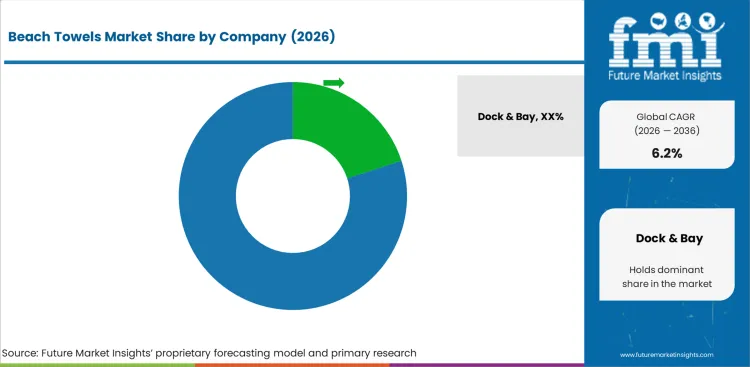
- Dock & Bay holds an estimated 20.0% market share through its distinctive microfiber quick-dry towel designs marketed through direct-to-consumer and online retail channels.
- Pendleton, Tesalate, and Sand Cloud compete on design heritage, material technology, and purpose-driven brand positioning with distinct target consumer segments.
- The competitive landscape is shaped by the tension between commodity cotton towel manufacturers competing on price and branded lifestyle towel companies competing on design and community.
Dock & Bay holds an estimated 20.0% market share through its compact, quick-dry microfiber towels with distinctive stripe designs, distributed primarily through its website, Amazon, and select lifestyle retail partnerships.
Pendleton competes on American heritage design and premium cotton quality. Tesalate offers sand-free microfiber technology from its Australian base. Sand Cloud builds community through ocean conservation mission-driven marketing.
The competitive landscape includes direct-to-consumer lifestyle brands, traditional textile manufacturers, and hospitality supply companies, with different competitive dynamics governing consumer retail versus institutional procurement.
Key Companies in the Beach Towels Market
Key global companies leading the beach towels market include:
- Dock & Bay, Pendleton, Tesalate, Sand Cloud hold established positions through product portfolios, brand recognition, and distribution relationships.
- Slowtide, Nomadix, Rumpl are specialized players focusing on differentiation and niche positioning.
- Turkish Towel Co., Laguna Beach Textile Co. represent emerging participants with growth potential.
Competitive Benchmarking: Beach Towels Market
| Company | Design Identity | Material Technology | DTC Capability | Brand Community |
|---|---|---|---|---|
| Dock & Bay | Strong | Strong | Strong | Strong |
| Pendleton | Strong | Moderate | Moderate | Strong |
| Tesalate | Moderate | Strong | Strong | Moderate |
| Sand Cloud | Moderate | Moderate | Strong | Strong |
Source: Future Market Insights competitive analysis, 2026.
Key Developments in Beach Towels Market
- In 2025, Dock & Bay launched a recycled plastic bottle microfiber towel collection targeting environmentally conscious consumers seeking sustainable beach accessories.
- In 2025, Sand Cloud expanded its towel range with a new Turkish cotton oversized beach towel collection, with proceeds supporting marine life conservation programs.
Key Players in the Beach Towels Market
Major Global Players
- Dock & Bay
- Pendleton
- Tesalate
- Sand Cloud
Emerging Players/Startups
- Slowtide
- Nomadix
- Rumpl
- Turkish Towel Co.
- Laguna Beach Textile Co.
Report Scope and Coverage
| Parameter | Details |
|---|---|
| Quantitative Units | USD 4.46 Billion to USD 8.14 Billion, at a CAGR of 6.2% |
| Market Definition | The beach towels market covers textile products designed for beach, pool, bath, and outdoor leisure use including cotton, microfiber, and blend fabric towels. |
| Regions Covered | North America, Latin America, Europe, East Asia, South Asia and Pacific, Middle East and Africa |
| Countries Covered | China, India, USA, Germany, UK, 30 plus countries |
| Key Companies Profiled | Dock & Bay, Pendleton, Tesalate, Sand Cloud |
| Forecast Period | 2026 to 2036 |
| Approach | Hybrid bottom up and top down methodology starting with verified transaction data, projecting adoption velocity across segments and regions. |
Market Segmentation Analysis
Beach Towels Market Segmented by Product:
- Cotton Towels
- Bath Towels
- Hand Towels
- Microfiber Towels
- Quick Dry Towels
- Sports Towels
- Velour Towels
- Luxury Velour Towels
- Printed Velour Towels
- Terry Cloth Towels
- Premium Terry Towels
- Hotel Use Terry Towels
- Others
Beach Towels Market Segmented by Distribution Channel:
-
- E Commerce Platforms
- Company Website
- Supermarkets and Hypermarkets
- Specialty Stores
- Department Stores
Beach Towels Market Segmented by End User:
- Residential
- Commercial
- Hospitality
Beach Towels Market Segmented by Application:
- Bath Use
- Sports and Fitness
- Travel Use
Beach Towels Market Segmented by Price Tier:
- Mass
- Premium
Beach Towels Market by Region:
- North America
- USA
- Canada
- Mexico
- Latin America
- Brazil
- Chile
- Rest of Latin America
- Western Europe
- Germany
- UK
- Italy
- Spain
- France
- Nordic
- BENELUX
- Rest of Western Europe
- Eastern Europe
- Russia
- Poland
- Hungary
- Balkan & Baltic
- Rest of Eastern Europe
- East Asia
- China
- Japan
- South Korea
- South Asia and Pacific
- India
- ASEAN
- Australia & New Zealand
- Rest of South Asia and Pacific
- Middle East & Africa
- Kingdom of Saudi Arabia
- Other GCC Countries
- Turkiye
- South Africa
- Other African Union
- Rest of Middle East & Africa
Research Sources and Bibliography
- 1. World Tourism Organization. (2025). UNWTO Global Tourism Recovery Barometer. UNWTO.
- 2. Euromonitor International. (2025). Home Textiles Market Data. Euromonitor.
- 3. International Trade Centre. (2025). ITC Cotton and Textile Trade Statistics. ITC.
- 4. National Retail Federation. (2025). NRF Home Furnishings Retail Report. NRF.
- 5. USA Bureau of Economic Analysis. (2025). BEA Personal Consumption: Household Textiles. BEA.
This bibliography is provided for reader reference. The full Future Market Insights report contains the complete reference list with publication dates, URLs, and supporting data for all cited works.
This Report Answers
- Estimating the size of the market and revenue from 2026 to 2036.
- Segmentation by product, distribution channel, end user, application, price tier.
- Insights about more than 30 markets in the region.
- Analysis of trends shaping the market.
- Assessment of the competitive landscape.
- Finding investment opportunities across key application areas.
- Supply chain and procurement pattern tracking.
- Delivery of data in PDF and Excel formats.
Frequently Asked Questions
How big is the beach towels market in 2026?
The global beach towels market is estimated to be valued at USD 4.5 billion in 2026.
What will be the size of beach towels market in 2036?
The market size for the beach towels market is projected to reach USD 8.1 billion by 2036.
How much will be the beach towels market growth between 2026 and 2036?
The beach towels market is expected to grow at a 6.2% CAGR between 2026 and 2036.
What are the key product types in the beach towels market?
The key product types in beach towels market are cotton towels, bath towels, hand towels, microfiber towels, quick dry towels, sports towels, velour towels, luxury velour towels, printed velour towels, terry cloth towels, premium terry towels, hotel use terry towels and others.
Which distribution channel segment is expected to contribute significant share in the beach towels market in 2026?
In terms of distribution channel, e commerce platforms segment is expected to command 34.0% share in the beach towels market in 2026.
Preview the report firsthand - request a free sample
Get SampleGet the brochure for pricing and purchase details.
Get PDFTable of Content
- Executive Summary
- Global Market Outlook
- Demand-side Trends
- Supply-side Trends
- Technology Roadmap Analysis
- Analysis and Recommendations
- Market Overview
- Market Coverage / Taxonomy
- Market Definition / Scope / Limitations
- Research Methodology
- Chapter Orientation
- Analytical Lens and Working Hypotheses
- Market Structure, Signals, and Trend Drivers
- Benchmarking and Cross-market Comparability
- Market Sizing, Forecasting, and Opportunity Mapping
- Research Design and Evidence Framework
- Desk Research Programme (Secondary Evidence)
- Company Annual and Sustainability Reports
- Peer-reviewed Journals and Academic Literature
- Corporate Websites, Product Literature, and Technical Notes
- Earnings Decks and Investor Briefings
- Statutory Filings and Regulatory Disclosures
- Technical White Papers and Standards Notes
- Trade Journals, Industry Magazines, and Analyst Briefs
- Conference Proceedings, Webinars, and Seminar Materials
- Government Statistics Portals and Public Data Releases
- Press Releases and Reputable Media Coverage
- Specialist Newsletters and Curated Briefings
- Sector Databases and Reference Repositories
- FMI Internal Proprietary Databases and Historical Market Datasets
- Subscription Datasets and Paid Sources
- Social Channels, Communities, and Digital Listening Inputs
- Additional Desk Sources
- Expert Input and Fieldwork (Primary Evidence)
- Primary Modes
- Qualitative Interviews and Expert Elicitation
- Quantitative Surveys and Structured Data Capture
- Blended Approach
- Why Primary Evidence is Used
- Field Techniques
- Interviews
- Surveys
- Focus Groups
- Observational and In-context Research
- Social and Community Interactions
- Stakeholder Universe Engaged
- C-suite Leaders
- Board Members
- Presidents and Vice Presidents
- R&D and Innovation Heads
- Technical Specialists
- Domain Subject-matter Experts
- Scientists
- Physicians and Other Healthcare Professionals
- Governance, Ethics, and Data Stewardship
- Research Ethics
- Data Integrity and Handling
- Primary Modes
- Tooling, Models, and Reference Databases
- Desk Research Programme (Secondary Evidence)
- Data Engineering and Model Build
- Data Acquisition and Ingestion
- Cleaning, Normalisation, and Verification
- Synthesis, Triangulation, and Analysis
- Quality Assurance and Audit Trail
- Market Background
- Market Dynamics
- Drivers
- Restraints
- Opportunity
- Trends
- Scenario Forecast
- Demand in Optimistic Scenario
- Demand in Likely Scenario
- Demand in Conservative Scenario
- Opportunity Map Analysis
- Product Life Cycle Analysis
- Supply Chain Analysis
- Investment Feasibility Matrix
- Value Chain Analysis
- PESTLE and Porter’s Analysis
- Regulatory Landscape
- Regional Parent Market Outlook
- Production and Consumption Statistics
- Import and Export Statistics
- Market Dynamics
- Global Market Analysis 2021 to 2025 and Forecast, 2026 to 2036
- Historical Market Size Value (USD Million) Analysis, 2021 to 2025
- Current and Future Market Size Value (USD Million) Projections, 2026 to 2036
- Y-o-Y Growth Trend Analysis
- Absolute $ Opportunity Analysis
- Global Market Pricing Analysis 2021 to 2025 and Forecast 2026 to 2036
- Global Market Analysis 2021 to 2025 and Forecast 2026 to 2036, By Product
- Introduction / Key Findings
- Historical Market Size Value (USD Million) Analysis By Product , 2021 to 2025
- Current and Future Market Size Value (USD Million) Analysis and Forecast By Product , 2026 to 2036
- Cotton Towels
- Bath Towels
- Hand Towels
- Microfiber Towels
- Quick Dry Towels
- Sports Towels
- Velour Towels
- Luxury Velour Towels
- Printed Velour Towels
- Terry Cloth Towels
- Cotton Towels
- Y-o-Y Growth Trend Analysis By Product , 2021 to 2025
- Absolute $ Opportunity Analysis By Product , 2026 to 2036
- Global Market Analysis 2021 to 2025 and Forecast 2026 to 2036, By Distribution Channel
- Introduction / Key Findings
- Historical Market Size Value (USD Million) Analysis By Distribution Channel, 2021 to 2025
- Current and Future Market Size Value (USD Million) Analysis and Forecast By Distribution Channel, 2026 to 2036
- E Commerce Platforms
- Company Website
- Supermarkets and Hypermarkets
- Specialty Stores
- Department Stores
- E Commerce Platforms
- Y-o-Y Growth Trend Analysis By Distribution Channel, 2021 to 2025
- Absolute $ Opportunity Analysis By Distribution Channel, 2026 to 2036
- Global Market Analysis 2021 to 2025 and Forecast 2026 to 2036, By End User
- Introduction / Key Findings
- Historical Market Size Value (USD Million) Analysis By End User, 2021 to 2025
- Current and Future Market Size Value (USD Million) Analysis and Forecast By End User, 2026 to 2036
- Residential
- Commercial
- Hospitality
- Residential
- Y-o-Y Growth Trend Analysis By End User, 2021 to 2025
- Absolute $ Opportunity Analysis By End User, 2026 to 2036
- Global Market Analysis 2021 to 2025 and Forecast 2026 to 2036, By Application
- Introduction / Key Findings
- Historical Market Size Value (USD Million) Analysis By Application, 2021 to 2025
- Current and Future Market Size Value (USD Million) Analysis and Forecast By Application, 2026 to 2036
- Bath Use
- Sports and Fitness
- Travel Use
- Bath Use
- Y-o-Y Growth Trend Analysis By Application, 2021 to 2025
- Absolute $ Opportunity Analysis By Application, 2026 to 2036
- Global Market Analysis 2021 to 2025 and Forecast 2026 to 2036, By Price Tier
- Introduction / Key Findings
- Historical Market Size Value (USD Million) Analysis By Price Tier, 2021 to 2025
- Current and Future Market Size Value (USD Million) Analysis and Forecast By Price Tier, 2026 to 2036
- Mass
- Premium
- Mass
- Y-o-Y Growth Trend Analysis By Price Tier, 2021 to 2025
- Absolute $ Opportunity Analysis By Price Tier, 2026 to 2036
- Global Market Analysis 2021 to 2025 and Forecast 2026 to 2036, By Region
- Introduction
- Historical Market Size Value (USD Million) Analysis By Region, 2021 to 2025
- Current Market Size Value (USD Million) Analysis and Forecast By Region, 2026 to 2036
- North America
- Latin America
- Western Europe
- Eastern Europe
- East Asia
- South Asia and Pacific
- Middle East & Africa
- Market Attractiveness Analysis By Region
- North America Market Analysis 2021 to 2025 and Forecast 2026 to 2036, By Country
- Historical Market Size Value (USD Million) Trend Analysis By Market Taxonomy, 2021 to 2025
- Market Size Value (USD Million) Forecast By Market Taxonomy, 2026 to 2036
- By Country
- USA
- Canada
- Mexico
- By Product
- By Distribution Channel
- By End User
- By Application
- By Price Tier
- By Country
- Market Attractiveness Analysis
- By Country
- By Product
- By Distribution Channel
- By End User
- By Application
- By Price Tier
- Key Takeaways
- Latin America Market Analysis 2021 to 2025 and Forecast 2026 to 2036, By Country
- Historical Market Size Value (USD Million) Trend Analysis By Market Taxonomy, 2021 to 2025
- Market Size Value (USD Million) Forecast By Market Taxonomy, 2026 to 2036
- By Country
- Brazil
- Chile
- Rest of Latin America
- By Product
- By Distribution Channel
- By End User
- By Application
- By Price Tier
- By Country
- Market Attractiveness Analysis
- By Country
- By Product
- By Distribution Channel
- By End User
- By Application
- By Price Tier
- Key Takeaways
- Western Europe Market Analysis 2021 to 2025 and Forecast 2026 to 2036, By Country
- Historical Market Size Value (USD Million) Trend Analysis By Market Taxonomy, 2021 to 2025
- Market Size Value (USD Million) Forecast By Market Taxonomy, 2026 to 2036
- By Country
- Germany
- UK
- Italy
- Spain
- France
- Nordic
- BENELUX
- Rest of Western Europe
- By Product
- By Distribution Channel
- By End User
- By Application
- By Price Tier
- By Country
- Market Attractiveness Analysis
- By Country
- By Product
- By Distribution Channel
- By End User
- By Application
- By Price Tier
- Key Takeaways
- Eastern Europe Market Analysis 2021 to 2025 and Forecast 2026 to 2036, By Country
- Historical Market Size Value (USD Million) Trend Analysis By Market Taxonomy, 2021 to 2025
- Market Size Value (USD Million) Forecast By Market Taxonomy, 2026 to 2036
- By Country
- Russia
- Poland
- Hungary
- Balkan & Baltic
- Rest of Eastern Europe
- By Product
- By Distribution Channel
- By End User
- By Application
- By Price Tier
- By Country
- Market Attractiveness Analysis
- By Country
- By Product
- By Distribution Channel
- By End User
- By Application
- By Price Tier
- Key Takeaways
- East Asia Market Analysis 2021 to 2025 and Forecast 2026 to 2036, By Country
- Historical Market Size Value (USD Million) Trend Analysis By Market Taxonomy, 2021 to 2025
- Market Size Value (USD Million) Forecast By Market Taxonomy, 2026 to 2036
- By Country
- China
- Japan
- South Korea
- By Product
- By Distribution Channel
- By End User
- By Application
- By Price Tier
- By Country
- Market Attractiveness Analysis
- By Country
- By Product
- By Distribution Channel
- By End User
- By Application
- By Price Tier
- Key Takeaways
- South Asia and Pacific Market Analysis 2021 to 2025 and Forecast 2026 to 2036, By Country
- Historical Market Size Value (USD Million) Trend Analysis By Market Taxonomy, 2021 to 2025
- Market Size Value (USD Million) Forecast By Market Taxonomy, 2026 to 2036
- By Country
- India
- ASEAN
- Australia & New Zealand
- Rest of South Asia and Pacific
- By Product
- By Distribution Channel
- By End User
- By Application
- By Price Tier
- By Country
- Market Attractiveness Analysis
- By Country
- By Product
- By Distribution Channel
- By End User
- By Application
- By Price Tier
- Key Takeaways
- Middle East & Africa Market Analysis 2021 to 2025 and Forecast 2026 to 2036, By Country
- Historical Market Size Value (USD Million) Trend Analysis By Market Taxonomy, 2021 to 2025
- Market Size Value (USD Million) Forecast By Market Taxonomy, 2026 to 2036
- By Country
- Kingdom of Saudi Arabia
- Other GCC Countries
- Turkiye
- South Africa
- Other African Union
- Rest of Middle East & Africa
- By Product
- By Distribution Channel
- By End User
- By Application
- By Price Tier
- By Country
- Market Attractiveness Analysis
- By Country
- By Product
- By Distribution Channel
- By End User
- By Application
- By Price Tier
- Key Takeaways
- Key Countries Market Analysis
- USA
- Pricing Analysis
- Market Share Analysis, 2025
- By Product
- By Distribution Channel
- By End User
- By Application
- By Price Tier
- Canada
- Pricing Analysis
- Market Share Analysis, 2025
- By Product
- By Distribution Channel
- By End User
- By Application
- By Price Tier
- Mexico
- Pricing Analysis
- Market Share Analysis, 2025
- By Product
- By Distribution Channel
- By End User
- By Application
- By Price Tier
- Brazil
- Pricing Analysis
- Market Share Analysis, 2025
- By Product
- By Distribution Channel
- By End User
- By Application
- By Price Tier
- Chile
- Pricing Analysis
- Market Share Analysis, 2025
- By Product
- By Distribution Channel
- By End User
- By Application
- By Price Tier
- Germany
- Pricing Analysis
- Market Share Analysis, 2025
- By Product
- By Distribution Channel
- By End User
- By Application
- By Price Tier
- UK
- Pricing Analysis
- Market Share Analysis, 2025
- By Product
- By Distribution Channel
- By End User
- By Application
- By Price Tier
- Italy
- Pricing Analysis
- Market Share Analysis, 2025
- By Product
- By Distribution Channel
- By End User
- By Application
- By Price Tier
- Spain
- Pricing Analysis
- Market Share Analysis, 2025
- By Product
- By Distribution Channel
- By End User
- By Application
- By Price Tier
- France
- Pricing Analysis
- Market Share Analysis, 2025
- By Product
- By Distribution Channel
- By End User
- By Application
- By Price Tier
- India
- Pricing Analysis
- Market Share Analysis, 2025
- By Product
- By Distribution Channel
- By End User
- By Application
- By Price Tier
- ASEAN
- Pricing Analysis
- Market Share Analysis, 2025
- By Product
- By Distribution Channel
- By End User
- By Application
- By Price Tier
- Australia & New Zealand
- Pricing Analysis
- Market Share Analysis, 2025
- By Product
- By Distribution Channel
- By End User
- By Application
- By Price Tier
- China
- Pricing Analysis
- Market Share Analysis, 2025
- By Product
- By Distribution Channel
- By End User
- By Application
- By Price Tier
- Japan
- Pricing Analysis
- Market Share Analysis, 2025
- By Product
- By Distribution Channel
- By End User
- By Application
- By Price Tier
- South Korea
- Pricing Analysis
- Market Share Analysis, 2025
- By Product
- By Distribution Channel
- By End User
- By Application
- By Price Tier
- Russia
- Pricing Analysis
- Market Share Analysis, 2025
- By Product
- By Distribution Channel
- By End User
- By Application
- By Price Tier
- Poland
- Pricing Analysis
- Market Share Analysis, 2025
- By Product
- By Distribution Channel
- By End User
- By Application
- By Price Tier
- Hungary
- Pricing Analysis
- Market Share Analysis, 2025
- By Product
- By Distribution Channel
- By End User
- By Application
- By Price Tier
- Kingdom of Saudi Arabia
- Pricing Analysis
- Market Share Analysis, 2025
- By Product
- By Distribution Channel
- By End User
- By Application
- By Price Tier
- Turkiye
- Pricing Analysis
- Market Share Analysis, 2025
- By Product
- By Distribution Channel
- By End User
- By Application
- By Price Tier
- South Africa
- Pricing Analysis
- Market Share Analysis, 2025
- By Product
- By Distribution Channel
- By End User
- By Application
- By Price Tier
- USA
- Market Structure Analysis
- Competition Dashboard
- Competition Benchmarking
- Market Share Analysis of Top Players
- By Regional
- By Product
- By Distribution Channel
- By End User
- By Application
- By Price Tier
- Competition Analysis
- Competition Deep Dive
- Dock & Bay
- Overview
- Product Portfolio
- Profitability by Market Segments (Product/Age /Sales Channel/Region)
- Sales Footprint
- Strategy Overview
- Marketing Strategy
- Product Strategy
- Channel Strategy
- Pendleton
- Tesalate
- Sand Cloud
- Other Companies (combined)
- Dock & Bay
- Competition Deep Dive
- Assumptions & Acronyms Used


