

- Industry Size (2026)
- USD 1360.0 Mn
- Forecast (2036)
- USD 3980.0 Mn
- CAGR (2026 to 2036)
- 11.30%
Compaction Technology Market for PCR Feedstock Transport Forecast and Outlook 2026 to 2036
The compaction technology market for PCR feedstock transport is likely to be valued at USD 1,360.0 million in 2026, is projected to reach USD 3,980.0 million by 2036, and is expected to expand at an 11.3% CAGR. Regulatory pressure is a primary force shaping adoption, as governments tighten controls on plastic waste handling, transport efficiency, and traceability across recycling chains. Extended producer responsibility rules, minimum recycled content mandates, and stricter reporting on material losses are pushing recyclers to formalize logistics operations, where compaction becomes a compliance enabler rather than an optional efficiency tool.
Certification requirements around bale quality, contamination thresholds, and transport safety are raising the bar for equipment performance and documentation, favoring vendors with proven designs and compliance-ready specifications. Compliance costs covering audits, monitoring, and standardized handling are encouraging buyers to invest in durable, high-throughput systems that reduce downstream risk. Vendors able to align equipment design with evolving regulatory frameworks are strengthening their positioning, while smaller or non-compliant suppliers face increasing barriers to participation.
Quick Stats for Compaction Technology Market for PCR Feedstock Transport
- Compaction Technology Market for PCR Feedstock Transport Value (2026): USD 1,360.0 Million
- Compaction Technology Market for PCR Feedstock Transport Forecast Value (2036): USD 3,980.0 Million
- Compaction Technology Market for PCR Feedstock Transport Forecast CAGR 2026 to 2036: 11.30%
- Leading Feedstock Type in Compaction Technology Market for PCR Feedstock Transport: Post-Consumer Plastics
- Key Growth Regions in Compaction Technology Market for PCR Feedstock Transport: Asia Pacific, Europe, North America
- Top Key Players in Compaction Technology Market for PCR Feedstock Transport: HSM, Marathon Equipment, International Baler, Jiangsu Sinobaler, Nihon Spindle, Maxwell Crushtech, Wuxi Shredwell
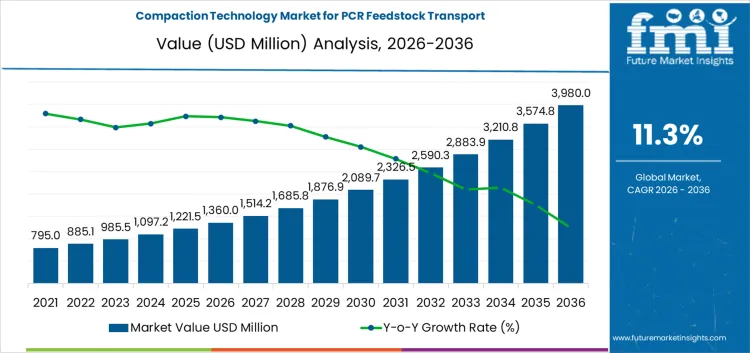
Compaction Technology Market for PCR Feedstock Transport Key Takeaways
| Metric | Value |
|---|---|
| Industry Value (2026) | USD 1,360.0 Million |
| Forecast Value (2036) | USD 3,980.0 Million |
| Forecast CAGR 2026 to 2036 | 11.30% |
How Is the Global Compaction Technology Market for PCR Feedstock Transport Advancing?
The global compaction technology market for PCR feedstock transport is advancing rapidly, driven by increasing volumes of post-consumer recycled (PCR) plastics moving through collection, sorting, and recycling value chains. Compaction systems are critical for reducing the volume of lightweight plastic waste such as films, bottles, and rigid packaging, enabling more efficient storage and cost-effective transportation to recycling facilities.
A key driver supporting market growth is the rising operational focus on logistics efficiency within plastic recycling networks. Transporting low-density PCR feedstock without compaction leads to high freight costs and inefficient use of transport capacity. Compaction technologies such as balers, densifiers, and screw compactors allow recyclers, material recovery facilities, and waste management operators to increase payload density while maintaining feedstock integrity for downstream processing.
Expansion of recycling infrastructure and PCR usage targets across packaging, consumer goods, and industrial applications is further contributing to market demand. As more manufacturers commit to higher PCR content, recycling facilities are scaling throughput, increasing the need for robust compaction systems that can handle mixed and contaminated plastic streams.
Technological advancements are strengthening market adoption. Improvements in compactor durability, automation, and material handling integration are enhancing uptime and processing efficiency. Modular and mobile compaction units are gaining traction for decentralized collection points. As PCR supply chains continue to scale globally, compaction technology for feedstock transport is expected to experience strong growth over the forecast period.
What is the Segment-Wise Overview of the Compaction Technology Market for PCR Feedstock Transport?
The compaction technology market for PCR feedstock transport is driven by the need to improve logistics efficiency and reduce transportation costs in recycling value chains. PCR feedstock logistics for rigid and flexible plastics lead the end-use segment with a 40% share, as large volumes of low-density plastic waste must be compacted before long-distance transport. Effective compaction improves load density, handling efficiency, and downstream processing economics. By feedstock type, post-consumer plastics dominate with a 51% share, reflecting their central role in circular plastics initiatives and regulatory mandates for recycled content. These segments highlight a market focused on optimizing logistics for post-consumer plastic recovery and improving the economics of PCR material movement across recycling networks.
Why Does PCR Feedstock Logistics Lead the Compaction Technology Market for PCR Feedstock Transport?
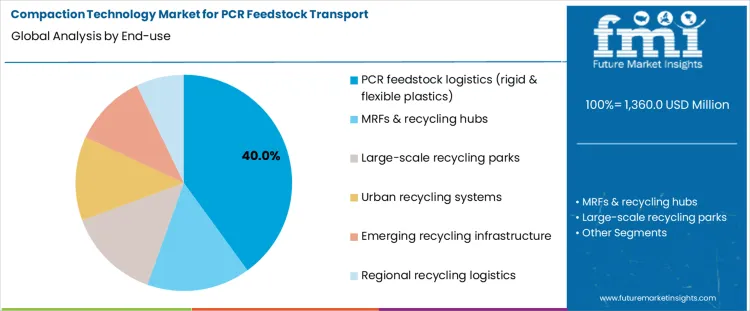
PCR feedstock logistics account for 40% of end-use demand due to the high cost and complexity of transporting lightweight plastic waste. Rigid and flexible plastics occupy significant volume relative to weight, making compaction essential for efficient logistics. Compaction technologies such as balers, compactors, and densifiers enable higher payload utilization, reduced transport frequency, and lower fuel costs. Logistics operators, recyclers, and aggregators rely on compaction to stabilize material flows between collection points, MRFs, and recycling plants. As recycling networks expand geographically, efficient feedstock transport becomes critical for maintaining supply continuity. This strong dependence on logistics optimization positions PCR feedstock transport as the leading end-use segment.
How Do Post-Consumer Plastics Drive Demand in the Compaction Technology Market?
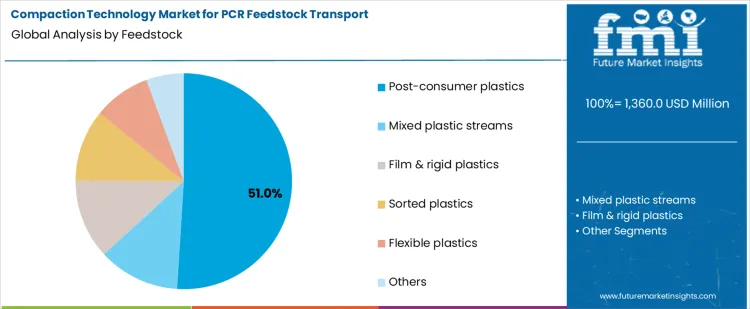
Post-consumer plastics represent 51% of feedstock demand, making them the dominant driver of compaction technology adoption. These materials originate from households, retail, and commercial waste streams, where plastics are dispersed, contaminated, and low in bulk density. Compaction is essential to consolidate collected plastics into manageable, transport-ready formats. Regulatory pressure to increase recycled content in packaging and consumer goods is accelerating recovery of post-consumer plastics, increasing handling volumes. Recycling operators require efficient compaction to move materials economically from collection sites to sorting and reprocessing facilities. As post-consumer plastic recovery scales, demand for robust, high-throughput compaction systems continues to rise across recycling infrastructure.
What Are the Key Dynamics for the Compaction Technology Market for PCR Feedstock Transport?
PCR feedstock such as plastic bottles, films, and rigid containers is typically low-density and bulky, increasing transportation costs if not compacted. Key market dynamics include rising volumes of collected plastic waste, expansion of recycling infrastructure, and the need to reduce transport frequency and cost per ton. Compaction technologies such as balers, compactors, densifiers, and agglomerators enable higher payload utilization and safer material handling. As recyclers focus on cost control and throughput optimization, demand for reliable compaction systems tailored to PCR feedstock transport continues to grow.
Why Is the Compaction Technology Market for PCR Feedstock Transport Growing?
The compaction technology market for PCR feedstock transport is growing as recycling programs scale up and material recovery facilities handle higher volumes of post-consumer plastics. Transporting uncompressed PCR feedstock is inefficient and costly due to low bulk density, making compaction a critical pre-transport step. Growth in packaging recycling mandates and brand commitments to increase PCR content are increasing demand for consistent, high-volume feedstock movement. Recycling operators are investing in compaction systems to reduce logistics costs, improve storage efficiency, and stabilize feedstock supply to downstream processors. Expansion of regional recycling hubs and cross-border feedstock movement further supports adoption.
What Are the Challenges Impacting the Compaction Technology Market for PCR Feedstock Transport?
Challenges in the compaction technology market for PCR feedstock transport include high upfront capital costs for industrial-grade compactors and balers, particularly for smaller recycling facilities. Variability in PCR feedstock composition, contamination levels, and moisture content can affect compaction efficiency and equipment wear. Space constraints at collection centers and material recovery facilities may limit installation of large compaction systems. Maintenance requirements and downtime risks can impact throughput if equipment is not properly serviced. Lack of standardized bale specifications across regions can complicate transport and acceptance by downstream recyclers. Workforce skill gaps in operating and maintaining automated compaction equipment also pose challenges, requiring ongoing training and technical support to ensure consistent performance.
What Is the Growth Outlook for the Compaction Technology Market for PCR Feedstock Transport by Country?
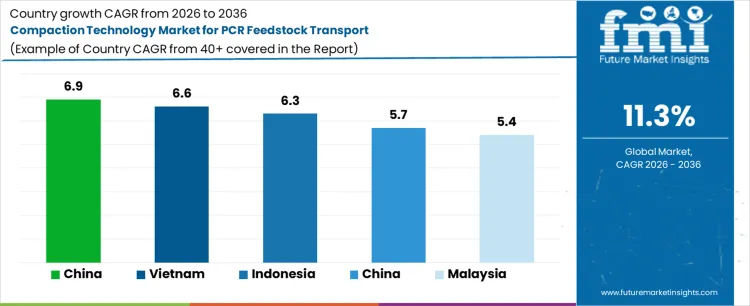
| Country | CAGR (%) |
|---|---|
| China | 6.9% |
| Vietnam | 6.6% |
| Indonesia | 6.3% |
| India | 5.7% |
| Malaysia | 5.4% |
The compaction technology market for PCR feedstock transport is expanding as recyclers focus on logistics efficiency and cost control. China leads with a 6.9% CAGR, driven by large-scale recycling operations and centralized processing. Vietnam follows at 6.6%, supported by export-oriented PCR growth. Indonesia grows at 6.3%, reflecting dispersed collection networks and rising recycling formalization. India records 5.7% growth, driven by organized recycling expansion and logistics optimization. Malaysia expands at 5.4%, supported by steady improvements in recycling operations. As PCR volumes rise, demand for efficient compaction solutions is expected to remain strong across these regions.
Why Is the Compaction Technology Market for PCR Feedstock Transport Expanding Strongly in China?
The compaction technology market for PCR feedstock transport in China is growing at a CAGR of 6.9%, driven by large-scale plastic recycling capacity expansion and high-volume post-consumer waste generation. China’s recycling operators are focusing on improving logistics efficiency for PCR feedstock such as PET, HDPE, and mixed plastics. Compaction systems reduce transport costs by increasing material density and improving load efficiency. Growth of centralized recycling hubs and long-distance transport from collection centers to processing facilities is strengthening demand. Operators are prioritizing equipment that improves handling efficiency and reduces contamination risks during transport. Industrial-scale recycling facilities require robust compaction solutions to manage high throughput. Policy-driven emphasis on circular material flows is reinforcing investment in downstream logistics infrastructure. As China continues to scale PCR utilization across packaging and manufacturing sectors, demand for compaction technology is expected to grow steadily.
What Is Driving Compaction Technology Market Growth for PCR Feedstock Transport in Vietnam?
The compaction technology market for PCR feedstock transport in Vietnam is expanding at a CAGR of 6.6%, supported by rapid growth in plastic recycling and export-oriented PCR processing. Vietnam’s recycling sector handles large volumes of post-consumer plastics collected from urban centers and coastal regions. Transport efficiency plays a critical role due to fragmented collection networks and centralized processing locations. Compaction systems help reduce logistics costs and improve storage efficiency. Recycling operators are investing in balers and compactors to stabilize feedstock quality during transport. Expansion of PCR usage in packaging and textiles is increasing throughput requirements. Growing involvement of multinational recyclers is raising operational standards across logistics chains. As Vietnam strengthens its recycling infrastructure, adoption of compaction technology for PCR feedstock transport is expected to rise consistently.
Why Is the Compaction Technology Market Developing Steadily in Indonesia?
The compaction technology market for PCR feedstock transport in Indonesia is growing at a CAGR of 6.3%, driven by increasing formalization of plastic waste collection and recycling activities. Indonesia’s dispersed geography makes transport efficiency a key operational challenge for recyclers. Compaction systems enable economical movement of low-density plastic waste from collection points to processing facilities. Growth of community-based collection programs and material recovery facilities is increasing demand for compactors. Recycling operators are focusing on reducing transport frequency and improving handling safety. Rising investment in PCR capacity for packaging and consumer goods is supporting higher feedstock volumes. Adoption of mobile and modular compaction systems is improving flexibility across collection networks. As Indonesia continues to improve recycling logistics, demand for compaction technology is expected to grow steadily.
What Factors Are Supporting Compaction Technology Market Growth for PCR Feedstock Transport in India?
The compaction technology market for PCR feedstock transport in India is expanding at a CAGR of 5.7%, supported by growing emphasis on organized recycling and extended producer responsibility frameworks. Collection of post-consumer plastics from urban and semi-urban regions creates high logistics complexity. Compaction systems improve transport economics by reducing volume and improving payload efficiency. Recycling operators are adopting compactors to manage mixed plastic streams and improve storage density. Growth of centralized recycling parks is increasing long-haul transport needs. Focus on reducing material losses during handling supports demand for enclosed compaction solutions. As PCR demand rises across packaging and consumer products, investment in logistics efficiency is increasing. These factors are supporting steady growth of compaction technology adoption in India.
Why Is the Compaction Technology Market Expanding Gradually in Malaysia?
The compaction technology market for PCR feedstock transport in Malaysia is growing at a CAGR of 5.4%, driven by gradual expansion of recycling capacity and PCR export activity. Recycling operators are focusing on improving feedstock consistency and reducing logistics costs. Compaction systems support efficient transport from collection centers to processing facilities and export hubs. Growth of industrial recycling and material recovery operations is supporting equipment demand. Operators value compactors that integrate easily into existing sorting lines. Rising quality requirements from downstream PCR buyers are encouraging better material handling practices. While market size remains moderate, operational efficiency goals continue to support adoption. As Malaysia strengthens its role in regional recycling supply chains, demand for compaction technology is expected to increase steadily.
How Are Companies Competing in the Compaction Technology Market for PCR Feedstock Transport?
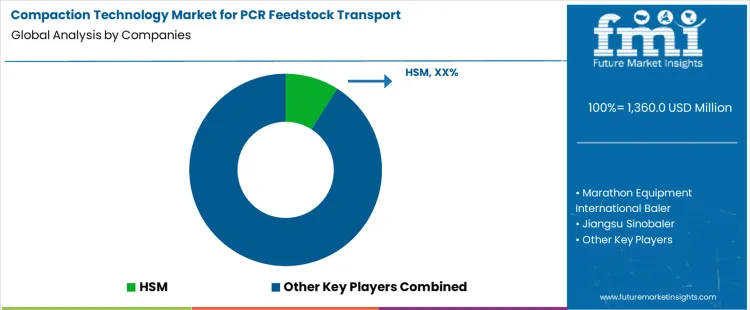
Competition in the compaction technology market for PCR feedstock transport is driven by bale density, throughput efficiency, operational uptime, and load stability during storage and transportation. Recyclers and material recovery facilities prioritize compaction systems that reduce logistics cost per ton while producing uniform, stable bales suitable for downstream sorting and reprocessing. Companies compete on ram force, hydraulic efficiency, automation level, contamination tolerance, and the ability to handle variable PCR feedstocks such as mixed plastics, films, and rigid materials. Differentiation increasingly centers on high-density compaction, reduced manual intervention, and systems designed for continuous, high-volume operation.
HSM, Marathon Equipment, and International Baler lead competition through extensive baler portfolios, strong presence in recycling operations, and proven reliability in high-duty-cycle environments. These companies emphasize robust frame construction, consistent bale formation, and serviceability to minimize downtime in PCR logistics workflows. International Baler differentiates through customization options and system configurations tailored to specific feedstock characteristics. Jiangsu Sinobaler competes through cost-efficient hydraulic balers designed for export markets, offering competitive density performance and broad product availability for price-sensitive operators.
Wuxi Shredwell, Nihon Spindle, and Maxwell Crushtech compete by positioning compaction within broader material handling and preprocessing solutions. Shredwell integrates baling and compaction with shredding and size-reduction systems, supporting efficient feedstock preparation before transport. Nihon Spindle focuses on industrial-grade machinery with emphasis on durability and precision engineering. Maxwell Crushtech competes through upstream material conditioning and volume reduction for rigid PCR streams. Across the market, competitive advantage is defined by consistent bale quality, transport efficiency, system reliability, and the ability to integrate compaction seamlessly into end-to-end PCR feedstock handling and logistics operations.
Key Players in Compaction Technology Market for PCR Feedstock Transport
- HSM
- Marathon Equipment International Baler
- Jiangsu Sinobaler
- Nihon Spindle
- Maxwell Crushtech
- Wuxi Shredwell
- International Baler
Scope of Report
| Attributes | Description |
|---|---|
| Quantitative Unit (2026) | USD Million |
| End-use | PCR Feedstock Logistics (Rigid & Flexible Plastics), MRFs & Recycling Hubs, Large-Scale Recycling Parks, Urban Recycling Systems, Emerging Recycling Infrastructure, Regional Recycling Logistics |
| Feedstock | Post-Consumer Plastics, Mixed Plastic Streams, Film & Rigid Plastics, Sorted Plastics, Flexible Plastics, Others |
| Regions Covered | Asia Pacific, Europe, North America, Latin America, Middle East & Africa |
| Countries Covered | China, Japan, South Korea, India, Australia & New Zealand, ASEAN, Rest of Asia Pacific, Germany, United Kingdom, France, Italy, Spain, Nordic, BENELUX, Rest of Europe, United States, Canada, Mexico, Brazil, Chile, Rest of Latin America, Kingdom of Saudi Arabia, Other GCC Countries, Turkey, South Africa, Other African Union, Rest of Middle East & Africa |
| Key Companies Profiled | HSM, Marathon Equipment International Baler, Jiangsu Sinobaler, Nihon Spindle, Maxwell Crushtech, Wuxi Shredwell, International Baler |
| Additional Attributes | Dollar sales by end-use and feedstock; regional market size and forecast analysis; growth outlook across major regions; adoption trends for compaction systems in PCR feedstock transport; assessment of volume reduction efficiency, logistics cost optimization, and demand patterns across recycling hubs, MRFs, and large-scale recycling infrastructure. |
Compaction Technology Market for PCR Feedstock Transport by Key Segments
End-use
- PCR feedstock logistics (rigid & flexible plastics)
- MRFs & recycling hubs
- Large-scale recycling parks
- Urban recycling systems
- Emerging recycling infrastructure
- Regional recycling logistics
Feedstock
- Post-consumer plastics
- Mixed plastic streams
- Film & rigid plastics
- Sorted plastics
- Flexible plastics
- Others
Region
- Asia Pacific
- China
- Japan
- South Korea
- India
- Australia & New Zealand
- ASEAN
- Rest of Asia Pacific
- Europe
- Germany
- United Kingdom
- France
- Italy
- Spain
- Nordic
- BENELUX
- Rest of Europe
- North America
- United States
- Canada
- Mexico
- Latin America
- Brazil
- Chile
- Rest of Latin America
- Middle East & Africa
- Kingdom of Saudi Arabia
- Other GCC Countries
- Turkey
- South Africa
- Other African Union
- Rest of Middle East & Africa
Bibliography
- European Union (EUR-Lex). Regulation (EU) 2025/40 of the European Parliament and of the Council of 19 December 2024 on packaging and packaging waste. (Published 2025).
- Basel Convention (BRS Secretariat). Technical guidelines on the environmentally sound management (ESM) of plastic wastes (updated version referenced under COP-16 decisions).
- Central Pollution Control Board (CPCB), Government of India. Environment Compensation (EC) regime / document for Plastic Waste Management (PDF dated 04-04-2024)
- Recycled Materials Association (ReMA) - ISRI Specs site. ReMA’s ISRI Specifications (site note: ISRI rebrand to ReMA in April 2024).
Frequently Asked Questions
How big is the compaction technology market for pcr feedstock transport in 2026?
The global compaction technology market for pcr feedstock transport is estimated to be valued at USD 1,360.0 million in 2026.
What will be the size of compaction technology market for pcr feedstock transport in 2036?
The market size for the compaction technology market for pcr feedstock transport is projected to reach USD 3,980.0 million by 2036.
How much will be the compaction technology market for pcr feedstock transport growth between 2026 and 2036?
The compaction technology market for pcr feedstock transport is expected to grow at a 11.3% CAGR between 2026 and 2036.
What are the key product types in the compaction technology market for pcr feedstock transport?
The key product types in compaction technology market for pcr feedstock transport are pcr feedstock logistics (rigid & flexible plastics), mrfs & recycling hubs, large-scale recycling parks, urban recycling systems, emerging recycling infrastructure and regional recycling logistics.
Which feedstock segment to contribute significant share in the compaction technology market for pcr feedstock transport in 2026?
In terms of feedstock, post-consumer plastics segment to command 51.0% share in the compaction technology market for pcr feedstock transport in 2026.
Preview the report firsthand - request a free sample
Get SampleGet the brochure for pricing and purchase details.
Get PDFTable of Content
- Executive Summary
- Global Market Outlook
- Demand-side Trends
- Supply-side Trends
- Technology Roadmap Analysis
- Analysis and Recommendations
- Market Overview
- Market Coverage / Taxonomy
- Market Definition / Scope / Limitations
- Market Background
- Market Dynamics
- Drivers
- Restraints
- Opportunity
- Trends
- Scenario Forecast
- Demand in Optimistic Scenario
- Demand in Likely Scenario
- Demand in Conservative Scenario
- Opportunity Map Analysis
- Product Life Cycle Analysis
- Supply Chain Analysis
- Investment Feasibility Matrix
- Value Chain Analysis
- PESTLE and Porter’s Analysis
- Regulatory Landscape
- Regional Parent Market Outlook
- Production and Consumption Statistics
- Import and Export Statistics
- Market Dynamics
- Global Market Analysis 2021 to 2025 and Forecast, 2026 to 2036
- Historical Market Size Value (USD Million) Analysis, 2021 to 2025
- Current and Future Market Size Value (USD Million) Projections, 2026 to 2036
- Y-o-Y Growth Trend Analysis
- Absolute $ Opportunity Analysis
- Global Market Pricing Analysis 2021 to 2025 and Forecast 2026 to 2036
- Global Market Analysis 2021 to 2025 and Forecast 2026 to 2036, By End-use
- Introduction / Key Findings
- Historical Market Size Value (USD Million) Analysis By End-use, 2021 to 2025
- Current and Future Market Size Value (USD Million) Analysis and Forecast By End-use, 2026 to 2036
- PCR feedstock logistics (rigid & flexible plastics)
- MRFs & recycling hubs
- Large-scale recycling parks
- Urban recycling systems
- Emerging recycling infrastructure
- Regional recycling logistics
- PCR feedstock logistics (rigid & flexible plastics)
- Y-o-Y Growth Trend Analysis By End-use, 2021 to 2025
- Absolute $ Opportunity Analysis By End-use, 2026 to 2036
- Global Market Analysis 2021 to 2025 and Forecast 2026 to 2036, By Feedstock
- Introduction / Key Findings
- Historical Market Size Value (USD Million) Analysis By Feedstock, 2021 to 2025
- Current and Future Market Size Value (USD Million) Analysis and Forecast By Feedstock, 2026 to 2036
- Post-consumer plastics
- Mixed plastic streams
- Film & rigid plastics
- Sorted plastics
- Flexible plastics
- Others
- Post-consumer plastics
- Y-o-Y Growth Trend Analysis By Feedstock, 2021 to 2025
- Absolute $ Opportunity Analysis By Feedstock, 2026 to 2036
- Global Market Analysis 2021 to 2025 and Forecast 2026 to 2036, By Region
- Introduction
- Historical Market Size Value (USD Million) Analysis By Region, 2021 to 2025
- Current Market Size Value (USD Million) Analysis and Forecast By Region, 2026 to 2036
- North America
- Latin America
- Western Europe
- Eastern Europe
- East Asia
- South Asia and Pacific
- Middle East & Africa
- Market Attractiveness Analysis By Region
- North America Market Analysis 2021 to 2025 and Forecast 2026 to 2036, By Country
- Historical Market Size Value (USD Million) Trend Analysis By Market Taxonomy, 2021 to 2025
- Market Size Value (USD Million) Forecast By Market Taxonomy, 2026 to 2036
- By Country
- USA
- Canada
- Mexico
- By End-use
- By Feedstock
- By Country
- Market Attractiveness Analysis
- By Country
- By End-use
- By Feedstock
- Key Takeaways
- Latin America Market Analysis 2021 to 2025 and Forecast 2026 to 2036, By Country
- Historical Market Size Value (USD Million) Trend Analysis By Market Taxonomy, 2021 to 2025
- Market Size Value (USD Million) Forecast By Market Taxonomy, 2026 to 2036
- By Country
- Brazil
- Chile
- Rest of Latin America
- By End-use
- By Feedstock
- By Country
- Market Attractiveness Analysis
- By Country
- By End-use
- By Feedstock
- Key Takeaways
- Western Europe Market Analysis 2021 to 2025 and Forecast 2026 to 2036, By Country
- Historical Market Size Value (USD Million) Trend Analysis By Market Taxonomy, 2021 to 2025
- Market Size Value (USD Million) Forecast By Market Taxonomy, 2026 to 2036
- By Country
- Germany
- UK
- Italy
- Spain
- France
- Nordic
- BENELUX
- Rest of Western Europe
- By End-use
- By Feedstock
- By Country
- Market Attractiveness Analysis
- By Country
- By End-use
- By Feedstock
- Key Takeaways
- Eastern Europe Market Analysis 2021 to 2025 and Forecast 2026 to 2036, By Country
- Historical Market Size Value (USD Million) Trend Analysis By Market Taxonomy, 2021 to 2025
- Market Size Value (USD Million) Forecast By Market Taxonomy, 2026 to 2036
- By Country
- Russia
- Poland
- Hungary
- Balkan & Baltic
- Rest of Eastern Europe
- By End-use
- By Feedstock
- By Country
- Market Attractiveness Analysis
- By Country
- By End-use
- By Feedstock
- Key Takeaways
- East Asia Market Analysis 2021 to 2025 and Forecast 2026 to 2036, By Country
- Historical Market Size Value (USD Million) Trend Analysis By Market Taxonomy, 2021 to 2025
- Market Size Value (USD Million) Forecast By Market Taxonomy, 2026 to 2036
- By Country
- China
- Japan
- South Korea
- By End-use
- By Feedstock
- By Country
- Market Attractiveness Analysis
- By Country
- By End-use
- By Feedstock
- Key Takeaways
- South Asia and Pacific Market Analysis 2021 to 2025 and Forecast 2026 to 2036, By Country
- Historical Market Size Value (USD Million) Trend Analysis By Market Taxonomy, 2021 to 2025
- Market Size Value (USD Million) Forecast By Market Taxonomy, 2026 to 2036
- By Country
- India
- ASEAN
- Australia & New Zealand
- Rest of South Asia and Pacific
- By End-use
- By Feedstock
- By Country
- Market Attractiveness Analysis
- By Country
- By End-use
- By Feedstock
- Key Takeaways
- Middle East & Africa Market Analysis 2021 to 2025 and Forecast 2026 to 2036, By Country
- Historical Market Size Value (USD Million) Trend Analysis By Market Taxonomy, 2021 to 2025
- Market Size Value (USD Million) Forecast By Market Taxonomy, 2026 to 2036
- By Country
- Kingdom of Saudi Arabia
- Other GCC Countries
- Turkiye
- South Africa
- Other African Union
- Rest of Middle East & Africa
- By End-use
- By Feedstock
- By Country
- Market Attractiveness Analysis
- By Country
- By End-use
- By Feedstock
- Key Takeaways
- Key Countries Market Analysis
- USA
- Pricing Analysis
- Market Share Analysis, 2025
- By End-use
- By Feedstock
- Canada
- Pricing Analysis
- Market Share Analysis, 2025
- By End-use
- By Feedstock
- Mexico
- Pricing Analysis
- Market Share Analysis, 2025
- By End-use
- By Feedstock
- Brazil
- Pricing Analysis
- Market Share Analysis, 2025
- By End-use
- By Feedstock
- Chile
- Pricing Analysis
- Market Share Analysis, 2025
- By End-use
- By Feedstock
- Germany
- Pricing Analysis
- Market Share Analysis, 2025
- By End-use
- By Feedstock
- UK
- Pricing Analysis
- Market Share Analysis, 2025
- By End-use
- By Feedstock
- Italy
- Pricing Analysis
- Market Share Analysis, 2025
- By End-use
- By Feedstock
- Spain
- Pricing Analysis
- Market Share Analysis, 2025
- By End-use
- By Feedstock
- France
- Pricing Analysis
- Market Share Analysis, 2025
- By End-use
- By Feedstock
- India
- Pricing Analysis
- Market Share Analysis, 2025
- By End-use
- By Feedstock
- ASEAN
- Pricing Analysis
- Market Share Analysis, 2025
- By End-use
- By Feedstock
- Australia & New Zealand
- Pricing Analysis
- Market Share Analysis, 2025
- By End-use
- By Feedstock
- China
- Pricing Analysis
- Market Share Analysis, 2025
- By End-use
- By Feedstock
- Japan
- Pricing Analysis
- Market Share Analysis, 2025
- By End-use
- By Feedstock
- South Korea
- Pricing Analysis
- Market Share Analysis, 2025
- By End-use
- By Feedstock
- Russia
- Pricing Analysis
- Market Share Analysis, 2025
- By End-use
- By Feedstock
- Poland
- Pricing Analysis
- Market Share Analysis, 2025
- By End-use
- By Feedstock
- Hungary
- Pricing Analysis
- Market Share Analysis, 2025
- By End-use
- By Feedstock
- Kingdom of Saudi Arabia
- Pricing Analysis
- Market Share Analysis, 2025
- By End-use
- By Feedstock
- Turkiye
- Pricing Analysis
- Market Share Analysis, 2025
- By End-use
- By Feedstock
- South Africa
- Pricing Analysis
- Market Share Analysis, 2025
- By End-use
- By Feedstock
- USA
- Market Structure Analysis
- Competition Dashboard
- Competition Benchmarking
- Market Share Analysis of Top Players
- By Regional
- By End-use
- By Feedstock
- Competition Analysis
- Competition Deep Dive
- HSM
- Overview
- Product Portfolio
- Profitability by Market Segments (Product/Age /Sales Channel/Region)
- Sales Footprint
- Strategy Overview
- Marketing Strategy
- Product Strategy
- Channel Strategy
- Marathon Equipment International Baler
- Jiangsu Sinobaler
- Nihon Spindle
- Maxwell Crushtech
- Wuxi Shredwell
- International Baler
- HSM
- Competition Deep Dive
- Assumptions & Acronyms Used
- Research Methodology


