

- Market Size (2026)
- USD 1.23 Bn
- Forecast (2036)
- USD 1.56 Bn
- CAGR (2026 to 2036)
- 2.4%
Crown Closures Market Size, Market Forecast and Outlook By FMI
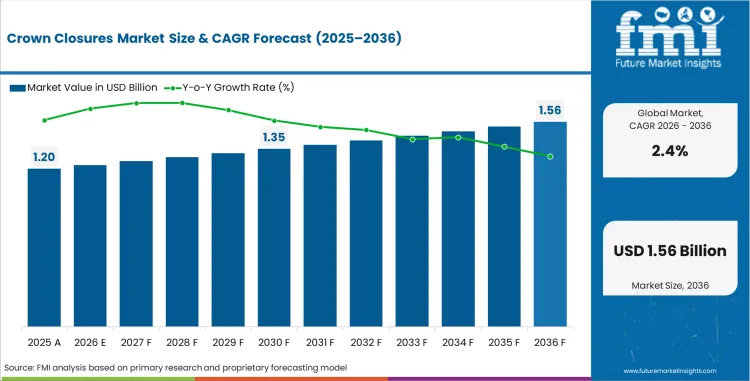
The crown closures market was valued at USD 1.2 billion in 2025. The market is set to reach USD 1.23 billion by 2026-end and grow at a CAGR of 2.4% between 2026-2036 to reach USD 1.56 billion by 2036. Metal Crown Closures will dominate with a 90.0% share, while Beverages will lead with a 85.0% share.
Summary of the Crown Closures Market
- Demand and Growth Drivers
- Beverage production volume growth in beer, carbonated soft drinks, and sparkling water is sustaining procurement of crown closures as the standard sealing format for glass bottle packaging.
- Craft brewery proliferation across North America and Europe is generating incremental demand for short run, custom printed crown closures with brand specific lithography.
- Regulatory pressure on PVC free liner materials is accelerating reformulation cycles across major closure manufacturers, creating replacement procurement opportunities.
- Product and Segment View
- Metal crown closures are estimated to account for 90.0% of the product segment in 2026, reflecting the dominance of tinplate steel and aluminum closures in beverage packaging applications.
- Beverages are projected to hold 85.0% of the application segment, concentrated in alcoholic and non alcoholic bottled beverage categories.
- Printed and coated closures are expected to represent 70.0% of the material coating segment, driven by brand differentiation requirements in retail beverage packaging.
- Geography and Competitive Outlook
- China is projected to lead global growth at 3.24% CAGR, supported by expanding beer production capacity and domestic beverage brand proliferation.
- North America and Europe represent mature markets where craft beverage growth and sustainability driven liner reformulation are the primary demand catalysts.
- Companies with integrated lithography capabilities, multi region manufacturing footprints, and long term supply agreements with major beverage producers hold competitive advantage.
- Analyst Opinion
- Nandini Roy Choudhury, Principal Consultant at FMI says, 'The crown closures market operates within a well defined competitive structure where procurement is concentrated among a small number of global beverage producers. Cost per unit, lithography capability, PVC free liner compliance, and supply chain reliability are the primary selection criteria. Manufacturers that can deliver consistent quality across high volume production runs while meeting evolving material compliance standards are positioned to retain and expand contract relationships.'
- The crown closures market is a mature packaging category where growth reflects beverage production volume trends rather than format substitution dynamics.
- Adoption of PVC free liner technologies is reshaping material specifications across the supply chain, creating both compliance costs and competitive differentiation opportunities.
- Demand is further supported by craft beverage sector growth that generates higher margin, short run procurement for custom printed closures.
Key Takeaways, Market Size, and Forecast
- The crown closures market was valued at USD 1.20 billion in 2025.
- By 2036, the Crown Closures Market is expected to be worth USD 1.56 billion.
- From 2026 to 2036, the market is projected to expand at a CAGR of 2.4%.
- The market is projected to create an incremental opportunity of USD 0.33 billion between 2026 and 2036.
- In 2026, Metal Crown Closures is expected to account for 90% of the Product segment, driven by sustained demand from beverage bottling operations requiring tamper evident metal closure systems.
- China (3.24%) and India (3%) are two of the fastest growing markets in the world.
Crown Closures Market Definition
The crown closures market includes metal and plastic crown caps designed for sealing glass bottles in beverage and food packaging applications. Product scope covers tinplate steel closures, aluminum closures, hybrid plastic metal combinations, and specialty closures with printed, coated, or plain finishes and various liner configurations.
Crown Closures Market Inclusions
Market scope encompasses all commercially traded crown closures categorized by product (metal crown closures, plastic crown closures), application (beverages, food products), end use (beverage manufacturers, food manufacturers), distribution channel (direct sales, distributors), material coating (printed and coated closures, plain closures), and liner type (polyvinyl chloride free liners, polyvinyl chloride liners). The range of revenue sizes is from 2026 to 2036.
Crown Closures Market Exclusions
The scope does not include screw caps, twist off closures, corks, synthetic stoppers, or crown closures used exclusively for non commercial laboratory or testing purposes.
Crown Closures Market Research Methodology
- Primary Research: FMI analysts conducted interviews with beverage packaging procurement managers, brewery operations directors, and crown closure manufacturers across key producing and consuming markets.
- Desk Research: Combined data from beverage industry production statistics, packaging material compliance databases, and manufacturer annual reports.
- Market Sizing and Forecasting: Bottom up aggregation of crown closure procurement across beer, soft drink, sparkling water, and food bottling segments with regional production volume curves.
- Data Validation: Cross checked quarterly against global beverage production data, packaging trade statistics, and manufacturer shipment disclosures.
Why is the Crown Closures Market Growing?
- The procurement of crown closures as the standard glass bottle sealing format in the baseline is driven by global beverage production volume growth, especially beer, carbonated soft drinks and sparkling water.
- Mandates for PVC free liners in the EU and voluntary reformulation commitments by the major beverage producers are stimulating changes in material specifications that generate replacement procurement cycles.
- Growth is led by China at 3.24% CAGR, reflecting expanding beer production capacity, domestic brand proliferation and rising quality standards for export oriented beverage packaging.
The crown closures market is aligned with the global glass bottled beverage industry in terms of production volume. Crown closure continues to be the preferred sealing format for beer and some carbonated soft drink and sparkling water categories where glass is the preferred packaging format due to product integrity, brand positioning or regulatory compliance. Growth is closely correlated with growth in beverage production capacity and per capita consumption patterns across these categories as such.
Compliance with materials is becoming a structural growth driver. Regulatory mandates from the European Union limiting the amount of PVC in food contact materials are driving reformulation of liner compounds across the crown closure supply chain. Global beer companies and other major beverage makers have set voluntary timelines for procurement of PVC free closures. This cycle of reformulation creates replacement demand for compliant closures and benefits manufacturers that have invested in thermoplastic elastomer and polyolefin liner technologies.
The craft beverage industry is a unique demand channel with different buying characteristics. Craft breweries, cideries and specialty beverage producers require shorter production runs with custom lithography, brand specific designs and premium finishing. This segment produces higher per unit margins and benefits closure manufacturers with flexible printing and responsive order fulfillment.
Market Segmentation Analysis
- The metal crown closures segment accounted for a 90.0% share of the market, with tinplate steel and aluminum configurations for beverage bottling applications.
- Beverages dominate the application segment, with a share of 85.0%. Beer & cider bottling, the largest single category, is an example of alcoholic beverages.
- Direct sales are 65.0% of distribution. Direct sales are indicative of the long term contract procurement model between closure manufacturers and beverage producers.
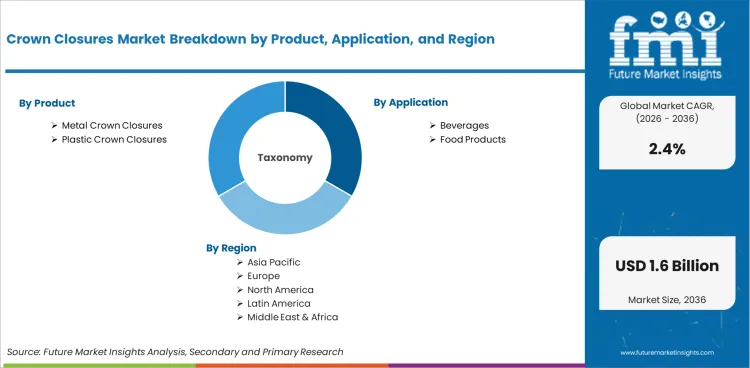
The crown closures market is segmented based on product, application, end use, distribution channel, material coating, and liner type. Product types are metal crown closures and plastic crown closures. Application Segments include Beverages and Food products.
Insights into the Metal Crown Closures Product Segment
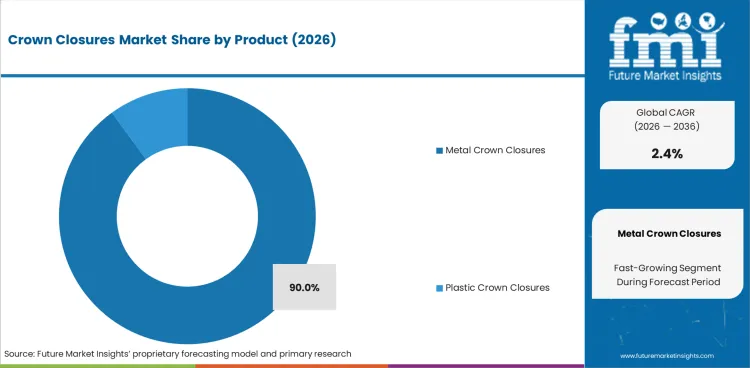
In 2026, metal crown closures are expected to account for 90.0% of the product segment. Tinplate steel closures are the dominant format, offering cost-effective production at scale and established recycling infrastructure. Aluminum closures are an emerging sub segment preferred for its light weight properties and corrosion resistance for premium beverage applications.
The biggest change in material in the forecast period is the move to PVC free liners in the metal closure segment. Traditional PVC compounds are expected to be displaced by thermoplastic elastomer and polyolefin liner technologies, with compliance timelines varying by region and end use customer requirements.
Insights into the Beverages Application Segment
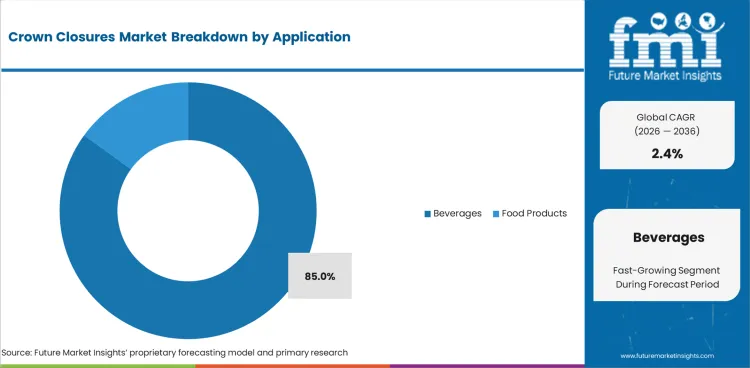
Beverages are expected to hold 85.0% of the application segment by 2026. The largest single application is beer bottling, with crown closures the standard sealing format for glass beer bottles in both mass market and craft categories. Carbonated soft drinks and sparkling water are secondary application areas where glass packaging is used for premium positioning or specific market requirements.
The food products segment including sauces, condiments and dairy products is also a smaller, but stable demand channel for crown closures in specialty glass packaging formats.
Crown Closures Market Drivers, Restraints, and Opportunities
- Growth in production volumes of beverages in the beer, soft drinks and sparkling water categories supports baseline procurement demand for crown closures.
- Restrictions on PVC content and voluntary reformulation commitments are driving compliance driven replacement cycles throughout the liner supply chain.
- The growth of craft beverage creates a demand for higher margin custom printed, short run crown closures with brand specific lithography.
The crown closures market dynamics is influenced by the convergence of beverage production volume trends, packaging materials compliance requirements and the competitive scenario of a consolidated supply chain. Format substitution is not the growth driver, beverage category expansion is. Material specification changes create incremental procurement opportunities.
Beverage Production Volume Growth
Demand is driven by the growth in global beer production capacity, particularly in East Asia and South Asia. Growth in per capita consumption and the proliferation of domestic brands are spurring investment in bottling lines. Carbonated soft drinks and sparkling water continue to buy stable crown caps in markets where consumers still prefer glass packaging or where glass has regulatory advantages.
PVC Free Liner Compliance
Growth is supported by regulatory and voluntary compliance timelines for reformulating crown closure liner compounds. EU food contact material regulations and major beverage producer sustainability commitments are driving specification changes to thermoplastic elastomer and polyolefin liner systems, creating replacement procurement across the installed closure supply base.
Craft Beverage Sector Demand
Growth in craft breweries, cideries and specialty beverage producers across North America and Europe is driving adoption. These producers require flexible order quantities, custom lithography and premium finishing that offer higher per unit margins than mass market beverage procurement.
Glass Packaging Format Stability
In some beverage categories, the gradual shift to aluminum can packaging is limiting demand. Structural headwind for crown closure volume from glass bottle market share erosion in some segments, somewhat offset by premium positioning and sustainability messaging that help drive continued glass use.
Analysis of Crown Closures Market By Key Countries
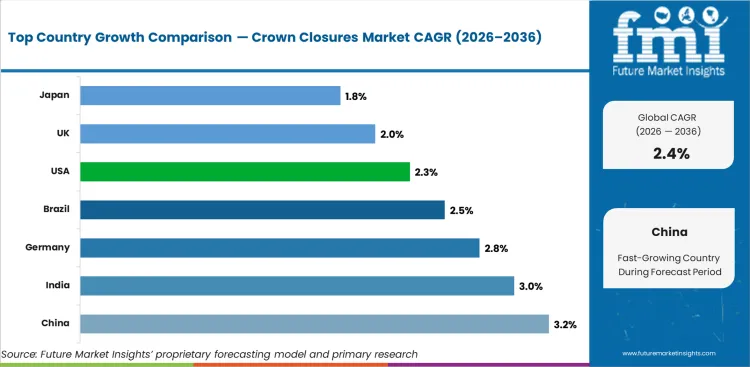
.webp "Top Country Growth Comparison Crown Closures Market Cagr (2026 2036)")
| Country | CAGR |
|---|---|
| China | 3.24% |
| India | 3.0% |
| Germany | 2.76% |
| Brazil | 2.52% |
| USA | 2.28% |
| UK | 2.04% |
| Japan | 1.8% |
- China is the fastest growing market with a CAGR of 3.24% driven by expansion of beer production capacity, growth of domestic beverage brands and increasing quality standards for export packaging.
- The Indian market at 3.0% is due to rising per capita beverage consumption, brewery capacity investments and growth in organised retail channels for glass bottled beverages.
- Germany (2.76%) is growing steadily on the back of growth in craft beer sector and procurement reformulation due to EU PVC free liner compliance.
- Brazil (2.52%) and Japan (2.04%) continue to grow with volume of beverage production and demand for premium packaging.
The global crown closures market is projected to grow at a CAGR of 2.4% from 2026 to 2036. The analysis covers more than 30 countries, with key markets detailed below.
Sales Analysis of Crown Closures Market in China
China is projected to grow at 3.24% through 2036. Sustained procurement for crown closures is driven by China’s position as the world’s largest beer producer, proliferation of domestic beverage brands and higher packaging quality standards for export oriented products.
- Long-term supply contracts are supporting high-volume crown closure purchases as domestic and multinational breweries increase their beer production capacity.
- Custom lithography and brand specific closure designs are being driven by demand for domestic beverage brand proliferation across beer, cider and sparkling water categories.
- Adoption of higher specification closures with improved corrosion resistance and food safe liner compounds are being driven by export packaging quality requirements.
Demand Outlook for Crown Closures Market in India
India is projected to grow by 3.0% through 2036. Rising per capita alcohol consumption, investment in brewery capacity by domestic and international players and growth of organized retail channels for glass bottled beverages are supporting the growth in demand for crown closures.
- Urbanization and organized retail expansion are increasing distribution of glass bottled beverages, generating procurement volume for closure manufacturers with domestic production facilities.
- Brewery capacity investment across tier 1 and tier 2 cities by both domestic producers and multinational brewers is creating new long term supply contract opportunities.
- Growth in premium and craft beer categories within urban markets is generating higher margin demand for custom printed closures with differentiated finishes.
Opportunity Analysis of Crown Closures Market in Germany
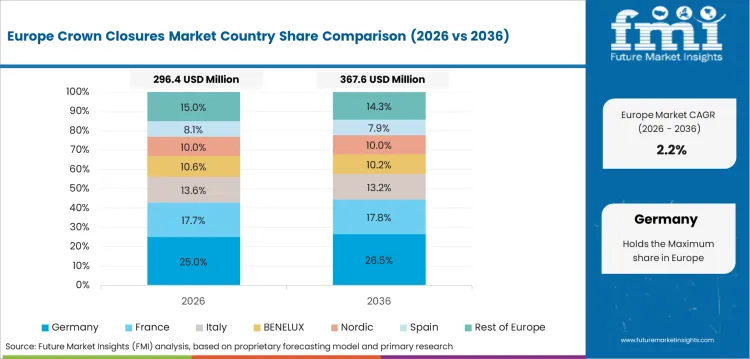
Germany is projected to grow at 2.76% through 2036. Germany’s robust beer culture, combined with the need to comply with EU packaging requirements and the rise of craft and specialty brewing, is helping to support demand for crown closures in a mature market.
- EU food contact material legislation is leading to the adoption of PVC free liners and closure manufacturers are reformulating and qualifying new liner compounds for German brewery procurement.
- Craft brewing in Germany is growing and so is the demand for short run, custom lithographed closures with brand specific designs and premium finishes.
- EU packaging directive extended producer responsibility regulations are driving recyclable and sustainable closure configurations in material selection.
Future Outlook for Crown Closures Market in the United Kingdom
The UK is expected to grow by 2.28% to 2036. Crown closure procurement in the UK market is being shaped by post Brexit packaging regulations, craft brewery expansion and retailer sustainability commitments.
- The UK Plastics Tax and packaging compliance requirements are affecting the choice of closure material and liner compound specifications across the beverage supply chain.
- Craft beer and cider producers’ expansion, flexible manufacturing, and regional distributor channels are driving demand for custom printed closures.
- Retailer sustainability targets are driving supermarket beverage categories to specify PVC free, recyclable closure systems for own label beverage products.
In-depth Analysis of Crown Closures Market in Japan
Japan is projected to grow at 2.04% through 2036. Japan’s premium beverage culture, strict JIS packaging quality standards and the continued preference for beer in glass bottles and specialty beverages support stable demand for crown closures.
- The rigorous quality standards required for JIS-compliant standards for food contact packaging work in favor of established closure manufacturers with certified production processes.
- Trends in premium and craft beer consumption in urban markets are fueling demand for high quality lithographed closures with detailed branding and specialty finishes.
- Long standing supplier relationships and rigorous qualification cycles in Japanese beverage procurement create stable demand for qualified closure manufacturers.
In-depth Analysis of Crown Closures Market in Brazil
Brazil is projected to grow at 2.52% through 2036. Crown closure procurement growth is supported by Brazil’s large beer market, increasing soft drink consumption and growing packaging quality standards in organized retail.
- As one of the largest beer markets in the world, Brazil supports high volume crown closure procurement in focused supply relationships with the large domestic breweries.
- Growth in premium and craft beer segments in urban markets is driving demand for higher specification closures with customised branding.
- National infrastructure programs improving cold chain logistics are expanding glass bottled beverage distribution, facilitating closure procurement in previously underserved regions.
Competitive Landscape and Strategic Positioning
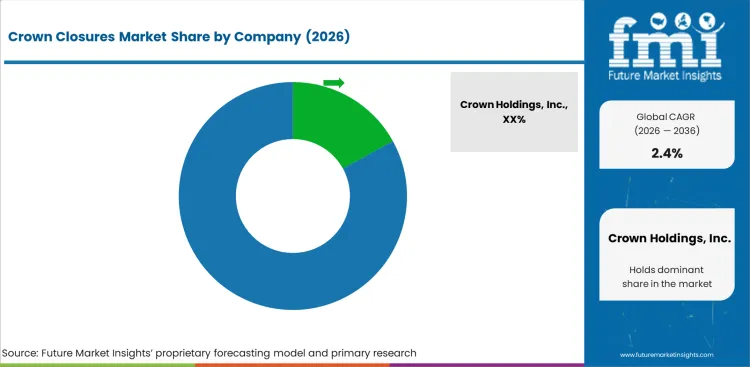
- Crown Holdings, Inc. maintains global leadership through integrated manufacturing, multi region production facilities, and long term supply contracts with the largest global beverage producers.
- Silgan Holdings Inc. and Nippon Closures Co. compete based on geographic manufacturing strengths and technical capabilities in liner reformulation and compliance.
- Pelliconi & Co. With a focus on the craft beverage sector and flexible manufacturing for custom lithography applications, SpA has a strong European presence.
Crown Holdings, Inc. is the largest player in the world, with crown closure manufacturing facilities on multiple continents and integrated tin plate processing, lithography and liner application capabilities. The company has long term supply relationships with the major global beer and beverage producers giving stable demand visibility.
O.Berk Company serves as a specialized packaging distributor with crown closure sourcing capabilities for mid tier beverage producers. Silgan Holdings Inc. competes through North American manufacturing strength and metal packaging expertise. Nippon Closures Co. holds strong position in the Japanese market through JIS certified production and long standing brewery relationships.
Pelliconi and C. SpA is a European leader in crown closures, with particular strength in craft beverage and specialty closure applications. Competitive barriers in the crown closures market include capital intensity of high speed production lines, lithography capabilities, food contact material certifications, and the relationship driven procurement model of major beverage producers.
Key Companies in the Crown Closures Market
Key global companies leading the crown closures market include:
- Crown Holdings, Inc. (USA), Silgan Holdings Inc. (USA), and Nippon Closures Co. (Japan) maintain global or regional leadership through integrated manufacturing, certified production processes, and established beverage producer relationships.
- O.Berk Company (USA) and Pelliconi and C. SpA (Italy) has specialized distribution and flexible manufacturing capabilities serving mid tier and craft beverage producers.
- Regional manufacturers in East Asia and South Asia are expanding capacity to serve domestic beverage brand growth, competing on cost per unit and proximity to growing production markets.
Competitive Benchmarking: Crown Closures Market
| Company | Production Capacity | Lithography Capability | Liner Technology | Geographic Footprint |
|---|---|---|---|---|
| Crown Holdings, Inc. | High | High | Strong | Global |
| O.Berk Company | Low | Medium | Medium | N. America |
| Silgan Holdings Inc. | High | High | Strong | N. America, Europe |
| Nippon Closures Co. | Medium | High | Strong | Asia |
| Pelliconi & C. SpA | Medium | High | Strong | Europe |
Source: Future Market Insights competitive analysis, 2026.
Key Developments in Crown Closures Market
- Crown Holdings (2025): Continued scaling the integration of PVC-free liner materials across its metal closures portfolio to meet tightening global food-contact regulations. The company also advanced smart packaging features, including inside-the-cap printed or laser-etched QR codes, to support brand engagement, traceability, and anti-counterfeiting measures.
- Pelliconi (2025): Expanded its structural lightweighting initiatives targeting premium and craft beverage sectors. This included optimization of its 26 mm crown corks and 28 mm plastic and ROPP aluminum closure lines, achieving notable reductions in material usage (typically in the 10-15% range for specific lightweight variants like the Smart Crown and 28 mm lightweight plastic closures) while maintaining pressure resistance and seal integrity.
Key Players in the Crown Closures Market
Major Global Players
- Crown Holdings, Inc.
- O.Berk Company
- Silgan Holdings Inc.
- Nippon Closures Co.
- Pelliconi & C. SpA
Emerging Players/Startups
- Amcor Limited
- Guala Closures Group
- Closure Systems International
- Oriental Can Co., Ltd.
- Astir Vitogiannis Bros S.A.
Report Scope and Coverage
| Parameter | Details |
|---|---|
| Quantitative Units | USD 1.23 billion to USD 1.56 billion, at a CAGR of 2.4% |
| Market Definition | The crown closures market encompasses metal and plastic crown caps designed for sealing glass bottles in beverage and food packaging applications. |
| Regions Covered | North America, Latin America, Europe, East Asia, South Asia and Pacific, Middle East and Africa |
| Countries Covered | USA, UK, France, Germany, Italy, South Korea, Japan, China, India, Brazil, 30 plus countries |
| Key Companies Profiled | Crown Holdings, Inc., O.Berk Company, Silgan Holdings Inc., Nippon Closures Co., Pelliconi & C. SpA |
| Forecast Period | 2026 to 2036 |
| Approach | Hybrid bottom up and top down methodology starting with verified beverage production and packaging trade data, projecting procurement velocity across segments and regions. |
Market Segmentation Analysis
Crown Closures Market Segmented by Product:
- Metal Crown Closures
- Steel Crown Closures
- Tinplate Steel Closures
- Electrolytic Chromium Coated Steel
- Aluminum Crown Closures
- Lightweight Aluminum Closures
- Corrosion Resistant Closures
- Steel Crown Closures
- Plastic Crown Closures
- Standard Plastic Closures
- Injection Molded Closures
- Low Cost Plastic Caps
- Hybrid Closures
- Plastic And Metal Combination
- Reinforced Plastic Caps
- Standard Plastic Closures
Crown Closures Market Segmented by Application:
- Beverages
- Alcoholic Beverages
- Beer Bottles
- Cider Bottles
- Non Alcoholic Beverages
- Carbonated Soft Drinks
- Sparkling Water
- Alcoholic Beverages
- Food Products
- Sauces And Condiments
- Glass Bottled Sauces
- Pickled Products
- Dairy Products
- Milk Bottles
- Flavored Dairy Drinks
- Sauces And Condiments
Crown Closures Market Segmented by End Use:
- Beverage Manufacturers
- Breweries
- Large Breweries
- Craft Breweries
- Soft Drink Manufacturers
- Carbonated Beverage Producers
- Bottled Water Companies
- Breweries
- Food Manufacturers
- Sauce Producers
- Condiment Manufacturers
- Pickle Producers
- Dairy Companies
- Milk Processors
- Flavored Dairy Producers
- Sauce Producers
Crown Closures Market Segmented by Distribution Channel:
- Direct Sales
- Manufacturer To Industry
- Long Term Supply Contracts
- Bulk Procurement Agreements
- Strategic Partnerships
- Co Packaging Agreements
- Exclusive Supply Deals
- Manufacturer To Industry
- Distributors
- Packaging Distributors
- Regional Distributors
- Global Supply Chains
- Online Platforms
- B2B Marketplaces
- Industrial Supply Platforms
- Packaging Distributors
Crown Closures Market Segmented by Material Coating:
- Printed And Coated Closures
- Lithographed Closures
- Brand Printed Designs
- Custom Graphics
- Protective Coatings
- Corrosion Resistant Coatings
- Food Safe Linings
- Lithographed Closures
- Plain Closures
- Unprinted Closures
- Standard Finishes
- Bulk Supply Closures
- Unprinted Closures
Crown Closures Market Segmented by Liner Type:
- Polyvinyl Chloride Free Liners
- Thermoplastic Elastomer Liners
- Food Grade Liners
- High Seal Integrity Liners
- Polyolefin Liners
- Recyclable Liners
- Sustainable Materials
- Thermoplastic Elastomer Liners
- Polyvinyl Chloride Liners
- Standard Liners
- Conventional Materials
- Cost Effective Liners
- Standard Liners
Crown Closures Market by Region:
- North America
- USA
- Canada
- Mexico
- Latin America
- Brazil
- Chile
- Rest of Latin America
- Western Europe
- Germany
- UK
- Italy
- Spain
- France
- Nordic
- BENELUX
- Rest of Western Europe
- Eastern Europe
- Russia
- Poland
- Hungary
- Balkan & Baltic
- Rest of Eastern Europe
- East Asia
- China
- Japan
- South Korea
- South Asia and Pacific
- India
- ASEAN
- Australia & New Zealand
- Rest of South Asia and Pacific
- Middle East & Africa
- Kingdom of Saudi Arabia
- Other GCC Countries
- Turkiye
- South Africa
- Other African Union
- Rest of Middle East & Africa
Research Sources and Bibliography
- 1. Beverage Industry Association. (2025). Global Beverage Packaging Market Statistics. BIA.
- 2. European Commission. (2024). EU Regulation on Food Contact Materials: Packaging Compliance Standards. EC.
- 3. World Packaging Organisation. (2025). WPO Global Packaging Industry Report. WPO.
- 4. USA Food and Drug Administration. (2024). FDA Food Contact Material Safety Standards. FDA.
- 5. International Organization for Standardization. (2025). ISO Packaging Standards for Food and Beverage Applications. ISO.
This bibliography is provided for reader reference.
This Report Answers
- Estimating the size of the market and revenue projections from 2026 to 2036.
- Segmentation by product, application, end use, distribution channel, material coating, and liner type.
- Insights about more than 30 markets across all regions.
- Material technology analysis covering liner reformulation and coating compliance.
- Assessment of the competitive landscape including key players and strategic positioning.
- Identifying investment opportunities in beverage, food, and craft closure segments.
- Supply chain and procurement model analysis.
- Delivery of data in PDF and Excel formats.
Frequently Asked Questions
How big is the crown closures market in 2026?
The global crown closures market is estimated to be valued at USD 1.23 billion in 2026.
What will be the size of crown closures market in 2036?
The market size for the crown closures market is projected to reach USD 1.56 billion by 2036.
How much will be the crown closures market growth between 2026 and 2036?
The crown closures market is expected to grow at a 2.4% CAGR between 2026 and 2036.
What are the key product types in the crown closures market?
The key product types in crown closures market are metal crown closures and plastic crown closures.
Which application segment is expected to contribute significant share in the crown closures market in 2026?
In terms of application, beverages segment is expected to command 85.0% share in the crown closures market in 2026.
Preview the report firsthand - request a free sample
Get SampleGet the brochure for pricing and purchase details.
Get PDFTable of Content
- Executive Summary
- Global Market Outlook
- Demand-side Trends
- Supply-side Trends
- Technology Roadmap Analysis
- Analysis and Recommendations
- Market Overview
- Market Coverage / Taxonomy
- Market Definition / Scope / Limitations
- Research Methodology
- Chapter Orientation
- Analytical Lens and Working Hypotheses
- Market Structure, Signals, and Trend Drivers
- Benchmarking and Cross-market Comparability
- Market Sizing, Forecasting, and Opportunity Mapping
- Research Design and Evidence Framework
- Desk Research Programme (Secondary Evidence)
- Company Annual and Sustainability Reports
- Peer-reviewed Journals and Academic Literature
- Corporate Websites, Product Literature, and Technical Notes
- Earnings Decks and Investor Briefings
- Statutory Filings and Regulatory Disclosures
- Technical White Papers and Standards Notes
- Trade Journals, Industry Magazines, and Analyst Briefs
- Conference Proceedings, Webinars, and Seminar Materials
- Government Statistics Portals and Public Data Releases
- Press Releases and Reputable Media Coverage
- Specialist Newsletters and Curated Briefings
- Sector Databases and Reference Repositories
- FMI Internal Proprietary Databases and Historical Market Datasets
- Subscription Datasets and Paid Sources
- Social Channels, Communities, and Digital Listening Inputs
- Additional Desk Sources
- Expert Input and Fieldwork (Primary Evidence)
- Primary Modes
- Qualitative Interviews and Expert Elicitation
- Quantitative Surveys and Structured Data Capture
- Blended Approach
- Why Primary Evidence is Used
- Field Techniques
- Interviews
- Surveys
- Focus Groups
- Observational and In-context Research
- Social and Community Interactions
- Stakeholder Universe Engaged
- C-suite Leaders
- Board Members
- Presidents and Vice Presidents
- R&D and Innovation Heads
- Technical Specialists
- Domain Subject-matter Experts
- Scientists
- Physicians and Other Healthcare Professionals
- Governance, Ethics, and Data Stewardship
- Research Ethics
- Data Integrity and Handling
- Primary Modes
- Tooling, Models, and Reference Databases
- Desk Research Programme (Secondary Evidence)
- Data Engineering and Model Build
- Data Acquisition and Ingestion
- Cleaning, Normalisation, and Verification
- Synthesis, Triangulation, and Analysis
- Quality Assurance and Audit Trail
- Market Background
- Market Dynamics
- Drivers
- Restraints
- Opportunity
- Trends
- Scenario Forecast
- Demand in Optimistic Scenario
- Demand in Likely Scenario
- Demand in Conservative Scenario
- Opportunity Map Analysis
- Product Life Cycle Analysis
- Supply Chain Analysis
- Investment Feasibility Matrix
- Value Chain Analysis
- PESTLE and Porter’s Analysis
- Regulatory Landscape
- Regional Parent Market Outlook
- Production and Consumption Statistics
- Import and Export Statistics
- Market Dynamics
- Global Market Analysis 2021 to 2025 and Forecast, 2026 to 2036
- Historical Market Size Value (USD Million) Analysis, 2021 to 2025
- Current and Future Market Size Value (USD Million) Projections, 2026 to 2036
- Y-o-Y Growth Trend Analysis
- Absolute $ Opportunity Analysis
- Global Market Pricing Analysis 2021 to 2025 and Forecast 2026 to 2036
- Global Market Analysis 2021 to 2025 and Forecast 2026 to 2036, By Product
- Introduction / Key Findings
- Historical Market Size Value (USD Million) Analysis By Product , 2021 to 2025
- Current and Future Market Size Value (USD Million) Analysis and Forecast By Product , 2026 to 2036
- Metal Crown Closures
- Steel Crown Closures
- Tinplate Steel Closures
- Electrolytic Chromium Coated Steel
- Aluminum Crown Closures
- Lightweight Aluminum Closures
- Corrosion Resistant Closures
- Plastic Crown Closures
- Standard Plastic Closures
- Injection Molded Closures
- Low Cost Plastic Caps
- Hybrid Closures
- Plastic And Metal Combination
- Metal Crown Closures
- Y-o-Y Growth Trend Analysis By Product , 2021 to 2025
- Absolute $ Opportunity Analysis By Product , 2026 to 2036
- Global Market Analysis 2021 to 2025 and Forecast 2026 to 2036, By Application
- Introduction / Key Findings
- Historical Market Size Value (USD Million) Analysis By Application, 2021 to 2025
- Current and Future Market Size Value (USD Million) Analysis and Forecast By Application, 2026 to 2036
- Beverages
- Alcoholic Beverages
- Beer Bottles
- Cider Bottles
- Non Alcoholic Beverages
- Carbonated Soft Drinks
- Sparkling Water
- Food Products
- Sauces And Condiments
- Glass Bottled Sauces
- Pickled Products
- Dairy Products
- Milk Bottles
- Beverages
- Y-o-Y Growth Trend Analysis By Application, 2021 to 2025
- Absolute $ Opportunity Analysis By Application, 2026 to 2036
- Global Market Analysis 2021 to 2025 and Forecast 2026 to 2036, By End Use
- Introduction / Key Findings
- Historical Market Size Value (USD Million) Analysis By End Use, 2021 to 2025
- Current and Future Market Size Value (USD Million) Analysis and Forecast By End Use, 2026 to 2036
- Beverage Manufacturers
- Breweries
- Large Breweries
- Craft Breweries
- Soft Drink Manufacturers
- Carbonated Beverage Producers
- Bottled Water Companies
- Food Manufacturers
- Sauce Producers
- Condiment Manufacturers
- Pickle Producers
- Dairy Companies
- Milk Processors
- Beverage Manufacturers
- Y-o-Y Growth Trend Analysis By End Use, 2021 to 2025
- Absolute $ Opportunity Analysis By End Use, 2026 to 2036
- Global Market Analysis 2021 to 2025 and Forecast 2026 to 2036, By Distribution Channel
- Introduction / Key Findings
- Historical Market Size Value (USD Million) Analysis By Distribution Channel, 2021 to 2025
- Current and Future Market Size Value (USD Million) Analysis and Forecast By Distribution Channel, 2026 to 2036
- Direct Sales
- Manufacturer To Industry
- Long Term Supply Contracts
- Bulk Procurement Agreements
- Strategic Partnerships
- Co Packaging Agreements
- Exclusive Supply Deals
- Distributors
- Packaging Distributors
- Regional Distributors
- Global Supply Chains
- Online Platforms
- B2B Marketplaces
- Direct Sales
- Y-o-Y Growth Trend Analysis By Distribution Channel, 2021 to 2025
- Absolute $ Opportunity Analysis By Distribution Channel, 2026 to 2036
- Global Market Analysis 2021 to 2025 and Forecast 2026 to 2036, By Material Coating
- Introduction / Key Findings
- Historical Market Size Value (USD Million) Analysis By Material Coating, 2021 to 2025
- Current and Future Market Size Value (USD Million) Analysis and Forecast By Material Coating, 2026 to 2036
- Printed And Coated Closures
- Lithographed Closures
- Brand Printed Designs
- Custom Graphics
- Protective Coatings
- Corrosion Resistant Coatings
- Food Safe Linings
- Plain Closures
- Unprinted Closures
- Standard Finishes
- Bulk Supply Closures
- Printed And Coated Closures
- Y-o-Y Growth Trend Analysis By Material Coating, 2021 to 2025
- Absolute $ Opportunity Analysis By Material Coating, 2026 to 2036
- Global Market Analysis 2021 to 2025 and Forecast 2026 to 2036, By Liner Type
- Introduction / Key Findings
- Historical Market Size Value (USD Million) Analysis By Liner Type, 2021 to 2025
- Current and Future Market Size Value (USD Million) Analysis and Forecast By Liner Type, 2026 to 2036
- Polyvinyl Chloride Free Liners
- Thermoplastic Elastomer Liners
- Food Grade Liners
- High Seal Integrity Liners
- Polyolefin Liners
- Recyclable Liners
- Sustainable Materials
- Polyvinyl Chloride Liners
- Standard Liners
- Conventional Materials
- Cost Effective Liners
- Polyvinyl Chloride Free Liners
- Y-o-Y Growth Trend Analysis By Liner Type, 2021 to 2025
- Absolute $ Opportunity Analysis By Liner Type, 2026 to 2036
- Global Market Analysis 2021 to 2025 and Forecast 2026 to 2036, By Region
- Introduction
- Historical Market Size Value (USD Million) Analysis By Region, 2021 to 2025
- Current Market Size Value (USD Million) Analysis and Forecast By Region, 2026 to 2036
- North America
- Latin America
- Western Europe
- Eastern Europe
- East Asia
- South Asia and Pacific
- Middle East & Africa
- Market Attractiveness Analysis By Region
- North America Market Analysis 2021 to 2025 and Forecast 2026 to 2036, By Country
- Historical Market Size Value (USD Million) Trend Analysis By Market Taxonomy, 2021 to 2025
- Market Size Value (USD Million) Forecast By Market Taxonomy, 2026 to 2036
- By Country
- USA
- Canada
- Mexico
- By Product
- By Application
- By End Use
- By Distribution Channel
- By Material Coating
- By Liner Type
- By Country
- Market Attractiveness Analysis
- By Country
- By Product
- By Application
- By End Use
- By Distribution Channel
- By Material Coating
- By Liner Type
- Key Takeaways
- Latin America Market Analysis 2021 to 2025 and Forecast 2026 to 2036, By Country
- Historical Market Size Value (USD Million) Trend Analysis By Market Taxonomy, 2021 to 2025
- Market Size Value (USD Million) Forecast By Market Taxonomy, 2026 to 2036
- By Country
- Brazil
- Chile
- Rest of Latin America
- By Product
- By Application
- By End Use
- By Distribution Channel
- By Material Coating
- By Liner Type
- By Country
- Market Attractiveness Analysis
- By Country
- By Product
- By Application
- By End Use
- By Distribution Channel
- By Material Coating
- By Liner Type
- Key Takeaways
- Western Europe Market Analysis 2021 to 2025 and Forecast 2026 to 2036, By Country
- Historical Market Size Value (USD Million) Trend Analysis By Market Taxonomy, 2021 to 2025
- Market Size Value (USD Million) Forecast By Market Taxonomy, 2026 to 2036
- By Country
- Germany
- UK
- Italy
- Spain
- France
- Nordic
- BENELUX
- Rest of Western Europe
- By Product
- By Application
- By End Use
- By Distribution Channel
- By Material Coating
- By Liner Type
- By Country
- Market Attractiveness Analysis
- By Country
- By Product
- By Application
- By End Use
- By Distribution Channel
- By Material Coating
- By Liner Type
- Key Takeaways
- Eastern Europe Market Analysis 2021 to 2025 and Forecast 2026 to 2036, By Country
- Historical Market Size Value (USD Million) Trend Analysis By Market Taxonomy, 2021 to 2025
- Market Size Value (USD Million) Forecast By Market Taxonomy, 2026 to 2036
- By Country
- Russia
- Poland
- Hungary
- Balkan & Baltic
- Rest of Eastern Europe
- By Product
- By Application
- By End Use
- By Distribution Channel
- By Material Coating
- By Liner Type
- By Country
- Market Attractiveness Analysis
- By Country
- By Product
- By Application
- By End Use
- By Distribution Channel
- By Material Coating
- By Liner Type
- Key Takeaways
- East Asia Market Analysis 2021 to 2025 and Forecast 2026 to 2036, By Country
- Historical Market Size Value (USD Million) Trend Analysis By Market Taxonomy, 2021 to 2025
- Market Size Value (USD Million) Forecast By Market Taxonomy, 2026 to 2036
- By Country
- China
- Japan
- South Korea
- By Product
- By Application
- By End Use
- By Distribution Channel
- By Material Coating
- By Liner Type
- By Country
- Market Attractiveness Analysis
- By Country
- By Product
- By Application
- By End Use
- By Distribution Channel
- By Material Coating
- By Liner Type
- Key Takeaways
- South Asia and Pacific Market Analysis 2021 to 2025 and Forecast 2026 to 2036, By Country
- Historical Market Size Value (USD Million) Trend Analysis By Market Taxonomy, 2021 to 2025
- Market Size Value (USD Million) Forecast By Market Taxonomy, 2026 to 2036
- By Country
- India
- ASEAN
- Australia & New Zealand
- Rest of South Asia and Pacific
- By Product
- By Application
- By End Use
- By Distribution Channel
- By Material Coating
- By Liner Type
- By Country
- Market Attractiveness Analysis
- By Country
- By Product
- By Application
- By End Use
- By Distribution Channel
- By Material Coating
- By Liner Type
- Key Takeaways
- Middle East & Africa Market Analysis 2021 to 2025 and Forecast 2026 to 2036, By Country
- Historical Market Size Value (USD Million) Trend Analysis By Market Taxonomy, 2021 to 2025
- Market Size Value (USD Million) Forecast By Market Taxonomy, 2026 to 2036
- By Country
- Kingdom of Saudi Arabia
- Other GCC Countries
- Turkiye
- South Africa
- Other African Union
- Rest of Middle East & Africa
- By Product
- By Application
- By End Use
- By Distribution Channel
- By Material Coating
- By Liner Type
- By Country
- Market Attractiveness Analysis
- By Country
- By Product
- By Application
- By End Use
- By Distribution Channel
- By Material Coating
- By Liner Type
- Key Takeaways
- Key Countries Market Analysis
- USA
- Pricing Analysis
- Market Share Analysis, 2025
- By Product
- By Application
- By End Use
- By Distribution Channel
- By Material Coating
- By Liner Type
- Canada
- Pricing Analysis
- Market Share Analysis, 2025
- By Product
- By Application
- By End Use
- By Distribution Channel
- By Material Coating
- By Liner Type
- Mexico
- Pricing Analysis
- Market Share Analysis, 2025
- By Product
- By Application
- By End Use
- By Distribution Channel
- By Material Coating
- By Liner Type
- Brazil
- Pricing Analysis
- Market Share Analysis, 2025
- By Product
- By Application
- By End Use
- By Distribution Channel
- By Material Coating
- By Liner Type
- Chile
- Pricing Analysis
- Market Share Analysis, 2025
- By Product
- By Application
- By End Use
- By Distribution Channel
- By Material Coating
- By Liner Type
- Germany
- Pricing Analysis
- Market Share Analysis, 2025
- By Product
- By Application
- By End Use
- By Distribution Channel
- By Material Coating
- By Liner Type
- UK
- Pricing Analysis
- Market Share Analysis, 2025
- By Product
- By Application
- By End Use
- By Distribution Channel
- By Material Coating
- By Liner Type
- Italy
- Pricing Analysis
- Market Share Analysis, 2025
- By Product
- By Application
- By End Use
- By Distribution Channel
- By Material Coating
- By Liner Type
- Spain
- Pricing Analysis
- Market Share Analysis, 2025
- By Product
- By Application
- By End Use
- By Distribution Channel
- By Material Coating
- By Liner Type
- France
- Pricing Analysis
- Market Share Analysis, 2025
- By Product
- By Application
- By End Use
- By Distribution Channel
- By Material Coating
- By Liner Type
- India
- Pricing Analysis
- Market Share Analysis, 2025
- By Product
- By Application
- By End Use
- By Distribution Channel
- By Material Coating
- By Liner Type
- ASEAN
- Pricing Analysis
- Market Share Analysis, 2025
- By Product
- By Application
- By End Use
- By Distribution Channel
- By Material Coating
- By Liner Type
- Australia & New Zealand
- Pricing Analysis
- Market Share Analysis, 2025
- By Product
- By Application
- By End Use
- By Distribution Channel
- By Material Coating
- By Liner Type
- China
- Pricing Analysis
- Market Share Analysis, 2025
- By Product
- By Application
- By End Use
- By Distribution Channel
- By Material Coating
- By Liner Type
- Japan
- Pricing Analysis
- Market Share Analysis, 2025
- By Product
- By Application
- By End Use
- By Distribution Channel
- By Material Coating
- By Liner Type
- South Korea
- Pricing Analysis
- Market Share Analysis, 2025
- By Product
- By Application
- By End Use
- By Distribution Channel
- By Material Coating
- By Liner Type
- Russia
- Pricing Analysis
- Market Share Analysis, 2025
- By Product
- By Application
- By End Use
- By Distribution Channel
- By Material Coating
- By Liner Type
- Poland
- Pricing Analysis
- Market Share Analysis, 2025
- By Product
- By Application
- By End Use
- By Distribution Channel
- By Material Coating
- By Liner Type
- Hungary
- Pricing Analysis
- Market Share Analysis, 2025
- By Product
- By Application
- By End Use
- By Distribution Channel
- By Material Coating
- By Liner Type
- Kingdom of Saudi Arabia
- Pricing Analysis
- Market Share Analysis, 2025
- By Product
- By Application
- By End Use
- By Distribution Channel
- By Material Coating
- By Liner Type
- Turkiye
- Pricing Analysis
- Market Share Analysis, 2025
- By Product
- By Application
- By End Use
- By Distribution Channel
- By Material Coating
- By Liner Type
- South Africa
- Pricing Analysis
- Market Share Analysis, 2025
- By Product
- By Application
- By End Use
- By Distribution Channel
- By Material Coating
- By Liner Type
- USA
- Market Structure Analysis
- Competition Dashboard
- Competition Benchmarking
- Market Share Analysis of Top Players
- By Regional
- By Product
- By Application
- By End Use
- By Distribution Channel
- By Material Coating
- By Liner Type
- Competition Analysis
- Competition Deep Dive
- Crown Holdings, Inc.
- Overview
- Product Portfolio
- Profitability by Market Segments (Product/Age /Sales Channel/Region)
- Sales Footprint
- Strategy Overview
- Marketing Strategy
- Product Strategy
- Channel Strategy
- O.Berk Company
- Silgan Holdings Inc.
- Nippon Closures Co.
- Pelliconi & C. SpA
- Crown Holdings, Inc.
- Competition Deep Dive
- Assumptions & Acronyms Used


