

- Market Size (2026)
- USD 17.3 Bn
- Forecast (2036)
- USD 21.3 Bn
- CAGR (2026 to 2036)
- 2.1%
Dredging Market Size, Market Forecast and Outlook By FMI
Summary of Dredging Market
- Demand and Growth Drivers
- Demand is driven by ports and waterways need for repeated sediment removal to preserve vessel access.
- Industry outlook is supported by coastal protection work and port expansion activity across trade-linked corridors.
- Adoption is moderated by environmental review and project approval timelines.
- Product and Segment View
- Government leads due to public control over port access waterway upkeep and shoreline protection work.
- Trade maintenance holds the largest revenue pool due to repeated dredging need in active shipping channels and berths.
- Fleet modernization supports project execution due to stronger equipment efficiency and broader operating flexibility.
- Dredging equipment and submersible dredge pumps demand is projected to propel adoption in fleet modernization.
- Geography and Competitive Outlook
- Japan and China and India post faster growth due to port expansion and ongoing dredging activity linked with trade and shoreline management.
- Europe keeps strong market value due to regulated waterways and continued focus on navigation efficiency and port competitiveness.
- Large contractors retain an edge due to deeper fleets and stronger execution capability and better handling of permits.
- Analyst Opinion
- Nikhil Kaitwade, Principal Analyst states: “Dredging adoption is influenced by factors such as navigability upkeep and recurring port access work as trade corridors require dependable draft depth across long operating cycles. Global demand is being shaped by steady investment in waterway maintenance and coastal protection programs. Rising requirement for shoreline resilience and channel reliability backs project continuity in public infrastructure budgets.”
- Dredging Market Value Analysis
- Growth outlook is higher from maintenance dredging in ports and inland waterways, compared to one-time project categories.
- Government-backed programs keep value higher in awarded contracts than in fragmented private marine works.
- Coastal protection and land reclamation support better value realization in selected geographies with stronger shoreline pressure.
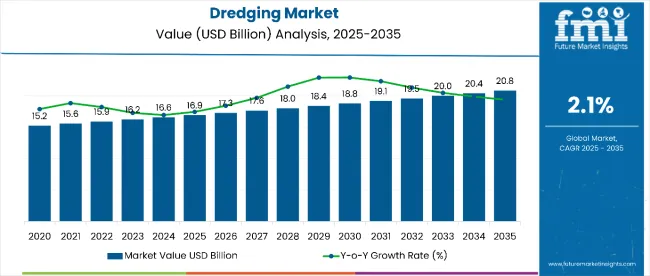
Key Takeaways
| Metric | Value |
|---|---|
| Market Size (2025) | USD 16.9 Billion |
| Market Size (2036) | USD 21.3 Billion |
| CAGR (2026–2036) | 2.1% |
| Incremental Opportunity (2026–2036) | USD 4.0 Billion |
| Leading Customer Type (2026) | Government |
| By Customer Type, Government Segment Share (2026) | 46.0% |
| Fastest-Growing Country | Japan |
| Japan CAGR | 5.7% |
| Fastest-Growing Country | China |
| China CAGR | 5.1% |
| Highlight | Demand is supported by navigability maintenance coastal protection work and long-cycle port upkeep |
Dredging Market Definition
Dredging covers excavation removal and relocation of sediment debris and underwater material from ports channels rivers coastlines and other water bodies. Commercial relevance is highest in navigability support port access and shoreline protection because marine trade and waterway function depend on depth reliability. Market behavior depends more on public infrastructure cycles and project execution capability than on asset count alone.
Dredging Market Inclusions
The scope includes trade maintenance and trade activity. Energy infrastructure urban development coastal protection and leisure applications are covered. Scope includes capital dredging maintenance dredging land reclamation support and selected environmental sediment removal across ports harbors inland waterways and berth deepening work. Public and private project flow enters scope across marine infrastructure and shoreline protection settings.
Dredging Market Exclusions
The scope excludes stand-alone port cranes and terminal software. Vessel manufacturing sold without dredging service value is excluded. General marine construction work without sediment removal activity is not included. Logistics revenue and port operations revenue enter count only if dredging execution is the primary service component.
Dredging Market Research Methodology
- Primary Research: Interviews with dredging contractors and port stakeholders and marine infrastructure participants.
- Desk Research: Review of port activity and waterway upkeep. Coastal resilience sources and current terminal automation and container terminal trends were reviewed.
- Market sizing and forecasting: Bottom-up build based on project mix and contract type and end-use demand.
- Data validation: Cross-check against contractor activity and port investment patterns and adjacent marine infrastructure categories.
Why is the Dredging Market Growing?
- Trade routes need regular channel upkeep to maintain navigational depth and predictable berth access for vessels.
- Coastal erosion and flood risk increase shoreline projects across ports and exposed urban waterfront zones.
- Public spending still shapes a large part of demand as many waterways ports and coastal defense systems stay under government oversight.
Sediment build up reduces draft depth in ports and inland routes over operating cycles. Cargo movement becomes less efficient when navigational clearance narrows and vessel loading limits increase. Dredging restores access and protects cargo flow for terminals that depend on high throughput. Demand stays higher in trade corridors with heavy traffic because small depth losses reduce berth productivity. Many port operators treat dredging as routine operations work because access reliability supports revenue and schedules.
Coastal infrastructure needs ongoing support in areas exposed to erosion and repeated storm surge impacts. Beach nourishment and shoreline defense programs require planned sediment handling across defined project cycles. This keeps demand broader than port maintenance because protection work continues beyond shipping needs. Governments and coastal agencies fund these programs because shoreline damage disrupts transport assets and industrial land. Dredging adds value because it supports protection goals and sediment placement within one delivery plan.
Public investment plays a major role in market direction across ports and connected waterway systems. Many waterways and coastal defenses remain under public oversight which makes budget timing a key driver. Project schedules depend on tenders and environmental clearance rather than private construction speed alone. This creates steady demand over long periods although quarterly award flow can still vary. Companies with strong public access and consistent tender delivery usually gain an advantage.
Contracting and Execution Factors
Contract awards depend on more than dredger size because delivery risk depends on several operational factors. Permit handling and disposal routes shape delivery plans while fleet availability sets realistic execution windows. Sediment condition can change disposal cost and project design which affects total project economics. Seasonal constraints can reduce workable days in exposed coasts and rivers across many geographies. Contractors with strong delivery records tend to win complex tenders because buyers value reliable compliance.
Long Cycle Demand Base
The market benefits from long cycle infrastructure spending that supports both new builds and recurring upkeep. New ports and industrial waterfront projects support capital dredging to create capacity for larger vessels. Existing routes require maintenance dredging each year because sediment returns through natural transport processes. Flood control plans and resilience programs add demand in vulnerable coastal areas through multi year budgets. This mix supports recurring work even when new marine construction slows across major regions.
Market Segmentation Analysis
- The government segment is estimated to account for 46.0% share in 2026 due to public control over ports waterways and coastal defense systems in many countries.
- The trade maintenance segment is expected to hold 31.0% share in 2026, supported by recurring sediment removal across active shipping lanes and berths.
- Maintenance dredging is anticipated to capture 38.0% in 2026 owing to repeated sediment return in active ports and inland channels.
- Trailing suction hopper dredgers are poised to garner 29.0% share in 2026, supported by versatility across port maintenance and coastal work.
- Coastal and port waters are set to represent 49.0% of the segment mix in 2026, driven by harbor maintenance berth deepening and marine access work.
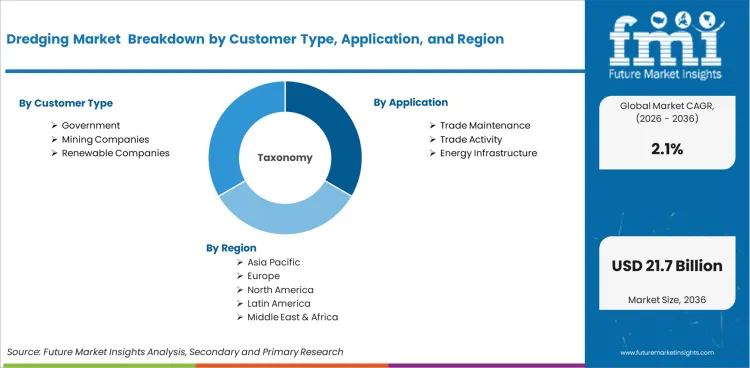
The market is divided into customer type application project type equipment type water body / site type and region. Customer type covers government O&G companies mining companies renewable companies construction companies port authorities private developers engineering consultancies environmental agencies real estate developers tourism companies and others. Application covers trade maintenance trade activity energy infrastructure urban development coastal protection leisure and other applications. Project type covers maintenance dredging capital dredging land reclamation dredging environmental dredging and channel deepening dredging. Equipment type covers trailing suction hopper dredgers cutter suction dredgers backhoe dredgers grab / clamshell dredgers auger dredgers and water injection dredgers. Water body and site type covers coastal and port waters rivers and inland waterways estuaries and deltas lakes and reservoirs offshore and nearshore zones.
Insights into the Customer Type Segment
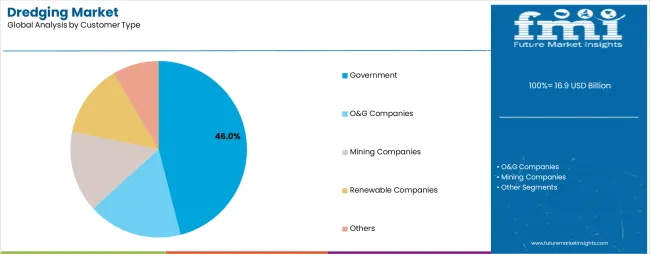
- The Government segment is estimated to account for 46.0% share in 2026. Demand stays high because public agencies fund channel upkeep port access coastal defense and flood control work.
- Port authorities and construction-linked buyers add value in project execution. Public buyers still lead because large navigation programs and resilience work usually depend on state-backed budgets.
Insights into the Application Segment
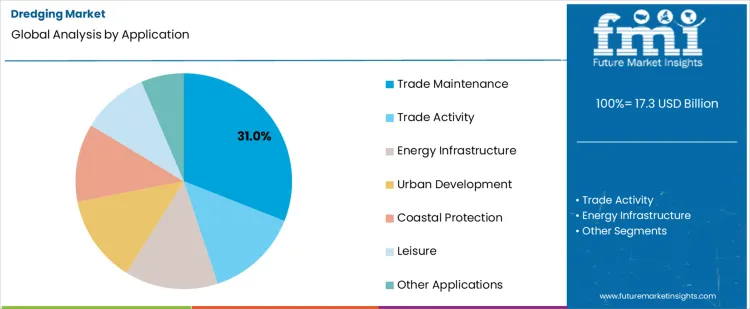
- The Trade Maintenance segment is expected to hold 31.0% share in 2026. Recurrent sediment build-up in shipping routes and berths keeps this application ahead.
- Coastal protection and urban development support added demand where shoreline pressure and land use intensity are rising.
Insights into the Project Type Segment
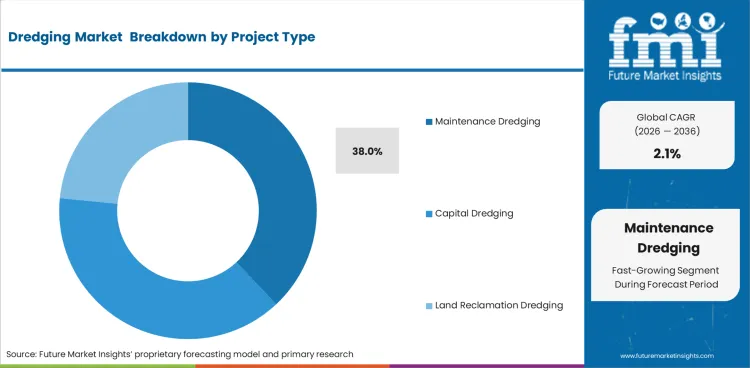
- Maintenance dredging is estimated to account for 38.0% share in 2026. Regular sediment return in active ports and inland channels keeps this project type ahead of one-time capital work.
- Capital dredging and land reclamation dredging add value in expansion cycles. Maintenance work still stays broader because it supports recurring access requirements rather than one-off construction phases.
Insights into the Equipment Type Segment
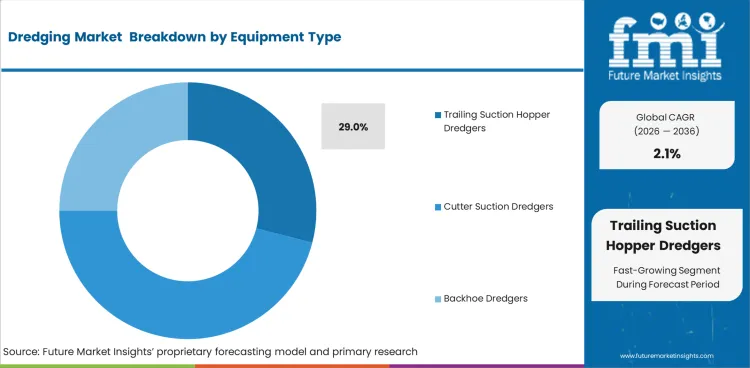
- Trailing suction hopper dredgers are expected to account for 29.0% share in 2026. Versatility in port maintenance and coastal work keeps this class visible across large marine projects.
- Cutter suction dredgers and backhoe dredgers stay relevant in dense sediment and localized excavation work. Equipment choice depends on material condition and project depth.
Insights into the Water Body / Site Type Segment
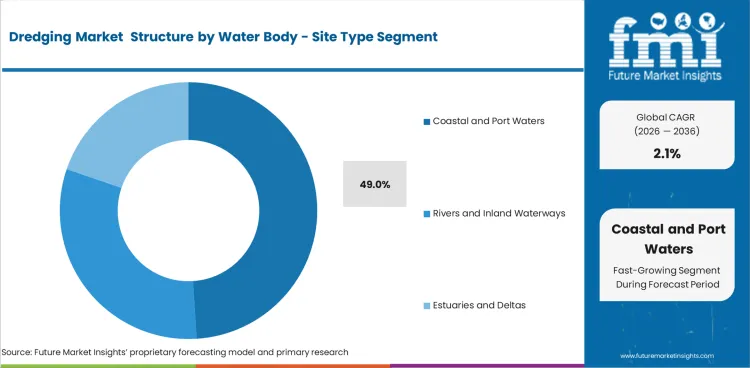
- Coastal and port waters are poised to garner 49.0% share in 2026. Harbor maintenance berth deepening and marine access work keep this site type ahead in commercial terms.
- Rivers and inland waterways keep importance in logistics and flood-control programs. Estuaries and offshore zones also add value in regions with stronger shoreline stress and marine infrastructure expansion.
Dredging Market Drivers Restraints and Opportunities
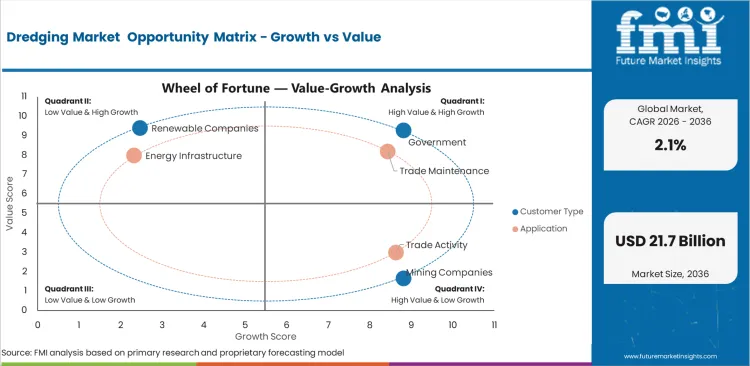
- Maritime trade growth supports regular depth maintenance in ports and channels.
- Permitting and environmental review can slow project start.
- Beneficial reuse of dredged material opens new value in shoreline and habitat work.
Market growth is propelled by navigability needs port expansion and coastal resilience programs. Wider adoption is limited by project approval cycles disposal rules and public scrutiny around environmental impact. Opportunity is higher in programs blending maintenance dredging with shoreline restoration or land-building use.
Coastal Defense and Nourishment Work
Shoreline erosion and storm exposure keep nourishment work active across vulnerable coastlines and low-lying waterfront zones. Dredging supports sediment placement in beach and wetland programs and helps rebuild protective landforms in areas facing repeated shoreline stress. Public agencies and coastal authorities fund such work because erosion can damage transport links industrial frontage tourism assets and urban coastal infrastructure. This gives contractors access to a wider project mix beyond pure trade maintenance and improves project visibility in resilience-linked public spending programs.
Fleet Modernization and Specialized Capability
Industry is witnessing rise owing to demand in fleets that can shift across capital work maintenance jobs and sensitive sediment programs without heavy execution loss. Contractor preference is higher for this capability because public tenders and complex marine assignments reward operational flexibility more than single-use vessel depth. Specialized assets keep demand high in programs with stricter compliance pressure and more demanding sediment handling needs.
DEME stated in its 2024 Annual Report that Viking Neptun was equipped with a second large carousel in 2024. The same report stated that Yellowstone joined the fleet in 2024 and that Karina joined the fleet in 2024. This gives 3 fleet modernization additions or upgrades in one year from one company alone. This evidence indicates that fleet renewal can improve deployment flexibility. It can also strengthen contractor positioning in tenders requiring deeper capability and lower operational disruption. [1]
Analysis of Dredging Market By Key Countries
.webp "Top Country Growth Comparison Dredging Market Cagr (2026 2036)")
| Country | CAGR |
|---|---|
| Japan | 5.7% |
| China | 5.1% |
| India | 4.4% |
| Germany | 3.8% |
| France | 2.1% |
Source: FMI analysis and primary research
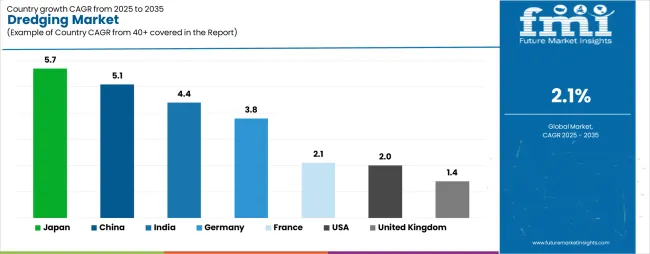
Dredging Market CAGR Analysis By Country
- Japan is projected to record the highest CAGR of 5.7% through 2036, supported by island-based trade dependence and ongoing shoreline management work.
- China is expected to grow at a CAGR of 5.1%, supported by maritime trade scale and continued coastal infrastructure development.
- India is projected to expand at a CAGR of 4.4%, as port development and inland waterway improvement continue to support project demand.
- Germany is expected to progress at a CAGR of 3.8%, driven by port maintenance needs and steady flood protection work.
- France is expected to post a CAGR of 2.1%, as mature infrastructure and stricter environmental review continue to shape project pace.
FMI analysis indicates that global dredging demand is rising at a steady pace in trade based port and coastal development markets, while expansion in mature countries is being supported more by maintenance activity and resilience programs.
Demand Outlook for Dredging in Japan
Japan depends on efficient ports and shoreline management across an island-based trade system. Demand for dredging in Japan is projected to rise at a CAGR of 5.7% through 2036, as navigational upkeep and flood-risk control continue to support recurring project flow. Contractors are expected to gain more from port access work and shoreline defense programs that align with public infrastructure priorities.
- Port maintenance remains essential for cargo handling continuity.
- Coastal erosion control supports recurring project need.
- Public budgets continue to shape contract timing and award flow.
Future Outlook for Dredging in China
China is supported by a large maritime trade base and ongoing coastal development activity. Dredging industry in China are forecast to rise at a CAGR of 5.1% during the assessment period, as channel deepening and port modernization continue to support project demand. Value growth is expected to stay stronger in large marine works and in high-throughput port programs.
- Port expansion continues to support capital dredging demand.
- Sediment management remains important in busy shipping channels.
- Large contractors benefit more from project scale and execution depth.
Opportunity Analysis of Dredging in India
India is expanding through port infrastructure development and stronger inland waterway use. The dredging market in India is projected to record a CAGR of 4.4% through 2036, as port-led development and river transport improvement continue to support project demand. Supplier access is expected to remain stronger in public infrastructure programs than in private leisure-led work.
- Port development is supporting steady contract flow.
- Inland route access is adding more project depth.
- Public tenders continue to shape contractor visibility.
In-depth Analysis of Dredging in Germany
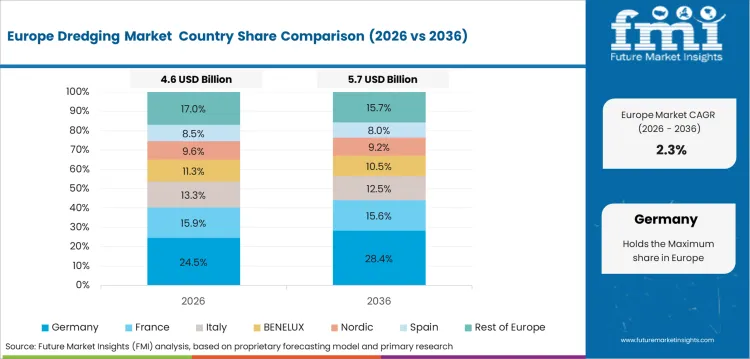
Germany is supported by high-value waterways and established port logistics infrastructure. The dredging market in Germany is expected to expand at a CAGR of 3.8% through 2036, as port competitiveness and flood protection continue to keep marine civil work relevant. Suppliers are likely to gain more through stronger compliance execution and engineering discipline.
- River and port upkeep continue to support baseline demand.
- Compliance burden remains higher than in faster-growth markets.
- Engineering quality continues to influence contractor selection.
Sales Analysis of Dredging in France
France is supported by major port activity and continued coastal protection requirements. Dredging demand in France is forecast to advance at a CAGR of 2.1% by 2036, as harbor maintenance and erosion defense work continue to support project flow. Commercial activity is expected to stay steadier here because growth remains moderate and project screening is tighter.
- Port access work continues to keep baseline demand active.
- Coastal defense adds incremental project value.
- Environmental review continues to affect execution pace.
Competitive Landscape and Strategic Positioning
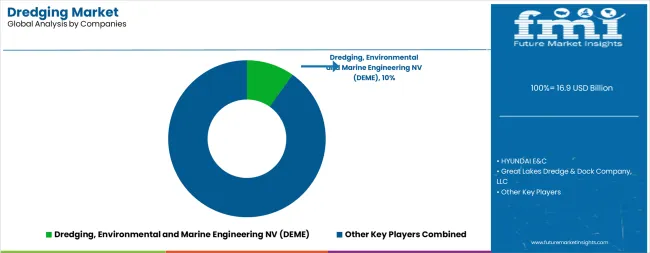
- DEME Great Lakes Dredge & Dock and Penta-Ocean carry strong visibility in marine works.
- Specialist contractors gain share through fleet depth execution skill and regional access.
- Entry barriers rise due to vessel cost permit handling and disposal management.
Fleet scale and project execution capability shape competition in the dredging market. Large contractors hold a firmer position because large dredging programs often require several vessel types and reliable delivery across complex port or coastal conditions. Market positioning depends on permit handling and sediment disposal planning.
Leading companies strengthen position through wide vessel portfolios that cover maintenance dredging and capital dredging. Strategic advantage is higher in contractors that can match equipment with sediment conditions and project scope without raising execution risk. Regional presence matters in ports and shoreline defense programs tied to public spending.
Entry barriers are high and new participants may face limits in fleet investment and compliance capability. Technical execution and tender qualification raise barriers. Long operating history and successful delivery across large marine projects shape competitive strength.
Key Companies in the Dredging Market
Key global companies leading the dredging market include:
- Large international contractors such as Dredging Environmental and Marine Engineering NV and Penta-Ocean Construction Co. Ltd.
- Regional marine leaders such as Great Lakes Dredge & Dock Company LLC and TOA Corporation.
- Specialized execution firms such as CALLAN MARINE LTD CASHMAN DREDGING INC and J.F. Brennan Company Inc.
Competitive Benchmarking: Dredging
| Company | Fleet Depth | Port and Coastal Project Reach | Execution and Contracting Capability | Geographic Footprint |
|---|---|---|---|---|
| DEME | High | Strong | High | Global |
| Great Lakes Dredge & Dock Corporation | High | Strong | High | North America and International |
| Penta-Ocean Construction Co. Ltd. | Medium | Strong | High | Asia and International |
| TOA Corporation | Medium | Medium | Strong | Asia |
| J.F. Brennan Company Inc. | Medium | Medium | Medium | United States |
Source: Future Market Insights competitive analysis 2026. Ratings reflect relative positioning based on fleet depth port and coastal project reach and execution and contracting capability.
Key Developments in Dredging Market
- In October 2024, Great Lakes reported USD 342.3 million in newly awarded work. For the dredging market, the update signals steady demand across both capital and maintenance jobs in USA waterways. [2]
- In October 2025, DEME secured the Port of Paranaguá access‑channel concession in Brazil by winning the auction. The win is notable because it combines channel operations and maintenance with planned expansion at a major public port. [3]
- In March 2026, Penta‑Ocean issued a funding procurement notice for a cable‑laying vessel. This development points to growing investment in offshore/seabed capabilities that increasingly overlap with energy‑infrastructure work within the broader dredging project mix. [4]
Key players in dredging
Major global players:
- Dredging Environmental and Marine Engineering NV
- Great Lakes Dredge & Dock Company LLC
- Penta-Ocean Construction Co. Ltd.
- TOA Corporation
Emerging Players/Startups
- CALLAN MARINE LTD
- CASHMAN DREDGING INC
- J.F. Brennan Company Inc.
Report Scope and Coverage
| Parameter | Details |
|---|---|
| Quantitative Units | USD Billion |
| Market Definition | Services used to excavate remove and relocate sediment and underwater material for navigability shoreline protection reclamation and marine infrastructure work |
| Regions Covered | North America Latin America Western Europe Eastern Europe South Asia and Pacific East Asia Middle East and Africa |
| Countries Covered | United States Canada Mexico Brazil Argentina Germany France United Kingdom Italy Spain Netherlands China India Japan South Korea ANZ GCC Countries South Africa |
| Key Companies Profiled | Dredging Environmental and Marine Engineering NV Great Lakes Dredge & Dock Company LLC TOA Corporation Penta-Ocean Construction Co. Ltd. National Marine Company CALLAN MARINE LTD CASHMAN DREDGING INC COTTRELL CONTRACTING CORPORATION J.F. Brennan Company Inc. |
| Forecast Period | 2026 to 2036 |
| Approach | Bottom-up project mix model with contractor triangulation region weighting and end-use demand mapping |
Dredging market by segments
Dredging Market Segmented by Customer Type:
- Government
- O&G Companies
- Mining Companies
- Renewable Companies
- Others
- Construction Companies
- Port Authorities
- Private Developers
- Engineering Consultancies
- Environmental Agencies
- Real Estate Developers
- Tourism Companies
Dredging Market Segmented by Application:
- Trade Maintenance
- Trade Activity
- Energy Infrastructure
- Urban Development
- Coastal Protection
- Leisure
- Other Applications
Dredging Market Segmented by Project Type:
- Maintenance Dredging
- Capital Dredging
- Land Reclamation Dredging
- Environmental Dredging
- Channel Deepening Dredging
Dredging Market Segmented by Equipment Type:
- Trailing Suction Hopper Dredgers
- Cutter Suction Dredgers
- Backhoe Dredgers
- Grab / Clamshell Dredgers
- Auger Dredgers
- Water Injection Dredgers
Dredging Market Segmented by Water Body / Site Type:
- Coastal and Port Waters
- Rivers and Inland Waterways
- Estuaries and Deltas
- Lakes and Reservoirs
- Offshore and Nearshore Zones
Dredging Market Segmented by Region:
- North America
- USA
- Canada
- Mexico
- Latin America
- Brazil
- Chile
- Rest of Latin America
- Western Europe
- Germany
- UK
- Italy
- Spain
- France
- Nordic
- BENELUX
- Rest of Western Europe
- Eastern Europe
- Russia
- Poland
- Hungary
- Balkan & Baltic
- Rest of Eastern Europe
- East Asia
- China
- Japan
- South Korea
- South Asia and Pacific
- India
- ASEAN
- Australia & New Zealand
- Rest of South Asia and Pacific
- Middle East & Africa
- Kingdom of Saudi Arabia
- Other GCC Countries
- Turkiye
- South Africa
- Other African Union
- Rest of Middle East & Africa
Research Sources and Bibliography
- DEME Group NV. (2025, April). Annual Report 2024.
- Great Lakes Dredge & Dock Corporation. (2024, October 1). Great Lakes Announces Receipt of $342.3 Million in Awarded Work.
- DEME Group NV. (2025, October 23). DEME wins auction for Port of Paranaguá access channel concession in Brazil.
- PENTA-OCEAN CONSTRUCTION CO., LTD. (2026, March 30). Notice regarding Procurement of Funds for Construction of Cable Laying Vessel (CLV).
- USA Army Corps of Engineers. (2025, August). San Francisco Bay Regional Dredged Material Management Plan 2025-2044
- Ayodele Afolayan, Robert Černý, and Jan Fořt. (2025, May). Review of Treatment Techniques for Dredged Sediments in the Context of Valorization as Secondary Raw Materials.
- Chiara Fratini, Serena Anselmi, and Monia Renzi. (2025, June). Dredge Sediment as an Opportunity: A Comprehensive and Updated Review of Beneficial Uses in Marine, River, and Lagoon Eco-Systems.
This bibliography is provided for reader reference and is not exhaustive. The full report contains the complete reference list and detailed citations.
This Report Answers
- How large is the dredging market in 2025?
- How much revenue is expected by 2036?
- What growth pace is projected across 2026 to 2036?
- What keeps government demand ahead in this category?
- Why does trade maintenance lead application demand?
- Which countries show faster project expansion?
- What keeps dredging demand stable across port systems?
- What slows project start in sensitive geographies?
- Which suppliers hold stronger project visibility?
- What raises barriers for new entrants?
- How does coastal protection support added project flow?
- Which application set offers better contractor opportunity?
Frequently Asked Questions
What is included in this market?
Services for excavation removal and relocation of sediment in ports channels rivers coastlines and related marine works are included.
What keeps demand active?
Sediment build-up in shipping lanes and berths keeps demand active across large waterways.
Which customer type leads demand?
Government leads due to public responsibility for ports waterways and coastal defense.
Which application leads demand?
Trade maintenance leads because active routes need repeated depth restoration.
What limits quicker expansion?
Permitting disposal rules and environmental review can slow project timing.
Which country grows fastest in this study set?
Japan records the fastest growth pace among the countries covered.
Why do large contractors keep an advantage?
Fleet range execution record and permit handling improve bid strength.
Do coastal programs matter for future demand?
Yes. Shoreline defense nourishment and resilience work support added dredging value.
Can beneficial reuse improve project economics?
Yes. Reuse in shoreline or habitat work can improve disposal logic and project acceptance.
Why does trade maintenance stay ahead of other uses?
Regular sediment return keeps channels and berths in need of repeat work.
Preview the report firsthand - request a free sample
Get SampleGet the brochure for pricing and purchase details.
Get PDFTable of Content
- Executive Summary
- Global Market Outlook
- Demand-side Trends
- Supply-side Trends
- Technology Roadmap Analysis
- Analysis and Recommendations
- Market Overview
- Market Coverage / Taxonomy
- Market Definition / Scope / Limitations
- Research Methodology
- Chapter Orientation
- Analytical Framework
- Market Structure, Signals, and Trend Drivers
- Benchmarking and Cross-market Comparability
- Market Sizing, Forecasting, and Opportunity Mapping
- Research Design and Evidence Framework
- Desk Research Programme (Secondary Evidence)
- Company Annual and Sustainability Reports
- Peer-reviewed Journals and Academic Literature
- Corporate Websites, Product Literature, and Technical Notes
- Earnings Decks and Investor Briefings
- Statutory Filings and Regulatory Disclosures
- Technical White Papers and Standards Notes
- Trade Journals, Industry Magazines, and Analyst Briefs
- Conference Proceedings, Webinars, and Seminar Materials
- Government Statistics Portals and Public Data Releases
- Press Releases and Reputable Media Coverage
- Specialist Newsletters and Curated Briefings
- Sector Databases and Reference Repositories
- FMI Proprietary Databases and Historical Market Data
- Subscription Datasets and Paid Sources
- Social Channels, Communities, and Digital Listening Inputs
- Additional Desk Sources
- Expert Input and Fieldwork (Primary Evidence)
- Primary Modes
- Qualitative Interviews and Expert Elicitation
- Quantitative Surveys and Structured Data Capture
- Blended Approach
- Why Primary Evidence is Used
- Field Techniques
- Interviews
- Surveys
- Focus Groups
- Observational and In-context Research
- Social and Community Interactions
- Stakeholder Universe Engaged
- C-suite Leaders
- Board Members
- Presidents and Vice Presidents
- R&D and Innovation Heads
- Technical Specialists
- Domain Subject-matter Experts
- Scientists
- Physicians and Other Healthcare Professionals
- Governance, Ethics, and Data Stewardship
- Research Ethics
- Data Integrity and Handling
- Primary Modes
- Research Methods and Reference Sources
- Desk Research Programme (Secondary Evidence)
- Market Data Analysis and Forecast Development
- Data Collection
- Data Review and Validation
- Synthesis, Triangulation, and Analysis
- Research Quality and Validation
- Market Background
- Market Dynamics
- Drivers
- Restraints
- Opportunity
- Trends
- Scenario Forecast
- Demand in Optimistic Scenario
- Demand in Likely Scenario
- Demand in Conservative Scenario
- Opportunity Map Analysis
- Product Life Cycle Analysis
- Supply Chain Analysis
- Investment Feasibility Matrix
- Value Chain Analysis
- PESTLE and Porter’s Analysis
- Regulatory Landscape
- Regional Parent Market Outlook
- Production and Consumption Statistics
- Import and Export Statistics
- Market Dynamics
- Global Market Analysis 2021 to 2025 and Forecast, 2026 to 2036
- Historical Market Size Value (USD Million) Analysis, 2021 to 2025
- Current and Future Market Size Value (USD Million) Projections, 2026 to 2036
- Y-o-Y Growth Trend Analysis
- Absolute $ Opportunity Analysis
- Global Market Pricing Analysis 2021 to 2025 and Forecast 2026 to 2036
- Global Market Analysis 2021 to 2025 and Forecast 2026 to 2036, By Customer Type
- Introduction / Key Findings
- Historical Market Size Value (USD Million) Analysis By Customer Type , 2021 to 2025
- Current and Future Market Size Value (USD Million) Analysis and Forecast By Customer Type , 2026 to 2036
- Government
- Mining Companies
- Renewable Companies
- Government
- Y-o-Y Growth Trend Analysis By Customer Type , 2021 to 2025
- Absolute $ Opportunity Analysis By Customer Type , 2026 to 2036
- Global Market Analysis 2021 to 2025 and Forecast 2026 to 2036, By Application
- Introduction / Key Findings
- Historical Market Size Value (USD Million) Analysis By Application, 2021 to 2025
- Current and Future Market Size Value (USD Million) Analysis and Forecast By Application, 2026 to 2036
- Trade Maintenance
- Trade Activity
- Energy Infrastructure
- Trade Maintenance
- Y-o-Y Growth Trend Analysis By Application, 2021 to 2025
- Absolute $ Opportunity Analysis By Application, 2026 to 2036
- Global Market Analysis 2021 to 2025 and Forecast 2026 to 2036, By Project Type
- Introduction / Key Findings
- Historical Market Size Value (USD Million) Analysis By Project Type, 2021 to 2025
- Current and Future Market Size Value (USD Million) Analysis and Forecast By Project Type, 2026 to 2036
- Maintenance Dredging
- Capital Dredging
- Land Reclamation Dredging
- Maintenance Dredging
- Y-o-Y Growth Trend Analysis By Project Type, 2021 to 2025
- Absolute $ Opportunity Analysis By Project Type, 2026 to 2036
- Global Market Analysis 2021 to 2025 and Forecast 2026 to 2036, By Equipment Type
- Introduction / Key Findings
- Historical Market Size Value (USD Million) Analysis By Equipment Type, 2021 to 2025
- Current and Future Market Size Value (USD Million) Analysis and Forecast By Equipment Type, 2026 to 2036
- Trailing Suction Hopper Dredgers
- Cutter Suction Dredgers
- Backhoe Dredgers
- Trailing Suction Hopper Dredgers
- Y-o-Y Growth Trend Analysis By Equipment Type, 2021 to 2025
- Absolute $ Opportunity Analysis By Equipment Type, 2026 to 2036
- Global Market Analysis 2021 to 2025 and Forecast 2026 to 2036, By Water Body - Site Type
- Introduction / Key Findings
- Historical Market Size Value (USD Million) Analysis By Water Body - Site Type, 2021 to 2025
- Current and Future Market Size Value (USD Million) Analysis and Forecast By Water Body - Site Type, 2026 to 2036
- Coastal and Port Waters
- Rivers and Inland Waterways
- Estuaries and Deltas
- Coastal and Port Waters
- Y-o-Y Growth Trend Analysis By Water Body - Site Type, 2021 to 2025
- Absolute $ Opportunity Analysis By Water Body - Site Type, 2026 to 2036
- Global Market Analysis 2021 to 2025 and Forecast 2026 to 2036, By Region
- Introduction
- Historical Market Size Value (USD Million) Analysis By Region, 2021 to 2025
- Current Market Size Value (USD Million) Analysis and Forecast By Region, 2026 to 2036
- North America
- Latin America
- Western Europe
- Eastern Europe
- East Asia
- South Asia and Pacific
- Middle East & Africa
- Market Attractiveness Analysis By Region
- North America Market Analysis 2021 to 2025 and Forecast 2026 to 2036, By Country
- Historical Market Size Value (USD Million) Trend Analysis By Market Taxonomy, 2021 to 2025
- Market Size Value (USD Million) Forecast By Market Taxonomy, 2026 to 2036
- By Country
- USA
- Canada
- Mexico
- By Customer Type
- By Application
- By Project Type
- By Equipment Type
- By Water Body - Site Type
- By Country
- Market Attractiveness Analysis
- By Country
- By Customer Type
- By Application
- By Project Type
- By Equipment Type
- By Water Body - Site Type
- Key Takeaways
- Latin America Market Analysis 2021 to 2025 and Forecast 2026 to 2036, By Country
- Historical Market Size Value (USD Million) Trend Analysis By Market Taxonomy, 2021 to 2025
- Market Size Value (USD Million) Forecast By Market Taxonomy, 2026 to 2036
- By Country
- Brazil
- Chile
- Rest of Latin America
- By Customer Type
- By Application
- By Project Type
- By Equipment Type
- By Water Body - Site Type
- By Country
- Market Attractiveness Analysis
- By Country
- By Customer Type
- By Application
- By Project Type
- By Equipment Type
- By Water Body - Site Type
- Key Takeaways
- Western Europe Market Analysis 2021 to 2025 and Forecast 2026 to 2036, By Country
- Historical Market Size Value (USD Million) Trend Analysis By Market Taxonomy, 2021 to 2025
- Market Size Value (USD Million) Forecast By Market Taxonomy, 2026 to 2036
- By Country
- Germany
- UK
- Italy
- Spain
- France
- Nordic
- BENELUX
- Rest of Western Europe
- By Customer Type
- By Application
- By Project Type
- By Equipment Type
- By Water Body - Site Type
- By Country
- Market Attractiveness Analysis
- By Country
- By Customer Type
- By Application
- By Project Type
- By Equipment Type
- By Water Body - Site Type
- Key Takeaways
- Eastern Europe Market Analysis 2021 to 2025 and Forecast 2026 to 2036, By Country
- Historical Market Size Value (USD Million) Trend Analysis By Market Taxonomy, 2021 to 2025
- Market Size Value (USD Million) Forecast By Market Taxonomy, 2026 to 2036
- By Country
- Russia
- Poland
- Hungary
- Balkan & Baltic
- Rest of Eastern Europe
- By Customer Type
- By Application
- By Project Type
- By Equipment Type
- By Water Body - Site Type
- By Country
- Market Attractiveness Analysis
- By Country
- By Customer Type
- By Application
- By Project Type
- By Equipment Type
- By Water Body - Site Type
- Key Takeaways
- East Asia Market Analysis 2021 to 2025 and Forecast 2026 to 2036, By Country
- Historical Market Size Value (USD Million) Trend Analysis By Market Taxonomy, 2021 to 2025
- Market Size Value (USD Million) Forecast By Market Taxonomy, 2026 to 2036
- By Country
- China
- Japan
- South Korea
- By Customer Type
- By Application
- By Project Type
- By Equipment Type
- By Water Body - Site Type
- By Country
- Market Attractiveness Analysis
- By Country
- By Customer Type
- By Application
- By Project Type
- By Equipment Type
- By Water Body - Site Type
- Key Takeaways
- South Asia and Pacific Market Analysis 2021 to 2025 and Forecast 2026 to 2036, By Country
- Historical Market Size Value (USD Million) Trend Analysis By Market Taxonomy, 2021 to 2025
- Market Size Value (USD Million) Forecast By Market Taxonomy, 2026 to 2036
- By Country
- India
- ASEAN
- Australia & New Zealand
- Rest of South Asia and Pacific
- By Customer Type
- By Application
- By Project Type
- By Equipment Type
- By Water Body - Site Type
- By Country
- Market Attractiveness Analysis
- By Country
- By Customer Type
- By Application
- By Project Type
- By Equipment Type
- By Water Body - Site Type
- Key Takeaways
- Middle East & Africa Market Analysis 2021 to 2025 and Forecast 2026 to 2036, By Country
- Historical Market Size Value (USD Million) Trend Analysis By Market Taxonomy, 2021 to 2025
- Market Size Value (USD Million) Forecast By Market Taxonomy, 2026 to 2036
- By Country
- Kingdom of Saudi Arabia
- Other GCC Countries
- Turkiye
- South Africa
- Other African Union
- Rest of Middle East & Africa
- By Customer Type
- By Application
- By Project Type
- By Equipment Type
- By Water Body - Site Type
- By Country
- Market Attractiveness Analysis
- By Country
- By Customer Type
- By Application
- By Project Type
- By Equipment Type
- By Water Body - Site Type
- Key Takeaways
- Key Countries Market Analysis
- USA
- Pricing Analysis
- Market Share Analysis, 2025
- By Customer Type
- By Application
- By Project Type
- By Equipment Type
- By Water Body - Site Type
- Canada
- Pricing Analysis
- Market Share Analysis, 2025
- By Customer Type
- By Application
- By Project Type
- By Equipment Type
- By Water Body - Site Type
- Mexico
- Pricing Analysis
- Market Share Analysis, 2025
- By Customer Type
- By Application
- By Project Type
- By Equipment Type
- By Water Body - Site Type
- Brazil
- Pricing Analysis
- Market Share Analysis, 2025
- By Customer Type
- By Application
- By Project Type
- By Equipment Type
- By Water Body - Site Type
- Chile
- Pricing Analysis
- Market Share Analysis, 2025
- By Customer Type
- By Application
- By Project Type
- By Equipment Type
- By Water Body - Site Type
- Germany
- Pricing Analysis
- Market Share Analysis, 2025
- By Customer Type
- By Application
- By Project Type
- By Equipment Type
- By Water Body - Site Type
- UK
- Pricing Analysis
- Market Share Analysis, 2025
- By Customer Type
- By Application
- By Project Type
- By Equipment Type
- By Water Body - Site Type
- Italy
- Pricing Analysis
- Market Share Analysis, 2025
- By Customer Type
- By Application
- By Project Type
- By Equipment Type
- By Water Body - Site Type
- Spain
- Pricing Analysis
- Market Share Analysis, 2025
- By Customer Type
- By Application
- By Project Type
- By Equipment Type
- By Water Body - Site Type
- France
- Pricing Analysis
- Market Share Analysis, 2025
- By Customer Type
- By Application
- By Project Type
- By Equipment Type
- By Water Body - Site Type
- India
- Pricing Analysis
- Market Share Analysis, 2025
- By Customer Type
- By Application
- By Project Type
- By Equipment Type
- By Water Body - Site Type
- ASEAN
- Pricing Analysis
- Market Share Analysis, 2025
- By Customer Type
- By Application
- By Project Type
- By Equipment Type
- By Water Body - Site Type
- Australia & New Zealand
- Pricing Analysis
- Market Share Analysis, 2025
- By Customer Type
- By Application
- By Project Type
- By Equipment Type
- By Water Body - Site Type
- China
- Pricing Analysis
- Market Share Analysis, 2025
- By Customer Type
- By Application
- By Project Type
- By Equipment Type
- By Water Body - Site Type
- Japan
- Pricing Analysis
- Market Share Analysis, 2025
- By Customer Type
- By Application
- By Project Type
- By Equipment Type
- By Water Body - Site Type
- South Korea
- Pricing Analysis
- Market Share Analysis, 2025
- By Customer Type
- By Application
- By Project Type
- By Equipment Type
- By Water Body - Site Type
- Russia
- Pricing Analysis
- Market Share Analysis, 2025
- By Customer Type
- By Application
- By Project Type
- By Equipment Type
- By Water Body - Site Type
- Poland
- Pricing Analysis
- Market Share Analysis, 2025
- By Customer Type
- By Application
- By Project Type
- By Equipment Type
- By Water Body - Site Type
- Hungary
- Pricing Analysis
- Market Share Analysis, 2025
- By Customer Type
- By Application
- By Project Type
- By Equipment Type
- By Water Body - Site Type
- Kingdom of Saudi Arabia
- Pricing Analysis
- Market Share Analysis, 2025
- By Customer Type
- By Application
- By Project Type
- By Equipment Type
- By Water Body - Site Type
- Turkiye
- Pricing Analysis
- Market Share Analysis, 2025
- By Customer Type
- By Application
- By Project Type
- By Equipment Type
- By Water Body - Site Type
- South Africa
- Pricing Analysis
- Market Share Analysis, 2025
- By Customer Type
- By Application
- By Project Type
- By Equipment Type
- By Water Body - Site Type
- USA
- Market Structure Analysis
- Competition Dashboard
- Competition Benchmarking
- Market Share Analysis of Top Players
- By Regional
- By Customer Type
- By Application
- By Project Type
- By Equipment Type
- By Water Body - Site Type
- Competition Analysis
- Competition Deep Dive
- Dredging Environmental and Marine Engineering NV
- Overview
- Product Portfolio
- Profitability by Market Segments (Product/Age /Sales Channel/Region)
- Sales Footprint
- Strategy Overview
- Marketing Strategy
- Product Strategy
- Channel Strategy
- Great Lakes Dredge & Dock Company LLC
- Penta-Ocean Construction Co. Ltd.
- TOA Corporation
- CALLAN MARINE LTD
- Dredging Environmental and Marine Engineering NV
- Competition Deep Dive
- Assumptions & Acronyms Used


