


About The Report
Dredging Market Forecast and Outlook 2026 to 2036
The dredging market is projected to grow from USD 17.3 billion in 2026 to USD 21.3 billion by 2036, reflecting a compound annual growth rate (CAGR) of 2.1%. This market holds strategic importance as it supports critical infrastructure development, particularly in coastal areas, ports, and waterways. Dredging is essential for maintaining navigability, mitigating flood risks, and enabling the expansion of maritime trade.
Control points in this sector include specialized equipment, regulatory compliance, and environmental considerations, where projects must balance operational needs with sustainability goals. Dependency factors such as government investment in infrastructure and fluctuating demand from global trade will significantly influence market outcomes. Strategic trade-offs are seen in the balancing act between project costs, environmental impact, and the need for timely execution. Companies that can navigate complex regulatory frameworks, manage operational risks effectively, and offer cost-efficient solutions will capture value, solidifying their position as key players in this essential industry.
Quick Stats of the Dredging Market
- Dredging Market Value (2026): USD 17.3 billion
- Dredging Market Forecast Value (2036): USD 21.3 billion
- Dredging Market Global Forecast CAGR (2026-2036): 2.1%
- Dredging Market Leading Segment: Customer Type (Government) 46%
- Key Growth Regions in Dredging Market: Japan
- Top Players in Dredging Market: Dredging, Environmental and Marine Engineering NV (DEME), HYUNDAI E&C, Great Lakes Dredge & Dock Company, LLC, TOA Corporation, Penta-Ocean Construction Co., Ltd., National Marine Company, CALLAN MARINE, LTD., CASHMAN DREDGING, INC., COTTRELL CONTRACTING CORPORATION, J.F. Brennan Company, Inc.
What is the Growth Forecast for the Dredging Market through 2036?
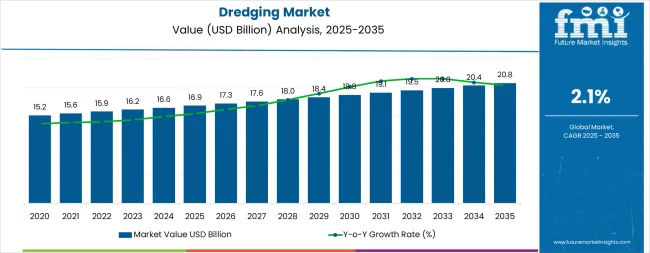
The peak-to-trough analysis for the dredging market shows a relatively stable growth pattern, with limited fluctuations over the forecast period. From 2026 to 2031, the market will grow from USD 17.3 billion to USD 19.6 billion, reflecting a gradual increase of USD 2.3 billion. The market will experience a steady rise during these years, driven by continuous infrastructure projects and the ongoing need for dredging services for port and harbor maintenance. During this phase, the market growth rate will be moderate, reflecting the steady demand for dredging services but with limited volatility.
From 2031 to 2036, the market will continue to expand, increasing from USD 19.6 billion to USD 21.3 billion, an additional USD 1.7 billion. The growth in the later years will be slower as the market matures, and the rate of growth will decelerate. However, the demand for dredging will remain relatively stable, driven by long-term infrastructure needs and ongoing climate change mitigation efforts. The peak-to-trough analysis suggests that the dredging market will experience consistent, gradual growth with minimal volatility, making it a stable and essential sector within global infrastructure development.
Dredging Market Key Takeaways
| Metric | Value |
|---|---|
| Industry Sales Value (2026) | USD 17.3 billion |
| Industry Forecast Value (2036) | USD 21.3 billion |
| Industry Forecast CAGR (2026-2036) | 2.1% |
What Is Driving the Demand for the Dredging Market?
Historical demand for dredging has been shaped by the long standing need to maintain and expand waterways, ports, and coastal infrastructure as maritime trade and urban development increased globally. Dredging involves excavation and removal of sediment and debris from underwater environments to support navigability, deepen shipping channels, and enable safe vessel passage, services that have been essential as global trade volumes expanded with industrialization. Maintenance dredging historically constituted a steady source of demand because sedimentation naturally reduces channel depth and port capacity over time. Capital dredging projects supported initial construction of harbors, canals, and inland waterways, linking inland regions with seaborne trade routes. Land reclamation also supported coastal urbanization and industrial expansion in dense coastal economies, adding to demand for dredging services. In addition, environmental dredging for contaminated sediment removal gained traction as regulators and stakeholders recognized the importance of remediation in water quality and ecosystem health, creating specialized service requirements. Overall, these long standing needs underpinned the evolution of dredging as a key segment within marine infrastructure and heavy civil works.
Future demand for the dredging market is expected to grow steadily as maritime trade, port expansion, coastal protection, and offshore infrastructure investment continue to rise. Multiple forecasts project growth through the early 2030s with dredging market value increasing from about USD 16.9 billion in 2025 to around USD 20.8 billion by 2035 at roughly 2.1 % CAGR, reflecting sustained infrastructure activity and maintenance needs. Key drivers include investments in port deepening to accommodate larger container ships, expansion of coastal urban and industrial facilities, and rising off shore energy infrastructure requiring seabed preparation and cable trenching. Growth in environmental dredging activity to address sediment contamination and restore aquatic habitats also shapes future demand. The need to maintain inland waterways and support logistics efficiency further contributes as regions prioritize resilient supply chains. Demand for advanced dredging fleet modernization and equipment innovation supports this trend, with associated dredging equipment markets also projected to grow at mid single digit CAGRs, driven by ongoing infrastructure development and climate resilience initiatives.
What are the Leading Segments in the Global Dredging Market?
The global dredging market is segmented by customer type and application. Among customer types, government leads the market, capturing 46% of the share, followed by O&G companies, mining companies, renewable companies, and others. Government entities are the largest customers due to their involvement in public infrastructure projects, port maintenance, and coastal protection. On the application side, trade maintenance dominates, holding 31% of the share, followed by trade activity, energy infrastructure, urban development, coastal protection, leisure, and other applications. Trade maintenance is crucial for maintaining the navigability of shipping routes and ports, ensuring the smooth flow of global trade.
What Drives the Growth of Government Customers in the Dredging Market?
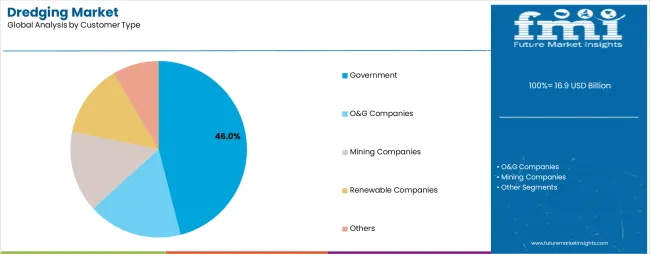
Government entities are the leading customer type in the dredging market, holding 46% of the share. This demand is driven by the government’s responsibility for managing public infrastructure, including ports, waterways, and coastlines. Governments around the world invest in dredging to maintain and expand their maritime trade infrastructure, ensure the navigability of shipping lanes, and protect coastal areas from erosion. Furthermore, dredging is essential for environmental management, such as the restoration of natural habitats or the removal of pollutants from waterways. The growing emphasis on improving and expanding port facilities to accommodate larger vessels, as well as government initiatives to support trade and economic growth, drives the demand for dredging services. Additionally, government-led coastal protection projects, such as flood defenses and the prevention of land loss due to erosion, require significant dredging efforts. As governments continue to prioritize infrastructure development and environmental protection, they will remain the dominant customer group in the dredging market.
What is Driving the Demand for Trade Maintenance in the Dredging Market?
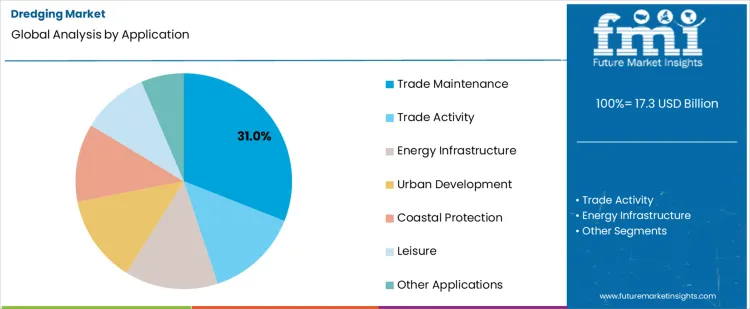
Trade maintenance is the leading application segment in the dredging market, capturing 31% of the share. This demand is primarily driven by the critical need to keep shipping lanes, harbors, and ports clear of sediment and debris to ensure the safe and efficient movement of goods. Dredging is essential to maintaining the depth of navigable waters, preventing the accumulation of silt that could block or reduce the capacity of ports and waterways. As global trade continues to grow, particularly in regions with high volumes of shipping activity, regular dredging operations are required to accommodate larger vessels and ensure that ports can handle increasing cargo demands. In addition, dredging for trade maintenance supports the continuous operation of key global shipping routes and logistics hubs. As ports around the world continue to expand and upgrade to meet the demands of modern trade, the need for dredging to maintain these facilities will continue to drive growth in this segment.
What are the Key Dynamics in the Dredging Market?
The dredging market encompasses services and equipment used to excavate and remove sediment, debris, and materials from water bodies to maintain or deepen navigational channels, ports, and waterways. Demand is tied to global trade volumes, port expansion, and maritime infrastructure projects that require regular maintenance dredging. Environmental permitting and sediment management practices influence project scope and technology choice. Offshore energy, coastal protection, and land reclamation also drive activity. Contractors evaluate dredging solutions based on performance, cost, and regulatory compliance. Market dynamics reflect investment cycles in public works, shipping infrastructure, and water resource management across regions.
What are the Main Drivers Supporting Growth in the Market?
Growth in the dredging market is supported by expansion of global maritime trade and corresponding port infrastructure upgrades. Larger vessels and deeper draft requirements necessitate ongoing dredging to maintain safe navigation channels and berths. Urbanisation and coastal development drive land reclamation and shoreline protection projects where dredging plays a central role. Environmental restoration initiatives, such as removal of contaminated sediments and wetland rehabilitation, increasingly rely on specialised dredging techniques. Governments prioritise flood control and waterway accessibility, allocating budgets for maintenance dredging. Investments in offshore wind and energy infrastructure also create demand for dredging to support foundation and cable installation works.
What Restraints Are Limiting Market Expansion?
Market expansion is limited by regulatory and environmental constraints that affect project approvals and execution. Permitting for dredging can be lengthy and costly, particularly where sediment disposal and water quality impacts are tightly regulated. Public concern over ecological disruption and habitat loss can delay or modify dredging plans. Project economics challenge some regions where funding for infrastructure maintenance is constrained by fiscal priorities. Technological complexity and high capital expenditure for advanced dredging vessels and equipment raise entry barriers. Access to skilled operators and crew influences contractor capacity, especially on specialised or offshore projects with stringent safety and performance standards.
What Emerging Trends Are Shaping the Future of the Market?
Emerging trends in the dredging market include increased use of precision dredging technologies that optimise sediment removal while reducing environmental impact. Digital tools, including sonar mapping and GPS based control systems, enhance accuracy and project efficiency. There is growing emphasis on sustainable sediment management, including beneficial reuse for beach nourishment, habitat restoration, and construction fill. Hybrid and lower emission dredging equipment is gaining attention as operators respond to decarbonisation goals in marine operations. Cross sector collaboration among dredging contractors, environmental consultants, and regulators supports integrated planning approaches. Investment in modular and adaptable fleet assets helps address diverse project requirements and enhances market responsiveness.
What is the Country-Wise Analysis of the Dredging Market?
The dredging market is seeing steady growth, primarily driven by the increasing need for port expansion, maintenance of waterways, and infrastructure development globally. Japan, China, and India are significant players in the dredging industry due to their vast coastlines and increasing industrialization. These countries are focusing on improving ports and waterways to boost trade and address challenges posed by sedimentation, erosion, and environmental concerns. Developed countries like Germany and France also contribute to the global dredging market, driven by the need to maintain ports, navigational channels, and flood protection systems. As trade activities expand and climate change poses challenges to coastal infrastructure, the dredging market is expected to grow across all regions.
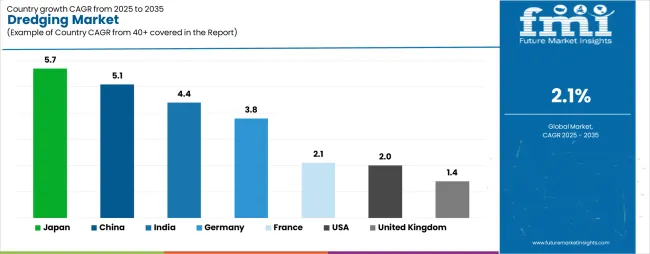
| Country | CAGR (2026-2036) |
|---|---|
| Japan | 5.7% |
| China | 5.1% |
| India | 4.4% |
| Germany | 3.8% |
| France | 2.1% |
What is the Growth Outlook for the Dredging Market in Japan?
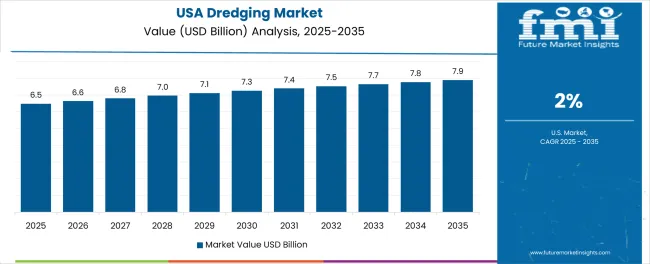
The dredging market in Japan is projected to grow steadily, with a projected CAGR of 5.7% from 2026 to 2036. Japan, an island nation with extensive coastal areas, relies heavily on dredging for maintaining navigational channels, port expansion, and flood prevention efforts. The need for regular dredging activities to keep Japan’s busy ports operational and its inland waterways navigable is essential to the country’s trade infrastructure. Additionally, Japan’s focus on climate resilience and the management of coastal erosion further drives the demand for dredging services. As Japan continues to invest in infrastructure development and environmental sustainability, the dredging market is expected to expand steadily over the next decade, with both government and private sector initiatives supporting the industry’s growth.
What is the Market Outlook for the Dredging Market in China?
China is expected to experience steady growth in the dredging market, with a projected CAGR of 5.1% from 2026 to 2036. As the world’s largest trading nation, China’s need for modernized ports and infrastructure plays a significant role in driving demand for dredging activities. The country’s focus on expanding and maintaining its maritime transportation network, including deepening ports and navigational channels, is crucial for facilitating global trade. China is also tackling issues related to sedimentation and land reclamation, which contributes to the growing demand for dredging. Furthermore, the rise of coastal cities and the need for flood control are also pushing the dredging market forward. With ongoing infrastructure development and government-led initiatives in coastal and port projects, China’s dredging market is expected to grow steadily in the coming years.
What is the Growth Forecast for the Dredging Market in India?
The dredging market in India is projected to grow at a moderate rate, with a projected CAGR of 4.4% from 2026 to 2036. India, with its long coastline and growing maritime trade, requires extensive dredging to support port expansion and improve navigational routes. The country’s focus on modernizing its ports, particularly under the "Sagarmala" project aimed at port-led development, is driving demand for dredging services. Additionally, the Indian government is focusing on improving inland waterways for transportation, which also contributes to the need for dredging. As trade activities increase and the country expands its infrastructure to accommodate larger vessels, the dredging market in India is expected to see steady growth in the coming years. The focus on maintaining coastal and riverine ecosystems amid climate change concerns will further fuel demand for dredging services.
What is the Market Outlook for the Dredging Market in Germany?
Germany is expected to see moderate growth in the dredging market, with a projected CAGR of 3.8% from 2026 to 2036. As one of Europe’s key industrialized countries, Germany requires ongoing dredging activities to maintain its extensive ports and navigational channels, particularly along the North Sea and Baltic Sea coasts. The country's focus on improving maritime logistics, trade infrastructure, and flood protection systems ensures continued demand for dredging services. Furthermore, Germany’s commitment to maintaining its ports’ competitiveness in global trade drives investment in dredging projects. With climate change and rising sea levels posing challenges to coastal infrastructure, Germany is also increasingly focusing on dredging for flood control and coastal protection. As the demand for efficient port operations and environmental management grows, Germany’s dredging market is expected to see steady growth.
What is the Growth Forecast for the Dredging Market in France?
The dredging market in France is expected to grow at a moderate pace, with a projected CAGR of 2.1% from 2026 to 2036. France has a significant maritime infrastructure, with major ports like Le Havre and Marseille that require regular dredging to accommodate larger vessels and ensure navigational safety. However, compared to other countries, France's demand for dredging services is relatively steady, driven by the need to maintain and expand existing ports and protect its coastline from erosion and flooding. Additionally, environmental regulations and sustainability efforts are leading to more focused dredging practices to protect marine ecosystems. Although growth in France's dredging market is moderate, it remains crucial for the country's maritime industry and overall trade. As France continues to modernize its ports and address environmental concerns, the dredging market will continue to be an essential part of infrastructure development.
What is the Competitive Landscape for the Dredging Market?
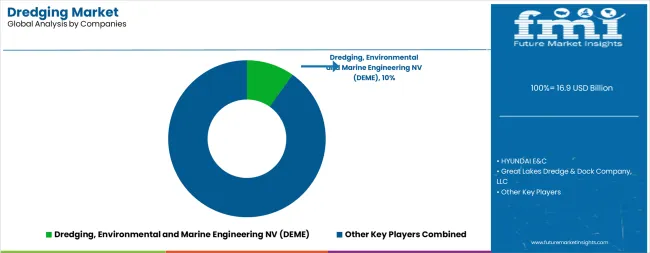
The dredging market is expanding as demand for port development, coastal protection, and environmental remediation increases globally. Dredging, Environmental and Marine Engineering NV (DEME) leads the market with its comprehensive dredging services, offering state-of-the-art equipment and environmentally responsible solutions. Their focus on large-scale, complex projects and their ability to provide sustainable dredging services have positioned them as a dominant player. HYUNDAI E&C, Great Lakes Dredge & Dock Company, LLC, and TOA Corporation are key competitors, each offering specialized dredging services for a range of applications. HYUNDAI E&C brings significant experience in large-scale infrastructure projects, while Great Lakes Dredge & Dock is a major player in the U.S. market with expertise in dredging for ports and waterways. TOA Corporation focuses on dredging and civil engineering solutions, contributing to infrastructure development.
Penta-Ocean Construction Co., Ltd., National Marine Company, and CALLAN MARINE, LTD. further strengthen the competitive landscape by offering their own dredging services. Penta-Ocean Construction focuses on marine and offshore infrastructure projects, including dredging services, while National Marine Company specializes in dredging for infrastructure and environmental projects. CALLAN MARINE, LTD. is known for its dredging expertise in large-scale environmental and construction projects. CASHMAN DREDGING, INC., COTTRELL CONTRACTING CORPORATION, and J.F. Brennan Company, Inc. play key roles by offering specialized dredging services for smaller, more focused projects. CASHMAN DREDGING provides turnkey dredging solutions, while COTTRELL CONTRACTING and J.F. Brennan Company specialize in environmentally sensitive dredging and waterway maintenance. These companies compete by focusing on innovation, sustainability, and the ability to deliver complex dredging solutions. As global infrastructure development and environmental projects continue to increase, the dredging market is expected to expand, driving further innovation and competition.
Key Players of the Dredging Market
- Dredging, Environmental and Marine Engineering NV (DEME)
- HYUNDAI E&C
- Great Lakes Dredge & Dock Company, LLC
- TOA Corporation
- Penta-Ocean Construction Co., Ltd.
- National Marine Company
- CALLAN MARINE, LTD.
- CASHMAN DREDGING, INC.
- COTTRELL CONTRACTING CORPORATION
- J.F. Brennan Company, Inc.
Scope of the Report
| Items | Values |
|---|---|
| Quantitative Units (2026) | USD Billion |
| Customer Type | Government, O&G Companies, Mining Companies, Renewable Companies, Others, Construction Companies, Port Authorities, Private Developers, Engineering Consultancies, Environmental Agencies, Real Estate Developers, Tourism Companies |
| Application | Trade Maintenance, Trade Activity, Energy Infrastructure, Urban Development, Coastal Protection, Leisure, Other Applications |
| Companies | Dredging, Environmental and Marine Engineering NV (DEME), HYUNDAI E&C, Great Lakes Dredge & Dock Company, LLC, TOA Corporation, Penta Ocean Construction Co., Ltd., National Marine Company, CALLAN MARINE, LTD., CASHMAN DREDGING, INC., COTTRELL CONTRACTING CORPORATION, J.F. Brennan Company, Inc. |
| Regions Covered | North America, Latin America, Western Europe, Eastern Europe, South Asia & Pacific, East Asia, Middle East & Africa |
| Countries Covered | United States, Canada, Mexico, Brazil, Argentina, Germany, France, United Kingdom, Italy, Spain, Netherlands, China, India, Japan, South Korea, ANZ, GCC Countries, South Africa |
| Additional Attributes | Dollar by sales by customer type and application, and by region. Includes analysis of market trends in dredging demand across government and private sectors, maintenance and trade activity, infrastructure and coastal protection projects, urban development and leisure port expansion, cost and operational considerations, regulatory and environmental frameworks, competitive positioning and market share of key companies, technology adoption and fleet modernization trends, and evaluation of impact on marine logistics, sediment management, and coastal resilience. |
Dredging Market Segmentation
Customer Type
- Government
- O&G Companies
- Mining Companies
- Renewable Companies
- Others
- Construction Companies
- Port Authorities
- Private Developers
- Engineering Consultancies
- Environmental Agencies
- Real Estate Developers
- Tourism Companies
Application
- Trade Maintenance
- Trade Activity
- Energy Infrastructure
- Urban Development
- Coastal Protection
- Leisure
- Other Applications
Region
- Asia Pacific
- China
- Japan
- South Korea
- India
- Australia & New Zealand
- ASEAN
- Rest of Asia Pacific
- Europe
- Germany
- United Kingdom
- France
- Italy
- Spain
- Nordic
- BENELUX
- Rest of Europe
- North America
- United States
- Canada
- Mexico
- Latin America
- Brazil
- Chile
- Rest of Latin America
- Middle East & Africa
- Kingdom of Saudi Arabia
- Other GCC Countries
- Turkey
- South Africa
- Other African Union
- Rest of Middle East & Africa
Bibliography
- Dredging, Environmental and Marine Engineering NV (DEME). (2026). Dredging market forecast and outlook 2026-2036. DEME Group.
- HYUNDAI E&C. (2026). Dredging market growth and demand analysis.
Frequently Asked Questions
How big is the dredging market in 2026?
The global dredging market is estimated to be valued at USD 17.3 billion in 2026.
What will be the size of dredging market in 2036?
The market size for the dredging market is projected to reach USD 21.3 billion by 2036.
How much will be the dredging market growth between 2026 and 2036?
The dredging market is expected to grow at a 2.1% CAGR between 2026 and 2036.
What are the key product types in the dredging market?
The key product types in dredging market are government, o&g companies, mining companies, renewable companies, others, construction companies, port authorities, private developers, engineering consultancies, environmental agencies, real estate developers and tourism companies.
Which application segment to contribute significant share in the dredging market in 2026?
In terms of application, trade maintenance segment to command 31.0% share in the dredging market in 2026.
Table of Content
- Executive Summary
- Global Market Outlook
- Demand to side Trends
- Supply to side Trends
- Technology Roadmap Analysis
- Analysis and Recommendations
- Market Overview
- Market Coverage / Taxonomy
- Market Definition / Scope / Limitations
- Market Background
- Market Dynamics
- Drivers
- Restraints
- Opportunity
- Trends
- Scenario Forecast
- Demand in Optimistic Scenario
- Demand in Likely Scenario
- Demand in Conservative Scenario
- Opportunity Map Analysis
- Product Life Cycle Analysis
- Supply Chain Analysis
- Investment Feasibility Matrix
- Value Chain Analysis
- PESTLE and Porter’s Analysis
- Regulatory Landscape
- Regional Parent Market Outlook
- Production and Consumption Statistics
- Import and Export Statistics
- Market Dynamics
- Global Market Analysis 2021 to 2025 and Forecast, 2026 to 2036
- Historical Market Size Value (USD Million) Analysis, 2021 to 2025
- Current and Future Market Size Value (USD Million) Projections, 2026 to 2036
- Y to o to Y Growth Trend Analysis
- Absolute $ Opportunity Analysis
- Global Market Pricing Analysis 2021 to 2025 and Forecast 2026 to 2036
- Global Market Analysis 2021 to 2025 and Forecast 2026 to 2036, By Customer Type
- Introduction / Key Findings
- Historical Market Size Value (USD Million) Analysis By Customer Type , 2021 to 2025
- Current and Future Market Size Value (USD Million) Analysis and Forecast By Customer Type , 2026 to 2036
- Government
- O&G Companies
- Mining Companies
- Renewable Companies
- Others
- Construction Companies
- Port Authorities
- Private Developers
- Engineering Consultancies
- Environmental Agencies
- Real Estate Developers
- Government
- Y to o to Y Growth Trend Analysis By Customer Type , 2021 to 2025
- Absolute $ Opportunity Analysis By Customer Type , 2026 to 2036
- Global Market Analysis 2021 to 2025 and Forecast 2026 to 2036, By Application
- Introduction / Key Findings
- Historical Market Size Value (USD Million) Analysis By Application, 2021 to 2025
- Current and Future Market Size Value (USD Million) Analysis and Forecast By Application, 2026 to 2036
- Trade Maintenance
- Trade Activity
- Energy Infrastructure
- Urban Development
- Coastal Protection
- Leisure
- Other Applications
- Trade Maintenance
- Y to o to Y Growth Trend Analysis By Application, 2021 to 2025
- Absolute $ Opportunity Analysis By Application, 2026 to 2036
- Global Market Analysis 2021 to 2025 and Forecast 2026 to 2036, By Region
- Introduction
- Historical Market Size Value (USD Million) Analysis By Region, 2021 to 2025
- Current Market Size Value (USD Million) Analysis and Forecast By Region, 2026 to 2036
- North America
- Latin America
- Western Europe
- Eastern Europe
- East Asia
- South Asia and Pacific
- Middle East & Africa
- Market Attractiveness Analysis By Region
- North America Market Analysis 2021 to 2025 and Forecast 2026 to 2036, By Country
- Historical Market Size Value (USD Million) Trend Analysis By Market Taxonomy, 2021 to 2025
- Market Size Value (USD Million) Forecast By Market Taxonomy, 2026 to 2036
- By Country
- USA
- Canada
- Mexico
- By Customer Type
- By Application
- By Country
- Market Attractiveness Analysis
- By Country
- By Customer Type
- By Application
- Key Takeaways
- Latin America Market Analysis 2021 to 2025 and Forecast 2026 to 2036, By Country
- Historical Market Size Value (USD Million) Trend Analysis By Market Taxonomy, 2021 to 2025
- Market Size Value (USD Million) Forecast By Market Taxonomy, 2026 to 2036
- By Country
- Brazil
- Chile
- Rest of Latin America
- By Customer Type
- By Application
- By Country
- Market Attractiveness Analysis
- By Country
- By Customer Type
- By Application
- Key Takeaways
- Western Europe Market Analysis 2021 to 2025 and Forecast 2026 to 2036, By Country
- Historical Market Size Value (USD Million) Trend Analysis By Market Taxonomy, 2021 to 2025
- Market Size Value (USD Million) Forecast By Market Taxonomy, 2026 to 2036
- By Country
- Germany
- UK
- Italy
- Spain
- France
- Nordic
- BENELUX
- Rest of Western Europe
- By Customer Type
- By Application
- By Country
- Market Attractiveness Analysis
- By Country
- By Customer Type
- By Application
- Key Takeaways
- Eastern Europe Market Analysis 2021 to 2025 and Forecast 2026 to 2036, By Country
- Historical Market Size Value (USD Million) Trend Analysis By Market Taxonomy, 2021 to 2025
- Market Size Value (USD Million) Forecast By Market Taxonomy, 2026 to 2036
- By Country
- Russia
- Poland
- Hungary
- Balkan & Baltic
- Rest of Eastern Europe
- By Customer Type
- By Application
- By Country
- Market Attractiveness Analysis
- By Country
- By Customer Type
- By Application
- Key Takeaways
- East Asia Market Analysis 2021 to 2025 and Forecast 2026 to 2036, By Country
- Historical Market Size Value (USD Million) Trend Analysis By Market Taxonomy, 2021 to 2025
- Market Size Value (USD Million) Forecast By Market Taxonomy, 2026 to 2036
- By Country
- China
- Japan
- South Korea
- By Customer Type
- By Application
- By Country
- Market Attractiveness Analysis
- By Country
- By Customer Type
- By Application
- Key Takeaways
- South Asia and Pacific Market Analysis 2021 to 2025 and Forecast 2026 to 2036, By Country
- Historical Market Size Value (USD Million) Trend Analysis By Market Taxonomy, 2021 to 2025
- Market Size Value (USD Million) Forecast By Market Taxonomy, 2026 to 2036
- By Country
- India
- ASEAN
- Australia & New Zealand
- Rest of South Asia and Pacific
- By Customer Type
- By Application
- By Country
- Market Attractiveness Analysis
- By Country
- By Customer Type
- By Application
- Key Takeaways
- Middle East & Africa Market Analysis 2021 to 2025 and Forecast 2026 to 2036, By Country
- Historical Market Size Value (USD Million) Trend Analysis By Market Taxonomy, 2021 to 2025
- Market Size Value (USD Million) Forecast By Market Taxonomy, 2026 to 2036
- By Country
- Kingdom of Saudi Arabia
- Other GCC Countries
- Turkiye
- South Africa
- Other African Union
- Rest of Middle East & Africa
- By Customer Type
- By Application
- By Country
- Market Attractiveness Analysis
- By Country
- By Customer Type
- By Application
- Key Takeaways
- Key Countries Market Analysis
- USA
- Pricing Analysis
- Market Share Analysis, 2025
- By Customer Type
- By Application
- Canada
- Pricing Analysis
- Market Share Analysis, 2025
- By Customer Type
- By Application
- Mexico
- Pricing Analysis
- Market Share Analysis, 2025
- By Customer Type
- By Application
- Brazil
- Pricing Analysis
- Market Share Analysis, 2025
- By Customer Type
- By Application
- Chile
- Pricing Analysis
- Market Share Analysis, 2025
- By Customer Type
- By Application
- Germany
- Pricing Analysis
- Market Share Analysis, 2025
- By Customer Type
- By Application
- UK
- Pricing Analysis
- Market Share Analysis, 2025
- By Customer Type
- By Application
- Italy
- Pricing Analysis
- Market Share Analysis, 2025
- By Customer Type
- By Application
- Spain
- Pricing Analysis
- Market Share Analysis, 2025
- By Customer Type
- By Application
- France
- Pricing Analysis
- Market Share Analysis, 2025
- By Customer Type
- By Application
- India
- Pricing Analysis
- Market Share Analysis, 2025
- By Customer Type
- By Application
- ASEAN
- Pricing Analysis
- Market Share Analysis, 2025
- By Customer Type
- By Application
- Australia & New Zealand
- Pricing Analysis
- Market Share Analysis, 2025
- By Customer Type
- By Application
- China
- Pricing Analysis
- Market Share Analysis, 2025
- By Customer Type
- By Application
- Japan
- Pricing Analysis
- Market Share Analysis, 2025
- By Customer Type
- By Application
- South Korea
- Pricing Analysis
- Market Share Analysis, 2025
- By Customer Type
- By Application
- Russia
- Pricing Analysis
- Market Share Analysis, 2025
- By Customer Type
- By Application
- Poland
- Pricing Analysis
- Market Share Analysis, 2025
- By Customer Type
- By Application
- Hungary
- Pricing Analysis
- Market Share Analysis, 2025
- By Customer Type
- By Application
- Kingdom of Saudi Arabia
- Pricing Analysis
- Market Share Analysis, 2025
- By Customer Type
- By Application
- Turkiye
- Pricing Analysis
- Market Share Analysis, 2025
- By Customer Type
- By Application
- South Africa
- Pricing Analysis
- Market Share Analysis, 2025
- By Customer Type
- By Application
- USA
- Market Structure Analysis
- Competition Dashboard
- Competition Benchmarking
- Market Share Analysis of Top Players
- By Regional
- By Customer Type
- By Application
- Competition Analysis
- Competition Deep Dive
- Dredging, Environmental and Marine Engineering NV (DEME)
- Overview
- Product Portfolio
- Profitability by Market Segments (Product/Age /Sales Channel/Region)
- Sales Footprint
- Strategy Overview
- Marketing Strategy
- Product Strategy
- Channel Strategy
- HYUNDAI E&C
- Great Lakes Dredge & Dock Company, LLC
- TOA Corporation
- Penta-Ocean Construction Co., Ltd.
- National Marine Company
- CALLAN MARINE, LTD.
- CASHMAN DREDGING, INC.
- COTTRELL CONTRACTING CORPORATION
- J.F. Brennan Company, Inc.
- Dredging, Environmental and Marine Engineering NV (DEME)
- Competition Deep Dive
- Assumptions & Acronyms Used
- Research Methodology
List of Tables
- Table 1: Global Market Value (USD Million) Forecast by Region, 2021 to 2036
- Table 2: Global Market Value (USD Million) Forecast by Customer Type , 2021 to 2036
- Table 3: Global Market Value (USD Million) Forecast by Application, 2021 to 2036
- Table 4: North America Market Value (USD Million) Forecast by Country, 2021 to 2036
- Table 5: North America Market Value (USD Million) Forecast by Customer Type , 2021 to 2036
- Table 6: North America Market Value (USD Million) Forecast by Application, 2021 to 2036
- Table 7: Latin America Market Value (USD Million) Forecast by Country, 2021 to 2036
- Table 8: Latin America Market Value (USD Million) Forecast by Customer Type , 2021 to 2036
- Table 9: Latin America Market Value (USD Million) Forecast by Application, 2021 to 2036
- Table 10: Western Europe Market Value (USD Million) Forecast by Country, 2021 to 2036
- Table 11: Western Europe Market Value (USD Million) Forecast by Customer Type , 2021 to 2036
- Table 12: Western Europe Market Value (USD Million) Forecast by Application, 2021 to 2036
- Table 13: Eastern Europe Market Value (USD Million) Forecast by Country, 2021 to 2036
- Table 14: Eastern Europe Market Value (USD Million) Forecast by Customer Type , 2021 to 2036
- Table 15: Eastern Europe Market Value (USD Million) Forecast by Application, 2021 to 2036
- Table 16: East Asia Market Value (USD Million) Forecast by Country, 2021 to 2036
- Table 17: East Asia Market Value (USD Million) Forecast by Customer Type , 2021 to 2036
- Table 18: East Asia Market Value (USD Million) Forecast by Application, 2021 to 2036
- Table 19: South Asia and Pacific Market Value (USD Million) Forecast by Country, 2021 to 2036
- Table 20: South Asia and Pacific Market Value (USD Million) Forecast by Customer Type , 2021 to 2036
- Table 21: South Asia and Pacific Market Value (USD Million) Forecast by Application, 2021 to 2036
- Table 22: Middle East & Africa Market Value (USD Million) Forecast by Country, 2021 to 2036
- Table 23: Middle East & Africa Market Value (USD Million) Forecast by Customer Type , 2021 to 2036
- Table 24: Middle East & Africa Market Value (USD Million) Forecast by Application, 2021 to 2036
List of Figures
- Figure 1: Global Market Pricing Analysis
- Figure 2: Global Market Value (USD Million) Forecast 2021-2036
- Figure 3: Global Market Value Share and BPS Analysis by Customer Type , 2026 and 2036
- Figure 4: Global Market Y-o-Y Growth Comparison by Customer Type , 2026-2036
- Figure 5: Global Market Attractiveness Analysis by Customer Type
- Figure 6: Global Market Value Share and BPS Analysis by Application, 2026 and 2036
- Figure 7: Global Market Y-o-Y Growth Comparison by Application, 2026-2036
- Figure 8: Global Market Attractiveness Analysis by Application
- Figure 9: Global Market Value (USD Million) Share and BPS Analysis by Region, 2026 and 2036
- Figure 10: Global Market Y-o-Y Growth Comparison by Region, 2026-2036
- Figure 11: Global Market Attractiveness Analysis by Region
- Figure 12: North America Market Incremental Dollar Opportunity, 2026-2036
- Figure 13: Latin America Market Incremental Dollar Opportunity, 2026-2036
- Figure 14: Western Europe Market Incremental Dollar Opportunity, 2026-2036
- Figure 15: Eastern Europe Market Incremental Dollar Opportunity, 2026-2036
- Figure 16: East Asia Market Incremental Dollar Opportunity, 2026-2036
- Figure 17: South Asia and Pacific Market Incremental Dollar Opportunity, 2026-2036
- Figure 18: Middle East & Africa Market Incremental Dollar Opportunity, 2026-2036
- Figure 19: North America Market Value Share and BPS Analysis by Country, 2026 and 2036
- Figure 20: North America Market Value Share and BPS Analysis by Customer Type , 2026 and 2036
- Figure 21: North America Market Y-o-Y Growth Comparison by Customer Type , 2026-2036
- Figure 22: North America Market Attractiveness Analysis by Customer Type
- Figure 23: North America Market Value Share and BPS Analysis by Application, 2026 and 2036
- Figure 24: North America Market Y-o-Y Growth Comparison by Application, 2026-2036
- Figure 25: North America Market Attractiveness Analysis by Application
- Figure 26: Latin America Market Value Share and BPS Analysis by Country, 2026 and 2036
- Figure 27: Latin America Market Value Share and BPS Analysis by Customer Type , 2026 and 2036
- Figure 28: Latin America Market Y-o-Y Growth Comparison by Customer Type , 2026-2036
- Figure 29: Latin America Market Attractiveness Analysis by Customer Type
- Figure 30: Latin America Market Value Share and BPS Analysis by Application, 2026 and 2036
- Figure 31: Latin America Market Y-o-Y Growth Comparison by Application, 2026-2036
- Figure 32: Latin America Market Attractiveness Analysis by Application
- Figure 33: Western Europe Market Value Share and BPS Analysis by Country, 2026 and 2036
- Figure 34: Western Europe Market Value Share and BPS Analysis by Customer Type , 2026 and 2036
- Figure 35: Western Europe Market Y-o-Y Growth Comparison by Customer Type , 2026-2036
- Figure 36: Western Europe Market Attractiveness Analysis by Customer Type
- Figure 37: Western Europe Market Value Share and BPS Analysis by Application, 2026 and 2036
- Figure 38: Western Europe Market Y-o-Y Growth Comparison by Application, 2026-2036
- Figure 39: Western Europe Market Attractiveness Analysis by Application
- Figure 40: Eastern Europe Market Value Share and BPS Analysis by Country, 2026 and 2036
- Figure 41: Eastern Europe Market Value Share and BPS Analysis by Customer Type , 2026 and 2036
- Figure 42: Eastern Europe Market Y-o-Y Growth Comparison by Customer Type , 2026-2036
- Figure 43: Eastern Europe Market Attractiveness Analysis by Customer Type
- Figure 44: Eastern Europe Market Value Share and BPS Analysis by Application, 2026 and 2036
- Figure 45: Eastern Europe Market Y-o-Y Growth Comparison by Application, 2026-2036
- Figure 46: Eastern Europe Market Attractiveness Analysis by Application
- Figure 47: East Asia Market Value Share and BPS Analysis by Country, 2026 and 2036
- Figure 48: East Asia Market Value Share and BPS Analysis by Customer Type , 2026 and 2036
- Figure 49: East Asia Market Y-o-Y Growth Comparison by Customer Type , 2026-2036
- Figure 50: East Asia Market Attractiveness Analysis by Customer Type
- Figure 51: East Asia Market Value Share and BPS Analysis by Application, 2026 and 2036
- Figure 52: East Asia Market Y-o-Y Growth Comparison by Application, 2026-2036
- Figure 53: East Asia Market Attractiveness Analysis by Application
- Figure 54: South Asia and Pacific Market Value Share and BPS Analysis by Country, 2026 and 2036
- Figure 55: South Asia and Pacific Market Value Share and BPS Analysis by Customer Type , 2026 and 2036
- Figure 56: South Asia and Pacific Market Y-o-Y Growth Comparison by Customer Type , 2026-2036
- Figure 57: South Asia and Pacific Market Attractiveness Analysis by Customer Type
- Figure 58: South Asia and Pacific Market Value Share and BPS Analysis by Application, 2026 and 2036
- Figure 59: South Asia and Pacific Market Y-o-Y Growth Comparison by Application, 2026-2036
- Figure 60: South Asia and Pacific Market Attractiveness Analysis by Application
- Figure 61: Middle East & Africa Market Value Share and BPS Analysis by Country, 2026 and 2036
- Figure 62: Middle East & Africa Market Value Share and BPS Analysis by Customer Type , 2026 and 2036
- Figure 63: Middle East & Africa Market Y-o-Y Growth Comparison by Customer Type , 2026-2036
- Figure 64: Middle East & Africa Market Attractiveness Analysis by Customer Type
- Figure 65: Middle East & Africa Market Value Share and BPS Analysis by Application, 2026 and 2036
- Figure 66: Middle East & Africa Market Y-o-Y Growth Comparison by Application, 2026-2036
- Figure 67: Middle East & Africa Market Attractiveness Analysis by Application
- Figure 68: Global Market - Tier Structure Analysis
- Figure 69: Global Market - Company Share Analysis
Our Research Products

The "Full Research Suite" delivers actionable market intel, deep dives on markets or technologies, so clients act faster, cut risk, and unlock growth.
The Leaderboard benchmarks and ranks top vendors, classifying them as Established Leaders, Leading Challengers, or Disruptors & Challengers.

Locates where complements amplify value and substitutes erode it, forecasting net impact by horizon

We deliver granular, decision-grade intel: market sizing, 5-year forecasts, pricing, adoption, usage, revenue, and operational KPIs—plus competitor tracking, regulation, and value chains—across 60 countries broadly.

Spot the shifts before they hit your P&L. We track inflection points, adoption curves, pricing moves, and ecosystem plays to show where demand is heading, why it is changing, and what to do next across high-growth markets and disruptive tech

Real-time reads of user behavior. We track shifting priorities, perceptions of today’s and next-gen services, and provider experience, then pace how fast tech moves from trial to adoption, blending buyer, consumer, and channel inputs with social signals (#WhySwitch, #UX).
Partner with our analyst team to build a custom report designed around your business priorities. From analysing market trends to assessing competitors or crafting bespoke datasets, we tailor insights to your needs.
Supplier Intelligence
Discovery & Profiling
Capacity & Footprint
Performance & Risk
Compliance & Governance
Commercial Readiness
Who Supplies Whom
Scorecards & Shortlists
Playbooks & Docs
Category Intelligence
Definition & Scope
Demand & Use Cases
Cost Drivers
Market Structure
Supply Chain Map
Trade & Policy
Operating Norms
Deliverables
Buyer Intelligence
Account Basics
Spend & Scope
Procurement Model
Vendor Requirements
Terms & Policies
Entry Strategy
Pain Points & Triggers
Outputs
Pricing Analysis
Benchmarks
Trends
Should-Cost
Indexation
Landed Cost
Commercial Terms
Deliverables
Brand Analysis
Positioning & Value Prop
Share & Presence
Customer Evidence
Go-to-Market
Digital & Reputation
Compliance & Trust
KPIs & Gaps
Outputs
Full Research Suite comprises of:

Market outlook & trends analysis
Interviews & case studies
Strategic recommendations
Vendor profiles & capabilities analysis
5-year forecasts
8 regions and 60+ country-level data splits
Market segment data splits
12 months of continuous data updates
DELIVERED AS:
PDF EXCEL ONLINE


