

- Market Size (2026)
- USD 11.0 Bn
- Forecast (2036)
- USD 28.7 Bn
- CAGR (2026 to 2036)
- 10.1%
Expense Tracker Apps Market Size, Market Forecast and Outlook By FMI
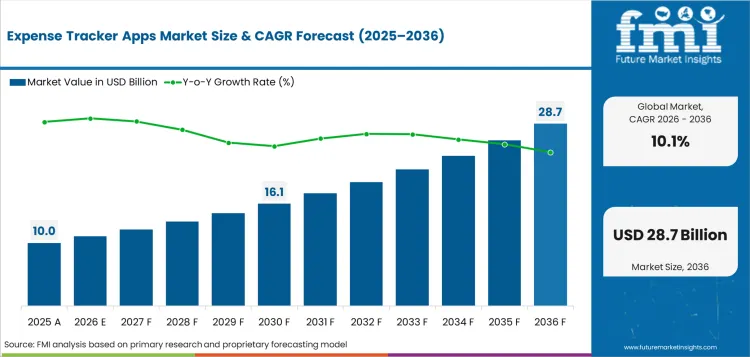
The expense tracker apps market was valued at USD 10.0 billion in 2025. The market is set to reach USD 11.0 billion by 2026-end and grow at a CAGR of 10.1% between 2026-2036 to reach USD 28.7 billion by 2036. Mobile Apps will dominate with a 68.5% share, while Freemium will lead with a 61.9% share.
Summary of the Expense Tracker Apps Market
- Demand and Growth Drivers
- Demand is being influenced by the growing adoption of expense tracker apps solutions across core end-use industries, with procurement trends shifting towards higher-specification and compliance-driven products.
- Regulatory frameworks and sustainability mandates are driving a faster transition away from conventional alternatives, creating structured demand in both developed and emerging markets.
- Technology upgrades and the growth of expense tracker apps within existing supply chains are fueling expansion in downstream applications, which are driving growth.
- Product and Segment View
- Mobile Apps are anticipated to hold the largest share of 68.5% in the platform segment in 2026, owing to constant procurement cycles and performance needs.
- Freemium accounts for 61.9% of the subscription model segment, indicating high concentration of demand from established buyer groups.
- The adoption is accelerating because of the performance benchmarking and lifecycle cost advantages over conventional alternatives.
- Geography and Competitive Outlook
- USA is expected to lead global demand at 10.3% CAGR, supported by capacity expansion and policy alignment.
- South Korea is projected to grow at 10.2% CAGR, reflecting strong institutional and commercial adoption.
- Companies that combine production scale, distribution reach, and compliance capabilities are expected to consolidate market position over the forecast period.
- Analyst Opinion
- The expense tracker apps market is moving from a fragmented supply landscape to a more structured procurement environment where compliance, cost efficiency and supply reliability are the drivers of competitive positioning.
- The adoption is driven by rising regulatory frameworks and the increasing role of expense tracker apps in traditional and new applications.
- Prices continue to be impacted by input cost volatility, regional capacity utilization, and the premium-commodity balance.
- Companies investing in capacity expansion, securing supply chain partnerships, and addressing regional compliance requirements are expected to capture disproportionate share over the 2026 to 2036 forecast period.
Key Takeaways, Market Size, and Forecast
- The expense tracker apps market was valued at USD 9.98 billion in 2025.
- By 2036, the Expense Tracker Apps Market is expected to be worth USD 28.75 billion.
- From 2026 to 2036, the market is projected to expand at a CAGR of 10.1%.
- The market is projected to create an incremental opportunity of USD 17.77 billion between 2026 and 2036.
- In 2026, mobile apps is expected to account for 68.5% of the platform segment, driven by sustained demand across primary end-use applications.
- USA (10.3%) and South Korea (10.2%) are two of the fastest growing markets in the world.
Expense Tracker Apps Market Definition
The expense tracker apps market encompasses all commercially traded products and services classified under expense tracker apps, including products segmented by platform, subscription model, functionality, and spanning applications across multiple industries and regions. The market covers the forecast period from 2026 to 2036.
Expense Tracker Apps Market Inclusions
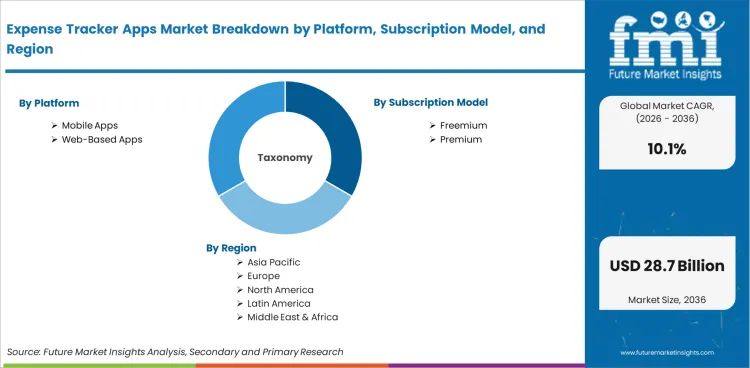
Market scope encompasses all commercially traded expense tracker apps products categorized by platform (Mobile Apps, Web-Based Apps); subscription model (Freemium, Premium); functionality (Basic Expense Tracker, Finance Analytics, Receipt Scanning and Management); end user (Personal, Business). The range of revenue sizes is from 2026 to 2036.
Expense Tracker Apps Market Exclusions
The scope does not include products that fall outside the defined segmentation taxonomy, raw materials traded as intermediate inputs without processing, or adjacent product categories that do not directly compete within the expense tracker apps classification.
Expense Tracker Apps Market Research Methodology
- Primary Research: FMI analysts interviewed manufacturers, distributors, procurement specialists and end-use industry participants in key markets.
- Desk Research: industry association, regulatory filings, trade databases and manufacturer disclosures aggregated data.
- Market sizing and forecasting: Bottom-up aggregation across segments and regions calibrated with regional adoption curves and procurement data.
- Data Validation: Quarterly cross check with production stats, trade data and manufacturer reported figures.
Why is the Expense Tracker Apps Market Growing?
- Demand is fuelled by tighter regulatory requirements and a move to higher specification products in key industries that offer defined replacement and upgrade cycles.
- Growth is fueled by growing penetration in emerging markets where infrastructure investment and industrialization are driving procurement.
- The USA is leading the growth, with 10.3%, driven by capacity expansion and policy-level support for expense tracker apps adoption.
The market for expense tracker apps is driven by the focus of end-use industries on compliance, consistency in performance, and supply chain reliability. Procurement - moving from cost-driven spot buying to specification-led, contract-based sourcing. This transition benefits suppliers with established quality systems, regulatory clearances and multi-region distribution infrastructure. The market structure that emerges favors scale, technical ability and proximity to demand centers.
Price continues to be affected by input cost volatility, capacity utilization rates and the competitive interface between integrated producers and smaller regional suppliers. Compliance requirements or performance standards are barriers to entry into premium segments which command higher margins and more predictable demand. Margins are being squeezed in commodity segments by overcapacity in some regions and price competition from lower-cost producers.
Supply concentration is a structural risk. Relying on specific raw materials, production geographies or regulatory regimes introduces vulnerability to disruption. Firms with diversified sourcing, backward integration or strategic inventory positions are better positioned to maintain supply continuity and protect margins when input costs rise.
Market Segmentation Analysis
- Mobile Apps dominates the platform segment with 68.5% share, demonstrating established procurement and specification patterns.
- Freemium makes up 61.9% of the subscription model segment, driven by intense demand from main buyer groups.
- The market is segmented by platform, subscription model, functionality and end user with each segment demonstrating different procurement drivers and growth trajectories.
The expense tracker apps market is segmented on the basis of platform, subscription model, functionality, end user. Each dimension is linked to distinct buyer behaviours, pricing dynamics and growth characteristics.
Insights into the Mobile Apps Segment
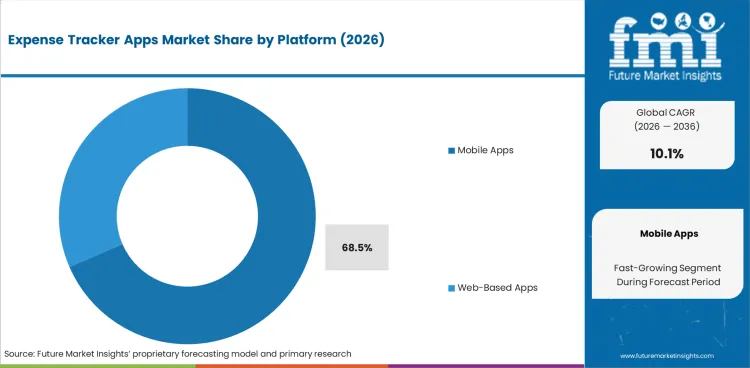
Mobile apps are projected to account for 68.5% of the platform segment in 2026. The demand is concentrated from established buyer groups with set specification requirements and recurring procurement cycles. Growth is driven by replacement demand and new capacity additions in key regions.
Insights into the Freemium Segment
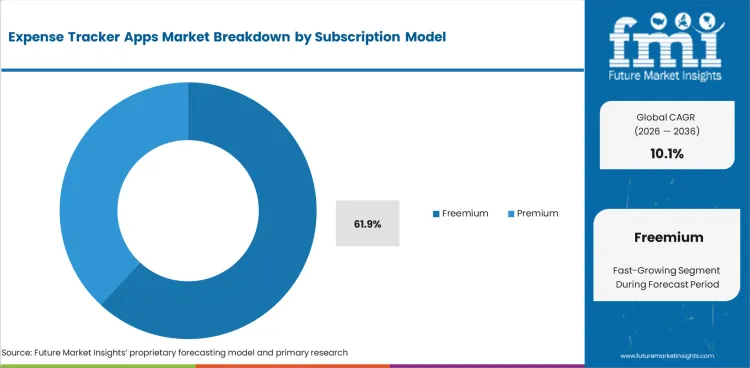
Freemium accounts for 61.9% of the subscription model segment. The adoption is being driven by operational needs, compliance needs and the lifecycle cost benefits of higher specification products over conventional alternatives.
Expense Tracker Apps Market Drivers, Restraints, and Opportunities
- Higher specification expense tracker apps products are witnessing organized demand in major end-use industries due to strict regulatory adherence and standardization of performance.
- Cost premiums over conventional alternatives are a barrier to adoption in price-sensitive commodity applications, leading to concentration of growth in regulated and premium segments.
- Long-term volume potential is emerging from the expansion of infrastructure in developing markets and industrial modernization programs.
The market for expense tracker apps has been impacted by the confluence of regulatory tightening, technology development and changing procurement patterns in end-use industries. Focus on growth segments with compliance, performance or sustainability requirements that generate structured demand and barriers to substitution.
Regulatory and Compliance-led Demand
Demand is being shaped by tightening regulatory frameworks in key geographies. In regulated sectors, compliance requirements are transforming procurement from optional to mandatory, creating a base demand that is less cyclical.
Cost and Scalability Constraints
Cost premiums restrict adoption of price sensitive applications. Large-scale manufacturers with integrated supply chains are favored in production economics. “Smaller producers are squeezed by volatile input costs and limited ability to pass on price increases.
Infrastructure Expansion in Emerging Markets
Growth is driven by infrastructure investment and industrialisation in emerging economies. There are also industrial modernization programs and government procurement programs that are creating new demand channels with multi-year volume commitments.
Technology Upgrade Cycles
Demand for replacement is accelerating as legacy systems come to end-of-life and next-generation specifications require upgraded components. Technology transition cycles result in narrow procurement windows that favor suppliers with inventory and qualification.
Analysis of Expense Tracker Apps Market By Key Countries
.webp "Top Country Growth Comparison Expense Tracker Apps Market Cagr (2026 2036)")
| Country | CAGR |
|---|---|
| USA | 10.3% |
| South Korea | 10.2% |
| EU | 10.1% |
| Japan | 10.1% |
| UK | 10.0% |
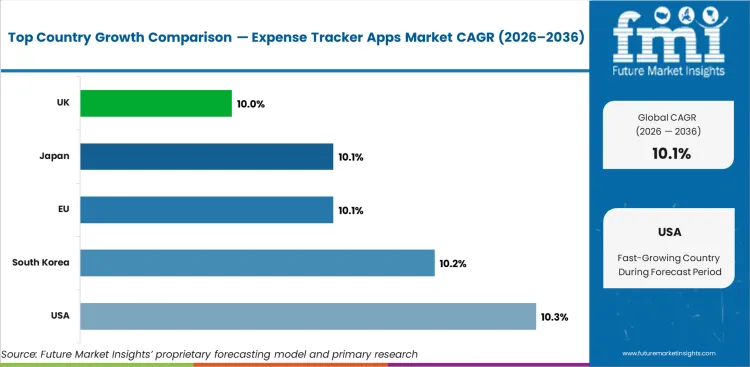
- The USA at 10.3% CAGR reflects the world's largest personal finance app market, Mint (Intuit) and YNAB dominant user bases, and consumer demand for automated expense categorization integrated with US banking through Plaid and open banking APIs.
- South Korea at 10.2% CAGR is shaped by Korean consumer digital finance adoption, Toss and KakaoPay super-app integration of expense tracking features, and MyData open banking framework enabling automated transaction aggregation.
- The EU at 10.1% CAGR is supported by PSD2 open banking enabling automated account aggregation, European consumer interest in budgeting tools amid cost-of-living pressures, and multi-currency expense tracking demand across Eurozone and non-Eurozone economies.
- Japan at 10.1% CAGR reflects Money Forward and Moneytree dominance in Japanese personal finance, cashless payment growth creating digital expense trails, and Japanese consumer preference for detailed household budgeting (kakeibo tradition digitized).
- The UK at 10.0% CAGR is driven by open banking maturity (UK leads globally in open banking API adoption), Monzo, Starling, and Revolut built-in expense analytics, and HMRC self-assessment driving self-employed expense tracking demand.
The expense tracker apps market is projected to register a CAGR of 10.1% during the forecast period 2026-2036. Key takeaways of the market drivers are proliferation of open banking APIs to enable automated transaction aggregation, mobile apps with a 68.5% share of the platform reflecting smartphone-first personal finance management, freemium with a 61.9% share of subscription as the dominant acquisition model with premium upsell driving monetization, and AI-powered expense categorization replacing manual entry.
Demand Outlook for Expense Tracker Apps Market in USA
The USA is projected to grow at 10.3% CAGR through 2036, driven by the world's largest personal finance software market, Plaid open banking connectivity enabling automated expense import, and consumer financial wellness trends.
- Mint (Intuit), YNAB, and PocketGuard offer automated bank transaction import, AI-powered expense categorization, and budget tracking to millions of USA consumers, with recurring revenue generated from freemium and subscription models.
- Plaid, Finicity (Mastercard) and MX open banking APIs allow expense tracker apps to pull transaction data from thousands of USA banks and credit card issuers, eliminating the need to manually enter data and improving the accuracy of categorization.
- More and more expense tracking and budgeting apps are being included as part of employee benefit packages as financial wellness employer benefit programs, with companies like YNAB and other premium apps available through corporate wellness.
Future Outlook for Expense Tracker Apps Market in South Korea
South Korea is projected to grow at 10.2% CAGR through 2036, reflecting Korean fintech ecosystem maturity, MyData framework enabling automated financial data aggregation, and super-app expense tracking integration.
- MyData’s open banking framework (launched 2022) allows Korean expense tracker apps to pull data from bank accounts, credit cards, insurance and investment products through standardized APIs, creating comprehensive personal financial dashboards.
- Toss (Viva Republica) offers expense tracking for more than 20 million Korean users, with automated transaction categorization, spending alerts and budget recommendations within the Toss super-app ecosystem.
- The detailed household budget management that is prevalent in Korean consumer culture drives the demand for expense tracking apps that support Korean language NLP categorization, recognize local merchants, and integrate with Korean payment systems (Samsung Pay, Kakao Pay).
Opportunity Analysis of Expense Tracker Apps Market in EU
The EU is projected to grow at 10.1% CAGR through 2036, supported by PSD2 open banking, cost-of-living budget consciousness, and multi-currency expense management requirements unique to European consumers.
- PSD2 Account Information Service Provider (AISP) licensing allows European expense tracker apps to pull transaction data from banks in all 27 EU member states via standardized APIs. Infrastructure providers include Tink (Visa) and Nordigen.
- Cost-of-living pressures across European economies are driving consumer use of budgeting and expense tracking tools, with free and freemium apps gaining users from demographics previously not engaged in managing their personal finances.
- European consumers need multi-currency expense tracking as they travel and transact in Eurozone and non-Eurozone currencies. Apps such as Buddy, Spendee and bank-native tools provide automatic currency conversion and categorization.
In-depth Analysis of Expense Tracker Apps Market in Japan
Japan is projected to grow at 10.1% CAGR through 2036, reflecting Money Forward market leadership, Japanese budgeting culture digitization, and cashless payment expansion creating comprehensive digital expense trails.
- The largest Japanese personal finance players are Money Forward ME and Moneytree, which collectively have more than 15 million users. They provide Japanese-language automated bank and credit card aggregation, receipt scanning, and household budget analytics.
- Culturally, the Japanese practice of detailed expense recording in the kakeibo (household ledger) provides a foundation for the adoption of digital expense tracking, as apps digitize a practice that has been central to Japanese household finance for over a century.
- The Japanese government is promoting cashless payments (40% cashless ratio target) and the digital transaction trails are expanding, which can be automatically aggregated by the expense tracker apps to reduce the burden of manual cash expenses entry.
Sales Analysis of Expense Tracker Apps Market in UK
The UK is projected to grow at 10.0% CAGR through 2036, driven by world-leading open banking adoption, neobank built-in expense analytics, and self-employed expense tracking for HMRC self-assessment compliance.
- The UK leads the world in open banking adoption, with standards set by the UK Open Banking Implementation Entity (OBIE) enabling expense tracker apps to aggregate current account, credit card and savings data from all major UK banks via standard APIs.
- Built-in expense categorization, spending insights and budget tracking are core features of neobank apps like Monzo, Starling and Revolut, putting competitive pressure on standalone expense tracker apps to further differentiate themselves with deeper analytics.
- Over 5.5 million self-employed workers in the UK need to track expenses when filing HMRC self-assessment tax returns. This compliance-focused segment is served by FreeAgent, QuickBooks Self-Employed and dedicated expense apps.
Competitive Landscape and Strategic Positioning
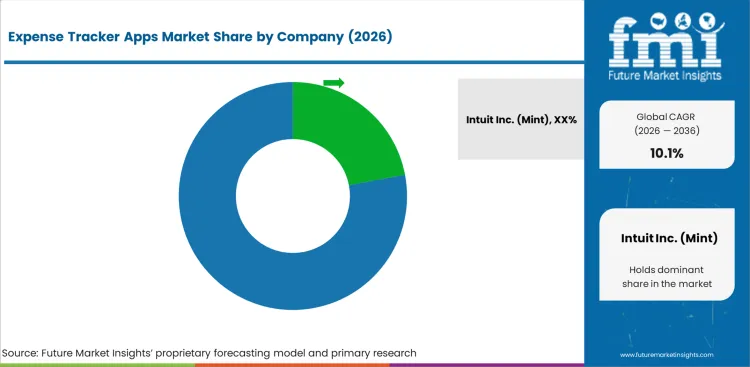
- Intuit Inc. (Mint) maintains a strong market position, supported by integrated production capabilities and its global distribution infrastructure.
- Mid-tier and regional players compete on specialization, local compliance expertise and closeness to demand centers.
- New entrants are focusing on niche applications and underserved geographies with focused product portfolios.
Intuit Inc. (Mint) has a competitive advantage of integrated manufacturing, established buyer relationships and broad product coverage. PocketGuard, Inc. and You Need a Budget (YNAB) have complementary capabilities across product categories and geographies.
Barriers to entry include existing supply chain relationships, regulatory qualification requirements, production scale economics, and the capital intensity of manufacturing infrastructure. Cost reduction, geographical expansion and compliance to changing regulatory norms have been the focus of market players.
Key Companies in the Expense Tracker Apps Market
Key global companies leading the expense tracker apps market include:
- Intuit Inc. (Mint), PocketGuard, Inc., You Need a Budget (YNAB), Expensify, Inc. maintain strong market positions through integrated manufacturing infrastructure, established buyer relationships, and broad product portfolios.
- Wally (Wally Global Inc.), GoodBudget, Spendee have established regional presence through specialization in specific product categories and proximity to key demand centers.
- Monefy, Zoho Expense, Money Manager Expense & Budget represent emerging competitors targeting niche applications and underserved segments with focused product development and agile market entry strategies.
Competitive Benchmarking: Expense Tracker Apps Market
| Company | Product Breadth | Technology Capability | Distribution Reach | Geographic Footprint |
|---|---|---|---|---|
| Intuit Inc. (Mint) | High | High | Strong | Global |
| PocketGuard, Inc. | High | High | Strong | Global |
| You Need a Budget (YNAB) | High | High | Strong | Global |
| Expensify, Inc. | Medium | High | Moderate | Multi-region |
| Wally (Wally Global Inc.) | Medium | Medium | Moderate | Multi-region |
| GoodBudget | Medium | Medium | Moderate | Multi-region |
| Spendee | Low | Medium | Moderate | Regional |
| Monefy | Low | Medium | Low | Regional |
| Zoho Expense | Low | Medium | Low | Regional |
| Money Manager Expense & Budget | Low | Medium | Low | Regional |
Source: Future Market Insights competitive analysis, 2026.
Key Developments in Expense Tracker Apps Market
- In 2025, Intuit Inc. continued integrating Mint’s expense tracking and personal finance features into Credit Karma following the shutdown of the Mint app, expanding digital financial management capabilities for consumers in North America.
- In 2025, PocketGuard, Inc. enhanced its AI-powered budgeting and expense tracking platform with automated spending insights, subscription monitoring, and bank connectivity features to support growing consumer demand for personal finance management applications.
Key Players in the Expense Tracker Apps Market
Major Global Players
- Intuit Inc. (Mint)
- PocketGuard, Inc.
- You Need a Budget (YNAB)
- Expensify, Inc.
- Wally (Wally Global Inc.)
- GoodBudget
- Spendee
Emerging Players/Startups
- Monefy
- Zoho Expense
- Money Manager Expense & Budget
Report Scope and Coverage
| Parameter | Details |
|---|---|
| Quantitative Units | USD 10.98 billion to USD 28.75 billion, at a CAGR of 10.1% |
| Market Definition | The expense tracker apps market encompasses expense tracker apps products and services across all commercially relevant categories, including segmentation by platform, subscription model, functionality. |
| Regions Covered | North America, Latin America, Europe, East Asia, South Asia and Pacific, Middle East and Africa |
| Countries Covered | USA, South Korea, EU, Japan, UK, 30 plus countries |
| Key Companies Profiled | Intuit Inc. (Mint), PocketGuard, Inc., You Need a Budget (YNAB), Expensify, Inc., Wally (Wally Global Inc.), GoodBudget, Spendee, Monefy, Zoho Expense, Money Manager Expense & Budget |
| Forecast Period | 2026 to 2036 |
| Approach | Hybrid bottom-up and top-down methodology starting with verified transaction data, projecting adoption velocity across segments and regions. |
Segmentation
Expense Tracker Apps Market Segmented by Platform:
- Mobile Apps
- Web-Based Apps
Expense Tracker Apps Market Segmented by Subscription Model:
- Freemium
- Premium
Expense Tracker Apps Market Segmented by Functionality:
- Basic Expense Tracker
- Finance Analytics
- Receipt Scanning and Management
Expense Tracker Apps Market Segmented by End User:
- Personal
- Business
Expense Tracker Apps Market by Region:
- North America
- USA
- Canada
- Mexico
- Latin America
- Brazil
- Chile
- Rest of Latin America
- Western Europe
- Germany
- UK
- Italy
- Spain
- France
- Nordic
- BENELUX
- Rest of Western Europe
- Eastern Europe
- Russia
- Poland
- Hungary
- Balkan & Baltic
- Rest of Eastern Europe
- East Asia
- China
- Japan
- South Korea
- South Asia and Pacific
- India
- ASEAN
- Australia & New Zealand
- Rest of South Asia and Pacific
- Middle East & Africa
- Kingdom of Saudi Arabia
- Other GCC Countries
- Turkiye
- South Africa
- Other African Union
- Rest of Middle East & Africa
Research Sources and Bibliography
- 1. World Bank. (2025). World Development Indicators: Industrial Production and Trade Statistics. World Bank Group.
- 2. International Organization for Standardization. (2025). ISO Standards Catalogue: Industry-Specific Compliance Frameworks. ISO.
- 3. United Nations Industrial Development Organization. (2025). UNIDO Industrial Statistics Database. UNIDO.
- 4. USA Bureau of Labor Statistics. (2025). Producer Price Index: Manufacturing Sector. BLS.
- 5. European Commission. (2025). EU Industrial Strategy: Regulatory Compliance and Market Access Framework. EC.
This bibliography is provided for reader reference. The full Future Market Insights report contains the complete reference list with publication dates, URLs, and supporting data for all cited works.
This Report Answers
- Estimating the size of the market and revenue trajectory from 2026 to 2036.
- Segmentation analysis by platform, subscription model, functionality, end user.
- Regional insights covering more than 30 markets.
- Competitive landscape assessment and company benchmarking.
- Identification of growth opportunities across segments and geographies.
- Supply chain and procurement structure analysis.
- Technology and regulatory trend assessment.
- Delivery of data in PDF and Excel formats.
Frequently Asked Questions
What is the global market demand for Expense Tracker Apps Market in 2026?
In 2026, the global expense tracker apps market is expected to be worth USD 10.98 billion.
How big will the market for Expense Tracker Apps Market be in 2036?
By 2036, the expense tracker apps market is expected to be worth USD 28.75 billion.
How much is demand for Expense Tracker Apps Market expected to grow between 2026 and 2036?
Between 2026 and 2036, the demand for expense tracker apps market is expected to grow at a CAGR of 10.1%.
Which Platform segment is expected to lead in the Expense Tracker Apps Market in 2026?
Mobile Apps is expected to account for 68.5% of the platform segment in the Expense Tracker Apps Market in 2026, reflecting sustained demand from primary end-use applications.
What is driving demand in USA for the Expense Tracker Apps Market?
USA is projected to grow at 10.3% CAGR through 2036 in the Expense Tracker Apps Market, supported by industrial capacity expansion, regulatory compliance requirements, and sustained procurement growth.
What is driving demand in South Korea for the Expense Tracker Apps Market?
South Korea is projected to grow at 10.2% CAGR through 2036 in the Expense Tracker Apps Market, reflecting strong institutional and commercial adoption across core end-use industries.
What does this report mean by Expense Tracker Apps Market definition?
The expense tracker apps market encompasses all commercially traded products and services classified under expense tracker apps, segmented by platform, subscription model, functionality, covering the 2026 to 2036 forecast period.
How does FMI make the Expense Tracker Apps Market forecast and verify it?
Forecasting models use a hybrid bottom-up and top-down approach, starting with verified transaction data and checking it against production statistics and manufacturer disclosures.
Preview the report firsthand - request a free sample
Get SampleGet the brochure for pricing and purchase details.
Get PDFTable of Content
- Executive Summary
- Global Market Outlook
- Demand-side Trends
- Supply-side Trends
- Technology Roadmap Analysis
- Analysis and Recommendations
- Market Overview
- Market Coverage / Taxonomy
- Market Definition / Scope / Limitations
- Research Methodology
- Chapter Orientation
- Analytical Lens and Working Hypotheses
- Market Structure, Signals, and Trend Drivers
- Research Design and Evidence Framework
- Desk Research Programme (Secondary Evidence)
- Company Annual and Sustainability Reports
- Peer-reviewed Journals and Academic Literature
- Corporate Websites, Product Literature, and Technical Notes
- Earnings Decks and Investor Briefings
- Statutory Filings and Regulatory Disclosures
- Technical White Papers and Standards Notes
- Trade Journals, Industry Magazines, and Analyst Briefs
- Conference Proceedings, Webinars, and Seminar Materials
- Government Statistics Portals and Public Data Releases
- Press Releases and Reputable Media Coverage
- Specialist Newsletters and Curated Briefings
- Sector Databases and Reference Repositories
- FMI Internal Proprietary Databases and Historical Market Datasets
- Subscription Datasets and Paid Sources
- Social Channels, Communities, and Digital Listening Inputs
- Additional Desk Sources
- Expert Input and Fieldwork (Primary Evidence)
- Primary Modes
- Qualitative Interviews and Expert Elicitation
- Quantitative Surveys and Structured Data Capture
- Blended Approach
- Why Primary Evidence is Used
- Field Techniques
- Interviews
- Surveys
- Focus Groups
- Observational and In-context Research
- Social and Community Interactions
- Stakeholder Universe Engaged
- Tooling, Models, and Reference Databases
- Data Engineering and Model Build
- Data Acquisition and Ingestion
- Cleaning, Normalisation, and Verification
- Synthesis, Triangulation, and Analysis
- Quality Assurance and Audit Trail
- Primary Modes
- Market Background
- Market Dynamics
- Drivers
- Restraints
- Opportunity
- Trends
- Scenario Forecast
- Demand in Optimistic Scenario
- Demand in Likely Scenario
- Demand in Conservative Scenario
- Opportunity Map Analysis
- Product Life Cycle Analysis
- Supply Chain Analysis
- Investment Feasibility Matrix
- Value Chain Analysis
- PESTLE and Porter’s Analysis
- Regulatory Landscape
- Regional Parent Market Outlook
- Production and Consumption Statistics
- Import and Export Statistics
- Market Dynamics
- Global Market Analysis 2021 to 2025 and Forecast, 2026 to 2036
- Historical Market Size Value (USD Million) Analysis, 2021 to 2025
- Current and Future Market Size Value (USD Million) Projections, 2026 to 2036
- Y-o-Y Growth Trend Analysis
- Absolute $ Opportunity Analysis
- Global Market Pricing Analysis 2021 to 2025 and Forecast 2026 to 2036
- Global Market Analysis 2021 to 2025 and Forecast 2026 to 2036, By Platform
- Introduction / Key Findings
- Historical Market Size Value (USD Million) Analysis By Platform , 2021 to 2025
- Current and Future Market Size Value (USD Million) Analysis and Forecast By Platform , 2026 to 2036
- Mobile Apps
- Web-Based Apps
- Mobile Apps
- Y-o-Y Growth Trend Analysis By Platform , 2021 to 2025
- Absolute $ Opportunity Analysis By Platform , 2026 to 2036
- Global Market Analysis 2021 to 2025 and Forecast 2026 to 2036, By Subscription Model
- Introduction / Key Findings
- Historical Market Size Value (USD Million) Analysis By Subscription Model, 2021 to 2025
- Current and Future Market Size Value (USD Million) Analysis and Forecast By Subscription Model, 2026 to 2036
- Freemium
- Premium
- Freemium
- Y-o-Y Growth Trend Analysis By Subscription Model, 2021 to 2025
- Absolute $ Opportunity Analysis By Subscription Model, 2026 to 2036
- Global Market Analysis 2021 to 2025 and Forecast 2026 to 2036, By Functionality
- Introduction / Key Findings
- Historical Market Size Value (USD Million) Analysis By Functionality, 2021 to 2025
- Current and Future Market Size Value (USD Million) Analysis and Forecast By Functionality, 2026 to 2036
- Basic Expense Tracker
- Finance Analytics
- Receipt Scanning and Management
- Basic Expense Tracker
- Y-o-Y Growth Trend Analysis By Functionality, 2021 to 2025
- Absolute $ Opportunity Analysis By Functionality, 2026 to 2036
- Global Market Analysis 2021 to 2025 and Forecast 2026 to 2036, By End User
- Introduction / Key Findings
- Historical Market Size Value (USD Million) Analysis By End User, 2021 to 2025
- Current and Future Market Size Value (USD Million) Analysis and Forecast By End User, 2026 to 2036
- Personal
- Business
- Personal
- Y-o-Y Growth Trend Analysis By End User, 2021 to 2025
- Absolute $ Opportunity Analysis By End User, 2026 to 2036
- Global Market Analysis 2021 to 2025 and Forecast 2026 to 2036, By Region
- Introduction
- Historical Market Size Value (USD Million) Analysis By Region, 2021 to 2025
- Current Market Size Value (USD Million) Analysis and Forecast By Region, 2026 to 2036
- North America
- Latin America
- Western Europe
- Eastern Europe
- East Asia
- South Asia and Pacific
- Middle East & Africa
- Market Attractiveness Analysis By Region
- North America Market Analysis 2021 to 2025 and Forecast 2026 to 2036, By Country
- Historical Market Size Value (USD Million) Trend Analysis By Market Taxonomy, 2021 to 2025
- Market Size Value (USD Million) Forecast By Market Taxonomy, 2026 to 2036
- By Country
- USA
- Canada
- Mexico
- By Platform
- By Subscription Model
- By Functionality
- By End User
- By Country
- Market Attractiveness Analysis
- By Country
- By Platform
- By Subscription Model
- By Functionality
- By End User
- Key Takeaways
- Latin America Market Analysis 2021 to 2025 and Forecast 2026 to 2036, By Country
- Historical Market Size Value (USD Million) Trend Analysis By Market Taxonomy, 2021 to 2025
- Market Size Value (USD Million) Forecast By Market Taxonomy, 2026 to 2036
- By Country
- Brazil
- Chile
- Rest of Latin America
- By Platform
- By Subscription Model
- By Functionality
- By End User
- By Country
- Market Attractiveness Analysis
- By Country
- By Platform
- By Subscription Model
- By Functionality
- By End User
- Key Takeaways
- Western Europe Market Analysis 2021 to 2025 and Forecast 2026 to 2036, By Country
- Historical Market Size Value (USD Million) Trend Analysis By Market Taxonomy, 2021 to 2025
- Market Size Value (USD Million) Forecast By Market Taxonomy, 2026 to 2036
- By Country
- Germany
- UK
- Italy
- Spain
- France
- Nordic
- BENELUX
- Rest of Western Europe
- By Platform
- By Subscription Model
- By Functionality
- By End User
- By Country
- Market Attractiveness Analysis
- By Country
- By Platform
- By Subscription Model
- By Functionality
- By End User
- Key Takeaways
- Eastern Europe Market Analysis 2021 to 2025 and Forecast 2026 to 2036, By Country
- Historical Market Size Value (USD Million) Trend Analysis By Market Taxonomy, 2021 to 2025
- Market Size Value (USD Million) Forecast By Market Taxonomy, 2026 to 2036
- By Country
- Russia
- Poland
- Hungary
- Balkan & Baltic
- Rest of Eastern Europe
- By Platform
- By Subscription Model
- By Functionality
- By End User
- By Country
- Market Attractiveness Analysis
- By Country
- By Platform
- By Subscription Model
- By Functionality
- By End User
- Key Takeaways
- East Asia Market Analysis 2021 to 2025 and Forecast 2026 to 2036, By Country
- Historical Market Size Value (USD Million) Trend Analysis By Market Taxonomy, 2021 to 2025
- Market Size Value (USD Million) Forecast By Market Taxonomy, 2026 to 2036
- By Country
- China
- Japan
- South Korea
- By Platform
- By Subscription Model
- By Functionality
- By End User
- By Country
- Market Attractiveness Analysis
- By Country
- By Platform
- By Subscription Model
- By Functionality
- By End User
- Key Takeaways
- South Asia and Pacific Market Analysis 2021 to 2025 and Forecast 2026 to 2036, By Country
- Historical Market Size Value (USD Million) Trend Analysis By Market Taxonomy, 2021 to 2025
- Market Size Value (USD Million) Forecast By Market Taxonomy, 2026 to 2036
- By Country
- India
- ASEAN
- Australia & New Zealand
- Rest of South Asia and Pacific
- By Platform
- By Subscription Model
- By Functionality
- By End User
- By Country
- Market Attractiveness Analysis
- By Country
- By Platform
- By Subscription Model
- By Functionality
- By End User
- Key Takeaways
- Middle East & Africa Market Analysis 2021 to 2025 and Forecast 2026 to 2036, By Country
- Historical Market Size Value (USD Million) Trend Analysis By Market Taxonomy, 2021 to 2025
- Market Size Value (USD Million) Forecast By Market Taxonomy, 2026 to 2036
- By Country
- Kingdom of Saudi Arabia
- Other GCC Countries
- Turkiye
- South Africa
- Other African Union
- Rest of Middle East & Africa
- By Platform
- By Subscription Model
- By Functionality
- By End User
- By Country
- Market Attractiveness Analysis
- By Country
- By Platform
- By Subscription Model
- By Functionality
- By End User
- Key Takeaways
- Key Countries Market Analysis
- USA
- Pricing Analysis
- Market Share Analysis, 2025
- By Platform
- By Subscription Model
- By Functionality
- By End User
- Canada
- Pricing Analysis
- Market Share Analysis, 2025
- By Platform
- By Subscription Model
- By Functionality
- By End User
- Mexico
- Pricing Analysis
- Market Share Analysis, 2025
- By Platform
- By Subscription Model
- By Functionality
- By End User
- Brazil
- Pricing Analysis
- Market Share Analysis, 2025
- By Platform
- By Subscription Model
- By Functionality
- By End User
- Chile
- Pricing Analysis
- Market Share Analysis, 2025
- By Platform
- By Subscription Model
- By Functionality
- By End User
- Germany
- Pricing Analysis
- Market Share Analysis, 2025
- By Platform
- By Subscription Model
- By Functionality
- By End User
- UK
- Pricing Analysis
- Market Share Analysis, 2025
- By Platform
- By Subscription Model
- By Functionality
- By End User
- Italy
- Pricing Analysis
- Market Share Analysis, 2025
- By Platform
- By Subscription Model
- By Functionality
- By End User
- Spain
- Pricing Analysis
- Market Share Analysis, 2025
- By Platform
- By Subscription Model
- By Functionality
- By End User
- France
- Pricing Analysis
- Market Share Analysis, 2025
- By Platform
- By Subscription Model
- By Functionality
- By End User
- India
- Pricing Analysis
- Market Share Analysis, 2025
- By Platform
- By Subscription Model
- By Functionality
- By End User
- ASEAN
- Pricing Analysis
- Market Share Analysis, 2025
- By Platform
- By Subscription Model
- By Functionality
- By End User
- Australia & New Zealand
- Pricing Analysis
- Market Share Analysis, 2025
- By Platform
- By Subscription Model
- By Functionality
- By End User
- China
- Pricing Analysis
- Market Share Analysis, 2025
- By Platform
- By Subscription Model
- By Functionality
- By End User
- Japan
- Pricing Analysis
- Market Share Analysis, 2025
- By Platform
- By Subscription Model
- By Functionality
- By End User
- South Korea
- Pricing Analysis
- Market Share Analysis, 2025
- By Platform
- By Subscription Model
- By Functionality
- By End User
- Russia
- Pricing Analysis
- Market Share Analysis, 2025
- By Platform
- By Subscription Model
- By Functionality
- By End User
- Poland
- Pricing Analysis
- Market Share Analysis, 2025
- By Platform
- By Subscription Model
- By Functionality
- By End User
- Hungary
- Pricing Analysis
- Market Share Analysis, 2025
- By Platform
- By Subscription Model
- By Functionality
- By End User
- Kingdom of Saudi Arabia
- Pricing Analysis
- Market Share Analysis, 2025
- By Platform
- By Subscription Model
- By Functionality
- By End User
- Turkiye
- Pricing Analysis
- Market Share Analysis, 2025
- By Platform
- By Subscription Model
- By Functionality
- By End User
- South Africa
- Pricing Analysis
- Market Share Analysis, 2025
- By Platform
- By Subscription Model
- By Functionality
- By End User
- USA
- Market Structure Analysis
- Competition Dashboard
- Competition Benchmarking
- Market Share Analysis of Top Players
- By Regional
- By Platform
- By Subscription Model
- By Functionality
- By End User
- Competition Analysis
- Competition Deep Dive
- Intuit Inc. (Mint)
- Overview
- Product Portfolio
- Profitability by Market Segments (Product/Age /Sales Channel/Region)
- Sales Footprint
- Strategy Overview
- Marketing Strategy
- Product Strategy
- Channel Strategy
- PocketGuard, Inc.
- You Need a Budget (YNAB)
- Expensify, Inc.
- Wally (Wally Global Inc.)
- GoodBudget
- Spendee
- Monefy
- Zoho Expense
- Money Manager Expense & Budget
- Intuit Inc. (Mint)
- Competition Deep Dive
- Desk Research Programme (Secondary Evidence)
- Assumptions & Acronyms Used


