

- Market Size (2026)
- USD 1.5 Bn
- Forecast (2036)
- USD 3.6 Bn
- CAGR (2026 to 2036)
- 9.1%
How big is the fermented legume protein market in 2026?
USD 1.5 billion in 2026 and USD 3.6 billion by 2036 at a 9.1% CAGR.
The fermented legume protein industry value is forecast to grow from USD 1.4 billion in 2025 to USD 3.6 billion by 2036 at 9.1% CAGR. Demand is led by chilled tempeh-style blocks and fermented ingredient systems. These systems reduce beany notes in pea, fava, chickpea, and lentil proteins.
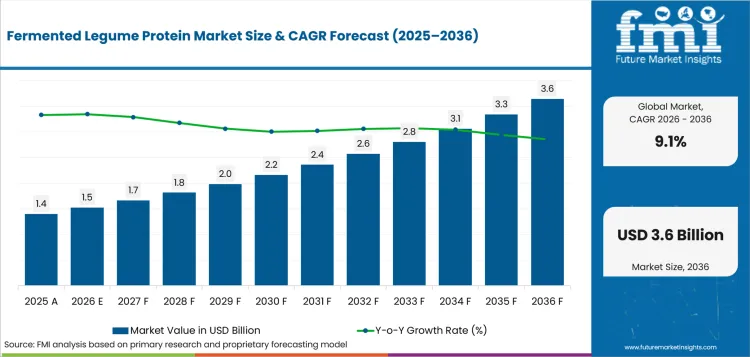
Fermented Legume Protein Market Overview: Size and Forecast
- 2026 Market Size: USD 1.5 billion
- 2036 Market Size: USD 3.6 billion
- Forecast CAGR: 9.1% from 2026 to 2036
- Leading Fermentation Method: Solid-State Fermentation
- Solid-State Fermentation Share in 2026: 61.0%
- Leading Source Legume: Soybean
- Soybean Share in 2026: 58.0%
- Leading Product Format: Whole-Bean Blocks
- Whole-Bean Blocks Share in 2026: 52.0%
- Fastest-growing Country: India
- India CAGR: 10.8% by 2036
Summary of Fermented Legume Protein Market
- Demand and Growth Drivers
- Fermented blocks are expected to gain shelf space because shoppers can see whole beans and understand the format faster than powdered protein.
- Ingredient makers are projected to use fermentation for taste correction across pea, fava, chickpea, lentil systems.
- Foodservice buyers are likely to test tempeh-style blocks where bowls and wraps need prep-stable protein. Stir-fry meals create another use case.
- Product and Segment View
- Solid-State Fermentation is forecast to account for 61.0% share in 2026 because whole beans and side streams work well under low-moisture culture systems.
- Soybean is expected to hold 58.0% share in 2026 due to established tempeh and natto-style supply chains.
- Whole-Bean Blocks are projected to secure 52.0% share in 2026 since tempeh carries visible texture and simple cooking cues.
- Geography and Competitive Outlook
- India is projected to record 10.8% CAGR by 2036 due to pulse availability and vegetarian protein habits.
- The United Kingdom is expected to expand at 9.7% CAGR through 2036 as Better Nature and Tiba Tempeh build retail visibility. The Tofoo Co adds another chilled benchmark.
- Better Nature and Tiba Tempeh compete through branded chilled formats. The Tofoo Co and Noble Bean add further shelf visibility.
- MycoTechnology and Ferm Food compete through fermented ingredient platforms. European Protein and Luya Foods add side-stream fermentation routes.
- Analyst Opinion
- Nandini Roy Choudhury observes: “Fermented legume protein is a correction to the first wave of plant-based meat. Buyers ask whether a product tastes clean and digests well. They also check whether it fits a short label. That favors tempeh blocks and okara ferments. Pulse protein fermentates can reduce beany notes before the recipe bench.”
Fermentation is changing legumes from a basic crop input into a taste-control and texture-control platform. A February 2024 Foods study reported that selected lactic acid bacteria reduced off-flavor compounds such as hexanal in a 5% pea protein suspension. OECD and FAO reported that global pulses consumption reached 101 million tonnes in 2024. This gives suppliers a large crop pool beyond soy.
What supports value in the fermented legume protein market?
Finished chilled blocks and documented ingredient functionality support market value across retail and B2B channels.
- Whole-bean blocks support market value because they sell as finished protein portions rather than low-priced pulse flour.
- Fermented powders are expected to lift average selling value as beverage and snack makers pay for cleaner taste systems.
- Foodservice trials support volume when tempeh works as a prep-stable protein for bowls and wraps.
- Supplier margins depend on culture control and shelf-life validation because spoilage risk can erase the premium from fermentation.
Why is the fermented legume protein market growing?
Fermentation is lowering taste barriers and giving retailers a whole-food plant protein with clearer cooking cues.
Fermented legume protein is growing first where taste blocks repeat purchase. The February 2024 Foods study showed that lactic fermentation reduced off-flavor compounds in pea protein. This matters commercially because pea protein often needs masking in drinks and meat alternatives. Fermentation gives formulators a pre-treatment step before sweeteners and spices are added. Flavor systems can then work with a cleaner base.
Retail demand is changing as buyers compare ingredient lists and protein grams together. Tempeh-style blocks can be diced or fried without factory-made meat shapes. They can also be crumbled or marinated. The effect is strongest in chilled retail where the product is placed near tofu and prepared meals.
How is the fermented legume protein market segmented?
The fermented legume protein industry is segmented by source legume and product format. It is also segmented by application, fermentation method, distribution channel.
- Solid-State Fermentation is projected to hold 61.0% share in 2026 because whole beans and okara side streams suit low-moisture culture systems.
- Soybean is anticipated to hold 58.0% share in 2026 due to the long production history of soy tempeh and natto-style foods.
- Whole-Bean Blocks are expected to capture 52.0% share in 2026 because shoppers recognize tempeh-style blocks faster than powders.
- Retail Chilled is forecast to represent 46.0% share in 2026 as supermarkets remain the main product trial route.
- Meat Alternatives are projected to account for 44.0% share in 2026 with fermented blocks replacing heavily extruded pieces.
Which fermentation method leads the fermented legume protein market?
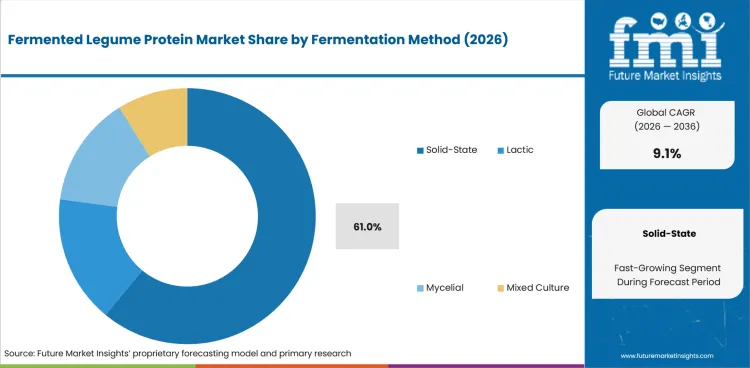
- Solid-State Fermentation is projected to account for 61.0% share in 2026 because it fits whole beans and okara. Low-moisture pulse substrates support the same process route.
- Lactic fermentation gains use in powders and beverage bases where suppliers need cleaner taste and better digestibility.
Which source legume leads the fermented legume protein market?
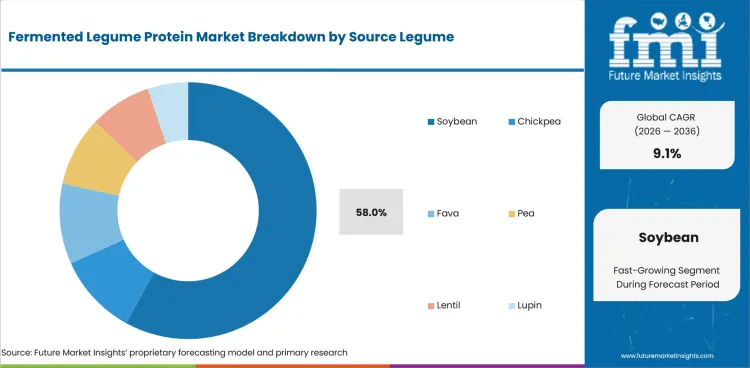
- Soybean is expected to hold 58.0% share in 2026 due to established culture knowledge and familiar whole-bean formats.
- Chickpea and fava formats gain space where brands want non-soy claims. Pea, lentil, lupin support regional crop stories.
Why do whole-bean blocks lead the fermented legume protein market?
- Whole-Bean Blocks are forecast to account for 52.0% share in 2026 because tempeh gives shoppers a familiar block format.
- Fermented powders gain B2B relevance where beverage and snack makers need sensory proof before recipe adoption.
Which application leads the fermented legume protein market?
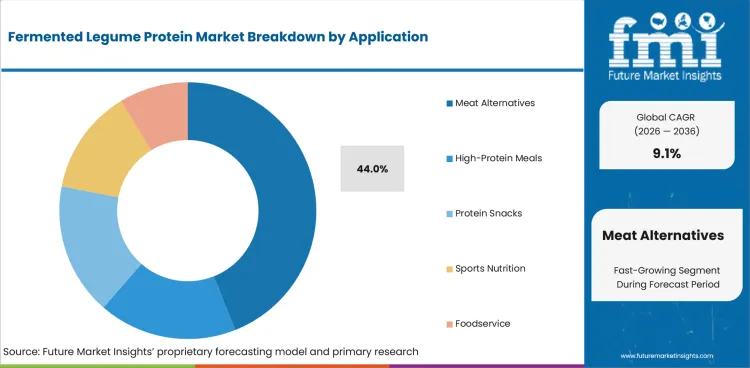
- Meat Alternatives are anticipated to represent 44.0% share in 2026 as fermented blocks serve bowls and sandwiches. Mince-style recipes add another route.
- High-protein meals gain use when brands position fermented legumes as recognizable meal protein rather than burger-only substitutes.
Which distribution channel leads the fermented legume protein market?
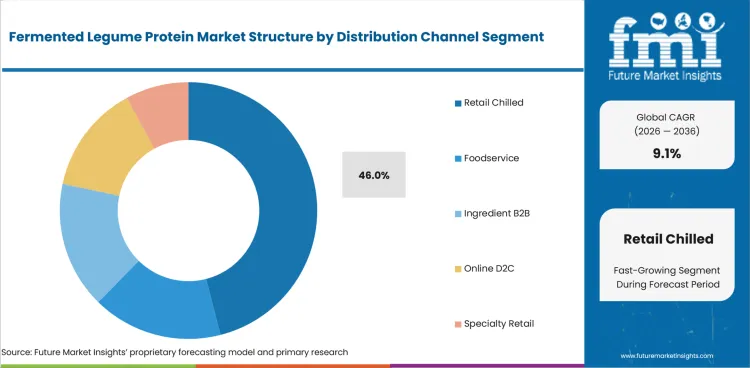
- Retail Chilled is estimated to account for 46.0% share in 2026 because shopper trial happens near tofu and refrigerated meat-free foods.
- Ingredient B2B gains importance where food makers compare specification sheets and sensory results. Culture-control documentation also shapes supplier selection.
What are the drivers and restraints in the fermented legume protein market?
Taste correction and whole-food positioning support growth while cold-chain risk limits smaller brands.
- Driver: Fermentation is expected to reduce beany notes before brands add flavor systems.
- Driver: Whole-food positioning supports chilled blocks because shoppers can identify beans and cultures on short labels.
- Restraint: Shelf-life risk can restrict smaller brands because fermented products need tight process control and cold-chain discipline.
- Opportunity: B2B beverage bases can gain attention where pea and rice protein blends need better taste and solubility.
Off-flavor control is the most technical driver for fermented legume ingredients. A February 2024 ACS study examined fermentation of texturized pea protein with plant-based fat compounds and compared sensory-relevant changes in a meat analogue context. Fermentation changes the substrate before final processing. This gives formulators a more stable starting point for savory and mild-tasting foods.
Who are the primary drivers of fermented legume protein?
Retail shoppers and foodservice buyers form the main buyer base for fermented legume formats. B2B formulators add ingredient demand. Consumer segmentation is expected to center on shoppers who want recognizable plant protein with short ingredient lists. Foodservice buyers use tempeh where kitchen teams need a block that holds shape during frying and marination. Ingredient buyers evaluate fermented powders through solubility and sensory scores. Batch documentation supports repeat purchasing.
What influences fermented legume protein purchase decisions?
Taste and cooking clarity shape repeat purchase behavior. Allergen position, shelf life, price-per-protein serving guide product comparison.
Purchase decisions depend on whether the product solves a clear meal role. Chilled blocks need recipe cues and pack integrity. Ingredient formats need proof that fermentation improves flavor without creating stability problems. Buyers also compare soy allergen exposure against non-soy alternatives.
Which countries are growing fastest in the fermented legume protein market?
India reaches 10.8% CAGR followed by the United Kingdom at 9.7% through 2036.
| Country | CAGR |
|---|---|
| India | 10.8% |
| United Kingdom | 9.7% |
| United States | 9.5% |
| Germany | 9.3% |
| France | 8.9% |
| China | 8.6% |
| South Korea | 8.4% |
| Japan | 7.8% |
Source: Future Market Insights, 2026.
How do country-level CAGRs compare in the fermented legume protein market?
India leads selected-country growth while Japan records the most cautious expansion outlook among profiled markets.
- India is forecast to record 10.8% CAGR by 2036 as pulses and vegetarian protein habits support local product formats.
- The United Kingdom is expected to expand at 9.7% CAGR through 2036 as branded tempeh gains supermarket visibility.
- The United States is projected to grow at 9.5% CAGR from 2026 to 2036 through natural retail and ingredient formulation demand.
- Germany is anticipated to post 9.3% CAGR by 2036 with organic retail and protein-crop development supporting trials.
- France is estimated to rise at 8.9% CAGR through 2036 as protein crops and selective retail modernization support product tests.
- China is projected to advance at 8.6% CAGR by 2036 as soy-food familiarity meets e-commerce test channels.
- South Korea is expected to grow at 8.4% CAGR over the forecast period through convenience meals and fermented soy familiarity.
- Japan is forecast to record 7.8% CAGR through 2036 as mature soy fermentation culture supports selective entry.
What is driving fermented legume protein growth in India?
A 10.8% CAGR through 2036 is supported by pulse availability and packaged vegetarian protein demand.
Country Market Snapshot Table
| Parameter | Value |
|---|---|
| Market Size in 2025 (Value) | USD 108.3 million |
| Market Size in 2026 (Value) | USD 120.0 million |
| Market Forecast in 2036 (Value) | USD 334.6 million |
| CAGR (2026 to 2036) | 10.8% |
| Years Considered | 2021 to 2036 |
| Base Year | 2025 |
| Forecast Period | 2026 to 2036 |
| Units Considered | Value (USD million) |
| Leading Sub-Region | Maharashtra Karnataka and Delhi NCR retail corridors |
India Fermented Legume Protein Market Outlook
- India fermented legume protein demand is shaped by pulse availability and vegetarian meal habits. Brands can position chickpea, lentil, mung, fava formats around snacks and meal sides.
- Modern trade and quick-commerce platforms are expected to help chilled products gain early trial. Shelf-stable and semi-chilled formats should travel faster outside large metros.
Key Growth Drivers
- Pulse supply supports local substrates. PIB reported final 2024-25 foodgrain production at 357.73 million tonnes.
- Policy support strengthens the non-soy route. PIB stated the Mission for Aatmanirbharta in Pulses aims to expand pulses area by 35 lakh hectares.
- Vegetarian meal habits create a familiar base for legume-based protein trials.
- Quick-commerce grocery gives premium fermented blocks a faster urban discovery route.
Key Restraints
- Cold-chain gaps can restrict chilled expansion. PIB stated that 1,601 PMKSY projects were approved by June 2025. It also reported 1,133 completed projects.
- Price sensitivity can slow premium fermented blocks in mass retail.
- Regional taste expectations require stronger localization before repeat buying improves.
What makes India unique
India is unique due to daily pulse use and the strongest selected-country CAGR in this forecast.
Key Companies
- GoodDot
- Blue Tribe Foods
- Shaka Harry
- Proeon Foods
- Tata Soulfull
- Patanjali Foods
- Wakao Foods
Sales & Marketing Channels
- Modern trade supermarkets
- Quick-commerce grocery
- Vegetarian restaurant chains
- Health food retailers
- Snack manufacturers
- Regional co-manufacturers
Country Segment Breakdown Table
| Segment | Sub-Segments |
|---|---|
| By Source Legume | Soybean, Chickpea, Fava, Pea, Lentil, Lupin |
| By Product Format | Whole-Bean Blocks, Fermented Powders, Textured Ferments, Ready Meals, Beverage Bases |
| By Application | Meat Alternatives, High-Protein Meals, Protein Snacks, Sports Nutrition, Foodservice |
| By Fermentation Method | Solid-State, Lactic, Mycelial, Mixed Culture |
| By Distribution Channel | Retail Chilled, Foodservice, Ingredient B2B, Online D2C, Specialty Retail |
| Key Sub-Regions Covered, Retail and Ingredient Corridors | Maharashtra, Karnataka, Delhi NCR, Tamil Nadu, Gujarat, Telangana |
Frequently Asked Questions
How fast is India fermented legume protein market growing?
India is projected to grow at 10.8% CAGR from 2026 to 2036 through pulse-led vegetarian protein adoption.
Who leads India fermented legume protein market?
GoodDot and Blue Tribe Foods are relevant local or adjacent suppliers. Shaka Harry, Proeon Foods, Tata Soulfull add further category adjacency.
What is driving adoption in India fermented legume protein market?
Pulse supply and vegetarian food habits are moving buyers toward chickpea, lentil, fava, mung fermentation routes.
How fast is the fermented legume protein market growing in the United Kingdom?
A 9.7% CAGR through 2036 reflects supermarket tempeh listings and stronger chilled trial.
Country Market Snapshot Table
| Parameter | Value |
|---|---|
| Market Size in 2025 (Value) | USD 136.7 million |
| Market Size in 2026 (Value) | USD 150.0 million |
| Market Forecast in 2036 (Value) | USD 378.6 million |
| CAGR (2026 to 2036) | 9.7% |
| Years Considered | 2021 to 2036 |
| Base Year | 2025 |
| Forecast Period | 2026 to 2036 |
| Units Considered | Value (USD million) |
| Leading Sub-Region | London and national supermarket corridors |
United Kingdom Fermented Legume Protein Market Outlook
- United Kingdom fermented legume protein demand is led by branded chilled tempeh and supermarket access. Better Nature and Tiba Tempeh give retailers visible local benchmarks. The Tofoo Co adds another chilled reference.
- Retail buyers are expected to keep judging the category on rotation speed and recipe clarity. Brands must explain how shoppers can fry and crumble fermented blocks. Marination cues add another repeat-use prompt.
Key Growth Drivers
- Pulse acreage supports local sourcing stories. Defra reported the overall UK pulse area at 224 thousand hectares in 2024.
- Field peas give brands a specific non-soy route. Defra stated field pea area increased 46% to 89 thousand hectares in 2024.
- Supermarket listings give tempeh brands national test routes across chilled plant-based shelves.
- Flexitarian shoppers use tempeh as a cooking ingredient rather than a burger-only substitute.
Key Restraints
- Field bean weakness can limit domestic protein crop flexibility. Defra reported field bean area fell 37% to 135 thousand hectares in 2024.
- Meat-free category discounting can pressure chilled tempeh price points.
- National supermarket listings can raise promotion and compliance costs for smaller brands.
What makes United Kingdom unique
The United Kingdom is unique because supermarket-listed tempeh brands provide a clear repeat-buy test case.
Key Companies
- Better Nature
- Tiba Tempeh
- The Tofoo Co
- Plant Power Foods
- This
- Quorn Foods
- Meatless Farm
Sales & Marketing Channels
- National supermarket listings
- Ocado and online grocery
- Natural and organic retail
- Foodservice recipe partnerships
- Chilled distributor routes
- Social recipe marketing
Country Segment Breakdown Table
| Segment | Sub-Segments |
|---|---|
| By Source Legume | Soybean, Chickpea, Fava, Pea, Lentil, Lupin |
| By Product Format | Whole-Bean Blocks, Fermented Powders, Textured Ferments, Ready Meals, Beverage Bases |
| By Application | Meat Alternatives, High-Protein Meals, Protein Snacks, Sports Nutrition, Foodservice |
| By Fermentation Method | Solid-State, Lactic, Mycelial, Mixed Culture |
| By Distribution Channel | Retail Chilled, Foodservice, Ingredient B2B, Online D2C, Specialty Retail |
| Key Sub-Regions Covered, Retail and Ingredient Corridors | London, Manchester, Birmingham, Leeds, Bristol, Glasgow |
Frequently Asked Questions
How fast is United Kingdom fermented legume protein market growing?
The United Kingdom is expected to expand at 9.7% CAGR from 2026 to 2036 as chilled tempeh reaches mainstream shelves.
Who leads United Kingdom fermented legume protein market?
Better Nature and Tiba Tempeh lead visible local chilled formats. The Tofoo Co adds mainstream shelf recognition.
What is driving adoption in United Kingdom fermented legume protein market?
Supermarket access and pulse acreage are supporting fermented legume protein trial in the United Kingdom.
What is the fermented legume protein market outlook in the United States?
A 9.5% CAGR through 2036 reflects pulse ingredient supply and specialty retail trial.
Country Market Snapshot Table
| Parameter | Value |
|---|---|
| Market Size in 2025 (Value) | USD 337.9 million |
| Market Size in 2026 (Value) | USD 370.0 million |
| Market Forecast in 2036 (Value) | USD 916.9 million |
| CAGR (2026 to 2036) | 9.5% |
| Years Considered | 2021 to 2036 |
| Base Year | 2025 |
| Forecast Period | 2026 to 2036 |
| Units Considered | Value (USD million) |
| Leading Sub-Region | West Coast and Northeast natural retail corridors |
United States Fermented Legume Protein Market Outlook
- United States fermented legume protein demand is shaped by natural retail and foodservice bowls. Pulse ingredient formulation creates a B2B route. Brands can use chilled blocks for consumer trial.
- Ingredient buyers remain more cautious than retail shoppers. They need proof that fermentation improves flavor and does not create stability problems.
Key Growth Drivers
- Pulse availability supports ingredient trials. USDA ERS data show annual dry pulse statistics across production and trade. Per capita utilization adds a demand benchmark.
- Pulse crop tracking supports domestic sourcing. USDA ERS reported current trade and price data for dry pulse crops. Yearbook tables add longer trend visibility.
- Natural grocers create space for tempeh near tofu and refrigerated meat alternatives.
- Foodservice bowl chains use cubed or crumbled tempeh as a flexible protein add-on.
Key Restraints
- Soy allergen rules limit some placements. FDA identifies soybeans among the nine major food allergens under federal labeling law.
- Fermented blocks need cold-chain discipline that smaller regional brands often lack.
- Consumer education remains necessary because tempeh is less familiar than tofu in mass retail.
What makes United States unique
The United States is unique due to the combination of pulse crop data depth and strong natural retail influence.
Key Companies
- Lightlife Foods
- Turtle Island Foods
- SoyBoy
- Smiling Hara
- Franklin Farms
- MycoTechnology
- Prime Roots
Sales & Marketing Channels
- Natural grocery distributors
- Club and mass retail testing
- Foodservice bowl chains
- Ingredient distributor networks
- Online D2C subscriptions
- Co-manufacturing partnerships
Country Segment Breakdown Table
| Segment | Sub-Segments |
|---|---|
| By Source Legume | Soybean, Chickpea, Fava, Pea, Lentil, Lupin |
| By Product Format | Whole-Bean Blocks, Fermented Powders, Textured Ferments, Ready Meals, Beverage Bases |
| By Application | Meat Alternatives, High-Protein Meals, Protein Snacks, Sports Nutrition, Foodservice |
| By Fermentation Method | Solid-State, Lactic, Mycelial, Mixed Culture |
| By Distribution Channel | Retail Chilled, Foodservice, Ingredient B2B, Online D2C, Specialty Retail |
| Key Sub-Regions Covered, Retail and Ingredient Corridors | West Coast, Northeast, Midwest pulse belt, Texas, Colorado, Pacific Northwest |
Frequently Asked Questions
How fast is United States fermented legume protein market growing?
The United States is projected to grow at 9.5% CAGR from 2026 to 2036 through pulse ingredients and specialty retail demand.
Who leads United States fermented legume protein market?
Lightlife Foods and Turtle Island Foods are relevant local suppliers. SoyBoy, Smiling Hara, MycoTechnology add further market relevance.
What is driving adoption in United States fermented legume protein market?
Natural retail and pulse ingredient formulation are supporting adoption across chilled blocks and B2B fermentates.
How is the fermented legume protein market performing in Germany?
A 9.3% CAGR through 2036 reflects organic retail and engineering-led plant protein processing.
Country Market Snapshot Table
| Parameter | Value |
|---|---|
| Market Size in 2025 (Value) | USD 114.4 million |
| Market Size in 2026 (Value) | USD 125.0 million |
| Market Forecast in 2036 (Value) | USD 304.2 million |
| CAGR (2026 to 2036) | 9.3% |
| Years Considered | 2021 to 2036 |
| Base Year | 2025 |
| Forecast Period | 2026 to 2036 |
| Units Considered | Value (USD million) |
| Leading Sub-Region | Bavaria North Rhine-Westphalia and Berlin retail corridors |
Germany Fermented Legume Protein Market Outlook
- Germany fermented legume protein demand is shaped by organic retail and ingredient-list scrutiny. Buyers want short labels and credible processing claims before trial expands.
- Fermented blocks and powders are expected to gain space where brands can document culture control. Suppliers must compete against tofu and dairy protein on price and taste.
Key Growth Drivers
- Field pea acreage supports protein crop development. Destatis expected field pea area to rise from 129.2 to 139.1 thousand hectares in 2025.
- Field beans add a second local substrate. Destatis expected field bean area to increase from 61.5 to 74.6 thousand hectares in 2025.
- Organic supermarkets and reformhaus channels support fermented whole-food protein trial.
- Food machinery links help processors scale blocks and powders with stronger process control.
Key Restraints
- Organic reach is still selective. Destatis reported that 11.1% of Germany’s agricultural area was organically farmed in 2024.
- Price gaps against tofu and dairy protein can limit mainstream velocity.
- German shoppers may reject products that appear too processed or poorly localized.
What makes Germany unique
Germany is unique due to organic retail discipline and strong process-engineering expectations.
Key Companies
- Tempehmanufaktur
- Taifun-Tofu GmbH
- Lord of Tofu
- Alberts
- Koro Handels GmbH
- Veganz Group
- Berief Food
Sales & Marketing Channels
- Organic supermarket chains
- Reformhaus stores
- Foodservice distributors
- Ingredient fairs
- Private-label partnerships
- Retailer innovation shelves
Country Segment Breakdown Table
| Segment | Sub-Segments |
|---|---|
| By Source Legume | Soybean, Chickpea, Fava, Pea, Lentil, Lupin |
| By Product Format | Whole-Bean Blocks, Fermented Powders, Textured Ferments, Ready Meals, Beverage Bases |
| By Application | Meat Alternatives, High-Protein Meals, Protein Snacks, Sports Nutrition, Foodservice |
| By Fermentation Method | Solid-State, Lactic, Mycelial, Mixed Culture |
| By Distribution Channel | Retail Chilled, Foodservice, Ingredient B2B, Online D2C, Specialty Retail |
| Key Sub-Regions Covered, Retail and Ingredient Corridors | Bavaria, North Rhine-Westphalia, Baden-Württemberg, Berlin, Hamburg, Hesse |
Frequently Asked Questions
How fast is Germany fermented legume protein market growing?
Germany is forecast to grow at 9.3% CAGR from 2026 to 2036 through organic retail and local protein crop development.
Who leads Germany fermented legume protein market?
Tempehmanufaktur and Taifun-Tofu are relevant local suppliers. Lord of Tofu, Alberts, Berief Food add further category adjacency.
What is driving adoption in Germany fermented legume protein market?
Organic retail and protein crop acreage are supporting fermented block and ingredient trials.
What is the fermented legume protein market forecast for France?
An 8.9% CAGR through 2036 reflects protein crop depth and selective retail modernization.
Country Market Snapshot Table
| Parameter | Value |
|---|---|
| Market Size in 2025 (Value) | USD 87.2 million |
| Market Size in 2026 (Value) | USD 95.0 million |
| Market Forecast in 2036 (Value) | USD 222.8 million |
| CAGR (2026 to 2036) | 8.9% |
| Years Considered | 2021 to 2036 |
| Base Year | 2025 |
| Forecast Period | 2026 to 2036 |
| Units Considered | Value (USD million) |
| Leading Sub-Region | Paris Lyon and western protein crop corridors |
France Fermented Legume Protein Market Outlook
- France fermented legume protein demand is supported by protein crop research and retailer interest in plant-based prepared foods. Demand remains selective because consumers compare fermented legumes against tofu and dairy. Traditional meal proteins add another benchmark.
- Brands are expected to gain traction where cooking instructions and local ingredient stories are clear. B2B uptake should depend on sensory proof in snacks and ready meals.
Key Growth Drivers
- Protein crop depth supports product development. INRAE stated that France produced about 1 million tonnes of pulses in 2024.
- Cultivated area supports non-soy options. INRAE noted that France had nearly 500 thousand hectares cultivated for pulses.
- Manufacturing recovery supports ingredient trials. INSEE reported manufacturing output increased 0.4% in April 2026.
- Retail and foodservice buyers use local crop narratives to test chickpea and pea formats. Fava adds another French protein-crop route.
Key Restraints
- Food price pressure can limit premium blocks. INSEE reported food prices rose 1.1% year on year in May 2026.
- Medium-sized brands may struggle with chilled distribution beyond Paris and Lyon.
- Consumer comparison with tofu and dairy protein can slow repeat purchase unless taste is clear.
What makes France unique
France is unique due to its protein crop base and strong public research around pulses.
Key Companies
- Tossolia
- Sojasun
- Céréal Bio
- HappyVore
- Nutrition & Santé
- Olga Group
- Hari&Co
Sales & Marketing Channels
- Organic retail chains
- Supermarket chilled shelves
- Foodservice distributors
- Ingredient distributors
- Private-label partnerships
- Regional food innovation clusters
Country Segment Breakdown Table
| Segment | Sub-Segments |
|---|---|
| By Source Legume | Soybean, Chickpea, Fava, Pea, Lentil, Lupin |
| By Product Format | Whole-Bean Blocks, Fermented Powders, Textured Ferments, Ready Meals, Beverage Bases |
| By Application | Meat Alternatives, High-Protein Meals, Protein Snacks, Sports Nutrition, Foodservice |
| By Fermentation Method | Solid-State, Lactic, Mycelial, Mixed Culture |
| By Distribution Channel | Retail Chilled, Foodservice, Ingredient B2B, Online D2C, Specialty Retail |
| Key Sub-Regions Covered, Retail and Ingredient Corridors | Paris, Lyon, Brittany, Hauts-de-France, Toulouse, Nantes |
Frequently Asked Questions
How fast is France fermented legume protein market growing?
France is projected to grow at 8.9% CAGR from 2026 to 2036 through protein crop depth and selective retail modernization.
Who leads France fermented legume protein market?
Tossolia and Sojasun are relevant local or adjacent suppliers. Céréal Bio, HappyVore, Hari&Co add further market adjacency.
What is driving adoption in France fermented legume protein market?
Protein crop output and manufacturing activity are supporting fermented legume protein product development.
What is the fermented legume protein market outlook in China?
An 8.6% CAGR through 2036 reflects soy-food familiarity and e-commerce test channels.
Country Market Snapshot Table
| Parameter | Value |
|---|---|
| Market Size in 2025 (Value) | USD 151.9 million |
| Market Size in 2026 (Value) | USD 165.0 million |
| Market Forecast in 2036 (Value) | USD 376.5 million |
| CAGR (2026 to 2036) | 8.6% |
| Years Considered | 2021 to 2036 |
| Base Year | 2025 |
| Forecast Period | 2026 to 2036 |
| Units Considered | Value (USD million) |
| Leading Sub-Region | Yangtze River Delta and coastal modern retail corridors |
China Fermented Legume Protein Market Outlook
- China fermented legume protein demand is shaped by soy-food familiarity and rapid e-commerce testing. Urban consumers already understand tofu and soy milk. Fermented bean pastes and soy snacks add familiar cues.
- Tempeh-style blocks need localization beyond Western plant-based claims. Ingredient demand may grow faster where fermentation improves taste in snacks and ready meals.
Key Growth Drivers
- Soy supply supports familiar raw material use. NBS reported soybean output of 20.65 million tonnes in 2024.
- Digital retail supports premium test formats. NBS reported online retail sales of 15,972.2 billion yuan in 2025.
- Food-security policy keeps attention on domestic soybean and alternative protein processing.
- Urban grocery and e-commerce platforms allow small brands to test localized flavors.
Key Restraints
- Domestic soy output pressure can affect origin claims. NBS reported soybean output fell 0.9% in 2024.
- Traditional tofu and soy foods create strong price competition.
- Localized taste development is needed because Western tempeh positioning may not transfer directly.
What makes China unique
China is unique due to the largest soy-food consumer base and fast digital retail testing.
Key Companies
- Yantai Shuangta Food
- Shandong Yuwang Industrial
- Qihe Biotech
- Fujian Panpan Foods
- Haitian Flavouring
- Lee Kum Kee China
- Plantag
Sales & Marketing Channels
- E-commerce marketplaces
- Modern grocery chains
- Convenience food processors
- Foodservice distributors
- Ingredient trading houses
- Regional soy product makers
Country Segment Breakdown Table
| Segment | Sub-Segments |
|---|---|
| By Source Legume | Soybean, Chickpea, Fava, Pea, Lentil, Lupin |
| By Product Format | Whole-Bean Blocks, Fermented Powders, Textured Ferments, Ready Meals, Beverage Bases |
| By Application | Meat Alternatives, High-Protein Meals, Protein Snacks, Sports Nutrition, Foodservice |
| By Fermentation Method | Solid-State, Lactic, Mycelial, Mixed Culture |
| By Distribution Channel | Retail Chilled, Foodservice, Ingredient B2B, Online D2C, Specialty Retail |
| Key Sub-Regions Covered, Retail and Ingredient Corridors | Yangtze River Delta, Pearl River Delta, Beijing, Chengdu, Shandong, Fujian |
Frequently Asked Questions
How fast is China fermented legume protein market growing?
China is expected to grow at 8.6% CAGR from 2026 to 2036 as soy-food familiarity meets e-commerce testing.
Who leads China fermented legume protein market?
Yantai Shuangta Food and Shandong Yuwang Industrial are relevant local or adjacent suppliers. Qihe Biotech and Plantag add further category adjacency.
What is driving adoption in China fermented legume protein market?
Soybean output and online retail scale are supporting localized fermented legume formats.
How is the fermented legume protein market performing in South Korea?
An 8.4% CAGR through 2036 reflects fermented soy familiarity and premium convenience meals.
Country Market Snapshot Table
| Parameter | Value |
|---|---|
| Market Size in 2025 (Value) | USD 69.2 million |
| Market Size in 2026 (Value) | USD 75.0 million |
| Market Forecast in 2036 (Value) | USD 168.0 million |
| CAGR (2026 to 2036) | 8.4% |
| Years Considered | 2021 to 2036 |
| Base Year | 2025 |
| Forecast Period | 2026 to 2036 |
| Units Considered | Value (USD million) |
| Leading Sub-Region | Seoul and national convenience retail corridors |
South Korea Fermented Legume Protein Market Outlook
- South Korea fermented legume protein demand is supported by fermented soybean familiarity through doenjang and cheonggukjang. Modern convenience retail creates a route for premium side dishes and ready meals.
- Tempeh and mild fermented blocks need positioning as modern protein foods rather than heritage condiments. Brands must manage flavor carefully to avoid foreign or overprocessed perceptions.
Key Growth Drivers
- Domestic soybean output supports local trials. USDA FAS forecast Republic of Korea soybean production at 154,000 MT in MY 2026/27.
- Government stocks create processing interest. USDA FAS noted estimated government soybean stocks reached 127,000 MT in 2025.
- Convenience retail supports small pack formats for side dishes and ready meals.
- Online grocery allows premium protein brands to test demand before broader listing.
Key Restraints
- Crushing economics can limit local ingredient depth. USDA FAS forecast soybean crushing at 800,000 MT in MY 2026/27 and 20% below the historic average.
- Domestic soybean supply remains limited compared with broader import needs.
- Strong traditional fermented soy foods raise expectations for flavor authenticity.
What makes South Korea unique
South Korea is unique because modern convenience retail sits beside a deep fermented soybean culture.
Key Companies
- CJ CheilJedang
- Pulmuone
- Sempio Foods
- Daesang Corporation
- Ottogi
- Nongshim
- Orga Whole Foods
Sales & Marketing Channels
- Convenience retail chains
- Online grocery platforms
- Health food stores
- Ready meal manufacturers
- Foodservice distributors
- Ingredient importers
Country Segment Breakdown Table
| Segment | Sub-Segments |
|---|---|
| By Source Legume | Soybean, Chickpea, Fava, Pea, Lentil, Lupin |
| By Product Format | Whole-Bean Blocks, Fermented Powders, Textured Ferments, Ready Meals, Beverage Bases |
| By Application | Meat Alternatives, High-Protein Meals, Protein Snacks, Sports Nutrition, Foodservice |
| By Fermentation Method | Solid-State, Lactic, Mycelial, Mixed Culture |
| By Distribution Channel | Retail Chilled, Foodservice, Ingredient B2B, Online D2C, Specialty Retail |
| Key Sub-Regions Covered, Retail and Ingredient Corridors | Seoul, Gyeonggi, Busan, Incheon, Daegu, Daejeon |
Frequently Asked Questions
How fast is South Korea fermented legume protein market growing?
South Korea is projected to grow at 8.4% CAGR from 2026 to 2036 through fermented soy familiarity and convenience meals.
Who leads South Korea fermented legume protein market?
CJ CheilJedang and Pulmuone are relevant local or adjacent suppliers. Sempio Foods, Daesang, Ottogi add further category adjacency.
What is driving adoption in South Korea fermented legume protein market?
Fermented soybean familiarity and online grocery are supporting premium legume protein trials.
What is the fermented legume protein market outlook in Japan?
A 7.8% CAGR through 2036 reflects mature fermented soy culture and selective retail entry.
Country Market Snapshot Table
| Parameter | Value |
|---|---|
| Market Size in 2025 (Value) | USD 97.4 million |
| Market Size in 2026 (Value) | USD 105.0 million |
| Market Forecast in 2036 (Value) | USD 222.5 million |
| CAGR (2026 to 2036) | 7.8% |
| Years Considered | 2021 to 2036 |
| Base Year | 2025 |
| Forecast Period | 2026 to 2036 |
| Units Considered | Value (USD million) |
| Leading Sub-Region | Tokyo Osaka and Nagoya convenience retail corridors |
Japan Fermented Legume Protein Market Outlook
- Japan fermented legume protein demand is shaped by natto and miso familiarity. Soy sauce reinforces fermented soy acceptance. Tempeh must still compete with everyday fermented soy foods.
- Convenience meals and chilled side dishes offer practical entry routes. Non-soy formats such as chickpea and fava need careful localization before scale improves.
Key Growth Drivers
- E-commerce supports premium specialty food discovery. METI reported Japan’s B-to-C EC market reached 26.1 trillion yen in 2024.
- Soy processing capacity supports familiar substrate use. USDA FAS forecast Japan soybean meal production at 1.84 MMT in MY 2025/26.
- Natto and miso familiarity lowers the education burden for fermented soy foods.
- Convenience retail can trial small packs and ready-to-eat fermented protein meals.
Key Restraints
- Soy processing is not a growth surge. USDA FAS forecast soybean meal production to decline to 1.80 MMT in MY 2026/27.
- Tempeh lacks the everyday cultural position that natto already holds.
- Imported soybean reliance can weaken local-origin claims for premium products.
What makes Japan unique
Japan is unique due to deep fermented soy knowledge and cautious acceptance of Western tempeh formats.
Key Companies
- Marukome
- Takanofoods
- Mizkan Holdings
- Kikkoman Corporation
- Asahimatsu Foods
- House Foods Group
- Otsuka Foods
Sales & Marketing Channels
- Supermarket chilled aisles
- Convenience meal suppliers
- Co-op retail networks
- Health food stores
- Foodservice side-dish suppliers
- Ingredient importers
Country Segment Breakdown Table
| Segment | Sub-Segments |
|---|---|
| By Source Legume | Soybean, Chickpea, Fava, Pea, Lentil, Lupin |
| By Product Format | Whole-Bean Blocks, Fermented Powders, Textured Ferments, Ready Meals, Beverage Bases |
| By Application | Meat Alternatives, High-Protein Meals, Protein Snacks, Sports Nutrition, Foodservice |
| By Fermentation Method | Solid-State, Lactic, Mycelial, Mixed Culture |
| By Distribution Channel | Retail Chilled, Foodservice, Ingredient B2B, Online D2C, Specialty Retail |
| Key Sub-Regions Covered, Retail and Ingredient Corridors | Tokyo, Osaka, Nagoya, Yokohama, Fukuoka, Sapporo |
Frequently Asked Questions
How fast is Japan fermented legume protein market growing?
Japan is forecast to grow at 7.8% CAGR from 2026 to 2036 through selective replacement of familiar soy formats.
Who leads Japan fermented legume protein market?
Marukome and Takanofoods are relevant local or adjacent suppliers. Mizkan, Kikkoman, Asahimatsu, House Foods add further category adjacency.
What is driving adoption in Japan fermented legume protein market?
Fermented soy familiarity and convenience retail are supporting cautious product trials.
Who are the leading companies in the fermented legume protein market?
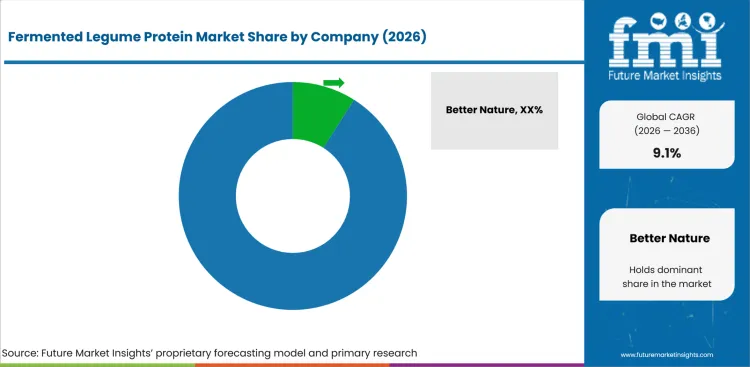
Better Nature and Tiba Tempeh define the chilled benchmark supplier set. The Tofoo Co, MycoTechnology, Ferm Food, Luya Foods add further relevance.
- Branded chilled companies hold an advantage when retailers need repeatable packs and simple cooking instructions.
- Fermented ingredient specialists gain relevance where food makers need taste correction before final recipe design.
- Upcycled substrate companies compete through okara and lupin. Side-stream fermentation concepts add another supply route.
- Equipment and process partners gain influence when they help processors scale pulse formats without quality drift.
Competitive strength starts with product proof rather than broad plant-based claims. Better Nature and Tiba Tempeh compete through chilled visibility. The Tofoo Co adds mainstream retail recognition. MycoTechnology and Ferm Food compete through functionality. European Protein and Luya Foods add process capability. Buyers compare culture control and allergen documentation. Shelf-life validation and channel proof also guide repeat business.
How do top fermented legume protein companies compare?
Better Nature and Tiba Tempeh score strongest on chilled retail proof while MycoTechnology leads on ingredient functionality.
| Company | Relevance to Market Title | Culture-Control Depth | Substrate Flexibility | Channel Proof | Geographic Footprint |
|---|---|---|---|---|---|
| Better Nature | Very High | Strong | Medium | Very Strong | United Kingdom |
| Tiba Tempeh | Very High | Strong | Medium | Strong | United Kingdom and Europe |
| The Tofoo Co | High | Moderate | Medium | Very Strong | United Kingdom |
| Noble Bean | High | Strong | Medium | Moderate | Canada |
| Luya Foods | High | Very Strong | Very Strong | Moderate | Switzerland |
| MycoTechnology | High | Very Strong | Strong | Strong | United States |
| Ferm Food | High | Strong | Strong | Moderate | Denmark |
| European Protein | Moderate to High | Strong | Moderate | Moderate | Europe and Southeast Asia |
| NextFerm | Moderate | Strong | Medium | Moderate | Israel |
| Yellow Sunshine | Moderate | Moderate | Strong | Moderate | Switzerland and Germany |
Source: Future Market Insights competitive analysis, 2026.
Key Developments in Fermented Legume Protein Market
- In August 2024, Comitis Capital acquired The Tofoo Co. The deal placed tofu and tempeh expansion under an investor-backed UK plant-based platform.
- In September 2024, European Protein and Yenher Holdings announced two fermentation factories in Southeast Asia. The first Malaysian facility targets fermented plant protein supply by Q4 2025.
- In January 2025, Bühler acquired CEREX puffing technology for grain and pulse processing. The deal improved scale options for puffed pulse and high-protein snack concepts.
- In June 2025, Yellow Sunshine launched a lupin-based plant protein brand using fermented functional proteins. The launch showed supplier interest in legume sources beyond soy.
Key Players in the Fermented Legume Protein Market
Branded Chilled Fermented Foods
- Better Nature
- Tiba Tempeh
- The Tofoo Co
- Noble Bean
Fermented Ingredient Specialists
- MycoTechnology
- Ferm Food
- European Protein
- NextFerm
Upcycled and New-Substrate Players
- Luya Foods
- Yellow Sunshine
Fermented Legume Protein Market - Scope & Definition
| Attribute | Detail |
|---|---|
| Market Definition | Food and ingredient products made by fermenting soybeans, chickpeas, fava beans, peas, lentils, lupins, or legume side streams for human food use |
| Functions Covered | Protein delivery, taste correction, digestibility support, texture development, whole-food meal replacement, ingredient functionality |
| Applications Covered | Tempeh-style blocks, fermented powders, textured pieces, ready meals, beverage bases, snacks, foodservice protein formats |
| End-Use Industries | Plant-based foods, meat alternatives, high-protein meals, protein snacks, sports nutrition, foodservice, ingredient manufacturing |
| Grades Covered | Whole-bean formats, powder formats, textured formats, chilled formats, shelf-stable ingredient formats, mixed-culture fermentates |
| Inclusions | Commercially traded fermented legume food and ingredient products across source legumes, product formats, applications, fermentation methods, distribution channels |
| Exclusions | Unfermented pulse flours, isolated plant proteins without fermentation, dairy cultures, mycoprotein without legume substrate, cultivated meat, general tofu products that are coagulated but not fermented |
Fermented Legume Protein Market - Research Methodology
| Method | Description |
|---|---|
| Primary Research | FMI analyst interviews with chilled plant-based food brands, pulse ingredient suppliers, fermentation technologists, specialty retailers, foodservice buyers, ingredient distributors across key markets |
| Desk Research | Review of government crop data, pulse supply statistics, academic fermentation studies, food safety references, company product information, official company development sources |
| Market Sizing & Forecasting | Bottom-up product-boundary approach using fermented product volumes, retail pricing, ingredient pricing, crop availability, channel penetration, country-level demand maturity |
| Data Validation | Cross-verification using country pulse supply, supermarket availability, company product ranges, fermentation process evidence, buyer use cases, documented supplier activity |
Fermented Legume Protein Market - Report Scope
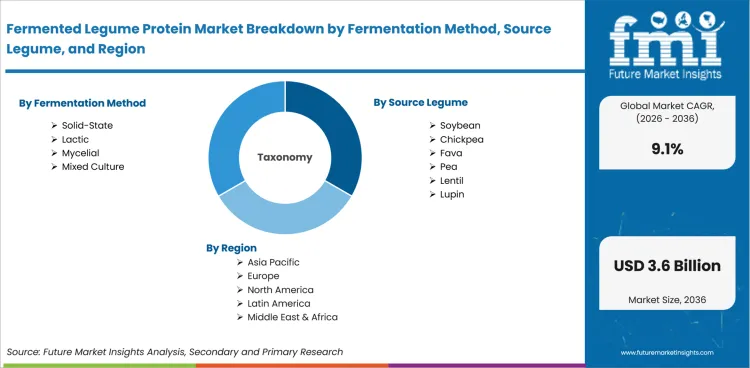
| Item | Value |
|---|---|
| Market size by 2036 | USD 3.6 billion |
| Growth rate | 9.1% CAGR from 2026 to 2036 |
| Forecast period | 2026 to 2036 |
| Base year value (2025) | USD 1.4 billion |
| By source legume | Soybean, chickpea, fava, pea, lentil, lupin |
| By product format | Whole-bean blocks, fermented powders, textured ferments, ready meals, beverage bases |
| By application | Meat alternatives, high-protein meals, protein snacks, sports nutrition, foodservice |
| By fermentation method | Solid-state, lactic, mycelial, mixed culture |
| By distribution channel | Retail chilled, foodservice, ingredient B2B, online D2C, specialty retail |
| Regions covered | North America, Latin America, Europe, East Asia, South Asia and Pacific, Middle East and Africa |
| Countries covered | India, United Kingdom, United States, Germany, France, China, South Korea, Japan |
| Key companies profiled | Better Nature, Tiba Tempeh, The Tofoo Co, Noble Bean, Luya Foods, MycoTechnology, Ferm Food |
| Approach | Bottom-up product-boundary approach using eligible fermented legume SKU revenue, channel presence, substrate data, culture process evidence, country-level adoption |
Source: Future Market Insights, 2026.
Fermented Legume Protein Market Breakdown by Source Legume and Product Format. Application, Fermentation Method, Distribution Channel, Region are covered.
Fermented Legume Protein Market Segmented by Source Legume
- Soybean
- Chickpea
- Fava
- Pea
- Lentil
- Lupin
Fermented Legume Protein Market Segmented by Product Format
- Whole-Bean Blocks
- Fermented Powders
- Textured Ferments
- Ready Meals
- Beverage Bases
Fermented Legume Protein Market Segmented by Application
- Meat Alternatives
- High-Protein Meals
- Protein Snacks
- Sports Nutrition
- Foodservice
Fermented Legume Protein Market Segmented by Fermentation Method
- Solid-State
- Lactic
- Mycelial
- Mixed Culture
Fermented Legume Protein Market Segmented by Distribution Channel
- Retail Chilled
- Foodservice
- Ingredient B2B
- Online D2C
- Specialty Retail
Fermented Legume Protein Market by Region
- North America
- Latin America
- Europe
- East Asia
- South Asia and Pacific
- Middle East and Africa
Research Sources and Bibliography
- Organisation for Economic Co-operation and Development and Food and Agriculture Organization. (2025, July 15). OECD-FAO Agricultural Outlook 2025-2034: Other products. OECD Publishing.
- Zipori, D., Zannini, E., Arendt, E. K., & Sahin, A. W. (2024). Rapid acidification and off-flavor reduction of pea protein by fermentation with lactic acid bacteria and yeasts. Foods, 13(4), 588.
- Flores, M., Zhao, J., Zhang, Y., Gibis, M., & Weiss, J. (2024, February 23). Fermentation of texturized pea protein in combination with plant-based fat compounds. Journal of Agricultural and Food Chemistry.
- United States Department of Agriculture Economic Research Service. (2025, September 22). Vegetables and Pulses Data.
- United States Food and Drug Administration. (2025). Food allergies.
- United Kingdom Department for Environment, Food & Rural Affairs. (2025, July 25). Agriculture in the United Kingdom 2024.
- Federal Statistical Office of Germany. (2025, May 19). Field crops: Expected acreage of field crops.
- Federal Statistical Office of Germany. (2026, February 17). Organic farming in the EU 2024.
- INRAE. (2025). Pulse group.
- National Institute of Statistics and Economic Studies. (2026, June 5). In April 2026, manufacturing output increased by 0.4%.
- National Institute of Statistics and Economic Studies. (2026, June 12). In May 2026, consumer prices rose by 2.4% year on year.
- National Bureau of Statistics of China. (2025, February 28). Statistical Communiqué of the People’s Republic of China on the 2024 National Economic and Social Development.
- National Bureau of Statistics of China. (2026, January 20). Total retail sales of consumer goods in December 2025.
- United States Department of Agriculture Foreign Agricultural Service. (2026, March 31). Oilseeds and Products Annual: Japan.
- Ministry of Economy, Trade and Industry. (2025, August 26). Results of FY2024 E-commerce Market Survey Compiled.
- United States Department of Agriculture Foreign Agricultural Service. (2026, March 4). South Korea: Oilseeds and Products Annual.
- Ministry of Agriculture & Farmers Welfare. (2025, November 20). Record foodgrain output breaks all previous highs.
- Press Information Bureau. (2025, October 11). India’s Mission for Aatmanirbharta in Pulses.
- Ministry of Food Processing Industries. (2025, July 25). Cold Chain Infrastructure and Value Addition through PMKSY.
- The Tofoo Co. (2024, August 20). New investment to drive further growth for The Tofoo Co.
- Bühler Group. (2025, January 16). Bühler acquires CEREX puffing technology for grain and pulse processing.
- Bühler Group. (2025, June 12). Where grains get their volume: Bühler opens puffing technology center.
- European Protein. (2024, September 13). European Protein is building two new fermentation factories in Southeast Asia.
- Swiss Food & Nutrition Valley. (2025, June). New Roots founders launch Yellow Sunshine.
This bibliography is provided for reader reference and is not exhaustive. The full report contains the complete reference list and detailed citations.
This Report Answers
- What is the 2026 value and 2036 forecast for fermented legume protein market?
- Which fermentation method is projected to hold the leading share during the forecast period?
- What source legume is expected to account for the leading 2026 share?
- How does fermentation improve pea and fava protein use in foods?
- Which companies compete in fermented legume protein?
Frequently Asked Questions
What is the fermented legume protein market size in 2026?
The fermented legume protein market size is anticipated to cross USD 1.5 billion in 2026.
What is the fermented legume protein market forecast for 2036?
The fermented legume protein industry revenue is predicted to reach USD 3.6 billion by 2036 as chilled blocks and B2B fermentates expand.
What is the fermented legume protein market CAGR?
The fermented legume protein sector is projected to expand at 9.1% CAGR from 2026 to 2036.
What segment leads the fermented legume protein market?
Solid-State Fermentation is likely to capture 61.0% share in 2026 because whole-bean substrates fit low-moisture culture systems.
What country grows fastest in the fermented legume protein market?
India is set to record 10.8% CAGR by 2036 due to pulse supply and vegetarian protein habits.
What does fermented legume protein include?
It includes fermented soy, chickpea, fava, pea, lentil, lupin products. These products are sold as blocks, powders, textured pieces, meals, ingredients.
What are the disadvantages of fermented legume protein?
The main disadvantages are cold-chain needs and soy allergen exposure. Flavor variability, scale-up risk, premium pricing create added barriers.
Preview the report firsthand - request a free sample
Get SampleGet the brochure for pricing and purchase details.
Get PDFTable of Content
- Key Takeaways
- Market Size and CAGR
- Top Growth Driver
- Fastest Growing Segment
- Leading Region
- Key Companies
- Emerging Opportunities
- Executive Summary
- Global Market Outlook
- Demand-side Trends
- Supply-side Trends
- Technology Roadmap Analysis
- Analysis and Recommendations
- Analyst Perspective (What is happening? Why now? What should investors know?)
- Key Questions Answered
- How large is the market?
- What is the CAGR?
- What are key trends?
- Which region dominates?
- Who are the leaders?
- Market Overview
- Market Coverage / Taxonomy
- Market Definition / Scope / Limitations
- Research Methodology
- Chapter Orientation
- Analytical Lens and Working Hypotheses
- Market Structure, Signals, and Trend Drivers
- Benchmarking and Cross-market Comparability
- Market Sizing, Forecasting, and Opportunity Mapping
- Research Design and Evidence Framework
- Desk Research Programme (Secondary Evidence)
- Expert Input and Fieldwork (Primary Evidence)
- Tooling, Models, and Reference Databases
- Data Engineering and Model Build
- Quality Assurance and Audit Trail
- Market Background
- Market Dynamics (Drivers, Restraints, Opportunity, Trends)
- Scenario Forecast (Optimistic, Likely, Conservative)
- Impact Analysis
- AI Impact
- Sustainability Impact
- Regulatory Impact
- Technology Impact
- Consumer / Buyer Analysis
- Purchase Drivers
- Adoption Barriers
- Buyer Journey
- Opportunity Map Analysis
- Product Life Cycle Analysis
- Supply Chain Analysis
- Investment Feasibility Matrix
- Value Chain Analysis
- PESTLE and Porter's Analysis
- Regulatory Landscape
- Regional Parent Market Outlook
- Production and Consumption Statistics
- Import and Export Statistics
- Global Market Analysis and Forecast, 2021 to 2036
- Historical Market Size Value (USD Billion) & Volume (Unit) Analysis, 2021 to 2025
- Current and Future Market Size Value (USD Billion) & Volume (Unit) Projections, 2026 to 2036
- Y-o-Y Growth Trend Analysis
- Absolute $ Opportunity Analysis
- Global Market Pricing Analysis, 2021 to 2036
- Global Market Analysis and Forecast, By Source Legume, 2021 to 2036
- Introduction / Key Findings
- Historical Market Size Value (USD Billion) & Volume (Unit) Analysis By Source Legume, 2021 to 2025
- Current and Future Market Size Value (USD Billion) & Volume (Unit) Analysis and Forecast By Source Legume, 2026 to 2036
- Soybean
- Chickpea
- Fava
- Pea
- Lentil
- Lupin
- Soybean
- Y-o-Y Growth Trend Analysis By Source Legume, 2021 to 2025
- Absolute $ Opportunity Analysis By Source Legume, 2026 to 2036
- Global Market Analysis and Forecast, By Product Format, 2021 to 2036
- Introduction / Key Findings
- Historical Market Size Value (USD Billion) & Volume (Unit) Analysis By Product Format, 2021 to 2025
- Current and Future Market Size Value (USD Billion) & Volume (Unit) Analysis and Forecast By Product Format, 2026 to 2036
- Whole-Bean Blocks
- Fermented Powders
- Textured Ferments
- Ready Meals
- Beverage Bases
- Whole-Bean Blocks
- Y-o-Y Growth Trend Analysis By Product Format, 2021 to 2025
- Absolute $ Opportunity Analysis By Product Format, 2026 to 2036
- Global Market Analysis and Forecast, By Application, 2021 to 2036
- Introduction / Key Findings
- Historical Market Size Value (USD Billion) & Volume (Unit) Analysis By Application, 2021 to 2025
- Current and Future Market Size Value (USD Billion) & Volume (Unit) Analysis and Forecast By Application, 2026 to 2036
- Meat Alternatives
- High-Protein Meals
- Protein Snacks
- Sports Nutrition
- Foodservice
- Meat Alternatives
- Y-o-Y Growth Trend Analysis By Application, 2021 to 2025
- Absolute $ Opportunity Analysis By Application, 2026 to 2036
- Global Market Analysis and Forecast, By Fermentation Method, 2021 to 2036
- Introduction / Key Findings
- Historical Market Size Value (USD Billion) & Volume (Unit) Analysis By Fermentation Method, 2021 to 2025
- Current and Future Market Size Value (USD Billion) & Volume (Unit) Analysis and Forecast By Fermentation Method, 2026 to 2036
- Solid-State
- Lactic
- Mycelial
- Mixed Culture
- Solid-State
- Y-o-Y Growth Trend Analysis By Fermentation Method, 2021 to 2025
- Absolute $ Opportunity Analysis By Fermentation Method, 2026 to 2036
- Global Market Analysis and Forecast, By Distribution Channel, 2021 to 2036
- Introduction / Key Findings
- Historical Market Size Value (USD Billion) & Volume (Unit) Analysis By Distribution Channel, 2021 to 2025
- Current and Future Market Size Value (USD Billion) & Volume (Unit) Analysis and Forecast By Distribution Channel, 2026 to 2036
- Retail Chilled
- Foodservice
- Ingredient B2B
- Online D2C
- Specialty Retail
- Retail Chilled
- Y-o-Y Growth Trend Analysis By Distribution Channel, 2021 to 2025
- Absolute $ Opportunity Analysis By Distribution Channel, 2026 to 2036
- Global Market Analysis and Forecast, By Region, 2021 to 2036
- Introduction
- Historical Market Size Value (USD Billion) & Volume (Unit) Analysis By Region, 2021 to 2025
- Current Market Size Value (USD Billion) & Volume (Unit) Analysis and Forecast By Region, 2026 to 2036
- North America
- Latin America
- Western Europe
- Eastern Europe
- East Asia
- South Asia and Pacific
- Middle East & Africa
- Market Attractiveness Analysis By Region
- North America Market Analysis and Forecast, By Country, 2021 to 2036
- Historical Market Size Value (USD Billion) & Volume (Unit) Trend Analysis By Market Taxonomy, 2021 to 2025
- Market Size Value (USD Billion) & Volume (Unit) Forecast By Market Taxonomy, 2026 to 2036
- By Country
- USA
- Canada
- Mexico
- By Source Legume
- By Product Format
- By Application
- By Fermentation Method
- By Distribution Channel
- By Country
- Market Attractiveness Analysis
- By Country
- By Source Legume
- By Product Format
- By Application
- By Fermentation Method
- By Distribution Channel
- Key Takeaways
- Latin America Market Analysis and Forecast, By Country
- Historical Market Size Value (USD Billion) & Volume (Unit) Trend Analysis By Market Taxonomy, 2021 to 2025
- Market Size Value (USD Billion) & Volume (Unit) Forecast By Market Taxonomy, 2026 to 2036
- By Country
- Brazil
- Chile
- Rest of Latin America
- By Source Legume
- By Product Format
- By Application
- By Fermentation Method
- By Distribution Channel
- By Country
- Market Attractiveness Analysis
- By Country
- By Source Legume
- By Product Format
- By Application
- By Fermentation Method
- By Distribution Channel
- Key Takeaways
- Western Europe Market Analysis and Forecast, By Country
- Historical Market Size Value (USD Billion) & Volume (Unit) Trend Analysis By Market Taxonomy, 2021 to 2025
- Market Size Value (USD Billion) & Volume (Unit) Forecast By Market Taxonomy, 2026 to 2036
- By Country
- Germany
- UK
- Italy
- Spain
- France
- Nordic
- BENELUX
- Rest of Western Europe
- By Source Legume
- By Product Format
- By Application
- By Fermentation Method
- By Distribution Channel
- By Country
- Market Attractiveness Analysis
- By Country
- By Source Legume
- By Product Format
- By Application
- By Fermentation Method
- By Distribution Channel
- Key Takeaways
- Eastern Europe Market Analysis and Forecast, By Country
- Historical Market Size Value (USD Billion) & Volume (Unit) Trend Analysis By Market Taxonomy, 2021 to 2025
- Market Size Value (USD Billion) & Volume (Unit) Forecast By Market Taxonomy, 2026 to 2036
- By Country
- Russia
- Poland
- Hungary
- Balkan & Baltic
- Rest of Eastern Europe
- By Source Legume
- By Product Format
- By Application
- By Fermentation Method
- By Distribution Channel
- By Country
- Market Attractiveness Analysis
- By Country
- By Source Legume
- By Product Format
- By Application
- By Fermentation Method
- By Distribution Channel
- Key Takeaways
- East Asia Market Analysis and Forecast, By Country
- Historical Market Size Value (USD Billion) & Volume (Unit) Trend Analysis By Market Taxonomy, 2021 to 2025
- Market Size Value (USD Billion) & Volume (Unit) Forecast By Market Taxonomy, 2026 to 2036
- By Country
- China
- Japan
- South Korea
- By Source Legume
- By Product Format
- By Application
- By Fermentation Method
- By Distribution Channel
- By Country
- Market Attractiveness Analysis
- By Country
- By Source Legume
- By Product Format
- By Application
- By Fermentation Method
- By Distribution Channel
- Key Takeaways
- South Asia and Pacific Market Analysis and Forecast, By Country
- Historical Market Size Value (USD Billion) & Volume (Unit) Trend Analysis By Market Taxonomy, 2021 to 2025
- Market Size Value (USD Billion) & Volume (Unit) Forecast By Market Taxonomy, 2026 to 2036
- By Country
- India
- ASEAN
- Australia & New Zealand
- Rest of South Asia and Pacific
- By Source Legume
- By Product Format
- By Application
- By Fermentation Method
- By Distribution Channel
- By Country
- Market Attractiveness Analysis
- By Country
- By Source Legume
- By Product Format
- By Application
- By Fermentation Method
- By Distribution Channel
- Key Takeaways
- Middle East & Africa Market Analysis and Forecast, By Country
- Historical Market Size Value (USD Billion) & Volume (Unit) Trend Analysis By Market Taxonomy, 2021 to 2025
- Market Size Value (USD Billion) & Volume (Unit) Forecast By Market Taxonomy, 2026 to 2036
- By Country
- Kingdom of Saudi Arabia
- Other GCC Countries
- Türkiye
- South Africa
- Other African Union
- Rest of Middle East & Africa
- By Source Legume
- By Product Format
- By Application
- By Fermentation Method
- By Distribution Channel
- By Country
- Market Attractiveness Analysis
- By Country
- By Source Legume
- By Product Format
- By Application
- By Fermentation Method
- By Distribution Channel
- Key Takeaways
- Key Countries Market Analysis
- USA
- Pricing Analysis
- Market Share Analysis, 2025
- By Source Legume
- By Product Format
- By Application
- By Fermentation Method
- By Distribution Channel
- Canada
- Pricing Analysis
- Market Share Analysis, 2025
- By Source Legume
- By Product Format
- By Application
- By Fermentation Method
- By Distribution Channel
- Mexico
- Pricing Analysis
- Market Share Analysis, 2025
- By Source Legume
- By Product Format
- By Application
- By Fermentation Method
- By Distribution Channel
- Brazil
- Pricing Analysis
- Market Share Analysis, 2025
- By Source Legume
- By Product Format
- By Application
- By Fermentation Method
- By Distribution Channel
- Chile
- Pricing Analysis
- Market Share Analysis, 2025
- By Source Legume
- By Product Format
- By Application
- By Fermentation Method
- By Distribution Channel
- Germany
- Pricing Analysis
- Market Share Analysis, 2025
- By Source Legume
- By Product Format
- By Application
- By Fermentation Method
- By Distribution Channel
- UK
- Pricing Analysis
- Market Share Analysis, 2025
- By Source Legume
- By Product Format
- By Application
- By Fermentation Method
- By Distribution Channel
- Italy
- Pricing Analysis
- Market Share Analysis, 2025
- By Source Legume
- By Product Format
- By Application
- By Fermentation Method
- By Distribution Channel
- Spain
- Pricing Analysis
- Market Share Analysis, 2025
- By Source Legume
- By Product Format
- By Application
- By Fermentation Method
- By Distribution Channel
- France
- Pricing Analysis
- Market Share Analysis, 2025
- By Source Legume
- By Product Format
- By Application
- By Fermentation Method
- By Distribution Channel
- India
- Pricing Analysis
- Market Share Analysis, 2025
- By Source Legume
- By Product Format
- By Application
- By Fermentation Method
- By Distribution Channel
- ASEAN
- Pricing Analysis
- Market Share Analysis, 2025
- By Source Legume
- By Product Format
- By Application
- By Fermentation Method
- By Distribution Channel
- Australia & New Zealand
- Pricing Analysis
- Market Share Analysis, 2025
- By Source Legume
- By Product Format
- By Application
- By Fermentation Method
- By Distribution Channel
- China
- Pricing Analysis
- Market Share Analysis, 2025
- By Source Legume
- By Product Format
- By Application
- By Fermentation Method
- By Distribution Channel
- Japan
- Pricing Analysis
- Market Share Analysis, 2025
- By Source Legume
- By Product Format
- By Application
- By Fermentation Method
- By Distribution Channel
- South Korea
- Pricing Analysis
- Market Share Analysis, 2025
- By Source Legume
- By Product Format
- By Application
- By Fermentation Method
- By Distribution Channel
- Russia
- Pricing Analysis
- Market Share Analysis, 2025
- By Source Legume
- By Product Format
- By Application
- By Fermentation Method
- By Distribution Channel
- Poland
- Pricing Analysis
- Market Share Analysis, 2025
- By Source Legume
- By Product Format
- By Application
- By Fermentation Method
- By Distribution Channel
- Hungary
- Pricing Analysis
- Market Share Analysis, 2025
- By Source Legume
- By Product Format
- By Application
- By Fermentation Method
- By Distribution Channel
- Kingdom of Saudi Arabia
- Pricing Analysis
- Market Share Analysis, 2025
- By Source Legume
- By Product Format
- By Application
- By Fermentation Method
- By Distribution Channel
- Türkiye
- Pricing Analysis
- Market Share Analysis, 2025
- By Source Legume
- By Product Format
- By Application
- By Fermentation Method
- By Distribution Channel
- South Africa
- Pricing Analysis
- Market Share Analysis, 2025
- By Source Legume
- By Product Format
- By Application
- By Fermentation Method
- By Distribution Channel
- USA
- Market Structure Analysis
- Competition Dashboard
- Competition Benchmarking
- Market Share Analysis of Top Players
- By Regional
- By Source Legume
- By Product Format
- By Application
- By Fermentation Method
- By Distribution Channel
- Emerging Startups
- Innovation Benchmarking
- Competition Analysis
- Competition Deep Dive
- Better Nature
- Overview
- Product Portfolio
- Profitability by Market Segments (Product/Region/Sales Channel)
- Sales Footprint
- Strategy Overview
- Marketing Strategy
- Product Strategy
- Channel Strategy
- Tiba Tempeh
- The Tofoo Co
- Noble Bean
- MycoTechnology
- Ferm Food
- European Protein
- NextFerm
- Luya Foods
- Yellow Sunshine
- Better Nature
- Case Studies
- Success Stories
- Recent Developments
- Competition Deep Dive
- Assumptions & Acronyms Used


