

- Market Size (2026)
- USD 1.9 Bn
- Forecast (2036)
- USD 3.4 Bn
- CAGR (2026 to 2036)
- 6.1%
How big is Fiber-Based Edge Boards Market in 2026?
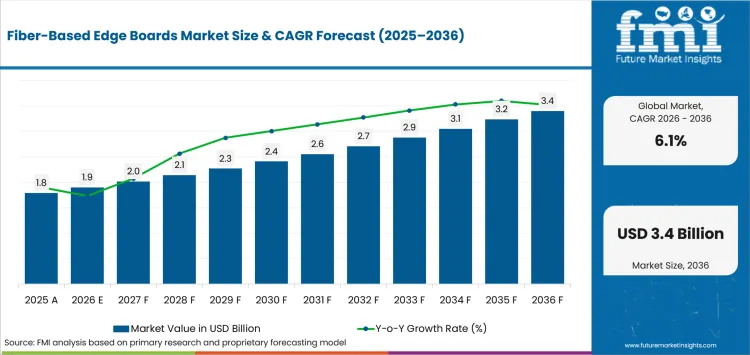
USD 1.9 Billion in 2026 and USD 3.4 Billion by 2036 at a 6.1% CAGR.
Demand for fiber-based edge boards stands at USD 1.9 billion in 2026 and rises to USD 3.4 billion by 2036, growing at a 6.1% CAGR. Growth is driven by packaging engineers specifying edge boards wherever strapping, stretch film, stacking pressure, or handling creates a crush or corner-stability risk on a pallet. Unlike a one-time equipment purchase, edge boards are a recurring shipment-level buy tied directly to pallet output volume, which means demand scales with shipping activity rather than capital budgets. That recurring consumption pattern gives consistent demand across consumer goods, industrial, and food-and-beverage supply chains wherever unitized pallet loads move through multi-stop or export logistics.
Price sensitivity and substitution risk from plastic or foam corner protection slow faster penetration, particularly where recycled fiber supply is tight enough to push costs above what buyers in price-competitive markets will absorb. Humidity performance in open or uncontrolled storage environments also limits fiber-based formats in certain applications without additional treatment. The stronger opportunities lie in high-recycled-content grades that meet export pallet specifications, lightweight formats suited for automated pallet-building lines, and custom-profile edge boards for non-standard load geometries. By board type, material grade, and end-use industry, load-bearing requirements and cost thresholds differ enough to warrant separate treatment. Regionally, Indian exporters and manufacturers are adding logistics capacity where edge board specification is growing alongside pallet standardization, while Chinese high-volume shippers prioritize throughput and local supply, keeping price and speed as the primary selection criteria.
Key Takeaways of Fiber-based Edge Boards Market
- More handled shipments and pressure to reduce damage with recyclable, material-efficient transport packaging support demand for fiber-based edge boards.
- Direct / OEM leads the sales channel because large users specify leg length, thickness, moisture grade, compression strength, and delivery cadence.
- Recovered / Recycled Paperboard leads material at 54.0%, while L-Shaped / Angle profiles lead at 47.0% and 3-5 mm boards at 44.0%.
- Logistics & Transportation leads application, while Furniture & Building Materials is the largest end-use category.
- Moisture sensitivity, recovered-fiber variability, and customer-specific testing can extend approval cycles and raise conversion cost.
- India leads the profiled country growth rates at 8.6% through 2036, followed by China at 7.6%.
- Signode, Cascades, Cordstrap, Eltete TPM, Smurfit WestRock, and Sonoco compete through edge-protection breadth, end-of-line integration, and coreboard supply.
Analyst Perspective
“Fiber-based edge boards are approved on performance, not on recycled content alone. Buyers need consistent compression strength, dimensional accuracy and moisture resistance because a weak profile can loosen straps, destabilize pallets and increase corner damage. Suppliers that control recovered-fiber variability and deliver application-specific profiles will be better placed to win direct OEM contracts.”
- Nandini Roy Choudhury, Principal Consultant, Future Market Insights
How is the Fiber-based Edge Boards Market segmented?
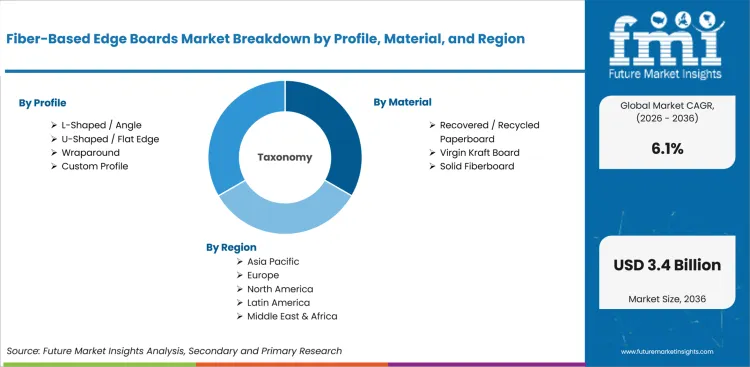
Profile separates standard angle protection from flat, wraparound, and application-specific geometries. Material distinguishes recovered or recycled paperboard from virgin kraft board and solid fiberboard according to cost, strength, surface, and circularity requirements.
What makes L-Shaped / Angle central to the Profile category?
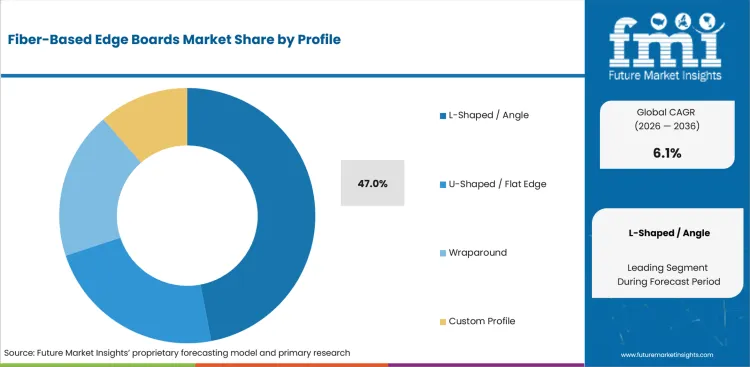
L-shaped and angle profiles solve two protection problems with a single lightweight piece, covering both faces at a corner where impact and strap-pressure concentration are most likely to damage a load. Packers handling palletized freight are the primary users, and the deciding factor is whether the profile can be cut, positioned, and applied quickly enough to fit into a normal packing line without slowing throughput.
- L-shaped/angle profiles lead Profile with 47.0% share, reflecting the geometry's fit for the most common corner-protection need across strapped and wrapped unit loads.
- Manual and automated application both favor this profile, since it can be positioned by hand or fed into a stretch-wrapping line without added equipment. That flexibility keeps it the default choice across facilities with different levels of packing automation.
Why does Recovered / Recycled Paperboard lead the Material category?
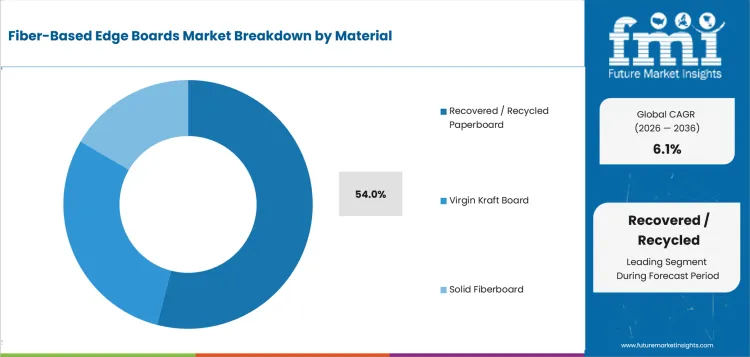
Edge boards need compressive stiffness to survive strap tension and stacking pressure, not a premium printable surface, which makes recovered paperboard's strength-to-cost ratio hard for virgin material to beat on a standard protective application. Converters supplying high-volume palletizing operations are the primary buyers, and the deciding factor is whether recovered fiber can maintain consistent stiffness despite the raw-material variability recycled streams often carry.
- Recovered/recycled paperboard leads Material at 54.0% share, reflecting its cost advantage on an application where raw compressive performance matters more than surface finish or brand presentation.
- Fiber-source variability is the practical risk converters manage, since inconsistent recovered stock can produce boards with uneven stiffness across a production run. Converters with tighter incoming-material screening deliver more consistent performance and retain high-volume accounts.
How does 3-5 mm balance the Thickness category?
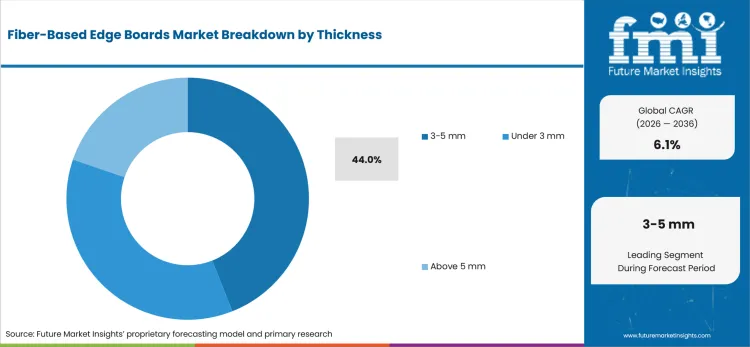
The 3-5 mm range gives a board enough section stiffness to spread strap load and resist typical pallet-edge compression without adding the weight and bulk a heavier profile would carry. Buyers shipping standard palletized freight are the primary users, and the deciding factor is whether that thickness holds up consistently across the range of compression forces a normal shipping and handling cycle applies.
- The 3-5 mm range leads Thickness at 44.0% share, reflecting its balance between adequate strap-load protection and the lower material cost and weight that thinner boards offer.
- Buyers shipping heavier or higher-value loads sometimes step up to a thicker profile, so suppliers offering a clear thickness range let customers match protection level to load weight without over-specifying and adding unnecessary cost.
What supports Logistics & Transportation in the Application category?
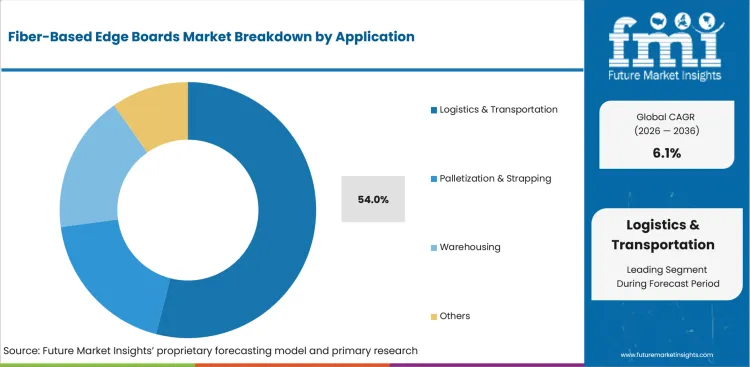
Logistics and transportation is where a packed item actually becomes a handled unit load, subject to strapping, wrapping, clamp handling, pallet transfers, storage, and final delivery, each of which puts stress on exposed corners and edges. Warehouse and logistics operators are the primary buyers, and the deciding factor is whether the edge board holds its protective shape through the full handling chain rather than just the initial strapping step.
- Logistics & Transportation leads Application with 54% share, reflecting the segment's exposure to the full range of handling stresses a load experiences between packing and final delivery.
- Damage reduction across multiple handling touchpoints is what operators evaluate most closely, since a board that performs well under strapping but fails during clamp handling or storage doesn't solve the full protection problem. Suppliers demonstrating performance across the entire handling chain win broader adoption.
What drives Furniture & Building Materials in the End Use category?
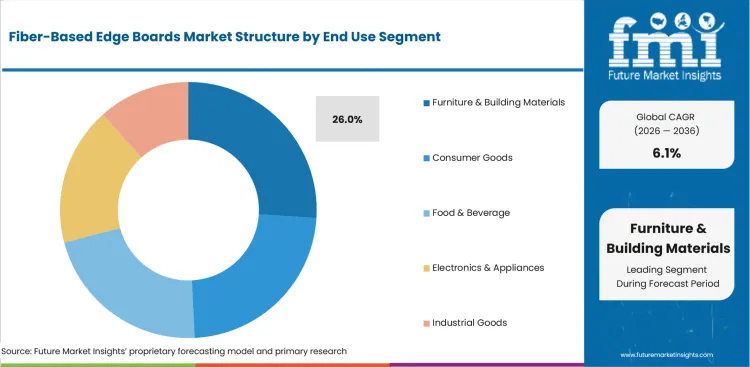
Furniture and building materials generate the largest end-use share because panels, doors, countertops, cabinetry, flooring packs, and assembled furniture all present long, exposed edges that carry high damage value if scratched, chipped, or crushed in transit. Manufacturers and distributors shipping these products are the primary buyers, and the deciding factor is whether the board's leg length and rigidity match the specific edge geometry of the product being protected.
- Furniture & Building Materials holds the largest End Use share, reflecting the category's combination of long exposed edges and high per-unit damage cost relative to smaller or less fragile products.
- Custom leg-length and dimension matching drives repeat specification, since furniture and building products come in enough size variation that a standard board doesn't fit every product line. Suppliers offering flexible sizing retain accounts across a manufacturer's full product range.
Why does Direct / OEM lead the Sales Channel category?
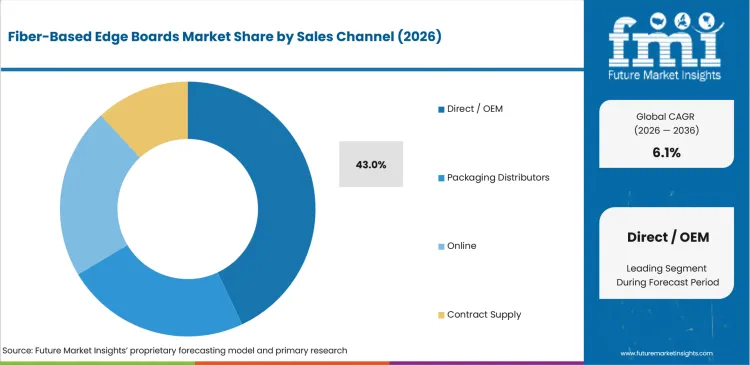
Large buyers purchase a full performance specification rather than an undifferentiated paper angle, requiring exact leg length, thickness, moisture grade, compression strength, and delivery cadence matched to their packing line. Procurement and packaging engineering teams at large manufacturers are the primary buyers through this channel, and the deciding factor is whether the direct supplier relationship can support the technical validation and consistent delivery cadence a specified program requires.
- Direct/OEM sales lead Sales Channel, reflecting how large-volume buyers with specific technical requirements favor a direct relationship over a distributor that may not support custom specification.
- Delivery cadence reliability is a recurring concern for large accounts, since a supply gap disrupts a packing line running on a fixed schedule. Suppliers with dependable, specification-matched delivery retain these accounts over lower-cost but less consistent alternatives.
What are the drivers, restraints, and opportunities in the Fiber-Based Edge Boards Market?
- Driver: More handled shipments and stronger pressure to reduce damage with recyclable, material-efficient transport packaging.
- Restraint: Moisture sensitivity, recovered-fiber variability, and customer-specific testing can extend approval cycles and raise conversion cost.
- Opportunity: Water-resistant custom profiles linked to end-of-line systems and regional direct-supply programs can capture higher-value applications.
Distribution intensity is the primary demand mechanism. The USA Census Bureau reported in May 2026 that first-quarter e-commerce sales rose 9.8% year over year, outpacing total retail growth. The main restraint appears during qualification. The strongest opportunity is not a generic paper-for-plastic substitution. It is a locally produced profile that combines recovered fiber, verified compression, water resistance, precise dimensions, and compatibility with the customer's strapping or wrapping method.
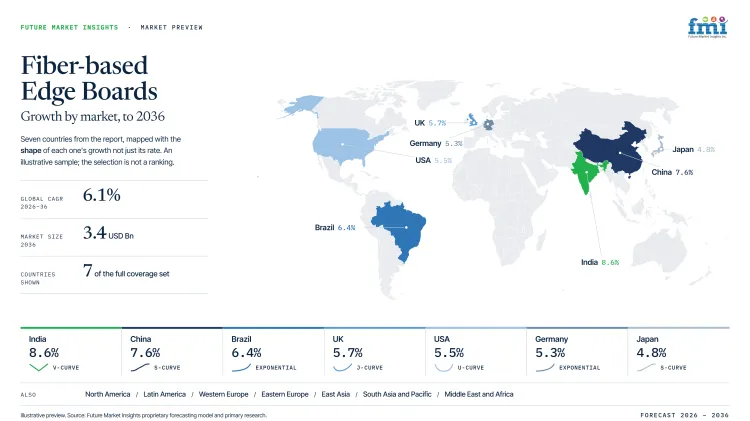
How do country-level CAGRs compare in the Fiber-Based Edge Boards Market?
| Country | CAGR |
|---|---|
| USA | 5.5% |
| China | 7.6% |
| Germany | 5.3% |
| Japan | 4.8% |
| India | 8.6% |
| UK | 5.7% |
| Brazil | 6.4% |
How do country-level CAGRs compare in the Fiber-Based Edge Boards Market?
The seven-country comparison spans 3.8 percentage points, from India at 8.6% to Japan at 4.8%. India and China represent the fastest-growing markets, while Brazil occupies a middle position at 6.4%. The United Kingdom, the United States and Germany remain closely grouped between 5.3% and 5.7%, with Japan recording the lowest CAGR.
- India leads with a CAGR of 8.6%. Demand reflects increasing use of fiber-based edge boards in industrial packaging and palletized shipments where product protection and load stability are important.
- China follows at 7.6%, 1.0 percentage point behind India. Packaging manufacturers continue expanding production of paper-based protective components to serve export-oriented industries and domestic logistics networks.
- Brazil records a CAGR of 6.4%, creating a clear midpoint between the higher-growth Asian markets and the remaining countries. Adoption is linked to broader use of protective packaging across manufacturing and distribution activities.
- The United Kingdom posts a CAGR of 5.7%, while the United States reaches 5.5% and Germany records 5.3%. The narrow 0.4 percentage point spread indicates a similar pace of market development, although packaging specifications, manufacturing activity and supply chain requirements differ across these markets.
- Japan records a CAGR of 4.8%, 0.5 percentage points below Germany. Market demand is supported by established industrial packaging applications rather than rapid capacity expansion.
Differences in manufacturing output, logistics activity, packaging standards and investment priorities influence market development across these countries. The full report provides country-level CAGR analysis across North America, Latin America, Europe, East Asia, South Asia, Oceania and the Middle East and Africa.
Who are the notable companies in the Fiber-Based Edge Boards Market?
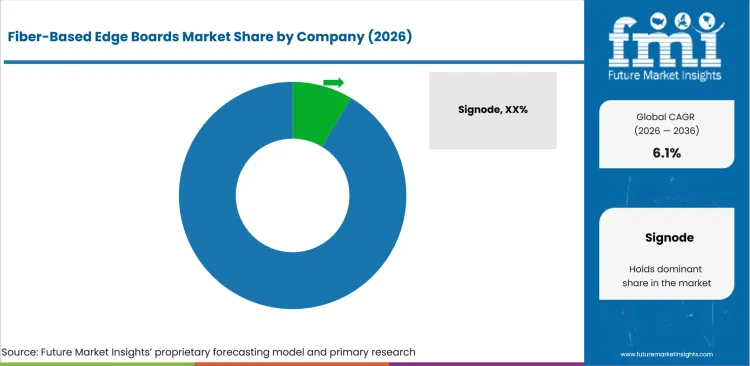
The competitive field is divided by how each supplier reaches the edge-board specification. Signode, Cordstrap, and Eltete TPM approach the need through load securing, pallet stability, and end-of-line application. Sonoco, Conitex Sonoco, Kunert Group, and VPK Group draw on paper-converting, coreboard, tubes and cores, or dedicated edge-protection operations to control dimensions, grades, and local supply.
Competitive Benchmarking: Fiber-Based Edge Boards Market
| Company | Capability profile | Geographic reach |
|---|---|---|
| Signode | Fiber Edge-Protection Breadth: High; End-of-Line / Load-Securing Integration: High; Recycled-Fiber / Coreboard Integration: Medium | Americas, Europe, and Asia-Pacific |
| Cascades | Fiber Edge-Protection Breadth: -; End-of-Line / Load-Securing Integration: Medium; Recycled-Fiber / Coreboard Integration: High | North America |
| Cordstrap | Fiber Edge-Protection Breadth: Medium; End-of-Line / Load-Securing Integration: High; Recycled-Fiber / Coreboard Integration: - | Americas, Europe, and Asia-Pacific |
| Eltete TPM | Fiber Edge-Protection Breadth: High; End-of-Line / Load-Securing Integration: Medium; Recycled-Fiber / Coreboard Integration: Medium | Europe, Asia-Pacific, and the Americas |
| Smurfit WestRock | Fiber Edge-Protection Breadth: Medium; End-of-Line / Load-Securing Integration: Medium; Recycled-Fiber / Coreboard Integration: High | Americas, Europe, and Asia-Pacific |
| Sonoco | Fiber Edge-Protection Breadth: High; End-of-Line / Load-Securing Integration: Medium; Recycled-Fiber / Coreboard Integration: High | Americas, Europe, and Asia-Pacific |
| Conitex Sonoco | Fiber Edge-Protection Breadth: Medium; End-of-Line / Load-Securing Integration: Medium; Recycled-Fiber / Coreboard Integration: High | Americas, Europe, and Asia |
| Packaging Corporation of America | Fiber Edge-Protection Breadth: Medium; End-of-Line / Load-Securing Integration: Medium; Recycled-Fiber / Coreboard Integration: High | United States and Canada |
| Kunert Group | Fiber Edge-Protection Breadth: High; End-of-Line / Load-Securing Integration: Medium; Recycled-Fiber / Coreboard Integration: High | Europe and Asia with international supply |
| VPK Group | Fiber Edge-Protection Breadth: High; End-of-Line / Load-Securing Integration: Medium; Recycled-Fiber / Coreboard Integration: High | Europe with international supply reach |
Key Developments in the Fiber-Based Edge Boards Market
- In September 2025, Signode launched the Octopus Prestige high-speed stretch wrapper for high-volume end-of-line operations.
- In May 2023, Cascades announced the successful start-up of its Bear Island Containerboard Packaging plant in Virginia.
- In July 2024, Smurfit WestRock completed the listing of the combined company's shares in London and New York following the Smurfit Kappa and WestRock transaction.
- In June 2024, VPK Group reported the start-up of its converted paper machine at Alizay, adding 550,000 tonnes of annual recycled-paper capacity, and the expansion of Corex through the acquisition of Arteche Paper in Portugal and Spain.
Key Players in the Fiber-Based Edge Boards Market
Integrated Load-Securing and End-of-Line Suppliers
- Signode
- Cordstrap
- Eltete TPM
Fiber Edgeboard and Coreboard Specialists
- Sonoco
- Conitex Sonoco
- Kunert Group
- VPK Group
Integrated Recycled Fiber and Corrugated Platforms
- Cascades
- Smurfit WestRock
- Packaging Corporation of America
Fiber-Based Edge Boards Market - Report Scope
| Coverage field | Report scope |
|---|---|
| Market breakdown | Profile, Material, Thickness, Application, End Use, and Sales Channel |
| Quantitative Units | Revenue in USD Billion, CAGR in %. |
| Market Definition | Revenue includes sales of fiber-based edge boards within the stated profiles, paperboard materials, thicknesses, applications, end uses, and sales channels. |
| Regions Covered | North America; Latin America; Western Europe; Eastern Europe; East Asia; South Asia and Pacific; Middle East and Africa |
| Countries Covered | USA, China, Germany, Japan, India, UK, Brazil, and more than twenty-five additional countries in the full report |
| Key Companies Profiled | Signode, Cascades, Cordstrap, Eltete TPM, Smurfit WestRock, Sonoco, Conitex Sonoco, Packaging Corporation of America, Kunert Group, and VPK Group |
| Forecast Period | 2026 to 2036 |
| Approach | Hybrid bottom-up and top-down market sizing using supplier, product, channel, application, end-use, country, and price-mix inputs, followed by triangulation against official and first-party evidence. |
Fiber-Based Edge Boards Market - Research Methodology
| Method | Approach |
|---|---|
| Primary Research |
FMI analysts gathered input from manufacturers, service providers, technology developers, distributors, end users, sourcing teams, and subject-matter experts. Interviews examined purchasing decisions, product or service evaluation, adoption barriers, approval requirements, pricing considerations, and expectations for technical or commercial support. Respondents were also asked what evidence is required before a trial, pilot, or initial order develops into regular purchasing. |
| Desk Research | Desk research covered government statistics, regulatory publications, trade data, industry associations, technical literature, standards, company filings, product information, and official corporate announcements. Sources were reviewed for relevance, publication date, geographic coverage, and consistency with the defined market scope. Claims relating to performance, applications, approvals, capacity, investment, and commercial activity were retained only when supported by credible public evidence. |
| Market Sizing and Forecasting | The market model combined the baseline value with historical performance, segment structure, pricing and volume indicators, adoption levels, company participation, and country-level demand conditions. Forecast assumptions considered economic activity, investment trends, regulatory developments, technology adoption, purchasing cycles, supply availability, and barriers to wider market use. Segment and regional estimates were reconciled before the final market total was calculated. |
| Data Validation | Estimates were checked against multiple independent indicators, including public data, company activity, trade patterns, industry developments, and findings from primary interviews. Validation also tested whether products, services, applications, and company revenues fell within the defined market boundaries. Adjacent categories, unsupported claims, overlapping revenues, and activities without direct market relevance were excluded to reduce double counting and maintain consistency across segments and countries. |
Fiber-Based Edge Boards Market by Segments
Fiber-Based Edge Boards Market segmented by Profile:
- L-Shaped / Angle
- U-Shaped / Flat Edge
- Wraparound
- Custom Profile
Fiber-Based Edge Boards Market segmented by Material:
- Recovered / Recycled Paperboard
- Virgin Kraft Board
- Solid Fiberboard
Fiber-Based Edge Boards Market segmented by Thickness:
- 3-5 mm
- Under 3 mm
- Above 5 mm
Fiber-Based Edge Boards Market segmented by Application:
- Logistics & Transportation
- Palletization & Strapping
- Warehousing
- Others
Fiber-Based Edge Boards Market segmented by End Use:
- Furniture & Building Materials
- Consumer Goods
- Food & Beverage
- Electronics & Appliances
- Industrial Goods
Fiber-Based Edge Boards Market segmented by Sales Channel:
- Direct / OEM
- Packaging Distributors
- Online
- Contract Supply
Research Sources and Bibliography
- USA Census Bureau. Quarterly Retail E-Commerce Sales, First Quarter 2026. May 18, 2026.
- European Union. Regulation (EU) 2025/40 on Packaging and Packaging Waste. December 19, 2024.
- International Safe Transit Association. Procedure 3E: Similar Packaged-Products in Unitized Loads for Truckload Shipment. January 2026.
- Sonoco Products Company. Edge Boards: Product Protection, Stacking, Handling, and Recycled Paperboard.
- Eltete TPM. Edgeboard: Corner Protection, Stability, and Stacking Strength.
- Cordstrap. Container Cargo Securing: Edge Boards and Load-Securing Add-ons.
- Signode. Octopus Prestige Stretch Wrapper Launch. September 15, 2025.
- Cascades. Successful Start-up of the Bear Island Containerboard Packaging Plant. May 2, 2023.
- Smurfit Westrock. Smurfit Westrock Makes Its Debut in New York and London. July 8, 2024.
- VPK Group. VPK Group Reports Strong Results in 2023. June 26, 2024.
This bibliography is provided for reader reference. Official and standards-body sources support logistics, testing, and regulatory context. Company sources are used only for documented products, capabilities, and dated developments. Market sizing and forecasts remain based on FMI’s proprietary research and forecasting model.
This Report Answers
- What value is forecast for the Fiber-Based Edge Boards Market in 2026 and by 2036?
- What CAGR is forecast for the Fiber-Based Edge Boards Market from 2026 to 2036?
- Which profile, material, thickness, application, end-use, and sales-channel segments define the disclosed market view?
- Which shipment-handling and damage-reduction pressures support repeat demand for fiber-based edge boards?
- How do moisture exposure, recovered-fiber variability, and customer qualification affect adoption?
- How do country CAGRs compare across the USA, China, Germany, Japan, India, the UK, and Brazil?
- Which companies compete through edge-protection breadth, end-of-line integration, and recycled-fiber or coreboard supply?
- What should procurement teams and packaging engineers test before approving a profile or supplier?
- How does FMI validate market sizing and forecasts through primary research, desk research, and triangulation?
Frequently Asked Questions
How big is the Fiber-Based Edge Boards Market in 2026?
The fiber-based edge boards market is valued at USD 1.9 billion in 2026 and is forecast to reach USD 3.4 billion by 2036.
What is the CAGR of the Fiber-Based Edge Boards Market from 2026 to 2036?
The fiber-based edge boards market is projected to grow at a CAGR of 6.1% between 2026 and 2036, supported by increasing shipment volumes, greater use of recyclable transport packaging, and continued demand for load stability and corner protection.
How much will the Fiber-Based Edge Boards Market add between 2026 and 2036?
The fiber-based edge boards market is expected to add approximately USD 1.5 billion in value between 2026 and 2036, increasing from USD 1.9 billion to USD 3.4 billion as manufacturers expand the use of protective paper-based packaging across shipping and distribution operations.
Who are the leading companies in the Fiber-Based Edge Boards Market?
Leading companies in the fiber-based edge boards market include Signode, Cascades, Cordstrap, Eltete TPM, and Smurfit WestRock. These companies compete through edge-protection solutions, recycled paperboard capabilities, end-of-line packaging integration, and broad global manufacturing networks.
Preview the report firsthand - request a free sample
Get SampleGet the brochure for pricing and purchase details.
Get PDFTable of Content
- Key Takeaways
- Market Size and CAGR
- Top Growth Driver
- Fastest Growing Segment
- Leading Region
- Key Companies
- Emerging Opportunities
- Executive Summary
- Global Market Outlook
- Demand-side Trends
- Supply-side Trends
- Technology Roadmap Analysis
- Analysis and Recommendations
- Analyst Perspective (What is happening? Why now? What should investors know?)
- Key Questions Answered
- How large is the market?
- What is the CAGR?
- What are key trends?
- Which region dominates?
- Who are the leaders?
- Market Overview
- Market Coverage / Taxonomy
- Market Definition / Scope / Limitations
- Research Methodology
- Chapter Orientation
- Analytical Lens and Working Hypotheses
- Market Structure, Signals, and Trend Drivers
- Benchmarking and Cross-market Comparability
- Market Sizing, Forecasting, and Opportunity Mapping
- Research Design and Evidence Framework
- Desk Research Programme (Secondary Evidence)
- Expert Input and Fieldwork (Primary Evidence)
- Tooling, Models, and Reference Databases
- Data Engineering and Model Build
- Quality Assurance and Audit Trail
- Market Background
- Market Dynamics (Drivers, Restraints, Opportunity, Trends)
- Scenario Forecast (Optimistic, Likely, Conservative)
- Impact Analysis
- AI Impact
- Sustainability Impact
- Regulatory Impact
- Technology Impact
- Consumer / Buyer Analysis
- Purchase Drivers
- Adoption Barriers
- Buyer Journey
- Opportunity Map Analysis
- Product Life Cycle Analysis
- Supply Chain Analysis
- Investment Feasibility Matrix
- Value Chain Analysis
- PESTLE and Porter's Analysis
- Regulatory Landscape
- Regional Parent Market Outlook
- Production and Consumption Statistics
- Import and Export Statistics
- Global Market Analysis and Forecast, 2021 to 2036
- Historical Market Size Value (USD Billion) Analysis, 2021 to 2025
- Current and Future Market Size Value (USD Billion) Projections, 2026 to 2036
- Y-o-Y Growth Trend Analysis
- Absolute $ Opportunity Analysis
- Global Market Pricing Analysis, 2021 to 2036
- Global Market Analysis and Forecast, By Profile, 2021 to 2036
- Introduction / Key Findings
- Historical Market Size Value (USD Billion) Analysis By Profile, 2021 to 2025
- Current and Future Market Size Value (USD Billion) Analysis and Forecast By Profile, 2026 to 2036
- L-Shaped / Angle
- U-Shaped / Flat Edge
- Wraparound
- Custom Profile
- L-Shaped / Angle
- Y-o-Y Growth Trend Analysis By Profile, 2021 to 2025
- Absolute $ Opportunity Analysis By Profile, 2026 to 2036
- Global Market Analysis and Forecast, By Material, 2021 to 2036
- Introduction / Key Findings
- Historical Market Size Value (USD Billion) Analysis By Material, 2021 to 2025
- Current and Future Market Size Value (USD Billion) Analysis and Forecast By Material, 2026 to 2036
- Recovered / Recycled Paperboard
- Virgin Kraft Board
- Solid Fiberboard
- Recovered / Recycled Paperboard
- Y-o-Y Growth Trend Analysis By Material, 2021 to 2025
- Absolute $ Opportunity Analysis By Material, 2026 to 2036
- Global Market Analysis and Forecast, By Thickness, 2021 to 2036
- Introduction / Key Findings
- Historical Market Size Value (USD Billion) Analysis By Thickness, 2021 to 2025
- Current and Future Market Size Value (USD Billion) Analysis and Forecast By Thickness, 2026 to 2036
- 3-5 mm
- Under 3 mm
- Above 5 mm
- 3-5 mm
- Y-o-Y Growth Trend Analysis By Thickness, 2021 to 2025
- Absolute $ Opportunity Analysis By Thickness, 2026 to 2036
- Global Market Analysis and Forecast, By Application, 2021 to 2036
- Introduction / Key Findings
- Historical Market Size Value (USD Billion) Analysis By Application, 2021 to 2025
- Current and Future Market Size Value (USD Billion) Analysis and Forecast By Application, 2026 to 2036
- Logistics & Transportation
- Palletization & Strapping
- Warehousing
- Others
- Logistics & Transportation
- Y-o-Y Growth Trend Analysis By Application, 2021 to 2025
- Absolute $ Opportunity Analysis By Application, 2026 to 2036
- Global Market Analysis and Forecast, By End Use, 2021 to 2036
- Introduction / Key Findings
- Historical Market Size Value (USD Billion) Analysis By End Use, 2021 to 2025
- Current and Future Market Size Value (USD Billion) Analysis and Forecast By End Use, 2026 to 2036
- Furniture & Building Materials
- Consumer Goods
- Food & Beverage
- Electronics & Appliances
- Industrial Goods
- Furniture & Building Materials
- Y-o-Y Growth Trend Analysis By End Use, 2021 to 2025
- Absolute $ Opportunity Analysis By End Use, 2026 to 2036
- Global Market Analysis and Forecast, By Sales Channel
- Introduction / Key Findings
- Historical Market Size Value (USD Billion) Analysis By Sales Channel, 2021 to 2025
- Current and Future Market Size Value (USD Billion) Analysis and Forecast By Sales Channel, 2026 to 2036
- Direct / OEM
- Packaging Distributors
- Online
- Contract Supply
- Direct / OEM
- Y-o-Y Growth Trend Analysis By Sales Channel, 2021 to 2025
- Absolute $ Opportunity Analysis By Sales Channel, 2026 to 2036
- Global Market Analysis and Forecast, By Region, 2021 to 2036
- Introduction
- Historical Market Size Value (USD Billion) Analysis By Region, 2021 to 2025
- Current Market Size Value (USD Billion) Analysis and Forecast By Region, 2026 to 2036
- North America
- Latin America
- Western Europe
- Eastern Europe
- East Asia
- South Asia and Pacific
- Middle East & Africa
- Market Attractiveness Analysis By Region
- North America Market Analysis and Forecast, By Country, 2021 to 2036
- Historical Market Size Value (USD Billion) Trend Analysis By Market Taxonomy, 2021 to 2025
- Market Size Value (USD Billion) Forecast By Market Taxonomy, 2026 to 2036
- By Country
- USA
- Canada
- By Profile
- By Material
- By Thickness
- By Application
- By End Use
- By Sales Channel
- By Country
- Market Attractiveness Analysis
- By Country
- By Profile
- By Material
- By Thickness
- By Application
- By End Use
- By Sales Channel
- Key Takeaways
- Latin America Market Analysis and Forecast, By Country
- Historical Market Size Value (USD Billion) Trend Analysis By Market Taxonomy, 2021 to 2025
- Market Size Value (USD Billion) Forecast By Market Taxonomy, 2026 to 2036
- By Country
- Brazil
- Mexico
- Chile
- Rest of Latin America
- By Profile
- By Material
- By Thickness
- By Application
- By End Use
- By Sales Channel
- By Country
- Market Attractiveness Analysis
- By Country
- By Profile
- By Material
- By Thickness
- By Application
- By End Use
- By Sales Channel
- Key Takeaways
- Western Europe Market Analysis and Forecast, By Country
- Historical Market Size Value (USD Billion) Trend Analysis By Market Taxonomy, 2021 to 2025
- Market Size Value (USD Billion) Forecast By Market Taxonomy, 2026 to 2036
- By Country
- Germany
- UK
- Italy
- Spain
- France
- Nordic
- BENELUX
- Rest of Western Europe
- By Profile
- By Material
- By Thickness
- By Application
- By End Use
- By Sales Channel
- By Country
- Market Attractiveness Analysis
- By Country
- By Profile
- By Material
- By Thickness
- By Application
- By End Use
- By Sales Channel
- Key Takeaways
- Eastern Europe Market Analysis and Forecast, By Country
- Historical Market Size Value (USD Billion) Trend Analysis By Market Taxonomy, 2021 to 2025
- Market Size Value (USD Billion) Forecast By Market Taxonomy, 2026 to 2036
- By Country
- Russia
- Poland
- Hungary
- Balkan & Baltic
- Rest of Eastern Europe
- By Profile
- By Material
- By Thickness
- By Application
- By End Use
- By Sales Channel
- By Country
- Market Attractiveness Analysis
- By Country
- By Profile
- By Material
- By Thickness
- By Application
- By End Use
- By Sales Channel
- Key Takeaways
- East Asia Market Analysis and Forecast, By Country
- Historical Market Size Value (USD Billion) Trend Analysis By Market Taxonomy, 2021 to 2025
- Market Size Value (USD Billion) Forecast By Market Taxonomy, 2026 to 2036
- By Country
- China
- Japan
- South Korea
- By Profile
- By Material
- By Thickness
- By Application
- By End Use
- By Sales Channel
- By Country
- Market Attractiveness Analysis
- By Country
- By Profile
- By Material
- By Thickness
- By Application
- By End Use
- By Sales Channel
- Key Takeaways
- South Asia and Pacific Market Analysis and Forecast, By Country
- Historical Market Size Value (USD Billion) Trend Analysis By Market Taxonomy, 2021 to 2025
- Market Size Value (USD Billion) Forecast By Market Taxonomy, 2026 to 2036
- By Country
- India
- ASEAN
- Australia & New Zealand
- Rest of South Asia and Pacific
- By Profile
- By Material
- By Thickness
- By Application
- By End Use
- By Sales Channel
- By Country
- Market Attractiveness Analysis
- By Country
- By Profile
- By Material
- By Thickness
- By Application
- By End Use
- By Sales Channel
- Key Takeaways
- Middle East & Africa Market Analysis and Forecast, By Country
- Historical Market Size Value (USD Billion) Trend Analysis By Market Taxonomy, 2021 to 2025
- Market Size Value (USD Billion) Forecast By Market Taxonomy, 2026 to 2036
- By Country
- Kingdom of Saudi Arabia
- Other GCC Countries
- Türkiye
- South Africa
- Other African Union
- Rest of Middle East & Africa
- By Profile
- By Material
- By Thickness
- By Application
- By End Use
- By Sales Channel
- By Country
- Market Attractiveness Analysis
- By Country
- By Profile
- By Material
- By Thickness
- By Application
- By End Use
- By Sales Channel
- Key Takeaways
- Key Countries Market Analysis
- USA
- Pricing Analysis
- Market Share Analysis, 2025
- By Profile
- By Material
- By Thickness
- By Application
- By End Use
- By Sales Channel
- Canada
- Pricing Analysis
- Market Share Analysis, 2025
- By Profile
- By Material
- By Thickness
- By Application
- By End Use
- By Sales Channel
- Mexico
- Pricing Analysis
- Market Share Analysis, 2025
- By Profile
- By Material
- By Thickness
- By Application
- By End Use
- By Sales Channel
- Brazil
- Pricing Analysis
- Market Share Analysis, 2025
- By Profile
- By Material
- By Thickness
- By Application
- By End Use
- By Sales Channel
- Chile
- Pricing Analysis
- Market Share Analysis, 2025
- By Profile
- By Material
- By Thickness
- By Application
- By End Use
- By Sales Channel
- Germany
- Pricing Analysis
- Market Share Analysis, 2025
- By Profile
- By Material
- By Thickness
- By Application
- By End Use
- By Sales Channel
- UK
- Pricing Analysis
- Market Share Analysis, 2025
- By Profile
- By Material
- By Thickness
- By Application
- By End Use
- By Sales Channel
- Italy
- Pricing Analysis
- Market Share Analysis, 2025
- By Profile
- By Material
- By Thickness
- By Application
- By End Use
- By Sales Channel
- Spain
- Pricing Analysis
- Market Share Analysis, 2025
- By Profile
- By Material
- By Thickness
- By Application
- By End Use
- By Sales Channel
- France
- Pricing Analysis
- Market Share Analysis, 2025
- By Profile
- By Material
- By Thickness
- By Application
- By End Use
- By Sales Channel
- India
- Pricing Analysis
- Market Share Analysis, 2025
- By Profile
- By Material
- By Thickness
- By Application
- By End Use
- By Sales Channel
- ASEAN
- Pricing Analysis
- Market Share Analysis, 2025
- By Profile
- By Material
- By Thickness
- By Application
- By End Use
- By Sales Channel
- Australia & New Zealand
- Pricing Analysis
- Market Share Analysis, 2025
- By Profile
- By Material
- By Thickness
- By Application
- By End Use
- By Sales Channel
- China
- Pricing Analysis
- Market Share Analysis, 2025
- By Profile
- By Material
- By Thickness
- By Application
- By End Use
- By Sales Channel
- Japan
- Pricing Analysis
- Market Share Analysis, 2025
- By Profile
- By Material
- By Thickness
- By Application
- By End Use
- By Sales Channel
- South Korea
- Pricing Analysis
- Market Share Analysis, 2025
- By Profile
- By Material
- By Thickness
- By Application
- By End Use
- By Sales Channel
- Russia
- Pricing Analysis
- Market Share Analysis, 2025
- By Profile
- By Material
- By Thickness
- By Application
- By End Use
- By Sales Channel
- Poland
- Pricing Analysis
- Market Share Analysis, 2025
- By Profile
- By Material
- By Thickness
- By Application
- By End Use
- By Sales Channel
- Hungary
- Pricing Analysis
- Market Share Analysis, 2025
- By Profile
- By Material
- By Thickness
- By Application
- By End Use
- By Sales Channel
- Kingdom of Saudi Arabia
- Pricing Analysis
- Market Share Analysis, 2025
- By Profile
- By Material
- By Thickness
- By Application
- By End Use
- By Sales Channel
- Türkiye
- Pricing Analysis
- Market Share Analysis, 2025
- By Profile
- By Material
- By Thickness
- By Application
- By End Use
- By Sales Channel
- South Africa
- Pricing Analysis
- Market Share Analysis, 2025
- By Profile
- By Material
- By Thickness
- By Application
- By End Use
- By Sales Channel
- USA
- Market Structure Analysis
- Competition Dashboard
- Competition Benchmarking
- Market Share Analysis of Top Players
- By Regional
- By Profile
- By Material
- By Thickness
- By Application
- By End Use
- By Sales Channel
- Emerging Startups
- Innovation Benchmarking
- Competition Analysis
- Competition Deep Dive
- Signode
- Overview
- Product Portfolio
- Profitability by Market Segments
- Sales Footprint
- Strategy Overview
- Marketing Strategy
- Product Strategy
- Channel Strategy
- Cascades
- Cordstrap
- Eltete TPM
- Smurfit WestRock
- Sonoco
- Conitex Sonoco
- Packaging Corporation of America
- Kunert Group
- VPK Group
- Signode
- Case Studies
- Success Stories
- Recent Developments
- Competition Deep Dive
- Assumptions & Acronyms Used


