

- Industry Size (2026)
- USD 32.5 Mn
- Forecast (2036)
- USD 44.9 Mn
- CAGR (2026 to 2036)
- 3.3%
Demand for Pallet Corner Boards in Japan Forecast and Outlook 2026 to 2036
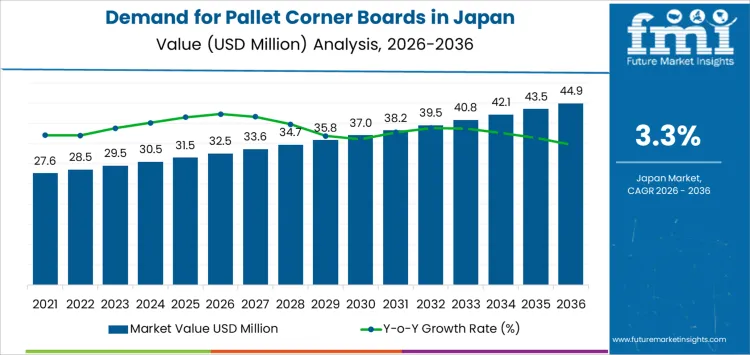
The demand for pallet corner boards in Japan is valued at USD 32.5 million in 2026 and is projected to reach USD 44.9 million by 2036, reflecting a CAGR of 3.3%. The progression from 2020 to 2026 shows an increase from USD 26.7 million to USD 32.5 million, supported by steady palletized shipping across manufacturing, food processing, and retail distribution. Early demand is shaped by routine packaging reinforcement rather than structural changes in freight patterns. Corrugated and composite formats see consistent placement where load stability and edge protection remain continuous requirements. Procurement decisions during this phase follow regular warehouse replenishment cycles and packaging standard updates. Growth reflects gradual improvements in shipping volume and regulated stacking practices within Japanese logistics networks, with no significant volatility across the observed range.
From 2027 onward, values rise from USD 33.6 million to USD 38.2 million by 2031, then progress to USD 44.9 million by 2036 through steady annual additions. Logistics operators increase usage as pallet loads diversify with mixed product shipments requiring stable edge support. Industrial and food distribution facilities maintain predictable intake patterns tied to internal handling guidelines. Replacement demand becomes more prominent as boards reach wear thresholds after repeated load cycles. Commercial warehousing expands moderate use of heavier grade boards for export shipments. After 2030, growth reflects incremental increases in packaging density rather than rapid expansion in pallet counts. Annual value changes remain narrow, indicating low volatility. The long range pattern shows measured accumulation shaped by routine supply chain operations, warehouse handling norms, and stable domestic freight movement across Japan.
Quick Stats of the Demand for Pallet Corner Boards in Japan:
- Demand for Pallet Corner Boards in Japan Value (2026): USD 32.5 million
- Demand for Pallet Corner Boards in Japan Forecast Value (2036): USD 44.9 million
- Demand for Pallet Corner Boards in Japan Forecast CAGR (2026-2036): 3.3%
- Demand for Pallet Corner Boards in Japan Leading Material Type: Paper (78%)
- Demand for Pallet Corner Boards in Japan Key Growth Regions: Kyushu & Okinawa, Kanto, Kansai
- Demand for Pallet Corner Boards in Japan Top Players: Signode Industrial Group, Smurfit Kappa Group, Georgia-Pacific LLC, Sonoco Products Company, Cascades Inc.
What is the Growth Forecast for Pallet Corner Boards in Japan through 2036?
Between 2026 and 2031, demand for pallet corner boards in Japan increases from USD 32.5 million to USD 37.0 million, reflecting an absolute expansion of USD 4.5 million across five years. Average annual value addition stays close to USD 0.9 million in this period. Growth is shaped by stable output across consumer goods, food distribution, and e commerce logistics networks. Earlier demand was driven by basic pallet load protection. Near term expansion reflects higher shipment consolidation, wider use of corrugated protection formats, and consistent procurement from manufacturing plants standardizing outbound packaging.
From 2031 to 2036, demand rises from USD 37.0 million to USD 44.9 million, adding USD 7.9 million during the latter five year phase. Yearly value creation moves closer to USD 1.6 million, indicating a clear acceleration relative to the earlier period. Growth is supported by increasing pallet circulation in automated warehouses, tighter transport damage standards, and rising export shipments requiring reinforced corner protection. Earlier growth relied on operational pallet usage, while later expansion reflects structured packaging optimization programs, higher adoption across third party logistics providers, and broader integration of protective packaging components within automated storage and retrieval operations.
Pallet Corner Boards Industry Key Takeaways
| Metric | Value |
|---|---|
| Industry Value (2026) | USD 32.5 million |
| Forecast Value (2036) | USD 44.9 million |
| Forecast CAGR (2026–2036) | 3.3% |
What Is Driving the Demand for Pallet Corner Boards in Japan from 2026 to 2036?
Demand for pallet corner boards in Japan grew alongside expansion of manufacturing, retail distribution, and e-commerce logistics. Usage increased as companies standardised palletised unit loads to reduce transit damage and comply with automated handling systems. Procurement emphasised board stiffness, dimensional accuracy, and moisture resistance for refrigerated supply chains. Domestic paperboard mills supplied engineered grades tailored to common pallet formats and transport practices. Retailers and exporters adopted corner protection to lower damage claims and improve stacking stability. Replacement cycles followed packaging refurbishment programs and seasonal shipping peaks. Historical growth reflected volume expansion, predictable warehouse workflows, and high standards for product presentation at retail. Cost optimisation and supply continuity shaped purchasing decisions more than advanced material innovation during that phase and durability.
Demand from 2026 to 2036 is likely to shift toward engineered, recyclable fibre solutions and automation compatibility. Buyers prioritise higher bending strength, consistent edges, and moisture treated surfaces for mixed temperature logistics. E commerce growth and multi channel fulfilment increase mixed pallet configurations, raising need for adaptable corner protection. Sustainability targets and corporate circularity plans push procurement toward recyclable, lower weight board grades that retain performance. Integration with automated packaging lines and robotic palletising influences design tolerances and application speed. Buyers evaluate total landed cost, damage reduction, and end of life recyclability when selecting suppliers. Larger distribution centres standardise corner board specifications to improve throughput and reduce manual handling. Demand depends on supply chain resilience, regulatory pressure, and logistics modernisation.
What Is the Demand for Pallet Corner Boards in Japan by Material Type and Thickness for 2026 to 2036?
The demand for pallet corner boards in Japan from 2026 to 2036 is shaped by export oriented manufacturing, logistics standardization, and protective packaging requirements across consumer goods and industrial shipments. Paper based boards lead by material type due to cost efficiency, recyclability, and compatibility with standard pallet loads. Thickness preferences concentrate around moderate ranges where load stability and edge reinforcement must balance weight and material usage. Procurement is driven by logistics operators, manufacturing plants, and packaging converters. Import reliance remains present for specialty kraft liners. Substitution pressure exists from molded fiber and engineered plastic edges. Demand stability is supported by continued e commerce distribution and export packaging compliance.
Why do paper based boards account for 78% of the demand for pallet corner boards in Japan by material type?
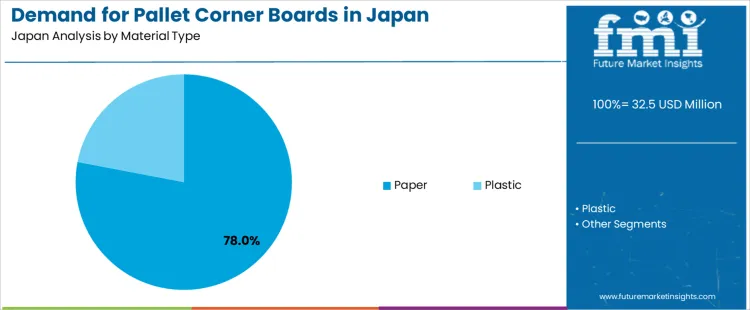
Paper based boards account for 78% of the demand for pallet corner boards in Japan by material type, reflecting high acceptance in export packaging and domestic distribution. Consumption intensity is driven by electronics, food processing, chemical drums, and consumer goods shipments that require compression resistance without material heaviness. Usage remains stable because paper boards provide predictable protection under strapping and film wrapping. Procurement is led by packaging suppliers and industrial converters. Price sensitivity remains moderate as buyers evaluate board strength relative to freight cost. Specification control emphasizes kraft liner quality, moisture resistance, stacking durability, and scoring precision for accurate fitment on pallet edges.
Paper corner boards also generate steady repeat demand through continuous pallet rotation and large scale shipment cycles between 2026 and 2036. Repeat utilization remains predictable across manufacturing hubs and regional distribution centers. Buyers favor standardized board lengths to fit pallet dimensions and automated wrapping systems. Margin structure remains controlled under high competition among domestic paperboard manufacturers. Regulatory exposure centers on recycling compliance and packaging waste reduction initiatives. Import reliance persists for high strength fiber inputs. Substitution pressure from plastic corner guards remains limited to heavy industrial loads requiring higher rigidity.
Why does the 3 to 5 inch thickness range represent 38.0% of the demand for pallet corner boards in Japan by thickness?
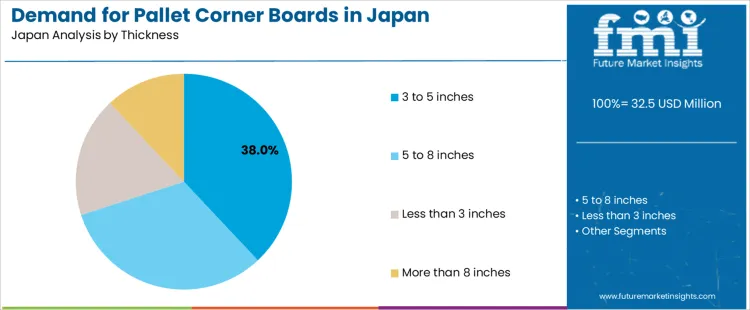
The 3 to 5 inch thickness range represents 38.0% of the demand for pallet corner boards in Japan by thickness, reflecting optimal reinforcement performance for mixed weight pallet loads. Consumption intensity is driven by shipments requiring moderate load containment where edge crush strength must withstand vertical stacking and transport vibration. Usage remains stable because this range supports both stretch wrapped retail pallets and bulk industrial shipments. Procurement is dominated by packaging plants and logistics operators standardizing corner board dimensions. Price sensitivity remains moderate because thickness directly influences material weight and freight cost. Specification control emphasizes cross sectional strength, dimensional uniformity, and compatibility with automated strapping systems.
This thickness category also generates consistent repeat demand through stable palletization patterns between 2026 and 2036. Repeat utilization remains predictable as manufacturing output and export activity continue across automotive components, electronics, and consumer packaged goods. Buyers favor boards that maintain rigidity without over reinforcing pallets. Margin structure remains controlled under capacity driven pricing from paper converters. Regulatory exposure centers on packaging waste minimization and material traceability. Import reliance persists for kraft paper grades used in heavy duty reinforcement. Substitution pressure from thinner boards remains limited where load stability must be assured through standardized pallet protection.
What Is Driving the Demand for Pallet Corner Boards in Japan Load Protection Needs in Dense Logistics Networks?
Demand for pallet corner boards in Japan rises through concentrated distribution activity, strict load presentation standards, and the shift toward mixed SKU shipments across urban warehouses. Retailers expect cartons to arrive without corner compression after frequent handling through conveyor clusters and narrow loading bays. Food and beverage manufacturers rely on corner boards to stabilize tall pallet stacks during summer humidity, when carton strength declines. Exporters use edge protection to meet overseas retailer specifications tied to impact tolerance. Demand aligns with damage avoidance practices, warehouse operating density, and compliance with packaging guidelines across regional logistics nodes rather than broad global packaging trends.
How Are Convenience Store Supply Chains and Urban DCs Shaping Corner Board Use in Japan?
Convenience store supply chains in Japan operate daily replenishment cycles with compact trucks and multiple transshipment stops. Pallet loads endure repeated rehandling at depots where cartons face edge abrasion and shifting during rapid restacking. Corner boards support upright stability for beverages, dairy, and seasonal boxed goods routed through mixed temperature zones. Urban DCs integrate automated shuttles and narrow aisle racking that require cleaner pallet geometry for predictable machine interaction. Operators value pre-cut, color-coded boards for quick identification. Demand reflects repetitive handling intensity and space-efficient logistics design rather than heavy export packaging practices within Japan’s short-cycle retail distribution framework.
Why Is the Push for Carton Downgauging Increasing Reliance on Corner Boards in Japan?
Japanese manufacturers continue reducing secondary packaging weight to manage material cost, storage limits, and environmental expectations. Thinner cartons compromise vertical compression strength, especially during humid months when fiberboard softens. Corner boards compensate for reduced rigidity by providing load bearing edges that sustain stacking pressure inside crowded warehouses. Beverage, confectionery, and household product producers view corner boards as insurance against deformation during seasonal promotions requiring high pallet density. This shift toward lighter packaging deepens reliance on edge reinforcement rather than reversing the trend. Demand follows structural packaging change, humidity sensitivity, and retailer rejection cost avoidance across domestic production and distribution networks.
What Factors Constrain Broader Adoption of Pallet Corner Boards Across Japan?
Adoption of pallet corner boards in Japan faces limits tied to storage space, material disposal, and cost discipline within fast moving goods sectors. Warehouses with compact back rooms resist storing bulky protective components. Recycling streams require clear separation of laminated corner boards, which increases staff burden. Some manufacturers avoid added components for shipments that undergo minimal handling or short intra-prefecture travel. Procurement teams weigh per-pallet cost against historical damage rates, leading to selective deployment only on high-risk loads. These practical constraints hold usage below full potential and concentrate demand within operators facing known edge vulnerability and high rejection penalties.
What is the Demand for Pallet Corner Boards in Japan by Region?
| Region | CAGR (%) |
|---|---|
| Kyushu & Okinawa | 4.1% |
| Kanto | 3.8% |
| Kansai | 3.3% |
| Chubu | 2.9% |
| Tohoku | 2.6% |
| Rest of Japan | 2.4% |
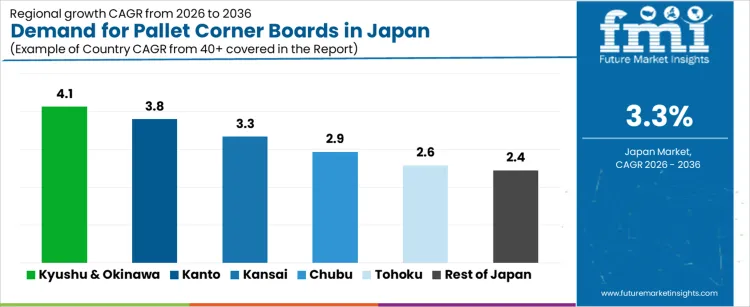
The demand for pallet corner boards in Japan is rising steadily across logistics, warehousing, and packaging operations, led by Kyushu and Okinawa at a 4.1% CAGR. Growth in this region is supported by strong trade flows, expanding third party logistics hubs, and higher use of protective packaging in export oriented industries. Kanto follows at 3.8%, driven by dense distribution networks, e commerce fulfillment centers, and consistent demand from consumer goods and electronics shipments. Kansai records 3.3% growth, reflecting stable consumption among manufacturers and regional logistics operators. Chubu at 2.9% shows moderate uptake linked to automotive, machinery, and industrial shipments requiring reinforced palletization. Tohoku and the Rest of Japan, at 2.6% and 2.4%, reflect slower growth shaped by lower freight volumes, smaller warehousing footprints, and more conservative packaging upgrades among regional shippers.
How Is Steady Manufacturing Activity Influencing Pallet Corner Board Demand in Kyushu and Okinawa?
Demand for pallet corner boards in Kyushu and Okinawa is rising at a CAGR of 4.1% from 2026 to 2036, supported by distribution centers, food packaging units, and localized logistics operations. The region applies corner boards for pallet load stability, edge reinforcement, and transport protection. Growth reflects stable output in packaged goods, rising palletized shipments within island logistics networks, and steady replacement of damaged protective materials across warehouses. Product use remains consistent across small and medium scale storage facilities.
- Packaged goods units use corner boards for load stability
- Warehouses apply protective boards for pallet reinforcement
- Local logistics flows support consistent demand
- Replacement cycles sustain ongoing product use
What Factors Support Controlled Pallet Corner Board Adoption in Kanto?
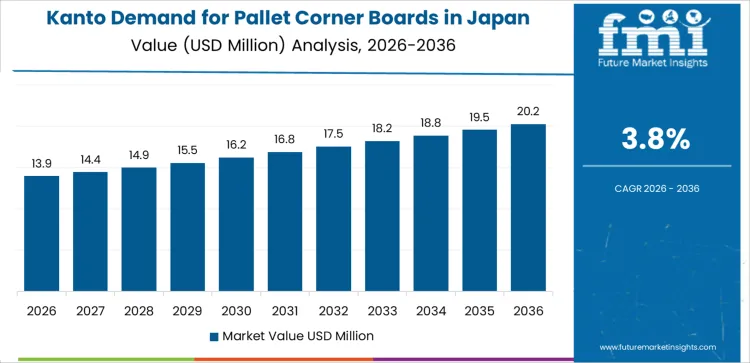
Demand for pallet corner boards in Kanto is advancing at a CAGR of 3.8% from 2026 to 2036, guided by large warehouse clusters, e commerce distribution sites, and consumer goods storage networks. Facilities apply corner boards to maintain pallet integrity during high frequency handling. Growth reflects continuous parcel volume movement, shelf ready packaging requirements, and structured inventory protection. Industrial users maintain systematic stocking of edge protection materials in routine packaging cycles.
- E commerce hubs rely on pallet edge protection
- Consumer goods storage uses corner boards for load safety
- High frequency handling supports steady consumption
- Warehousing clusters maintain planned material stocking
How Are Manufacturing Hubs Sustaining Corner Board Use in Kansai?
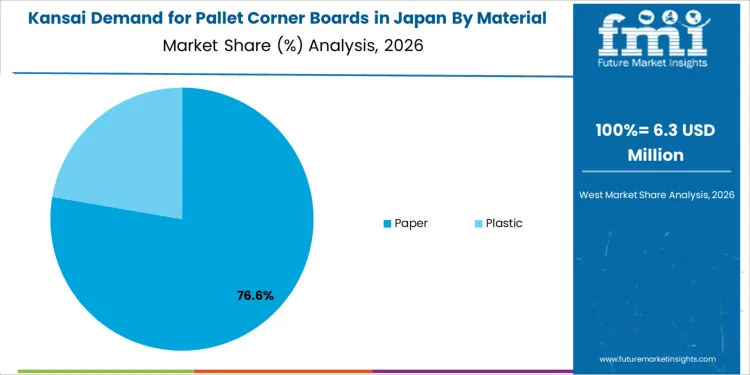
Demand for pallet corner boards in Kansai is moving at a CAGR of 3.3% from 2026 to 2036, supported by machinery production sites, beverage facilities, and mixed material warehouses. Corner boards support safe stacking, load uniformity, and compression resistance during transport. Growth aligns with moderate manufacturing output and continuous updates to pallet handling practices. Regional facilities rely on consistent stocks of protective materials to manage shifting product mixes and varied pallet configurations.
- Beverage facilities use corner boards for unit load protection
- Machinery plants rely on reinforced pallet packaging
- Mixed warehouses support diverse pallet requirements
- Ongoing handling adjustments guide product use
Why Is Gradual Industrial Activity Shaping Corner Board Demand in Chubu?
Demand for pallet corner boards in Chubu is increasing at a CAGR of 2.9% from 2026 to 2036, supported by automotive plants, precision component units, and general manufacturing warehouses. Corner boards help protect sensitive parts and maintain pallet alignment during shipment. Growth remains gradual due to measured output expansion and selective use across production lines. Warehouses continue to adopt corner boards where load stabilization enhances shipment reliability.
- Automotive plants use corner boards for part protection
- Component storage relies on pallet reinforcement
- Selective adoption supports controlled demand
- Shipment reliability drives targeted use
How Are Regional Logistics Networks Influencing Corner Board Use in Tohoku?
Demand for pallet corner boards in Tohoku is moving at a CAGR of 2.6% from 2026 to 2036, guided by agricultural shipments, food processing units, and regional distribution hubs. Corner boards support load consistency across cold storage and bulk handling environments. Growth aligns with steady cargo movement and moderate warehouse expansion. Local facilities apply corner boards in seasonal packaging cycles and routine pallet protection needs.
- Agricultural shipments use corner boards for load alignment
- Cold storage units rely on pallet protection
- Regional hubs maintain steady stocking cycles
- Seasonal packaging drives periodic demand
What Is Sustaining Pallet Corner Board Demand in Rest of Japan?
Demand for pallet corner boards in Rest of Japan is progressing at a CAGR of 2.4% from 2026 to 2036, supported by small warehouses, community level distribution sites, and local retail supply chains. Corner boards remain part of basic pallet protection practices. Growth reflects steady replacement needs, varied packaging requirements, and consistent handling of mixed shipment loads. Adoption remains practical across facilities with moderate throughput levels.
- Small warehouses rely on simple pallet reinforcement
- Retail supply chains apply protective corner boards
- Mixed load handling maintains steady consumption
- Routine replacement cycles support continued demand
What Is Driving the Demand for Pallet Corner Boards in Japan and Which Companies Shape Packaging Supply?
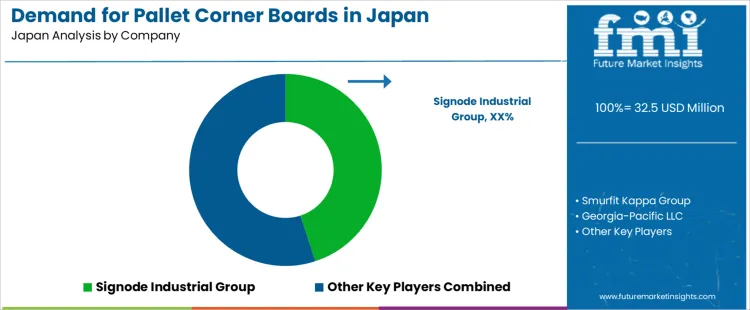
The demand for pallet corner boards in Japan is shaped by growth in e commerce fulfillment, strict load stability requirements in automated warehouses, and rising export shipments across electronics, machinery, and food products. Rengo and Oji Holdings hold central domestic roles through paper based protective packaging integrated into national logistics networks. Signode Industrial Group supports demand through high strength corner boards paired with strapping systems used in heavy goods, appliances, and industrial equipment shipments. Smurfit Kappa Group participates through imported fiber based protection supplied to export oriented manufacturers. Georgia Pacific LLC contributes through kraft based corner protection used in selected consumer goods and building materials. Cascades Inc. reaches Japan through distributors serving specialty packaging needs in food and health product sectors. Domestic converters align with these suppliers through localized cutting, scoring, and fast turnaround replenishment.
System selection in Japan is governed by compression strength under stacking, moisture tolerance in humid warehouses, printability for handling labels, and compatibility with automated palletizing lines. Buyer preference favors corner boards with consistent fiber density, clean edges for robotic placement, and reliable performance during long container transit. Usage extends from palletized beverages and electronics to machinery parts and temperature sensitive goods shipped through cold chains. Procurement cycles align with peak seasons in retail and export. Demand visibility tracks expansion of automated fulfillment centers, growth in third party logistics providers, rising export of precision machinery, and continued adoption of fiber based protection as an alternative to molded plastic edge guards across industrial regions.
Key Players in the Pallet Corner Boards Industry in Japan
- Signode Industrial Group
- Smurfit Kappa Group
- Georgia-Pacific LLC
- Sonoco Products Company
- Cascades Inc.
Scope of the Report
| Items | Values |
|---|---|
| Quantitative Units (2026) | USD 32.5 million |
| Material Type | Paper Based Boards, Plastic Boards |
| Thickness | Less than 3 inches, 3 to 5 inches, 5 to 8 inches, More than 8 inches |
| End Use | Shipping and Logistics, Building and Construction, Automotive, Electronics and Electrical, Others including Agriculture and Chemical |
| Regions Covered | Kyushu and Okinawa, Kanto, Kansai, Chubu, Tohoku, Rest of Japan |
| Countries Covered | Japan |
| Key Companies Profiled | Signode Industrial Group, Smurfit Kappa Group, Georgia Pacific LLC, Sonoco Products Company, Cascades Inc. |
| Additional Attributes | Dollar sales by material type, thickness, and end use; replacement versus new pallet cycle demand; usage intensity in automated warehouses and export shipments; fiber grade requirements for stacking durability and moisture resistance; board selection influenced by SKU mixing, carton downgauging, and pallet stability norms; integration with stretch |
Pallet Corner Boards Industry in Japan Segmentation
Material Type:
- Paper
- Plastic
Thickness:
- 3 to 5 inches
- 5 to 8 inches
- Less than 3 inches
- More than 8 inches
End Use:
- Shipping and logistics
- Building & Construction
- Automotive
- Electronics & Electrical
- Others (Agriculture, Chemical, etc)
Region:
- Kyushu & Okinawa
- Kanto
- Kansai
- Chubu
- Tohoku
- Rest of Japan
Frequently Asked Questions
How big is the demand for pallet corner boards in Japan in 2026?
The demand for pallet corner boards in Japan is estimated to be valued at USD 32.5 million in 2026.
What will be the size of pallet corner boards in Japan in 2036?
The market size for the pallet corner boards in Japan is projected to reach USD 44.9 million by 2036.
How much will be the demand for pallet corner boards in Japan growth between 2026 and 2036?
The demand for pallet corner boards in Japan is expected to grow at a 3.3% CAGR between 2026 and 2036.
What are the key product types in the pallet corner boards in Japan?
The key product types in pallet corner boards in Japan are paper and plastic.
Which thickness segment is expected to contribute significant share in the pallet corner boards in Japan in 2026?
In terms of thickness, 3 to 5 inches segment is expected to command 38.0% share in the pallet corner boards in Japan in 2026.
Preview the report firsthand - request a free sample
Get SampleGet the brochure for pricing and purchase details.
Get PDFTable of Content
- Executive Summary
- Japan Market Outlook
- Demand-side Trends
- Supply-side Trends
- Technology Roadmap Analysis
- Analysis and Recommendations
- Market Overview
- Market Coverage / Taxonomy
- Market Definition / Scope / Limitations
- Market Background
- Market Dynamics
- Drivers
- Restraints
- Opportunity
- Trends
- Scenario Forecast
- Demand in Optimistic Scenario
- Demand in Likely Scenario
- Demand in Conservative Scenario
- Opportunity Map Analysis
- Product Life Cycle Analysis
- Supply Chain Analysis
- Investment Feasibility Matrix
- Value Chain Analysis
- PESTLE and Porter’s Analysis
- Regulatory Landscape
- Regional Parent Market Outlook
- Production and Consumption Statistics
- Import and Export Statistics
- Market Dynamics
- Japan Market Analysis 2020 to 2024 and Forecast, 2025 to 2035
- Historical Market Size Value (USD Million) Analysis, 2020 to 2024
- Current and Future Market Size Value (USD Million) Projections, 2025 to 2035
- Y-o-Y Growth Trend Analysis
- Absolute $ Opportunity Analysis
- Japan Market Pricing Analysis 2020 to 2024 and Forecast 2025 to 2035
- Japan Market Analysis 2020 to 2024 and Forecast 2025 to 2035, By Material Type
- Introduction / Key Findings
- Historical Market Size Value (USD Million) Analysis By Material Type , 2020 to 2024
- Current and Future Market Size Value (USD Million) Analysis and Forecast By Material Type , 2025 to 2035
- Paper
- Plastic
- Y-o-Y Growth Trend Analysis By Material Type , 2020 to 2024
- Absolute $ Opportunity Analysis By Material Type , 2025 to 2035
- Japan Market Analysis 2020 to 2024 and Forecast 2025 to 2035, By Thickness
- Introduction / Key Findings
- Historical Market Size Value (USD Million) Analysis By Thickness, 2020 to 2024
- Current and Future Market Size Value (USD Million) Analysis and Forecast By Thickness, 2025 to 2035
- 3 to 5 inches
- 5 to 8 inches
- Less than 3 inches
- More than 8 inches
- Y-o-Y Growth Trend Analysis By Thickness, 2020 to 2024
- Absolute $ Opportunity Analysis By Thickness, 2025 to 2035
- Japan Market Analysis 2020 to 2024 and Forecast 2025 to 2035, By End Use
- Introduction / Key Findings
- Historical Market Size Value (USD Million) Analysis By End Use, 2020 to 2024
- Current and Future Market Size Value (USD Million) Analysis and Forecast By End Use, 2025 to 2035
- Shipping and logistics
- Building & Construction
- Automotive
- Electronics & Electrical
- Others (Agriculture, Chemical, etc)
- Y-o-Y Growth Trend Analysis By End Use, 2020 to 2024
- Absolute $ Opportunity Analysis By End Use, 2025 to 2035
- Market Structure Analysis
- Competition Dashboard
- Competition Benchmarking
- Market Share Analysis of Top Players
- By Regional
- By Material Type
- By Thickness
- By End Use
- Competition Analysis
- Competition Deep Dive
- Signode Industrial Group
- Overview
- Product Portfolio
- Profitability by Market Segments (Product/Age /Sales Channel/Region)
- Sales Footprint
- Strategy Overview
- Marketing Strategy
- Product Strategy
- Channel Strategy
- Smurfit Kappa Group
- Georgia-Pacific LLC
- Sonoco Products Company
- Cascades Inc.
- Signode Industrial Group
- Competition Deep Dive
- Assumptions & Acronyms Used
- Research Methodology


