

- Industry Size (2025)
- USD 513.3 Mn
- Forecast (2035)
- USD 785.7 Mn
- CAGR (2025 to 2035)
- 4.4%
Demand for Pallet Racking in Japan Forecast and Outlook 2025 to 2035
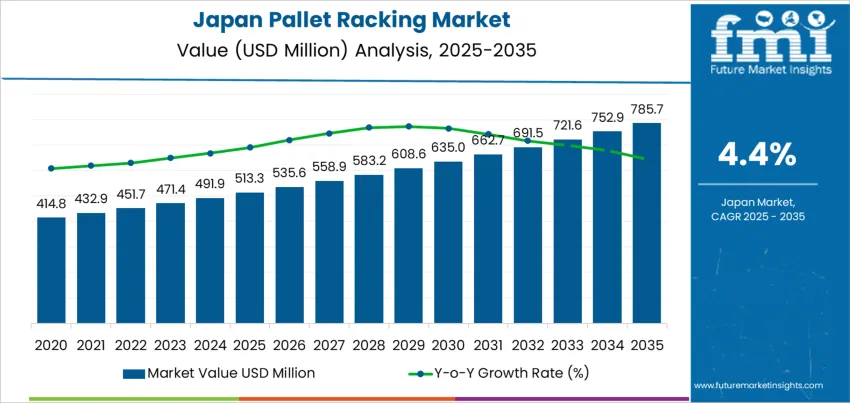
Demand for pallet racking in Japan is valued at USD 513.3 million in 2025 and is projected to reach USD 785.7 million by 2035 at a CAGR of 4.4%. Early growth is driven by continued expansion of distribution centers serving retail chains, third-party logistics providers, and cold storage operators. Urban land constraints push warehouses toward higher vertical storage density, which supports steady installation of selective and drive-in racking systems.
Food, beverage, and consumer goods account for a large share of new rack deployment as inventory turnover rates remain high. Automotive parts logistics and electronics distribution also contribute stable demand through standardized unit load handling. Procurement in this phase is closely tied to new warehouse completions and retrofit projects across the Kanto and Kansai regions.
Quick Stats of the Demand for Pallet Racking in Japan
- Demand for Pallet Racking in Japan Value (2025): USD 513.3 million
- Demand for Pallet Racking in Japan Forecast Value (2035): USD 785.7 million
- Demand for Pallet Racking in Japan Forecast CAGR (2025 to 2035): 4.4%
- Demand for Pallet Racking in Japan Leading System Type: Conventional (35%)
- Demand for Pallet Racking in Japan Key Growth Regions: Kyushu & Okinawa, Kanto, Kansai, Chubu, Tohoku, Rest of Japan
- Demand for Pallet Racking in Japan Top Players: Gonvarri Material Handling, Hannibal Industries, Mecalux, Daifuku Co. Ltd., Unarco Material Handling
What is the Demand Forecast for Pallet Racking in Japan through 2035?
After 2030, market growth in Japan shifts toward system upgrades and automation compatibility rather than footprint expansion alone. Demand rises from about USD 635.0 million in 2030 toward USD 785.7 million by 2035 as warehouses adapt racking layouts to support automated guided vehicles, shuttle systems, and robotic picking. High-bay racking and narrow aisle systems gain share in response to labor constraints and rising storage efficiency targets.
E-commerce fulfillment adds incremental value through multi-tier storage designs and frequent reconfiguration needs. Supplier competition focuses on seismic resistance, load bearing certification, and modular design flexibility. Long-term growth is shaped by warehouse modernization programs, rising SKU diversity, and tighter inventory control requirements across Japan logistics networks.
Pallet racking demand in Japan is anchored in warehouse throughput, urban logistics density, and inventory turnover efficiency rather than in discretionary industrial spending. Demand increases from USD 513.3 million in 2025 to USD 535.6 million by 2026 and USD 558.9 million by 2027, reaching USD 608.6 million by 2030 and adding USD 95.3 million from the 2025 base. This phase reflects steady expansion across e-commerce fulfillment centers, cold storage facilities, and third-party logistics hubs where vertical space optimization is critical. Growth is supported by rising demand for high-bay storage, narrow aisle systems, and faster order-picking configurations driven by same-day delivery models and urban micro-warehousing.
From 2030 to 2035, the market expands from USD 608.6 million to USD 785.7 million, adding USD 177.1 million in the second half of the decade. This back weighted acceleration reflects deeper penetration of automated storage and retrieval systems, shuttle racking, and seismic-resistant warehouse structures. Higher load capacities, intelligent rack monitoring, and robotic integration raise value per installation. As Japan continues to modernize its supply chain infrastructure to manage labor shortages and rising distribution complexity, pallet racking shifts from basic storage hardware to a core structural layer of automated logistics ecosystems, sustaining long-term demand growth through 2035.
Pallet Racking Industry in Japan Key Takeaways
| Metric | Value |
|---|---|
| Industry Value (2025) | USD 513.3 million |
| Forecast Value (2035) | USD 785.7 million |
| Forecast CAGR (2025 to 2035) | 4.4% |
What Is Driving the Demand for Pallet Racking in Japan?
The demand for pallet racking in Japan has grown from structural changes in warehousing, distribution efficiency, and retail logistics. Expansion of e commerce, convenience retail networks, and regional distribution hubs increased pressure on operators to store more inventory within limited warehouse footprints. Traditional floor stacking restricted inventory access speed and reduced usable vertical space.
Pallet racking systems allowed warehouses to improve storage density, standardize inventory handling, and reduce manual handling time. Demand was reinforced by growth in temperature controlled logistics for food, beverages, and pharmaceuticals where orderly storage and fast rotation are essential. Japans high land cost and limited warehouse availability also pushed operators to invest in vertical storage solutions rather than expand physical facilities.
Future demand for pallet racking in Japan will be shaped by automation, labor availability, and modernization of aging warehouse infrastructure. As logistics firms adopt automated picking systems, robotics, and guided vehicles, demand will shift toward precision engineered racking compatible with automated movement and higher load accuracy. Labor shortages in logistics will increase reliance on well-structured storage layouts that reduce handling time and training burden. Barriers include seismic compliance cost, rising steel prices, and retrofitting challenges in older warehouse structures. Smaller operators may delay upgrades due to capital constraints. Market expansion will depend on how effectively racking systems integrate with automation while meeting safety, cost control, and space optimization requirements.
How Are System Type and Load Capacity Structuring the Demand for Pallet Racking in Japan?
The demand for pallet racking in Japan is structured by racking system type and load capacity class. Conventional pallet racking accounts for 35% of total demand, followed by mobile systems and shuttle racking and hybrid racking solutions used in high density storage applications. By load capacity, racks rated up to 5 ton represent 40.0% of total installations, followed by 5 to 15 ton and above 15 ton heavy duty systems. Demand behavior is shaped by warehouse space constraints, inventory turnover speed, automation compatibility, seismic safety requirements, and handling equipment specifications. These segments reflect how storage efficiency targets and material handling profiles influence pallet racking selection across logistics, manufacturing, cold storage, and distribution facilities in Japan.
Why Does Conventional Pallet Racking Lead System Type Demand in Japan?
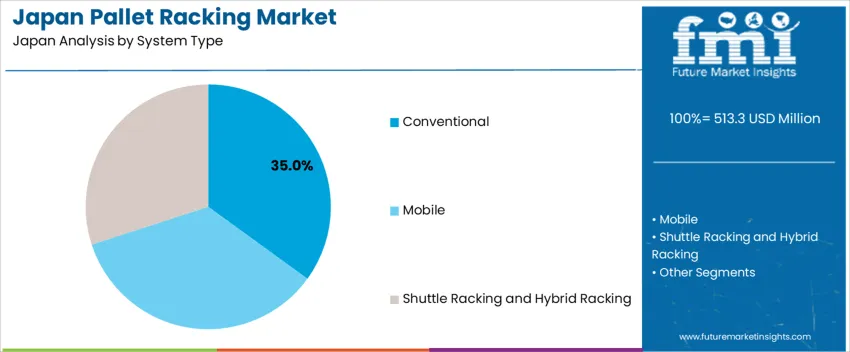
Conventional pallet racking accounts for 35% of total pallet racking demand in Japan due to its structural simplicity, low installation cost, and broad usability across warehouse formats. These systems provide direct access to every pallet location, which supports fast picking, inventory rotation, and daily order fulfillment in distribution centers. Small and mid sized warehouses rely on conventional racking to balance storage density with operational flexibility. The open aisle layout allows easy integration with standard forklifts, reach trucks, and pallet stackers without the need for specialized automation.
Conventional racking also supports phased expansion and reconfiguration without major structural modification. This flexibility is valuable in Japan where warehouse footprints are often constrained and inventory profiles change frequently. Maintenance requirements remain low compared with mobile or shuttle systems. These installation simplicity, handling compatibility, and cost control advantages sustain conventional racking as the leading system type in the Japan pallet racking demand structure.
Why Does the Up to 5 Ton Load Capacity Segment Dominate Pallet Racking Demand in Japan?
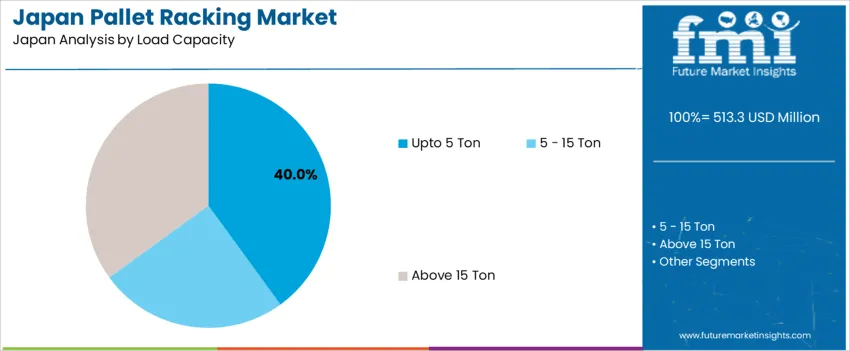
The up to 5-ton load capacity segment accounts for 40.0% of total pallet racking demand in Japan due to its alignment with standard palletized goods used across retail distribution, food storage, pharmaceuticals, and consumer goods logistics. Most palletized loads in Japan fall within this weight range due to regulatory transport limits, manual handling considerations, and compatibility with common forklift capacities. This segment supports fast moving consumer goods, packaged food, beverages, and electronics where unit weights remain relatively uniform.
Warehouses favor up to 5 ton racking to maximize vertical storage without requiring reinforced floor structures or heavy duty lifting equipment. Energy efficient material handling systems and narrow aisle formats also operate more effectively within this load range. These safety compatibility, equipment standardization, and volume throughput factors position the up to 5 ton load capacity class as the dominant segment in the Japan pallet racking demand landscape.
Why Is Pallet Racking in Japan Treated as a Space-Engineering System Rather Than Basic Warehouse Infrastructure?
Demand for pallet racking in Japan is shaped by extreme land scarcity and vertical storage pressure rather than by simple inventory growth. Warehouses are forced to maximize cubic efficiency within tight footprints near ports, urban distribution centers, and industrial zones. Ceiling height utilization, seismic load distribution, and forklift maneuver clearance drive racking design decisions. Storage density is not optional but structurally necessary. This turns pallet racking into a core spatial engineering system that determines how much commercial value can be extracted from each square meter of warehouse real estate.
How Do E-Commerce Fulfillment, Cold Chain Logistics, and Import Dependency Shape Demand?
Japan import-heavy supply structure pushes large volumes of consumer goods, food, and industrial components into centralized distribution hubs. E-commerce fulfillment requires fast SKU picking layered on top of palletized bulk storage. Cold storage expansion for frozen food, seafood, and pharmaceuticals introduces demand for corrosion-resistant, low-temperature racking systems. Rapid order fragmentation increases the need for selective racking rather than high-density block stacking. These logistics behaviors create pallet racking demand that is driven by flow-through velocity and thermal specialization rather than only static storage needs.
What Seismic Standards, Retrofitting Costs, and Labor Constraints Limit System Upgrades?
Pallet racking demand in Japan is tightly constrained by national earthquake resilience standards. Racks must meet strict anchoring, bracing, and load-spread rules, which raises material and installation cost. Older warehouses face expensive retrofitting challenges when upgrading rack height or density. Skilled installation labor is limited, slowing project rollouts. Many operators hesitate to modify existing layouts due to business downtime risk. These seismic, cost, and labor factors restrict rapid racking replacement cycles even when warehouse automation needs evolve.
How Are Automated Storage, Narrow-Aisle Systems, and Robotics Redefining Future Demand?
Future pallet racking demand in Japan is shifting toward structures designed for robotic access, automated guided vehicles, and narrow-aisle reach trucks. High-rise racking integrated with shuttle systems allows dense storage with reduced human labor. Precision rail alignment and load uniformity become as important as steel strength. Mixed pallet and tote storage is increasing in omni-channel facilities. These shifts show pallet racking evolving into a structural component of automation architecture rather than remaining a passive steel storage frame.
What is the Demand for Pallet Racking in Japan by Region?
| Region | CAGR (%) |
|---|---|
| Kyushu & Okinawa | 5.4% |
| Kanto | 5.0% |
| Kansai | 4.4% |
| Chubu | 3.9% |
| Tohoku | 3.4% |
| Rest of Japan | 3.2% |
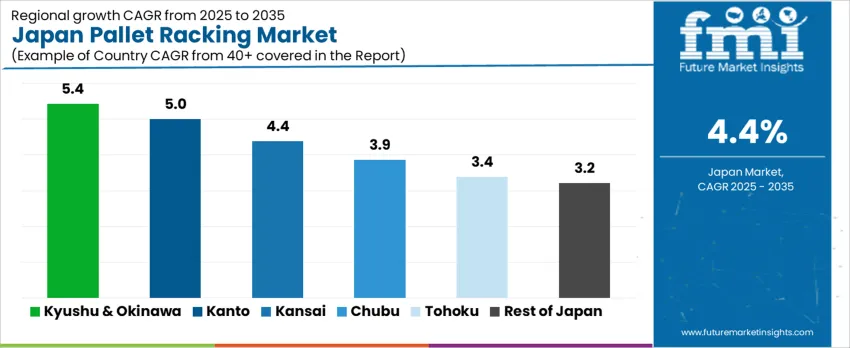
The demand for pallet racking in Japan is expanding steadily across all regions, with Kyushu & Okinawa leading at a 5.4% CAGR. Growth in this region is supported by rising warehouse construction, increasing cold storage capacity, and expansion of regional logistics hubs serving food and agricultural distribution. Kanto follows at 5.0%, driven by dense concentration of distribution centers, third party logistics providers, and large scale e commerce fulfillment operations. Kansai records 4.4% growth, supported by steady industrial warehousing and port linked storage activity. Chubu at 3.9% reflects moderate uptake tied to automotive and manufacturing logistics. Tohoku and Rest of Japan, at 3.4% and 3.2%, show slower growth shaped by lower warehouse density and fewer large scale logistics developments.
How Is Warehouse Expansion Driving Pallet Racking Demand in Kyushu And Okinawa?
Logistics development in Kyushu and Okinawa is advancing at a CAGR of 5.4% through 2035 for pallet racking demand, supported by port led distribution growth, cold storage expansion, and rising regional fulfillment activity. Food logistics, beverage warehousing, and pharmaceutical storage rely on adjustable and drive in racking systems for space optimization. Export cargo handling strengthens heavy duty rack installation. Tourism related supply chains also contribute to secondary warehouse capacity growth. Demand remains infrastructure driven, with procurement linked to greenfield warehouse projects, distribution hub upgrades, and steady expansion of regional storage throughput.
- Port logistics supports heavy duty rack installation
- Cold storage drives multi level rack configuration demand
- Export handling adds high load bearing requirements
- Greenfield warehouses anchor new system procurement
What Is Sustaining Strong Pallet Racking Installation Across Kanto?
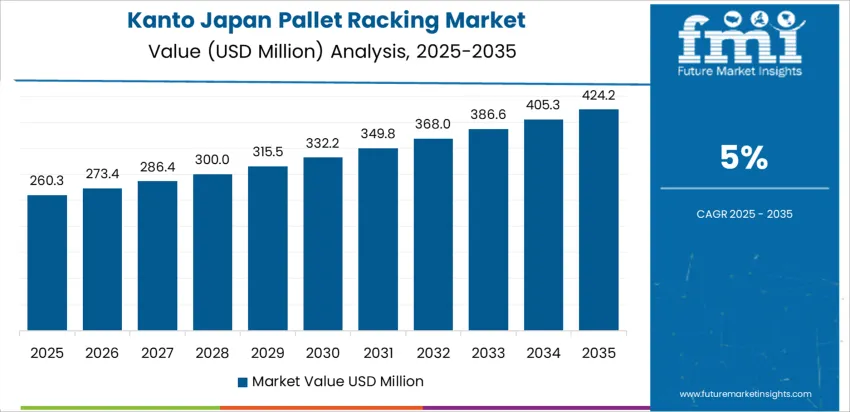
Urban distribution intensity in Kanto supports a CAGR of 5.0% through 2035 for pallet racking demand, driven by ecommerce fulfillment centers, third party logistics hubs, and retail distribution depots. High land costs push demand toward vertical storage density and automated rack integration. Selective and narrow aisle racking dominate large warehouse builds. High inventory turnover sustains frequent reconfiguration cycles. Demand remains scale driven and throughput focused, shaped by dense last mile logistics, regional stock pooling, and continuous optimization of warehouse cube utilization across metropolitan logistics clusters.
- Ecommerce fulfillment centers drive high density racking adoption
- Vertical storage optimizes limited warehouse footprints
- Narrow aisle systems support rapid order picking
- High turnover inventory drives frequent rack reconfiguration
Why Is Kansai Developing as a Balanced Pallet Racking Market?
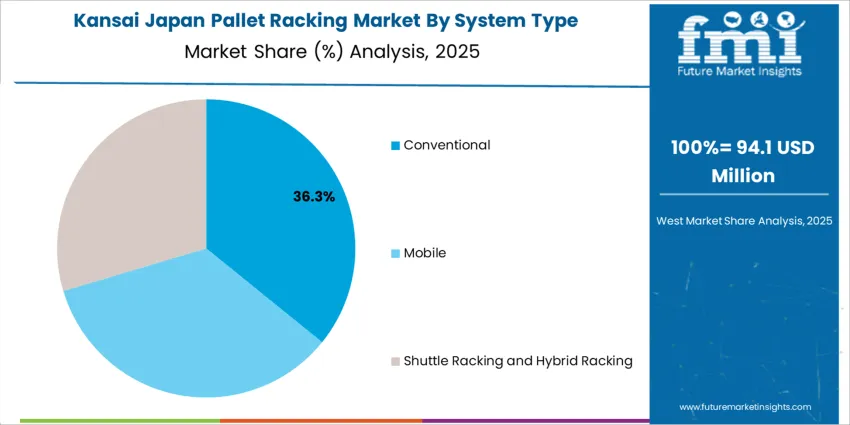
Regional logistics diversification in Kansai supports a CAGR of 4.4% through 2035 for pallet racking demand, shaped by food distribution centers, regional manufacturing storage, and wholesale trade hubs. Beverage, consumer goods, and spare parts warehouses rely on selective and double deep racking for medium volume throughput. Retrofit projects dominate over new greenfield builds. Local system integrators handle most installations. Demand remains replacement driven and capacity balanced, aligned with steady warehouse remodeling activity, controlled expansion of distribution floorspace, and consistent regional goods movement.
- Food and beverage distribution anchors core rack usage
- Retrofit projects dominate current installation activity
- Spare parts storage supports medium load racking demand
- Local integrators manage most system deployments
How Is Industrial Manufacturing Output Shaping Demand in Chubu?
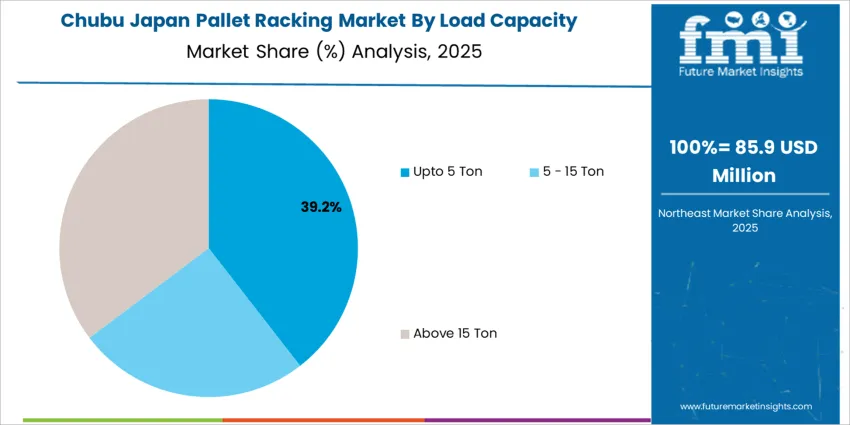
Manufacturing intensive activity in Chubu supports a CAGR of 3.9% through 2035 for pallet racking demand, driven by automotive parts warehousing, machinery storage, and industrial supply chain logistics. Tier one component suppliers rely on high load selective racking for stable inventory flow. Export oriented plants require organized pallet staging and buffer storage. Warehouse expansions remain incremental rather than large scale. Demand remains production aligned and contract driven, with procurement linked to predictable factory output, just in time inventory discipline, and steady industrial warehousing requirements.
- Automotive components dominate racking system utilization
- Export staging areas require structured pallet flow
- Just in time logistics shapes rack layout design
- Incremental warehouse expansion guides procurement pace
What Is Guiding Moderate Pallet Racking Growth in Tohoku?
Regional logistics recovery in Tohoku supports a CAGR of 3.4% through 2035 for pallet racking demand, shaped by agricultural distribution, frozen food storage, and cooperative warehouse systems. Grain, dairy, and seafood storage rely on basic selective racking for low to medium pallet loads. Limited ecommerce penetration moderates high density system adoption. Public warehouse facilities dominate installations. Demand remains necessity driven and locally anchored, with steady procurement linked to seasonal crop cycles, regional food security logistics, and gradual modernization of storage infrastructure.
- Agricultural produce storage anchors seasonal rack usage
- Cooperative warehouses sustain steady base demand
- Frozen food storage supports temperature stable rack designs
- Limited ecommerce moderates high density automation uptake
Why Does The Rest Of Japan Show Slower yet Stable Pallet Racking Expansion?
Community scale warehousing across the rest of Japan reflects a CAGR of 3.2% through 2035 for pallet racking demand, supported by municipal distribution centers, small manufacturing stores, and institutional supply depots. Storage needs focus on palletized food, maintenance supplies, and public inventory stock. Manual handling remains common. Capital investment stays cautious among small operators. Demand remains stable and function driven, guided by routine storage replacement cycles, essential inventory management, and basic warehouse safety compliance rather than large scale logistics automation projects.
- Municipal depots anchor routine pallet storage demand
- Manual handling limits high density rack deployment
- Small manufacturers rely on basic selective racking
- Safety compliance drives replacement driven procurement
What Is Driving the Demand for Pallet Racking in Japan and Who Are the Key Suppliers Shaping the Market?
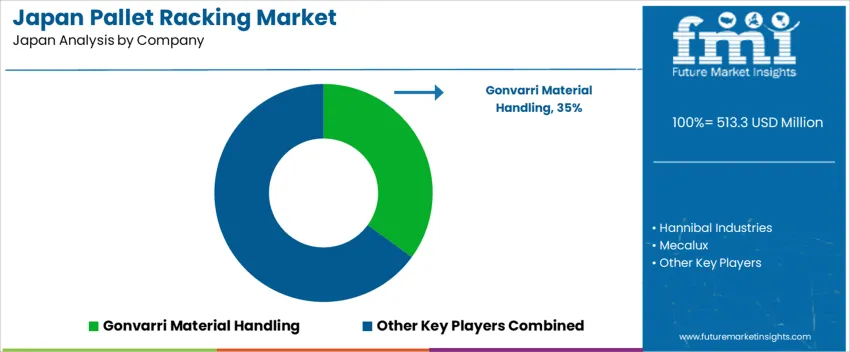
Demand for pallet racking in Japan is rising as e commerce, manufacturing, and third party logistics (3PL) firms expand warehouse capacity to meet growing distribution and fulfillment needs. Tight land availability and high real estate costs in urban areas make efficient vertical storage systems essential. Rising volumes of goods for retail, food, electronics, and industrial sectors require optimized storage density and rapid access. Warehouse automation, inventory turnover, and demand for faster shipments increase pressure on logistics operators to adopt high density, durable racking systems. As Japanese firms invest in automation and warehouse modernization, demand for pallet racks capable of supporting heavier loads, automated retrieval systems, and modular storage layouts grows.
Major suppliers influencing the pallet racking market in Japan include Gonvarri Material Handling, Hannibal Industries, Mecalux, Daifuku Co. Ltd., and Unarco Material Handling. These firms provide a range of racking solutions covering selective pallet racks, drive in racks, push back systems and heavy duty storage designed for dense warehouse environments. Mecalux and Gonvarri are known for modular, high capacity systems adapted for Europe and Japan.
Daifuku brings expertise in integrating racking with automation and logistics systems, appealing to warehouses aiming for smart operations. Hannibal and Unarco supply robust, cost efficient rack solutions for light to medium load applications. Together they support the modernization of warehousing infrastructure needed to meet rising demand in logistics, manufacturing, and retail distribution networks.
Key Players in Pallet Racking Industry in Japan
- Gonvarri Material Handling
- Hannibal Industries
- Mecalux
- Daifuku Co. Ltd.
- Unarco Material Handling
Scope of the Report
| Items | Values |
|---|---|
| Quantitative Units (2025) | USD million |
| System Type | Conventional, Mobile, Shuttle Racking and Hybrid Racking |
| Load Capacity | Up to 5 Ton, 5-15 Ton, Above 15 Ton |
| End Use Industry | Automotive, Food and Beverages, Retail, Manufacturing, Warehouse |
| Region | Kyushu & Okinawa, Kanto, Kinki, Chubu, Tohoku, Rest of Japan |
| Key Companies Profiled | Gonvarri Material Handling, Hannibal Industries, Mecalux, Daifuku Co. Ltd., Unarco Material Handling |
| Additional Attributes | Dollar by sales by system type, load capacity, and end-use industry. Includes selective vs drive-in system adoption, high-bay vs narrow aisle deployment, shuttle/hybrid racking share, integration with automated storage and retrieval systems (AS/RS), compatibility with AGVs and robotics, modular and seismic-resistant design, warehouse retrofit vs greenfield project distribution, e-commerce fulfillment penetration, cold storage adaptation, industrial logistics throughput influence, SKU density and multi-tier storage adoption, labor efficiency optimization, and long-term replacement cycles. Growth drivers include warehouse modernization, automation integration, and high inventory turnover requirements across logistics and manufacturing networks in Japan. |
Pallet Racking Industry in Japan Segmentation
System Type:
- Conventional
- Mobile
- Shuttle Racking and Hybrid Racking
Load Capacity:
- Up to 5 Ton
- 5 - 15 Ton
- Above 15 Ton
End Use Industry:
- Automotive
- Food and Beverages
- Retail
- Manufacturing
- Warehouse
Region
- Kyushu & Okinawa
- Kanto
- Kansai
- Chubu
- Tohoku
- Rest of Japan
Frequently Asked Questions
How big is the demand for pallet racking in Japan in 2025?
The demand for pallet racking in Japan is estimated to be valued at USD 513.3 million in 2025.
What will be the size of pallet racking in Japan in 2035?
The market size for the pallet racking in Japan is projected to reach USD 785.7 million by 2035.
How much will be the demand for pallet racking in Japan growth between 2025 and 2035?
The demand for pallet racking in Japan is expected to grow at a 4.4% CAGR between 2025 and 2035.
What are the key product types in the pallet racking in Japan?
The key product types in pallet racking in Japan are conventional, mobile and shuttle racking and hybrid racking.
Which load capacity segment is expected to contribute significant share in the pallet racking in Japan in 2025?
In terms of load capacity, upto 5 ton segment is expected to command 40.0% share in the pallet racking in Japan in 2025.
Preview the report firsthand - request a free sample
Get SampleGet the brochure for pricing and purchase details.
Get PDFTable of Content
- Executive Summary
- Japan Market Outlook
- Demand-side Trends
- Supply-side Trends
- Technology Roadmap Analysis
- Analysis and Recommendations
- Market Overview
- Market Coverage / Taxonomy
- Market Definition / Scope / Limitations
- Market Background
- Market Dynamics
- Drivers
- Restraints
- Opportunity
- Trends
- Scenario Forecast
- Demand in Optimistic Scenario
- Demand in Likely Scenario
- Demand in Conservative Scenario
- Opportunity Map Analysis
- Product Life Cycle Analysis
- Supply Chain Analysis
- Investment Feasibility Matrix
- Value Chain Analysis
- PESTLE and Porter’s Analysis
- Regulatory Landscape
- Regional Parent Market Outlook
- Production and Consumption Statistics
- Import and Export Statistics
- Market Dynamics
- Japan Market Analysis 2020 to 2024 and Forecast, 2025 to 2035
- Historical Market Size Value (USD Million) Analysis, 2020 to 2024
- Current and Future Market Size Value (USD Million) Projections, 2025 to 2035
- Y-o-Y Growth Trend Analysis
- Absolute $ Opportunity Analysis
- Japan Market Pricing Analysis 2020 to 2024 and Forecast 2025 to 2035
- Japan Market Analysis 2020 to 2024 and Forecast 2025 to 2035, By System Type
- Introduction / Key Findings
- Historical Market Size Value (USD Million) Analysis By System Type , 2020 to 2024
- Current and Future Market Size Value (USD Million) Analysis and Forecast By System Type , 2025 to 2035
- Conventional
- Mobile
- Shuttle Racking and Hybrid Racking
- Y-o-Y Growth Trend Analysis By System Type , 2020 to 2024
- Absolute $ Opportunity Analysis By System Type , 2025 to 2035
- Japan Market Analysis 2020 to 2024 and Forecast 2025 to 2035, By Load Capacity
- Introduction / Key Findings
- Historical Market Size Value (USD Million) Analysis By Load Capacity, 2020 to 2024
- Current and Future Market Size Value (USD Million) Analysis and Forecast By Load Capacity, 2025 to 2035
- Upto 5 Ton
- 5 - 15 Ton
- Above 15 Ton
- Y-o-Y Growth Trend Analysis By Load Capacity, 2020 to 2024
- Absolute $ Opportunity Analysis By Load Capacity, 2025 to 2035
- Japan Market Analysis 2020 to 2024 and Forecast 2025 to 2035, By End Use Industry
- Introduction / Key Findings
- Historical Market Size Value (USD Million) Analysis By End Use Industry, 2020 to 2024
- Current and Future Market Size Value (USD Million) Analysis and Forecast By End Use Industry, 2025 to 2035
- Automotive
- Food and Beverages
- Retail
- Manufacturing
- Warehouse
- Y-o-Y Growth Trend Analysis By End Use Industry, 2020 to 2024
- Absolute $ Opportunity Analysis By End Use Industry, 2025 to 2035
- Market Structure Analysis
- Competition Dashboard
- Competition Benchmarking
- Market Share Analysis of Top Players
- By Regional
- By System Type
- By Load Capacity
- By End Use Industry
- Competition Analysis
- Competition Deep Dive
- Gonvarri Material Handling
- Overview
- Product Portfolio
- Profitability by Market Segments (Product/Age /Sales Channel/Region)
- Sales Footprint
- Strategy Overview
- Marketing Strategy
- Product Strategy
- Channel Strategy
- Hannibal Industries
- Mecalux
- Daifuku Co. Ltd.
- Unarco Material Handling
- Gonvarri Material Handling
- Competition Deep Dive
- Assumptions & Acronyms Used
- Research Methodology


