

- Market Size (2026)
- USD 574.3 Mn
- Forecast (2036)
- USD 917.8 Mn
- CAGR (2026 to 2036)
- 4.8%
How big is Fiber-Based Slip Sheets Market in 2026?
USD 574.3 million in 2026 and USD 917.8 million by 2036 at a 4.8% CAGR.
Demand for Fiber-Based Slip Sheets is set to rise from USD 574.3 million in 2026 to USD 917.8 million by 2036 at a 4.8% CAGR. Fiber-based slip sheets replace a rigid pallet with a thin load platform that is pulled by a push-pull attachment, reducing tare weight and storage volume while preserving unit-load handling.
Adoption varies by country. India and China combine faster logistics expansion with pressure to standardize packaging, favoring suppliers that can deliver scalable grades and local technical support. Brazil export lanes reward low tare and avoidance of raw-wood handling steps, although humidity raises the value of moisture-resistant coatings. A related comparison is in the Recyclable Slip Sheets Market.
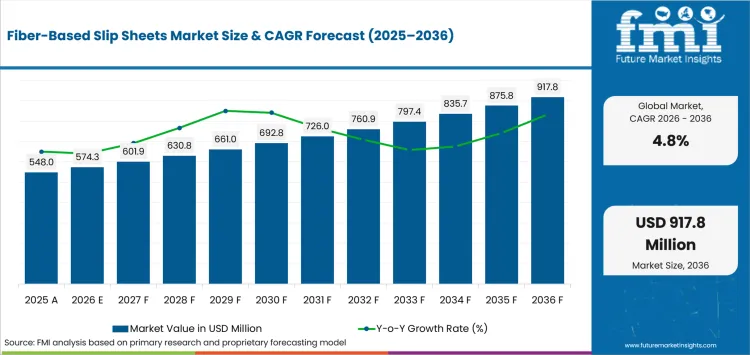
Key Takeaways of Fiber-based Slip Sheets Market
- Fiber-based slip sheets replace a rigid pallet with a thin load platform, reducing tare weight and storage volume when push-pull handling is available.
- Direct / OEM leads the sales channel at 40.0% because board grade, dimensions, lip geometry, coating, and handling equipment must be qualified together.
- Kraft Paperboard leads material at 48.0%, supported by its strength-to-caliper balance for scored lips and dense unit loads.
- Uncoated leads coating at 38.0%, while Single-Lip leads lip configuration at 32.0%.
- The 1,000-2,000 kg load-capacity segment and Food & Beverage lead their categories at 44.0% and 36.0%.
- India leads the profiled country growth rates at 7.0% through 2036, followed by China at 6.2%.
- Smurfit WestRock, International Paper, Sonoco, DS Smith, Mondi Group, and Nefab compete through board integration, finished-sheet converting, qualification, and global fulfillment.
Analyst Perspective
“Fiber-based slip sheets only deliver savings when the full logistics route is designed around them. Lower weight and storage volume mean little if the receiving site lacks push-pull equipment, operators are not trained, or moisture affects sheet performance. Buyers should qualify the board grade, lip design, coating and handling process as one system rather than treating the sheet as a cheaper pallet substitute.”
- Nandini Roy Choudhury, Principal Consultant, Future Market Insights
How is the fiber-based slip sheets market segmented?
Material distinguishes kraft paperboard, corrugated fiberboard, and solid fiberboard by stiffness, caliper, compression, and converting behavior. Lip Configuration separates the number and placement of pull tabs that determine approach direction. Coating identifies whether the sheet relies on native paper friction or adds anti-slip or moisture protection.
What makes Kraft Paperboard central to the Material category?
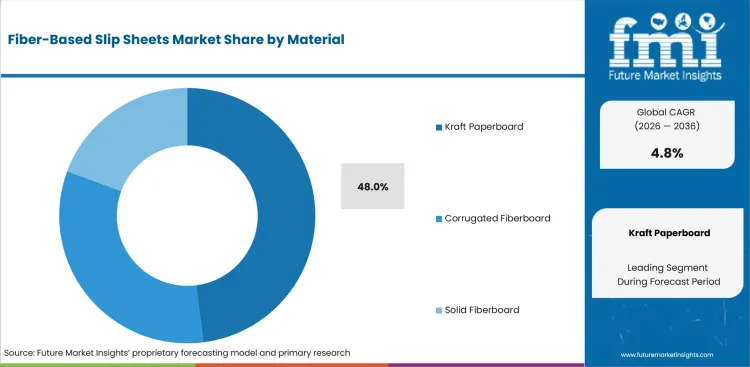
Kraft paperboard leads because the sheet must be thin enough to release storage and freight capacity yet stiff enough to distribute a concentrated unit load. Long fibers provide tensile and puncture strength, while controlled caliper supports scoring of a pull lip without adding pallet-like bulk.
Kraft Paperboard held a 48.0% share in 2026, as its strength-to-caliper balance supports scored lips, dense unit loads, and efficient storage.
Why does Single-Lip lead the Lip Configuration category?
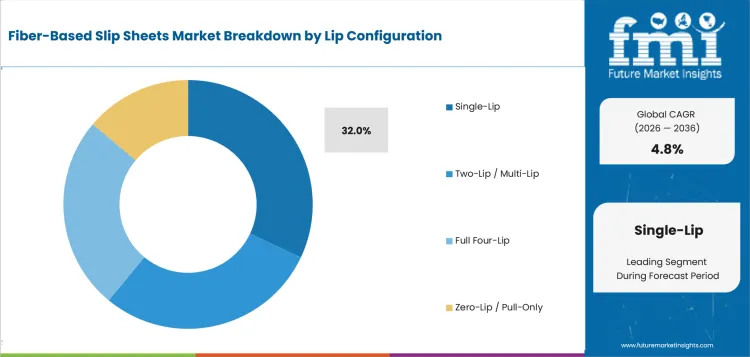
Single-Lip leads where unit loads travel in a controlled direction from the shipper's push-pull truck into a trailer, container, or receiver using the same approach face.
Single-Lip held a 32.0% share in 2026, since one-direction lanes favor lower material use, simple orientation, and a clearly defined gripping edge.
How does Uncoated support the Coating category?
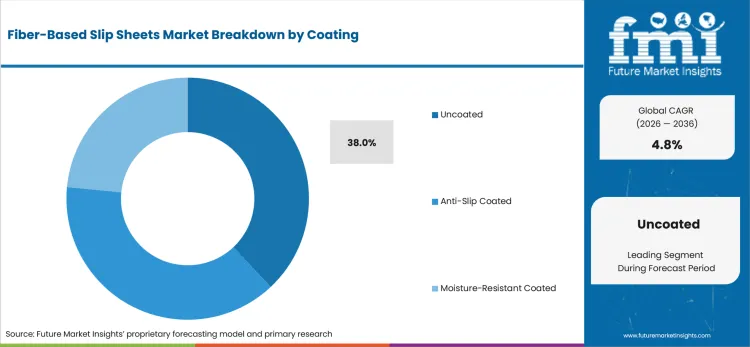
Uncoated sheets lead in dry, indoor, and short-dwell applications where the board's native surface friction and compression strength already meet the load test. Removing a coating keeps material cost low, simplifies repulping, and avoids adding performance features that a stable cartonized load does not need.
Uncoated held a 38.0% share in 2026, as many dry loads meet stability targets without adding coating cost or end-of-life complexity.
What supports the 1,000-2,000 kg segment in the Load Capacity category?
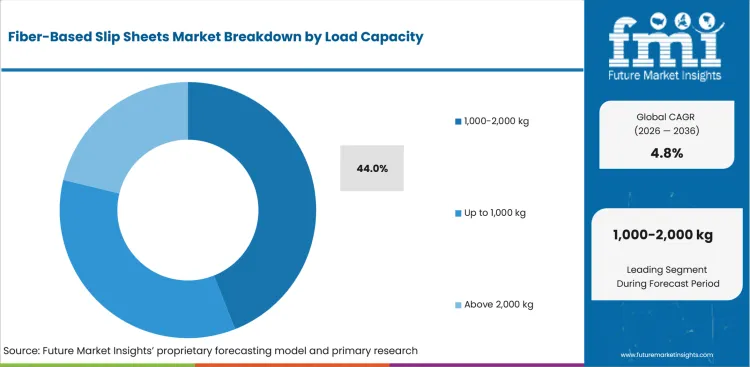
The 1,000-2,000 kg band sits at the center of industrial unit-load design. It covers dense food ingredients, beverage cases, chemicals, building products, and pharmaceutical secondary packaging without forcing buyers into the heavier board construction needed above 2,000 kg.
The 1,000-2,000 kg segment held a 44.0% share in 2026, since it covers common industrial unit loads without the material penalty of heavy-duty over-specification.
What drives Food & Beverage leadership in the End Use category?
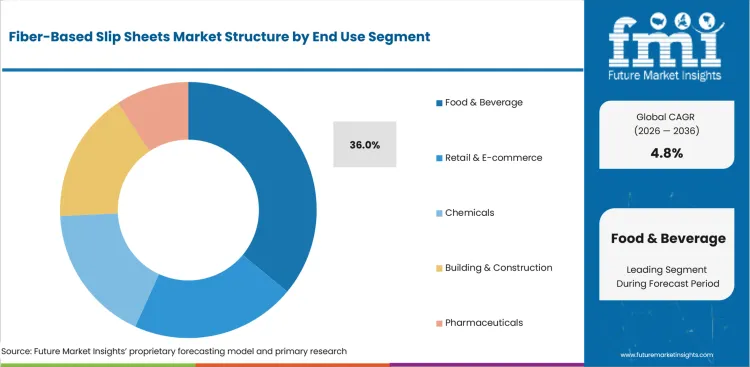
Food & Beverage leads because outbound flows are repetitive, volume-intensive, and often standardized around cases, sacks, or shrink-wrapped trays. These loads allow packaging engineers to test one sheet specification across many shipments, spreading attachment and trial costs over a large base.
Food & Beverage held a 36.0% share in 2026, as repeat case and bag flows allow qualification costs to be spread across high shipment volumes.
Why does Direct / OEM lead the Sales Channel category?
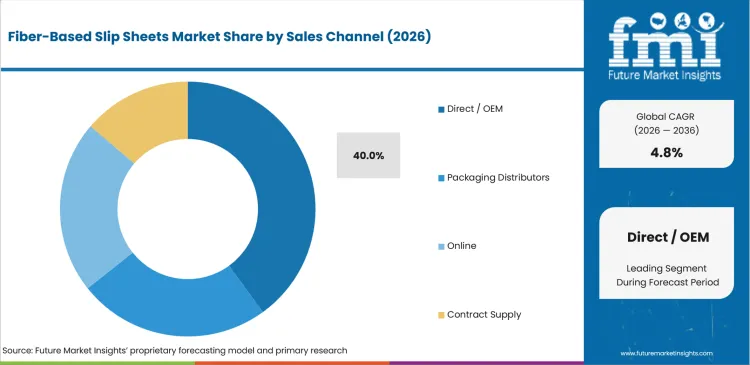
Direct / OEM channels lead because a slip sheet is not a catalog substitute selected only by dimensions. The supplier must translate load weight, contact pattern, humidity, acceleration, forklift interface, lip orientation, and receiving process into a board and coating specification.
Direct / OEM held a 40.0% share in 2026, since board grade, dimensions, lip geometry, coating, and handling equipment must be qualified as one application.
What are the drivers, restraints, and opportunities in the fiber-based slip sheets market?
- Driver: Lower tare, compact storage, and reduced raw-wood handling steps improve lane economics on recurring one-way shipments.
- Restraint: Push-pull equipment, operator training, floor conditions, and receiving procedures must be compatible at both ends.
- Opportunity: Standardized anti-slip and moisture-resistant grades can open automated, humid, and cross-border lanes that uncoated sheets cannot serve reliably.
Freight and warehouse economics create the clearest demand mechanism. A fiber slip sheet removes much of the non-product weight and volume associated with a wooden pallet, allowing more payload or more efficient cube utilization on suitable routes. Adoption fails when one facility optimizes the load platform but another still expects forks under a pallet.
How do country-level CAGRs compare in the fiber-based slip sheets market?
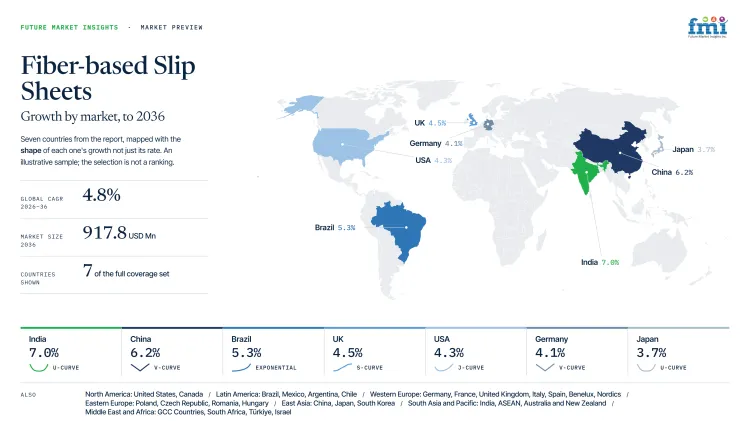
| Country | CAGR |
|---|---|
| USA | 4.3% |
| China | 6.2% |
| Germany | 4.1% |
| Japan | 3.7% |
| India | 7.0% |
| UK | 4.5% |
| Brazil | 5.3% |
The seven profiled markets form three growth bands. India at 7.0% and China at 6.2% lead as logistics networks, manufacturing output, and packaging standardization expand. Brazil at 5.3% occupies a middle position, supported by export and port flows but constrained by operating variability.
Country-wise Analysis
- USA: buyers typically start with high-throughput distribution centers, export plants, and food or beverage lanes where pallet weight, floor space, and repetitive handling can be measured.
- China: buyers operate at extreme parcel and manufacturing scale, so procurement favors standardized dimensions, high-volume converting, and fast local technical response.
- Germany: German purchasers emphasize recyclability evidence, precise load specifications, and documented compatibility with automated handling before approving a fiber platform.
- Japan: Japanese shippers tend to prioritize stable process design, common operating rules, and low failure rates over rapid material substitution.
- India: Indian buyers increasingly evaluate packaging within broader factory-to-port logistics programs, with strong attention to unit cost, local availability, and moisture exposure.
- UK: procurement teams compare packaging weight, recyclability, and disposal cost alongside warehouse throughput, particularly in retail and contract distribution.
- Brazil: Brazilian exporters and domestic distributors value lower tare, compact storage, and alternatives to non-returnable wood on long food, chemical, and industrial routes.
Who are the notable companies in the fiber-based slip sheets market?
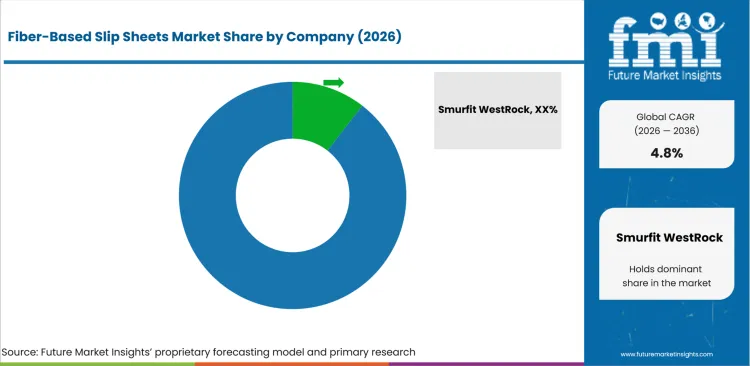
The competitive field includes integrated board manufacturers, industrial paper converters, engineered packaging specialists, and focused slip-sheet suppliers. Smurfit WestRock accounts for 10.5% of market revenue, supported by a broad fiber packaging footprint.
Competitive Benchmarking: Fiber-Based Slip Sheets Market
| Company | Capability profile | Geographic reach |
|---|---|---|
| Smurfit WestRock | Finished Slip-Sheet Converting: -; Board and Coating Integration: High; Qualification and Global Fulfillment: High | Global network across 40 countries |
| International Paper | Finished Slip-Sheet Converting: High; Board and Coating Integration: High; Qualification and Global Fulfillment: High | North America and EMEA packaging network |
| Sonoco | Finished Slip-Sheet Converting: Medium; Board and Coating Integration: High; Qualification and Global Fulfillment: High | Industrial paper operations across 37 countries |
| DS Smith | Finished Slip-Sheet Converting: Medium; Board and Coating Integration: High; Qualification and Global Fulfillment: High | Europe and North America |
| Mondi Group | Finished Slip-Sheet Converting: -; Board and Coating Integration: High; Qualification and Global Fulfillment: High | Europe, North America, Africa, and selected Asian markets |
| Nefab Group | Finished Slip-Sheet Converting: Medium; Board and Coating Integration: Medium; Qualification and Global Fulfillment: High | Engineering and service presence across 38 countries |
| Greif | Finished Slip-Sheet Converting: Medium; Board and Coating Integration: High; Qualification and Global Fulfillment: Medium | North America, EMEA, and Asia-Pacific |
| Mitsubishi HiTec Paper | Finished Slip-Sheet Converting: -; Board and Coating Integration: High; Qualification and Global Fulfillment: Medium | Germany-based production with worldwide sales and service |
| Conitex Sonoco | Finished Slip-Sheet Converting: -; Board and Coating Integration: Medium; Qualification and Global Fulfillment: Medium | International operations through Sonoco industrial channels |
| Badger Paperboard | Finished Slip-Sheet Converting: High; Board and Coating Integration: Medium; Qualification and Global Fulfillment: Medium | United States with nationwide distribution |
Finished Slip-Sheet Converting measures documented capability to cut, score, coat, and supply load-bearing sheet formats; High indicates direct, broad capability, Medium indicates narrower or adjacent sheet-converting evidence, and unscored indicates insufficient public documentation.
Key Developments in the Fiber-Based Slip Sheets Market
- In August 2025, Mondi Group launched Ad/Vantage Smooth Brown Semi Extensible, a high-strength, coating-ready kraft paper engineered over three years.
- In July 2024, Smurfit WestRock completed the combination of Smurfit Kappa and WestRock and began trading in New York and London.
- In April 2025, Nefab Group acquired Embalajes Echeberria, a Spanish supplier of complete packaging solutions and heavy-duty corrugated products.
- In May 2025, Greif announced the permanent closure of its Los Angeles paperboard mill, removing 50,000 tons of coated recycled board and 22,000 tons of uncoated recycled board capacity.
Key Players in the Fiber-Based Slip Sheets Market
Integrated Fiber and Corrugated Platforms
- Smurfit WestRock
- International Paper
- DS Smith
- Mondi Group
Industrial Paperboard and Converting Networks
- Sonoco
- Greif
- Conitex Sonoco
Application Engineering and Specialty Sheet Providers
- Nefab Group
- Mitsubishi HiTec Paper
- Badger Paperboard
Fiber-Based Slip Sheets Market - Report Scope
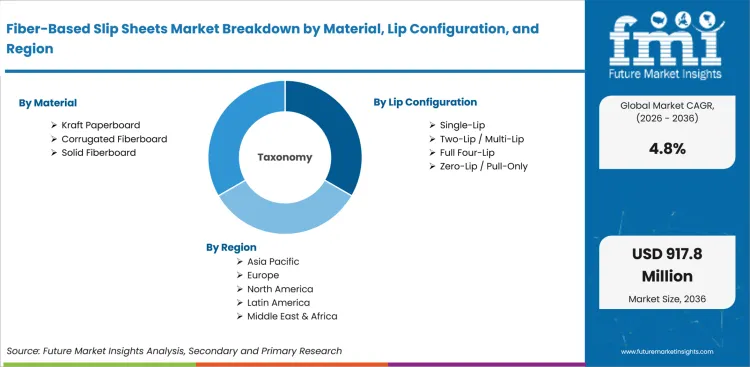
| Coverage field | Report scope |
|---|---|
| Market breakdown | Material, Lip Configuration, Coating, Load Capacity, End Use, and Sales Channel |
| Quantitative Units | USD Million |
| Market Definition | Revenue includes finished fiber-based slip sheets made from kraft paperboard, corrugated fiberboard, or solid fiberboard and sold within the listed lip, coating, capacity, end-use, and channel categories. |
| Regions Covered | North America: United States, Canada; Latin America: Brazil, Mexico, Argentina, Chile; Western Europe: Germany, France, United Kingdom, Italy, Spain, Benelux, Nordics; Eastern Europe: Poland, Czech Republic, Romania, Hungary; East Asia: China, Japan, South Korea; South Asia and Pacific: India, ASEAN, Australia and New Zealand; Middle East and Africa: GCC Countries, South Africa, Türkiye, Israel |
| Countries Covered | USA, China, Germany, Japan, India, UK, Brazil, and more than twenty-five additional countries in the full report |
| Key Companies Profiled | Smurfit WestRock, International Paper, Sonoco, DS Smith, Mondi Group, Nefab Group, Greif, Mitsubishi HiTec Paper, Conitex Sonoco, Badger Paperboard |
| Forecast Period | 2026 to 2036 |
| Approach | A hybrid bottom-up and top-down approach reconciles product-level pricing and shipment activity with board supply, converting capacity, end-use demand, trade flows, and country adoption conditions. |
Fiber-Based Slip Sheets Market - Research Methodology
| Method | Approach |
|---|---|
| Primary Research | FMI engages manufacturers, paperboard converters, packaging distributors, logistics providers, procurement teams, warehouse operators, end users, and subject-matter experts. |
| Desk Research | Desk research reviews official statistics, packaging and phytosanitary rules, standards, company filings, product documentation, public procurement material, transport data, and first-party company announcements published by the July 27, 2026 cutoff. |
| Market Sizing and Forecasting | Market sizing combines product prices, sheet specifications, converter output, buyer volumes, channel markups, end-use demand, and country-level adoption. |
| Data Validation | Findings are triangulated across primary inputs, official evidence, company disclosures, and cross-source consistency checks. |
Fiber-Based Slip Sheets Market by Segments
Fiber-Based Slip Sheets Market segmented by Material:
- Kraft Paperboard
- Corrugated Fiberboard
- Solid Fiberboard
Fiber-Based Slip Sheets Market segmented by Lip Configuration:
- Single-Lip
- Two-Lip / Multi-Lip
- Full Four-Lip
- Zero-Lip / Pull-Only
Fiber-Based Slip Sheets Market segmented by Coating:
- Uncoated
- Anti-Slip Coated
- Moisture-Resistant Coated
Fiber-Based Slip Sheets Market segmented by Load Capacity:
- 1,000-2,000 kg
- Up to 1,000 kg
- Above 2,000 kg
Fiber-Based Slip Sheets Market segmented by End Use:
- Food & Beverage
- Retail & E-commerce
- Chemicals
- Building & Construction
- Pharmaceuticals
Fiber-Based Slip Sheets Market segmented by Sales Channel:
- Direct / OEM
- Packaging Distributors
- Online
- Contract Supply
Research Sources and Bibliography
- USA Census Bureau (2026, May 18).
- State Council of the People's Republic of China / Xinhua (2026, July 5).
- German Environment Agency and Central Agency Packaging Register (2026, January 27).
- Ministry of Land, Infrastructure, Transport and Tourism, Japan (2026, May).
- Press Information Bureau, Government of India (2025, September 19).
- PackUK / Department for Environment, Food & Rural Affairs (2025, June 30).
- Agência Nacional de Transportes Aquaviários (2025, February 18).
- International Plant Protection Convention (2021, July 13).
- Smurfit WestRock (2024, July 8).
- Mondi Group (2025, August 19).
- Nefab Group (2025, April 23).
- Greif, Inc. (2025, May 1).
- Sonoco Products Company (2026, February 26). 2025 Annual Report.
- Badger Paperboard (2021, August).
- Mitsubishi HiTec Paper (accessed 2026, July 27).
This Report Answers
- What is the Fiber-Based Slip Sheets Market size in 2026 and what value is forecast for 2036?
- What logistics, packaging, and regulatory pressures support demand for fiber-based slip sheets?
- Why does Kraft Paperboard hold the leading position in the Material category?
- How does Single-Lip configuration influence handling simplicity and downstream demand?
- Why does Uncoated hold the leading position in the Coating category?
- How do growth rates differ across USA, China, Germany, Japan, India, UK, and Brazil?
- Which companies provide integrated board, converting, coating, or application-engineering capabilities?
- What limits adoption when push-pull equipment and receiving workflows are not aligned?
- What should decision-makers evaluate before purchasing and qualifying fiber-based slip sheets?
Frequently Asked Questions
What is driving growth in the Fiber-Based Slip Sheets Market?
Growth comes from shippers reducing pallet tare, storage space, raw-wood handling steps, and one-way platform cost on repeat logistics lanes.
Who are the key players in the Fiber-Based Slip Sheets Market?
The profiled companies are Smurfit WestRock, International Paper, Sonoco, DS Smith, Mondi Group, Nefab Group, Greif, Mitsubishi HiTec Paper, Conitex Sonoco, and Badger Paperboard.
What is a notable restraint in the Fiber-Based Slip Sheets Market?
The main restraint is the need for push-pull attachments, trained operators, suitable floors, and compatible receiving procedures at both ends of a lane.
Why should executives track the Fiber-Based Slip Sheets Market?
Executives should track the market because load-platform choices affect freight weight, warehouse space, packaging fees, damage risk, and cross-border operating steps.
What business problem does the Fiber-Based Slip Sheets Market address?
Fiber-based slip sheets address the cost and space consumed by rigid pallets in one-way or controlled distribution flows.
What should packaging and logistics procurement teams evaluate in the Fiber-Based Slip Sheets Market?
Packaging and logistics procurement teams should evaluate load compression, puncture resistance, surface friction, moisture exposure, lip geometry, dimensions, and push-pull compatibility.
What limits return on investment in the Fiber-Based Slip Sheets Market?
Return on investment is limited by attachment cost, training, trials, damaged lips, repalletization, and low shipment frequency.
What supports long-term commercial confidence in the Fiber-Based Slip Sheets Market?
Long-term confidence rests on recurring high-volume logistics, mature paperboard converting, and policy pressure for lighter, recyclable packaging.
Preview the report firsthand - request a free sample
Get SampleGet the brochure for pricing and purchase details.
Get PDFTable of Content
- Key Takeaways
- Market Size and CAGR
- Top Growth Driver
- Fastest Growing Segment
- Leading Region
- Key Companies
- Emerging Opportunities
- Executive Summary
- Global Market Outlook
- Demand-side Trends
- Supply-side Trends
- Technology Roadmap Analysis
- Analysis and Recommendations
- Analyst Perspective (What is happening? Why now? What should investors know?)
- Key Questions Answered
- How large is the market?
- What is the CAGR?
- What are key trends?
- Which region dominates?
- Who are the leaders?
- Market Overview
- Market Coverage / Taxonomy
- Market Definition / Scope / Limitations
- Research Methodology
- Chapter Orientation
- Analytical Lens and Working Hypotheses
- Market Structure, Signals, and Trend Drivers
- Benchmarking and Cross-market Comparability
- Market Sizing, Forecasting, and Opportunity Mapping
- Research Design and Evidence Framework
- Desk Research Programme (Secondary Evidence)
- Expert Input and Fieldwork (Primary Evidence)
- Tooling, Models, and Reference Databases
- Data Engineering and Model Build
- Quality Assurance and Audit Trail
- Market Background
- Market Dynamics (Drivers, Restraints, Opportunity, Trends)
- Scenario Forecast (Optimistic, Likely, Conservative)
- Impact Analysis
- AI Impact
- Sustainability Impact
- Regulatory Impact
- Technology Impact
- Consumer / Buyer Analysis
- Purchase Drivers
- Adoption Barriers
- Buyer Journey
- Opportunity Map Analysis
- Product Life Cycle Analysis
- Supply Chain Analysis
- Investment Feasibility Matrix
- Value Chain Analysis
- PESTLE and Porter's Analysis
- Regulatory Landscape
- Regional Parent Market Outlook
- Production and Consumption Statistics
- Import and Export Statistics
- Global Market Analysis and Forecast, 2021 to 2036
- Historical Market Size Value (USD Million) Analysis, 2021 to 2025
- Current and Future Market Size Value (USD Million) Projections, 2026 to 2036
- Y-o-Y Growth Trend Analysis
- Absolute $ Opportunity Analysis
- Global Market Pricing Analysis, 2021 to 2036
- Global Market Analysis and Forecast, By Material, 2021 to 2036
- Introduction / Key Findings
- Historical Market Size Value (USD Million) Analysis By Material, 2021 to 2025
- Current and Future Market Size Value (USD Million) Analysis and Forecast By Material, 2026 to 2036
- Kraft Paperboard
- Corrugated Fiberboard
- Solid Fiberboard
- Kraft Paperboard
- Y-o-Y Growth Trend Analysis By Material, 2021 to 2025
- Absolute $ Opportunity Analysis By Material, 2026 to 2036
- Global Market Analysis and Forecast, By Lip Configuration, 2021 to 2036
- Introduction / Key Findings
- Historical Market Size Value (USD Million) Analysis By Lip Configuration, 2021 to 2025
- Current and Future Market Size Value (USD Million) Analysis and Forecast By Lip Configuration, 2026 to 2036
- Single-Lip
- Two-Lip / Multi-Lip
- Full Four-Lip
- Zero-Lip / Pull-Only
- Single-Lip
- Y-o-Y Growth Trend Analysis By Lip Configuration, 2021 to 2025
- Absolute $ Opportunity Analysis By Lip Configuration, 2026 to 2036
- Global Market Analysis and Forecast, By Coating, 2021 to 2036
- Introduction / Key Findings
- Historical Market Size Value (USD Million) Analysis By Coating, 2021 to 2025
- Current and Future Market Size Value (USD Million) Analysis and Forecast By Coating, 2026 to 2036
- Uncoated
- Anti-Slip Coated
- Moisture-Resistant Coated
- Uncoated
- Y-o-Y Growth Trend Analysis By Coating, 2021 to 2025
- Absolute $ Opportunity Analysis By Coating, 2026 to 2036
- Global Market Analysis and Forecast, By Load Capacity, 2021 to 2036
- Introduction / Key Findings
- Historical Market Size Value (USD Million) Analysis By Load Capacity, 2021 to 2025
- Current and Future Market Size Value (USD Million) Analysis and Forecast By Load Capacity, 2026 to 2036
- 1,000-2,000 kg
- Up to 1,000 kg
- Above 2,000 kg
- 1,000-2,000 kg
- Y-o-Y Growth Trend Analysis By Load Capacity, 2021 to 2025
- Absolute $ Opportunity Analysis By Load Capacity, 2026 to 2036
- Global Market Analysis and Forecast, By End Use, 2021 to 2036
- Introduction / Key Findings
- Historical Market Size Value (USD Million) Analysis By End Use, 2021 to 2025
- Current and Future Market Size Value (USD Million) Analysis and Forecast By End Use, 2026 to 2036
- Food & Beverage
- Retail & E-commerce
- Chemicals
- Building & Construction
- Pharmaceuticals
- Food & Beverage
- Y-o-Y Growth Trend Analysis By End Use, 2021 to 2025
- Absolute $ Opportunity Analysis By End Use, 2026 to 2036
- Global Market Analysis and Forecast, By Sales Channel
- Introduction / Key Findings
- Historical Market Size Value (USD Million) Analysis By Sales Channel, 2021 to 2025
- Current and Future Market Size Value (USD Million) Analysis and Forecast By Sales Channel, 2026 to 2036
- Direct / OEM
- Packaging Distributors
- Online
- Contract Supply
- Direct / OEM
- Y-o-Y Growth Trend Analysis By Sales Channel, 2021 to 2025
- Absolute $ Opportunity Analysis By Sales Channel, 2026 to 2036
- Global Market Analysis and Forecast, By Region, 2021 to 2036
- Introduction
- Historical Market Size Value (USD Million) Analysis By Region, 2021 to 2025
- Current Market Size Value (USD Million) Analysis and Forecast By Region, 2026 to 2036
- North America
- Latin America
- Western Europe
- Eastern Europe
- East Asia
- South Asia and Pacific
- Middle East & Africa
- Market Attractiveness Analysis By Region
- North America Market Analysis and Forecast, By Country, 2021 to 2036
- Historical Market Size Value (USD Million) Trend Analysis By Market Taxonomy, 2021 to 2025
- Market Size Value (USD Million) Forecast By Market Taxonomy, 2026 to 2036
- By Country
- USA
- Canada
- By Material
- By Lip Configuration
- By Coating
- By Load Capacity
- By End Use
- By Sales Channel
- By Country
- Market Attractiveness Analysis
- By Country
- By Material
- By Lip Configuration
- By Coating
- By Load Capacity
- By End Use
- By Sales Channel
- Key Takeaways
- Latin America Market Analysis and Forecast, By Country
- Historical Market Size Value (USD Million) Trend Analysis By Market Taxonomy, 2021 to 2025
- Market Size Value (USD Million) Forecast By Market Taxonomy, 2026 to 2036
- By Country
- Brazil
- Mexico
- Chile
- Rest of Latin America
- By Material
- By Lip Configuration
- By Coating
- By Load Capacity
- By End Use
- By Sales Channel
- By Country
- Market Attractiveness Analysis
- By Country
- By Material
- By Lip Configuration
- By Coating
- By Load Capacity
- By End Use
- By Sales Channel
- Key Takeaways
- Western Europe Market Analysis and Forecast, By Country
- Historical Market Size Value (USD Million) Trend Analysis By Market Taxonomy, 2021 to 2025
- Market Size Value (USD Million) Forecast By Market Taxonomy, 2026 to 2036
- By Country
- Germany
- UK
- Italy
- Spain
- France
- Nordic
- BENELUX
- Rest of Western Europe
- By Material
- By Lip Configuration
- By Coating
- By Load Capacity
- By End Use
- By Sales Channel
- By Country
- Market Attractiveness Analysis
- By Country
- By Material
- By Lip Configuration
- By Coating
- By Load Capacity
- By End Use
- By Sales Channel
- Key Takeaways
- Eastern Europe Market Analysis and Forecast, By Country
- Historical Market Size Value (USD Million) Trend Analysis By Market Taxonomy, 2021 to 2025
- Market Size Value (USD Million) Forecast By Market Taxonomy, 2026 to 2036
- By Country
- Russia
- Poland
- Hungary
- Balkan & Baltic
- Rest of Eastern Europe
- By Material
- By Lip Configuration
- By Coating
- By Load Capacity
- By End Use
- By Sales Channel
- By Country
- Market Attractiveness Analysis
- By Country
- By Material
- By Lip Configuration
- By Coating
- By Load Capacity
- By End Use
- By Sales Channel
- Key Takeaways
- East Asia Market Analysis and Forecast, By Country
- Historical Market Size Value (USD Million) Trend Analysis By Market Taxonomy, 2021 to 2025
- Market Size Value (USD Million) Forecast By Market Taxonomy, 2026 to 2036
- By Country
- China
- Japan
- South Korea
- By Material
- By Lip Configuration
- By Coating
- By Load Capacity
- By End Use
- By Sales Channel
- By Country
- Market Attractiveness Analysis
- By Country
- By Material
- By Lip Configuration
- By Coating
- By Load Capacity
- By End Use
- By Sales Channel
- Key Takeaways
- South Asia and Pacific Market Analysis and Forecast, By Country
- Historical Market Size Value (USD Million) Trend Analysis By Market Taxonomy, 2021 to 2025
- Market Size Value (USD Million) Forecast By Market Taxonomy, 2026 to 2036
- By Country
- India
- ASEAN
- Australia & New Zealand
- Rest of South Asia and Pacific
- By Material
- By Lip Configuration
- By Coating
- By Load Capacity
- By End Use
- By Sales Channel
- By Country
- Market Attractiveness Analysis
- By Country
- By Material
- By Lip Configuration
- By Coating
- By Load Capacity
- By End Use
- By Sales Channel
- Key Takeaways
- Middle East & Africa Market Analysis and Forecast, By Country
- Historical Market Size Value (USD Million) Trend Analysis By Market Taxonomy, 2021 to 2025
- Market Size Value (USD Million) Forecast By Market Taxonomy, 2026 to 2036
- By Country
- Kingdom of Saudi Arabia
- Other GCC Countries
- Türkiye
- South Africa
- Other African Union
- Rest of Middle East & Africa
- By Material
- By Lip Configuration
- By Coating
- By Load Capacity
- By End Use
- By Sales Channel
- By Country
- Market Attractiveness Analysis
- By Country
- By Material
- By Lip Configuration
- By Coating
- By Load Capacity
- By End Use
- By Sales Channel
- Key Takeaways
- Key Countries Market Analysis
- USA
- Pricing Analysis
- Market Share Analysis, 2025
- By Material
- By Lip Configuration
- By Coating
- By Load Capacity
- By End Use
- By Sales Channel
- Canada
- Pricing Analysis
- Market Share Analysis, 2025
- By Material
- By Lip Configuration
- By Coating
- By Load Capacity
- By End Use
- By Sales Channel
- Mexico
- Pricing Analysis
- Market Share Analysis, 2025
- By Material
- By Lip Configuration
- By Coating
- By Load Capacity
- By End Use
- By Sales Channel
- Brazil
- Pricing Analysis
- Market Share Analysis, 2025
- By Material
- By Lip Configuration
- By Coating
- By Load Capacity
- By End Use
- By Sales Channel
- Chile
- Pricing Analysis
- Market Share Analysis, 2025
- By Material
- By Lip Configuration
- By Coating
- By Load Capacity
- By End Use
- By Sales Channel
- Germany
- Pricing Analysis
- Market Share Analysis, 2025
- By Material
- By Lip Configuration
- By Coating
- By Load Capacity
- By End Use
- By Sales Channel
- UK
- Pricing Analysis
- Market Share Analysis, 2025
- By Material
- By Lip Configuration
- By Coating
- By Load Capacity
- By End Use
- By Sales Channel
- Italy
- Pricing Analysis
- Market Share Analysis, 2025
- By Material
- By Lip Configuration
- By Coating
- By Load Capacity
- By End Use
- By Sales Channel
- Spain
- Pricing Analysis
- Market Share Analysis, 2025
- By Material
- By Lip Configuration
- By Coating
- By Load Capacity
- By End Use
- By Sales Channel
- France
- Pricing Analysis
- Market Share Analysis, 2025
- By Material
- By Lip Configuration
- By Coating
- By Load Capacity
- By End Use
- By Sales Channel
- India
- Pricing Analysis
- Market Share Analysis, 2025
- By Material
- By Lip Configuration
- By Coating
- By Load Capacity
- By End Use
- By Sales Channel
- ASEAN
- Pricing Analysis
- Market Share Analysis, 2025
- By Material
- By Lip Configuration
- By Coating
- By Load Capacity
- By End Use
- By Sales Channel
- Australia & New Zealand
- Pricing Analysis
- Market Share Analysis, 2025
- By Material
- By Lip Configuration
- By Coating
- By Load Capacity
- By End Use
- By Sales Channel
- China
- Pricing Analysis
- Market Share Analysis, 2025
- By Material
- By Lip Configuration
- By Coating
- By Load Capacity
- By End Use
- By Sales Channel
- Japan
- Pricing Analysis
- Market Share Analysis, 2025
- By Material
- By Lip Configuration
- By Coating
- By Load Capacity
- By End Use
- By Sales Channel
- South Korea
- Pricing Analysis
- Market Share Analysis, 2025
- By Material
- By Lip Configuration
- By Coating
- By Load Capacity
- By End Use
- By Sales Channel
- Russia
- Pricing Analysis
- Market Share Analysis, 2025
- By Material
- By Lip Configuration
- By Coating
- By Load Capacity
- By End Use
- By Sales Channel
- Poland
- Pricing Analysis
- Market Share Analysis, 2025
- By Material
- By Lip Configuration
- By Coating
- By Load Capacity
- By End Use
- By Sales Channel
- Hungary
- Pricing Analysis
- Market Share Analysis, 2025
- By Material
- By Lip Configuration
- By Coating
- By Load Capacity
- By End Use
- By Sales Channel
- Kingdom of Saudi Arabia
- Pricing Analysis
- Market Share Analysis, 2025
- By Material
- By Lip Configuration
- By Coating
- By Load Capacity
- By End Use
- By Sales Channel
- Türkiye
- Pricing Analysis
- Market Share Analysis, 2025
- By Material
- By Lip Configuration
- By Coating
- By Load Capacity
- By End Use
- By Sales Channel
- South Africa
- Pricing Analysis
- Market Share Analysis, 2025
- By Material
- By Lip Configuration
- By Coating
- By Load Capacity
- By End Use
- By Sales Channel
- USA
- Market Structure Analysis
- Competition Dashboard
- Competition Benchmarking
- Market Share Analysis of Top Players
- By Regional
- By Material
- By Lip Configuration
- By Coating
- By Load Capacity
- By End Use
- By Sales Channel
- Emerging Startups
- Innovation Benchmarking
- Competition Analysis
- Competition Deep Dive
- Smurfit WestRock
- Overview
- Product Portfolio
- Profitability by Market Segments
- Sales Footprint
- Strategy Overview
- Marketing Strategy
- Product Strategy
- Channel Strategy
- International Paper
- Sonoco
- DS Smith
- Mondi Group
- Nefab Group
- Greif
- Mitsubishi HiTec Paper
- Conitex Sonoco
- Badger Paperboard
- Smurfit WestRock
- Case Studies
- Success Stories
- Recent Developments
- Competition Deep Dive
- Assumptions & Acronyms Used


