

- Industry Size (2026)
- USD 5309.3 Mn
- Forecast (2036)
- USD 9421.4 Mn
- CAGR (2026 to 2036)
- 5.9%
Flip-Top Caps and Closures Market Size, Market Forecast and Outlook By FMI
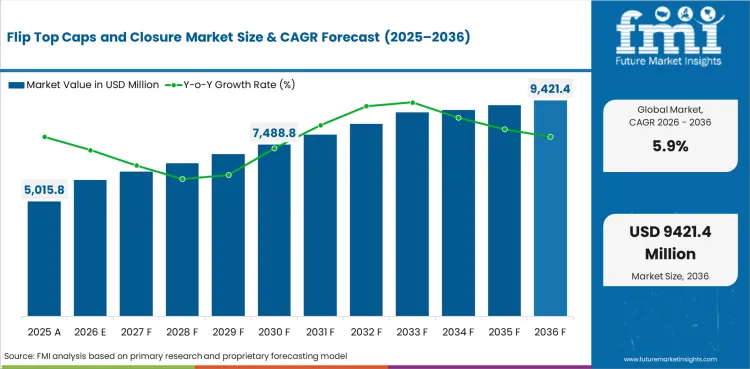
In 2025, the global flip-top caps and closures market was valued at approximately USD 5,015.8 million. Based on Future Market Insights’ analysis, demand for flip-top caps and closures is estimated to reach USD 5,309.3 million in 2026 and is projected to expand to USD 9,421.4 million by 2036, reflecting a compound annual growth rate of 5.9% during the forecast period.
Quick Stats for Flip-Top Caps and Closures Market
- Market Snapshot
- The global flip-top caps and closures market was valued at USD 5,015.8 million in 2025 and is projected to reach USD 9,421.4 million by 2036.
- The market is expected to grow at a CAGR of 5.9% from 2026 to 2036, generating an incremental opportunity of over USD 4.1 billion.
- The industry is evolving from a standard packaging component segment to a performance-driven dispensing and compliance-focused market.
- Demand and Growth Drivers
- Growth is driven by increasing demand for controlled dispensing, resealability, and convenience packaging across personal care, food, healthcare, and home-care products.
- Rising importance of leak-proof packaging for e-commerce distribution and integration of valve-based precision dispensing systems are key growth accelerators.
- Sustainability trends are pushing adoption of mono-material polypropylene closures, PCR-based designs, and lightweight closure engineering aligned with recyclability regulations.
- Product and Segment View
- The market includes non-valved and valved flip-top closures with materials such as polypropylene (PP), polyethylene (PE), and elastomer-based valve systems.
- Advanced features include tamper-evidence, child-resistance, tethered designs, and valve-regulated dispensing.
- Flip-top closures are widely used across bottles, tubes, pouches, jars, and specialty containers for liquid and semi-liquid products.
- Scope includes all hinged dispensing closures, excluding non-hinged systems such as pumps, sprayers, and screw caps.
- Geography and Competitive Outlook
- Asia Pacific is the fastest-growing region, driven by expanding FMCG packaging demand and rising adoption of resealable formats.
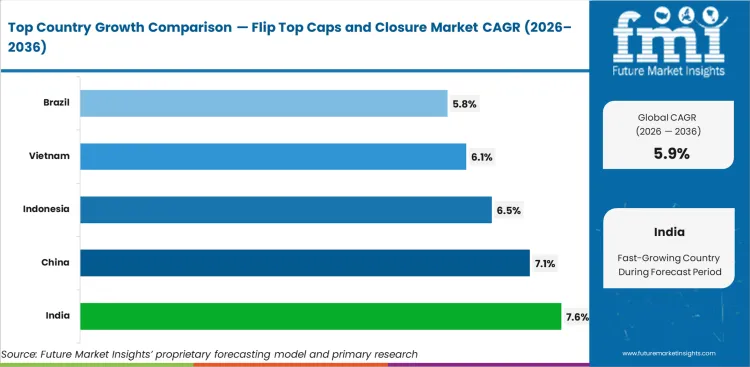
- Key growth markets include India (7.6%), China (7.1%), Indonesia (6.5%), Vietnam (6.1%), and Brazil (5.8%).
- North America and Europe represent mature but innovation-driven markets, with strong focus on sustainability and advanced dispensing technologies.
- Competition is moderately consolidated and increasingly defined by engineering capability, valve integration, and sustainability compliance, rather than price alone.
- Analyst Opinion at FMI
- Ismail Sutaria, Principal Consultant for Packaging Industry at Future Market Insights, opines, ‘investors will find in this report strategic clarity on how dispensing functionality, recyclability transitions, and regulatory developments such as tethered closure requirements are reshaping innovation priorities across the flip-top caps and closures market.’
- Strategic Implications / Executive Takeaways
- Invest in mono-material polypropylene dispensing closure platforms aligned with evolving recyclability targets across personal care and food packaging applications.
- Strengthen capabilities in valve-enabled and controlled-dispensing closure technologies supporting premium liquid product categories.
- Develop lightweight hinge-optimized closure architectures compatible with high-speed automated filling environments across FMCG packaging lines.
The market is expected to generate an absolute dollar opportunity exceeding USD 4.1 billion between 2026 and 2036. This growth reflects sustained structural expansion in controlled dispensing packaging formats across personal care liquids, sauces and condiments, nutraceutical syrups, OTC topical preparations, and household cleaning formulations. Expansion is further supported by the increasing role of closure-level engineering in ensuring leak-proof logistics performance across e-commerce distribution channels and by the integration of elastomer-based valve systems enabling precise dosing across viscous product categories.
At the same time, sustainability-driven packaging transitions are accelerating adoption of mono-material polypropylene closures and PCR-integrated dispensing formats that support recyclability compliance across multiple regional regulatory frameworks. Closure manufacturers are increasingly redesigning hinge systems and closure geometries to reduce resin usage while maintaining torque stability and opening reliability, thereby supporting brand owners’ lightweighting objectives without compromising dispensing performance.
“We are proud to be named one of TIME’s World’s Most Sustainable Companies for the second year in a row… This recognition highlights our commitment to furthering a more sustainable future through increasing renewable energy use, creating more recyclable and reusable products and helping the world’s leading brands meet their sustainability commitments.” - Stephan B. Tanda, President and CEO, AptarGroup, Inc.
Recent developments reflect this structural shift, with leading closure manufacturers expanding portfolios across tethered flip-top caps, mono-material dispensing closures, and PCR-enabled designs. Investments in advanced hinge systems, precision moulding, and valve technologies are reinforcing flip-top closures as critical enablers of functionality, compliance, and brand differentiation across food, personal care, healthcare, and home-care packaging applications.
FMI expects these regulation-driven, functionality-focused, and sustainability-aligned trends to structurally elevate the strategic and economic importance of flip-top caps and closures over the coming decade. As packaging systems evolve toward greater convenience, safety, and circularity, flip-top closures are expected to transition permanently from basic dispensing components to core elements of compliant, consumer-centric packaging architectures within the global rigid packaging value chain.
Industry investments across advanced hinge technologies, valve-regulated dispensing platforms, and tethered closure architectures indicate that flip-top closures are transitioning from commodity packaging accessories toward performance-critical packaging components that influence both consumer interaction quality and regulatory readiness within liquid packaging ecosystems.
India is projected to register the fastest growth during the forecast period with a CAGR of 7.6%, supported by rapid expansion in FMCG packaging output and increasing adoption of resealable dispensing formats across personal care and condiment packaging categories. China follows with a CAGR of 7.1%, supported by strong manufacturing infrastructure and export-oriented packaging conversion capacity. Indonesia and Vietnam are emerging as high-growth markets driven by rising packaged personal-care consumption and regional brand localization strategies. Brazil demonstrates steady growth supported by convenience-driven packaging adoption across home-care and food sectors.
Flip-Top Caps and Closures Market Definition
The flip-top caps and closures market refers to the global production and commercialization of hinged polymer dispensing closures designed to enable controlled, hygienic, and resealable product delivery across bottles, laminate tubes, flexible spouted pouches, jars, and specialty dispensing containers. These closures enable repeated opening and reclosing without compromising seal integrity and are widely used across liquid and semi-liquid packaging applications requiring precise dispensing control and consumer-friendly usability characteristics.
Modern flip-top closures increasingly incorporate elastomer valve systems, tamper-evident security features, child-resistant mechanisms, lightweight hinge geometries, mono-material recyclability-aligned resin structures, and tethered closure configurations designed to comply with evolving circular-economy packaging requirements. As packaging systems evolve toward improved ergonomics and regulatory compliance readiness, flip-top closures are being specified as functional interfaces within container-closure systems rather than interchangeable secondary packaging components.
Flip-Top Caps and Closures Market Inclusions
The report provides global and regional market size estimates for 2025 and 2026 with forecasts through 2036 and includes segmentation across closure type, material composition, neck finish diameter, packaging compatibility, dispensing functionality architecture, sustainability profile alignment, and end-use application demand patterns. The study evaluates closure performance characteristics including hinge durability, leak-prevention capability, valve-regulated dispensing performance, recyclability compatibility, and automation-line torque stability requirements across consumer goods packaging environments.
The analysis further incorporates procurement-level decision dynamics across brand owners and converters, particularly those related to container-closure compatibility, packaging line efficiency, and sustainability commitments that increasingly influence closure specification strategies across global FMCG packaging ecosystems.
Flip-Top Caps and Closures Market Exclusions
The scope excludes non-hinged closure systems including screw caps, trigger sprayers, dispensing pumps, aerosol valves, cork closures, and metal closures. Raw polymer production activities are excluded except where directly associated with closure-grade resin manufacturing for dispensing closure applications.
Flip-Top Caps and Closures Market Research Methodology
Primary research for the flip-top caps and closures market included structured interviews with closure manufacturers, polymer resin suppliers, packaging converters, filling-line automation specialists, and procurement teams across personal care, food condiment, nutraceutical, and household chemical packaging supply chains. These interviews validated adoption trends across valve-integrated dispensing closures, mono-material recyclability-aligned closure platforms, tethered closure implementation strategies, hinge durability engineering improvements, and leak-prevention performance requirements associated with e-commerce distribution environments.
Desk research incorporated packaging association publications, polymer trade statistics, sustainability disclosures from dispensing closure manufacturers, regulatory documentation covering child-resistant packaging standards, and global packaged liquid consumption benchmarks across key end-use sectors. Trade datasets were used to assess regional closure demand trends and compatibility with recycling infrastructure transitions.
Market sizing and forecasting were conducted using a hybrid top-down and bottom-up methodology in which closure penetration rates across squeeze bottles, laminate tubes, jars, and spouted pouch packaging formats were modeled against packaged liquid consumption volumes. Forecast sensitivity incorporated valve-integration adoption curves, hinge performance engineering improvements, mono-material recyclability transitions, and regulatory compliance timelines across major packaging markets.
Market estimates were validated through converter shipment benchmarking, supplier production-capacity mapping, closure diameter usage curves, and structured expert review prior to final release.
Summary of Flip-Top Caps and Closures Market
Demand for flip-top caps and closures is expanding steadily as packaging systems transition toward ergonomic dispensing formats that support single-hand usability and controlled product flow across frequently used liquid consumer goods. Increasing adoption of travel-size packaging formats and resealable dispensing solutions across personal care and home-care product categories continues to reinforce closure consumption growth across both developed and emerging markets.
At the same time, regulatory requirements related to child-resistant packaging and tamper-evident closure performance are expanding closure functionality expectations across nutraceutical and household chemical packaging applications. Closure manufacturers capable of integrating advanced hinge durability, valve-regulated dispensing capability, and recyclability-aligned material structures are expected to strengthen long-term supplier relationships with global consumer goods brand owners.
Regional Analysis
Region Introduction
The global flip-top caps and closures market is segmented across Asia Pacific, North America, Europe, and Latin America. Regional growth dynamics vary depending on FMCG production scale, packaging automation penetration, sustainability regulation implementation timelines, and packaged liquid consumption intensity across consumer goods sectors. The full report provides comprehensive regional attractiveness analysis supported by country-level adoption benchmarking.
.webp "Top Country Growth Comparison Flip Top Caps And Closure Market Cagr (2026 2036)")
| Country | CAGR (2026-2036) |
|---|---|
| India | 7.6% |
| China | 7.1% |
| Indonesia | 6.5% |
| Vietnam | 6.1% |
| Brazil | 5.8% |
Asia Pacific: High-Growth FMCG Packaging Engine
Asia Pacific represents the fastest-growing regional market for flip-top caps and closures, supported by expanding personal care manufacturing output, increasing sachet-to-bottle conversion trends, and rising adoption of resealable dispensing packaging formats across emerging consumer markets. Regional closure converters benefit from increasing domestic resin availability, localized injection-molding capacity expansion, and growing integration between packaging converters and multinational FMCG manufacturing networks. The region’s growth trajectory is also supported by rising consumer expectations regarding hygiene and packaging convenience across daily-use liquid product categories.
- India: Demand for flip-top caps and closures in India is projected to expand at a CAGR of 7.6% through 2036, supported by rapid expansion of FMCG packaging consumption and increasing penetration of resealable dispensing formats across shampoos, liquid soaps, edible oils, and condiment packaging applications. Growth is reinforced by domestic closure-manufacturing capacity expansion and increasing adoption of controlled-dispensing packaging architectures across mass-market product categories that require reliable resealability and improved consumer usability. The strengthening of organized retail infrastructure and continued expansion of packaged personal-care consumption further support sustained closure demand growth across both urban and semi-urban consumer markets.
- China:China’s flip-top caps and closures market is projected to expand at a CAGR of 7.1% during the forecast period, supported by strong export-oriented packaging conversion capacity and continuous improvements in hinge engineering and lightweight closure geometries designed to optimize resin consumption efficiency across high-volume production environments. Increasing alignment between closure manufacturers and multinational brand owners is supporting adoption of standardized dispensing closure platforms compatible with automated filling lines and international packaging performance requirements.
North America: Mature but Innovation-Driven Dispensing Closure Market
North America represents a mature but innovation-driven flip-top caps and closures market characterized by early adoption of advanced dispensing architectures and strong regulatory alignment across healthcare, nutraceutical, and household chemical packaging applications. Growth in the region is supported less by incremental packaging volume expansion and more by functional closure redesign initiatives aligned with recyclability targets, leak-prevention performance requirements in e-commerce distribution environments, and integration of controlled-dispensing valve systems across premium personal-care packaging formats. Closure manufacturers operating in the region benefit from strong relationships with global FMCG brand owners and contract packers that increasingly prioritize automated filling compatibility and torque-consistent hinge performance across high-speed packaging lines.
The region also demonstrates early adoption of mono-material polypropylene dispensing closures compatible with evolving recyclability infrastructure requirements. Investments in precision injection-molding technologies and valve-regulated dispensing platforms continue to reinforce North America’s role as a technology-lead market for engineered flip-top closure architectures rather than a volume-driven growth geography.
- United States:Demand for flip-top caps and closures in the United States continues to be supported by high consumption intensity across packaged personal-care liquids, sauces and condiments, nutraceutical syrups, and household cleaning formulations. The country maintains the largest share of global flip-top closure demand by value due to the strong presence of dispensing-closure manufacturers and early adoption of advanced hinge geometries and elastomer-based valve dispensing systems across consumer packaging platforms.
Growth is reinforced by expanding regulatory focus on child-resistant closure performance across healthcare-adjacent packaging applications and increasing deployment of leak-proof dispensing closures compatible with parcel distribution environments. Sustainability commitments from major consumer brands are accelerating adoption of mono-material polypropylene closure platforms aligned with mechanical recycling compatibility requirements across municipal waste management systems. At the same time, automation compatibility remains a critical specification criterion across large-scale contract packaging facilities operating high-speed filling lines across personal-care and home-care packaging supply chains.
Europe: Regulation-Driven Sustainability Alignment Market
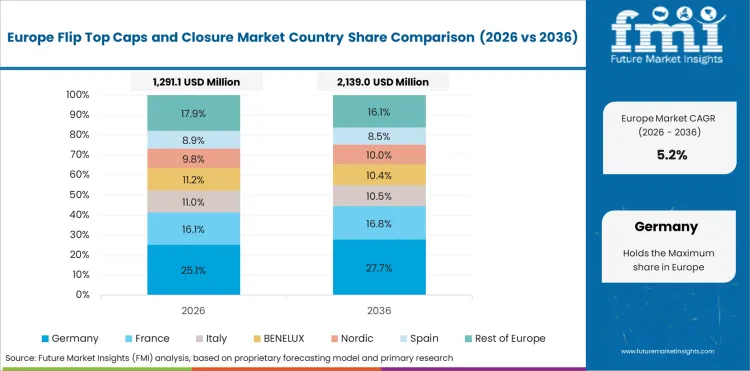
Europe represents a sustainability-driven flip-top caps and closures market shaped primarily by circular-economy packaging regulations and material-reduction mandates influencing closure design strategies across regional packaging supply chains. Closure manufacturers operating in the region are increasingly aligning product portfolios with mono-material recyclability frameworks and tethered closure requirements emerging under European packaging policy developments. These regulatory transitions are accelerating redesign of hinge geometries, closure diameters, and resin compositions to support recyclability compatibility without compromising dispensing performance reliability.
The region’s strong emphasis on packaging waste reduction and extended producer responsibility compliance is reinforcing adoption of lightweight dispensing closure architectures capable of maintaining torque stability while reducing polymer consumption intensity. As a result, Europe functions as a leading innovation geography for sustainability-aligned dispensing closure engineering rather than a purely consumption-driven closure market.
- Germany:Demand for flip-top caps and closures in Germany continues to expand steadily as packaging manufacturers align closure design strategies with compliance requirements under the German Packaging Act and broader European circular-economy frameworks. Closure adoption is supported by strong industrial packaging infrastructure and high penetration of automated filling systems across personal-care, pharmaceutical-adjacent, and household-chemical packaging environments that require consistent hinge performance and reliable leak-prevention capability across distribution networks.
Manufacturers operating in Germany are increasingly transitioning toward mono-material polypropylene dispensing closures compatible with regional recycling streams and are investing in lightweight closure architectures designed to reduce polymer consumption without compromising sealing reliability. Germany’s role as a manufacturing hub within the European packaging value chain further supports adoption of standardized closure geometries compatible with cross-border supply-chain integration requirements across consumer goods packaging ecosystems.
Latin America: Expanding Convenience Packaging Adoption Market
Latin America represents an expanding flip-top caps and closures market supported by steady growth in packaged personal-care consumption and increasing penetration of resealable dispensing formats across food condiment and household cleaning product categories. Growth across the region is reinforced by rising urbanization rates, improving retail distribution infrastructure, and increasing localization of packaging conversion capacity supporting multinational brand operations.
Closure manufacturers operating in Latin America are increasingly aligning product portfolios with cost-efficient hinge architectures capable of supporting large-volume FMCG packaging requirements while maintaining dispensing reliability across diverse climatic conditions. Regional demand growth remains strongly influenced by convenience-driven packaging adoption rather than regulatory transitions alone, reflecting evolving consumer expectations regarding usability and resealability across frequently used liquid packaging formats.
- Brazil: Demand for flip-top caps and closures in Brazil is projected to expand at a CAGR of 5.8% through 2036, supported by continued growth in packaged personal-care consumption and increasing adoption of resealable dispensing formats across sauces, cleaning liquids, and topical formulations. The country’s mature FMCG manufacturing sector continues to strengthen closure demand through consistent product innovation and packaging differentiation strategies deployed by multinational brand owners competing across domestic retail channels.
Expansion of automated packaging infrastructure across consumer-goods manufacturing facilities is reinforcing adoption of standardized dispensing closure geometries compatible with high-speed filling lines. At the same time, sustainability awareness across packaging supply chains is gradually encouraging adoption of mono-material closure platforms aligned with recyclability improvement initiatives across urban waste-management systems.
Competitive Analysis
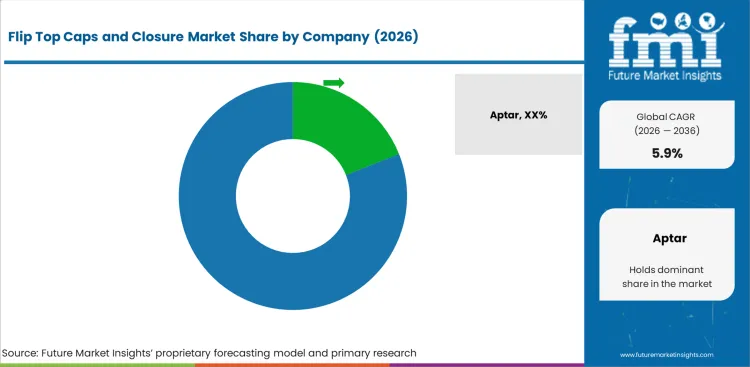
The flip-top caps and closures market is moderately consolidated at the global level and increasingly characterized by competition based on dispensing-system engineering capability rather than commodity closure supply scale alone. Leading closure manufacturers are repositioning flip-top dispensing architectures as value-adding packaging interfaces capable of improving consumer usability, enhancing leak-prevention reliability, and supporting sustainability compliance readiness across multiple end-use industries.
Manufacturers investing in elastomer-valve dispensing technologies are strengthening competitive positioning across premium personal-care and healthcare packaging applications requiring controlled dosing performance across viscous formulations. At the same time, development of mono-material polypropylene closure platforms compatible with mechanical recycling systems is emerging as a critical differentiation factor influencing supplier qualification decisions among multinational consumer goods brand owners.
Portfolio expansion through acquisitions and capability consolidation is reinforcing competitive barriers within the dispensing-closure segment. Larger closure manufacturers are increasingly integrating hinge-engineering expertise, tooling precision capability, and regional production optimization strategies to support high-volume FMCG packaging demand across multiple geographic markets. These developments are gradually shifting competition away from price-driven closure supply toward design sophistication, sustainability alignment, and integration with automated packaging-line infrastructure.
Recent Developments
- In July 2025, Aptar Closures introduced a new generation of tamper-evident and recycling-ready sport beverage closures at Drinktec 2025, including the NexTE, Rocket, and Balance closure platforms. These closures were developed to support one-hand opening functionality, improved tamper-evidence visibility, and compatibility with lightweight neck-finish transitions aligned with sustainability targets. The Rocket closure platform incorporates advanced hinge technology and optional thermoplastic elastomer valve integration, enabling improved drinking ergonomics and leak-prevention performance across beverage applications. The solutions are also designed to support compliance with European Single-Use Plastics Directive and Packaging and Packaging Waste Regulation requirements, reinforcing the growing role of tethered and mono-material closures within regulated beverage packaging systems.
- In February 2025, Aptar Closures introduced its SureSnap valve-retaining ring dispensing system designed for reusable beverage container applications. The solution integrates a flow-control valve and retaining ring architecture enabling contactless and leak-free dispensing performance across reusable hydration packaging formats including children’s sip cups, thermoses, and portable beverage containers. The development demonstrates continued expansion of elastomer-valve-enabled dispensing closure platforms supporting reusable packaging ecosystems aligned with circular packaging strategies.
Key Players
- Aptar
- Silgan Holdings
- Amcor plc
- ALPLA Werke Alwin Lehner GmbH & Co. KG
- BERICAP
- Weener Plastics
- MENSHEN
- Rieke (TriMas Corporation)
- YOSHINOKOGYOSHO Co., Ltd.
- Mahika Packaging
- Blackhawk Molding Co. Inc.
- MJS Packaging
- Guala Closures S.p.A.
Scope of Report
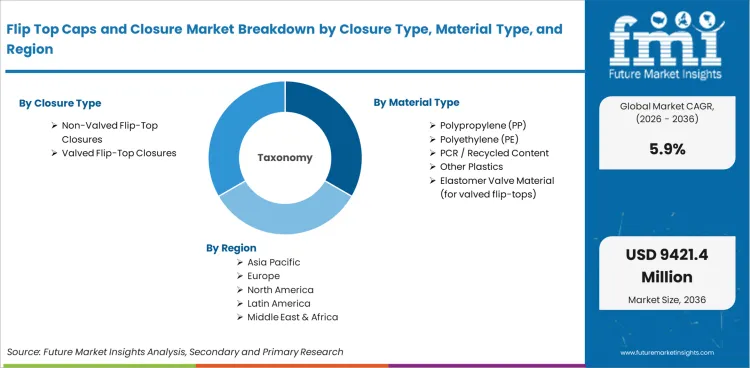
| Items | Values |
|---|---|
| Quantitative Units | USD million |
| By Closure Type | Non-Valved Flip-Top Closures (One-Piece Flip-Top; Two-Piece Flip-Top; Child-Resistant Flip-Top; Dispensing Flip-Top); Valved Flip-Top Closures (Elastomer Valve Flip-Tops; Silicone Valves; TPE Valves; Non-Elastomer Valves; Thermoplastic Valves; Hybrid Constructions) |
| By Material Type | Polypropylene (PP); Polyethylene (PE); PCR / Recycled Content Plastics; Other Plastics (PET; Bio-Based Plastics); Elastomer Valve Materials (Silicone; TPE; Other Elastomers) |
| End Use | Food & Beverage; Personal Care & Beauty; Baby Care Products; Home Care; Health Care & Pharmaceuticals; Industrial & Specialty Applications |
| Regions Covered | North America, Europe, East Asia, South Asia, Latin America, Middle East & Africa |
| Countries Covered | United States, Germany, China, India, Japan, Italy, and 40+ countries |
| Key Companies Profiled | Aptar; Silgan Holdings; Amcor plc; ALPLA Werke Alwin Lehner GmbH & Co KG; BERICAP; Others |
| Additional Attributes | Revenue analysis by closure type, material composition, neck finish diameter, packaging format, value tier, functionality, and sustainability profile; assessment of dispensing performance, leak prevention, child-resistance, and e-commerce readiness; evaluation of sustainability initiatives including mono-material designs, recycled content integration, and tethered flip-top compliance with evolving packaging regulations; analysis of procurement dynamics driven by brand differentiation, regulatory compliance, cost efficiency, and long-term partnerships between closure manufacturers and packaging converters. |
Segmentation of Flip-Top Caps and Closures Market
By Closure Type
- Non-Valved Flip-Top Closures
- One-piece flip-top
- Two-piece flip-top
- Child-resistant flip-top
- Dispensing flip-top (non-valved)
- Valved Flip-Top Closures
- Elastomer Valve Flip-Tops
- Silicone valves
- TPE valves
- Non-elastomer valves
- Thermoplastic valves
- Hybrid constructions
- Elastomer Valve Flip-Tops
By Material Type
- Polypropylene (PP)
- Homopolymer PP
- Random copolymer PP
- Polyethylene (PE)
- HDPE
- LDPE / LLDPE
- PCR / Recycled Content
- PCR-PP
- PCR-PE
- Other Plastics
- PET
- Bio-based plastics (e.g., bio-PP, bio-PE)
- Elastomer Valve Material (for valved flip-tops)
- Silicone
- TPE
- Other elastomers
By Neck Finish
- 20 mm
- 20-24 mm
- 25-28 mm
- 29-33 mm
- 34-38 mm
- 38 mm
By Packaging Format
- Bottles
- Rigid bottles (HDPE, PP, PET)
- Squeeze bottles
- Tubes
- Plastic laminate tubes
- Mono-material tubes
- Pouches
- Stand-up pouches with spout & flip-top
- Jars & Canisters
- Specialty Containers
- Airless containers
- Dual-chamber packs
By End-Use Category
- Food & Beverage
- Sauces & Condiments
- Ketchup & Tomato-based sauces
- Mayonnaise & Dressings
- Honey & Syrups
- Spreads & Nut butters
- Cooking oils & flavoured oils
- Dairy & dairy-alternatives beverages
- Sauces & Condiments
- Personal Care & Beauty
- Hair care (shampoo, conditioner, treatments)
- Skin care (lotions, creams, gels)
- Bath & shower (body wash, liquid soap)
- Sun care
- Baby Care Products
- Home Care
- Dishwashing liquids
- Laundry liquids & gels
- Surface cleaners
- Toilet & bathroom cleaners
- Health Care & Pharma
- OTC topical preparations
- Hand sanitizers
- Nutraceutical liquids & syrups
- Industrial & Specialty
- Lubricants & automotive fluids (small packs)
- DIY & household chemicals
By Value Tier
- Mass / Value Tier
- Mid-tier / Masstige
- Premium
- Prestige / Luxury
By Functionality
- Hinge Type
- Living hinge
- Mechanical hinge
- Tamper-Evidence
- With TE-band / seal
- Without TE features
- Child-Resistance
- Child-resistant flip-tops
- Non-CR flip-tops
- E-commerce Readiness
- E-commerce-certified / leak-proof designs
- Standard designs
By Sustainability Profile
- Mono-material Closures
- Mono-PP
- Mono-PE
- Recycled Content Closures
- PCR integrated
- Non-PCR
- Tethered Flip-Top Closures
- Tethered to neck finish (compliant with EU PPWR)
- Non-tethered
Bibliography
- International Organization for Standardization (ISO). Child-Resistant Packaging - Performance Requirements for Reclosable Packaging (ISO 8317).
- European Committee for Standardization (CEN). Packaging - Reclosable Plastic Caps and Closures Functional Performance Standards.
- USA Consumer Product Safety Commission (CPSC). Poison Prevention Packaging Standards (16 CFR Part 1700).
- ASTM International. Standard Test Methods for Mechanical Performance of Plastic Caps and Closures.
- PMMI - The Association for Packaging and Processing Technologies. Caps and Closures Performance in Consumer Packaging Systems.
- Institute of Packaging Professionals (IoPP). Closure Systems and Dispensing Components in Rigid Packaging.
- World Packaging Organisation (WPO). Global Packaging Technology Report: Dispensing Systems and Closures.
- PlasticsEurope. Polyolefin Materials for Caps and Closures Design and Recyclability Guidance.
This Report Addresses
- Strategic market intelligence enabling long-term portfolio planning across dispensing-closure manufacturing ecosystems.
- Global market size estimation with revenue forecasts validated through closure-penetration modeling across liquid packaging formats.
- Growth opportunity assessment across valve-regulated dispensing architectures supporting viscous product packaging applications.
- Material transition analysis covering mono-material polypropylene closures, PCR-integrated dispensing systems, and tethered closure regulatory readiness.
- End-use demand mapping across personal-care, food condiment, healthcare, nutraceutical, and household cleaning packaging supply chains.
- Regional outlook assessment covering Asia Pacific, North America, Europe, and Latin America supported by country-level adoption benchmarking.
- Competitive benchmarking of dispensing-closure manufacturers based on hinge-engineering capability, valve-integration expertise, sustainability alignment, and automated filling compatibility readiness.
Frequently Asked Questions
How large is the flip-top caps and closures market in 2026?
The flip-top caps and closures market is estimated to reach USD 5,309.3 million in 2026 supported by expanding adoption of ergonomic dispensing packaging formats across personal-care, food condiment, and household cleaning applications.
What will be the market size by 2036?
The market is projected to expand to USD 9,421.4 million by 2036 supported by increasing integration of valve-regulated dispensing systems and mono-material recyclable closure architectures.
What is the expected growth rate during the forecast period?
The market is expected to expand at a compound annual growth rate of 5.9% between 2026 and 2036.
Which closure type leads demand growth?
Valved flip-top closures lead demand growth due to their ability to support controlled dispensing performance across viscous liquid packaging applications.
Which material dominates closure production?
Polypropylene remains the dominant closure material due to hinge durability, lightweight structure, and recyclability compatibility across global packaging supply chains.
Which region represents the fastest-growing market?
South Asia led by India represents the fastest-growing regional market supported by rapid expansion in FMCG packaging consumption and increasing adoption of resealable dispensing formats.
Preview the report firsthand - request a free sample
Get SampleGet the brochure for pricing and purchase details.
Get PDFTable of Content
- Executive Summary
- Global Market Outlook
- Demand-side Trends
- Supply-side Trends
- Technology Roadmap Analysis
- Analysis and Recommendations
- Market Overview
- Market Coverage / Taxonomy
- Market Definition / Scope / Limitations
- Research Methodology
- Chapter Orientation
- Analytical Lens and Working Hypotheses
- Market Structure, Signals, and Trend Drivers
- Benchmarking and Cross-market Comparability
- Market Sizing, Forecasting, and Opportunity Mapping
- Research Design and Evidence Framework
- Desk Research Programme (Secondary Evidence)
- Company Annual and Sustainability Reports
- Peer-reviewed Journals and Academic Literature
- Corporate Websites, Product Literature, and Technical Notes
- Earnings Decks and Investor Briefings
- Statutory Filings and Regulatory Disclosures
- Technical White Papers and Standards Notes
- Trade Journals, Industry Magazines, and Analyst Briefs
- Conference Proceedings, Webinars, and Seminar Materials
- Government Statistics Portals and Public Data Releases
- Press Releases and Reputable Media Coverage
- Specialist Newsletters and Curated Briefings
- Sector Databases and Reference Repositories
- FMI Internal Proprietary Databases and Historical Market Datasets
- Subscription Datasets and Paid Sources
- Social Channels, Communities, and Digital Listening Inputs
- Additional Desk Sources
- Expert Input and Fieldwork (Primary Evidence)
- Primary Modes
- Qualitative Interviews and Expert Elicitation
- Quantitative Surveys and Structured Data Capture
- Blended Approach
- Why Primary Evidence is Used
- Field Techniques
- Interviews
- Surveys
- Focus Groups
- Observational and In-context Research
- Social and Community Interactions
- Stakeholder Universe Engaged
- C-suite Leaders
- Board Members
- Presidents and Vice Presidents
- R&D and Innovation Heads
- Technical Specialists
- Domain Subject-matter Experts
- Scientists
- Physicians and Other Healthcare Professionals
- Governance, Ethics, and Data Stewardship
- Research Ethics
- Data Integrity and Handling
- Primary Modes
- Tooling, Models, and Reference Databases
- Desk Research Programme (Secondary Evidence)
- Data Engineering and Model Build
- Data Acquisition and Ingestion
- Cleaning, Normalisation, and Verification
- Synthesis, Triangulation, and Analysis
- Quality Assurance and Audit Trail
- Market Background
- Market Dynamics
- Drivers
- Restraints
- Opportunity
- Trends
- Scenario Forecast
- Demand in Optimistic Scenario
- Demand in Likely Scenario
- Demand in Conservative Scenario
- Opportunity Map Analysis
- Product Life Cycle Analysis
- Supply Chain Analysis
- Investment Feasibility Matrix
- Value Chain Analysis
- PESTLE and Porter’s Analysis
- Regulatory Landscape
- Regional Parent Market Outlook
- Production and Consumption Statistics
- Import and Export Statistics
- Market Dynamics
- Global Market Analysis 2021 to 2025 and Forecast, 2026 to 2036
- Historical Market Size Value (USD Million) Analysis, 2021 to 2025
- Current and Future Market Size Value (USD Million) Projections, 2026 to 2036
- Y-o-Y Growth Trend Analysis
- Absolute $ Opportunity Analysis
- Global Market Pricing Analysis 2021 to 2025 and Forecast 2026 to 2036
- Global Market Analysis 2021 to 2025 and Forecast 2026 to 2036, By Closure Type
- Introduction / Key Findings
- Historical Market Size Value (USD Million) Analysis By Closure Type , 2021 to 2025
- Current and Future Market Size Value (USD Million) Analysis and Forecast By Closure Type , 2026 to 2036
- Non-Valved Flip-Top Closures
- Valved Flip-Top Closures
- Non-Valved Flip-Top Closures
- Y-o-Y Growth Trend Analysis By Closure Type , 2021 to 2025
- Absolute $ Opportunity Analysis By Closure Type , 2026 to 2036
- Global Market Analysis 2021 to 2025 and Forecast 2026 to 2036, By Material Type
- Introduction / Key Findings
- Historical Market Size Value (USD Million) Analysis By Material Type, 2021 to 2025
- Current and Future Market Size Value (USD Million) Analysis and Forecast By Material Type, 2026 to 2036
- Polypropylene (PP)
- Polyethylene (PE)
- PCR / Recycled Content
- Other Plastics
- Elastomer Valve Material (for valved flip-tops)
- Polypropylene (PP)
- Y-o-Y Growth Trend Analysis By Material Type, 2021 to 2025
- Absolute $ Opportunity Analysis By Material Type, 2026 to 2036
- Global Market Analysis 2021 to 2025 and Forecast 2026 to 2036, By Neck Finish
- Introduction / Key Findings
- Historical Market Size Value (USD Million) Analysis By Neck Finish, 2021 to 2025
- Current and Future Market Size Value (USD Million) Analysis and Forecast By Neck Finish, 2026 to 2036
- 20 mm
- 20–24 mm
- 25–28 mm
- 29–33 mm
- 34–38 mm
- 38 mm
- 20 mm
- Y-o-Y Growth Trend Analysis By Neck Finish, 2021 to 2025
- Absolute $ Opportunity Analysis By Neck Finish, 2026 to 2036
- Global Market Analysis 2021 to 2025 and Forecast 2026 to 2036, By Region
- Introduction
- Historical Market Size Value (USD Million) Analysis By Region, 2021 to 2025
- Current Market Size Value (USD Million) Analysis and Forecast By Region, 2026 to 2036
- North America
- Latin America
- Western Europe
- Eastern Europe
- East Asia
- South Asia and Pacific
- Middle East & Africa
- Market Attractiveness Analysis By Region
- North America Market Analysis 2021 to 2025 and Forecast 2026 to 2036, By Country
- Historical Market Size Value (USD Million) Trend Analysis By Market Taxonomy, 2021 to 2025
- Market Size Value (USD Million) Forecast By Market Taxonomy, 2026 to 2036
- By Country
- USA
- Canada
- Mexico
- By Closure Type
- By Material Type
- By Neck Finish
- By Country
- Market Attractiveness Analysis
- By Country
- By Closure Type
- By Material Type
- By Neck Finish
- Key Takeaways
- Latin America Market Analysis 2021 to 2025 and Forecast 2026 to 2036, By Country
- Historical Market Size Value (USD Million) Trend Analysis By Market Taxonomy, 2021 to 2025
- Market Size Value (USD Million) Forecast By Market Taxonomy, 2026 to 2036
- By Country
- Brazil
- Chile
- Rest of Latin America
- By Closure Type
- By Material Type
- By Neck Finish
- By Country
- Market Attractiveness Analysis
- By Country
- By Closure Type
- By Material Type
- By Neck Finish
- Key Takeaways
- Western Europe Market Analysis 2021 to 2025 and Forecast 2026 to 2036, By Country
- Historical Market Size Value (USD Million) Trend Analysis By Market Taxonomy, 2021 to 2025
- Market Size Value (USD Million) Forecast By Market Taxonomy, 2026 to 2036
- By Country
- Germany
- UK
- Italy
- Spain
- France
- Nordic
- BENELUX
- Rest of Western Europe
- By Closure Type
- By Material Type
- By Neck Finish
- By Country
- Market Attractiveness Analysis
- By Country
- By Closure Type
- By Material Type
- By Neck Finish
- Key Takeaways
- Eastern Europe Market Analysis 2021 to 2025 and Forecast 2026 to 2036, By Country
- Historical Market Size Value (USD Million) Trend Analysis By Market Taxonomy, 2021 to 2025
- Market Size Value (USD Million) Forecast By Market Taxonomy, 2026 to 2036
- By Country
- Russia
- Poland
- Hungary
- Balkan & Baltic
- Rest of Eastern Europe
- By Closure Type
- By Material Type
- By Neck Finish
- By Country
- Market Attractiveness Analysis
- By Country
- By Closure Type
- By Material Type
- By Neck Finish
- Key Takeaways
- East Asia Market Analysis 2021 to 2025 and Forecast 2026 to 2036, By Country
- Historical Market Size Value (USD Million) Trend Analysis By Market Taxonomy, 2021 to 2025
- Market Size Value (USD Million) Forecast By Market Taxonomy, 2026 to 2036
- By Country
- China
- Japan
- South Korea
- By Closure Type
- By Material Type
- By Neck Finish
- By Country
- Market Attractiveness Analysis
- By Country
- By Closure Type
- By Material Type
- By Neck Finish
- Key Takeaways
- South Asia and Pacific Market Analysis 2021 to 2025 and Forecast 2026 to 2036, By Country
- Historical Market Size Value (USD Million) Trend Analysis By Market Taxonomy, 2021 to 2025
- Market Size Value (USD Million) Forecast By Market Taxonomy, 2026 to 2036
- By Country
- India
- ASEAN
- Australia & New Zealand
- Rest of South Asia and Pacific
- By Closure Type
- By Material Type
- By Neck Finish
- By Country
- Market Attractiveness Analysis
- By Country
- By Closure Type
- By Material Type
- By Neck Finish
- Key Takeaways
- Middle East & Africa Market Analysis 2021 to 2025 and Forecast 2026 to 2036, By Country
- Historical Market Size Value (USD Million) Trend Analysis By Market Taxonomy, 2021 to 2025
- Market Size Value (USD Million) Forecast By Market Taxonomy, 2026 to 2036
- By Country
- Kingdom of Saudi Arabia
- Other GCC Countries
- Turkiye
- South Africa
- Other African Union
- Rest of Middle East & Africa
- By Closure Type
- By Material Type
- By Neck Finish
- By Country
- Market Attractiveness Analysis
- By Country
- By Closure Type
- By Material Type
- By Neck Finish
- Key Takeaways
- Key Countries Market Analysis
- USA
- Pricing Analysis
- Market Share Analysis, 2025
- By Closure Type
- By Material Type
- By Neck Finish
- Canada
- Pricing Analysis
- Market Share Analysis, 2025
- By Closure Type
- By Material Type
- By Neck Finish
- Mexico
- Pricing Analysis
- Market Share Analysis, 2025
- By Closure Type
- By Material Type
- By Neck Finish
- Brazil
- Pricing Analysis
- Market Share Analysis, 2025
- By Closure Type
- By Material Type
- By Neck Finish
- Chile
- Pricing Analysis
- Market Share Analysis, 2025
- By Closure Type
- By Material Type
- By Neck Finish
- Germany
- Pricing Analysis
- Market Share Analysis, 2025
- By Closure Type
- By Material Type
- By Neck Finish
- UK
- Pricing Analysis
- Market Share Analysis, 2025
- By Closure Type
- By Material Type
- By Neck Finish
- Italy
- Pricing Analysis
- Market Share Analysis, 2025
- By Closure Type
- By Material Type
- By Neck Finish
- Spain
- Pricing Analysis
- Market Share Analysis, 2025
- By Closure Type
- By Material Type
- By Neck Finish
- France
- Pricing Analysis
- Market Share Analysis, 2025
- By Closure Type
- By Material Type
- By Neck Finish
- India
- Pricing Analysis
- Market Share Analysis, 2025
- By Closure Type
- By Material Type
- By Neck Finish
- ASEAN
- Pricing Analysis
- Market Share Analysis, 2025
- By Closure Type
- By Material Type
- By Neck Finish
- Australia & New Zealand
- Pricing Analysis
- Market Share Analysis, 2025
- By Closure Type
- By Material Type
- By Neck Finish
- China
- Pricing Analysis
- Market Share Analysis, 2025
- By Closure Type
- By Material Type
- By Neck Finish
- Japan
- Pricing Analysis
- Market Share Analysis, 2025
- By Closure Type
- By Material Type
- By Neck Finish
- South Korea
- Pricing Analysis
- Market Share Analysis, 2025
- By Closure Type
- By Material Type
- By Neck Finish
- Russia
- Pricing Analysis
- Market Share Analysis, 2025
- By Closure Type
- By Material Type
- By Neck Finish
- Poland
- Pricing Analysis
- Market Share Analysis, 2025
- By Closure Type
- By Material Type
- By Neck Finish
- Hungary
- Pricing Analysis
- Market Share Analysis, 2025
- By Closure Type
- By Material Type
- By Neck Finish
- Kingdom of Saudi Arabia
- Pricing Analysis
- Market Share Analysis, 2025
- By Closure Type
- By Material Type
- By Neck Finish
- Turkiye
- Pricing Analysis
- Market Share Analysis, 2025
- By Closure Type
- By Material Type
- By Neck Finish
- South Africa
- Pricing Analysis
- Market Share Analysis, 2025
- By Closure Type
- By Material Type
- By Neck Finish
- USA
- Market Structure Analysis
- Competition Dashboard
- Competition Benchmarking
- Market Share Analysis of Top Players
- By Regional
- By Closure Type
- By Material Type
- By Neck Finish
- Competition Analysis
- Competition Deep Dive
- Aptar
- Overview
- Product Portfolio
- Profitability by Market Segments (Product/Age /Sales Channel/Region)
- Sales Footprint
- Strategy Overview
- Marketing Strategy
- Product Strategy
- Channel Strategy
- Silgan Holdings
- Amcor plc.
- ALPLA Werke Alwin Lehner GmbH & Co KG
- BERICAP
- Aptar
- Competition Deep Dive
- Assumptions & Acronyms Used


