

- Industry Size (2026)
- USD 899.9 Mn
- Forecast (2036)
- USD 1596.4 Mn
- CAGR (2026 to 2036)
- 5.9%
Flying Probe Tester Market Forecast and Outlook 2026 to 2036
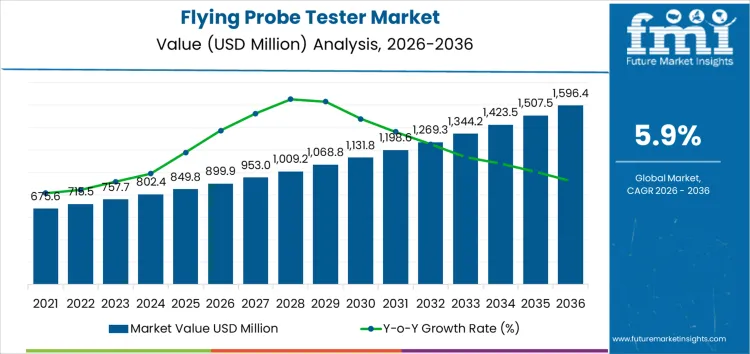
The global flying probe tester market is forecasted to grow from USD 899.9 million in 2026 to USD 1596.4 million by 2036, at a CAGR of 5.9% over the 2026–2036 period. Flying probe testers are especially valuable in prototyping, design iteration, low to medium volume production, and environments with frequent revisions. As electronic assemblies become more complex spanning rigid, flex, rigid‑flex, and HDI boards the ability to perform high‑coverage testing without bespoke fixtures supports quality assurance and shortens time‑to‑market. Industries like consumer electronics, automotive, aerospace, and medical devices are key adopters due to their high reliability and safety requirements.
Quick Stats for Flying Probe Tester Market
- Flying Probe Tester Market Value (2026): USD 899.9 million
- Flying Probe Tester Market Forecast Value (2036): USD 1596.4 million
- Flying Probe Tester Market Forecast CAGR: 5.9%
- Leading PCB Type in Flying Probe Tester Market: Rigid PCBs (44% share)
- Key Growth Region in Flying Probe Tester Market: Asia Pacific
- Key Players in Flying Probe Tester Market: SPEA, Seica, Takaya, Acculogic, ATG
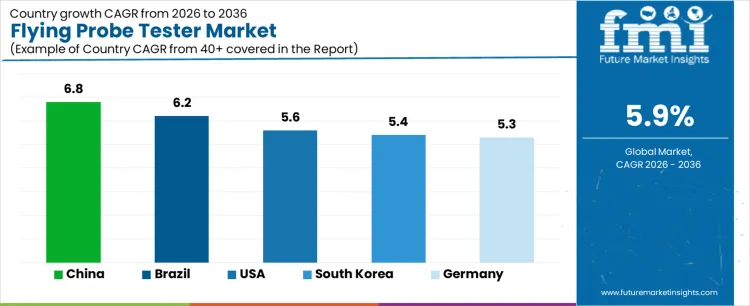
Country‑wise growth shows China leading the market with the highest expected growth at 6.8% CAGR, fueled by its large and expanding electronics manufacturing sector and increased focus on automation and quality testing. Brazil follows with a 6.2% CAGR, supported by growth in electronics, automotive, and industrial fabrication needing efficient PCB testing systems. In the USA, the market is expected to grow at 5.6%, reflecting strong demand in automotive, aerospace, and advanced manufacturing sectors that prioritize precision testing and reliability. South Korea sees a 5.4% CAGR, driven by its strong semiconductor and electronics industries, while Germany grows at 5.3%, backed by its emphasis on quality control and high‑precision manufacturing.
Flying Probe Tester Market Key Takeaways
| Metric | Value |
|---|---|
| Industry Value (2026) | USD 899.9 million |
| Forecast Value (2036) | USD 1,596.4 million |
| Forecast CAGR (2026 to 2036) | 5.9% |
How is the Global Flying Probe Tester Market Evolving?
The global flying probe tester market is growing steadily as electronics manufacturers seek flexible, cost-effective solutions for testing printed circuit boards (PCBs) and components during development and low-to-medium volume production. Flying probe testers use movable probes to contact circuit nodes without the need for custom fixtures, making them especially valuable for prototyping, small batch runs, and designs with frequent revisions. Traditional in-circuit testing methods often require bespoke fixtures that are time-consuming and expensive to produce, creating barriers for quick turnaround and iterative design cycles. In contrast, flying probe testers offer high test coverage with reduced setup overhead.
Demand for flying probe testers is driven by trends in electronics miniaturization, increasing complexity of multi-layer PCBs, and shorter product lifecycles in sectors such as consumer electronics, automotive, aerospace, and medical devices. Advances in probe control algorithms, high-speed data acquisition, and software integration have improved the accuracy, speed, and ease of programming of modern systems. Enhanced user interfaces and automation features also help engineers quickly validate design changes and detect faults early in the production process, reducing rework and material waste.
Challenges such as competition from alternative testing technologies, the need for skilled operators, and balancing investment costs with production volume may influence adoption rates. Flying probe testers will remain integral to electronics testing, particularly in environments where flexibility, reduced lead times, and cost efficiency are priorities.
What Is the Segment-Wise Analysis for the Global Flying Probe Tester Market?
The global flying probe tester market is segmented by PCB type and end user. Rigid PCBs lead the market with a 44% share due to their widespread use in various electronic applications. Flex PCBs, rigid-flex, and HDI follow, each playing significant roles in specific applications, offering flexibility, compactness, and high-density interconnections, respectively. In terms of end users, EMS providers dominate with a 34% share, driven by the need for precise testing solutions in assembly processes. Other key end users include PCB fabricators, OEM captive manufacturing, and test houses, each relying on flying probe testers for efficient and accurate testing solutions tailored to their specific production needs.
How Do Rigid PCBs Lead the Global Flying Probe Tester Market?
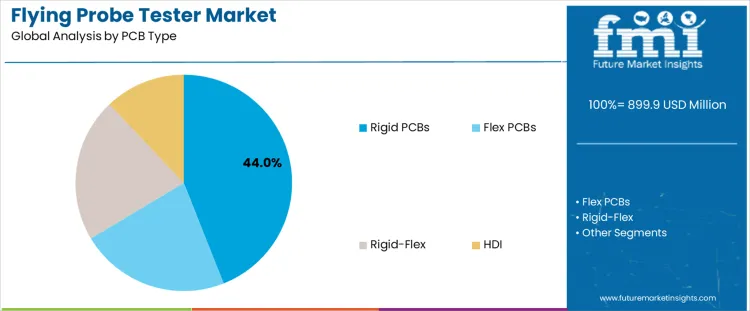
Rigid PCBs hold a 44% share in the global flying probe tester market due to their widespread application in a variety of electronic products. Rigid PCBs are crucial for providing stable, durable, and cost-effective solutions in industries ranging from automotive to consumer electronics. The demand for reliable and high-performance rigid PCBs, especially in mass production, increases the need for accurate testing solutions. Flying probe testers offer an efficient and non-contact testing method that ensures high-quality PCB production. As the demand for rigid PCBs continues to grow, driven by the expanding electronics sector, flying probe testers are becoming increasingly integral to the testing processes, reinforcing their leading position in the market.
How Do EMS Providers Contribute to the Global Flying Probe Tester Market?
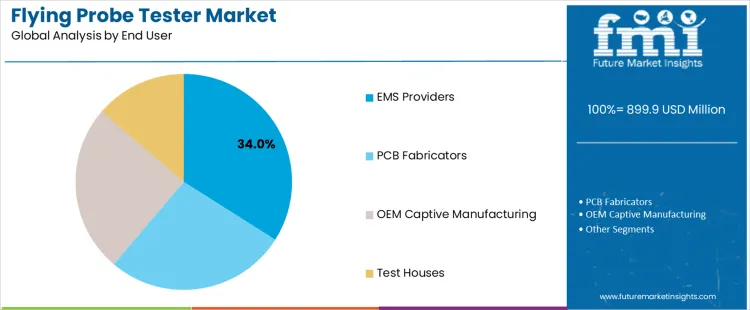
EMS providers account for 34% of the global flying probe tester market share due to the critical need for precise testing solutions in assembly processes. EMS providers rely on flying probe testers to ensure high-quality manufacturing by performing accurate and efficient testing of PCB assemblies. The ability to quickly and reliably test PCBs without the need for custom test fixtures makes flying probe testers highly valuable for EMS providers. As the demand for faster, more efficient manufacturing of complex electronic products rises, the role of flying probe testers in EMS continues to grow, driving market expansion in this segment.
What Are the Key Dynamics for the Flying Probe Tester Market?
Flying probe testers deliver high fault coverage without the need for custom fixtures, making them ideal for prototype validation, small batch production, and high-mix/low-volume environments. Growth in sectors such as automotive electronics, aerospace, medical devices, and IoT is driving adoption. The need for quick design-for-test feedback and reduced time-to-market encourages use of agile and non-intrusive testing technologies, positioning flying probe testers as essential tools in modern quality assurance programs.
What Are the Key Drivers for the Flying Probe Tester Market?
The flying probe tester market is driven by increasing complexity and diversity of electronic assemblies, which require adaptable and high-coverage testing strategies. Unlike traditional bed-of-nails ICT fixtures, flying probe systems offer fixture-less testing, reducing upfront tooling cost and time. This flexibility is particularly valuable for prototype runs, low-volume production, and frequent design changes. Rapid growth in advanced electronics such as automotive ECUs, wearable devices, industrial automation, and aerospace avionics requires reliable testing to ensure product quality and safety. The push for reduced manufacturing cycle times and lower scrap rates also reinforces demand for efficient, high-accuracy test platforms.
What Key Trends Are Shaping the Flying Probe Tester Market?
Key trends include the integration of advanced analytics and AI to optimize test routines, reduce false positives, and accelerate fault diagnosis. Vendors are enhancing software with pattern recognition and historical test data integration to improve coverage and predictive maintenance. Hybrid test solutions that combine flying probe capabilities with functional and boundary scan testing are gaining traction, offering broader fault detection in a single platform. Miniaturization of test heads and precision control improvements are enabling finer pitch and complex component testing as electronics become denser.
What is the Growth Outlook for the Flying Probe Tester Market by Country?
| Country | CAGR (%) |
|---|---|
| USA | 5.6% |
| South Korea | 5.4% |
| Germany | 5.3% |
| China | 6.8% |
| Brazil | 6.2% |
The flying probe tester market is growing steadily, with China leading at a 6.8% CAGR, driven by its expanding electronics manufacturing sector and the rising need for automated testing equipment. Brazil follows with a 6.2% growth rate, supported by increasing demand for efficient testing solutions across electronics and automotive sectors. The USA’s market grows at 5.6%, fueled by the rising demand for precision testing in sectors like automotive and aerospace. South Korea’s market grows at 5.4%, driven by the country’s strong semiconductor and electronics industries. Germany’s market grows at 5.3%, supported by the country’s emphasis on quality control and precision in manufacturing.
Why is China Leading in the Flying Probe Tester Market?

China’s flying probe tester market is growing at 6.8%, driven by the country’s dominant position in global electronics manufacturing. As China continues to expand its electronics production, including semiconductors and consumer goods, the demand for high-precision testing equipment like flying probe testers is increasing. These devices are crucial for testing printed circuit boards (PCBs) and ensuring the quality and functionality of electronic components. The rapid growth of the country’s manufacturing capabilities, coupled with its strong emphasis on automation and process optimization, is fueling demand for flying probe testers. With China’s continued focus on advancing its industrial base and technological infrastructure, the market for flying probe testers is expected to grow at a robust pace in the coming years.
What is Driving the Growth of the Flying Probe Tester Market in Brazil?
Brazil’s flying probe tester market is growing at 6.2%, driven by the expansion of its electronics, automotive, and industrial manufacturing sectors. As Brazil’s industrial base grows, the need for efficient, high-precision testing equipment for components such as printed circuit boards (PCBs) is increasing. Flying probe testers are vital tools in ensuring that these components meet quality standards and function as required in end applications. Brazil’s focus on modernizing its manufacturing capabilities, along with growing demand in industries such as automotive and consumer electronics, further boosts the market for flying probe testers. Regulatory standards for product quality and efficiency are encouraging the adoption of automated testing systems in Brazil’s industrial sectors, contributing to the market’s continued expansion.
How is the Flying Probe Tester Market Expanding in the USA?
The USA’s flying probe tester market is growing at 5.6%, driven by increased demand for precision testing equipment in various industries, including electronics, automotive, and aerospace. As these industries prioritize product quality and manufacturing efficiency, the need for advanced testing solutions, such as flying probe testers, continues to rise. Flying probe testers are essential tools for evaluating printed circuit boards (PCBs) and ensuring that they meet high-quality standards for performance and reliability. Furthermore, the USA’s focus on technological innovation and improvements in industrial production methods is contributing to market growth. As industries continue to invest in automation and advanced manufacturing processes, the demand for flying probe testers is expected to grow steadily.
What is Contributing to the Growth of the Flying Probe Tester Market in South Korea?
South Korea’s flying probe tester market is growing at 5.4%, supported by the country’s strong semiconductor and electronics industries. South Korea is a global leader in semiconductor manufacturing, and the demand for precise testing of printed circuit boards (PCBs) is increasing. Flying probe testers are critical for testing and ensuring the functionality of these components in high-tech applications such as electronics, consumer goods, and telecommunications. As the country continues to innovate and expand its industrial base, particularly in electronics and semiconductor production, the need for accurate and efficient testing solutions is rising. South Korea’s focus on enhancing manufacturing efficiency and product quality is further propelling the demand for flying probe testers, contributing to the steady growth of the market.
What is Driving the Growth of the Flying Probe Tester Market in Germany?
Germany’s flying probe tester market is growing at 5.3%, driven by the country’s strong industrial base, particularly in automotive, electronics, and manufacturing sectors. As a leader in industrial manufacturing, Germany requires high-precision testing equipment to ensure that components such as printed circuit boards (PCBs) meet stringent quality and performance standards. Flying probe testers are essential tools in these industries, enabling quick and accurate testing without the need for custom fixtures. With Germany’s emphasis on high-quality production and compliance with strict safety standards, the demand for flying probe testers is increasing. The market is also supported by Germany’s focus on innovation and technological advancements in industrial testing, ensuring continued growth in the flying probe tester market.
How Are Companies Competing in the Flying Probe Tester Market?
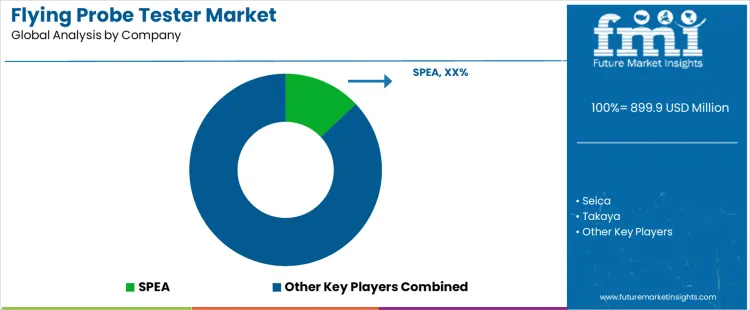
In the flying probe tester market SPEA, Seica, Takaya, Acculogic, ATG, MicroCraft, Keysight, Teradyne, Chroma ATE, and Nordson TEST & INSPECTION are positioned with product brochures that focus on test coverage, speed, and flexibility for bare boards and assembled PCBs. SPEA materials present high‑speed flying probe systems designed for mixed‑technology boards and low‑volume manufacturing. Brochures include clear specifications on probe count, axes configuration, and throughput to help test engineers evaluate suitability. Seica collateral emphasizes modular platforms with scalable architectures. Performance charts and interface snapshots are used to support specification in automated test environments.
Takaya product literature highlights precision probe mechanics and easy programming with concise visuals of setup screens and configuration options. Acculogic brochures focus on compact flying probe solutions with strong fault coverage and straightforward operator interfaces. Technical summaries and comparative tables help technicians match test systems to product complexity. ATG materials describe agile flying probe testers with expandable features and detailed application notes. MicroCraft collateral presents versatile systems where high‑accuracy probe positioning is described alongside clear test coverage maps.
Keysight and Teradyne product briefs showcase flying probe offerings with integration into broader ATE ecosystems. Performance data and use case highlights are included to support decisions in high‑mix test labs. Chroma ATE materials emphasize modular test capabilities with concise charts showing supported protocols and speeds. Nordson TEST & INSPECTION brochures describe flying probe testers with robust mechanics and software tools designed for reliable in‑line and off‑line testing.
Key Players in Flying Probe Tester Market
- SPEA
- Seica
- Takaya
- Acculogic
- ATG
- MicroCraft
- Keysight
- Teradyne
- Chroma ATE
- Nordson TEST & INSPECTION
Scope of Report
| Items | Values |
|---|---|
| Quantitative Unit (2026) | USD million |
| PCB Type | Rigid PCBs, Flex PCBs, Rigid-Flex, HDI |
| Test Capability | Continuity, Boundary Scan Support, Component, Hybrid |
| End User | EMS Providers, PCB Fabricators, OEM Captive Manufacturing, Test Houses |
| Regions Covered | Asia Pacific, Europe, North America, Latin America, Middle East & Africa |
| Countries Covered | USA, China, Japan, South Korea, India, Australia & New Zealand, ASEAN, Germany, UK, France, Italy, Spain, Nordic, BENELUX, Brazil, Chile, Mexico, Saudi Arabia, Other GCC Countries, Turkey, South Africa, Other African Union |
| Key Companies Profiled | SPEA, Seica, Takaya, Acculogic, ATG, MicroCraft, Keysight, Teradyne, Chroma ATE, Nordson TEST & INSPECTION |
| Additional Attributes | Dollar sales by PCB type, test capability, end user, and region provide insights into market segmentation and highlight the financial contribution of each segment. Regional CAGR and growth outlook reflect the potential expansion in various geographic areas. |
Flying Probe Tester Market by Segments
PCB Type
- Rigid PCBs
- Flex PCBs
- Rigid-Flex
- HDI
Test Capability
- Continuity
- Boundary Scan Support
- Component
- Hybrid
End User
- EMS Providers
- PCB Fabricators
- OEM Captive Manufacturing
- Test Houses
Region
- Asia Pacific
- China
- Japan
- South Korea
- India
- Australia & New Zealand
- ASEAN
- Rest of Asia Pacific
- Europe
- Germany
- United Kingdom
- France
- Italy
- Spain
- Nordic
- BENELUX
- Rest of Europe
- North America
- United States
- Canada
- Mexico
- Latin America
- Brazil
- Chile
- Rest of Latin America
- Middle East & Africa
- Kingdom of Saudi Arabia
- Other GCC Countries
- Turkey
- South Africa
- Other African Union
- Rest of Middle East & Africa
Frequently Asked Questions
How big is the flying probe tester market in 2026?
The global flying probe tester market is estimated to be valued at USD 899.9 million in 2026.
What will be the size of flying probe tester market in 2036?
The market size for the flying probe tester market is projected to reach USD 1,596.4 million by 2036.
How much will be the flying probe tester market growth between 2026 and 2036?
The flying probe tester market is expected to grow at a 5.9% CAGR between 2026 and 2036.
What are the key product types in the flying probe tester market?
The key product types in flying probe tester market are rigid pcbs, flex pcbs, rigid-flex and hdi.
Which test capability segment to contribute significant share in the flying probe tester market in 2026?
In terms of test capability, continuity segment to command 38.0% share in the flying probe tester market in 2026.
Preview the report firsthand - request a free sample
Get SampleGet the brochure for pricing and purchase details.
Get PDFTable of Content
- Executive Summary
- Global Market Outlook
- Demand-side Trends
- Supply-side Trends
- Technology Roadmap Analysis
- Analysis and Recommendations
- Market Overview
- Market Coverage / Taxonomy
- Market Definition / Scope / Limitations
- Market Background
- Market Dynamics
- Drivers
- Restraints
- Opportunity
- Trends
- Scenario Forecast
- Demand in Optimistic Scenario
- Demand in Likely Scenario
- Demand in Conservative Scenario
- Opportunity Map Analysis
- Product Life Cycle Analysis
- Supply Chain Analysis
- Investment Feasibility Matrix
- Value Chain Analysis
- PESTLE and Porter’s Analysis
- Regulatory Landscape
- Regional Parent Market Outlook
- Production and Consumption Statistics
- Import and Export Statistics
- Market Dynamics
- Global Market Analysis 2021 to 2025 and Forecast, 2026 to 2036
- Historical Market Size Value (USD Million) Analysis, 2021 to 2025
- Current and Future Market Size Value (USD Million) Projections, 2026 to 2036
- Y-o-Y Growth Trend Analysis
- Absolute $ Opportunity Analysis
- Global Market Pricing Analysis 2021 to 2025 and Forecast 2026 to 2036
- Global Market Analysis 2021 to 2025 and Forecast 2026 to 2036, By PCB Type
- Introduction / Key Findings
- Historical Market Size Value (USD Million) Analysis By PCB Type , 2021 to 2025
- Current and Future Market Size Value (USD Million) Analysis and Forecast By PCB Type , 2026 to 2036
- Rigid PCBs
- Flex PCBs
- Rigid-Flex
- HDI
- Rigid PCBs
- Y-o-Y Growth Trend Analysis By PCB Type , 2021 to 2025
- Absolute $ Opportunity Analysis By PCB Type , 2026 to 2036
- Global Market Analysis 2021 to 2025 and Forecast 2026 to 2036, By Test Capability
- Introduction / Key Findings
- Historical Market Size Value (USD Million) Analysis By Test Capability, 2021 to 2025
- Current and Future Market Size Value (USD Million) Analysis and Forecast By Test Capability, 2026 to 2036
- Continuity
- Boundary Scan Support
- Component
- Hybrid
- Continuity
- Y-o-Y Growth Trend Analysis By Test Capability, 2021 to 2025
- Absolute $ Opportunity Analysis By Test Capability, 2026 to 2036
- Global Market Analysis 2021 to 2025 and Forecast 2026 to 2036, By End User
- Introduction / Key Findings
- Historical Market Size Value (USD Million) Analysis By End User, 2021 to 2025
- Current and Future Market Size Value (USD Million) Analysis and Forecast By End User, 2026 to 2036
- EMS Providers
- PCB Fabricators
- OEM Captive Manufacturing
- Test Houses
- EMS Providers
- Y-o-Y Growth Trend Analysis By End User, 2021 to 2025
- Absolute $ Opportunity Analysis By End User, 2026 to 2036
- Global Market Analysis 2021 to 2025 and Forecast 2026 to 2036, By Region
- Introduction
- Historical Market Size Value (USD Million) Analysis By Region, 2021 to 2025
- Current Market Size Value (USD Million) Analysis and Forecast By Region, 2026 to 2036
- North America
- Latin America
- Western Europe
- Eastern Europe
- East Asia
- South Asia and Pacific
- Middle East & Africa
- Market Attractiveness Analysis By Region
- North America Market Analysis 2021 to 2025 and Forecast 2026 to 2036, By Country
- Historical Market Size Value (USD Million) Trend Analysis By Market Taxonomy, 2021 to 2025
- Market Size Value (USD Million) Forecast By Market Taxonomy, 2026 to 2036
- By Country
- USA
- Canada
- Mexico
- By PCB Type
- By Test Capability
- By End User
- By Country
- Market Attractiveness Analysis
- By Country
- By PCB Type
- By Test Capability
- By End User
- Key Takeaways
- Latin America Market Analysis 2021 to 2025 and Forecast 2026 to 2036, By Country
- Historical Market Size Value (USD Million) Trend Analysis By Market Taxonomy, 2021 to 2025
- Market Size Value (USD Million) Forecast By Market Taxonomy, 2026 to 2036
- By Country
- Brazil
- Chile
- Rest of Latin America
- By PCB Type
- By Test Capability
- By End User
- By Country
- Market Attractiveness Analysis
- By Country
- By PCB Type
- By Test Capability
- By End User
- Key Takeaways
- Western Europe Market Analysis 2021 to 2025 and Forecast 2026 to 2036, By Country
- Historical Market Size Value (USD Million) Trend Analysis By Market Taxonomy, 2021 to 2025
- Market Size Value (USD Million) Forecast By Market Taxonomy, 2026 to 2036
- By Country
- Germany
- UK
- Italy
- Spain
- France
- Nordic
- BENELUX
- Rest of Western Europe
- By PCB Type
- By Test Capability
- By End User
- By Country
- Market Attractiveness Analysis
- By Country
- By PCB Type
- By Test Capability
- By End User
- Key Takeaways
- Eastern Europe Market Analysis 2021 to 2025 and Forecast 2026 to 2036, By Country
- Historical Market Size Value (USD Million) Trend Analysis By Market Taxonomy, 2021 to 2025
- Market Size Value (USD Million) Forecast By Market Taxonomy, 2026 to 2036
- By Country
- Russia
- Poland
- Hungary
- Balkan & Baltic
- Rest of Eastern Europe
- By PCB Type
- By Test Capability
- By End User
- By Country
- Market Attractiveness Analysis
- By Country
- By PCB Type
- By Test Capability
- By End User
- Key Takeaways
- East Asia Market Analysis 2021 to 2025 and Forecast 2026 to 2036, By Country
- Historical Market Size Value (USD Million) Trend Analysis By Market Taxonomy, 2021 to 2025
- Market Size Value (USD Million) Forecast By Market Taxonomy, 2026 to 2036
- By Country
- China
- Japan
- South Korea
- By PCB Type
- By Test Capability
- By End User
- By Country
- Market Attractiveness Analysis
- By Country
- By PCB Type
- By Test Capability
- By End User
- Key Takeaways
- South Asia and Pacific Market Analysis 2021 to 2025 and Forecast 2026 to 2036, By Country
- Historical Market Size Value (USD Million) Trend Analysis By Market Taxonomy, 2021 to 2025
- Market Size Value (USD Million) Forecast By Market Taxonomy, 2026 to 2036
- By Country
- India
- ASEAN
- Australia & New Zealand
- Rest of South Asia and Pacific
- By PCB Type
- By Test Capability
- By End User
- By Country
- Market Attractiveness Analysis
- By Country
- By PCB Type
- By Test Capability
- By End User
- Key Takeaways
- Middle East & Africa Market Analysis 2021 to 2025 and Forecast 2026 to 2036, By Country
- Historical Market Size Value (USD Million) Trend Analysis By Market Taxonomy, 2021 to 2025
- Market Size Value (USD Million) Forecast By Market Taxonomy, 2026 to 2036
- By Country
- Kingdom of Saudi Arabia
- Other GCC Countries
- Turkiye
- South Africa
- Other African Union
- Rest of Middle East & Africa
- By PCB Type
- By Test Capability
- By End User
- By Country
- Market Attractiveness Analysis
- By Country
- By PCB Type
- By Test Capability
- By End User
- Key Takeaways
- Key Countries Market Analysis
- USA
- Pricing Analysis
- Market Share Analysis, 2025
- By PCB Type
- By Test Capability
- By End User
- Canada
- Pricing Analysis
- Market Share Analysis, 2025
- By PCB Type
- By Test Capability
- By End User
- Mexico
- Pricing Analysis
- Market Share Analysis, 2025
- By PCB Type
- By Test Capability
- By End User
- Brazil
- Pricing Analysis
- Market Share Analysis, 2025
- By PCB Type
- By Test Capability
- By End User
- Chile
- Pricing Analysis
- Market Share Analysis, 2025
- By PCB Type
- By Test Capability
- By End User
- Germany
- Pricing Analysis
- Market Share Analysis, 2025
- By PCB Type
- By Test Capability
- By End User
- UK
- Pricing Analysis
- Market Share Analysis, 2025
- By PCB Type
- By Test Capability
- By End User
- Italy
- Pricing Analysis
- Market Share Analysis, 2025
- By PCB Type
- By Test Capability
- By End User
- Spain
- Pricing Analysis
- Market Share Analysis, 2025
- By PCB Type
- By Test Capability
- By End User
- France
- Pricing Analysis
- Market Share Analysis, 2025
- By PCB Type
- By Test Capability
- By End User
- India
- Pricing Analysis
- Market Share Analysis, 2025
- By PCB Type
- By Test Capability
- By End User
- ASEAN
- Pricing Analysis
- Market Share Analysis, 2025
- By PCB Type
- By Test Capability
- By End User
- Australia & New Zealand
- Pricing Analysis
- Market Share Analysis, 2025
- By PCB Type
- By Test Capability
- By End User
- China
- Pricing Analysis
- Market Share Analysis, 2025
- By PCB Type
- By Test Capability
- By End User
- Japan
- Pricing Analysis
- Market Share Analysis, 2025
- By PCB Type
- By Test Capability
- By End User
- South Korea
- Pricing Analysis
- Market Share Analysis, 2025
- By PCB Type
- By Test Capability
- By End User
- Russia
- Pricing Analysis
- Market Share Analysis, 2025
- By PCB Type
- By Test Capability
- By End User
- Poland
- Pricing Analysis
- Market Share Analysis, 2025
- By PCB Type
- By Test Capability
- By End User
- Hungary
- Pricing Analysis
- Market Share Analysis, 2025
- By PCB Type
- By Test Capability
- By End User
- Kingdom of Saudi Arabia
- Pricing Analysis
- Market Share Analysis, 2025
- By PCB Type
- By Test Capability
- By End User
- Turkiye
- Pricing Analysis
- Market Share Analysis, 2025
- By PCB Type
- By Test Capability
- By End User
- South Africa
- Pricing Analysis
- Market Share Analysis, 2025
- By PCB Type
- By Test Capability
- By End User
- USA
- Market Structure Analysis
- Competition Dashboard
- Competition Benchmarking
- Market Share Analysis of Top Players
- By Regional
- By PCB Type
- By Test Capability
- By End User
- Competition Analysis
- Competition Deep Dive
- SPEA
- Overview
- Product Portfolio
- Profitability by Market Segments (Product/Age /Sales Channel/Region)
- Sales Footprint
- Strategy Overview
- Marketing Strategy
- Product Strategy
- Channel Strategy
- Seica
- Takaya
- Acculogic
- ATG
- MicroCraft
- Keysight
- Teradyne
- Chroma ATE
- Nordson TEST & INSPECTION
- SPEA
- Competition Deep Dive
- Assumptions & Acronyms Used
- Research Methodology


