

- Market Size (2026)
- USD 6.4 Bn
- Forecast (2036)
- USD 11.0 Bn
- CAGR (2026 to 2036)
- 5.5%
How big is Adsorbents Market in 2026?
Adsorbent market size moves from USD 6.1 billion in 2025 to USD 6.44 billion in 2026. The market is forecast to reach USD 10.99 billion by 2036, at a 5.5% CAGR over 2026 to 2036.
As per FMI, molecular sieves account for the leading 41.6% share in 2026, as synthetic zeolite grades are widely used for dehydration and impurity removal in gas, refinery and petrochemical streams. Market growth will remain moderate, as supplier results for 2025 reflected mixed demand conditions.
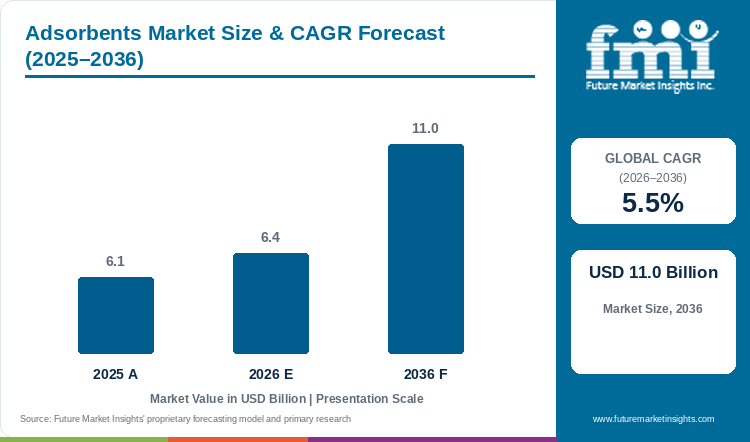
Kuraray reported higher activated carbon sales volume in fiscal 2025, mainly for drinking water applications, although some customers delayed purchases owing to US tariff policy and economic uncertainty [1]. Clariant reported flat local-currency sales in the Adsorbents & Additives business for 2025, as growth in additives offset a decline in adsorbents [2]. Gas processing provides firmer project demand, and in September 2026, BASF reported Durasorb LNG MAX in operation on several liquefaction trains at Cheniere's Corpus Christi LNG facility, with the remaining trains scheduled by the end of 2027 [3].
Demand is largely driven by replacement of spent media, and new LNG and refinery projects add first-fill demand on top of that base. Leading suppliers are investing in regeneration and service capacity close to end users. In February 2026, Kuraray announced a reactivated carbon capacity addition of 12,300 tons per year by Calgon Carbon in Columbus, Ohio, at an investment of about USD 100 million, to serve drinking water and PFAS treatment demand. Axens completed the acquisition of Eurecat in February 2026 to strengthen the global catalyst service. Suppliers offering bed-life guarantees, spent-media take-back and local production are expected to strengthen market position over the forecast period.
Key Market Trends & Insights
- By type, molecular sieves held 41.6% in 2026, as one product family covers several duties. Grace markets SYLOBEAD sieves for natural gas drying and sweetening, bio-ethanol dehydration and olefin purification [4].
- Catalyst protection is the main duty, and petroleum refining stayed the largest application outlet in 2026. Arkema lists Siliporite zeolites and activated alumina for water, chloride, oxygenate and sulfur removal ahead of FCC, alkylation, isomerization and reforming units.
Regional Highlights
- India posts the quickest profiled growth at 6.8% CAGR over 2026 to 2036.
- China (6.4%) and South Korea (5.9%) rank next, and Germany grows slowest at 4.9% as demand is driven more by wastewater rules than by new process plants.
- India's Ministry of Petroleum and Natural Gas put national refining capacity at 258.1 MMTPA in December 2025, with a plan for 309.5 MMTPA by 2030.
Market Size & Forecast
Table 1: Market Size and Forecast for the Adsorbents Market (USD billion and percentage), 2025 to 2036
| Metric | Value |
|---|---|
| 2025 Market Size | USD 6.1 billion |
| Estimated Market Size in 2026 | USD 6.44 billion |
| Projected Market Size by 2036 | USD 10.99 billion |
| CAGR, 2026 to 2036 | 5.5% |
| Added Market Value, 2026 to 2036 | USD 4.55 billion |
| Market Expansion Multiple | 1.7x |
Crude runs, gas output and drinking water regulation are the main factors influencing demand for adsorbent. China processed a record 737.59 million metric tons of crude in 2025, up 4.1% year on year, and natural gas output rose 6.2% to 261.9 billion cubic meters. In the United States, the EPA set enforceable limits of 4 parts per trillion each for PFOA and PFOS in April 2024 and named granular activated carbon among the best available technologies.
Utilities have started contracting supply, and in January 2025, Calgon Carbon agreed a nine-year exclusive deal to provide granular activated carbon, equipment and reactivation to more than 50 American Water sites in 10 states. Oxygen and nitrogen production also draws on molecular sieves and alumina, which links adsorbent volumes to the air separation plant build-out. Regeneration energy, spent-media handling and competing membrane systems remain the main limits in continuous duties. Tighter fuel specifications at refiners and PFAS compliance at utilities are expected to support steady market growth.
Regulatory and Capacity Evidence
Each indicator below ties adsorbent purchasing to a treatment limit, a throughput figure or a named capacity addition.
Table 2: Regulatory and Capacity Indicators for the Adsorbents Market (mixed units), mixed reporting years from 2024 to 2026
| Indicator | Data Point | Significance |
|---|---|---|
| US PFOA and PFOS drinking water limit | 4 ppt each, final rule April 2024; GAC listed as a best available technology | Sets a hard treatment target for public water systems |
| US PFAS compliance timing | EPA proposed extending compliance to 2031 (May 2025) | Spreads activated carbon procurement over a longer window |
| Reactivated carbon capacity, Columbus, Ohio | 12,300 tons per year, about USD 100 million, start Q1 2028 | Shows supplier confidence in drinking water carbon demand |
| India refining capacity | 258.1 MMTPA, target 309.5 MMTPA by 2030 | More refinery units need drying and purification media |
| China refinery throughput, 2025 | 737.59 million metric tons, up 4.1% | Sustains replacement demand for refinery adsorbents |
| EU quaternary wastewater treatment | Plants above 150,000 PE; at least 80% removal of 12 indicator micropollutants; first upgrades by end-2033 | Opens a sorption-based treatment route in European utilities |
Analyst Perspective
“Buyers now judge adsorbents on bed life against specification and on regeneration performance, not on price per tonne alone. Suppliers that can model the unit, guarantee cycle life and take back spent media stand to gain as refinery, LNG and water standards tighten.”
- Nikhil Kaitwade, Principal Consultant, Future Market Insights.
How is the adsorbents market segmented?
Adsorbents market is segmented by two primary commercial axes and region: type, application, and region. In 2026, molecular sieves are projected at 41.6% of type demand, and petroleum refining is identified as the largest application.
By type: molecular sieves (synthetic zeolites), activated carbon, silica gel, activated alumina, clay, polymeric adsorbents, other metal oxides, and others.
By application: petroleum refining, natural gas processing, chemicals and petrochemicals, water and wastewater treatment, air separation and drying, food and beverage, pharmaceuticals, and others.
By region: North America, Latin America, Western Europe, Eastern Europe, East Asia, South Asia and Pacific, and Middle East and Africa.
Why do molecular sieves retain the leading type share?
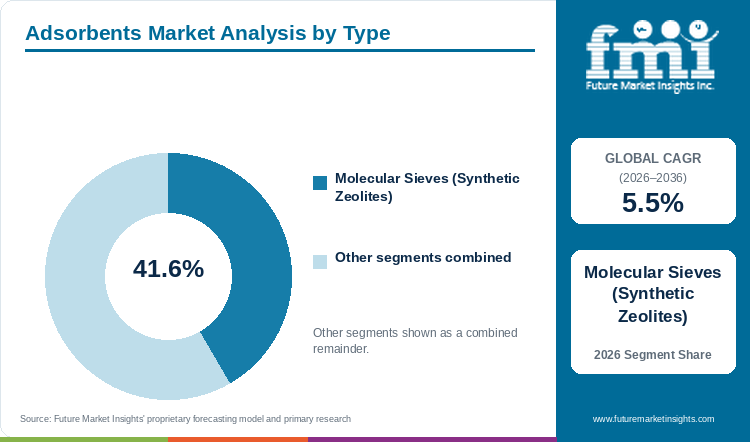
Molecular sieves are projected to hold 41.6% of type demand in 2026, supported by uniform pores, thermal stability and repeatable regeneration in cyclic units.
Table 3: Type Share for the Adsorbents Market (percentage share), 2026
| Type | Share (2026) |
|---|---|
| Molecular Sieves | 41.6% |
| Other Segments Combined | 58.4%* |
| Total | 100% |
*Includes activated carbon, silica gel, activated alumina, clay, polymeric adsorbents, other metal oxides and other adsorbent types, combined share in 2026.
Table 4: Type Leadership and Market Growth for the Adsorbents Market (segment and CAGR percentage), 2026 to 2036
| Metric | Value |
|---|---|
| Global CAGR (2026 to 2036) | 5.5% |
| Leading Segment | Molecular Sieves |
Grade breadth is behind the 41.6% type share FMI assigns to molecular sieves in 2026. Grace sells SYLOBEAD sieves for natural gas drying and sweetening, bio-ethanol dehydration and olefin purification [4]. KNT Group lists 3A, 4A, 5A and 13X sieves alongside activated alumina [5]. Arkema pairs Siliporite sieves with activated alumina for chloride removal in refinery units [6], a role tracked in the activated alumina analysis. Sieve demand is expected to hold as gas plants and refiners add units.
- A 41.6% type share in 2026 reflects sieves serving drying, sweetening and purification from one product family.
- Grade approval turns on crush strength, water capacity and co-adsorption behaviour at process conditions.
What keeps petroleum refining the largest application?
Refining remains the largest adsorbent application tracked by FMI, as catalytic units need drying and contaminant guard beds ahead of them.
Refiners use adsorbent beds to protect catalysts and meet product specifications. Arkema states that the Siliporite range for refining removes water, chlorides, oxygenates and sulfur compounds in FCC, alkylation, isomerization and reforming units. Clariant supplies TONSIL clays for jet fuel treatment and for olefin removal from BTX streams, showing that clay adsorbents also serve refinery polishing duties. Refinery capacity additions in India and record throughput in China are expected to keep replacement demand steady [7].
- Catalyst protection in FCC, alkylation, isomerization and reforming keeps refining the largest application in 2026.
- Change-out planning and spent-media handling weigh heavily in refinery supplier selection.
Why does activated carbon follow molecular sieves in type value?
Activated carbon ranks second by type value in the FMI assessment, with US drinking water rules adding a new block of granular carbon demand.
PFAS regulation is the clearest new driver for granular carbon. The EPA's April 2024 rule set limits of 4 ppt each for PFOA and PFOS, with granular activated carbon listed among the best available technologies. In May 2025, the EPA said the agency would keep these limits and propose moving the compliance deadline to 2031. Utilities are already locking in supply, as Calgon Carbon's nine-year agreement with American Water covers carbon, equipment and reactivation at more than 50 sites. Supplier positions in this type are reviewed in the activated carbon market share analysis.
- PFAS treatment contracts bundle carbon with reactivation, which ties utilities to one supplier for years.
- Breakthrough data on local water shapes whether a utility signs a multi-year carbon contract.
How does natural gas processing shape adsorbent demand?
LNG pretreatment and gas dehydration turn new gas projects into first-fill orders for sieves and specialty media.
LNG trains need water, BTEX and trace heavy hydrocarbons removed to cryogenic specifications before liquefaction, and BASF's Durasorb LNG MAX does this in a single unit at Cheniere's Corpus Christi facility, installed there since 2025 [3]. Arkema offers Siliporite NK30 grades for high-capacity gas dehydration with reduced COS formation. Monitoring tools covered in the natural gas analyzers category help operators time bed change-outs.
- Each new LNG train adds a first fill of dehydration media and a later replacement cycle.
- Single-unit designs such as Durasorb LNG MAX reduce the number of pretreatment vessels [3].
What are the drivers, restraints, and opportunities in the adsorbents market?
Refinery and LNG throughput keeps change-out orders flowing, the energy and disposal cost of regeneration holds adsorbents back in continuous duties, and PFAS and micropollutant limits form the newest demand pool.
- Driver: Refinery capacity additions and record throughput raise demand for drying and purification media.
- Restraint: Regeneration energy, spent-media disposal and membrane alternatives limit use in some duties.
- Opportunity: Drinking water PFAS limits and EU quaternary wastewater treatment create new sorption demand.
Refining and gas processing activity
India reported refining capacity of 258.1 MMTPA in December 2025, with a plan to raise capacity to 309.5 MMTPA by 2030. China's 2025 crude throughput reached a record 737.59 million metric tons. FMI expects each new or expanded unit to add first-fill bed volume for feed drying and contaminant removal. Adsorbents used in solvent recovery, covered in the spent solvent purification adsorbents segment, extend the same logic to chemical plants.
Regeneration cost and competing technologies
FMI views regeneration energy and spent-media handling as the largest lifetime cost items for adsorbent users, and membrane systems compete most in continuous duties. Suppliers are responding with reactivation services, and Calgon Carbon's planned Columbus, Ohio expansion is focused on reactivating used carbon for drinking water customers.
PFAS and micropollutant treatment
The EPA's PFOA and PFOS limits of 4 ppt each, set in April 2024, create a defined treatment need for public water systems. In Europe, the revised Urban Wastewater Treatment Directive entered into force on 1 January 2025 and requires quaternary treatment to remove micropollutants. Plants above 150,000 population equivalents are required to remove at least 80% of 12 indicator micropollutants, with first upgrades due by the end of 2033 and sorption among the eligible routes. These rules widen demand for activated carbon in water treatment.
Which country CAGRs are profiled in the adsorbents market?
Table 5: Country CAGR Comparison for the Adsorbents Market (CAGR percentage), 2026 to 2036
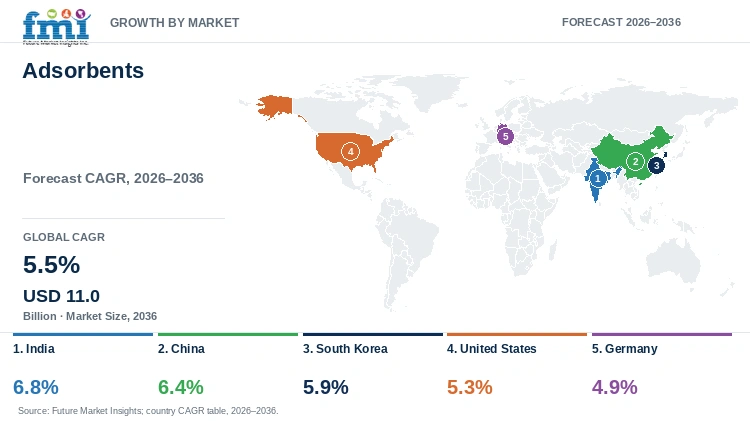
| Country | CAGR |
|---|---|
| India | 6.8% |
| China | 6.4% |
| South Korea | 5.9% |
| United States | 5.3% |
| Germany | 4.9% |
How do country-level CAGRs compare in the adsorbents market?
Asia's refining and petrochemical build-out places India (6.8%) and China (6.4%) at the top of FMI's country ranking, with South Korea (5.9%) close behind on a single large cracker project. The United States (5.3%) and Germany (4.9%) grow more slowly, as most of the added demand there is linked to water and wastewater regulation.
- India adds refinery capacity toward 309.5 MMTPA by 2030 and new sewage treatment plants in the Ganga basin.
- China's record crude runs and higher gas output raise replacement volumes.
- South Korea's Shaheen cracker in Ulsan brings first-fill purification demand.
- US utilities are buying granular carbon to meet PFAS limits.
- Germany leans on quaternary wastewater upgrades and pharmaceutical output, even as chemical output weakens.
Full report country CAGRs cover: North America; Latin America; Western Europe; Eastern Europe; East Asia; South Asia and Pacific; Middle East and Africa.
Country-wise Analysis
- India leads the profiled group with adsorbent demand set to grow at 6.8% CAGR through 2036. Refining capacity stood at 258.1 MMTPA in December 2025 against a 2030 target of 309.5 MMTPA. Water is a second pool, as Namami Gange had created 4,263 MLD of sewage treatment capacity in the Ganga basin by June 2026. New refinery units will each need first fills of drying and purification media, which gives India the steepest volume curve in the group.
- China follows at 6.4% CAGR through 2036, driven more by throughput than by new plants. Refiners processed a record 737.59 million metric tons of crude in 2025, and natural gas output rose 6.2% to 261.9 billion cubic meters. Higher runs shorten change-out intervals for sieves and guard beds, so replacement orders rise with utilisation.
- South Korea's 5.9% CAGR through 2036 hinges largely on one project. S-Oil's Shaheen complex in Ulsan, a roughly USD 7 billion build with 1.8 million tons of ethylene capacity, was in mechanical completion checks in August 2026 ahead of commercial operation planned for early 2027. The project's start-up brings first-fill orders for feed and product purification media.
- In the United States, adsorbent demand grows at 5.3% CAGR through 2036, led by drinking water carbon. EPA limits of 4 ppt each for PFOA and PFOS were finalized in April 2024, and in May 2025 the agency proposed moving compliance to 2031. Calgon Carbon plans 12,300 tons per year of new reactivation capacity in Ohio from Q1 2028. The later compliance date spreads utility carbon purchases across more of the forecast period.
- Germany grows slowest at 4.9% CAGR through 2036, as weak chemical output offsets new wastewater demand. German chemical production fell 2.5% in 2025 with capacity use near 70%, and pharmaceutical production rose 3%. The revised EU Urban Wastewater Treatment Directive, in force since January 2025, requires quaternary treatment for micropollutants and gives German utilities a sorption-based upgrade route [8].
Who are the notable companies in the adsorbents market?
The adsorbents market includes suppliers such as BASF, Honeywell UOP, Arkema, W. R. Grace & Co., Axens, Zeochem (CPH Group), Calgon Carbon (Kuraray), Jacobi Carbons, Haycarb, Clariant, Tosoh, Luoyang Jalon Micro-Nano New Materials, and KNT Group.
The market combines process technology licensors that bundle adsorbents with unit design, specialist molecular sieve and silica producers, and activated carbon and clay suppliers. Ownership has shifted recently, as Ecovyst sold the Advanced Materials and Catalysts business, including the Zeolyst joint venture stake, to Technip Energies in January 2026, and Albemarle completed the sale of a controlling stake in the Ketjen refining catalysts business in March 2026, though Ketjen is primarily a refining-catalysts business rather than an adsorbents supplier, so this change sits outside the adsorbents market's direct scope [9]. Arkema's adsorbent activity centres on molecular sieves, as the former activated carbon and filter aid activity was sold to Calgon Carbon.
- Process technology and diversified adsorbent suppliers: BASF, Honeywell UOP, Arkema, W. R. Grace & Co., Axens.
- Specialist molecular sieve and silica producers: Zeochem (CPH Group), Tosoh, Luoyang Jalon Micro-Nano New Materials, KNT Group.
- Activated carbon specialists: Calgon Carbon (Kuraray), Jacobi Carbons, Haycarb.
- Clays and desiccants specialist: Clariant.
Competitive Benchmarking: Adsorbents Market
Table 6: Competitive Benchmarking for the Adsorbents Market (qualitative capability ratings), 2026
| Company | Gas and LNG Treatment | Refining and Petrochemicals | Water Treatment | Reach |
|---|---|---|---|---|
| BASF | High | Medium | Low | High |
| Honeywell UOP | Medium | Medium | Low | High |
| Arkema | High | High | Low | High |
| W. R. Grace & Co. | High | High | Low | High |
| Axens | Medium | Medium | Medium | High |
| Zeochem (CPH Group) | Low | Low | Low | Medium |
| Calgon Carbon (Kuraray) | Low | Low | High | High |
| Clariant | Low | Medium | Low | High |
| Tosoh | Low | Low | Low | Medium |
| Luoyang Jalon Micro-Nano New Materials | Low | Medium | Low | Medium |
| KNT Group | Medium | Medium | Low | Low |
Ratings grade each company's documented strength in a duty. High applies when a company documents named adsorbent products and installations, Medium applies when evidence is limited to product listings, and Low applies when little documentation was found. The ratings are not a market-share ranking.
Key Developments in the Adsorbents Market
- In September 2026, BASF reported that Durasorb LNG MAX is installed on multiple liquefaction trains at Cheniere's Corpus Christi LNG facility, with the remaining trains planned by the end of 2027 [3].
- In February 2026, Kuraray announced that Calgon Carbon will add 12,300 tons per year of reactivated carbon capacity at Columbus, Ohio, for about USD 100 million, starting in Q1 2028.
- In February 2026, Axens completed the acquisition of 100% of Eurecat, and the combined portfolio includes adsorbents for refining, petrochemicals, gas and water treatment.
- In January 2026, Technip Energies completed the purchase of Ecovyst's Advanced Materials and Catalysts business, including Advanced Silicas and the Zeolyst joint venture.
Key Players in the Adsorbents Market
Process Technology and Diversified Adsorbent Suppliers
- BASF
- Honeywell UOP
- Arkema
- W. R. Grace & Co.
- Axens
Specialist Molecular Sieve and Silica Producers
- Zeochem (CPH Group)
- Tosoh
- Luoyang Jalon Micro-Nano New Materials
- KNT Group
Activated Carbon Specialists
- Calgon Carbon (Kuraray)
- Jacobi Carbons
- Haycarb
Clays and Desiccants Specialist
- Clariant
Adsorbents Market - Report Scope
Table 7: Report Scope for the Adsorbents Market (coverage fields and definitions), 2026 to 2036
| Coverage field | Report scope |
|---|---|
| Market breakdown | Type; application; region |
| Quantitative units | USD billion |
| Market definition | Revenue from solid, porous adsorbents that selectively retain molecules from gases or liquids, including molecular sieves (synthetic zeolites), activated carbon, silica gel, activated alumina, clay, polymeric adsorbents and other metal oxides. Excludes high-volume absorbents such as superabsorbent polymers, catalysts sold mainly for catalytic function, chromatography resins and low-volume research adsorbents. |
| Regions covered | North America; Latin America; Western Europe; Eastern Europe; East Asia; South Asia and Pacific; Middle East and Africa |
| Countries covered | India; China; South Korea; United States; Germany |
| Key companies profiled | BASF; Honeywell UOP; Arkema; W. R. Grace & Co.; Axens; Zeochem (CPH Group); Calgon Carbon (Kuraray); Jacobi Carbons; Haycarb; Clariant; Tosoh; Luoyang Jalon Micro-Nano New Materials; KNT Group |
| Forecast period | 2026 to 2036 |
| Approach | A hybrid bottom-up and top-down model, built to reconcile adsorbent consumption by unit type with supplier revenue within the defined revenue boundary. |
Adsorbents Market - Research Methodology
Table 8: Research Methodology for the Adsorbents Market (research methods and approach), 2026 edition
| Method | Approach |
|---|---|
| Primary Research | Interviews with refinery, gas processing, petrochemical, water utility, industrial gas and adsorbent manufacturing professionals. |
| Desk Research | Company releases, regulatory rules, government energy statistics and trade body data on refining, gas and water treatment. |
| Market Sizing and Forecasting | Bed volumes and change-out cycles by application, reconciled with supplier revenue and capacity additions by country. |
| Data Validation | Triangulation of primary inputs, company disclosures and regulatory timelines, with review of outliers by the analyst team. |
Adsorbents Market by Segments
Adsorbents Market segmented by Type:
- Molecular Sieves (Synthetic Zeolites)
- Activated Carbon
- Silica Gel
- Activated Alumina
- Clay
- Polymeric Adsorbents
- Other Metal Oxides
- Others
Adsorbents Market segmented by Application:
- Petroleum Refining
- Natural Gas Processing
- Chemicals and Petrochemicals
- Water and Wastewater Treatment
- Air Separation and Drying
- Food and Beverage
- Pharmaceuticals
- Others
Adsorbents Market by Region
- North America
- United States
- Canada
- Latin America
- Brazil
- Mexico
- Argentina
- Chile
- Western Europe
- Germany
- France
- United Kingdom
- Italy
- Spain
- Benelux
- Nordics
- Eastern Europe
- Poland
- Czech Republic
- Romania
- Hungary
- East Asia
- China
- Japan
- South Korea
- South Asia and Pacific
- India
- ASEAN
- Australia and New Zealand
- Middle East and Africa
- GCC Countries
- South Africa
- Türkiye
- Israel
Research Sources and Bibliography
- [1] Kuraray Co., Ltd. (2026, March). Kuraray Report 2026, Financial Section: Financial review and consolidated financial statements for the year ended December 31, 2025. https://www.kuraray.com/content/dam/kuraray/jp/en/sustainability/report/kuraray_en2026_30.pdf
- [2] Clariant AG. (2026, February 26). Clariant delivers third year of strong EBITDA margin improvement. https://www.clariant.com/corporate/news/2026/02/clariant-delivers-third-year-of-strong-ebitda-margin-improvement
- [3] BASF SE. (2026, September 9). Durasorb LNG MAX technology implemented at Cheniere's Corpus Christi LNG facility. https://www.basf.com/global/en/media/news-releases/2026/09/p-26-156
- [4] W. R. Grace & Co. (n.d.). Process adsorbents. https://grace.com/industries/general-industrial/process-adsorbents/
- [5] KNT Group. (n.d.). Adsorbents product range. https://kntgroup.ru/en/products/adsorbents
- [6] Arkema S.A. (n.d.). Molecular sieves for energy and chemicals. https://www.arkema.com/global/en/products/product-families/molecular-sieves/molecular-sieves-for-energy-chemicals/
- [7] Hydrocarbon Processing. (2026, January 19). China's 2025 refinery throughput, crude and gas output hit new highs. https://hydrocarbonprocessing.com/news/2026/01/chinas-2025-refinery-throughput-crude-and-gas-output-hit-new-highs/
- [8] RECETOX, Masaryk University. (2025, November 18). Cleaner water, new challenges: What does the revised Urban Wastewater Treatment Directive bring? https://www.recetox.muni.cz/en/about-us/news/cleaner-water-new-challenges-what-does-the-revised-urban-wastewater-treatment-directive-bring
- [9] Albemarle Corporation. (2026, March 2). Albemarle completes sale of controlling stake in Ketjen to KPS Capital Partners. https://www.albemarle.com/de/en/news/albemarle-completes-sale-controlling-stake-ketjen-kps-capital-partners
- [10] Kuraray Co., Ltd. (2026, February 27). Kuraray to expand reactivated carbon production capacity in the United States. https://www.kuraray.com/global-en/news/2026/0227/
- [11] Axens. (2026, February 5). Axens completes acquisition of Eurecat to enhance global catalyst service. https://www.axens.net/resources-events/news/axens-completes-acquisition-eurecat-enhance-global-catalyst-service
- [12] KNN India. (2025, December 2). India to expand refining capacity to 309.5 MMTPA by 2030. https://knnindia.co.in/news/newsdetails/sectors/energy/india-to-expand-refining-capacity-to-3095-mmtpa-by-2030-boost-clean-fuel-ecosystem
- [13] Holland & Knight. (2024, April 17). EPA finalizes PFAS drinking water regulation. https://www.hklaw.com/en/insights/publications/2024/04/epa-finalizes-pfas-drinking-water-regulation
- [14] Water Online. (2025, January 15). Calgon Carbon and American Water finalize supply agreement to support PFAS treatment in states. https://www.wateronline.com/doc/calgon-carbon-and-american-water-finalize-supply-agreement-to-support-pfas-treatment-in-states-0001
- [15] Environmental Protection (EPOnline). (2025, May 15). EPA extends PFAS rule deadline, keeps current water standards in place. https://eponline.com/articles/2025/05/15/epa-extends-pfas-rule-deadline.aspx
- [16] Clariant AG. (n.d.). Adsorbents and desiccants. https://www.clariant.com/en/Business-Units/Additives-and-Adsorbents/Adsorbents-and-desiccants
- [17] European Commission. (n.d.). Urban wastewater. https://environment.ec.europa.eu/topics/water/urban-wastewater_en
- [18] NBM&CW. (2026, August 7). Namami Gange creates 4,263 MLD sewage treatment capacity; 25 STPs commissioned in 2025. https://www.nbmcw.com/news/infra-development/namami-gange-creates-4-263-mld-sewage-treatment-capacity-25-stps-commissioned-in-2025.html
- [19] Korea JoongAng Daily. (2026, August 18). S-Oil's USD 7B Shaheen project nears completion. https://www.koreajoongangdaily.com/business/soils-7b-shaheen-project-nears-completion-aims-to-revive-koreas-sagging-petrochemical-industrynbsp/12829604
- [20] Industrial Production. (2025, December 10). German chemical industry in crisis: VCI takes stock. https://www.industrial-production.de/economy---business/german-chemical-industry-in-crisis--german-chemical-industry-association-takes-stock.htm
- [21] Technip Energies. (2026, January 2). Technip Energies completes acquisition of Ecovyst's Advanced Materials & Catalysts business. https://www.ten.com/en/media/press-releases/technip-energies-completes-acquisition-ecovysts-advanced-materials-catalysts
- [22] Arkema S.A. (2016, April 14). Arkema announces the proposed divestment of its activated carbon and filter aid activity to Calgon Carbon. https://www.arkema.com/usa/en/media/news/global/corporate/2016/20160414-arkema-announces-
- [23] Honeywell UOP. (n.d.). Air separation adsorbents. https://uop.honeywell.com/en/products-and-services/adsorbents/specialty/air-separation
- [24] Zeochem AG. (2025, July 16). Zeochem completes acquisition of SiliCycle, expanding global chromatography capabilities. https://zeochem.com/why-zeochem/news/zeochem-completes-acquisition-of-silicycle-expanding-global-chromatography-capabilities
- [25] Zeochem AG. (2024, May 2). Zeochem acquires Sorbead India and Swambe Chemicals. https://zeochem.com/why-zeochem/news/zeochem-acquires-sorbead-india-and-swambe-chemicals/
- [26] Shanghai Stock Exchange. (n.d.). Luoyang Jalon Micro-nano New Materials Co., Ltd. (688357) company snapshot. https://www.sse.com.cn/star/en/marketdata/snapshot/c/5481440.shtml
This Report Answers
- How big is the adsorbents market during 2026?
- What value is projected by 2036?
- Which type leads by share?
- Which application leads by share?
- Which countries show the fastest growth?
- Which companies are key players in the market?
Frequently Asked Questions
How large is the adsorbents market expected in 2026?
FMI puts adsorbent revenue at USD 6.44 billion in 2026, rising to USD 10.99 billion by 2036 as refinery, LNG and water treatment beds are added and replaced.
What CAGR is projected for the adsorbents market through 2036?
FMI projects 5.5% a year from 2026 to 2036. Replacement cycles in refining and gas plants give a stable base, and PFAS and micropollutant rules add new volume.
Which type leads the market by share in 2026?
Molecular sieves, at 41.6% of type demand in 2026. One family of grades covers gas drying, sweetening and olefin purification, which keeps sieves ahead of activated carbon.
Which application leads by share in 2026?
Petroleum refining has guard beds that protect FCC, alkylation, isomerization and reforming catalysts from water, chlorides, oxygenates and sulfur.
Which country has the fastest expansion outlook through 2036?
India, at 6.8% CAGR from 2026 to 2036, as refining capacity rises toward 309.5 MMTPA by 2030. China (6.4%) and South Korea (5.9%) follow.
Who are the key companies in the adsorbents market?
Profiled suppliers include BASF, Honeywell UOP, Arkema, W. R. Grace & Co., Axens, Zeochem (CPH Group), Calgon Carbon (Kuraray), Jacobi Carbons, Haycarb, Clariant, Tosoh, Luoyang Jalon Micro-Nano New Materials, and KNT Group.
Preview the report firsthand - request a free sample
Get SampleGet the brochure for pricing and purchase details.
Get PDFTable of Content
- Key Takeaways
- Market Size and CAGR
- Top Growth Driver
- Fastest Growing Segment
- Leading Region
- Key Companies
- Emerging Opportunities
- Executive Summary
- Global Market Outlook
- Demand-side Trends
- Supply-side Trends
- Technology Roadmap Analysis
- Analysis and Recommendations
- Analyst Perspective (What is happening? Why now? What should investors know?)
- Key Questions Answered
- How large is the market?
- What is the CAGR?
- What are key trends?
- Which region dominates?
- Who are the leaders?
- Market Overview
- Market Coverage / Taxonomy
- Market Definition / Scope / Limitations
- Research Methodology
- Chapter Orientation
- Analytical Lens and Working Hypotheses
- Market Structure, Signals, and Trend Drivers
- Benchmarking and Cross-market Comparability
- Market Sizing, Forecasting, and Opportunity Mapping
- Research Design and Evidence Framework
- Desk Research Programme (Secondary Evidence)
- Expert Input and Fieldwork (Primary Evidence)
- Tooling, Models, and Reference Databases
- Data Engineering and Model Build
- Quality Assurance and Audit Trail
- Market Background
- Market Dynamics (Drivers, Restraints, Opportunity, Trends)
- Scenario Forecast (Optimistic, Likely, Conservative)
- Impact Analysis
- AI Impact
- Sustainability Impact
- Regulatory Impact
- Technology Impact
- Consumer / Buyer Analysis
- Purchase Drivers
- Adoption Barriers
- Buyer Journey
- Opportunity Map Analysis
- Product Life Cycle Analysis
- Supply Chain Analysis
- Investment Feasibility Matrix
- Value Chain Analysis
- PESTLE and Porter's Analysis
- Regulatory Landscape
- Regional Parent Market Outlook
- Production and Consumption Statistics
- Import and Export Statistics
- Global Market Analysis and Forecast, 2021 to 2036
- Historical Market Size Value (USD Billion) Analysis, 2021 to 2025
- Current and Future Market Size Value (USD Billion) Projections, 2026 to 2036
- Y-o-Y Growth Trend Analysis
- Absolute $ Opportunity Analysis
- Global Market Pricing Analysis, 2021 to 2036
- Global Market Analysis and Forecast, By Type, 2021 to 2036
- Introduction / Key Findings
- Historical Market Size Value (USD Billion) Analysis By Type, 2021 to 2025
- Current and Future Market Size Value (USD Billion) Analysis and Forecast By Type, 2026 to 2036
- Molecular Sieves (Synthetic Zeolites)
- Activated Carbon
- Silica Gel
- Activated Alumina
- Clay
- Polymeric Adsorbents
- Other Metal Oxides
- Others
- Y-o-Y Growth Trend Analysis By Type, 2021 to 2025
- Absolute $ Opportunity Analysis By Type, 2026 to 2036
- Global Market Analysis and Forecast, By Application, 2021 to 2036
- Introduction / Key Findings
- Historical Market Size Value (USD Billion) Analysis By Application, 2021 to 2025
- Current and Future Market Size Value (USD Billion) Analysis and Forecast By Application, 2026 to 2036
- Petroleum Refining
- Natural Gas Processing
- Chemicals and Petrochemicals
- Water and Wastewater Treatment
- Air Separation and Drying
- Food and Beverage
- Pharmaceuticals
- Others
- Y-o-Y Growth Trend Analysis By Application, 2021 to 2025
- Absolute $ Opportunity Analysis By Application, 2026 to 2036
- Global Market Analysis and Forecast, By Region, 2021 to 2036
- Introduction
- Historical Market Size Value (USD Billion) Analysis By Region, 2021 to 2025
- Current Market Size Value (USD Billion) Analysis and Forecast By Region, 2026 to 2036
- North America
- Latin America
- Western Europe
- Eastern Europe
- East Asia
- South Asia and Pacific
- Middle East and Africa
- Market Attractiveness Analysis By Region
- North America Market Analysis and Forecast, By Country, 2021 to 2036
- Historical Market Size Value (USD Billion) Trend Analysis By Market Taxonomy, 2021 to 2025
- Market Size Value (USD Billion) Forecast By Market Taxonomy, 2026 to 2036
- By Country
- United States
- Canada
- By Type
- By Application
- By Country
- Market Attractiveness Analysis
- By Country
- By Type
- By Application
- Key Takeaways
- Latin America Market Analysis and Forecast, By Country
- Historical Market Size Value (USD Billion) Trend Analysis By Market Taxonomy, 2021 to 2025
- Market Size Value (USD Billion) Forecast By Market Taxonomy, 2026 to 2036
- By Country
- Brazil
- Mexico
- Argentina
- Chile
- By Type
- By Application
- By Country
- Market Attractiveness Analysis
- By Country
- By Type
- By Application
- Key Takeaways
- Western Europe Market Analysis and Forecast, By Country
- Historical Market Size Value (USD Billion) Trend Analysis By Market Taxonomy, 2021 to 2025
- Market Size Value (USD Billion) Forecast By Market Taxonomy, 2026 to 2036
- By Country
- Germany
- France
- United Kingdom
- Italy
- Spain
- Benelux
- Nordics
- By Type
- By Application
- By Country
- Market Attractiveness Analysis
- By Country
- By Type
- By Application
- Key Takeaways
- Eastern Europe Market Analysis and Forecast, By Country
- Historical Market Size Value (USD Billion) Trend Analysis By Market Taxonomy, 2021 to 2025
- Market Size Value (USD Billion) Forecast By Market Taxonomy, 2026 to 2036
- By Country
- Poland
- Czech Republic
- Romania
- Hungary
- By Type
- By Application
- By Country
- Market Attractiveness Analysis
- By Country
- By Type
- By Application
- Key Takeaways
- East Asia Market Analysis and Forecast, By Country
- Historical Market Size Value (USD Billion) Trend Analysis By Market Taxonomy, 2021 to 2025
- Market Size Value (USD Billion) Forecast By Market Taxonomy, 2026 to 2036
- By Country
- China
- Japan
- South Korea
- By Type
- By Application
- By Country
- Market Attractiveness Analysis
- By Country
- By Type
- By Application
- Key Takeaways
- South Asia and Pacific Market Analysis and Forecast, By Country
- Historical Market Size Value (USD Billion) Trend Analysis By Market Taxonomy, 2021 to 2025
- Market Size Value (USD Billion) Forecast By Market Taxonomy, 2026 to 2036
- By Country
- India
- ASEAN
- Australia and New Zealand
- By Type
- By Application
- By Country
- Market Attractiveness Analysis
- By Country
- By Type
- By Application
- Key Takeaways
- Middle East and Africa Market Analysis and Forecast, By Country
- Historical Market Size Value (USD Billion) Trend Analysis By Market Taxonomy, 2021 to 2025
- Market Size Value (USD Billion) Forecast By Market Taxonomy, 2026 to 2036
- By Country
- GCC Countries
- South Africa
- Türkiye
- Israel
- By Type
- By Application
- By Country
- Market Attractiveness Analysis
- By Country
- By Type
- By Application
- Key Takeaways
- Key Countries Market Analysis
- United States
- Pricing Analysis
- Market Share Analysis, 2025
- By Type
- By Application
- Canada
- Pricing Analysis
- Market Share Analysis, 2025
- By Type
- By Application
- Mexico
- Pricing Analysis
- Market Share Analysis, 2025
- By Type
- By Application
- Brazil
- Pricing Analysis
- Market Share Analysis, 2025
- By Type
- By Application
- Chile
- Pricing Analysis
- Market Share Analysis, 2025
- By Type
- By Application
- Germany
- Pricing Analysis
- Market Share Analysis, 2025
- By Type
- By Application
- United Kingdom
- Pricing Analysis
- Market Share Analysis, 2025
- By Type
- By Application
- Italy
- Pricing Analysis
- Market Share Analysis, 2025
- By Type
- By Application
- Spain
- Pricing Analysis
- Market Share Analysis, 2025
- By Type
- By Application
- France
- Pricing Analysis
- Market Share Analysis, 2025
- By Type
- By Application
- India
- Pricing Analysis
- Market Share Analysis, 2025
- By Type
- By Application
- ASEAN
- Pricing Analysis
- Market Share Analysis, 2025
- By Type
- By Application
- Australia and New Zealand
- Pricing Analysis
- Market Share Analysis, 2025
- By Type
- By Application
- China
- Pricing Analysis
- Market Share Analysis, 2025
- By Type
- By Application
- Japan
- Pricing Analysis
- Market Share Analysis, 2025
- By Type
- By Application
- South Korea
- Pricing Analysis
- Market Share Analysis, 2025
- By Type
- By Application
- Poland
- Pricing Analysis
- Market Share Analysis, 2025
- By Type
- By Application
- Hungary
- Pricing Analysis
- Market Share Analysis, 2025
- By Type
- By Application
- Türkiye
- Pricing Analysis
- Market Share Analysis, 2025
- By Type
- By Application
- South Africa
- Pricing Analysis
- Market Share Analysis, 2025
- By Type
- By Application
- United States
- Market Structure Analysis
- Competition Dashboard
- Competition Benchmarking
- Market Share Analysis of Top Players
- By Regional
- By Type
- By Application
- Emerging Startups
- Innovation Benchmarking
- Competition Analysis
- Competition Deep Dive
- BASF
- Overview
- Product Portfolio
- Profitability by Market Segments
- Sales Footprint
- Strategy Overview
- Marketing Strategy
- Product Strategy
- Channel Strategy
- Honeywell UOP
- Arkema
- W. R. Grace & Co.
- Axens
- Zeochem (CPH Group)
- Calgon Carbon (Kuraray)
- Clariant
- Tosoh
- Luoyang Jalon Micro-Nano New Materials
- KNT Group
- Jacobi Carbons
- Haycarb
- BASF
- Case Studies
- Success Stories
- Recent Developments
- Competition Deep Dive
- Assumptions & Acronyms Used


