

- Market Size (2026)
- USD 820.7 Mn
- Forecast (2036)
- USD 2015.4 Mn
- CAGR (2026 to 2036)
- 9.4%
How big is the Spent Solvent Purification Adsorbents Market in 2026?
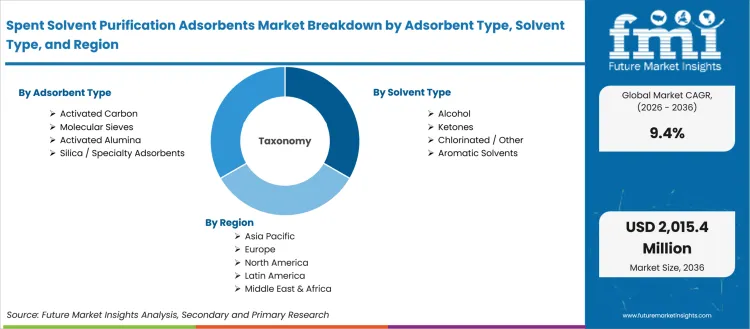
USD 820.7 million in 2026 and USD 2,015.4 million by 2036 at a 9.4% CAGR.
Solvent recovery buyers are shifting from disposal avoidance toward batch quality control across pharmaceutical plants and electronics chemical users. EPA’s July 2024 hazardous secondary material checklist reinforced the need to document recycling controls under RCRA before recovered streams move across recovery routes. That compliance layer makes solvent recovery systems more dependent on adsorbent proof and media life. It also pushes suppliers to support spent media handling records and qualification evidence before buyers approve repeat purchases. The result is a market in which purification media is judged by recovered solvent stability and lifecycle cost.
Pharma and fine chemical producers need recovered alcohols and ketones that meet moisture and residue limits before reuse in sensitive batches. Paints and coatings producers use purification media to reduce odor and color drift after distillation. Electronics chemical buyers need low-residue polishing so cleaning solvent can support surface quality. Industrial recyclers need adsorbents that lift recovered streams from low-value disposal alternatives toward resale or internal reuse quality. The market creates value by converting solvent recovery from a waste decision into a production reliability tool.
Regional adoption differs by buyer maturity and plant buildout across chemical clusters. North America and Western Europe place greater weight on documentation and reactivation service access. Japan adds heavier media qualification standards in electronics and specialty chemical loops. China, India and South Korea add demand from larger chemical parks and electronics-linked solvent loops. Adsorbents become more valuable once procurement teams connect media choice to recovered solvent yield and qualification risk. The strategic buyer point is clear: supplier selection depends on proof that purification media can protect recovered solvent quality across repeat operating cycles.
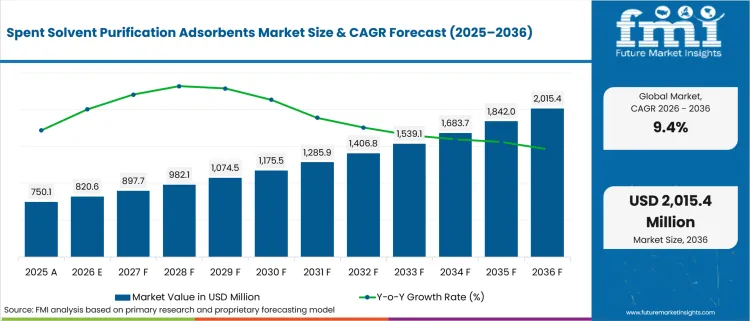
| Metric | Value |
|---|---|
| 2025 Market Size | USD 750.18 million |
| 2026 Market Size | USD 820.7 million |
| 2036 Market Size | USD 2,015.4 million |
| Forecast CAGR (2026-2036) | 9.4% |
| Leading Adsorbent Type | Activated Carbon |
| Activated Carbon Share (2026) | 38.0% |
| Leading Solvent Type | Alcohols |
| Alcohols Share (2026) | 34.0% |
| Leading Application | Water Removal |
| Water Removal Share (2026) | 36.0% |
| Fastest-growing Country | China |
| China CAGR by 2036 | 10.7% |
Summary of the Spent Solvent Purification Adsorbents Market
| Market Signal | Commercial Impact |
|---|---|
| Demand and Growth Drivers | Demand for spent solvent purification adsorbents is increasing as hazardous waste recovery, chemical recycling, and pharmaceutical manufacturing require reliable purification media that improve solvent reuse and regulatory compliance.
|
| Product and Segment View | Activated carbon, alcohol solvent purification, and water removal applications continue to represent the leading commercial opportunities across the market.
|
| Geography and Growth Outlook | Asia continues to lead market expansion through chemical manufacturing growth, pharmaceutical production, and increasing solvent recovery activities.
|
| Competitive Landscape | Competition increasingly focuses on adsorbent performance, regeneration capabilities, technical support, and long-term solvent recovery efficiency.
|
| Analyst Perspective | Spent solvent purification adsorbents are evolving from conventional filtration media into process reliability solutions that improve solvent quality, recovery efficiency, and operational sustainability.
- Nikhil Kaitwade, Principal Consultant at Future Market Insights |
How is the spent solvent purification adsorbents market segmented?
The Spent Solvent Purification Adsorbents industry is segmented by adsorbent type, solvent type, application, end use, sales channel, and region.
The Spent Solvent Purification Adsorbents Market is segmented by adsorbent type, solvent type, application, end use, sales channel, and region. Adsorbent type covers activated carbon, molecular sieves, activated alumina, and silica or specialty adsorbents. Solvent type includes alcohols, ketones, aromatic solvents, and chlorinated or other solvents. Application spans water removal, color or odor removal, trace impurity removal, and catalyst or metal removal. End use covers pharma or fine chemicals, paints and coatings, electronics chemicals, and industrial recycling. Sales channel includes direct sales, distributors, and service providers. Regional coverage extends across North America, Latin America, Western Europe, Eastern Europe, East Asia, South Asia and Pacific, and the Middle East and Africa.
Why does Activated Carbon matter within the adsorbent type category?
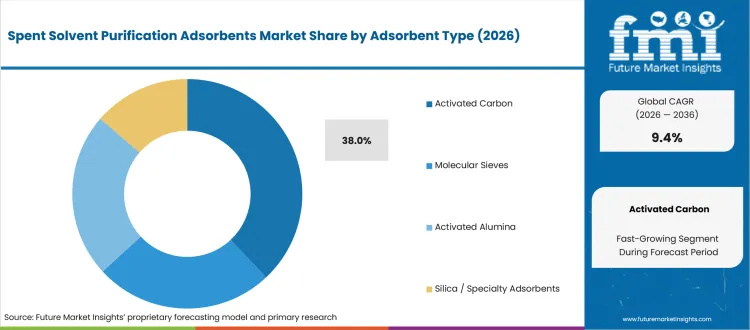
Solvent recovery operators need a media choice that can handle mixed organic residues without making recovered solvent harder to reuse. Activated carbon fits vapor recovery and liquid polishing duties once odor bodies and light organics remain after distillation. The buyer problem is not only capture capacity. It is the balance between adsorption behavior and desorption support across repeat operating cycles.
- In 2026, activated carbon is anticipated to hold 38.0% of adsorbent type demand, driven by broad capture of organic residues in vapor recovery and polishing beds. Jacobi states that steam desorption can drive solvent away from saturated carbon for separation and reuse. This supports carbon selection tied to recovery value.
- Plant teams using activated carbon are able to compare media life against solvent recovery yield, supported by desorption behavior and reactivation access. Buyers recovering aromatics or mixed solvent vapors need carbon grades that limit early saturation. This makes technical screening more valuable than first-fill price alone.
What supports demand for Alcohols within solvent type demand?
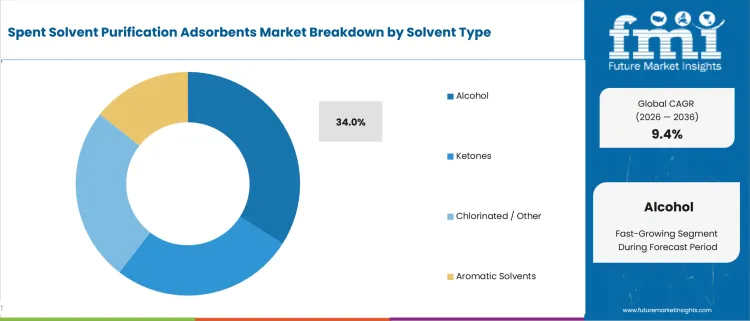
Alcohol recovery creates a clear drying problem for batch plants and cleaning operations. Ethanol, methanol and isopropanol are frequently reused in solvent loops. Residual water can still change cleaning performance or reaction behavior. Buyers therefore evaluate adsorbents by selectivity and solvent yield instead of moisture removal alone. A media that removes water but preserves recoverable alcohol gives the solvent loop a stronger commercial case.
- Alcohols are expected to account for 34.0% of solvent type demand in 2026, attributable to recurring use of ethanol and isopropanol in cleaning and synthesis loops. Arkema notes that 3A molecular sieves have an opening near 3 Angstroms. This supports selective water removal without avoidable solvent loss.
- Operating value rises once recovered alcohol can return to production without changing reaction yield or cleaning performance. Buyers therefore test drying media against internal moisture limits. This makes alcohol purification a technical selection process across pharmaceutical solvents used in regulated and high-value process environments.
How does Water Removal shape the application mix?
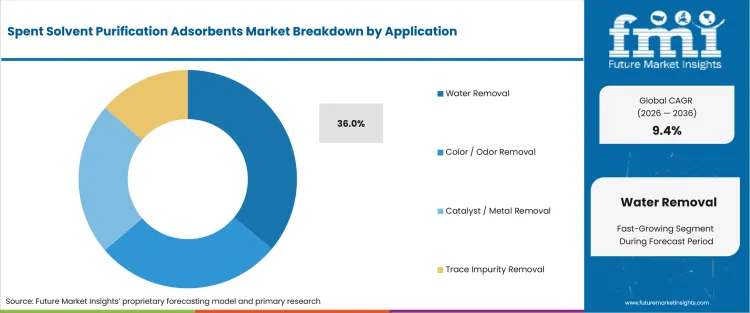
Recovered solvent can pass bulk distillation and still fail internal moisture limits. That gap gives water removal a distinct role inside purification beyond general separation. Buyers using alcohols and ketones usually need a final drying step before the solvent is released for reuse. The application depends on stable bead behavior, moisture pickup and compatibility for the recovered stream.
- Water Removal is set to hold 36.0% of application demand in 2026, supported by recovered solvent specifications that require moisture control after distillation. BASF identifies Sorbead R for acid-resistant silica gel dehydration of solvents. This supports drying duties in plants that need stable beads and low attrition.
- The purchasing case centers on reuse confidence beyond simple removal chemistry. Recovered ketones and alcohols can fail internal limits if water remains above batch tolerance. Adsorbents therefore become the final quality gate inside industrial solvents before recovered material moves back into process tanks.
What market factors influence demand from Pharma and Fine Chemicals?
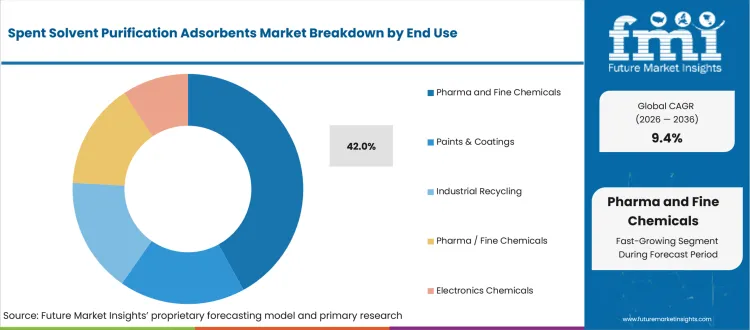
Pharma and fine chemical producers carry higher cost exposure once recovered solvent quality varies from batch to batch. Residual solvent controls, impurity checks and release testing make adsorbent performance part of the production risk discussion. Buyers in these plants need proof that media does not add extractables or dust. That creates a preference for documented products and supplier support.
- Pharma and Fine Chemicals are projected to hold 42.0% of end-use demand in 2026, led by batch processes that generate high-value recoverable solvent streams. The FDA warned in July 2025 that benzene belongs to Class 1 residual solvents under ICH Q3C. This supports strict control over recovered solvent quality.
- Commercial value comes from avoiding rejected batches and reducing fresh solvent exposure in regulated plants. Buyers in fine chemicals qualify adsorbents around extractables, dust and trace residue behavior before switching media. This turns supplier proof into part of recovered solvent release planning.
How is Direct positioned within the sales channel category?
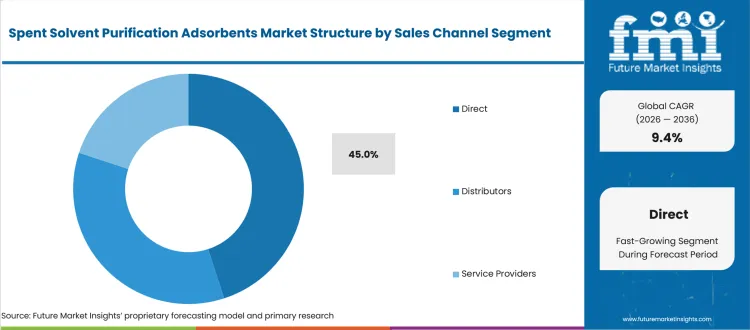
Large solvent users often buy adsorbents after lab trials and plant-specific qualification work. Direct sales matter in these accounts owing to purchasing teams needing one accountable supplier for grade selection, changeout planning and documentation. The channel question is practical. Buyers must know who supports media performance once solvent quality moves from specification risk to production disruption.
- Direct sales are expected to represent 45.0% of sales channel demand in 2026, shaped by plant-specific trials and approved supplier lists. NORIT’s solvent recovery page describes field services and design support for SORBONORIT activated carbon products. This fits buyers that need accountable supplier support for performance outcomes.
- Channel value rises once large solvent users need lab screening, changeout planning and reactivation documentation. Distributors remain useful for standard grades. Direct vendor control becomes more important once a recovered solvent stream must meet tight internal release criteria and supplier accountability affects operating confidence.
What are the drivers, restraints, and opportunities in the spent solvent purification adsorbents market?
Near-term purchases are being shaped by the solvent quality requirement, hazardous media constraint, and service-backed expansion route outlined below.
- Driver: Post-distillation polishing is driving adsorbent purchases due to recovered solvents that retain moisture and trace residues after bulk separation.
- Restraint: Hazardous spent media handling slows supplier changes due to transport, treatment and documentation work tied to loaded adsorbents.
- Opportunity: Service-backed supply gains traction from bundled testing and media changeout plus reactivation access and compliance records for smaller solvent users.
Chemical producers are raising spending once recovered solvent quality becomes a production release issue. Distillation handles volume recovery, yet it can leave odor bodies or moisture that limits reuse value. Eurostat reported in December 2025 that the EU produced 224 million tonnes of chemicals in 2024. That operating base helps explain why post-distillation adsorbents gain relevance beyond waste avoidance. Suppliers that prove media bed performance can defend pricing by connecting adsorbent selection to recovered solvent quality and lower rework risk. This gives service teams a clearer route to plant trials and repeat media contracts.
Compliance work can delay purchases once loaded media requires controlled storage and treatment. The restraint is not only the price of adsorbent media. It is the buyer’s need to prove that hazardous residues move under a valid recovery or disposal route. EPA reported in March 2026 that FY 2025 civil enforcement completed 2,127 cases and included RCRA compliance obligations. That environment favors suppliers able to document return handling and treatment pathways. Media vendors that reduce compliance uncertainty can convert a purchase barrier into a qualification advantage.
Smaller generators create a service opportunity for suppliers that combine media supply and changeout support. These buyers need traceable solvent recovery records and predictable media life. Kuraray Report 2025 stated that reactivated carbon reduces CO2 emissions by 80% compared to virgin activated carbon production. The figure supports this market by giving reactivation a practical lifecycle argument alongside cost control. Startups and service providers can enter by offering lab testing, containerized changeout and verified return programs.
Which country CAGRs are profiled in the spent solvent purification adsorbents market?
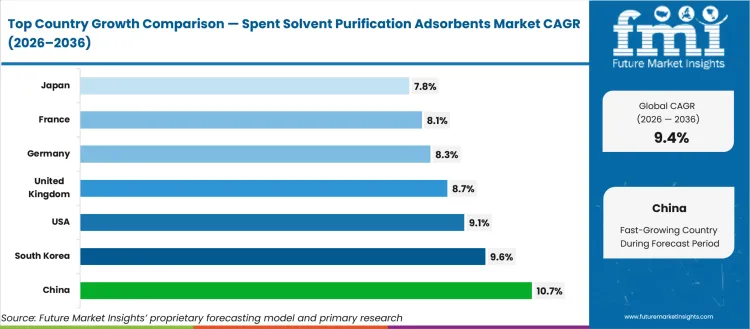
| Country | CAGR |
|---|---|
| United States | 9.1% |
| United Kingdom | 8.7% |
| Germany | 8.3% |
| France | 8.1% |
| Japan | 7.8% |
| China | 10.7% |
| South Korea | 9.6% |
| India | 10.4% |
How do country-level CAGRs compare in the spent solvent purification adsorbents market?
Country profiles in spent solvent purification adsorbents act like a map of operating risk and supplier qualification. In established chemical and pharmaceutical markets, the case is tied to compliance proof and reactivation service access. Japan and Germany place heavier weight on process stability before supplier changes. China, India and South Korea show broader purchase triggers from chemical park activity and electronics-linked solvent loops. Some buyers need lifecycle documentation before switching suppliers. Others need validated drying performance or service access for repeat media replacement. This variation helps suppliers choose between direct technical support and distributor-led coverage across regulated solvent recovery accounts.
- By 2036, the United States is projected to record 9.1% CAGR, supported by chemical manufacturing scale and service-backed reactivation. Calgon Carbon announced in May 2024 that it would acquire Sprint Environmental Services’ industrial reactivated carbon business, including 21 employees and a plant outside Houston. That local service depth supports steady replacement demand and a more documented buying profile than many faster-building Asian markets.
- The United Kingdom is expected to grow at 8.7% CAGR during the forecast period, shaped by permitted hazardous waste recovery routes and service-led solvent recycling. The Environment Agency reported in November 2025 that over 7 million tonnes of hazardous waste moved in 2024. This supports demand for documented media supply. The country tracks below Asian markets due to recovery-site discipline replacing broad new chemical capacity.
- Over the assessment period, Germany is forecast to advance at 8.3% CAGR, attributable to cost control inside a large chemical and pharmaceutical base. Cefic reported in 2025 that Germany generated EUR 225.5 billion in chemical and pharmaceutical turnover in 2023. That scale supports solvent savings projects across specialty chemicals. Growth remains measured due to careful media qualification and long proof cycles before supplier changes.
- Through 2036, France is anticipated to post 8.1% CAGR, reinforced by specialty chemical and API production that needs reliable recovered solvent quality. Cefic reported in 2025 that French chemical turnover reached EUR 108.5 billion in 2023. This creates demand for drying and impurity polishing. The market profile is steadier than India, reflecting technical qualification that can slow changes in approved solvent routes.
- Japan is likely to expand at 7.8% CAGR by 2036, shaped by purity discipline across electronics and specialty chemical operations. The Japan Chemical Industry Association reported in 2025 that chemical industry shipment value ranked second in manufacturing at JPY 51 trillion. This scale supports high-quality adsorbent demand. Growth trails China and South Korea due to heavier buyer focus on supplier qualification and process stability.
- China is estimated to rise at 10.7% CAGR between 2026 and 2036, propelled by chemical park scale and hazardous waste classification visibility. National Bureau of Statistics data released in October 2025 showed raw chemical materials capacity utilization at 72.5% in the third quarter. This leads to a large operating base for recovery media and a broader growth profile than Western Europe.
- South Korea is projected to post 9.6% CAGR by 2036, supported by electronics chemicals and petrochemical recycling discipline. Ministry of Data and Statistics reported in November 2025 that third-quarter export value rose 6.5% year over year. This supports solvent use across export-linked process plants. The country differs from Japan due to near-term demand tied more to electronics throughput and supply reliability.
- India is expected to grow at 10.4% CAGR during the forecast period, owing to API manufacturing and formal chemical-sector growth. PIB reported in October 2024 that the chemical and petrochemical sector contributes over 9% to manufacturing gross value added. This supports recovery economics for alcohol and ketone streams. India outpaces the United States due to wider room for solvent reuse formalization across clusters.
Who are the notable companies in the spent solvent purification adsorbents market?
Kuraray, Calgon Carbon, Jacobi Carbons, Norit, Arkema, Honeywell UOP, Axens, BASF, Zeochem, and W. R. Grace are the notable companies shaping this market.
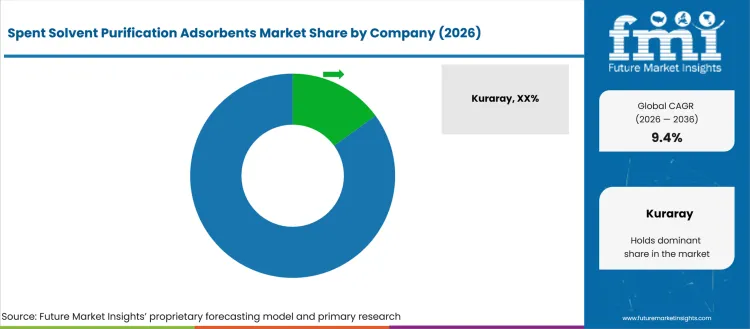
Supplier selection in spent solvent purification adsorbents is structured by the type of failure risk the buyer wants to control. Kuraray, Calgon Carbon, Jacobi Carbons and Norit are more relevant for activated carbon recovery and reactivation service. Arkema, Honeywell UOP and Axens become important for solvent reuse programs that depend on selective drying. BASF, Zeochem and W. R. Grace gain relevance in accounts that need silica or molecular sieve depth for trace moisture and impurity control. The practical question is whether the buyer wants to solve solvent quality at the carbon bed, drying bed or service layer.
- Kuraray and Calgon Carbon are relevant in accounts that need activated carbon supply backed by reactivation and spent media handling. The May 2024 Sprint Environmental transaction supports a service-led carbon position. This matters for solvent users that treat lifecycle control within the purchase decision.
- Jacobi Carbons and Norit focus on solvent vapor recovery and carbon-based polishing, supported by documented desorption and field service options. Jacobi lists steam, inert gas and hot air desorption routes. Norit lists solvent recovery within dedicated activated carbon application support for design and service planning.
- Buyers choosing Arkema, Honeywell UOP and Axens are typically looking for molecular sieve or activated alumina drying fit. Arkema’s molecular sieve guidance addresses light alcohol drying. Axens lists molecular sieves and alumina for low-moisture specifications, which suits buyers managing water after distillation.
- In specialty adsorbent accounts, BASF, Zeochem and W. R. Grace are relevant to silica and molecular sieve decisions. Grace highlights SYLOBEAD molecular sieves for ethanol and hydrocarbon purification. BASF positions Sorbead R for solvent dehydration. These suppliers compete on material specification within zeolite adsorbents.
Competitive Benchmarking: Spent Solvent Purification Adsorbents Market
| Company | Solvent Recovery Media Depth | Regeneration Support Fit | Trace Drying Capability | Geographic Footprint |
|---|---|---|---|---|
| Kuraray | High | Strong | Medium | Global |
| Calgon Carbon | High | Strong | Medium | North America and Europe |
| Jacobi Carbons | High | Strong | Medium | Global |
| Norit | High | Strong | Medium | Global |
| Arkema | Medium | Medium | High | Global |
| Honeywell UOP | Medium | Medium | High | Global |
| Axens | Medium | Medium | High | Global |
| BASF | Medium | Medium | Strong | Global |
| Zeochem | Medium | Medium | High | Europe and North America |
| W. R. Grace | Medium | Medium | Strong | Global |
Source: Future Market Insights competitive analysis, 2026. Ratings reflect relative portfolio relevance, workflow or project fit, service capability, and geographic reach.
Key Developments in the Spent Solvent Purification Adsorbents Market
- In May 2024, Kuraray announced that Calgon Carbon would acquire Sprint Environmental Services’ industrial reactivated carbon business. The move matters for spent solvent purification by expanding service-backed carbon reactivation access for industrial users that need return handling and documented media lifecycle support.
- In July 2025, Jacobi announced a 15-20% price increase across coconut shell-based activated carbons. The notice affects solvent recovery buyers by changing carbon cost assumptions. It also raises the importance of media life for buyers of solvent recycling and recovery equipment in projects focused on cost per recovered liter.
- In September 2025, Norit announced that its NSF-certified reactivation facility validated 99.98% PFAS destruction. The development matters beyond water treatment by showing how reactivation proof and compliance documentation have gained importance in activated carbon lifecycle services. Solvent recovery buyers use similar service confidence during supplier selection.
- In May 2025, BASF announced a Plug Power cooperation that qualified Sorbead Air adsorbents for hydrogen dehydration. It points to buyer preference for media backed by application testing and supplier support.
Key Players in the Spent Solvent Purification Adsorbents Market
Activated Carbon Recovery Specialists
- Kuraray
- Calgon Carbon
- Jacobi Carbons
- Norit
Molecular Sieve and Alumina Specialists
- Arkema
- Honeywell UOP
- Axens
- Zeochem
Silica and Specialty Adsorbent Suppliers
- BASF
- W. R. Grace
Spent Solvent Purification Adsorbents Market - Report Scope
| Coverage field | Report scope |
|---|---|
| Market breakdown | By adsorbent type, solvent type, application, end use, sales channel, and region. |
| Quantitative Units | USD 820.7 million in 2026 to USD 2,015.4 million by 2036, at a 9.4% CAGR. |
| Market Definition | Activated carbon, molecular sieves, activated alumina, and specialty adsorbents used to purify recovered or recycled industrial solvents. |
| Regions Covered | North America, Latin America, Western Europe, Eastern Europe, East Asia, South Asia and Pacific, and Middle East and Africa. |
| Countries Covered | United States, United Kingdom, Germany, France, Japan, China, South Korea, India, and broader regional markets. |
| Key Companies Profiled | Kuraray, Calgon Carbon, Jacobi Carbons, Norit, Arkema, Honeywell UOP, Axens, BASF, Zeochem, and W. R. Grace. |
| Forecast Period | 2026 to 2036. |
| Approach | Hybrid bottom-up and top-down sizing using recovered solvent demand, media replacement cycles, country chemical activity, and supplier portfolio checks. |
Spent Solvent Purification Adsorbents Market - Research Methodology
| Method | Approach |
|---|---|
| Primary Research | FMI reviewed inputs from solvent recyclers, chemical processors, pharmaceutical manufacturers, electronics chemical users, adsorbent distributors, and service providers. Discussions focused on media selection, regeneration limits, recovered solvent specifications, replacement cycles, and supplier qualification needs. |
| Desk Research | Desk research covered hazardous waste guidance, official chemical-sector statistics, residual solvent guidance, company product pages, and adsorbent portfolio documentation. Product scope was checked against activated carbon, molecular sieve, activated alumina, silica, and specialty adsorbent applications. |
| Market Sizing and Forecasting | The model combined recovered solvent volumes, adsorbent loading rates, media prices, replacement frequency, service uptake, and end-use solvent value. Country forecasts were adjusted for chemical production scale, hazardous waste oversight, recovery service depth, and purification specification pressure. |
| Data Validation | Forecasts were checked against adjacent solvent recovery systems, chemical production indicators, company portfolio fit, and industrial waste evidence. Duplicate public statistics were avoided by assigning each external figure to one section before final writing. |
Spent Solvent Purification Adsorbents Market by Segments
Spent Solvent Purification Adsorbents Market segmented by Adsorbent Type:
- Activated Carbon
- Molecular Sieves
- Activated Alumina
- Silica / Specialty Adsorbents
Spent Solvent Purification Adsorbents Market segmented by Solvent Type:
- Alcohols
- Ketones
- Aromatic Solvents
- Chlorinated / Other
Spent Solvent Purification Adsorbents Market segmented by Application:
- Water Removal
- Color / Odor Removal
- Trace Impurity Removal
- Catalyst / Metal Removal
Spent Solvent Purification Adsorbents Market segmented by End Use:
- Pharma / Fine Chemicals
- Paints & Coatings
- Electronics Chemicals
- Industrial Recycling
Spent Solvent Purification Adsorbents Market segmented by Sales Channel:
- Direct
- Distributors
- Service Providers
Spent Solvent Purification Adsorbents Market by Region:
- North America
- United States
- Canada
- Europe
- Germany
- United Kingdom
- France
- Italy
- Spain
- Asia Pacific
- China
- Japan
- South Korea
- Taiwan
- Singapore
- Latin America
- Brazil
- Mexico
- Argentina
- Middle East & Africa
- GCC Countries
- South Africa
- Israel
Research Sources and Bibliography
- United States Environmental Protection Agency. (2024, July). Hazardous Secondary Material Recycling Checklist. USA EPA.
- Environment Agency. (2025, November 21). Environment Agency Chief Regulator’s report 2024-25 supporting evidence. GOV.UK.
- Cefic. (2025). 2025 Facts and Figures of the European Chemical Industry. Cefic.
- National Bureau of Statistics of China. (2026, January 20). Industrial Production Operation in December 2025. National Bureau of Statistics of China.
- International Council for Harmonisation. (2025, July 25). ICH Q3C(R10) EWG Work Plan. ICH.
- BASF. (2026). Sorbead R Product Data Sheet. BASF.
- United States Census Bureau. (2026, March 5). USA Chemical Manufacturers Grew Despite Overall Manufacturing Drop During Pandemic Era. USA Census Bureau.
- Department of Chemicals and Petrochemicals. (2025, January 24). Chemical and Petrochemical Statistics at a Glance-2024. Government of India.
- Cefic. (2025). Germany: Landscape of the Industry. Cefic.
- Cefic. (2025). France: Landscape of the Industry. Cefic. https://cefic.org/landscape-of-the-industry/france/
- Japan Chemical Industry Association. (2025). Chemical Industry of Japan 2025. JCIA.
- National Bureau of Statistics of China. (2025, October 21). Industrial Capacity Utilization Rate in the Third Quarter of 2025. National Bureau of Statistics of China.
- Ministry of Data and Statistics. (2025, November 10). Preliminary Results of Trade by Enterprise Characteristics in the Third Quarter of 2025. Ministry of Data and Statistics.
- Press Information Bureau. (2024, October 19). India Chem 2024 concludes today in Mumbai. Government of India.
- USA Food and Drug Administration. (2025, July 24). FDA Alerts Drug Manufacturers to the Risk of Benzene Contamination in Certain Drugs. FDA.
- Norit. (2026). Solvent Recovery by NORIT and SORBONORIT Activated Carbon. Norit.
- Kuraray Co., Ltd. (2024, May 14). Acquisition of Industrial Reactivated Carbon Business by Calgon Carbon Corporation. Kuraray.
- Jacobi Group. (2025, May 19). Price Increase on Coconut Shell-Based Activated Carbons, effective July 1, 2025. Jacobi Group.
- Norit. (2025, September 9). NORIT NSF-Certified Reactivation Facility Validates 99.98% PFAS Destruction. Norit.
- BASF. (2025, May 7). BASF partners with Plug Power to deploy purification solutions in their advanced hydrogen liquefaction plants. BASF.
- Eurostat. (2025, December 16). EU chemical production: -15% over 10 years. European Commission.
- USA Environmental Protection Agency. (2026, March 10). Enforcement and Compliance Assurance Annual Results for FY 2025: Civil Enforcement. EPA.
- Kuraray Co., Ltd. (2025). Initiatives for Sustainable Growth through the Activated Carbon Business. Kuraray Report 2025.
This bibliography is provided for reader reference and uses primary government, standards-body, official trade body, and company sources.
This Report Answers
- What is the global value of the Spent Solvent Purification Adsorbents Market in 2026 and 2036?
- What CAGR is expected for the Spent Solvent Purification Adsorbents Market during the forecast period?
- Which adsorbent type is projected to hold a notable share in recovered solvent purification?
- Which solvent type creates meaningful purification adsorbent demand in 2026?
- Why do pharma and fine chemical users buy adsorbents for recovered solvent polishing?
- How do hazardous waste rules affect adsorbent selection and supplier qualification?
- Which countries are compared in the spent solvent purification adsorbents forecast?
- Which companies are relevant in activated carbon and molecular sieve supply?
- How does FMI size the market using recovered solvent demand and media replacement cycles?
- Which buyer factors influence supplier selection in this market?
Frequently Asked Questions
What is driving growth in the Spent Solvent Purification Adsorbents Market?
Growth is expected to be driven by rising solvent recovery activity and stricter environmental compliance requirements. Demand is also increasing as manufacturers seek to improve recovered solvent quality for reuse in production processes.
Who are the key players in the Spent Solvent Purification Adsorbents Market?
Key players include Kuraray Calgon Carbon Jacobi Carbons Norit Arkema Honeywell UOP Axens BASF Zeochem and W. R. Grace. These companies compete through purification expertise regeneration capabilities and global service networks.
What is a significant restraint in the Spent Solvent Purification Adsorbents Market?
A significant restraint is the complexity of handling and disposing of spent adsorbent materials containing hazardous contaminants. Market adoption can slow when compliance requirements increase the cost and administrative burden of media management.
Why should executives track the Spent Solvent Purification Adsorbents Market?
Executives should track the market because solvent recovery is becoming a production reliability and cost-efficiency priority across chemical and pharmaceutical industries. Strong growth is being supported by tighter environmental compliance requirements and increasing demand for higher-quality recovered solvents.
What business problem does the Spent Solvent Purification Adsorbents Market address?
The market addresses the challenge of improving the quality of recovered solvents for reuse in industrial processes. Advanced adsorbents help remove moisture impurities and unwanted residues that can affect product quality and operational performance.
What should procurement leaders evaluate before selecting suppliers?
Procurement leaders should evaluate adsorbent performance regeneration support and solvent-specific purification capabilities. They should also assess technical documentation service responsiveness and hazardous waste handling support.
What can limit return on investment for buyers?
Return on investment can be limited by low-performing adsorbents that saturate quickly and require frequent replacement. Poor regeneration options and inadequate solvent recovery quality can also increase overall operating costs.
How can suppliers build executive confidence?
Suppliers can build confidence by providing validated performance data and documented solvent recovery results. Strong technical support and reliable regeneration services can further strengthen long-term customer relationships.
Preview the report firsthand - request a free sample
Get SampleGet the brochure for pricing and purchase details.
Get PDFTable of Content
- Key Takeaways
- Market Size and CAGR
- Top Growth Driver
- Fastest Growing Segment
- Leading Region
- Key Companies
- Emerging Opportunities
- Executive Summary
- Global Market Outlook
- Demand-side Trends
- Supply-side Trends
- Technology Roadmap Analysis
- Analysis and Recommendations
- Analyst Perspective (What is happening? Why now? What should investors know?)
- Key Questions Answered
- How large is the market?
- What is the CAGR?
- What are key trends?
- Which region dominates?
- Who are the leaders?
- Market Overview
- Market Coverage / Taxonomy
- Market Definition / Scope / Limitations
- Research Methodology
- Chapter Orientation
- Analytical Lens and Working Hypotheses
- Market Structure, Signals, and Trend Drivers
- Benchmarking and Cross-market Comparability
- Market Sizing, Forecasting, and Opportunity Mapping
- Research Design and Evidence Framework
- Desk Research Programme (Secondary Evidence)
- Expert Input and Fieldwork (Primary Evidence)
- Tooling, Models, and Reference Databases
- Data Engineering and Model Build
- Quality Assurance and Audit Trail
- Market Background
- Market Dynamics (Drivers, Restraints, Opportunity, Trends)
- Scenario Forecast (Optimistic, Likely, Conservative)
- Impact Analysis
- AI Impact
- Sustainability Impact
- Regulatory Impact
- Technology Impact
- Consumer / Buyer Analysis
- Purchase Drivers
- Adoption Barriers
- Buyer Journey
- Opportunity Map Analysis
- Product Life Cycle Analysis
- Supply Chain Analysis
- Investment Feasibility Matrix
- Value Chain Analysis
- PESTLE and Porter's Analysis
- Regulatory Landscape
- Regional Parent Market Outlook
- Production and Consumption Statistics
- Import and Export Statistics
- Global Market Analysis and Forecast, 2021 to 2036
- Historical Market Size Value (USD Million) & Volume (Unit) Analysis, 2021 to 2025
- Current and Future Market Size Value (USD Million) & Volume (Unit) Projections, 2026 to 2036
- Y-o-Y Growth Trend Analysis
- Absolute $ Opportunity Analysis
- Global Market Pricing Analysis, 2021 to 2036
- Global Market Analysis and Forecast, By Adsorbent Type, 2021 to 2036
- Introduction / Key Findings
- Historical Market Size Value (USD Million) & Volume (Unit) Analysis By Adsorbent Type, 2021 to 2025
- Current and Future Market Size Value (USD Million) & Volume (Unit) Analysis and Forecast By Adsorbent Type, 2026 to 2036
- Activated Carbon
- Molecular Sieves
- Activated Alumina
- Silica / Specialty Adsorbents
- Activated Carbon
- Y-o-Y Growth Trend Analysis By Adsorbent Type, 2021 to 2025
- Absolute $ Opportunity Analysis By Adsorbent Type, 2026 to 2036
- Global Market Analysis and Forecast, By Solvent Type, 2021 to 2036
- Introduction / Key Findings
- Historical Market Size Value (USD Million) & Volume (Unit) Analysis By Solvent Type, 2021 to 2025
- Current and Future Market Size Value (USD Million) & Volume (Unit) Analysis and Forecast By Solvent Type, 2026 to 2036
- Alcohol
- Ketones
- Chlorinated / Other
- Aromatic Solvents
- Alcohol
- Y-o-Y Growth Trend Analysis By Solvent Type, 2021 to 2025
- Absolute $ Opportunity Analysis By Solvent Type, 2026 to 2036
- Global Market Analysis and Forecast, By Application, 2021 to 2036
- Introduction / Key Findings
- Historical Market Size Value (USD Million) & Volume (Unit) Analysis By Application, 2021 to 2025
- Current and Future Market Size Value (USD Million) & Volume (Unit) Analysis and Forecast By Application, 2026 to 2036
- Water Removal
- Color / Odor Removal
- Catalyst / Metal Removal
- Trace Impurity Removal
- Water Removal
- Y-o-Y Growth Trend Analysis By Application, 2021 to 2025
- Absolute $ Opportunity Analysis By Application, 2026 to 2036
- Global Market Analysis and Forecast, By End Use, 2021 to 2036
- Introduction / Key Findings
- Historical Market Size Value (USD Million) & Volume (Unit) Analysis By End Use, 2021 to 2025
- Current and Future Market Size Value (USD Million) & Volume (Unit) Analysis and Forecast By End Use, 2026 to 2036
- Pharma and Fine Chemicals
- Paints & Coatings
- Industrial Recycling
- Pharma / Fine Chemicals
- Electronics Chemicals
- Pharma and Fine Chemicals
- Y-o-Y Growth Trend Analysis By End Use, 2021 to 2025
- Absolute $ Opportunity Analysis By End Use, 2026 to 2036
- Global Market Analysis and Forecast, By Sales Channel, 2021 to 2036
- Introduction / Key Findings
- Historical Market Size Value (USD Million) & Volume (Unit) Analysis By Sales Channel, 2021 to 2025
- Current and Future Market Size Value (USD Million) & Volume (Unit) Analysis and Forecast By Sales Channel, 2026 to 2036
- Direct
- Distributors
- Service Providers
- Direct
- Y-o-Y Growth Trend Analysis By Sales Channel, 2021 to 2025
- Absolute $ Opportunity Analysis By Sales Channel, 2026 to 2036
- Global Market Analysis and Forecast, By Region, 2021 to 2036
- Introduction
- Historical Market Size Value (USD Million) & Volume (Unit) Analysis By Region, 2021 to 2025
- Current Market Size Value (USD Million) & Volume (Unit) Analysis and Forecast By Region, 2026 to 2036
- North America
- Latin America
- Western Europe
- Eastern Europe
- East Asia
- South Asia and Pacific
- Middle East & Africa
- Market Attractiveness Analysis By Region
- North America Market Analysis and Forecast, By Country, 2021 to 2036
- Historical Market Size Value (USD Million) & Volume (Unit) Trend Analysis By Market Taxonomy, 2021 to 2025
- Market Size Value (USD Million) & Volume (Unit) Forecast By Market Taxonomy, 2026 to 2036
- By Country
- USA
- Canada
- Mexico
- By Adsorbent Type
- By Solvent Type
- By Application
- By End Use
- By Sales Channel
- By Country
- Market Attractiveness Analysis
- By Country
- By Adsorbent Type
- By Solvent Type
- By Application
- By End Use
- By Sales Channel
- Key Takeaways
- Latin America Market Analysis and Forecast, By Country
- Historical Market Size Value (USD Million) & Volume (Unit) Trend Analysis By Market Taxonomy, 2021 to 2025
- Market Size Value (USD Million) & Volume (Unit) Forecast By Market Taxonomy, 2026 to 2036
- By Country
- Brazil
- Chile
- Rest of Latin America
- By Adsorbent Type
- By Solvent Type
- By Application
- By End Use
- By Sales Channel
- By Country
- Market Attractiveness Analysis
- By Country
- By Adsorbent Type
- By Solvent Type
- By Application
- By End Use
- By Sales Channel
- Key Takeaways
- Western Europe Market Analysis and Forecast, By Country
- Historical Market Size Value (USD Million) & Volume (Unit) Trend Analysis By Market Taxonomy, 2021 to 2025
- Market Size Value (USD Million) & Volume (Unit) Forecast By Market Taxonomy, 2026 to 2036
- By Country
- Germany
- UK
- Italy
- Spain
- France
- Nordic
- BENELUX
- Rest of Western Europe
- By Adsorbent Type
- By Solvent Type
- By Application
- By End Use
- By Sales Channel
- By Country
- Market Attractiveness Analysis
- By Country
- By Adsorbent Type
- By Solvent Type
- By Application
- By End Use
- By Sales Channel
- Key Takeaways
- Eastern Europe Market Analysis and Forecast, By Country
- Historical Market Size Value (USD Million) & Volume (Unit) Trend Analysis By Market Taxonomy, 2021 to 2025
- Market Size Value (USD Million) & Volume (Unit) Forecast By Market Taxonomy, 2026 to 2036
- By Country
- Russia
- Poland
- Hungary
- Balkan & Baltic
- Rest of Eastern Europe
- By Adsorbent Type
- By Solvent Type
- By Application
- By End Use
- By Sales Channel
- By Country
- Market Attractiveness Analysis
- By Country
- By Adsorbent Type
- By Solvent Type
- By Application
- By End Use
- By Sales Channel
- Key Takeaways
- East Asia Market Analysis and Forecast, By Country
- Historical Market Size Value (USD Million) & Volume (Unit) Trend Analysis By Market Taxonomy, 2021 to 2025
- Market Size Value (USD Million) & Volume (Unit) Forecast By Market Taxonomy, 2026 to 2036
- By Country
- China
- Japan
- South Korea
- By Adsorbent Type
- By Solvent Type
- By Application
- By End Use
- By Sales Channel
- By Country
- Market Attractiveness Analysis
- By Country
- By Adsorbent Type
- By Solvent Type
- By Application
- By End Use
- By Sales Channel
- Key Takeaways
- South Asia and Pacific Market Analysis and Forecast, By Country
- Historical Market Size Value (USD Million) & Volume (Unit) Trend Analysis By Market Taxonomy, 2021 to 2025
- Market Size Value (USD Million) & Volume (Unit) Forecast By Market Taxonomy, 2026 to 2036
- By Country
- India
- ASEAN
- Australia & New Zealand
- Rest of South Asia and Pacific
- By Adsorbent Type
- By Solvent Type
- By Application
- By End Use
- By Sales Channel
- By Country
- Market Attractiveness Analysis
- By Country
- By Adsorbent Type
- By Solvent Type
- By Application
- By End Use
- By Sales Channel
- Key Takeaways
- Middle East & Africa Market Analysis and Forecast, By Country
- Historical Market Size Value (USD Million) & Volume (Unit) Trend Analysis By Market Taxonomy, 2021 to 2025
- Market Size Value (USD Million) & Volume (Unit) Forecast By Market Taxonomy, 2026 to 2036
- By Country
- Kingdom of Saudi Arabia
- Other GCC Countries
- Türkiye
- South Africa
- Other African Union
- Rest of Middle East & Africa
- By Adsorbent Type
- By Solvent Type
- By Application
- By End Use
- By Sales Channel
- By Country
- Market Attractiveness Analysis
- By Country
- By Adsorbent Type
- By Solvent Type
- By Application
- By End Use
- By Sales Channel
- Key Takeaways
- Key Countries Market Analysis
- USA
- Pricing Analysis
- Market Share Analysis, 2025
- By Adsorbent Type
- By Solvent Type
- By Application
- By End Use
- By Sales Channel
- Canada
- Pricing Analysis
- Market Share Analysis, 2025
- By Adsorbent Type
- By Solvent Type
- By Application
- By End Use
- By Sales Channel
- Mexico
- Pricing Analysis
- Market Share Analysis, 2025
- By Adsorbent Type
- By Solvent Type
- By Application
- By End Use
- By Sales Channel
- Brazil
- Pricing Analysis
- Market Share Analysis, 2025
- By Adsorbent Type
- By Solvent Type
- By Application
- By End Use
- By Sales Channel
- Chile
- Pricing Analysis
- Market Share Analysis, 2025
- By Adsorbent Type
- By Solvent Type
- By Application
- By End Use
- By Sales Channel
- Germany
- Pricing Analysis
- Market Share Analysis, 2025
- By Adsorbent Type
- By Solvent Type
- By Application
- By End Use
- By Sales Channel
- UK
- Pricing Analysis
- Market Share Analysis, 2025
- By Adsorbent Type
- By Solvent Type
- By Application
- By End Use
- By Sales Channel
- Italy
- Pricing Analysis
- Market Share Analysis, 2025
- By Adsorbent Type
- By Solvent Type
- By Application
- By End Use
- By Sales Channel
- Spain
- Pricing Analysis
- Market Share Analysis, 2025
- By Adsorbent Type
- By Solvent Type
- By Application
- By End Use
- By Sales Channel
- France
- Pricing Analysis
- Market Share Analysis, 2025
- By Adsorbent Type
- By Solvent Type
- By Application
- By End Use
- By Sales Channel
- India
- Pricing Analysis
- Market Share Analysis, 2025
- By Adsorbent Type
- By Solvent Type
- By Application
- By End Use
- By Sales Channel
- ASEAN
- Pricing Analysis
- Market Share Analysis, 2025
- By Adsorbent Type
- By Solvent Type
- By Application
- By End Use
- By Sales Channel
- Australia & New Zealand
- Pricing Analysis
- Market Share Analysis, 2025
- By Adsorbent Type
- By Solvent Type
- By Application
- By End Use
- By Sales Channel
- China
- Pricing Analysis
- Market Share Analysis, 2025
- By Adsorbent Type
- By Solvent Type
- By Application
- By End Use
- By Sales Channel
- Japan
- Pricing Analysis
- Market Share Analysis, 2025
- By Adsorbent Type
- By Solvent Type
- By Application
- By End Use
- By Sales Channel
- South Korea
- Pricing Analysis
- Market Share Analysis, 2025
- By Adsorbent Type
- By Solvent Type
- By Application
- By End Use
- By Sales Channel
- Russia
- Pricing Analysis
- Market Share Analysis, 2025
- By Adsorbent Type
- By Solvent Type
- By Application
- By End Use
- By Sales Channel
- Poland
- Pricing Analysis
- Market Share Analysis, 2025
- By Adsorbent Type
- By Solvent Type
- By Application
- By End Use
- By Sales Channel
- Hungary
- Pricing Analysis
- Market Share Analysis, 2025
- By Adsorbent Type
- By Solvent Type
- By Application
- By End Use
- By Sales Channel
- Kingdom of Saudi Arabia
- Pricing Analysis
- Market Share Analysis, 2025
- By Adsorbent Type
- By Solvent Type
- By Application
- By End Use
- By Sales Channel
- Türkiye
- Pricing Analysis
- Market Share Analysis, 2025
- By Adsorbent Type
- By Solvent Type
- By Application
- By End Use
- By Sales Channel
- South Africa
- Pricing Analysis
- Market Share Analysis, 2025
- By Adsorbent Type
- By Solvent Type
- By Application
- By End Use
- By Sales Channel
- USA
- Market Structure Analysis
- Competition Dashboard
- Competition Benchmarking
- Market Share Analysis of Top Players
- By Regional
- By Adsorbent Type
- By Solvent Type
- By Application
- By End Use
- By Sales Channel
- Emerging Startups
- Innovation Benchmarking
- Competition Analysis
- Competition Deep Dive
- Kuraray
- Overview
- Product Portfolio
- Profitability by Market Segments (Product/Region/Sales Channel)
- Sales Footprint
- Strategy Overview
- Marketing Strategy
- Product Strategy
- Channel Strategy
- Calgon Carbon
- Jacobi Carbons
- Norit
- Arkema
- Kuraray
- Case Studies
- Success Stories
- Recent Developments
- Competition Deep Dive
- Assumptions & Acronyms Used


