

- Market Size (2026)
- USD 980.6 Mn
- Forecast (2036)
- USD 2078.2 Mn
- CAGR (2026 to 2036)
- 7.8%
How big is the Solvent Dehydration Chemicals Market in 2026?
USD 980.6 million in 2026 and USD 2,078.2 million by 2036 at a 7.8% CAGR.
Regulated solvent users are changing buying criteria from simple moisture removal to qualified process control in recovered and high-purity solvent loops. The shift is driven by tighter review of residual-solvent risk and waste handling. EPA listed spent solvent streams and still bottoms under F001 to F005 in its March 2026 hazardous-waste guidance. That source context is important for solvent dehydration chemicals and recovered material must be dried and documented before reuse. Buyers therefore treat drying media selection as a way to protect process yield and compliance files.
Pharmaceutical plants and electronics chemical users buy these materials to protect batch consistency across regulated or high-purity workflows. Coatings producers and recovery operators use them to improve reuse economics and reduce off-spec solvent risk. Drying media creates value by keeping pharmaceutical solvents and recovered alcohols closer to specification before they return to production. Large buyers evaluate pore size and dust profile before price, and audit teams also review packaging control. Supplier selection therefore depends on regeneration guidance and solvent compatibility data that can be used during qualification reviews.
Regional adoption differs by operating pressure and supplier qualification intensity across solvent-using sectors. North America and Western Europe prioritize audit records, supplier continuity, and predictable replacement cycles. China and South Korea add volume from electronics materials and chemical processing. India adds pharma exports and regional supplier access. Mature buyers prioritize switching risk across qualified plants. Higher-growth buyers focus on capacity additions and shorter lead time. The category becomes more valuable once drying media connects solvent quality, bed regeneration, and waste handling. That link turns solvent recovery systems into a broader operating decision for buyers managing reuse and off-spec risk across plants.
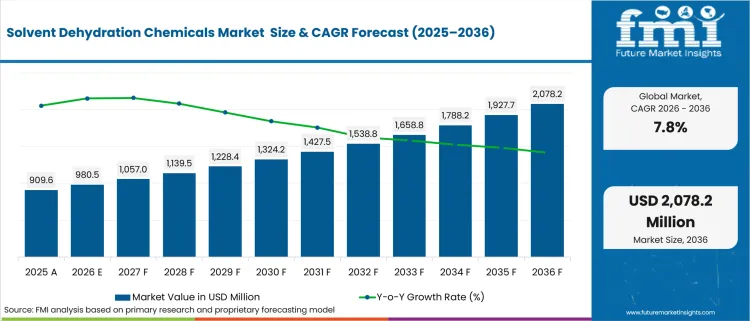
| Metric | Value |
|---|---|
| 2025 Market Size | USD 909.6 million |
| 2026 Market Size | USD 980.6 million |
| 2036 Market Size | USD 2,078.2 million |
| Forecast CAGR (2026-2036) | 7.8% |
| Leading Chemical Type | Molecular Sieves |
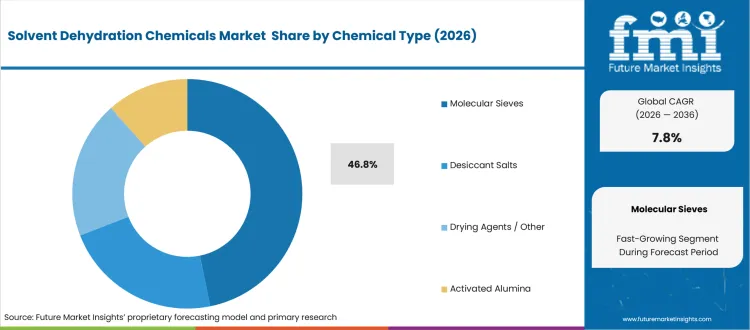
| Molecular Sieves Share (2026) | 46.8% |
| Leading Solvent Type | Alcohols |
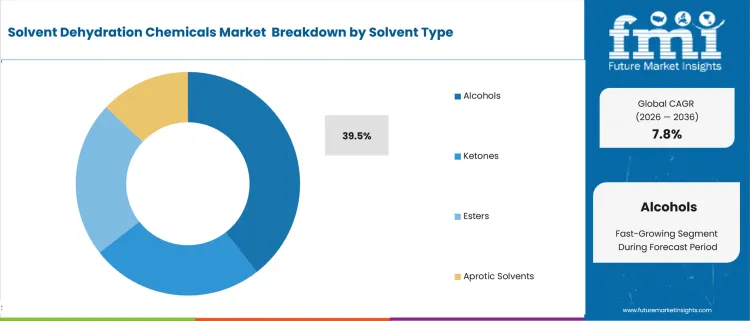
| Alcohols Share (2026) | 39.5% |
| Leading Application | Pharma Solvent Drying |
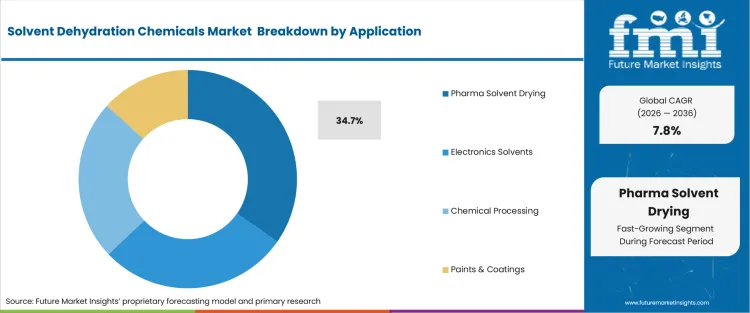
| Pharma Solvent Drying Share (2026) | 34.7% |
| Fastest-growing Country | India |
| India CAGR by 2036 | 9.2% |
Summary of the Solvent Dehydration Chemicals Market
| Market Signal | Commercial Impact |
|---|---|
| Demand and Growth Drivers | Demand for solvent dehydration chemicals is increasing as pharmaceutical manufacturers, solvent recovery facilities, and electronics chemical producers require validated moisture removal solutions that support product quality and regulatory compliance.
|
| Product and Segment View | Molecular sieves, alcohol solvent dehydration, and pharmaceutical solvent drying continue to represent the leading commercial opportunities across the market.
|
| Geography and Growth Outlook | Asia continues to lead market expansion through chemical manufacturing growth, semiconductor production, and increasing demand for high-purity solvent processing.
|
| Competitive Landscape | Competition increasingly focuses on advanced adsorbent technologies, validated documentation, regeneration expertise, and technical application support.
|
| Analyst Perspective | Solvent dehydration chemicals are evolving from commodity drying materials into qualification-driven process solutions that improve solvent quality, recovery efficiency, and regulatory compliance.
- Nikhil Kaitwade, Principal Consultant at Future Market Insights |
How is the solvent dehydration chemicals market segmented?
The Solvent Dehydration Chemicals industry is segmented by chemical type, solvent type, application, end use, sales channel, and region.
The Solvent Dehydration Chemicals Market is segmented by chemical type, solvent type, application, end use, sales channel, and region. Chemical type covers molecular sieves, desiccant salts, Activated alumina, and other drying agents. Solvent type includes alcohols, ketones, esters, and aprotic solvents used as industrial solvents. Application spans pharma solvent drying, electronics solvents, paints and coatings, and chemical processing. End use covers pharmaceuticals, specialty chemicals, electronics, and recycling or recovery users. Sales channel includes direct sales, distributors, and service contractors. Regional coverage extends across North America, Latin America, Europe, East Asia, South Asia and Pacific, and the Middle East and Africa.
Why do Molecular Sieves matter within the chemical type category?
Process buyers need drying media that removes water without taking valuable solvent components out of the stream. That problem is common in fixed-bed drying and recovery loops. Molecular sieves address this need by matching pore size to water molecules. Buyers also evaluate dusting and crush strength before they qualify a grade for plant use. Regeneration temperature is reviewed during the same process.
- In 2026, Molecular Sieves are anticipated to hold 46.8% of chemical type demand. The position is driven by pore-controlled adsorption in alcohols and aprotic solvents. Arkema states that 3A molecular sieves adsorb water and exclude larger alcohol molecules. That selectivity supports solvent-specific drying choices.
- Operations teams using beads and pellets reduce fixed-bed risk by controlling pressure drop and dust generation. The same buyer logic supports 13X molecular sieve activated powder in selected adsorption systems. Wider use of zeolite adsorbents also becomes important once regeneration behavior affects operating cost.
What makes Alcohols a meaningful solvent type segment?
Alcohol drying is commercially visible due to ethanol and methanol often carrying water back into recovery loops. Isopropanol adds another repeat-use route. The issue is not only moisture removal. Buyers need a media grade that preserves solvent value after distillation. This places alcohols close to pharma and coatings accounts. Specialty chemical users also rely on alcohol reuse streams.
- Alcohols represent 39.5% of solvent type demand in 2026, supported by frequent recovery of ethanol and methanol across regulated plants. Arkema identifies Siliporite EPX as a grade used for ethanol dehydration down to ppm-level moisture. That fit supports repeat dehydration purchases.
- Plant teams choose alcohol drying media to protect reuse value after distillation and reduce water carryover in synthesis. The commercial case is clear for buyers that purchase fresh solvent regularly. Ketone and ester drying remain relevant, yet alcohols create the repeat-use reference point.
Why is Pharma Solvent Drying central to application demand?
Pharmaceutical solvent drying is close to product quality systems because a media change can affect moisture removal and impurity profile. It can also trigger validation file updates, which makes the purchase less flexible than a commodity chemical order. Buyers need technical documentation before they switch suppliers, especially in API synthesis and formulation workflows.
- Pharma Solvent Drying is projected to represent 34.7% of application demand in 2026, attributable to process validation and residual-solvent review. ICH published the Q3C(R10) concept paper in November 2024. That maintenance process keeps solvent limits visible for quality teams.
- Pharma buyers value documented moisture capacity due to internal review requirements for qualified process materials. The supplier case rests on technical files and safety data. Repeatable media performance remains part of the review. Low-cost drying agents remain useful only in solvent loops that carry limited validation risk.
How do Pharmaceuticals influence end-use demand?
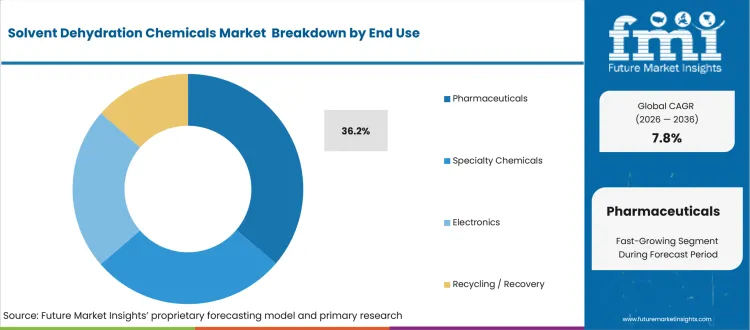
Pharmaceutical end users treat solvent dehydration as a quality and supply decision. API and excipient workflows rely on controlled solvents, and export-facing plants often need evidence that process materials behave consistently. This makes supplier documentation and batch traceability part of the buying conversation instead of an afterthought.
- Pharmaceuticals are estimated to hold 36.2% of end-use demand in 2026, attributable to API synthesis and formulation workflows that rely on controlled solvents. PIB reported that India exported medicines to 191 countries in 2024-25. That exposure raises documentation needs in solvent handling.
- The end-use value is expected to come from lower impurity risk and more predictable recovery economics. Pharmaceutical accounts compare suppliers on batch traceability and moisture data before price. The same quality pressure supports related demand in fine chemicals that use controlled solvent loops.
How is Direct positioned within the sales channel category?
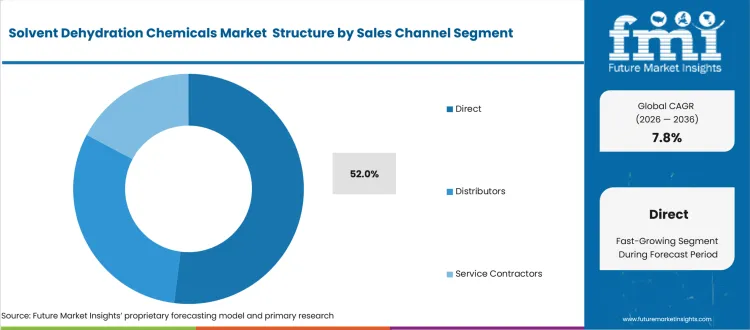
Direct sales matter due to solvent dehydration often needing supplier involvement before the purchase order is placed. Large plants ask for grade selection and regeneration guidance. Packaging data and safety files also guide supplier review. Distributors remain useful for smaller buyers, but high-value solvent loops create a clearer need for direct technical accountability.
- Direct sales are likely to represent 52.0% of channel demand in 2026, shaped by grade qualification and regeneration support needs. BASF revised its Singapore safety data sheet for 4A Molecular Sieve in November 2025. Such documentation matters during supplier review.
- Large plants prefer direct supplier routes once solvent loops are tied to audits or high-value production. Service contractors gain relevance once media replacement includes solvent recycling and recovery equipment maintenance. That route creates a service-led channel for repeat replacement demand.
What are the drivers, restraints, and opportunities in the solvent dehydration chemicals market?
Near-term purchases are being shaped by the validation requirement, regeneration-cost constraint, and service-linked recovery route outlined below.
- Driver: Qualified moisture control is driven by pharmaceutical and electronics buyers that need repeatable solvent quality in audited processes.
- Restraint: Regeneration energy and incorrect media selection slow adoption in low-value solvent streams due to uncertain payback.
- Opportunity: Service-linked media replacement gains traction from recovery accounts that want drying and monitoring support in one program.
Pharma and electronics buyers create spending pressure once water removal affects impurity risk or process stability. Qualified media reduces uncertainty before a solvent returns to synthesis or cleaning, and current quality alerts keep the issue visible. FDA warned drug manufacturers in July 2025 about benzene contamination risk and cited ICH Q3C expectations for Class 1 solvents. That reminder strengthens the business case for drying media that supports documented solvent control and safer reuse decisions.
Regeneration cost remains a restraint in solvent loops that carry low value or irregular reuse volume. The selection risk is technical and financial, and the wrong pore size can reduce solvent value or raise changeout work. Arkema notes that 3A molecular sieves are regenerated at 250-300 degrees C and 4A grades at 300-350 degrees C under dry purge or vacuum. Those operating ranges explain why buyers review energy cost and media life before adopting repeat dehydration programs. This review keeps procurement tied to operating evidence before approving purchases.
Recovery accounts create the supplier opportunity once solvent reuse becomes part of waste-control and purchasing discipline. EPA guidance updated in December 2025 recommends reclaiming solvents in onsite distillation units for several industrial sectors. Dehydration chemicals fit after distillation if the recovered stream still carries water above the reuse limit. Suppliers able to bundle media replacement, bed inspection, and regeneration guidance can turn a restraint into a service-led route for repeat business. That route is useful for plants that lack internal adsorption expertise and need outside support during changeout cycles.
Which country CAGRs are profiled in the solvent dehydration chemicals market?
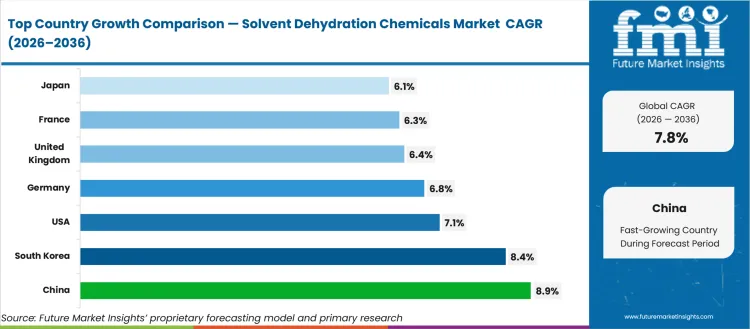
| Country | CAGR |
|---|---|
| United States | 7.1% |
| United Kingdom | 6.4% |
| Germany | 6.8% |
| France | 6.3% |
| Japan | 6.1% |
| China | 8.9% |
| South Korea | 8.4% |
| India | 9.2% |
How do country-level CAGRs compare in the solvent dehydration chemicals market?
Country CAGR in the industry should be viewed by buyer pressure instead of generic industrial growth. In established markets, demand is tied to supplier qualification and chemical park operations. Documented solvent handling remains the purchase anchor for pharmaceutical and specialty chemical users. In higher-growth Asian markets, the same materials sit closer to electronics capacity and pharma exports. Regional molecular sieve availability adds another purchase driver for buyers managing shorter lead times. Procurement teams should compare countries with the cost of off-spec solvent and the difficulty of switching media.
- The United States is expected to grow at 7.1% CAGR during the forecast period, supported by pharmaceutical production and coatings activity. FRED data from the USA Census Bureau showed pharmaceutical and medicine manufacturing shipments of USD 25,437 million in April 2026. This gives the country a steady base, but growth remains more measured than export-led Asian markets.
- The United Kingdom is estimated to rise at 6.4% CAGR between 2026 and 2036, shaped by life sciences manufacturing and contract development work. GOV.UK reported biopharmaceutical turnover of GBP 98.9 billion in 2023/2024. That supports validated solvent drying demand, yet smaller batch patterns keep the country profile below India and China.
- Germany is forecast to advance at 6.8% CAGR over the assessment period, reinforced by chemical parks and pharma manufacturing. VCI reported Q2 2025 chemical and pharmaceutical industry sales of EUR 52.2 billion. Germany shows a specification-led profile, but energy cost pressure keeps regeneration economics under review.
- France is anticipated to post 6.3% CAGR by 2036, influenced by specialty chemicals and domestic adsorbent expertise. France Chimie reported in June 2025 that chemical activity declined 5.6% in volume year over year during the first quarter. That pressure keeps growth measured, although Arkema provides a local molecular sieve reference.
- Japan is likely to expand at 6.1% CAGR by 2036, supported by precision chemicals and electronics material users. METI reported that Japan production index reached 104.6 in October 2025. The country remains specification-focused, but supplier switching is slower than in markets adding new capacity.
- China is estimated to rise at 8.9% CAGR between 2026 and 2036, supported by chemical processing and electronics production scale. NBS reported that China produced 170.3 billion integrated circuits from January to May 2024. That scale supports solvent purification in electronics chemicals and broader industrial processing.
- South Korea is projected to record 8.4% CAGR by 2036, shaped by semiconductor materials and tighter chemical purity expectations. Invest Korea reported that semiconductors accounted for 20.8% of national exports in 2024. South Korea differs from China due to narrower demand scope and greater weight on documentation.
- India is expected to grow at 9.2% CAGR during the forecast period, driven by pharma exports and local molecular sieve supply. PIB reported pharmaceutical exports of USD 30.5 billion in 2024-25. India outpaces established markets due to export-facing validation needs and improving regional supplier access.
Who are the notable companies in the solvent dehydration chemicals market?
Honeywell UOP, Arkema, BASF, W. R. Grace, Zeochem, Axens, Tosoh, Sorbchem India, Desicca Chemicals, and Merck KGaA are the notable companies shaping this market.
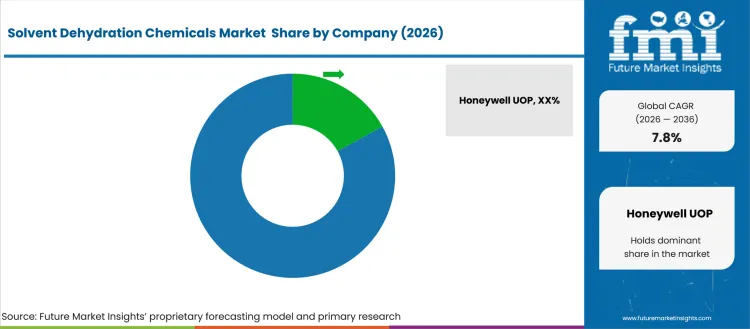
Supplier competition is organized around the support level required before a plant changes or regenerates drying media. Honeywell UOP and Arkema suit accounts seeking established adsorbent grades and product files. BASF, W. R. Grace, Zeochem, Axens, and Tosoh fit process buyers that compare pore size and regeneration guidance. Sorbchem India and Desicca Chemicals add regional supply access for mid-sized solvent users. Merck KGaA supports laboratory and controlled synthesis purchasing. The buyer decision centers on global technical files, local availability, and solvent-specific proof.
- Honeywell UOP and Axens are relevant in process accounts that need adsorbent selection support for engineered purification systems. Their role is practical once solvent dehydration sits near broader separation and regeneration decisions. Buyers use these suppliers to reduce technical risk before bed design or media replacement.
- Arkema and Zeochem focus on molecular sieve grades that support alcohol drying and solvent treating. Specification-driven accounts use their product evidence during qualification. Their position is supported by product evidence in ethanol dehydration and solvent-drying applications. Buyers look to these suppliers for pore-size matching and regeneration guidance.
- BASF and W. R. Grace are relevant in accounts that compare documentation and adsorbent handling. Supply continuity remains part of the decision. BASF safety data supports qualification reviews for 4A molecular sieve materials. Grace adds broader process purification relevance for buyers that already manage adsorbents across plant systems.
- Tosoh and Sorbchem India address specialized and regional buyer routes. Desicca Chemicals and Merck KGaA support smaller-pack or controlled synthesis needs. Tosoh supports zeolite chemistry choices. Indian suppliers improve availability for mid-sized accounts. Merck KGaA remains relevant to research and controlled synthesis workflows that need smaller-pack drying materials.
Competitive Benchmarking: Solvent Dehydration Chemicals Market
| Company | Adsorbent Portfolio Fit | Solvent-Drying Evidence | Technical Support Reach | Footprint |
|---|---|---|---|---|
| Honeywell UOP | High | Strong | High | Global |
| Arkema | High | Strong | Medium | Global |
| BASF | Medium | Strong | High | Global |
| W. R. Grace | High | Medium | High | Global |
| Zeochem | High | Strong | Strong | Global |
| Axens | Medium | Medium | Strong | Global |
| Tosoh | Medium | Medium | Medium | Global |
| Sorbchem India | Medium | Medium | Medium | India |
| Desicca Chemicals | Medium | Medium | Regional | India |
| Merck KGaA | Medium | Strong | High | Global |
Source: Future Market Insights competitive analysis, 2026. Ratings reflect relative portfolio relevance and workflow or project fit. They also reflect service capability and geographic reach.
Key Developments in the Solvent Dehydration Chemicals Market
- In April 2024, Zeochem completed the acquisition of Sorbead India and Swambe Chemicals. The action matters due to Sorbchem India adding molecular sieve distribution and chromatography gel activity in India. The implication is better regional access for pharmaceutical and chemical accounts.
- In September 2025, BASF revised the USA safety data sheet for 4A-BF Molecular Sieve. The document identifies the material and handling information for buyer review. This matters due to qualification teams needing current product files before adsorbents enter solvent drying loops.
- In July 2025, Zeochem completed the acquisition of SiliCycle Inc. The action matters due to SiliCycle adding chromatography-gel expertise for pharmaceutical purification accounts. The implication is wider separation-material relevance for buyers that compare drying media, purification aids, and solvent-control documentation across regulated workflows.
- In 2024, Arkema presented molecular sieve use in coatings and building applications at the American Coatings Show. The update is significant to drying media buyers due to moisture-control performance remaining relevant beyond solvent loops. It points to broader buyer attention around molecular sieve documentation.
Key Players in the Solvent Dehydration Chemicals Market
Integrated Adsorbent Suppliers
- Honeywell UOP
- Arkema
- BASF
- W. R. Grace
- Axens
Molecular Sieve Specialists
- Zeochem
- Tosoh
- Sorbchem India
Regional and Laboratory Supply Channels
- Desicca Chemicals
- Merck KGaA / MilliporeSigma
Solvent Dehydration Chemicals Market - Report Scope
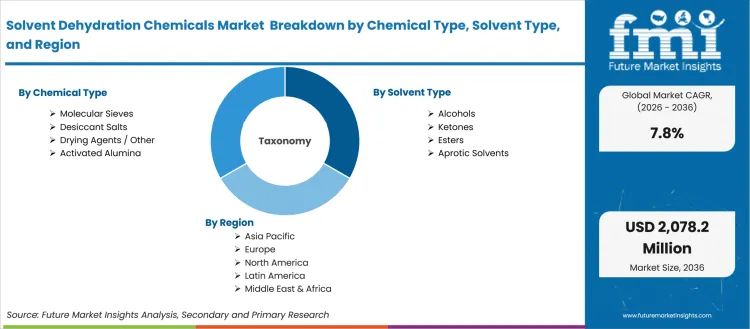
| Coverage field | Report scope |
|---|---|
| Market breakdown | Solvent Dehydration Chemicals Market Breakdown By Chemical Type, Solvent Type, Application, End Use, Sales Channel, and Region |
| Market Definition | Adsorbents and drying media used to remove water from organic solvent streams in commercial process use. |
| Regions Covered | North America, Latin America, Europe, East Asia, South Asia and Pacific, Middle East and Africa |
| Countries Covered | United States, United Kingdom, Germany, France, Japan, China, South Korea, India and additional countries |
| Key Companies Profiled | Honeywell UOP, Arkema, BASF, W. R. Grace, Zeochem, Axens, Tosoh, Sorbchem India, Desicca Chemicals, Merck KGaA |
| Forecast Period | 2026 to 2036 |
| Approach | Hybrid bottom-up and top-down method using solvent-use intensity, media replacement rates, end-use weighting, and supplier validation |
Solvent Dehydration Chemicals Market - Research Methodology
| Method | Approach |
|---|---|
| Primary Research | FMI analysts reviewed inputs from pharmaceutical manufacturers, electronics chemical users, coatings producers, specialty chemical plants, and solvent recovery operators. Interviews focused on media changeout cycles, solvent compatibility, qualification barriers, and channel preference. |
| Desk Research | Desk research covered ICH residual-solvent guidance, EPA waste rules, official manufacturing statistics, trade-body releases, and company product evidence. Sources were selected only for solvent drying, adsorbents, or buyer qualification relevance. |
| Market Sizing and Forecasting | The model combined solvent-use intensity, drying-media replacement rates, average realized pricing, and country-level end-use weighting. Pharma drying, electronics solvents, coatings, chemical processing, and recovery loops were weighted separately. |
| Data Validation | Forecasts were checked against parent adsorbent demand, solvent recovery evidence, pharma export signals, semiconductor output, and company portfolios. Duplicate external statistics were avoided by assigning each public figure to one article section. |
Solvent Dehydration Chemicals Market by Segments
Solvent Dehydration Chemicals Market segmented by Chemical Type:
- Molecular Sieves
- Desiccant Salts
- Activated Alumina
- Drying Agents / Other
Solvent Dehydration Chemicals Market segmented by Solvent Type:
- Alcohols
- Ketones
- Esters
- Aprotic Solvents
Solvent Dehydration Chemicals Market segmented by Application:
- Pharma Solvent Drying
- Electronics Solvents
- Paints & Coatings
- Chemical Processing
Solvent Dehydration Chemicals Market segmented by End Use:
- Pharmaceuticals
- Specialty Chemicals
- Electronics
- Recycling / Recovery
Solvent Dehydration Chemicals Market segmented by Sales Channel:
- Direct
- Distributors
- Service Contractors
Solvent Dehydration Chemicals Market by Region:
- North America
- United States
- Canada
- Mexico
- Latin America
- Brazil
- Chile
- Rest of Latin America
- Western Europe
- Germany
- United Kingdom
- France
- Italy
- Spain
- Nordics
- BENELUX
- Rest of Western Europe
- Eastern Europe
- Russia
- Poland
- Hungary
- Balkan & Baltic
- Rest of Eastern Europe
- East Asia
- China
- Japan
- South Korea
- South Asia and Pacific
- India
- ASEAN
- Australia and New Zealand
- Rest of South Asia and Pacific
- Middle East and Africa
- Kingdom of Saudi Arabia
- Other GCC Countries
- Turkiye
- South Africa
- Other African Union
- Rest of Middle East and Africa
Research Sources and Bibliography
- International Council for Harmonisation. (2024, February 15). The ICH Q3C(R9) Guideline reaches Step 4 of the ICH Process. ICH.
- European Medicines Agency. (2024, April 29). ICH Q3C (R9) Residual solvents - Scientific guideline. EMA.
- International Council for Harmonisation. (2024, November 26). Q3C(R10): Impurities: Guideline for Residual Solvents final concept paper. ICH.
- USA Environmental Protection Agency. (2026, March 20). Defining Hazardous Waste: Listed, Characteristic and Mixed Radiological Wastes. EPA.
- USA Environmental Protection Agency. (2025, December 16). Typical Wastes Generated by Industry Sectors. EPA.
- USA Food and Drug Administration. (2025, July 24). FDA alerts drug manufacturers to the risk of benzene contamination in certain drugs. FDA.
- Semiconductor Industry Association. (2026, February 6). Global Annual Semiconductor Sales Increase 25.6% to $791.7 Billion in 2025. SIA.
- USA Census Bureau. (2026, June 3). Monthly Full Report on Manufacturers' Shipments, Inventories and Orders: April 2026. USA Department of Commerce.
- Federal Reserve Bank of St. Louis. (2026, June 3). Manufacturers' Value of Shipments: Pharmaceutical and Medicine Manufacturing. FRED.
- Department for Business and Trade. (2025, October 2). Bioscience and health technology sector statistics 2023 to 2024. GOV.UK.
- Verband der Chemischen Industrie. (2025, September 3). Quarterly report 2/2025: Severe setback in chemical business. VCI.
- France Chimie. (2025, June 20). Bulletin économique 1er trimestre 2025. France Chimie.
- Ministry of Economy, Trade and Industry. (2025, November 28). Preliminary Report for October 2025. METI.
- National Bureau of Statistics of China. (2024, June 25). Industrial Production Operation in May 2024. National Bureau of Statistics of China.
- Invest Korea. (2025, October 2). South Korea's Semiconductor Industry and Investment Status. Invest Korea.
- Press Information Bureau. (2026, March 21). India's Pharmaceuticals in Global Healthcare. Government of India.
- BASF. (2025, September 3). BASF 4A-BF Molecular Sieve 2.5-5.0mm safety data sheet. BASF.
- BASF. (2025, November 12). BASF 4A Molecular Sieve 1.6-2.5mm safety data sheet. BASF
- Zeochem. (2024, April 29). Zeochem Acquires Sorbead India and Swambe Chemicals. Zeochem.
- Zeochem. (2025, July 16). Zeochem Completes Acquisition of SiliCycle, Expanding Global Chromatography Capabilities. Zeochem.
- Merck KGaA. (2025, April). GC accessories brochure. Sigma-Aldrich.
- Arkema. (2024, April 2). Arkema expands its sustainable offer at American Coatings Show 2024. Arkema.
This bibliography is provided for reader reference and uses primary government, standards-body, official trade body, and company sources.
This Report Answers
- What is the expected global value of the Solvent Dehydration Chemicals Market in 2026 and 2036?
- What CAGR is forecast for solvent dehydration chemicals during the 2026 to 2036 period?
- Which chemical type is used to assess Molecular Sieves demand in 2026?
- Why do pharmaceutical and electronics buyers use dehydration chemicals in solvent workflows?
- How do alcohol solvent loops shape repeat demand for molecular sieves?
- Which countries are compared in the solvent dehydration chemicals forecast?
- Which companies compete across molecular sieves, activated alumina, and drying media?
- What products and applications are included within the solvent dehydration chemicals definition?
- How does FMI size and validate demand across solvent type, end use, and country?
- What buyer factors should executives assess before selecting a drying media supplier?
Frequently Asked Questions
What is driving growth in the Solvent Dehydration Chemicals Market?
Growth is driven by regulated solvent quality, solvent recovery economics and tighter moisture control in pharma and electronics workflows.
Why should executives track the Solvent Dehydration Chemicals Market?
Executives should track this market because solvent quality directly affects regulatory compliance and the economics of solvent recovery across pharma and specialty chemical operations.
What business problem does the Solvent Dehydration Chemicals Market address?
It helps manufacturers and recyclers remove water from fresh and recovered solvents so that materials meet purity specifications before reuse and audit risk.
What should procurement leaders evaluate before selecting suppliers?
Procurement leaders should evaluate pore size selectivity, solvent compatibility, dust and crush strength, regeneration temperature, batch traceability, safety documentation, and supplier support during qualification and media changeover.
What can limit return on investment for buyers?
Return on investment can be limited when drying media is poorly matched to solvent chemistry or when regeneration energy cost outweighs reuse savings; buyers reduce this risk through solvent specific trials and documented regeneration plans.
How can suppliers build executive confidence?
Suppliers build confidence by providing solvent specific performance data and technical support that links drying performance to compliance and recovery outcomes.
Preview the report firsthand - request a free sample
Get SampleGet the brochure for pricing and purchase details.
Get PDFTable of Content
- Key Takeaways
- Market Size and CAGR
- Top Growth Driver
- Fastest Growing Segment
- Leading Region
- Key Companies
- Emerging Opportunities
- Executive Summary
- Global Market Outlook
- Demand-side Trends
- Supply-side Trends
- Technology Roadmap Analysis
- Analysis and Recommendations
- Analyst Perspective (What is happening? Why now? What should investors know?)
- Key Questions Answered
- How large is the market?
- What is the CAGR?
- What are key trends?
- Which region dominates?
- Who are the leaders?
- Market Overview
- Market Coverage / Taxonomy
- Market Definition / Scope / Limitations
- Research Methodology
- Chapter Orientation
- Analytical Lens and Working Hypotheses
- Market Structure, Signals, and Trend Drivers
- Benchmarking and Cross-market Comparability
- Market Sizing, Forecasting, and Opportunity Mapping
- Research Design and Evidence Framework
- Desk Research Programme (Secondary Evidence)
- Expert Input and Fieldwork (Primary Evidence)
- Tooling, Models, and Reference Databases
- Data Engineering and Model Build
- Quality Assurance and Audit Trail
- Market Background
- Market Dynamics (Drivers, Restraints, Opportunity, Trends)
- Scenario Forecast (Optimistic, Likely, Conservative)
- Impact Analysis
- AI Impact
- Sustainability Impact
- Regulatory Impact
- Technology Impact
- Consumer / Buyer Analysis
- Purchase Drivers
- Adoption Barriers
- Buyer Journey
- Opportunity Map Analysis
- Product Life Cycle Analysis
- Supply Chain Analysis
- Investment Feasibility Matrix
- Value Chain Analysis
- PESTLE and Porter's Analysis
- Regulatory Landscape
- Regional Parent Market Outlook
- Production and Consumption Statistics
- Import and Export Statistics
- Global Market Analysis and Forecast, 2021 to 2036
- Historical Market Size Value (USD Million) & Volume (Unit) Analysis, 2021 to 2025
- Current and Future Market Size Value (USD Million) & Volume (Unit) Projections, 2026 to 2036
- Y-o-Y Growth Trend Analysis
- Absolute $ Opportunity Analysis
- Global Market Pricing Analysis, 2021 to 2036
- Global Market Analysis and Forecast, By Chemical Type , 2021 to 2036
- Introduction / Key Findings
- Historical Market Size Value (USD Million) & Volume (Unit) Analysis By Chemical Type , 2021 to 2025
- Current and Future Market Size Value (USD Million) & Volume (Unit) Analysis and Forecast By Chemical Type , 2026 to 2036
- Molecular Sieves
- Desiccant Salts
- Drying Agents / Other
- Activated Alumina
- Molecular Sieves
- Y-o-Y Growth Trend Analysis By Chemical Type , 2021 to 2025
- Absolute $ Opportunity Analysis By Chemical Type , 2026 to 2036
- Global Market Analysis and Forecast, By Solvent Type, 2021 to 2036
- Introduction / Key Findings
- Historical Market Size Value (USD Million) & Volume (Unit) Analysis By Solvent Type, 2021 to 2025
- Current and Future Market Size Value (USD Million) & Volume (Unit) Analysis and Forecast By Solvent Type, 2026 to 2036
- Alcohols
- Ketones
- Esters
- Aprotic Solvents
- Alcohols
- Y-o-Y Growth Trend Analysis By Solvent Type, 2021 to 2025
- Absolute $ Opportunity Analysis By Solvent Type, 2026 to 2036
- Global Market Analysis and Forecast, By Application, 2021 to 2036
- Introduction / Key Findings
- Historical Market Size Value (USD Million) & Volume (Unit) Analysis By Application, 2021 to 2025
- Current and Future Market Size Value (USD Million) & Volume (Unit) Analysis and Forecast By Application, 2026 to 2036
- Pharma Solvent Drying
- Electronics Solvents
- Chemical Processing
- Paints & Coatings
- Pharma Solvent Drying
- Y-o-Y Growth Trend Analysis By Application, 2021 to 2025
- Absolute $ Opportunity Analysis By Application, 2026 to 2036
- Global Market Analysis and Forecast, By End Use, 2021 to 2036
- Introduction / Key Findings
- Historical Market Size Value (USD Million) & Volume (Unit) Analysis By End Use, 2021 to 2025
- Current and Future Market Size Value (USD Million) & Volume (Unit) Analysis and Forecast By End Use, 2026 to 2036
- Pharmaceuticals
- Specialty Chemicals
- Electronics
- Recycling / Recovery
- Pharmaceuticals
- Y-o-Y Growth Trend Analysis By End Use, 2021 to 2025
- Absolute $ Opportunity Analysis By End Use, 2026 to 2036
- Global Market Analysis and Forecast, By Sales Channel, 2021 to 2036
- Introduction / Key Findings
- Historical Market Size Value (USD Million) & Volume (Unit) Analysis By Sales Channel, 2021 to 2025
- Current and Future Market Size Value (USD Million) & Volume (Unit) Analysis and Forecast By Sales Channel, 2026 to 2036
- Direct
- Distributors
- Service Contractors
- Direct
- Y-o-Y Growth Trend Analysis By Sales Channel, 2021 to 2025
- Absolute $ Opportunity Analysis By Sales Channel, 2026 to 2036
- Global Market Analysis and Forecast, By Region , 2021 to 2036
- Introduction
- Historical Market Size Value (USD Million) & Volume (Unit) Analysis By Region, 2021 to 2025
- Current Market Size Value (USD Million) & Volume (Unit) Analysis and Forecast By Region, 2026 to 2036
- North America
- Latin America
- Western Europe
- Eastern Europe
- East Asia
- South Asia and Pacific
- Middle East & Africa
- Market Attractiveness Analysis By Region
- North America Market Analysis and Forecast, By Country , 2021 to 2036
- Historical Market Size Value (USD Million) & Volume (Unit) Trend Analysis By Market Taxonomy, 2021 to 2025
- Market Size Value (USD Million) & Volume (Unit) Forecast By Market Taxonomy, 2026 to 2036
- By Country
- USA
- Canada
- Mexico
- By Chemical Type
- By Solvent Type
- By Application
- By End Use
- By Sales Channel
- By Country
- Market Attractiveness Analysis
- By Country
- By Chemical Type
- By Solvent Type
- By Application
- By End Use
- By Sales Channel
- Key Takeaways
- Latin America Market Analysis and Forecast, By Country
- Historical Market Size Value (USD Million) & Volume (Unit) Trend Analysis By Market Taxonomy, 2021 to 2025
- Market Size Value (USD Million) & Volume (Unit) Forecast By Market Taxonomy, 2026 to 2036
- By Country
- Brazil
- Chile
- Rest of Latin America
- By Chemical Type
- By Solvent Type
- By Application
- By End Use
- By Sales Channel
- By Country
- Market Attractiveness Analysis
- By Country
- By Chemical Type
- By Solvent Type
- By Application
- By End Use
- By Sales Channel
- Key Takeaways
- Western Europe Market Analysis and Forecast, By Country
- Historical Market Size Value (USD Million) & Volume (Unit) Trend Analysis By Market Taxonomy, 2021 to 2025
- Market Size Value (USD Million) & Volume (Unit) Forecast By Market Taxonomy, 2026 to 2036
- By Country
- Germany
- UK
- Italy
- Spain
- France
- Nordic
- BENELUX
- Rest of Western Europe
- By Chemical Type
- By Solvent Type
- By Application
- By End Use
- By Sales Channel
- By Country
- Market Attractiveness Analysis
- By Country
- By Chemical Type
- By Solvent Type
- By Application
- By End Use
- By Sales Channel
- Key Takeaways
- Eastern Europe Market Analysis and Forecast, By Country
- Historical Market Size Value (USD Million) & Volume (Unit) Trend Analysis By Market Taxonomy, 2021 to 2025
- Market Size Value (USD Million) & Volume (Unit) Forecast By Market Taxonomy, 2026 to 2036
- By Country
- Russia
- Poland
- Hungary
- Balkan & Baltic
- Rest of Eastern Europe
- By Chemical Type
- By Solvent Type
- By Application
- By End Use
- By Sales Channel
- By Country
- Market Attractiveness Analysis
- By Country
- By Chemical Type
- By Solvent Type
- By Application
- By End Use
- By Sales Channel
- Key Takeaways
- East Asia Market Analysis and Forecast, By Country
- Historical Market Size Value (USD Million) & Volume (Unit) Trend Analysis By Market Taxonomy, 2021 to 2025
- Market Size Value (USD Million) & Volume (Unit) Forecast By Market Taxonomy, 2026 to 2036
- By Country
- China
- Japan
- South Korea
- By Chemical Type
- By Solvent Type
- By Application
- By End Use
- By Sales Channel
- By Country
- Market Attractiveness Analysis
- By Country
- By Chemical Type
- By Solvent Type
- By Application
- By End Use
- By Sales Channel
- Key Takeaways
- South Asia and Pacific Market Analysis and Forecast, By Country
- Historical Market Size Value (USD Million) & Volume (Unit) Trend Analysis By Market Taxonomy, 2021 to 2025
- Market Size Value (USD Million) & Volume (Unit) Forecast By Market Taxonomy, 2026 to 2036
- By Country
- India
- ASEAN
- Australia & New Zealand
- Rest of South Asia and Pacific
- By Chemical Type
- By Solvent Type
- By Application
- By End Use
- By Sales Channel
- By Country
- Market Attractiveness Analysis
- By Country
- By Chemical Type
- By Solvent Type
- By Application
- By End Use
- By Sales Channel
- Key Takeaways
- Middle East & Africa Market Analysis and Forecast, By Country
- Historical Market Size Value (USD Million) & Volume (Unit) Trend Analysis By Market Taxonomy, 2021 to 2025
- Market Size Value (USD Million) & Volume (Unit) Forecast By Market Taxonomy, 2026 to 2036
- By Country
- Kingdom of Saudi Arabia
- Other GCC Countries
- Türkiye
- South Africa
- Other African Union
- Rest of Middle East & Africa
- By Chemical Type
- By Solvent Type
- By Application
- By End Use
- By Sales Channel
- By Country
- Market Attractiveness Analysis
- By Country
- By Chemical Type
- By Solvent Type
- By Application
- By End Use
- By Sales Channel
- Key Takeaways
- Key Countries Market Analysis
- USA
- Pricing Analysis
- Market Share Analysis, 2025
- By Chemical Type
- By Solvent Type
- By Application
- By End Use
- By Sales Channel
- Canada
- Pricing Analysis
- Market Share Analysis, 2025
- By Chemical Type
- By Solvent Type
- By Application
- By End Use
- By Sales Channel
- Mexico
- Pricing Analysis
- Market Share Analysis, 2025
- By Chemical Type
- By Solvent Type
- By Application
- By End Use
- By Sales Channel
- Brazil
- Pricing Analysis
- Market Share Analysis, 2025
- By Chemical Type
- By Solvent Type
- By Application
- By End Use
- By Sales Channel
- Chile
- Pricing Analysis
- Market Share Analysis, 2025
- By Chemical Type
- By Solvent Type
- By Application
- By End Use
- By Sales Channel
- Germany
- Pricing Analysis
- Market Share Analysis, 2025
- By Chemical Type
- By Solvent Type
- By Application
- By End Use
- By Sales Channel
- UK
- Pricing Analysis
- Market Share Analysis, 2025
- By Chemical Type
- By Solvent Type
- By Application
- By End Use
- By Sales Channel
- Italy
- Pricing Analysis
- Market Share Analysis, 2025
- By Chemical Type
- By Solvent Type
- By Application
- By End Use
- By Sales Channel
- Spain
- Pricing Analysis
- Market Share Analysis, 2025
- By Chemical Type
- By Solvent Type
- By Application
- By End Use
- By Sales Channel
- France
- Pricing Analysis
- Market Share Analysis, 2025
- By Chemical Type
- By Solvent Type
- By Application
- By End Use
- By Sales Channel
- India
- Pricing Analysis
- Market Share Analysis, 2025
- By Chemical Type
- By Solvent Type
- By Application
- By End Use
- By Sales Channel
- ASEAN
- Pricing Analysis
- Market Share Analysis, 2025
- By Chemical Type
- By Solvent Type
- By Application
- By End Use
- By Sales Channel
- Australia & New Zealand
- Pricing Analysis
- Market Share Analysis, 2025
- By Chemical Type
- By Solvent Type
- By Application
- By End Use
- By Sales Channel
- China
- Pricing Analysis
- Market Share Analysis, 2025
- By Chemical Type
- By Solvent Type
- By Application
- By End Use
- By Sales Channel
- Japan
- Pricing Analysis
- Market Share Analysis, 2025
- By Chemical Type
- By Solvent Type
- By Application
- By End Use
- By Sales Channel
- South Korea
- Pricing Analysis
- Market Share Analysis, 2025
- By Chemical Type
- By Solvent Type
- By Application
- By End Use
- By Sales Channel
- Russia
- Pricing Analysis
- Market Share Analysis, 2025
- By Chemical Type
- By Solvent Type
- By Application
- By End Use
- By Sales Channel
- Poland
- Pricing Analysis
- Market Share Analysis, 2025
- By Chemical Type
- By Solvent Type
- By Application
- By End Use
- By Sales Channel
- Hungary
- Pricing Analysis
- Market Share Analysis, 2025
- By Chemical Type
- By Solvent Type
- By Application
- By End Use
- By Sales Channel
- Kingdom of Saudi Arabia
- Pricing Analysis
- Market Share Analysis, 2025
- By Chemical Type
- By Solvent Type
- By Application
- By End Use
- By Sales Channel
- Türkiye
- Pricing Analysis
- Market Share Analysis, 2025
- By Chemical Type
- By Solvent Type
- By Application
- By End Use
- By Sales Channel
- South Africa
- Pricing Analysis
- Market Share Analysis, 2025
- By Chemical Type
- By Solvent Type
- By Application
- By End Use
- By Sales Channel
- USA
- Market Structure Analysis
- Competition Dashboard
- Competition Benchmarking
- Market Share Analysis of Top Players
- By Regional
- By Chemical Type
- By Solvent Type
- By Application
- By End Use
- By Sales Channel
- Emerging Startups
- Innovation Benchmarking
- Competition Analysis
- Competition Deep Dive
- Honeywell UOP
- Overview
- Product Portfolio
- Profitability by Market Segments (Product/Region/Sales Channel)
- Sales Footprint
- Strategy Overview
- Marketing Strategy
- Product Strategy
- Channel Strategy
- Arkema
- BASF
- W. R. Grace
- Axens
- Zeochem
- Honeywell UOP
- Case Studies
- Success Stories
- Recent Developments
- Competition Deep Dive
- Assumptions & Acronyms Used


