

- Market Size (2026)
- USD 1960.7 Mn
- Forecast (2036)
- USD 5273.5 Mn
- CAGR (2026 to 2036)
- 10.4%
How big is the ZLD chemicals market in 2026?
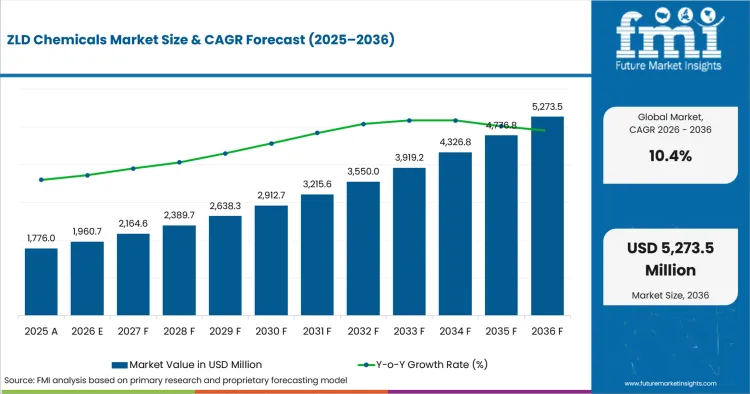
USD 1,960.7 million in 2026 and USD 5,273.5 million by 2036 at a 10.4% CAGR.
The ZLD chemicals market was valued at USD 1,776.0 million in 2025. It is expected to grow from USD 1,960.7 million in 2026 to USD 5,273.5 million in 2036 at a CAGR of 10.4% as industrial plants move higher-salinity wastewater into reuse-led treatment loops. Chemistry & Service is expected to hold 57.0% share in 2026, supported by dosing audits, lab testing, and operating reviews. Pretreatment is projected to secure 41.0% share in 2026, guided by feed conditioning needs before membranes and crystallizers. Antiscalants are expected to account for 39.0% share in 2026, reflecting the scale-control role of specialty chemistry in high-recovery systems.
| Metric | Value |
|---|---|
| 2026 Market Size | USD 1,960.7 million |
| 2036 Market Size | USD 5,273.5 million |
| Forecast CAGR | 10.4% from 2026 to 2036 |
| Leading Sales Model | Chemistry & Service |
| Chemistry & Service Share in 2026 | 57.0% |
| Leading System Stage | Pretreatment |
| Pretreatment Share in 2026 | 41.0% |
| Fastest-growing Country | India |
| India CAGR | 12.1% by 2036 |
| Market Signal | Commercial Impact |
|---|---|
| Demand and Growth Drivers | ZLD chemical demand is expanding as industrial facilities strengthen wastewater recovery, brine management, and compliance with stricter discharge regulations.
|
| Product and Segment View | Chemistry & Service programs, pretreatment processes, and antiscalants dominate their respective market segments.
|
| Geography and Growth Outlook | India and China are expected to remain the fastest-growing markets as industrial water reuse and zero-liquid-discharge investments accelerate.
|
| Competitive Landscape | Competition is increasingly focused on integrated chemical programs and operational support for high-recovery water treatment systems.
|
| Analyst Perspective | ZLD chemicals are evolving into strategic process-control solutions that improve water recovery, operational efficiency, and long-term plant reliability.
- Nikhil Kaitwade, Principal Consultant for Industrial Automation at FMI |
Which factors support expansion in the ZLD chemicals market?
Finished chemical supply and service-linked renewal programs support market value across industrial ZLD projects.
- Market value rises as high-recovery systems need stronger antiscalant programs to protect membrane recovery and evaporator heat transfer.
- Thermal ZLD raises chemical intensity per cubic meter as evaporation concentrates hardness and suspended solids.
- Power plants influence steady demand through flue gas desulfurization wastewater and combustion residual leachate treatment.
- Textile and dyeing clusters shift spending toward reuse-ready treatment as salt and organic load raise discharge risk.
- Chemistry & service contracts expand as buyers request dosage audits and operating data before annual renewals.
Why is the ZLD chemicals market growing?
High-recovery industrial wastewater treatment increases chemical demand as suspended solids and organics concentrate during reuse.
Industrial ZLD buyers spend more on chemistry as water recovery targets raise scaling and fouling risk. United States power wastewater rules finalized in 2024 are expected to reduce pollutant discharge from coal-fired power plant wastewater by about 660 million pounds each year, showing how difficult wastewater streams are being pushed toward stronger treatment control. Brine concentration from cooling and ash-handling streams increases demand for pH adjusters and sludge-conditioning chemicals. Suppliers able to link dosing programs with recovery levels and solids removal gain stronger renewal positions in industrial water treatment contracts.
How is the ZLD Chemicals Market segmented?
ZLD Chemicals Market is segmented by chemical type, application, end use, system stage, and sales model.
- Antiscalants are projected to account for 39.0% share in 2026, influenced by high-recovery operation that concentrates calcium and silica beyond standard wastewater duty.
- Evaporators / crystallizers are expected to hold 36.0% share in 2026, shaped by concentrated brine exposure and greater need for foaming and solids control.
- Power generation is anticipated to account for 32.0% share in 2026, led by complex wastewater streams from flue gas desulfurization and ash management.
- Pretreatment is projected to hold 41.0% share by System Stage in 2026, guided by feed conditioning needs that protect membranes and crystallizers from preventable fouling.
- Chemistry & service is expected to represent 57.0% share by Sales Model in 2026, supported by site audits and operating support during high-salinity treatment.
Why do antiscalants dominate the ZLD chemicals market by chemical type?
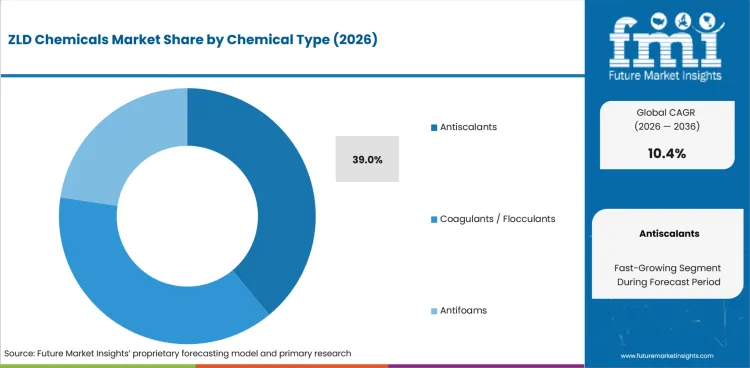
- Antiscalants are projected to account for 39.0% share in 2026, driven by scale prevention needs in membranes and thermal systems exposed to high mineral concentration.
- Coagulants / flocculants gain demand as plants need stronger solids separation before brine concentration and crystallizer operation.
Which application leads the ZLD chemicals market?
- Evaporators / crystallizers are expected to hold 36.0% share in 2026, shaped by thermal concentration steps that raise fouling and salt-management risk.
- Brine concentrators gain use as plants try to reduce final evaporator load and lower thermal energy exposure before solids recovery.
Which end use leads the ZLD Chemicals Market?
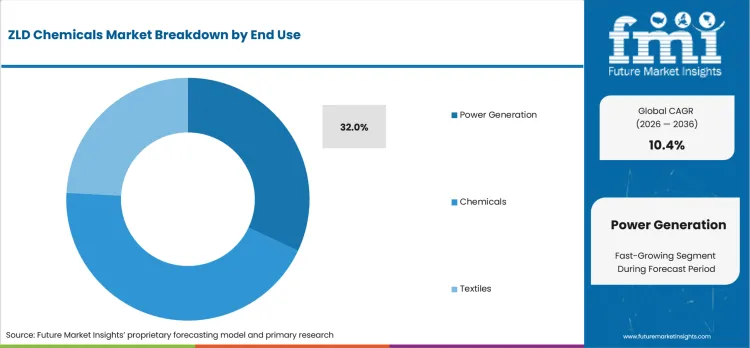
- Power Generation is anticipated to account for 32.0% share in 2026, led by wastewater from flue gas desulfurization, ash transport, cooling systems, and boiler operations.
- Chemical plants create added demand as specialty streams require plant-specific pH correction and organic load control before high-recovery treatment.
Which system stage leads the ZLD Chemicals Market?
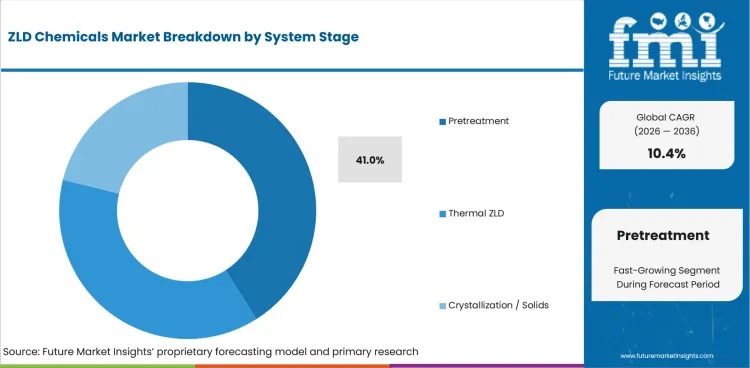
- Pretreatment is projected to hold 41.0% share in 2026, reflected by feed stabilization before membranes, evaporators, and crystallizers.
- Thermal ZLD gains chemical intensity as higher brine concentration raises antifoam and pH-control requirements during evaporation.
Which sales model leads the ZLD Chemicals Market?
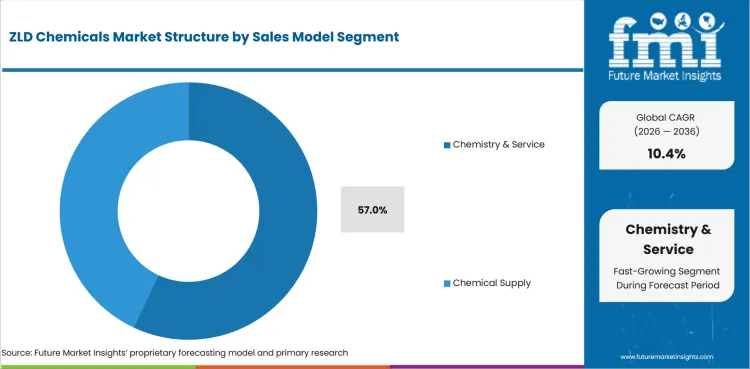
- Chemistry & Service is expected to represent 57.0% share in 2026, guided by buyer preference for dosage control, lab support, and field troubleshooting.
- Chemical Supply remains active in mature plants with stable wastewater chemistry and existing internal teams for monitoring and operating control.
What are the drivers, restraints, and opportunities in the ZLD Chemicals Market?
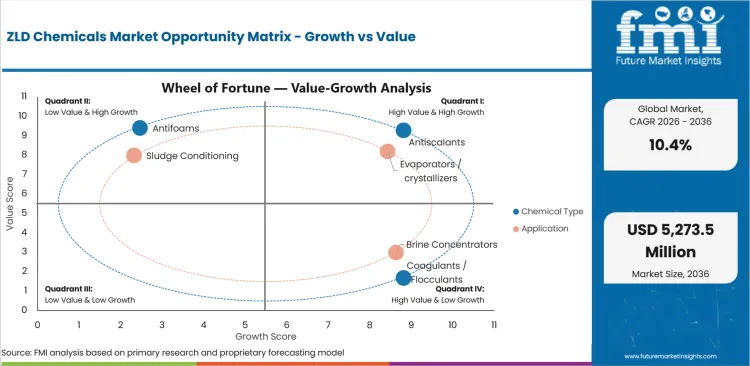
Industrial water reuse and service-led chemistry programs are shaping ZLD chemical buying decisions.
- Driver: High-salinity wastewater streams require stronger antiscalants and pH control chemicals before reuse targets can be achieved.
- Restraint: ZLD operating costs can limit chemical upgrades in smaller facilities with unstable wastewater flow and limited plant-level testing capacity.
- Opportunity: Chemistry-linked service contracts can improve supplier renewal rates as buyers request documented performance across recovery and solids handling.
High-Recovery Brine Control Strengthens Chemical Demand
Drought exposure is increasing industrial interest in reuse-ready treatment. OECD’s 2025 drought outlook reported that a drought episode now costs at least 2 times more than in 2000, while costs may rise 35% to 110% by 2035. Higher drought-related cost exposure pushes water-intensive industrial plants to protect recoverable water and reduce discharge dependence. ZLD chemicals gain demand as antiscalants and antifoams help plants maintain recovery without losing uptime to scaling or sludge instability.
Operating-Cost Burden Limits Smaller Plant Adoption
ZLD systems can require higher energy input and operator attention than conventional treatment routes. United States steam electric wastewater rules finalized in 2024 estimated annualized compliance costs in the range of USD 536 million to USD 1.1 billion, showing how wastewater control can add major cost exposure before plants stabilize treatment programs. Smaller industrial buyers can delay chemical upgrades if feed characterization or long-term service contracts remain weak. Chemical suppliers can reduce adoption pressure through staged dosing trials and performance-linked support models.
Water Reuse Policy Creates Service-Led Expansion
Industrial reuse policy creates a stronger opening for chemistry programs aligned to proof of performance. European Commission research shows recovered water could cover 10% of agricultural water needs, indicating how reuse policy can shift water management away from single-pass consumption. Industrial ZLD chemical suppliers can use similar reuse pressure to support monitoring-led contracts across textiles and metals. Site-specific dosing and digital logs can make chemistry service a renewal driver instead of a one-time consumable sale.
Which countries are growing fastest in the ZLD chemicals market?
India 12.1% CAGR, China 11.2% CAGR, South Korea 10.8% CAGR, United States 9.6% CAGR, Germany 9.2% CAGR, France 8.9% CAGR, United Kingdom 8.7% CAGR, and Japan 8.5% CAGR through 2036.
.webp "Top Country Growth Comparison Zld Chemicals Market Cagr (2026 2036)")
| Country | CAGR |
|---|---|
| India | 12.1% |
| China | 11.2% |
| South Korea | 10.8% |
| United States | 9.6% |
| Germany | 9.2% |
| France | 8.9% |
| United Kingdom | 8.7% |
| Japan | 8.5% |
Source: Future Market Insights, 2026.
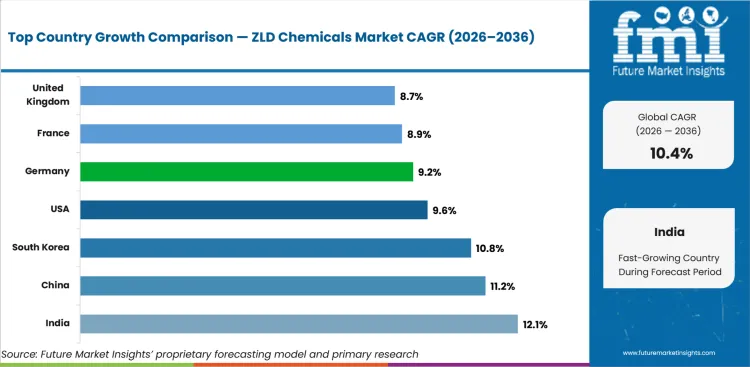
How do country-level CAGRs compare in the ZLD Chemicals Market?
India leads country expansion while Japan records the most cautious pace among profiled markets.
- India is forecast to record 12.1% CAGR by 2036 due to textile clusters and industrial parks increasing ZLD adoption.
- China is expected to expand at 11.2% CAGR from 2026 to 2036, led by industrial water efficiency targets influencing high-recovery treatment programs.
- South Korea is projected to grow at 10.8% CAGR through 2036 since electronics and advanced materials plants need reliable reuse loops.
- United States is estimated to rise at 9.6% CAGR by 2036, reflected by power and chemical assets investing in discharge control.
- Germany is expected to advance at 9.2% CAGR over the forecast period as chemical and semiconductor corridors add wastewater treatment capability.
- France is forecast to grow at 8.9% CAGR by 2036, backed by industrial water savings programs encouraging reuse.
- United Kingdom is projected to post 8.7% CAGR by 2036, guided by water scarcity planning and industrial compliance influencing treatment investments.
- Japan is expected to record 8.5% CAGR by 2036, driven by advanced manufacturing and high-purity water reuse maintaining steady demand.
How fast is the ZLD chemicals market growing in India?
A 12.1% CAGR through 2036 reflects textile wastewater control and common effluent treatment upgrades.
Country Market Snapshot Table
| Parameter | Value |
|---|---|
| Market Size in 2025 (Value) | USD 218.6 million |
| Market Size in 2026 (Value) | USD 245.0 million |
| Market Forecast in 2036 (Value) | USD 768.1 million |
| CAGR (2026 to 2036) | 12.1% |
| Years Considered | 2021 to 2036 |
| Base Year | 2025 |
| Forecast Period | 2026 to 2036 |
| Units Considered | Value (USD million) |
| Leading Sub-Region | Tamil Nadu textile and western industrial corridors |
India ZLD Chemicals Market Outlook
India ZLD chemical market is driven by textile processing and common effluent treatment upgrades. Industrial clusters need chemical programs stabilizing high-salinity feed before reuse and solids recovery.
Buyers are expected to favor suppliers offering site testing and operator support. Local service access will remain critical as wastewater quality changes across shifts and product lines.
Key Growth Drivers
- Common effluent treatment networks create a strong chemical demand base, supported by India’s 222 operational common effluent treatment plants and 53 ZLD-designed facilities reported in 2025.
- Monitored industrial categories need steadier dosing discipline, reinforced by MoEFCC’s 2024-25 OCEMS coverage across 17 highly polluting industry groups and common treatment facilities.
- Distillery and textile plants are adopting brine-control chemistry as salt recovery and water reuse become operating priorities.
- Domestic suppliers gain scope as buyers need fast sample testing and service visits for complex wastewater streams.
Key Restraints
- Smaller factories can delay chemical upgrades as energy use and skilled operator needs raise operating burden.
- Common effluent treatment assets can face uneven feed quality, making standard chemical programs less reliable across mixed industrial inflows.
- Consent and surveillance pressure can raise administrative work, shown through CPCB’s 2025 classification of 419 sectors and sub-sectors across 5 environmental categories before industrial approvals.
What makes India unique
India is unique due to common effluent treatment networks and fast-growing industrial reuse pressure.
Key Companies
- Thermax
- Kurita AquaChemie India
- Aquatech
- Veolia
- Ecolab
- Ion Exchange India
- Gradiant
Sales & Marketing Channels
- Direct technical sales to large industrial sites
- Common effluent treatment plant partnerships
- EPC and system-integrator relationships
- Regional chemical distributors
- Annual service contracts with site audits
- Laboratory testing and trial-based selling
Country Segment Breakdown Table
| Segment | Sub-Segments |
|---|---|
| By Chemical Type | Antiscalants · Coagulants / Flocculants · Antifoams · pH Adjusters & Others |
| By Application | Brine Concentrators · Evaporators / Crystallizers · Membrane Pretreatment · Sludge Conditioning |
| By End Use | Power Generation · Chemicals · Textiles · Mining & Metals · Other Industrial End Uses |
| By System Stage | Pretreatment · Thermal ZLD · Crystallization / Solids |
| By Sales Model | Chemical Supply · Chemistry & Service |
| Key Sub-Regions Covered, Industrial Corridors | Tamil Nadu · Gujarat · Maharashtra · Karnataka · Telangana · Punjab |
Frequently Asked Questions
How fast is India ZLD chemicals market growing?
Industry in India is projected to rise at 12.1% CAGR from 2026 to 2036, driven by textile clusters and industrial reuse.
Who leads India ZLD chemicals market?
Thermax, Kurita AquaChemie India, Aquatech, Veolia, Ecolab, and Ion Exchange India compete due to local service and treatment chemistry.
What is driving adoption in India ZLD chemicals market?
Common effluent treatment upgrades and brine management requirements are moving industrial sites toward chemistry-linked ZLD programs.
What is the ZLD chemicals market outlook in China?
An 11.2% CAGR through 2036 reflects manufacturing water efficiency targets and industrial reuse planning.
Country Market Snapshot Table
| Parameter | Value |
|---|---|
| Market Size in 2025 (Value) | USD 346.2 million |
| Market Size in 2026 (Value) | USD 385.0 million |
| Market Forecast in 2036 (Value) | USD 1,114.2 million |
| CAGR (2026 to 2036) | 11.2% |
| Years Considered | 2021 to 2036 |
| Base Year | 2025 |
| Forecast Period | 2026 to 2036 |
| Units Considered | Value (USD million) |
| Leading Sub-Region | North China chemical parks and Yangtze River Delta industrial corridors |
China ZLD Chemicals Market Outlook
China ZLD chemical setor is shaped by large industrial zones and municipal-industrial reuse programs. High-salinity wastewater control supports demand for antiscalants and sludge-conditioning chemicals.
Suppliers with strong field teams and application laboratories are expected to gain preference. Buyers will favor chemical programs reducing downtime in brine concentrators and crystallizers.
Key Growth Drivers
- Water-intensive manufacturing creates scale for reuse-linked chemical programs, backed by China’s total water consumption of 592.5 billion cubic meters in 2024.
- Factory efficiency goals favor treatment chemicals that support recovery, indicated by a 5.3% decline in water use per CNY 10,000 of industrial added value in 2024.
- Chemical parks need brine-control dosing as mixed wastewater streams can raise scaling, foaming, and sludge instability.
- Electronics and advanced materials plants support service-led sales as high-purity reuse needs closer control of feed chemistry.
Key Restraints
- Feed variability across chemical parks makes single-product chemical programs less reliable without plant-specific testing.
- Sludge and solids handling can raise treatment complexity, illustrated through official trade reporting that placed sludge production above 70 million tons in 2024.
- Price-sensitive industrial users can delay premium chemical programs if internal teams treat dosing as a consumable expense rather than uptime protection.
What makes China unique
China is unique due to chemical manufacturing scale and extensive reuse planning across water-stressed production zones.
Key Companies
- Ecolab
- Veolia
- Kurita Water Industries
- Solenis
- Kemira
- Gradiant
- Aquatech
Sales & Marketing Channels
- Direct enterprise account selling
- Chemical park service contracts
- EPC and equipment supplier partnerships
- Regional distributor networks
- Technical laboratory demonstrations
- Multi-site framework agreements
Country Segment Breakdown Table
| Segment | Sub-Segments |
|---|---|
| By Chemical Type | Antiscalants · Coagulants / Flocculants · Antifoams · pH Adjusters & Others |
| By Application | Brine Concentrators · Evaporators / Crystallizers · Membrane Pretreatment · Sludge Conditioning |
| By End Use | Power Generation · Chemicals · Textiles · Mining & Metals · Other Industrial End Uses |
| By System Stage | Pretreatment · Thermal ZLD · Crystallization / Solids |
| By Sales Model | Chemical Supply · Chemistry & Service |
| Key Sub-Regions Covered, Industrial Corridors | Yangtze River Delta · Shandong · Jiangsu · Guangdong · Inner Mongolia · Hebei |
Frequently Asked Qustions
How fast is China ZLD chemicals market growing?
Industry in China is projected to rise at 11.2% CAGR from 2026 to 2036, guided by industrial reuse and chemical-park treatment needs.
Who leads China ZLD chemicals market?
Ecolab, Veolia, Kurita Water Industries, Solenis, Kemira, Gradiant, and Aquatech compete based on chemical service and industrial treatment support.
What is driving adoption in China ZLD chemicals market?
Chemical parks and industrial water efficiency targets are moving buyers toward high-recovery wastewater chemistry.
What is the ZLD Chemicals Market outlook in South Korea?
A 10.8% CAGR through 2036 reflects electronics and high-purity reuse requirements.
Country Market Snapshot Table
| Parameter | Value |
|---|---|
| Market Size in 2025 (Value) | USD 140.8 million |
| Market Size in 2026 (Value) | USD 156.0 million |
| Market Forecast in 2036 (Value) | USD 435.2 million |
| CAGR (2026 to 2036) | 10.8% |
| Years Considered | 2021 to 2036 |
| Base Year | 2025 |
| Forecast Period | 2026 to 2036 |
| Units Considered | Value (USD million) |
| Leading Sub-Region | Gyeonggi and Ulsan advanced manufacturing corridors |
South Korea ZLD Chemicals Market Outlook
South Korea ZLD chemical industry is influenced by electronics and advanced materials. Buyers need chemical programs that protect reuse loops and wastewater treatment assets.
Industrial users are expected to prioritize reliable monitoring and compatibility with compact plant layouts. Suppliers with experience in electronics-grade water treatment can gain stronger acceptance.
Key Growth Drivers
- Advanced manufacturing buyers need high-control chemistry, reflected in South Korea’s 94.4 wastewater-treatment score in the 2024 Environmental Performance Index.
- Water-company support strengthens local treatment capability, substantiated by K-eco’s 66% budget increase from KRW 7.4 billion in 2023 to KRW 12.3 billion in 2024.
- Semiconductor and battery plants need controlled pretreatment chemistry to reduce contamination risk before reuse loops.
- Petrochemical clusters create demand for coagulants and sludge-conditioning chemicals in concentrated wastewater streams.
Key Restraints
- Compact industrial sites can face installation limits as ZLD systems need testing areas and operator access.
- Chemical compliance changes can slow supplier approvals, noted in South Korea’s 2025 policy shift that changed registration thresholds from 0.1 tons per year to 1 ton per year.
- Electronics-grade buyers may require long qualification cycles before approving new antiscalant or coagulant programs.
What makes South Korea unique
South Korea is unique due to electronics and advanced materials demand tied to high-control wastewater treatment.
Key Companies
- Kurita Hansu
- Veolia
- Ecolab
- Solenis
- Kemira
- Gradiant
- DuPont Water Solutions
Sales & Marketing Channels
- Direct sales to electronics and materials plants
- Qualified vendor programs
- EPC and ultrapure water system partnerships
- Technical seminars for plant engineers
- Site service contracts
- Local distributor support for smaller industrial users
Country Segment Breakdown Table
| Segment | Sub-Segments |
|---|---|
| By Chemical Type | Antiscalants · Coagulants / Flocculants · Antifoams · pH Adjusters & Others |
| By Application | Brine Concentrators · Evaporators / Crystallizers · Membrane Pretreatment · Sludge Conditioning |
| By End Use | Power Generation · Chemicals · Textiles · Mining & Metals · Other Industrial End Uses |
| By System Stage | Pretreatment · Thermal ZLD · Crystallization / Solids |
| By Sales Model | Chemical Supply · Chemistry & Service |
| Key Sub-Regions Covered, Industrial Corridors | Gyeonggi · Ulsan · Incheon · Chungcheong · Busan · Gumi |
Frequently Asked Questions
How fast is South Korea ZLD chemicals market growing?
Industry in South Korea is projected to rise at 10.8% CAGR from 2026 to 2036, driven by electronics and advanced materials plants.
Who leads South Korea ZLD chemicals market?
Kurita Hansu, Veolia, Ecolab, Solenis, Kemira, Gradiant, and DuPont Water Solutions compete depending on technical service and high-control treatment programs.
What is driving adoption in South Korea ZLD chemicals market?
Semiconductor, battery, chemical, and advanced materials plants are moving buyers toward controlled pretreatment and reuse-linked chemistry.
How is the ZLD Chemicals Market performing in the United States?
A 9.6% CAGR through 2036 reflects power wastewater rules and industrial reuse planning.
Country Market Snapshot Table
| Parameter | Value |
|---|---|
| Market Size in 2025 (Value) | USD 297.4 million |
| Market Size in 2026 (Value) | USD 326.0 million |
| Market Forecast in 2036 (Value) | USD 815.7 million |
| CAGR (2026 to 2036) | 9.6% |
| Years Considered | 2021 to 2036 |
| Base Year | 2025 |
| Forecast Period | 2026 to 2036 |
| Units Considered | Value (USD million) |
| Leading Sub-Region | Gulf Coast power and semiconductor corridors |
United States ZLD Chemicals Market Outlook
United States ZLD chemical demand is influenced by power plant wastewater control and water-stressed industrial regions. Complex wastewater streams support demand for antiscalants and sludge-conditioning chemicals.
Suppliers are expected to compete due to plant trials and digital monitoring. Large industrial users will value proof of performance in recovery and chemical dose reduction.
Key Growth Drivers
- Power assets create a large wastewater-treatment base, underlined by thermoelectric withdrawals of 80,432 million gallons per day for water year 2020 reported in 2025.
- Domestic fabs raise high-purity water needs, substantiated by a 2024 Commerce award of up to USD 6.6 billion for TSMC Arizona.
- Semiconductor fabs need high-purity water recovery and strict contamination control, supporting service-led chemical programs.
- Mining and chemical plants use ZLD chemistry to manage metal-bearing streams and difficult sludge profiles.
Key Restraints
- Capital and operating cost exposure can slow smaller ZLD projects, especially in plants lacking steady feed characterization.
- Coal-power wastewater conversion can move slowly, documented in EPA’s 2025 rule that extended 7 compliance deadlines and moved the permanent-cessation notice date from December 31, 2025, to December 31, 2034.
- Industrial sites may require lengthy vendor approvals before changing antiscalants or antifoam programs.
What makes United States unique
United States is unique due to power wastewater rules and advanced chemical manufacturing.
Key Companies
- Ecolab
- Veolia
- Solenis
- Kemira
- Aquatech
- Gradiant
- DuPont Water Solutions
Sales & Marketing Channels
- Direct enterprise accounts
- EPC and system integrator channels
- Technical service contracts
- Distributor support for smaller plants
- Pilot testing and lab validation
- Multi-site industrial agreements
Country Segment Breakdown Table
| Segment | Sub-Segments |
|---|---|
| By Chemical Type | Antiscalants · Coagulants / Flocculants · Antifoams · pH Adjusters & Others |
| By Application | Brine Concentrators · Evaporators / Crystallizers · Membrane Pretreatment · Sludge Conditioning |
| By End Use | Power Generation · Chemicals · Textiles · Mining & Metals · Other Industrial End Uses |
| By System Stage | Pretreatment · Thermal ZLD · Crystallization / Solids |
| By Sales Model | Chemical Supply · Chemistry & Service |
| Key Sub-Regions Covered, Industrial Corridors | Gulf Coast · Texas · Arizona · California · Midwest · Appalachian power corridors |
Frequently Asked Questions
How fast is United States ZLD chemicals market growing?
Industry in the United States is projected to rise at 9.6% CAGR from 2026 to 2036, driven by power wastewater control and semiconductor water needs.
Who leads United States ZLD chemicals market?
Ecolab, Veolia, Solenis, Kemira, Aquatech, Gradiant, and DuPont Water Solutions compete depending on chemistry and system support.
What is driving adoption in United States ZLD chemicals market?
Power wastewater rules, semiconductor fabs and chemical plants are moving buyers toward high-recovery wastewater chemistry.
What is the ZLD Chemicals Market forecast for Germany?
A 9.2% CAGR through 2036 reflects chemical manufacturing and water-efficiency pressure across industrial corridors.
Country Market Snapshot Table
| Parameter | Value |
|---|---|
| Market Size in 2025 (Value) | USD 166.7 million |
| Market Size in 2026 (Value) | USD 182.0 million |
| Market Forecast in 2036 (Value) | USD 438.8 million |
| CAGR (2026 to 2036) | 9.2% |
| Years Considered | 2021 to 2036 |
| Base Year | 2025 |
| Forecast Period | 2026 to 2036 |
| Units Considered | Value (USD million) |
| Leading Sub-Region | Saxony semiconductor and Rhine-Ruhr chemical corridors |
Germany ZLD Chemicals Market Outlook
Germany ZLD chemical demand is shaped by chemical production and advanced manufacturing. Industrial users need water treatment chemistry that supports discharge control and high-reliability plant operation.
Suppliers with strong technical documentation and local service networks are expected to gain preference. Buyers will favor validated chemical programs that protect membrane systems and thermal concentration assets.
Key Growth Drivers
- Advanced wastewater infrastructure supports chemical-service demand, validated through more than 5 billion cubic meters of wastewater and around 3 billion cubic meters of rainwater entering German treatment plants each year.
- Water-technology depth strengthens supplier capability, quantified by EUR 23.6 billion turnover in water supply and wastewater disposal in 2025 and water-technology exports near EUR 1.4 billion.
- Chemical and semiconductor corridors create demand for pretreatment chemicals with strong quality control.
- Industrial buyers value documented service records before approving chemical changes in high-recovery systems.
Key Restraints
- High technical approval requirements can slow new supplier entry into chemical and semiconductor plants.
- Surface-water performance raises treatment scrutiny, documented in European Commission reporting that only 9.3% of German surface water bodies reached good ecological status or potential in third-cycle reviews.
- Mid-sized industrial plants can delay premium chemistry programs if internal teams lack staff for testing, logging, and service coordination.
What makes Germany unique
Germany is unique due to water technology suppliers and semiconductor investment.
Key Companies
- Kemira
- Veolia
- Ecolab
- Kurita Water Industries
- Gradiant
- Aquatech
- Solenis
Sales & Marketing Channels
- Direct technical account management
- Engineering consultant partnerships
- EPC and system integrator programs
- Laboratory-backed product trials
- Regional service teams
- Distributor support for small and mid-sized plants
Country Segment Breakdown Table
| Segment | Sub-Segments |
|---|---|
| By Chemical Type | Antiscalants · Coagulants / Flocculants · Antifoams · pH Adjusters & Others |
| By Application | Brine Concentrators · Evaporators / Crystallizers · Membrane Pretreatment · Sludge Conditioning |
| By End Use | Power Generation · Chemicals · Textiles · Mining & Metals · Other Industrial End Uses |
| By System Stage | Pretreatment · Thermal ZLD · Crystallization / Solids |
| By Sales Model | Chemical Supply · Chemistry & Service |
| Key Sub-Regions Covered, Industrial Corridors | Rhine-Ruhr · Saxony · Bavaria · Baden-Württemberg · Hesse · Hamburg industrial area |
Frequently Asked Questions
How fast is Germany ZLD chemicals market growing?
Industry in Germany is projected to rise at 9.2% CAGR from 2026 to 2036, reflected by semiconductors and water technology activity.
Who leads Germany ZLD chemicals market?
Kemira, Veolia, Ecolab, Kurita Water Industries, Gradiant, Aquatech, and Solenis compete with industrial water chemistry and service.
What is driving adoption in Germany ZLD chemicals market?
Chemical manufacturing and high wastewater treatment standards are moving buyers toward validated ZLD chemical programs.
What is driving ZLD Chemicals Market growth in France?
An 8.9% CAGR through 2036 reflects industrial water-saving policy and reuse project development.
Country Market Snapshot Table
| Parameter | Value |
|---|---|
| Market Size in 2025 (Value) | USD 126.7 million |
| Market Size in 2026 (Value) | USD 138.0 million |
| Market Forecast in 2036 (Value) | USD 323.6 million |
| CAGR (2026 to 2036) | 8.9% |
| Years Considered | 2021 to 2036 |
| Base Year | 2025 |
| Forecast Period | 2026 to 2036 |
| Units Considered | Value (USD million) |
| Leading Sub-Region | Auvergne-Rhône-Alpes and northern chemical-industrial corridors |
France ZLD Chemicals Market Outlook
France ZLD chemical demand is influenced by industrial water-saving goals and food processing. Wastewater reuse planning supports demand for coagulants and pH control chemicals.
Suppliers are expected to gain through environmental documentation and integration with plant water-saving programs. Industrial buyers will prioritize chemical programs supporting stable operation under tighter withdrawal targets.
Key Growth Drivers
- Industrial water-saving policy encourages recovery chemistry, anchored in France’s target to reduce withdrawals by 10% by 2030.
- Alternative water planning expands treatment opportunities, measured against France’s target for 1,000 projects using non-conventional water sources by 2027.
- Chemical and materials plants need high-recovery treatment chemistry to manage organics and variable feed quality.
- Food and beverage industrial sites create demand for pH adjustment and sludge-conditioning chemicals.
Key Restraints
- Site permitting and operating approval cycles can delay adoption of new chemical programs.
- Water-use restriction exposure has intensified, indicated through Île-de-France annual restriction days rising from 0.7 during 2011 to 2016 to 21.7 during 2017 to 2022.
- Industrial buyers can face cost pressure as energy and testing needs increase during high-recovery operation.
What makes France unique
France is unique due to national water-saving targets and high-consuming manufacturing site reviews.
Key Companies
- Veolia
- Ecolab
- Kemira
- Solenis
- Gradiant
- Kurita Water Industries
- Aquatech
Sales & Marketing Channels
- Direct sales to industrial water managers
- Environmental engineering partnerships
- EPC collaboration
- Distributor support for regional plants
- Site audits and lab testing
- Service agreements tied to reuse targets
Country Segment Breakdown Table
| Segment | Sub-Segments |
|---|---|
| By Chemical Type | Antiscalants · Coagulants / Flocculants · Antifoams · pH Adjusters & Others |
| By Application | Brine Concentrators · Evaporators / Crystallizers · Membrane Pretreatment · Sludge Conditioning |
| By End Use | Power Generation · Chemicals · Textiles · Mining & Metals · Other Industrial End Uses |
| By System Stage | Pretreatment · Thermal ZLD · Crystallization / Solids |
| By Sales Model | Chemical Supply · Chemistry & Service |
| Key Sub-Regions Covered, Industrial Corridors | Auvergne-Rhône-Alpes · Hauts-de-France · Normandy · Grand Est · Île-de-France · Provence-Alpes-Côte d’Azur |
Frequently Asked Questions
How fast is France ZLD chemicals market growing?
Industry in France is projected to rise at 8.9% CAGR from 2026 to 2036, supported by water-saving programs and industrial reuse.
Who leads France ZLD chemicals market?
Veolia, Ecolab, Kemira, Solenis, Gradiant, Kurita Water Industries, and Aquatech compete led by service and water treatment chemistry.
What is driving adoption in France ZLD chemicals market?
Industrial water-saving targets and materials production are moving buyers toward ZLD chemistry.
How is the ZLD Chemicals Market performing in the United Kingdom?
An 8.7% CAGR through 2036 reflects water resource planning and treatment upgrades across power and manufacturing sites.
Country Market Snapshot Table
| Parameter | Value |
|---|---|
| Market Size in 2025 (Value) | USD 112.2 million |
| Market Size in 2026 (Value) | USD 122.0 million |
| Market Forecast in 2036 (Value) | USD 280.8 million |
| CAGR (2026 to 2036) | 8.7% |
| Years Considered | 2021 to 2036 |
| Base Year | 2025 |
| Forecast Period | 2026 to 2036 |
| Units Considered | Value (USD million) |
| Leading Sub-Region | Midlands and northern industrial corridors |
United Kingdom ZLD Chemicals Market Outlook
United Kingdom ZLD chemical industry is backed by water resource planning and advanced manufacturing. Industrial buyers need chemical programs reducing fouling and strengthen discharge control.
Suppliers are expected to gain through compliance support and trial-based selling. Buyers will prefer chemical vendors that can connect dosing programs with stable plant operation.
Key Growth Drivers
- Permit compliance creates stronger demand for reliable treatment programs, sustained by 98.8% compliance with numeric permit conditions for sewage and water treatment works in 2024.
- Water-saving planning encourages industrial reuse projects, supported through a 20% public water-supply reduction commitment by 2037 to 2038.
- Chemical and food processing plants need reliable pH adjustment and sludge conditioning for difficult wastewater streams.
- Advanced manufacturing projects promote demand for cleaner process water loops and controlled wastewater treatment.
Key Restraints
- Smaller industrial sites can struggle with testing budgets and chemical storage requirements.
- Compliance expectations add pressure to treatment operators, framed by a 100% numeric compliance target in water-sector regulatory methodology.
- Industrial users may delay premium service contracts if wastewater loads appear stable under current discharge permits.
What makes United Kingdom unique
United Kingdom is unique due to industrial compliance pressure and power-sector wastewater exposure.
Key Companies
- Ecolab
- Veolia
- Kemira
- Solenis
- Aquatech
- Gradiant
- DuPont Water Solutions
Sales & Marketing Channels
- Direct industrial account sales
- Environmental consultant relationships
- EPC and plant upgrade partnerships
- Regional distributor channels
- Laboratory-backed technical trials
- Service contracts for compliance support
Country Segment Breakdown Table
| Segment | Sub-Segments |
|---|---|
| By Chemical Type | Antiscalants · Coagulants / Flocculants · Antifoams · pH Adjusters & Others |
| By Application | Brine Concentrators · Evaporators / Crystallizers · Membrane Pretreatment · Sludge Conditioning |
| By End Use | Power Generation · Chemicals · Textiles · Mining & Metals · Other Industrial End Uses |
| By System Stage | Pretreatment · Thermal ZLD · Crystallization / Solids |
| By Sales Model | Chemical Supply · Chemistry & Service |
| Key Sub-Regions Covered, Industrial Corridors | Midlands · Yorkshire · Humber · North West England · Scotland · South Wales |
Frequently Asked Questions
How fast is United Kingdom ZLD chemicals market growing?
Industry in the United Kingdom is projected to rise at 8.7% CAGR from 2026 to 2036, aided by industrial compliance and water planning.
Who leads United Kingdom ZLD chemicals market?
Ecolab, Veolia, Kemira, Solenis, Aquatech, Gradiant, and DuPont Water Solutions compete depending on service-led chemical support.
What is driving adoption in United Kingdom ZLD chemicals market?
Water resource planning and industrial compliance are supporting ZLD chemical adoption.
What is the ZLD chemicals market forecast for Japan?
An 8.5% CAGR through 2036 reflects advanced manufacturing, high-purity reuse, and stable wastewater treatment practices.
Country Market Snapshot Table
| Parameter | Value |
|---|---|
| Market Size in 2025 (Value) | USD 150.2 million |
| Market Size in 2026 (Value) | USD 163.0 million |
| Market Forecast in 2036 (Value) | USD 368.5 million |
| CAGR (2026 to 2036) | 8.5% |
| Years Considered | 2021 to 2036 |
| Base Year | 2025 |
| Forecast Period | 2026 to 2036 |
| Units Considered | Value (USD million) |
| Leading Sub-Region | Kanto, Chubu, and Kyushu manufacturing corridors |
Japan ZLD Chemicals Market Outlook
Japan ZLD chemical demand is shaped by electronics and advanced materials. High-purity water loops and strong treatment discipline support demand for service-led chemical programs.
Buyers are expected to prioritize low-risk supplier changes and compatibility with compact plant layouts. Suppliers with proven electronics and chemical plant experience will gain stronger positions.
Key Growth Drivers
- Wastewater system maturity supports reuse programs, tracked through 92.9% population coverage of wastewater treatment systems in 2024.
- Advanced treatment demand gains support from reuse performance, reflected through Japan’s 70.7 wastewater-reuse score in the 2024 Environmental Performance Index.
- Electronics and specialty chemicals require tight control of feed quality before membrane and thermal recovery steps.
- Compact industrial sites favor chemical programs reducing cleaning downtime and improving operator predictability.
Key Restraints
- Conservative qualification processes can slow new chemical approvals in electronics and pharmaceutical plants.
- High treatment expectations restrict unproven programs, measured by Japan’s 80.6 wastewater-treatment score in the 2024 Environmental Performance Index.
- Aging industrial assets can limit space for chemical storage and added testing equipment.
What makes Japan unique
Japan is unique due to advanced manufacturing, compact plant layouts and high-purity reuse loops.
Key Companies
- Kurita Water Industries
- Ecolab
- Veolia
- Solenis
- Kemira
- Gradiant
- DuPont Water Solutions
Sales & Marketing Channels
- Direct technical sales to industrial users
- Qualified vendor programs
- Engineering company relationships
- Laboratory-backed field trials
- Service contracts for high-purity systems
- Distributor support for regional manufacturers
Country Segment Breakdown Table
| Segment | Sub-Segments |
|---|---|
| By Chemical Type | Antiscalants · Coagulants / Flocculants · Antifoams · pH Adjusters & Others |
| By Application | Brine Concentrators · Evaporators / Crystallizers · Membrane Pretreatment · Sludge Conditioning |
| By End Use | Power Generation · Chemicals · Textiles · Mining & Metals · Other Industrial End Uses |
| By System Stage | Pretreatment · Thermal ZLD · Crystallization / Solids |
| By Sales Model | Chemical Supply · Chemistry & Service |
| Key Sub-Regions Covered, Industrial Corridors | Kanto · Chubu · Kansai · Kyushu · Tohoku · Setouchi industrial belt |
Frequently Asked Questions
How fast is Japan ZLD chemicals market growing?
Industry in Japan is projected to rise at 8.5% CAGR from 2026 to 2036, led by electronics and high-purity reuse loops.
Who leads Japan ZLD chemicals market?
Kurita Water Industries, Ecolab, Veolia, Solenis, Kemira, Gradiant, and DuPont Water Solutions compete across technical water treatment support.
What is driving adoption in Japan ZLD chemicals market?
Electronics, specialty chemicals, pharmaceuticals, and compact high-purity reuse systems are moving buyers toward service-led ZLD chemistry.
Who are the leading companies in the ZLD Chemicals Market?
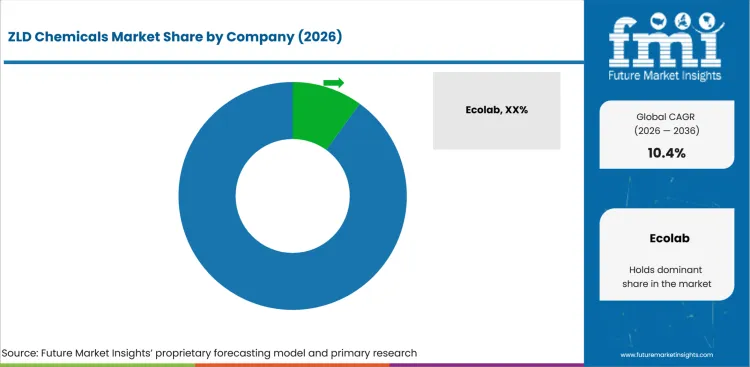
Ecolab, Veolia, Kurita Water Industries, Solenis and Kemira.
- Established industrial water companies hold an advantage through technical service teams and proven chemical programs.
- System-linked suppliers gain stronger acceptance by connecting brine chemistry with membrane and thermal ZLD operation.
- Regional treatment companies win in country markets by offering fast field response and locally stocked chemical supply.
- Service-ready suppliers improve renewal chances led by sample testing and plant-level troubleshooting.
Industrial water companies compete by combining antiscalants and service programs. Ecolab has a strong position through Nalco Water programs and industrial customer coverage. Veolia competes based on water technology and brine concentration knowledge. Kurita Water Industries has deep industrial water chemistry capability across Asia and global markets.
Manufacturing and technical service depth have become stronger competitive separators as ZLD plants move beyond basic chemical supply. Solenis and Kemira compete based on coagulants and wastewater treatment chemistry. Thermax, Aquatech, Gradiant, DuPont Water Solutions, and Xylem Evoqua strengthen competition depending on system integration and industrial treatment support. Buyers compare supplier performance through scaling control and operating records.
Smaller and regional suppliers can win through local wastewater knowledge and faster field support. India, China, and South Korea create opportunities for suppliers with application laboratories and local service teams. United States and Europe create stronger demand for compliance documentation and technical validation. Companies that prove chemical performance under changing feed chemistry should gain more durable annual supply contracts.
How do top ZLD chemicals companies compare?
Ecolab and Veolia score strongest on service depth while Kurita leads through industrial water chemistry capability.
| Company | Relevance to Market Title | Chemical Portfolio Depth | ZLD Service Strength | System Integration Support | Channel Reach | Geographic Footprint |
|---|---|---|---|---|---|---|
| Ecolab | Very High | Very Strong | Very Strong | Strong | Very Strong | Global |
| Veolia | Very High | Strong | Very Strong | Very Strong | Very Strong | Global |
| Kurita Water Industries | Very High | Very Strong | Very Strong | Strong | Strong | Asia and Global |
| Solenis | High | Very Strong | Strong | Moderate | Strong | Global |
| Kemira | High | Very Strong | Strong | Moderate | Strong | Europe and Americas |
| Thermax | High | Strong | Strong | Very Strong | Strong | India and International |
| Aquatech | High | Moderate | Strong | Very Strong | Moderate | Global |
| Gradiant | High | Moderate | Strong | Very Strong | Moderate | Global |
| DuPont Water Solutions | Moderate to High | Moderate | Moderate | Very Strong | Strong | Global |
| Xylem Evoqua | Moderate to High | Moderate | Strong | Strong | Strong | Global |
Source: Future Market Insights competitive analysis, 2026.
Who are the key players in the ZLD Chemicals Market?
Ecolab, Veolia and Kurita Water Industries are listed with Solenis and Kemira among other suppliers.
Key global companies leading the ZLD Chemicals Market include:
- Ecolab
- Veolia
- Kurita Water Industries
- Solenis
- Kemira
- Thermax
- Aquatech
- Gradiant
- DuPont Water Solutions
- Xylem Evoqua
Key Developments in ZLD Chemicals Market
- In August 2025, Ecolab agreed to acquire Ovivo’s Electronics business, strengthening ultrapure water and wastewater capabilities for microelectronics customers.
- In September 2025, Kemira agreed to acquire Water Engineering Inc., expanding industrial water treatment chemicals and service reach in North America.
- In June 2024, Kurita Water Industries established Kurita AquaChemie India to expand water treatment chemical sales and service operations in India.
Key Players in the ZLD Chemicals Market
Industrial Water Chemistry Leaders
- Ecolab
- Kurita Water Industries
- Solenis
- Kemira
Water Technology and ZLD System Companies
- Veolia
- Aquatech
- Gradiant
- Xylem Evoqua
Regional Service and Treatment Companies
- Thermax
- Ion Exchange India
- Kurita AquaChemie India
- Kurita Hansu
Membrane and Pretreatment Specialists
- DuPont Water Solutions
- SUEZ Water Technologies legacy portfolios
- Local industrial chemical distributors
ZLD Chemicals Market - Report Scope
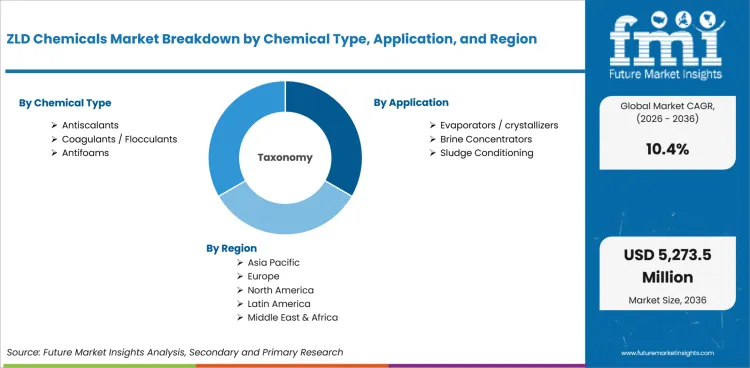
| Parameter | Details |
|---|---|
| Forecast period | 2026 to 2036 |
| Historical period | 2021 to 2025 |
| Quantitative unit | Revenue in USD million |
| By chemical type | Antiscalants, coagulants / flocculants, antifoams, pH adjusters & others |
| By application | Brine concentrators, evaporators / crystallizers, membrane pretreatment, sludge conditioning |
| By end use | Power generation, chemicals, textiles, mining & metals, other industrial end uses |
| By system stage | Pretreatment, thermal ZLD, crystallization / solids |
| By sales model | Chemical supply, chemistry & service |
| Regions covered | North America, Latin America, Europe, East Asia, South Asia and Pacific, Middle East and Africa |
| Countries covered | India, China, South Korea, United States, Germany, France, United Kingdom, Japan |
| Key companies profiled | Ecolab, Veolia, Kurita Water Industries, Solenis, Kemira, Thermax, Aquatech, Gradiant, DuPont Water Solutions, Xylem Evoqua |
| Approach | Bottom-up chemical consumption approach using ZLD operating volume, dose intensity, service contract share, application mix, and country-level industrial wastewater exposure |
Source: Future Market Insights competitive analysis, 2026.
ZLD Chemicals Market - Scope & Definition
| Attribute | Detail |
|---|---|
| Market Definition | Consumable chemicals used inside zero liquid discharge systems that recover water and convert residual brine into solids, including chemicals used in pretreatment, membrane systems, brine concentrators, evaporators, and crystallizers |
| Functions Covered | Scale control, coagulation, flocculation, foam control, pH adjustment, solids conditioning, feed stabilization, and brine chemistry control |
| Applications Covered | Brine concentrators, evaporators / crystallizers, membrane pretreatment, and sludge conditioning |
| End-Use Industries | Power generation, chemicals, textiles, mining & metals, pharmaceuticals, electronics, food processing, and other industrial users |
| Grades Covered | Commodity-grade, specialty-grade, high-performance antiscalant blends, service-linked formulations, and site-specific dosing programs |
| Inclusions | All commercially traded ZLD chemicals across chemical type, application, end use, system stage, sales model, and country-level industrial treatment use |
| Exclusions | Standalone ZLD systems, evaporation equipment, crystallizers sold as capital equipment, membrane modules, ion exchange resins sold outside ZLD duty, civil works, municipal disinfectants, wastewater hauling, and general water treatment chemicals used outside ZLD applications |
ZLD Chemicals Market - Research Methodology
| Method | Description |
|---|---|
| Primary Research | FMI analyst interviews with industrial water managers, chemical dosing specialists, ZLD system integrators, EPC firms, distributor networks, and plant service teams across selected markets |
| Desk Research | Review of regulatory data, official wastewater statistics, industrial water reports, company disclosures, product literature, environmental standards, and public water reuse evidence |
| Market Sizing & Forecasting | Bottom-up chemical consumption approach using ZLD operating volume, chemical dose intensity, contract renewal behavior, system-stage share, application mix, and country-level industrial wastewater exposure |
| Data Validation | Cross-verification using company portfolios, official wastewater data, country industrial activity, system supplier disclosures, and parent water treatment chemical demand checks |
ZLD Chemicals Market Breakdown by Chemical Type, Application, End Use, System Stage, Sales Model, and Region
ZLD Chemicals Market Segmented by Chemical Type
- Antiscalants
- Coagulants / Flocculants
- Antifoams
- pH Adjusters & Others
ZLD Chemicals Market Segmented by Application
- Brine Concentrators
- Evaporators / Crystallizers
- Membrane Pretreatment
- Sludge Conditioning
ZLD Chemicals Market Segmented by End Use
- Power Generation
- Chemicals
- Textiles
- Mining & Metals
- Other Industrial End Uses
ZLD Chemicals Market Segmented by System Stage
- Pretreatment
- Thermal ZLD
- Crystallization / Solids
ZLD Chemicals Market Segmented by Sales Model
- Chemical Supply
- Chemistry & Service
ZLD Chemicals Market by Region
- North America
- Latin America
- Europe
- East Asia
- South Asia and Pacific
- Middle East and Africa
Research Sources and Bibliography
- United Nations. (2024, August). Progress on wastewater treatment: 2024 update.
- United States Environmental Protection Agency. (2024, April). Steam electric power generating effluent guidelines: 2024 final rule.
- United States Geological Survey. (2025). Water use in the United States, 2020.
- Council of the European Union. (2024, November). Urban wastewater treatment: Council adopts new rules for more efficient treatment.
- European Environment Agency. (2025, March). Water abstraction by source and economic sector in Europe.
- Environment Agency. (2025, October). Water and sewerage companies in England: Environmental performance report for 2024.
- Environment Agency. (2025). Environmental performance assessment methodology for 2026 to 2030.
- UK Parliament. (2025, July 8). Data centres: Energy and water consumption.
- Federal Ministry for the Environment, Nature Conservation, Nuclear Safety and Consumer Protection. (2026, February 11). Waste water.
- Germany Trade & Invest. (2026). Water technologies in Germany.
- European Commission. (2025). Commission staff working document: Third river basin management plans - Member State Germany.
- Ministry for Ecological Transition, Biodiversity, Forest, Sea and Fisheries. (2025). National climate change adaptation plan and water planning measures.
- Organisation for Economic Co-operation and Development. (2025, June). Global drought outlook: Trends, impacts and policies to adapt to a drier world.
- Ministry of Ecology and Environment of the People’s Republic of China. (2025). Annual water resources and environmental management updates.
- National Bureau of Statistics of China. (2025, February). Statistical communiqué of the People’s Republic of China on the 2024 national economic and social development.
- Ministry of Water Resources of the People’s Republic of China. (2025). China water resources bulletin and efficiency updates.
- International Trade Administration. (2025). China environmental technology.
- Ministry of Environment, Forest and Climate Change. (2025). Annual report 2024-25.
- Parliament of India, Lok Sabha. (2025, August 4). Common effluent treatment plants and zero liquid discharge systems.
- Central Pollution Control Board. (2025, February 12). Classification of sectors into Red, Orange, Green, White and Blue categories: A tool for progressive environmental management.
- Ministry of Environment, Republic of Korea. (2025, January 1). Environmental policies: Changes coming in 2025.
- Korea Environment Corporation. (2025, July). K-eco 2025 sustainability report: Summary.
- Yale Center for Environmental Law and Policy. (2024). 2024 Environmental Performance Index: South Korea.
- Ministry of the Environment, Japan. (2024). Annual report on the environment in Japan 2024.
- Yale Center for Environmental Law and Policy. (2024). 2024 Environmental Performance Index: Japan.
- Ecolab. (2025, August). Ecolab to acquire Ovivo’s Electronics business.
- Kemira. (2025, September). Kemira to acquire Water Engineering Inc.
- Kurita Water Industries. (2024, June). Establishment of Kurita AquaChemie India.
- United States Department of Commerce. (2024). CHIPS for America award announcement for TSMC Arizona.
- European Commission Joint Research Centre. (2024). Water reuse research and policy support.
- This bibliography is provided for reader reference and is not exhaustive. The full report contains the complete reference list and detailed citations.
This Report Answers
- Market size estimates for 2026 and forecasts through 2036 for the ZLD Chemicals Market.
- Insights across regional and country-level industrial wastewater treatment markets.
- Analysis of demand drivers and purchasing behavior.
- Evaluation of chemical types, applications, end uses, system stages, and sales models.
- Assessment of industrial discharge rules, water reuse policy, and high-recovery treatment impacts.
- Identification of opportunities across antiscalants and service-led chemistry.
- Evaluation of service contract models and technical sales channels.
- Country-level analysis covering India, China, South Korea, United States, Germany, France, United Kingdom, and Japan.
- Assessment of competition, including leading industrial water chemical suppliers and ZLD system-linked companies.
- Analysis of plant-level decision drivers and renewal criteria.
- Regional outlooks across North America, Europe, East Asia, South Asia and Pacific, Latin America, and Middle East and Africa.
- Delivery of market data, forecasts, and supporting analysis in report-ready format.
Frequently Asked Questions
What is the growth prospect for ZLD chemicals?
Demand for ZLD chemicals is expected to rise at a considerable pace as industrial plants shift toward high-recovery wastewater treatment and brine solids control.
Which companies are expected to shape the ZLD chemicals market?
Ecolab, Veolia, Kurita Water Industries, Solenis, Kemira, Thermax, Aquatech, and Gradiant are expected to shape market competition due to chemical portfolios and system support.
Why are industrial water companies investing in ZLD chemicals?
Industrial water companies are investing in ZLD chemicals to expand high-recovery treatment programs and support customers managing brine and solids.
Why are service-led sales channels important in the ZLD chemicals market?
Service-led sales channels support testing and plant troubleshooting across high-salinity wastewater systems.
Which chemical formats are gaining attention in ZLD chemicals?
Coagulants / flocculants and pH adjusters are gaining attention as plants push higher recovery rates.
How do regulations influence ZLD chemical demand?
Regulations influence demand through stricter wastewater treatment standards and compliance documentation needs.
Why is pretreatment important for ZLD chemicals?
Pretreatment is important since feed conditioning protects membranes and crystallizers from scaling and unstable solids behavior.
What role does Chemistry & Service play in ZLD chemical adoption?
Chemistry & service supports adoption by combining chemical supply with testing and field support.
Which country grows fastest in the ZLD Chemicals Market?
India grows fastest with 12.1% CAGR through 2036, supported by distillery wastewater control and ZLD-linked common effluent treatment systems.
Preview the report firsthand - request a free sample
Get SampleGet the brochure for pricing and purchase details.
Get PDFTable of Content
- Key Takeaways
- Market Size and CAGR
- Top Growth Driver
- Fastest Growing Segment
- Leading Region
- Key Companies
- Emerging Opportunities
- Executive Summary
- Global Market Outlook
- Demand-side Trends
- Supply-side Trends
- Technology Roadmap Analysis
- Analysis and Recommendations
- Analyst Perspective (What is happening? Why now? What should investors know?)
- Key Questions Answered
- How large is the market?
- What is the CAGR?
- What are key trends?
- Which region dominates?
- Who are the leaders?
- Market Overview
- Market Coverage / Taxonomy
- Market Definition / Scope / Limitations
- Research Methodology
- Chapter Orientation
- Analytical Lens and Working Hypotheses
- Market Structure, Signals, and Trend Drivers
- Benchmarking and Cross-market Comparability
- Market Sizing, Forecasting, and Opportunity Mapping
- Research Design and Evidence Framework
- Desk Research Programme (Secondary Evidence)
- Expert Input and Fieldwork (Primary Evidence)
- Tooling, Models, and Reference Databases
- Data Engineering and Model Build
- Quality Assurance and Audit Trail
- Market Background
- Market Dynamics (Drivers, Restraints, Opportunity, Trends)
- Scenario Forecast (Optimistic, Likely, Conservative)
- Impact Analysis
- AI Impact
- Sustainability Impact
- Regulatory Impact
- Technology Impact
- Consumer / Buyer Analysis
- Purchase Drivers
- Adoption Barriers
- Buyer Journey
- Opportunity Map Analysis
- Product Life Cycle Analysis
- Supply Chain Analysis
- Investment Feasibility Matrix
- Value Chain Analysis
- PESTLE and Porter's Analysis
- Regulatory Landscape
- Regional Parent Market Outlook
- Production and Consumption Statistics
- Import and Export Statistics
- Global Market Analysis and Forecast, 2021 to 2036
- Historical Market Size Value (USD Million) Analysis, 2021 to 2025
- Current and Future Market Size Value (USD Million) Projections, 2026 to 2036
- Y-o-Y Growth Trend Analysis
- Absolute $ Opportunity Analysis
- Global Market Pricing Analysis, 2021 to 2036
- Global Market Analysis and Forecast, By Chemical Type, 2021 to 2036
- Introduction / Key Findings
- Historical Market Size Value (USD Million) Analysis By Chemical Type, 2021 to 2025
- Current and Future Market Size Value (USD Million) Analysis and Forecast By Chemical Type, 2026 to 2036
- Y-o-Y Growth Trend Analysis By Chemical Type, 2021 to 2025
- Absolute $ Opportunity Analysis By Chemical Type, 2026 to 2036
- Global Market Analysis and Forecast, By Application, 2021 to 2036
- Introduction / Key Findings
- Historical Market Size Value (USD Million) Analysis By Application, 2021 to 2025
- Current and Future Market Size Value (USD Million) Analysis and Forecast By Application, 2026 to 2036
- Y-o-Y Growth Trend Analysis By Application, 2021 to 2025
- Absolute $ Opportunity Analysis By Application, 2026 to 2036
- Global Market Analysis and Forecast, By End Use, 2021 to 2036
- Introduction / Key Findings
- Historical Market Size Value (USD Million) Analysis By End Use, 2021 to 2025
- Current and Future Market Size Value (USD Million) Analysis and Forecast By End Use, 2026 to 2036
- Y-o-Y Growth Trend Analysis By End Use, 2021 to 2025
- Absolute $ Opportunity Analysis By End Use, 2026 to 2036
- Global Market Analysis and Forecast, By System Stage, 2021 to 2036
- Introduction / Key Findings
- Historical Market Size Value (USD Million) Analysis By System Stage, 2021 to 2025
- Current and Future Market Size Value (USD Million) Analysis and Forecast By System Stage, 2026 to 2036
- Y-o-Y Growth Trend Analysis By System Stage, 2021 to 2025
- Absolute $ Opportunity Analysis By System Stage, 2026 to 2036
- Global Market Analysis and Forecast, By Sales Model, 2021 to 2036
- Introduction / Key Findings
- Historical Market Size Value (USD Million) Analysis By Sales Model, 2021 to 2025
- Current and Future Market Size Value (USD Million) Analysis and Forecast By Sales Model, 2026 to 2036
- Y-o-Y Growth Trend Analysis By Sales Model, 2021 to 2025
- Absolute $ Opportunity Analysis By Sales Model, 2026 to 2036
- Global Market Analysis and Forecast, By Region, 2021 to 2036
- Introduction
- Historical Market Size Value (USD Million) Analysis By Region, 2021 to 2025
- Current Market Size Value (USD Million) Analysis and Forecast By Region, 2026 to 2036
- North America
- Latin America
- Western Europe
- Eastern Europe
- East Asia
- South Asia and Pacific
- Middle East & Africa
- Market Attractiveness Analysis By Region
- North America Market Analysis and Forecast, By Country, 2021 to 2036
- Historical Market Size Value (USD Million) Trend Analysis By Market Taxonomy, 2021 to 2025
- Market Size Value (USD Million) Forecast By Market Taxonomy, 2026 to 2036
- By Country
- USA
- Canada
- Mexico
- By Chemical Type
- By Application
- By End Use
- By System Stage
- By Sales Model
- By Country
- Market Attractiveness Analysis
- By Country
- By Chemical Type
- By Application
- By End Use
- By System Stage
- By Sales Model
- Key Takeaways
- Latin America Market Analysis and Forecast, By Country
- Historical Market Size Value (USD Million) Trend Analysis By Market Taxonomy, 2021 to 2025
- Market Size Value (USD Million) Forecast By Market Taxonomy, 2026 to 2036
- By Country
- Brazil
- Chile
- Rest of Latin America
- By Chemical Type
- By Application
- By End Use
- By System Stage
- By Sales Model
- By Country
- Market Attractiveness Analysis
- By Country
- By Chemical Type
- By Application
- By End Use
- By System Stage
- By Sales Model
- Key Takeaways
- Western Europe Market Analysis and Forecast, By Country
- Historical Market Size Value (USD Million) Trend Analysis By Market Taxonomy, 2021 to 2025
- Market Size Value (USD Million) Forecast By Market Taxonomy, 2026 to 2036
- By Country
- Germany
- UK
- Italy
- Spain
- France
- Nordic
- BENELUX
- Rest of Western Europe
- By Chemical Type
- By Application
- By End Use
- By System Stage
- By Sales Model
- By Country
- Market Attractiveness Analysis
- By Country
- By Chemical Type
- By Application
- By End Use
- By System Stage
- By Sales Model
- Key Takeaways
- Eastern Europe Market Analysis and Forecast, By Country
- Historical Market Size Value (USD Million) Trend Analysis By Market Taxonomy, 2021 to 2025
- Market Size Value (USD Million) Forecast By Market Taxonomy, 2026 to 2036
- By Country
- Russia
- Poland
- Hungary
- Balkan & Baltic
- Rest of Eastern Europe
- By Chemical Type
- By Application
- By End Use
- By System Stage
- By Sales Model
- By Country
- Market Attractiveness Analysis
- By Country
- By Chemical Type
- By Application
- By End Use
- By System Stage
- By Sales Model
- Key Takeaways
- East Asia Market Analysis and Forecast, By Country
- Historical Market Size Value (USD Million) Trend Analysis By Market Taxonomy, 2021 to 2025
- Market Size Value (USD Million) Forecast By Market Taxonomy, 2026 to 2036
- By Country
- China
- Japan
- South Korea
- By Chemical Type
- By Application
- By End Use
- By System Stage
- By Sales Model
- By Country
- Market Attractiveness Analysis
- By Country
- By Chemical Type
- By Application
- By End Use
- By System Stage
- By Sales Model
- Key Takeaways
- South Asia and Pacific Market Analysis and Forecast, By Country
- Historical Market Size Value (USD Million) Trend Analysis By Market Taxonomy, 2021 to 2025
- Market Size Value (USD Million) Forecast By Market Taxonomy, 2026 to 2036
- By Country
- India
- ASEAN
- Australia & New Zealand
- Rest of South Asia and Pacific
- By Chemical Type
- By Application
- By End Use
- By System Stage
- By Sales Model
- By Country
- Market Attractiveness Analysis
- By Country
- By Chemical Type
- By Application
- By End Use
- By System Stage
- By Sales Model
- Key Takeaways
- Middle East & Africa Market Analysis and Forecast, By Country
- Historical Market Size Value (USD Million) Trend Analysis By Market Taxonomy, 2021 to 2025
- Market Size Value (USD Million) Forecast By Market Taxonomy, 2026 to 2036
- By Country
- Kingdom of Saudi Arabia
- Other GCC Countries
- Türkiye
- South Africa
- Other African Union
- Rest of Middle East & Africa
- By Chemical Type
- By Application
- By End Use
- By System Stage
- By Sales Model
- By Country
- Market Attractiveness Analysis
- By Country
- By Chemical Type
- By Application
- By End Use
- By System Stage
- By Sales Model
- Key Takeaways
- Key Countries Market Analysis
- USA
- Pricing Analysis
- Market Share Analysis, 2025
- By Chemical Type
- By Application
- By End Use
- By System Stage
- By Sales Model
- Canada
- Pricing Analysis
- Market Share Analysis, 2025
- By Chemical Type
- By Application
- By End Use
- By System Stage
- By Sales Model
- Mexico
- Pricing Analysis
- Market Share Analysis, 2025
- By Chemical Type
- By Application
- By End Use
- By System Stage
- By Sales Model
- Brazil
- Pricing Analysis
- Market Share Analysis, 2025
- By Chemical Type
- By Application
- By End Use
- By System Stage
- By Sales Model
- Chile
- Pricing Analysis
- Market Share Analysis, 2025
- By Chemical Type
- By Application
- By End Use
- By System Stage
- By Sales Model
- Germany
- Pricing Analysis
- Market Share Analysis, 2025
- By Chemical Type
- By Application
- By End Use
- By System Stage
- By Sales Model
- UK
- Pricing Analysis
- Market Share Analysis, 2025
- By Chemical Type
- By Application
- By End Use
- By System Stage
- By Sales Model
- Italy
- Pricing Analysis
- Market Share Analysis, 2025
- By Chemical Type
- By Application
- By End Use
- By System Stage
- By Sales Model
- Spain
- Pricing Analysis
- Market Share Analysis, 2025
- By Chemical Type
- By Application
- By End Use
- By System Stage
- By Sales Model
- France
- Pricing Analysis
- Market Share Analysis, 2025
- By Chemical Type
- By Application
- By End Use
- By System Stage
- By Sales Model
- India
- Pricing Analysis
- Market Share Analysis, 2025
- By Chemical Type
- By Application
- By End Use
- By System Stage
- By Sales Model
- ASEAN
- Pricing Analysis
- Market Share Analysis, 2025
- By Chemical Type
- By Application
- By End Use
- By System Stage
- By Sales Model
- Australia & New Zealand
- Pricing Analysis
- Market Share Analysis, 2025
- By Chemical Type
- By Application
- By End Use
- By System Stage
- By Sales Model
- China
- Pricing Analysis
- Market Share Analysis, 2025
- By Chemical Type
- By Application
- By End Use
- By System Stage
- By Sales Model
- Japan
- Pricing Analysis
- Market Share Analysis, 2025
- By Chemical Type
- By Application
- By End Use
- By System Stage
- By Sales Model
- South Korea
- Pricing Analysis
- Market Share Analysis, 2025
- By Chemical Type
- By Application
- By End Use
- By System Stage
- By Sales Model
- Russia
- Pricing Analysis
- Market Share Analysis, 2025
- By Chemical Type
- By Application
- By End Use
- By System Stage
- By Sales Model
- Poland
- Pricing Analysis
- Market Share Analysis, 2025
- By Chemical Type
- By Application
- By End Use
- By System Stage
- By Sales Model
- Hungary
- Pricing Analysis
- Market Share Analysis, 2025
- By Chemical Type
- By Application
- By End Use
- By System Stage
- By Sales Model
- Kingdom of Saudi Arabia
- Pricing Analysis
- Market Share Analysis, 2025
- By Chemical Type
- By Application
- By End Use
- By System Stage
- By Sales Model
- Türkiye
- Pricing Analysis
- Market Share Analysis, 2025
- By Chemical Type
- By Application
- By End Use
- By System Stage
- By Sales Model
- South Africa
- Pricing Analysis
- Market Share Analysis, 2025
- By Chemical Type
- By Application
- By End Use
- By System Stage
- By Sales Model
- USA
- Market Structure Analysis
- Competition Dashboard
- Competition Benchmarking
- Market Share Analysis of Top Players
- By Regional
- By Chemical Type
- By Application
- By End Use
- By System Stage
- By Sales Model
- Emerging Startups
- Innovation Benchmarking
- Competition Analysis
- Competition Deep Dive
- Competition Deep Dive
- Case Studies
- Success Stories
- Recent Developments
- Assumptions & Acronyms Used


