

- Market Size (2026)
- USD 920.7 Mn
- Forecast (2036)
- USD 1618.0 Mn
- CAGR (2026 to 2036)
- 5.8%
How big is FOG Removing Chemicals Market in 2026?
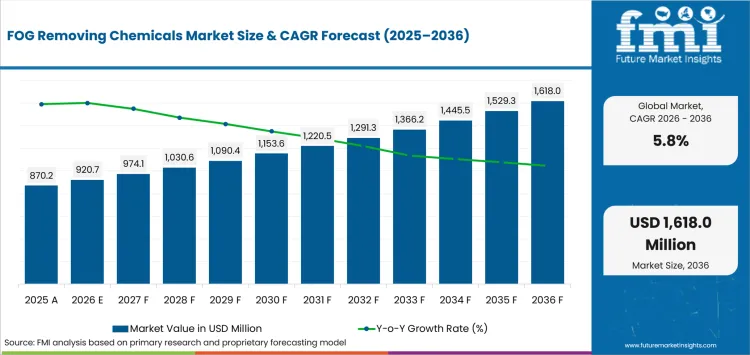
USD 920.7 million in 2026 and USD 1,618.0 million by 2036 at a 5.8% CAGR.
Demand for fog removing chemicals is projected to expand at a 5.8% CAGR between 2026 and 2036. Valuation is expected to rise from USD 920.7 million in 2026 to USD 1618.0 million by 2036. Sewer blockages remain a recurring concern for municipalities, restaurants and commercial kitchens where fats, oils and grease accumulate within drainage systems. EPA guidance updated in April 2026 identifies FOG as a sewer-blockage cause and lists FOG controls among overflow-reduction measures. That operating risk turns institutional cleaning chemicals used in drains into planned maintenance purchases at permitted treatment points.
Key Takeaways of FOG Removing Chemicals Market
- Frequent FOG loading in commercial kitchens turns drain care and grease control into planned maintenance purchases.
- By product type, enzyme cleaners are estimated to hold 22.0% in 2026 owing to their fit with planned organic-residue treatment.
- In 2026, liquid concentrate is expected to lead form with 42.0% share as controlled dilution suits repeated professional dosing.
- Grease traps are projected to hold 32.0% share in 2026 owing to their role as the primary engineered FOG capture point.
- Local codes can prohibit additives inside interceptors and therefore narrow the locations where chemical or biological treatment is acceptable.
- Some of the key players in this market include Ecolab Inc., Diversey, Zep Inc., Betco Corporation, State Industrial Products Corporation, Rockwell Labs Ltd., Bionetix International, and Mechline Developments Ltd.
Analyst Perspective
"FOG-removal programs should be judged first against the exact dosing point and the mechanical grease-removal schedule already required at the site. Commercial value comes from fewer avoidable drain interventions without weakening pumping discipline or local wastewater compliance."
- Nikhil Kaitwade, Principal Consultant, Future Market Insights
How is the FOG Removing Chemicals Market segmented?
The fog removing chemicals market is segmented by product type, form, application, end use, sales channel and region.
Product types include enzyme cleaners, bacterial drain treatments, caustic degreasers, solvent-based degreasers, surfactant emulsifiers and foaming degreasers. Forms include liquid concentrate, ready-to-use liquid, powder or sachet, foam and tablet or block. Applications cover grease traps, commercial drains, sewer lines, food-processing floors and lift stations. End uses include restaurants, food processors, municipal wastewater, institutional kitchens and industrial facilities. Sales channels include janitorial distributors, water-treatment suppliers, direct institutional supply and e-commerce or retail.
What makes Enzyme Cleaners central to the Product Type category?
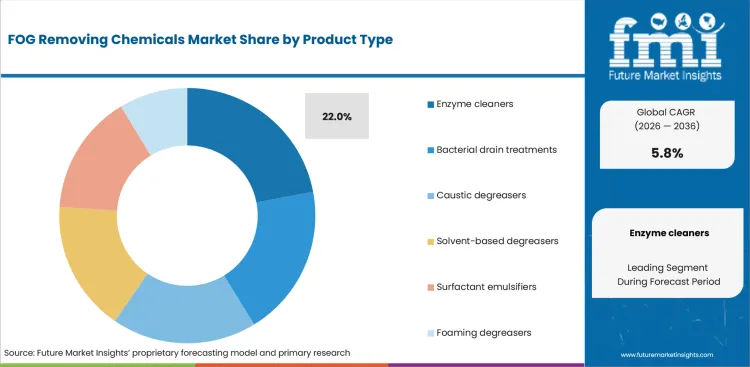
Enzyme cleaners suit drains that need preventive organic-residue control without the same corrosive profile as strong caustics. Rockwell Labs documented a continuous microbial program in March 2025 for drains and grease traps. Its microbes digest FOG during repeated treatment and support plant-derived cleaning ingredients used in lower-corrosivity formulations.
- By product type, enzyme cleaners are estimated to hold 22.0% in 2026 owing to their fit with scheduled biological maintenance at permitted locations.
- Programmable dispensers and slow-release microbial blocks keep treatment active between manual cleaning visits without changing the required grease-removal schedule.
Why does Liquid Concentrate lead the Form category?
Liquid concentrate fits facilities that already control dilution during professional sanitation and need one container to support repeated applications. That handling model matters in kitchens where staff already manage dilution for other sanitation tasks.
- In 2026, liquid concentrate is expected to lead form with 42.0% share owing to controlled dilution that reduces handling variation during scheduled maintenance.
- Betco moved Push into FastDraw bottles in June 2025 with a pre-metered insert that controls dilution and supports drain-line maintenance. The format follows the same operating logic as detergent dosing systems that standardize chemical delivery.
How do Grease Traps Anchor the Application category?
Grease traps form the engineered capture point that determines what reaches downstream sewer lines. Connecticut DEEP reissued its food-establishment wastewater permit in October 2025 and requires covered establishments to install approved FOG-management equipment. The rule places physical capture before complementary hotel housekeeping chemicals used in kitchen maintenance.
- Grease traps are projected to hold 32.0% share in 2026 owing to their position as the primary engineered control for commercial-kitchen FOG.
- Chemical formulations therefore compete around permitted drains or maintenance programs instead of replacing interceptor pumping and captured-grease removal.
What supports Restaurants in the End Use category?
Restaurants generate FOG during cooking and warewashing every operating day at multiple drains and preparation stations. Their purchase cycle is tied closely to drain condition, grease-control service and sanitation schedules.
- Based on end use, restaurants are projected to account for 31.0% in 2026 due to frequent grease loading at distributed commercial kitchens.
- San Francisco Public Utilities Commission documented in December 2025 that its FOG program covers more than 4,500 restaurants. That compliance base makes floor care chemicals and drain treatment easier to standardize beside grease-capture equipment.
What are the drivers, restraints and opportunities in the FOG Removing Chemicals Market?
Repeated FOG loading increases preventive demand. Additive restrictions narrow acceptable treatment points while controlled dosing expands serviceable maintenance programs.
- Driver: Grease accumulation converts drain protection into scheduled maintenance for commercial kitchens and wastewater operators with repeated organic loads.
- Restraint: Local plumbing rules can prohibit additives inside interceptors and remove a high-volume application from the addressable chemical set.
- Opportunity: Metered treatment can turn approved preventive dosing into a repeat program with predictable concentrate or cartridge replenishment.
FOG control gains a defined purchasing role at commercial kitchens once blockage risk appears in sewer maintenance records and service calls. EPA updated its industrial-use guidance in December 2025 and states that FOG can clog public sewer pipes and pumps. That direct maintenance burden keeps preventive chemistry relevant beside industrial degreasers used on grease-heavy facility surfaces during routine sanitation programs.
The restraint appears at the interceptor boundary since local codes can prohibit chemical treatment there during routine grease management. New York State published its 2025 Plumbing Code with controls governing grease-interceptor operation and automatic grease-removal devices. Those requirements push acceptable chemistry toward documented use points and away from broad substitution claims associated with industrial cleaning solvents that are not designed for sewer-connected applications.
Controlled dosing gives service companies a clearer route into preventive maintenance at sites that permit treatment under local wastewater rules and maintenance plans. Mechline documented in September 2025 that kitchens using its FOG-management systems extended collection intervals from 28 days to 12 weeks during trials. That operating result supports scheduled replenishment models similar to retail cleaning chemicals sold through routine facility channels.
Which country CAGRs are profiled in the FOG Removing Chemicals Market?
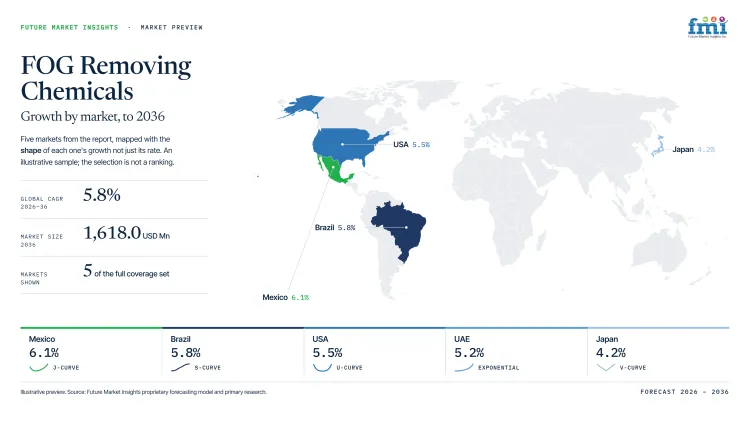
| Country | CAGR |
|---|---|
| Mexico | 6.1% |
| Brazil | 5.8% |
| USA | 5.5% |
| UAE | 5.2% |
| Japan | 4.2% |
How do country-level CAGRs compare in the FOG Removing Chemicals Market?
Mexico and Brazil outpace Japan by 1.9 and 1.6 percentage points, respectively, while USA remains in the middle of the profiled range. Utilities that formalize restaurant grease controls or extend inspection coverage create the stronger demand route. Country differences therefore reflect enforcement intensity and service-channel development rather than market size alone.
- Utility registration places Mexican food businesses inside documented grease-control programs and supports the country’s higher growth rate.
- Poor grease-box maintenance adds to sewer problems in Brazil and keeps physical upkeep central to treatment decisions.
- Municipal pretreatment rules differ materially among American foodservice sewer districts and shape the acceptable treatment point.
- UAE's expanding foodservice and hospitality infrastructure supports structured grease-management practices and recurring demand for complementary treatment solutions.
- Japan's mature foodservice and wastewater-management systems position chemical treatment as a complementary solution alongside established grease-control equipment and maintenance.
Comparable CAGRs still carry different qualification burdens because local rules define different roles for chemical treatment.
The full report provides country-level CAGR analysis across North America, Latin America, Europe, East Asia, South Asia, Oceania and the Middle East and Africa.
Country-wise Analysis
- Demand in Mexico is projected to expand at a 6.1% CAGR over the forecast period, driven by the growing number of grease-control compliance programs that create identifiable demand channels for treatment products. CESPT recorded 10,971 non-domestic registrations within its grease-control program across Tijuana and Playas de Rosarito in May 2025, marking a 14% increase from the previous year. The expanding compliance base provides distributors with a direct route to engage foodservice operators on drain-maintenance practices and approved treatment programs. While grease interceptors remain the primary control measure, chemical products continue to play a supporting role alongside documented waste-management procedures.
- Brazil industry is forecast to register a 5.8% CAGR between 2026 and 2036, underpinned by recurring sewer-maintenance challenges that keep grease management high on the agenda for commercial kitchens. Sanesul reported in August 2025 that oily waste and inadequate grease-box maintenance contributed to sewer problems in Iguatemi. This finding highlights the importance of preventive treatment between scheduled cleanouts and collection visits. FOG-removal chemicals can assist in reducing grease accumulation, but physical grease removal and collection services remain central to long-term maintenance programs.
- The United States is expected to record a 5.5% CAGR during the assessment period, supported by established professional-maintenance networks and extensive foodservice activity. The SRPMIC FOG program updated in October 2025 requires grease interceptors for food establishments operating dishwashers. Comparable pretreatment requirements across multiple sewer districts continue to influence where and how chemical treatments are deployed. Market participation depends on clear use-point documentation and adherence to existing interceptor-maintenance regulations.
- The UAE is projected to expand at a 5.2% CAGR from 2026 to 2036, reflecting increasing emphasis on commercial-kitchen grease management, wastewater protection, and structured maintenance practices. The country's expanding foodservice and hospitality infrastructure supports recurring demand for grease-control solutions. Chemical treatments are expected to serve as complementary maintenance products alongside grease traps, interceptors, scheduled cleaning, and approved waste-disposal procedures.
- Japan is anticipated to register a 4.2% CAGR over the forecast period, reflecting a mature foodservice market and established wastewater-management practices. Demand is supported by the need for regular kitchen-drain maintenance and effective control of fats, oils, and grease in commercial establishments. Chemical treatments generally occupy a supporting role within broader grease-management programs, with physical cleaning and equipment maintenance remaining essential to compliance and operational efficiency.
Who are the notable companies in the FOG Removing Chemicals Market?
Ecolab Inc., Diversey, Zep Inc., Betco Corporation, State Industrial Products Corporation, Rockwell Labs Ltd., Bionetix International and Mechline Developments Ltd. are the notable companies serving this market.
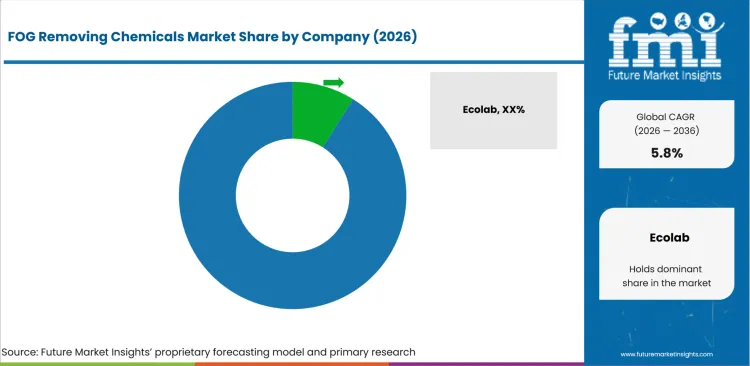
Competition divides between institutional hygiene platforms, professional chemical manufacturers and biological drain specialists. Ecolab and Diversey reach large foodservice accounts through wider kitchen programs. Zep, Betco and State Industrial Products use professional maintenance channels. Rockwell Labs, Bionetix and Mechline specialize more strongly in biological treatment or dosing. Entry depends on credible use-point instructions plus channel access in multi-site accounts such as airport cleaning chemicals.
- Ecolab Inc. and Diversey serve institutional accounts that evaluate drain treatment beside broader commercial-kitchen hygiene programs.
- Zep Inc., Betco Corporation and State Industrial Products Corporation use professional cleaning channels with varied grease-control chemistries and formats.
- Rockwell Labs Ltd., Bionetix International and Mechline Developments Ltd. emphasize biological treatment or controlled FOG-management systems.
Competitive Benchmarking: FOG Removing Chemicals Market
| Company | FOG Application Breadth | Controlled Delivery Depth | Foodservice Integration | Geographic Reach |
|---|---|---|---|---|
| Ecolab Inc. | High | High | High | Global |
| Diversey | High | High | High | Global |
| Zep Inc. | Medium | Low | Medium | North America with selected international channels |
| Betco Corporation | Medium | Medium | Medium | North America |
| State Industrial Products Corporation | High | Low | Medium | North America |
| Rockwell Labs Ltd. | High | High | High | North America with specialist international distribution |
| Bionetix International | Medium | Low | High | North America and international formulation markets |
| Mechline Developments Ltd. | High | High | High | United Kingdom with international dealer coverage |
Scoring basis: High application breadth requires at least three documented FOG-relevant use points while Medium requires two and Low identifies one. High delivery depth requires automated or programmed treatment, Medium requires controlled dispensing, and Low identifies documented manual treatment. High foodservice integration requires explicit commercial-kitchen FOG use while Medium covers professional kitchen or drain use and Low identifies broader facility use.
Key Developments in the FOG Removing Chemicals Market
- In June 2026, Diversey expanded its commercial-kitchen drain offering with the fully automated bio-based ecoSTORM program for FOG and organic buildup.
- In May 2026, Bionetix International released ENVIA CORE as a five-enzyme concentrate with lipase for grease-trap and commercial-kitchen drain management.
- In November 2025, Zep Inc. launched Liquid Heat Max Clog Remover Gel for grease and buildup in household and commercial drains.
Key Players in the FOG Removing Chemicals Market
Institutional Hygiene Platforms
- Ecolab Inc.
- Diversey
Professional Cleaning Chemical Manufacturers
- Zep Inc.
- Betco Corporation
- State Industrial Products Corporation
Biological Drain and FOG Specialists
- Rockwell Labs Ltd.
- Bionetix International
- Mechline Developments Ltd.
FOG Removing Chemicals Market - Report Scope
| Coverage field | Report scope |
|---|---|
| Market breakdown | By product type, form, application, end use, sales channel and region. |
| Quantitative Units | USD Million. |
| Market Definition | Commercial chemical and biological formulations used to remove, break down or control fats, oils and grease in drains, grease-management systems and related wastewater maintenance points. |
| Regions Covered | North America, Latin America, Europe, East Asia, South Asia and Pacific and Middle East and Africa. |
| Countries Covered | Mexico, Brazil, USA, UK, Germany, and 20+ countries included in the full report. |
| Key Companies Profiled | Ecolab Inc., Diversey, Zep Inc., Betco Corporation, State Industrial Products Corporation, Rockwell Labs Ltd., Bionetix International, Mechline Developments Ltd.. |
| Forecast Period | 2026 to 2036. |
| Approach | Primary and secondary research with market triangulation. |
FOG Removing Chemicals Market - Research Methodology
| Method | Approach |
|---|---|
| Primary Research | FMI analysts gathered input from manufacturers, service providers, technology developers, distributors, end users, procurement teams, and subject-matter experts. Interviews examined purchasing decisions, product or service evaluation, adoption barriers, approval requirements, pricing considerations, and expectations for technical or commercial support. Respondents were also asked what evidence is required before a trial, pilot, or initial order develops into regular purchasing. |
| Desk Research | Desk research covered government statistics, regulatory publications, trade data, industry associations, technical literature, standards, company filings, product information, and official corporate announcements. Sources were reviewed for relevance, publication date, geographic coverage, and consistency with the defined market scope. Claims relating to performance, applications, approvals, capacity, investment, and commercial activity were retained only when supported by credible public evidence. |
| Market Sizing and Forecasting | The market model combined the baseline value with historical performance, segment structure, pricing and volume indicators, adoption levels, company participation, and country-level demand conditions. Forecast assumptions considered economic activity, investment trends, regulatory developments, technology adoption, purchasing cycles, supply availability, and barriers to wider market use. Segment and regional estimates were reconciled before the final market total was calculated. |
| Data Validation | Estimates were checked against multiple independent indicators, including public data, company activity, trade patterns, industry developments, and findings from primary interviews. Validation also tested whether products, services, applications, and company revenues fell within the defined market boundaries. Adjacent categories, unsupported claims, overlapping revenues, and activities without direct market relevance were excluded to reduce double counting and maintain consistency across segments and countries. |
FOG Removing Chemicals Market by Segments
FOG Removing Chemicals Market segmented by Product Type:
- Enzyme cleaners
- Bacterial drain treatments
- Caustic degreasers
- Solvent-based degreasers
- Surfactant emulsifiers
- Foaming degreasers
FOG Removing Chemicals Market segmented by Form:
- Liquid concentrate
- Ready-to-use liquid
- Powder / sachet
- Foam
- Tablet / block
FOG Removing Chemicals Market segmented by Application:
- Grease traps
- Commercial drains
- Sewer lines
- Food processing floors
- Lift stations
FOG Removing Chemicals Market segmented by End Use:
- Restaurants
- Food processors
- Municipal wastewater
- Institutional kitchens
- Industrial facilities
FOG Removing Chemicals Market segmented by Sales Channel:
- Janitorial distributors
- Water treatment suppliers
- Direct institutional supply
- E-commerce / retail
FOG Removing Chemicals Market by Region:
- North America
- United States
- Canada
- Latin America
- Brazil
- Mexico
- Argentina
- Chile
- Western Europe
- Germany
- France
- United Kingdom
- Italy
- Spain
- Benelux
- Nordics
- Eastern Europe
- Poland
- Czech Republic
- Romania
- Hungary
- East Asia
- China
- Japan
- South Korea
- South Asia and Pacific
- India
- ASEAN
- Australia and New Zealand
- Middle East and Africa
- GCC Countries
- South Africa
- Türkiye
- Israel
Research Sources and Bibliography
- USA Environmental Protection Agency. (2026, April 13). Sanitary Sewer Overflow (SSO) Frequent Questions.
- Government of the State of Nuevo León. (2025, January 22). Trabaja AyD en control de descargas contaminantes a la red de drenaje.
- Rockwell Labs Ltd.. (2025, March 13). Continuous Microbial Drain Line & Drain Treatment Options.
- Betco Corporation. (2025, June 12). Push® with Lemon and Sage Fragrance Now Available in FastDraw®.
- Connecticut Department of Energy and Environmental Protection. (2025, October). Fats Oils and Grease FOG Model Program.
- San Francisco Public Utilities Commission. (2025, December 4). Azim Shaikh Helps 4,500 Restaurants Protect the Environment - One Grease Trap at a Time.
- USA Environmental Protection Agency. (2025, December 22). Industrial Uses for Wasted Food.
- New York State Department of State. (2025). 2025 Plumbing Code of New York State.
- Mechline Developments Ltd.. (2025, September 17). Mechline Returns to Host 2025 with a Mission to Support International Dealers and End Users in Hygiene, FOG Management, and Water Efficiency.
- Comisión Estatal de Servicios Públicos de Tijuana. (2025, May 6). Más de 10 mil negocios están dentro programa Atrapa la Grasa y/o Sólidos de CESPT.
- Empresa de Saneamento de Mato Grosso do Sul. (2025, August 29). Sanesul apresenta plano de contingência para rede de esgoto em Iguatemi.
- Salt River Pima-Maricopa Indian Community. (2025, October 22). Fats, Oils and Grease (FOG) Program.
- Brent Council. (2026, July 18). Food business waste.
- Free and Hanseatic City of Hamburg. (2025, February). Anforderungen an den Betrieb einer Fettabscheideranlage.
- Ecolab Inc.. (2026). Lodging Program & Product Guide.
- Solenis. (2026, June 9). Diversey Adds Bio-based ecoSTORM® Drain Maintenance Program for Commercial Kitchen, Hospitality, Retail and Healthcare Facilities.
- Zep Inc.. (2025, November 13). Zep® Launches Liquid Heat Max Clog Remover Gel - The Most Powerful Drain Opener for Homeowners and Professionals.
- Betco Corporation. (2025, November 18). Betco® at ISSA Show North America 2025 Recap.
- State Industrial Products. (2026, February). 2026 US Solutions Guide.
- Cortec Corporation and Bionetix International. (2026, May 20). PRODUCT RELEASE: Bionetix® Announces New Synergistic Five-Enzyme Concentrate for Detergent and Industrial Cleaning Power.
- Ecolab Inc.. (2025, January 21). Simplify Your Cleaning Routine with Ecolab® ReadyDose™: A Game-Changer for Small Format Locations Around the World.
- Solenis. (2025, October 28). Diversey Introduces Suma® D-GREAZEE D9.9 Next-Generation Kitchen Degreaser.
- Solenis. (2025, November 3). Solenis Completes Acquisition of NCH Corporation.
- Betco Corporation. (2026, July 20). Betco® and Minuteman® International Announce Strategic Asset Exchange.
- State Industrial Products. (2025, January 12). Care for Work Environments®.
- Mechline Developments Ltd.. (2025, August 26). Mechline Developments achieves ISO 14001 environmental management certification.
- Environmental Products and Services Ltd.. (2025, December 8). EPAS - GreaseShield Connect app, now available on Android and iOS.
- BIOSTATIQ. (2025, August 24). Exclusive partnership with QBTEC.
This bibliography is provided for reader reference and is not exhaustive. The full report contains the complete reference list and detailed citations
This Report Answers
- What are the 2026 and 2036 fog removing chemicals market values?
- Which operating pressures support planned FOG-treatment purchases?
- Why do enzyme cleaners lead product type in 2026?
- Why does liquid concentrate lead the form category?
- How do grease-trap rules constrain chemical treatment?
- Why do country CAGRs differ among profiled markets?
- Which companies compete in the fog removing chemicals market?
- What should kitchens evaluate before adding preventive chemistry?
Frequently Asked Questions
How big is the fog removing chemicals market in 2026?
The fog removing chemicals market is valued at USD 920.7 million in 2026 and is projected to reach USD 1,618.0 million by 2036. Planned drain and grease-control maintenance supports repeat purchases.
What is the CAGR of the fog removing chemicals market from 2026 to 2036?
The fog removing chemicals market is projected to grow at a CAGR of 5.8% between 2026 and 2036. Commercial kitchens and wastewater operators reorder treatment as FOG loads return between service intervals.
Which product type leads the fog removing chemicals market?
The enzyme cleaners segment is expected to hold 22.0% of the fog removing chemicals market in 2026, driven by its fit with planned organic-residue treatment. Biological formats also support repeated drain maintenance at permitted treatment points.
Which form leads the fog removing chemicals market?
The liquid concentrate segment is expected to hold 42.0% of the fog removing chemicals market in 2026, attributable to controlled dilution during professional maintenance. Concentrates also suit facilities with established chemical-dispensing routines.
Which countries are projected to record the highest growth in the fog removing chemicals market?
Mexico is projected to grow at 6.1% CAGR, followed by Brazil at 5.8% and USA at 5.5% through 2036. Utility grease-control programs and foodservice sewer-maintenance pressure support the higher rates.
Which companies are active in the fog removing chemicals market?
Key companies operating in the market include Ecolab Inc., Diversey, Zep Inc., Betco Corporation, State Industrial Products Corporation, Rockwell Labs Ltd., Bionetix International, and Mechline Developments Ltd. Their positions differ by treatment depth and institutional service reach.
Preview the report firsthand - request a free sample
Get SampleGet the brochure for pricing and purchase details.
Get PDFTable of Content
- Key Takeaways
- Market Size and CAGR
- Top Growth Driver
- Fastest Growing Segment
- Leading Region
- Key Companies
- Emerging Opportunities
- Executive Summary
- Global Market Outlook
- Demand-side Trends
- Supply-side Trends
- Technology Roadmap Analysis
- Analysis and Recommendations
- Analyst Perspective (What is happening? Why now? What should investors know?)
- Key Questions Answered
- How large is the market?
- What is the CAGR?
- What are key trends?
- Which region dominates?
- Who are the leaders?
- Market Overview
- Market Coverage / Taxonomy
- Market Definition / Scope / Limitations
- Research Methodology
- Chapter Orientation
- Analytical Lens and Working Hypotheses
- Market Structure, Signals, and Trend Drivers
- Benchmarking and Cross-market Comparability
- Market Sizing, Forecasting, and Opportunity Mapping
- Research Design and Evidence Framework
- Desk Research Programme (Secondary Evidence)
- Expert Input and Fieldwork (Primary Evidence)
- Tooling, Models, and Reference Databases
- Data Engineering and Model Build
- Quality Assurance and Audit Trail
- Market Background
- Market Dynamics (Drivers, Restraints, Opportunity, Trends)
- Scenario Forecast (Optimistic, Likely, Conservative)
- Impact Analysis
- AI Impact
- Sustainability Impact
- Regulatory Impact
- Technology Impact
- Consumer / Buyer Analysis
- Purchase Drivers
- Adoption Barriers
- Buyer Journey
- Opportunity Map Analysis
- Product Life Cycle Analysis
- Supply Chain Analysis
- Investment Feasibility Matrix
- Value Chain Analysis
- PESTLE and Porter's Analysis
- Regulatory Landscape
- Regional Parent Market Outlook
- Production and Consumption Statistics
- Import and Export Statistics
- Global Market Analysis and Forecast, 2021 to 2036
- Historical Market Size Value (USD Million) Analysis, 2021 to 2025
- Current and Future Market Size Value (USD Million) Projections, 2026 to 2036
- Y-o-Y Growth Trend Analysis
- Absolute $ Opportunity Analysis
- Global Market Pricing Analysis, 2021 to 2036
- Global Market Analysis and Forecast, By Product Type, 2021 to 2036
- Introduction / Key Findings
- Historical Market Size Value (USD Million) Analysis By Product Type, 2021 to 2025
- Current and Future Market Size Value (USD Million) Analysis and Forecast By Product Type, 2026 to 2036
- Enzyme cleaners
- Bacterial drain treatments
- Caustic degreasers
- Solvent-based degreasers
- Surfactant emulsifiers
- Foaming degreasers
- Enzyme cleaners
- Y-o-Y Growth Trend Analysis By Product Type, 2021 to 2025
- Absolute $ Opportunity Analysis By Product Type, 2026 to 2036
- Global Market Analysis and Forecast, By Form, 2021 to 2036
- Introduction / Key Findings
- Historical Market Size Value (USD Million) Analysis By Form, 2021 to 2025
- Current and Future Market Size Value (USD Million) Analysis and Forecast By Form, 2026 to 2036
- Liquid concentrate
- Ready-to-use liquid
- Powder / sachet
- Foam
- Tablet / block
- Liquid concentrate
- Y-o-Y Growth Trend Analysis By Form, 2021 to 2025
- Absolute $ Opportunity Analysis By Form, 2026 to 2036
- Global Market Analysis and Forecast, By Application, 2021 to 2036
- Introduction / Key Findings
- Historical Market Size Value (USD Million) Analysis By Application, 2021 to 2025
- Current and Future Market Size Value (USD Million) Analysis and Forecast By Application, 2026 to 2036
- Grease traps
- Commercial drains
- Sewer lines
- Food processing floors
- Lift stations
- Grease traps
- Y-o-Y Growth Trend Analysis By Application, 2021 to 2025
- Absolute $ Opportunity Analysis By Application, 2026 to 2036
- Global Market Analysis and Forecast, By End Use, 2021 to 2036
- Introduction / Key Findings
- Historical Market Size Value (USD Million) Analysis By End Use, 2021 to 2025
- Current and Future Market Size Value (USD Million) Analysis and Forecast By End Use, 2026 to 2036
- Restaurants
- Food processors
- Municipal wastewater
- Institutional kitchens
- Industrial facilities
- Restaurants
- Y-o-Y Growth Trend Analysis By End Use, 2021 to 2025
- Absolute $ Opportunity Analysis By End Use, 2026 to 2036
- Global Market Analysis and Forecast, By Sales Channel, 2021 to 2036
- Introduction / Key Findings
- Historical Market Size Value (USD Million) Analysis By Sales Channel, 2021 to 2025
- Current and Future Market Size Value (USD Million) Analysis and Forecast By Sales Channel, 2026 to 2036
- Janitorial distributors
- Water treatment suppliers
- Direct institutional supply
- E-commerce / retail
- Janitorial distributors
- Y-o-Y Growth Trend Analysis By Sales Channel, 2021 to 2025
- Absolute $ Opportunity Analysis By Sales Channel, 2026 to 2036
- Global Market Analysis and Forecast, By Region, 2021 to 2036
- Introduction
- Historical Market Size Value (USD Million) Analysis By Region, 2021 to 2025
- Current Market Size Value (USD Million) Analysis and Forecast By Region, 2026 to 2036
- North America
- Latin America
- Western Europe
- Eastern Europe
- East Asia
- South Asia and Pacific
- Middle East & Africa
- Market Attractiveness Analysis By Region
- North America Market Analysis and Forecast, By Country, 2021 to 2036
- Historical Market Size Value (USD Million) Trend Analysis By Market Taxonomy, 2021 to 2025
- Market Size Value (USD Million) Forecast By Market Taxonomy, 2026 to 2036
- By Country
- USA
- Canada
- By Product Type
- By Form
- By Application
- By End Use
- By Sales Channel
- By Country
- Market Attractiveness Analysis
- By Country
- By Product Type
- By Form
- By Application
- By End Use
- By Sales Channel
- Key Takeaways
- Latin America Market Analysis and Forecast, By Country
- Historical Market Size Value (USD Million) Trend Analysis By Market Taxonomy, 2021 to 2025
- Market Size Value (USD Million) Forecast By Market Taxonomy, 2026 to 2036
- By Country
- Brazil
- Mexico
- Chile
- Rest of Latin America
- By Product Type
- By Form
- By Application
- By End Use
- By Sales Channel
- By Country
- Market Attractiveness Analysis
- By Country
- By Product Type
- By Form
- By Application
- By End Use
- By Sales Channel
- Key Takeaways
- Western Europe Market Analysis and Forecast, By Country
- Historical Market Size Value (USD Million) Trend Analysis By Market Taxonomy, 2021 to 2025
- Market Size Value (USD Million) Forecast By Market Taxonomy, 2026 to 2036
- By Country
- Germany
- UK
- Italy
- Spain
- France
- Nordic
- BENELUX
- Rest of Western Europe
- By Product Type
- By Form
- By Application
- By End Use
- By Sales Channel
- By Country
- Market Attractiveness Analysis
- By Country
- By Product Type
- By Form
- By Application
- By End Use
- By Sales Channel
- Key Takeaways
- Eastern Europe Market Analysis and Forecast, By Country
- Historical Market Size Value (USD Million) Trend Analysis By Market Taxonomy, 2021 to 2025
- Market Size Value (USD Million) Forecast By Market Taxonomy, 2026 to 2036
- By Country
- Russia
- Poland
- Hungary
- Balkan & Baltic
- Rest of Eastern Europe
- By Product Type
- By Form
- By Application
- By End Use
- By Sales Channel
- By Country
- Market Attractiveness Analysis
- By Country
- By Product Type
- By Form
- By Application
- By End Use
- By Sales Channel
- Key Takeaways
- East Asia Market Analysis and Forecast, By Country
- Historical Market Size Value (USD Million) Trend Analysis By Market Taxonomy, 2021 to 2025
- Market Size Value (USD Million) Forecast By Market Taxonomy, 2026 to 2036
- By Country
- China
- Japan
- South Korea
- By Product Type
- By Form
- By Application
- By End Use
- By Sales Channel
- By Country
- Market Attractiveness Analysis
- By Country
- By Product Type
- By Form
- By Application
- By End Use
- By Sales Channel
- Key Takeaways
- South Asia and Pacific Market Analysis and Forecast, By Country
- Historical Market Size Value (USD Million) Trend Analysis By Market Taxonomy, 2021 to 2025
- Market Size Value (USD Million) Forecast By Market Taxonomy, 2026 to 2036
- By Country
- India
- ASEAN
- Australia & New Zealand
- Rest of South Asia and Pacific
- By Product Type
- By Form
- By Application
- By End Use
- By Sales Channel
- By Country
- Market Attractiveness Analysis
- By Country
- By Product Type
- By Form
- By Application
- By End Use
- By Sales Channel
- Key Takeaways
- Middle East & Africa Market Analysis and Forecast, By Country
- Historical Market Size Value (USD Million) Trend Analysis By Market Taxonomy, 2021 to 2025
- Market Size Value (USD Million) Forecast By Market Taxonomy, 2026 to 2036
- By Country
- Kingdom of Saudi Arabia
- Other GCC Countries
- Türkiye
- South Africa
- Other African Union
- Rest of Middle East & Africa
- By Product Type
- By Form
- By Application
- By End Use
- By Sales Channel
- By Country
- Market Attractiveness Analysis
- By Country
- By Product Type
- By Form
- By Application
- By End Use
- By Sales Channel
- Key Takeaways
- Key Countries Market Analysis
- USA
- Pricing Analysis
- Market Share Analysis, 2025
- By Product Type
- By Form
- By Application
- By End Use
- By Sales Channel
- Canada
- Pricing Analysis
- Market Share Analysis, 2025
- By Product Type
- By Form
- By Application
- By End Use
- By Sales Channel
- Mexico
- Pricing Analysis
- Market Share Analysis, 2025
- By Product Type
- By Form
- By Application
- By End Use
- By Sales Channel
- Brazil
- Pricing Analysis
- Market Share Analysis, 2025
- By Product Type
- By Form
- By Application
- By End Use
- By Sales Channel
- Chile
- Pricing Analysis
- Market Share Analysis, 2025
- By Product Type
- By Form
- By Application
- By End Use
- By Sales Channel
- Germany
- Pricing Analysis
- Market Share Analysis, 2025
- By Product Type
- By Form
- By Application
- By End Use
- By Sales Channel
- UK
- Pricing Analysis
- Market Share Analysis, 2025
- By Product Type
- By Form
- By Application
- By End Use
- By Sales Channel
- Italy
- Pricing Analysis
- Market Share Analysis, 2025
- By Product Type
- By Form
- By Application
- By End Use
- By Sales Channel
- Spain
- Pricing Analysis
- Market Share Analysis, 2025
- By Product Type
- By Form
- By Application
- By End Use
- By Sales Channel
- France
- Pricing Analysis
- Market Share Analysis, 2025
- By Product Type
- By Form
- By Application
- By End Use
- By Sales Channel
- India
- Pricing Analysis
- Market Share Analysis, 2025
- By Product Type
- By Form
- By Application
- By End Use
- By Sales Channel
- ASEAN
- Pricing Analysis
- Market Share Analysis, 2025
- By Product Type
- By Form
- By Application
- By End Use
- By Sales Channel
- Australia & New Zealand
- Pricing Analysis
- Market Share Analysis, 2025
- By Product Type
- By Form
- By Application
- By End Use
- By Sales Channel
- China
- Pricing Analysis
- Market Share Analysis, 2025
- By Product Type
- By Form
- By Application
- By End Use
- By Sales Channel
- Japan
- Pricing Analysis
- Market Share Analysis, 2025
- By Product Type
- By Form
- By Application
- By End Use
- By Sales Channel
- South Korea
- Pricing Analysis
- Market Share Analysis, 2025
- By Product Type
- By Form
- By Application
- By End Use
- By Sales Channel
- Russia
- Pricing Analysis
- Market Share Analysis, 2025
- By Product Type
- By Form
- By Application
- By End Use
- By Sales Channel
- Poland
- Pricing Analysis
- Market Share Analysis, 2025
- By Product Type
- By Form
- By Application
- By End Use
- By Sales Channel
- Hungary
- Pricing Analysis
- Market Share Analysis, 2025
- By Product Type
- By Form
- By Application
- By End Use
- By Sales Channel
- Kingdom of Saudi Arabia
- Pricing Analysis
- Market Share Analysis, 2025
- By Product Type
- By Form
- By Application
- By End Use
- By Sales Channel
- Türkiye
- Pricing Analysis
- Market Share Analysis, 2025
- By Product Type
- By Form
- By Application
- By End Use
- By Sales Channel
- South Africa
- Pricing Analysis
- Market Share Analysis, 2025
- By Product Type
- By Form
- By Application
- By End Use
- By Sales Channel
- USA
- Market Structure Analysis
- Competition Dashboard
- Competition Benchmarking
- Market Share Analysis of Top Players
- By Regional
- By Product Type
- By Form
- By Application
- By End Use
- By Sales Channel
- Emerging Startups
- Innovation Benchmarking
- Competition Analysis
- Competition Deep Dive
- Ecolab
- Overview
- Product Portfolio
- Profitability by Market Segments
- Sales Footprint
- Strategy Overview
- Marketing Strategy
- Product Strategy
- Channel Strategy
- Diversey
- Zep
- Spartan Chemical
- Bio-Clean
- Roebic Laboratories
- InVade / Rockwell Labs
- Nilodor
- Green Gobbler
- Chem-Aqua
- Ecolab
- Case Studies
- Success Stories
- Recent Developments
- Competition Deep Dive
- Assumptions & Acronyms Used


