

- Market Size (2026)
- USD 1.53 Bn
- Forecast (2036)
- USD 3.02 Bn
- CAGR (2026 to 2036)
- 7.0%
High-Pressure Fuel Pump Replacement Parts Market Size, Market Forecast and Outlook By FMI
The high-pressure fuel pump replacement parts market stood at USD 1.43 billion in 2025. The market value is expected to rise to USD 1.53 billion in 2026 and reach USD 3.02 billion by 2036, expanding at a 7.0% CAGR from 2026 to 2036, driven by aging GDI and diesel common rail vehicles needing accurate fuel pressure restoration with pump assemblies accounting for 47.5% share and independent aftermarket channels contributing 54.2% share as workshops prioritize faster part access and reduced repeat repairs.
Summary of the High-Pressure Fuel Pump Replacement Parts Market
- Demand and Growth Drivers
- Direct-injection vehicle fleets lift replacement demand as pump pressure loss enhances starting issues and drivability faults.
- Older gasoline direct injection cars raise service volumes across independent workshops and dealer networks.
- Diesel common rail systems create higher ticket values as pump wear can damage injectors and rails.
- Repair buyers seek validated pump assemblies as rail pressure faults can trigger repeat workshop visits.
- Product and Segment View
- Pump assemblies are expected to lead the product type segment, as workshops prefer complete replacement for pressure-related failures.
- Gasoline direct systems are likely to lead fuel technology demand, driven by broad GDI use across passenger car platforms.
- Independent aftermarket channels are expected to retain value importance as local workshops prioritize faster access and competitive pricing.
- Geography and Competitive Outlook
- India is expected to record a CAGR of 8.2% through 2036, backed by BS VI service demand.
- China is projected to expand at 7.8% CAGR by 2036, as local vehicle output keeps replacement volumes active.
- The United States is expected to advance at 6.4% CAGR, backed by older vehicle use.
- Bosch Mobility Aftermarket and ACDelco compete on fitment depth.
- Analyst Opinion
- Nikhil Kaitwade, Principal Consultant for Automotive domain at FMI, says, “High pressure fuel pump demand is shifting toward diagnosis and exact fit replacement. Service technicians prioritize pressure validation warranty and vehicle coverage. GDI platforms drive volume while diesel common rail failures raise repair value through contamination risk and exchange discipline.”
- High-Pressure Fuel Pump Replacement Parts Market Value Analysis
- The high-pressure fuel pump replacement parts market is shifting from basic replacement sales toward fault-based repair planning and verified part selection.
- Demand is rising as older GDI and diesel common rail vehicles require accurate fuel pressure recovery during service.
- Repair channels are placing greater emphasis on exact-fit pump assemblies and tested replacement parts to reduce repeat workshop visits.
- Service providers are prioritizing faster vehicle turnaround and dependable repair outcomes across high-pressure fuel system jobs.
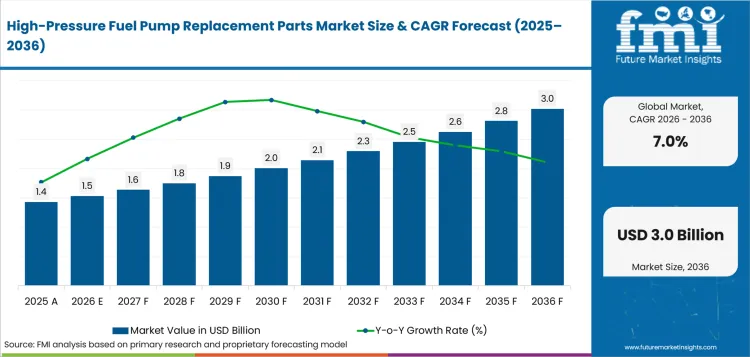
Key Takeaways, Market Size, and Forecast
- 2026 Market Size: USD 1.53 billion
- 2036 Market Size: USD 3.02 billion
- Forecast CAGR: 7.0% from 2026 to 2036
- Leading Product Type: Pump assemblies
- Pump Assemblies Share in 2026: 47.5%
- Leading Sales Channel: Independent aftermarket
- Independent Aftermarket Share in 2026: 54.2%
- Fastest-growing Country: India
- India CAGR: 8.2% through 2036
Repair shops now face two main issues with high-pressure fuel pump replacement. The first is correct part selection. Standard Motor Products expanded its gasoline fuel injection program in May 2026 with over 1,100 all-new fuel injection components and over 115 GDI high-pressure fuel pump SKUs. This helps distributors and workshops cover more late-model vehicles with fewer ordering errors.
The second issue is pressure and fuel compatibility. PHINIA lists Delphi GDI fuel pumps with 350 bar and 500+ bar versions, along with E0 to E100 and M15 fuel compatibility. This means replacement pumps need the right pressure rating and material strength for modern GDI engines. Euro 7 does not directly mandate fuel pump replacement, but its stricter vehicle emission rules increase the need for reliable pressure control after repair.
High-Pressure Fuel Pump Replacement Parts Market Definition
The high-pressure fuel pump replacement parts market includes aftermarket parts used to restore fuel pressure in gasoline direct injection and diesel common rail systems. The scope includes pump assemblies, cam followers, seal kits, pressure valves, and repair kits. These parts serve passenger cars, light commercial vehicles, heavy commercial vehicles, off-highway vehicles, and two wheelers. Factory-installed pump systems, low-pressure lift pumps sold alone, fuel rails, fuel tanks, injectors sold alone, and workshop labor without parts are outside the scope.
High-Pressure Fuel Pump Replacement Parts Market Inclusions
Market scope covers all commercially traded high-pressure fuel pump replacement parts categorized by product type, including pump assemblies, cam followers, seal kits, pressure valves, and repair kits; fuel technology, including gasoline direct systems, diesel common rail systems, hybrid ICE systems, flex fuel systems, and alternative fuel systems; vehicle type, including passenger cars, light commercial vehicles, heavy commercial vehicles, off-highway vehicles, and two wheelers; and sales channels, including independent aftermarket, OEM dealer, online retail, fleet contracts, and core exchange.
Revenue scope covers 2026 to 2036. The key stakeholders include high-pressure fuel pump manufacturers, remanufacturers, fuel system component suppliers, aftermarket distributors, OEM dealer networks, independent repair workshops, fleet maintenance operators, online auto parts platforms, vehicle manufacturers, diagnostic tool providers, warranty administrators, and regulatory bodies.
High-Pressure Fuel Pump Replacement Parts Market Exclusions
Scope does not include factory-installed fuel pumps, standalone low-pressure lift pumps, fuel injectors sold alone, fuel rails, fuel tanks, diagnostic tools, software tuning, or labor-only repair invoices.
High-Pressure Fuel Pump Replacement Parts Market Research Methodology
- Primary Research: FMI analysts reviewed independent workshops, fuel system parts distributors, fleet service operators, and aftermarket catalog teams in major markets.
- Desk Research: The study combined vehicle production data, vehicle sales data, supplier catalogs, service channel structures, and official automotive statistics.
- Market sizing and forecasting: The model used vehicle parc, direct-injection penetration, replacement incidence, average selling prices, and country-level service channel differences.
- Data validation: Forecasts were checked against pump supplier portfolios, failure mode patterns, national vehicle data, and adjacent automotive pumps market outlook.
Why is the High-Pressure Fuel Pump Replacement Parts Market Growing?
- Direct-injection engines increase higher pump stress as rail pressure control is central to starting and drivability.
- Diesel common rail failures create larger repair bills as metal debris can damage multiple fuel system parts.
- Older vehicles increase replacement volume as pump faults usually appear after factory warranty coverage.
- Independent workshops require exact-fit assemblies as wrong pump selection can enhance repeat diagnostic codes.
High-pressure pump replacement demand expands as global vehicle fleets create larger future service pools. OICA reported global vehicle production of 96.4 million units in April 2026 for calendar year 2025, and global sales reached 99.8 million units in the same period. This production base feeds future replacement activity as gasoline direct injection and diesel common rail vehicles age into workshop service. Parts suppliers benefit most through validated pump assemblies and fault-specific repair kits.
Fuel system pressure levels raise the value of correct replacement. Bosch lists gasoline high-pressure pump variants with up to 250 bar and 350 bar pressure ratings, which makes pump sealing and pressure control critical in repair jobs. High pressure raises quality risk for low-cost parts and makes fitment validation important for distributors. This condition improves demand for fuel injection system industry analysis across aftermarket planning.
Market Segmentation Analysis
- Pump assemblies are estimated to account for 47.5% of product type demand in 2026 with strong use across pressure fault repairs.
- Gasoline direct systems are expected to account for 52.8% of fuel technology demand in 2026 with broad use across passenger cars.
- Passenger cars are expected to account for 61.4% of vehicle type demand in 2026 with high service frequency.
- Independent aftermarket channels are estimated to account for 54.2% of sales channel demand in 2026 with quick workshop access.
- Wear leakage is estimated to account for 38.6% of failure mode demand in 2026 with seal fatigue and plunger wear.
The market for high-pressure fuel pump replacement parts is divided into groups based on product type, fuel technology, vehicle type, sales channel, failure mode, and region. There are pump assemblies, cam followers, seal kits, pressure valves, and repair kits under product type. By fuel technology, the market includes gasoline direct systems, diesel common rail systems, hybrid ICE systems, flex fuel systems, and alternative fuel systems. By vehicle type, the market covers passenger cars, light commercial vehicles, heavy commercial vehicles, off-highway vehicles, and two wheelers. Based on sales channel, it includes independent aftermarket, OEM dealer, online retail, fleet contracts, and core exchange. By failure mode, the market is segmented into wear leakage, pressure loss, electrical faults, contamination, and noise vibration.
Insights into Pump Assemblies High-Pressure Fuel Pump Replacement Parts Market by Product Type
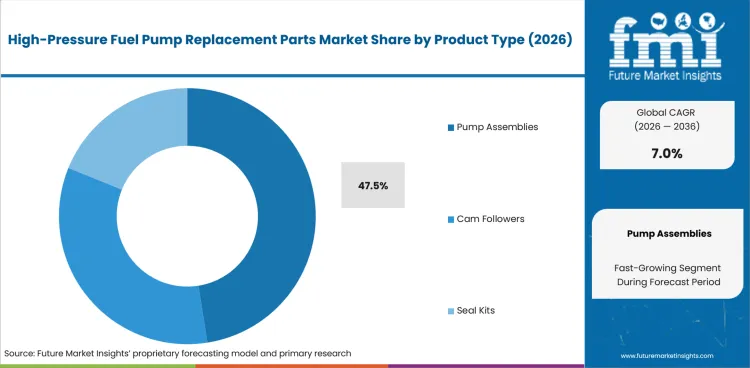
- Pump assemblies are estimated to make up 47.5% of global product type demand in 2026. Complete assemblies reduce repeat repair risk as pressure faults often involve seals and plungers together.
- Repair kits and pressure valves address selected service jobs with lower part cost. Their value improves in targeted repairs without full pump replacement.
Insights into Gasoline Direct High-Pressure Fuel Pump Replacement Parts Market by Fuel Technology
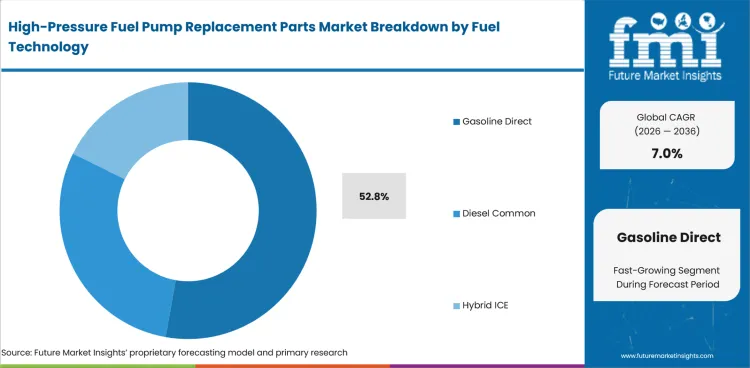
- Gasoline direct systems are expected to hold 52.8% of global fuel technology demand in 2026. GDI vehicles enhance broad replacement coverage across late-model passenger car platforms.
- Diesel common rail systems support higher-value repair demand in commercial and heavy-use vehicles. Replacement need often increases after contamination or pressure instability affects fuel delivery.
Insights into Passenger Cars High-Pressure Fuel Pump Replacement Parts Market by Vehicle Type
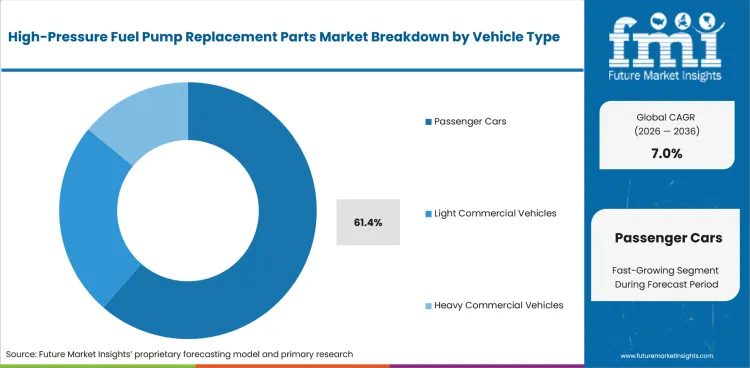
- Passenger cars are forecast to hold 61.4% of global vehicle type demand in 2026. High service frequency and large fleet size keep replacement volumes concentrated across this segment.
- Light commercial vehicles increase steady demand through delivery fleets and work vehicles. Repair buyers focus on reducing downtime and restoring fuel pressure quickly.
Insights into Independent Aftermarket High-Pressure Fuel Pump Replacement Parts Market by Sales Channel
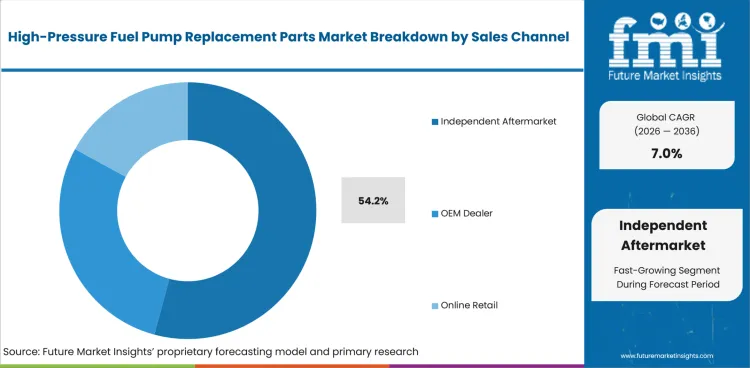
- Independent aftermarket channels are projected to account for 54.2% share in 2026. Local workshops prefer this channel for faster access and competitive replacement pricing.
- OEM dealer channels support newer vehicles requiring exact-fit parts and warranty-linked service. Online retail improves access for buyers using vehicle identification-based part selection.
Insights into Wear Leakage High-Pressure Fuel Pump Replacement Parts Market by Failure Mode
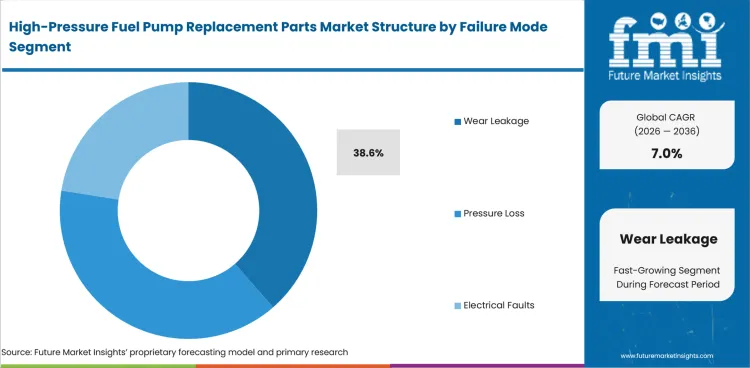
- Wear leakage is projected to account for 38.6% share in 2026. Seal fatigue and plunger wear increase pressure loss across high-pressure pump systems.
- Contamination and pressure loss drive wider repair work across fuel systems. Bundled seal kits help workshops complete lower-cost repairs with fewer repeat visits.
High-Pressure Fuel Pump Replacement Parts Market Drivers, Restraints and Opportunities
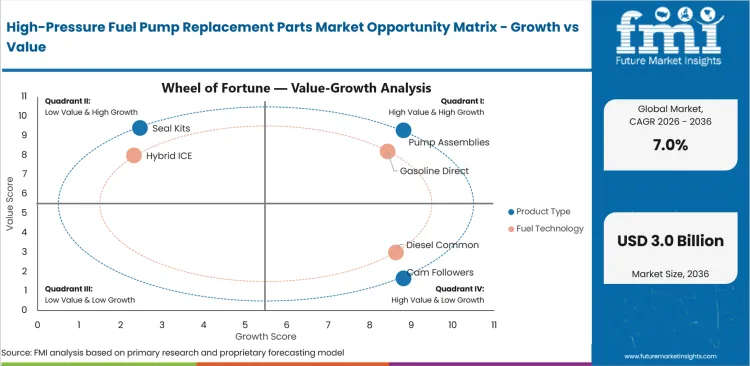
- Driver: Recall-linked diesel pump failures keep verified-fitment kits important as service channels reserve stock for affected truck platforms.
- Restraint: Online price discovery limits broad markup power as buyers compare branded and generic replacement parts faster.
- Opportunity: Bundled HPFP kits enhance value as pump failure often extends service need to filters and cleanup parts.
Recall-Linked Pump Failure and Inventory Analysis
High-pressure fuel pump replacement demand is strengthened by recall events involving large diesel truck populations. NHTSA’s Part 573 report for Ford recall 24V957 listed 295,449 potentially involved vehicles and an estimated 4% defect rate tied to aged biodiesel deposits on internal high-pressure fuel pump components. The recall enhances a visible service pool around 6.7L diesel platforms. Parts suppliers must plan stock for pump assemblies and contamination cleanup parts. Verified-fitment HPFP kits can retain stronger pricing as service channels prioritize repair certainty.
Online Price Discovery and Channel Pricing Analysis
Replacement part pricing is facing stronger limits from digital comparison behavior across aftermarket channels. Auto Care Association and MEMA Aftermarket Suppliers reported in November 2025, e-commerce sales of aftermarket parts were projected to grow 4.6% in 2025 after excluding third-party marketplaces. The same source noted ticket amounts in selected parts groups rose up to 6% year over year from 2016 to 2025. Premium pricing is more defensible for OE-matched and VIN-specific fuel-system kits. Generic sellers face tighter markup room as buyers compare prices online.
Service Kit Bundling and Repair Value Analysis
High-pressure fuel pump replacement is shifting toward broader repair kits instead of single-part transactions. Recall-linked pump failures can involve pump assemblies and nearby fuel-system components after contamination enters the system. This raises the value of bundled repair packs with filters and related cleanup parts. Dealers and independent workshops need parts packages to reduce repeat visits. Suppliers with kit-level coverage and fast regional stock are better placed to capture urgent service orders.
Analysis of High-Pressure Fuel Pump Replacement Parts Market By Key Countries
.webp "Top Country Growth Comparison High-Pressure Fuel Pump Replacement Parts Market Cagr (2026 2036)")
| Country | CAGR |
|---|---|
| India | 8.2% |
| China | 7.8% |
| United States | 6.4% |
| Brazil | 6.1% |
| Germany | 5.6% |
| Japan | 5.1% |
| United Kingdom | 4.7% |
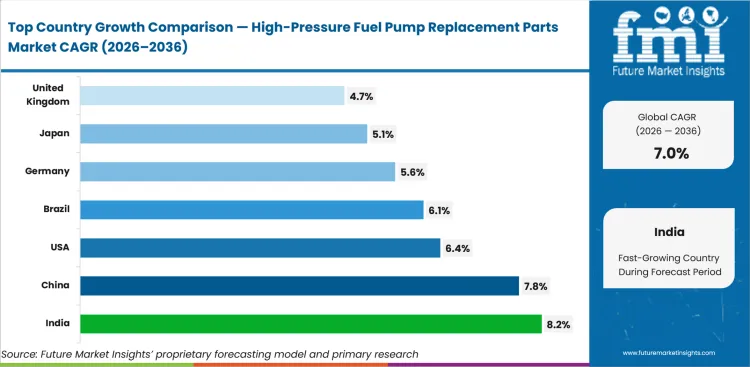
Source: Future Market Insights, 2026.
Demand Outlook for High-Pressure Fuel Pump Replacement Parts Market in India
India High-Pressure Fuel Pump Replacement Parts Market Outlook
Fastest-growing country market · 2026 to 2036
Country Market Snapshot Table
| Parameter | Value |
|---|---|
| Market Size in 2025 (Value) | USD 0.09 billion |
| Market Size in 2026 (Value) | USD 0.10 billion |
| Market Forecast in 2036 (Value) | USD 0.22 billion |
| Incremental Opportunity | USD 0.12 billion |
| CAGR (2026-2036) | 8.2% |
| Years Considered | 2016-2036 |
| Base Year | 2025 |
| Forecast Period | 2026-2036 |
| Units Considered | Value (USD Billion) |
| Leading Sub-Region | Maharashtra |
Demand Outlook for High-Pressure Fuel Pump Replacement Parts Industry in India
India’s BS VI vehicle base raises a strong service funnel for high-pressure fuel pump replacement parts. Maharashtra and Tamil Nadu combine large vehicle use with major service networks. Indian workshops handle high daily repair volumes across gasoline direct and diesel common rail vehicles. This mix raises demand for exact-fit assemblies and verified repair kits.
Urban commuting in Delhi NCR and Bengaluru increases stop-start operation for passenger cars. Commercial vehicle use across Gujarat and Maharashtra raises pump stress across diesel fleets. Parts distributors benefit as independent garages handle a large share of post-warranty repairs. Replacement demand is strongest for fast-moving assemblies with warranty clarity.
Key Growth Drivers
- BS VI repair activity in Delhi NCR raises pump replacement need, as emission-ready engines rely on stable fuel pressure control.
- Maharashtra workshop networks expand catalog demand, as SIAM reported 4.3 million passenger vehicle sales in FY 2024-25 during August 2025, backing service volume.
- Gujarat manufacturing clusters improve parts availability, as the Economic Survey reported 5.3 million vehicle exports in FY 2025 during January 2026, backing supplier scale.
- Chennai and Pune service belts raise stronger demand for automotive fuel delivery system industry analysis across repair planning.
Key Restraints
- Counterfeit parts in Delhi NCR weaken price confidence and raise warranty risk for independent workshops.
- Rural service gaps across Uttar Pradesh limit diagnostic accuracy, as rail pressure tools are less common outside major cities.
- Fuel quality variation across long-haul routes raises repeat repair risk, as mixed storage conditions can shorten pump life.
What makes India unique
India combines BS VI compliance, dense independent garages, and cost-sensitive car owners into a fast replacement market.
Key Companies
- Bosch India
- DENSO India
- PHINIA India
- Hitachi Astemo India
- Standard Motor Products distribution partners
Sales & Marketing Channels
- Independent garage networks in Maharashtra
- OEM dealer workshops in Tamil Nadu
- Wholesale auto parts markets in Delhi NCR
- E-commerce platforms serving Bengaluru workshops
Country Segment Breakdown Table
| Segment | Sub-Segments |
|---|---|
| By Product Type | Pump Assemblies · Cam Followers · Seal Kits · Pressure Valves · Repair Kits |
| By Fuel Technology | Gasoline Direct · Diesel Common · Hybrid ICE · Flex Fuel · Alternative Fuel |
| By Vehicle Type | Passenger Cars · Light Commercial Vehicles · Heavy Commercial Vehicles · Off-Highway Vehicles · Two Wheelers |
| By Sales Channel | Independent Aftermarket · OEM Dealer · Online Retail · Fleet Contracts · Core Exchange |
| By Failure Mode | Wear Leakage · Pressure Loss · Electrical Faults · Contamination · Noise Vibration |
| Key Sub-Regions Covered, Provinces / Municipalities | Maharashtra, Tamil Nadu, Gujarat, Delhi NCR, Karnataka, Haryana, Uttar Pradesh, Telangana |
Market Taxonomy and Sub-Regions Covered
Frequently Asked Questions (Country-Specific)
How fast is India’s High-Pressure Fuel Pump Replacement Parts Industry growing through 2036?
India is projected to record a 8.2% CAGR through 2036, driven by BS VI service demand.
Who leads the India High-Pressure Fuel Pump Replacement Parts Industry?
Bosch India and DENSO India lead through OE fitment depth, dealer reach, and diesel service coverage.
What is driving demand in India?
BS VI vehicle service, urban stop-start use, and independent garage repair activity drive pump replacement demand.
Sales Analysis of High-Pressure Fuel Pump Replacement Parts Industry in China
China High-Pressure Fuel Pump Replacement Parts Industry Outlook
Leading production-linked opportunity · 2026 to 2036
Country Market Snapshot Table
| Parameter | Value |
|---|---|
| Market Size in 2025 (Value) | USD 0.26 billion |
| Market Size in 2026 (Value) | USD 0.28 billion |
| Market Forecast in 2036 (Value) | USD 0.59 billion |
| Incremental Opportunity | USD 0.31 billion |
| CAGR (2026-2036) | 7.8% |
| Years Considered | 2016-2036 |
| Base Year | 2025 |
| Forecast Period | 2026-2036 |
| Units Considered | Value (USD Billion) |
| Leading Sub-Region | Guangdong |
Sales Analysis of High-Pressure Fuel Pump Replacement Parts Industry in China
China has the leading vehicle production base, giving pump replacement suppliers a deep service pool. Guangdong and Jiangsu combine vehicle manufacturing with dense repair distribution. Gasoline direct injection platforms favor large part coverage needs across passenger cars. Local workshops need catalog precision as imported and domestic engine platforms mix.
Shanghai and Zhejiang carry high vehicle ownership density and advanced dealer networks. Commercial fleets in coastal provinces drive diesel common rail repair activity. Suppliers with local stock and fast fitment data gain a stronger position. Cost pressure supports reliable mid-tier parts for older vehicles.
Key Growth Drivers
- Guangdong vehicle service hubs raise replacement volumes as gasoline direct injection vehicles age across urban fleets.
- China production scale expands future service demand, as OICA listed 34.53 million vehicles produced in 2025, reported in April 2026.
- Jiangsu and Zhejiang parts clusters improve access, as China vehicle sales reached 34.40 million units in 2025, reported in January 2026.
- Shanghai repair networks strengthen demand for fuel injection system across direct-injection service programs.
Key Restraints
- Domestic price rivalry in Guangdong compresses margins for branded pump assemblies.
- Mixed vehicle platforms in Shanghai raise fitment risk for smaller catalog providers.
- Electrification growth reduces future ICE repair exposure, as China set a 15.5 million NEV sales target for 2025 in September 2025.
What makes China unique
China combines huge local output with fast catalog turnover across domestic and imported powertrain platforms.
Key Companies
- Bosch China
- DENSO China
- PHINIA China
- Hitachi Astemo China
- AUMOVIO China
Sales & Marketing Channels
- Guangzhou parts wholesale networks
- Shanghai OEM dealer groups
- Jiangsu distributor warehouses
- Zhejiang online automotive parts platforms
Country Segment Breakdown Table
| Segment | Sub-Segments |
|---|---|
| By Product Type | Pump Assemblies · Cam Followers · Seal Kits · Pressure Valves · Repair Kits |
| By Fuel Technology | Gasoline Direct · Diesel Common · Hybrid ICE · Flex Fuel · Alternative Fuel |
| By Vehicle Type | Passenger Cars · Light Commercial Vehicles · Heavy Commercial Vehicles · Off-Highway Vehicles · Two Wheelers |
| By Sales Channel | Independent Aftermarket · OEM Dealer · Online Retail · Fleet Contracts · Core Exchange |
| By Failure Mode | Wear Leakage · Pressure Loss · Electrical Faults · Contamination · Noise Vibration |
| Key Sub-Regions Covered, Provinces / Municipalities | Guangdong, Jiangsu, Shanghai, Zhejiang, Shandong, Chongqing, Hubei, Beijing |
Market Taxonomy and Sub-Regions Covered
Frequently Asked Questions (Country-Specific)
How fast is China’s High-Pressure Fuel Pump Replacement Parts Industry growing through 2036?
China is expected to expand at 7.8% CAGR through 2036, driven by large vehicle output.
Who leads the China High-Pressure Fuel Pump Replacement Parts Industry?
Bosch China, DENSO China, and PHINIA China lead through OE links and broad fuel system portfolios.
What is driving demand in China?
Guangdong service density, Jiangsu parts supply, and gasoline direct platform diversity drive replacement demand.
Demand Analysis of High-Pressure Fuel Pump Replacement Parts Industry in the United States
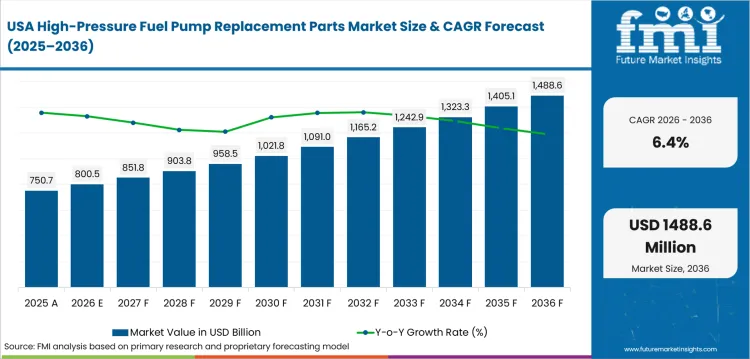
Leading aftermarket value base · 2026 to 2036
Country Market Snapshot Table
| Parameter | Value |
|---|---|
| Market Size in 2025 (Value) | USD 0.36 billion |
| Market Size in 2026 (Value) | USD 0.38 billion |
| Market Forecast in 2036 (Value) | USD 0.71 billion |
| Incremental Opportunity | USD 0.33 billion |
| CAGR (2026-2036) | 6.4% |
| Years Considered | 2016-2036 |
| Base Year | 2025 |
| Forecast Period | 2026-2036 |
| Units Considered | Value (USD Billion) |
| Leading Sub-Region | Great Lakes |
Demand Analysis of High-Pressure Fuel Pump Replacement Parts Industry in the United States
The United States high-pressure fuel pump replacement parts industry is shaped by older vehicles and high repair-ticket sensitivity. Great Lakes states carry large commuting fleets and mature repair networks. Pickup and SUV use keeps gasoline direct injection service needs active. Buyers often compare new pump assemblies with remanufactured choices before approving repairs.
Texas and California create two very different service profiles. Texas supports light truck and fleet repair demand. California emphasizes emissions readiness and dealer-grade diagnostics. Large parts distributors and online sellers make availability strong. This channel depth protects replacement volumes despite slower new ICE mix expansion.
Key Growth Drivers
- Great Lakes repair shops handle older cars, as BTS referenced a 12.8-year average U.S. light vehicle age in August 2025.
- Texas pickup service lifts pump demand, as OICA listed U.S. commercial vehicle sales at 13,946,387 units in 2025.
- California emissions inspections raise demand for pressure-ready pumps across gasoline direct injection vehicles.
- Online parts buyers increase automotive e-tailing industry analysis relevance for VIN-based pump selection.
Key Restraints
- California emissions compliance can raise diagnostic time and discourage low-cost parts.
- Midwest reman returns pressure distributor margins if core quality falls below rebuild needs.
- U.S. truck-heavy sales mix raises pump coverage complexity, as OICA listed U.S. commercial vehicle sales above passenger car sales in 2025.
What makes the United States unique
The United States combines old vehicle age, large light truck use, and mature online parts channels.
Key Companies
- Bosch Mobility Aftermarket
- Standard Motor Products
- ACDelco
- DENSO Products and Services Americas
- PHINIA aftermarket channels
Sales & Marketing Channels
- National auto parts chains in the Great Lakes
- Online VIN-based parts platforms in California
- Fleet maintenance buyers in Texas
- Dealer service networks across the Southeast
Country Segment Breakdown Table
| Segment | Sub-Segments |
|---|---|
| By Product Type | Pump Assemblies · Cam Followers · Seal Kits · Pressure Valves · Repair Kits |
| By Fuel Technology | Gasoline Direct · Diesel Common · Hybrid ICE · Flex Fuel · Alternative Fuel |
| By Vehicle Type | Passenger Cars · Light Commercial Vehicles · Heavy Commercial Vehicles · Off-Highway Vehicles · Two Wheelers |
| By Sales Channel | Independent Aftermarket · OEM Dealer · Online Retail · Fleet Contracts · Core Exchange |
| By Failure Mode | Wear Leakage · Pressure Loss · Electrical Faults · Contamination · Noise Vibration |
| Key Sub-Regions Covered, Provinces / Municipalities | Great Lakes, Texas, California, Southeast, Midwest, Northeast Corridor, Pacific Northwest, Mountain States |
Market Taxonomy and Sub-Regions Covered
Frequently Asked Questions (Country-Specific)
How fast is the United States High-Pressure Fuel Pump Replacement Parts Industry growing through 2036?
The United States is forecast to grow at 6.4% CAGR through 2036, driven by older vehicle use.
Who leads the United States High-Pressure Fuel Pump Replacement Parts Industry?
Bosch, Standard Motor Products, and ACDelco lead through strong catalog coverage and repair channel reach.
What is driving demand in the United States?
Older vehicles, pickup-heavy service demand, and online fitment tools drive high-pressure pump replacement activity.
Opportunity Analysis of High-Pressure Fuel Pump Replacement Parts Industry in Brazil
Flex-fuel replacement opportunity · 2026 to 2036
Country Market Snapshot Table
| Parameter | Value |
|---|---|
| Market Size in 2025 (Value) | USD 0.06 billion |
| Market Size in 2026 (Value) | USD 0.06 billion |
| Market Forecast in 2036 (Value) | USD 0.11 billion |
| Incremental Opportunity | USD 0.05 billion |
| CAGR (2026-2036) | 6.1% |
| Years Considered | 2016-2036 |
| Base Year | 2025 |
| Forecast Period | 2026-2036 |
| Units Considered | Value (USD Billion) |
| Leading Sub-Region | São Paulo |
Opportunity Analysis of High-Pressure Fuel Pump Replacement Parts Industry in Brazil
Brazil’s flex fuel base raises distinct replacement for high-pressure pump parts. São Paulo and Minas Gerais hold dense vehicle repair ecosystems with frequent ethanol blend use. Pump seals and pressure valves face chemical exposure across mixed fuel conditions. Workshops need reliable parts capable of handling local fuel patterns.
Paraná and Rio Grande do Sul add service demand through long-distance passenger and light commercial vehicle use. Imported parts compete with local supply across price-sensitive repair lanes. Fleet operators often focus on downtime control over brand premium. Suppliers with ethanol-resistant parts and fast distribution can defend share.
Key Growth Drivers
- São Paulo flex fuel use raises seal demand as ethanol exposure increases material stress inside pump assemblies.
- Brazil output scale backs service potential, as ANFAVEA-linked data cited 2.65 million vehicles produced in 2025 during January 2026.
- Minas Gerais fleet repair demand expands, as Brazil vehicle sales reached 2.55 million units in 2025 in January 2026.
- Flex fuel repair needs improve demand for automotive fuel transfer pumps across local service channels.
Key Restraints
- High interest rates in Brazil pressure vehicle repair spending across older passenger cars.
- Imported pump prices expose São Paulo distributors to currency-linked cost swings.
- January output weakness limited near-term parts confidence, as ANFAVEA reported 159,552 vehicles produced in January 2026.
What makes Brazil unique
Brazil’s flex fuel vehicle base raises unusual chemical-resistance needs for pump seals and pressure components.
Key Companies
- Bosch Brazil
- DENSO Brazil
- ACDelco Brazil
- Hitachi Astemo distribution partners
- PHINIA Brazil channels
Sales & Marketing Channels
- São Paulo independent repair distributors
- Minas Gerais fleet service shops
- Paraná wholesale parts networks
- Rio Grande do Sul dealer service centers
Country Segment Breakdown Table
| Segment | Sub-Segments |
|---|---|
| By Product Type | Pump Assemblies · Cam Followers · Seal Kits · Pressure Valves · Repair Kits |
| By Fuel Technology | Gasoline Direct · Diesel Common · Hybrid ICE · Flex Fuel · Alternative Fuel |
| By Vehicle Type | Passenger Cars · Light Commercial Vehicles · Heavy Commercial Vehicles · Off-Highway Vehicles · Two Wheelers |
| By Sales Channel | Independent Aftermarket · OEM Dealer · Online Retail · Fleet Contracts · Core Exchange |
| By Failure Mode | Wear Leakage · Pressure Loss · Electrical Faults · Contamination · Noise Vibration |
| Key Sub-Regions Covered, Provinces / Municipalities | São Paulo, Minas Gerais, Paraná, Rio Grande do Sul, Bahia, Rio de Janeiro, Santa Catarina, Goiás |
Market Taxonomy and Sub-Regions Covered
Frequently Asked Questions (Country-Specific)
How fast is Brazil’s High-Pressure Fuel Pump Replacement Parts Industry growing through 2036?
Brazil is expected to advance at 6.1% CAGR through 2036, driven by flex fuel pump service needs.
Who leads the Brazil High-Pressure Fuel Pump Replacement Parts Industry?
Bosch Brazil, DENSO Brazil, and ACDelco Brazil lead through dealer links and aftermarket supply reach.
What is driving demand in Brazil?
São Paulo flex fuel use, Minas Gerais fleet repair, and ethanol-related seal stress drive replacement demand.
Future Outlook for High-Pressure Fuel Pump Replacement Parts Industry in Germany
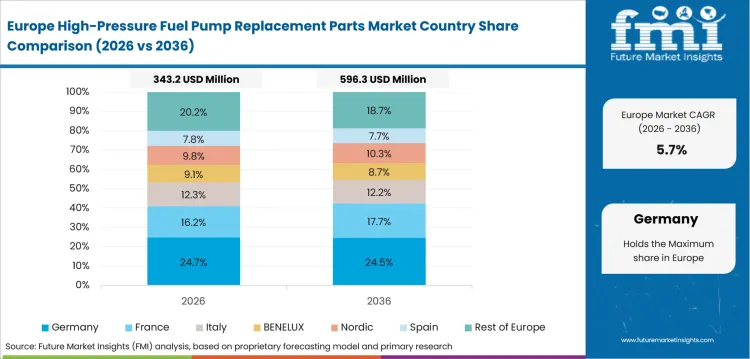
Premium vehicle repair base · 2026 to 2036
Country Market Snapshot Table
| Parameter | Value |
|---|---|
| Market Size in 2025 (Value) | USD 0.11 billion |
| Market Size in 2026 (Value) | USD 0.12 billion |
| Market Forecast in 2036 (Value) | USD 0.21 billion |
| Incremental Opportunity | USD 0.09 billion |
| CAGR (2026-2036) | 5.6% |
| Years Considered | 2016-2036 |
| Base Year | 2025 |
| Forecast Period | 2026-2036 |
| Units Considered | Value (USD Billion) |
| Leading Sub-Region | Baden-Württemberg |
Future Outlook for High-Pressure Fuel Pump Replacement Parts Industry in Germany
Germany’s repair sector is influenced by premium car ownership and high workshop standards. Baden-Württemberg and Bavaria concentrate many premium platforms using direct injection and turbocharged engines. These vehicles require high-pressure pump validation and exact fitment. Dealer networks and specialist garages maintain high expectations for warranty-safe parts.
North Rhine-Westphalia and Lower Saxony create large service pools through dense car use and strong supplier presence. German buyers often value certified parts and supplier reputation. Independent workshops are important for older vehicles. Premium car repair value keeps pump assemblies commercially important despite slower unit expansion.
Key Growth Drivers
- Baden-Württemberg premium vehicle service raises demand for validated pump assemblies across direct-injection engines.
- Germany has deep production depth, as GTAI reported almost 4.1 million passenger cars and 351,000 commercial vehicles made in 2024 during May 2025.
- Bavaria supplier clusters strengthen parts access, as GTAI reported 51 automobile assembly and production sites in Germany at end-2024.
- Premium service demand links with automotive turbocharger revenue across boosted gasoline engines.
Key Restraints
- Strict workshop expectations in Bavaria reduce acceptance of low-cost untested pump assemblies.
- Electric vehicle adoption in Baden-Württemberg reduces future ICE repair exposure in newer fleets.
- Germany’s production transition adds uncertainty, as VDA noted electric passenger car output reached 1.22 million vehicles in 2025.
What makes Germany unique
Germany’s premium vehicle mix improves high replacement value even with slower ICE fleet expansion.
Key Companies
- Bosch Mobility Aftermarket
- AUMOVIO SE
- DENSO Germany
- PHINIA Germany
- Hitachi Astemo Europe
Sales & Marketing Channels
- Baden-Württemberg specialist garages
- Bavaria dealer service networks
- North Rhine-Westphalia distributor hubs
- Lower Saxony fleet maintenance channels
Country Segment Breakdown Table
| Segment | Sub-Segments |
|---|---|
| By Product Type | Pump Assemblies · Cam Followers · Seal Kits · Pressure Valves · Repair Kits |
| By Fuel Technology | Gasoline Direct · Diesel Common · Hybrid ICE · Flex Fuel · Alternative Fuel |
| By Vehicle Type | Passenger Cars · Light Commercial Vehicles · Heavy Commercial Vehicles · Off-Highway Vehicles · Two Wheelers |
| By Sales Channel | Independent Aftermarket · OEM Dealer · Online Retail · Fleet Contracts · Core Exchange |
| By Failure Mode | Wear Leakage · Pressure Loss · Electrical Faults · Contamination · Noise Vibration |
| Key Sub-Regions Covered, Provinces / Municipalities | Baden-Württemberg, Bavaria, North Rhine-Westphalia, Lower Saxony, Saxony, Hesse, Rhineland-Palatinate, Berlin-Brandenburg |
Market Taxonomy and Sub-Regions Covered
Frequently Asked Questions (Country-Specific)
How fast is Germany’s High-Pressure Fuel Pump Replacement Parts Industry growing through 2036?
Germany is projected to rise at 5.6% CAGR through 2036, driven by premium repair value.
Who leads the Germany High-Pressure Fuel Pump Replacement Parts Industry?
Bosch Mobility Aftermarket and AUMOVIO SE lead through German supplier depth and service networks.
What is driving demand in Germany?
Premium direct-injection vehicles, validated repair standards, and specialist workshops drive pump assembly demand.
Demand Outlook for High-Pressure Fuel Pump Replacement Parts Industry in the United Kingdom
Mature aftermarket channel base · 2026 to 2036
Country Market Snapshot Table
| Parameter | Value |
|---|---|
| Market Size in 2025 (Value) | USD 0.07 billion |
| Market Size in 2026 (Value) | USD 0.07 billion |
| Market Forecast in 2036 (Value) | USD 0.11 billion |
| Incremental Opportunity | USD 0.04 billion |
| CAGR (2026-2036) | 4.7% |
| Years Considered | 2016-2036 |
| Base Year | 2025 |
| Forecast Period | 2026-2036 |
| Units Considered | Value (USD Billion) |
| Leading Sub-Region | West Midlands |
Demand Outlook for High-Pressure Fuel Pump Replacement Parts Industry in the United Kingdom
The United Kingdom high-pressure fuel pump replacement parts sector has a mature aftermarket base with strong dealer and independent repair channels. West Midlands and North East England serve as important automotive service regions. Pump replacement demand is linked with older petrol direct injection cars and diesel common rail vans. Workshops rely on fast parts access and exact catalog matching.
London and South East England enhance high repair activity through dense passenger car ownership. Light commercial vehicle maintenance is important for urban delivery fleets. Import reliance can boost price swings for branded assemblies. Mature service standards favor reliable pump suppliers with clear warranty handling.
Key Growth Drivers
- West Midlands repair networks raise pump demand as older petrol direct injection cars need pressure-stable assemblies.
- UK service scale persists, as SMMT reported 764,715 cars and commercial vehicles produced in 2025 during January 2026.
- Export-linked supplier activity helps parts access, as SMMT reported 555,826 cars exported in 2025 during January 2026.
- Online catalog use improves fitment search for automotive e-tailing across pump replacement.
Key Restraints
- Imported pump exposure can raise replacement prices across independent workshops in South East England.
- Urban diesel restrictions in London reduce long-term diesel common rail repair volumes.
- Production disruption affected supplier confidence, as SMMT reported total vehicle output down 15.5% in 2025.
What makes the United Kingdom unique
The United Kingdom has mature workshop networks and high online fitment use for replacement parts.
Key Companies
- Bosch UK
- DENSO UK
- ACDelco distribution partners
- Standard Motor Products Europe channels
- PHINIA UK channels
Sales & Marketing Channels
- West Midlands motor factor networks
- South East England online parts sellers
- North East dealer service channels
- London fleet maintenance shops
Country Segment Breakdown Table
| Segment | Sub-Segments |
|---|---|
| By Product Type | Pump Assemblies · Cam Followers · Seal Kits · Pressure Valves · Repair Kits |
| By Fuel Technology | Gasoline Direct · Diesel Common · Hybrid ICE · Flex Fuel · Alternative Fuel |
| By Vehicle Type | Passenger Cars · Light Commercial Vehicles · Heavy Commercial Vehicles · Off-Highway Vehicles · Two Wheelers |
| By Sales Channel | Independent Aftermarket · OEM Dealer · Online Retail · Fleet Contracts · Core Exchange |
| By Failure Mode | Wear Leakage · Pressure Loss · Electrical Faults · Contamination · Noise Vibration |
| Key Sub-Regions Covered, Provinces / Municipalities | West Midlands, North East England, South East England, Greater London, Yorkshire, North West England, Scotland Central Belt, Wales |
Market Taxonomy and Sub-Regions Covered
Frequently Asked Questions (Country-Specific)
How fast is the United Kingdom High-Pressure Fuel Pump Replacement Parts Industry growing through 2036?
The United Kingdom is expected to post 4.7% CAGR through 2036, driven by mature repair activity.
Who leads the United Kingdom High-Pressure Fuel Pump Replacement Parts Industry?
Bosch UK, DENSO UK, and PHINIA UK channels lead through catalog coverage and dealer reach.
What is driving demand in the United Kingdom?
Older petrol direct injection cars, van maintenance, and online fitment tools drive pump replacement demand.
In-depth Analysis of High-Pressure Fuel Pump Replacement Parts Industry in Japan
Hybrid ICE service base · 2026 to 2036
Country Market Snapshot Table
| Parameter | Value |
|---|---|
| Market Size in 2025 (Value) | USD 0.10 billion |
| Market Size in 2026 (Value) | USD 0.11 billion |
| Market Forecast in 2036 (Value) | USD 0.18 billion |
| Incremental Opportunity | USD 0.07 billion |
| CAGR (2026-2036) | 5.1% |
| Years Considered | 2016-2036 |
| Base Year | 2025 |
| Forecast Period | 2026-2036 |
| Units Considered | Value (USD Billion) |
| Leading Sub-Region | Aichi |
In-depth Analysis of High-Pressure Fuel Pump Replacement Parts Industry in Japan
High-pressure fuel pump replacement parts industry in Japan is shaped by hybrid ICE vehicles and high service quality standards. Aichi and Shizuoka create strong vehicle production and maintenance clusters. GDI and hybrid gasoline platforms enhance demand for precise pump assemblies. Buyers favor OE-grade parts with stable warranty outcomes.
Tokyo and Osaka service centers handle high vehicle density and frequent inspection-led repairs. Smaller car ownership keeps part volumes active. Japan’s supplier base is technically strong, and replacement demand rises at a measured pace. Hybrid powertrain service keeps gasoline pressure systems relevant across the forecast period.
Key Growth Drivers
- Aichi hybrid service clusters raise demand for compact high-pressure pump assemblies in gasoline hybrid platforms.
- Japan is a major production base, as CEIC cited JAMA-linked 8,410,232 motor vehicles produced in 2025.
- Tokyo repair demand benefits from dense ownership, as the International Trade Administration cited 4,421,494 new passenger vehicles sold in 2024 during November 2025.
- Hybrid ICE repair planning connects with two-wheeler fuel injection system revenue across compact fuel systems.
Key Restraints
- High service standards in Aichi reduce acceptance of low-cost unverified pump assemblies.
- Older vehicle replacement cycles in Tokyo can be limited by strict inspection economics.
- Electrification limits long-term gasoline-only repair demand, as Japan’s automotive industry employed 5.58 million people during 2024 and stays deeply linked to transition planning.
What makes Japan unique
Japan’s hybrid-heavy service base boosts steady GDI pump demand without fast volume acceleration.
Key Companies
- DENSO Corporation
- Hitachi Astemo
- Bosch Japan
- PHINIA Japan channels
- ACDelco import channels
Sales & Marketing Channels
- Aichi dealer service networks
- Tokyo online parts sellers
- Osaka independent workshops
- Shizuoka supplier-linked distributors
Country Segment Breakdown Table
| Segment | Sub-Segments |
|---|---|
| By Product Type | Pump Assemblies · Cam Followers · Seal Kits · Pressure Valves · Repair Kits |
| By Fuel Technology | Gasoline Direct · Diesel Common · Hybrid ICE · Flex Fuel · Alternative Fuel |
| By Vehicle Type | Passenger Cars · Light Commercial Vehicles · Heavy Commercial Vehicles · Off-Highway Vehicles · Two Wheelers |
| By Sales Channel | Independent Aftermarket · OEM Dealer · Online Retail · Fleet Contracts · Core Exchange |
| By Failure Mode | Wear Leakage · Pressure Loss · Electrical Faults · Contamination · Noise Vibration |
| Key Sub-Regions Covered, Provinces / Municipalities | Aichi, Shizuoka, Tokyo, Osaka, Kanagawa, Saitama, Hiroshima, Fukuoka |
Market Taxonomy and Sub-Regions Covered
Frequently Asked Questions (Country-Specific)
How fast is Japan’s High-Pressure Fuel Pump Replacement Parts Industry growing through 2036?
Japan is forecast at 5.1% CAGR through 2036, driven by hybrid ICE service needs.
Who leads the Japan High-Pressure Fuel Pump Replacement Parts Industry?
DENSO Corporation and Hitachi Astemo lead through domestic fuel system expertise and OE relationships.
What is driving demand in Japan?
Hybrid gasoline vehicles, dense inspection-led service, and high-quality repair standards drive pump replacement activity.
Competitive Landscape and Strategic Positioning
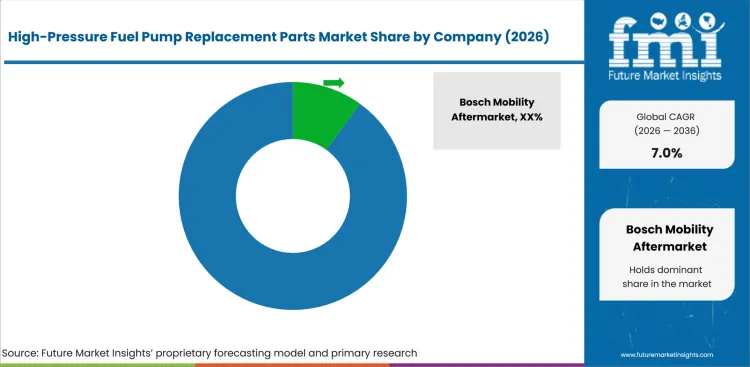
- Bosch Mobility Aftermarket leads with broad high-pressure pump coverage and remanufactured diesel pump capability across major service channels.
- DENSO Corporation and Hitachi Astemo compete on OE fuel system knowledge and high-quality direct-injection pump engineering.
- Standard Motor Products and ACDelco hold strong aftermarket positions through catalog breadth and distributor reach.
Bosch Mobility Aftermarket has a high position due to diesel pump coverage and remanufactured part programs for price-sensitive repairs. DENSO Corporation brings OE fuel system depth across Japanese and global vehicle platforms with high fitment confidence. PHINIA Inc. competes through fuel systems expertise built on Delphi heritage across gasoline and diesel applications. Hitachi Astemo adds direct-injection pump capability and chemical-resistant seal knowledge for fuel-compatible replacement needs. AUMOVIO SE improves European aftermarket reach through mobility component portfolios and established service channel access.
Barriers include pressure testing cost and warranty return exposure across high-pressure fuel pump replacement programs. Strategic priorities include catalog accuracy and final production testing across high-volume service markets. Buyers favor suppliers offering validated pump assemblies and repair kits with clear fault guidance. Companies covering adjacent brushless fuel pumps market outlook can compare low-pressure and high-pressure fuel system changes together. Suppliers best placed to win combine proven pump quality and dependable service documentation.
Key Companies in the High-Pressure Fuel Pump Replacement Parts Market
Key global companies leading the high-pressure fuel pump replacement parts market include:
- Bosch Mobility Aftermarket, DENSO Corporation, and PHINIA Inc. have strong fuel system coverage for gasoline direct and diesel common rail platforms.
- Hitachi Astemo, AUMOVIO SE, and ACDelco serve manufacturers and repair channels through OE-grade product coverage and service reach.
- Standard Motor Products holds a strong aftermarket position across GDI high-pressure pumps and related fuel system parts.
Competitive Benchmarking: High-Pressure Fuel Pump Replacement Parts Market
| Company | Pressure Validation Depth | OE Fitment Coverage | Remanufactured Pump Capability |
|---|---|---|---|
| Bosch Mobility Aftermarket | High | High | Strong |
| DENSO Corporation | High | High | Moderate |
| PHINIA Inc. | High | High | Moderate |
| Hitachi Astemo | High | Medium | Low |
| AUMOVIO SE | Medium | High | Moderate |
| Standard Motor Products | Medium | High | Low |
| ACDelco | Medium | High | Moderate |
Source: Future Market Insights, 2026.
Key Developments in High-Pressure Fuel Pump Replacement Parts Market
- In May 2026, Standard Motor Products expanded its Standard® Gas Fuel Injection program with GDI high-pressure fuel pumps and Blue Streak® GDI High-Pressure Fuel Pump Kits. The kits include high-pressure fuel pump service parts in one box, while recent pump releases cover Audi, Volkswagen, and BMW applications, including 1.2 million BMW vehicles through the 2025 model year.
- In March 2024, DENSO added 42 diesel aftermarket products for common rail applications, including 15 common rail fuel pumps, 23 common rail injectors, and four smaller parts. The release targeted medium-duty commercial vehicles and added coverage for 56 vehicle applications across Europe.
Key Players in the High-Pressure Fuel Pump Replacement Parts Market
Major Global Players:
- Bosch Mobility Aftermarket
- DENSO Corporation
- PHINIA Inc.
- Hitachi Astemo
- AUMOVIO SE
Specialist Players:
- Standard Motor Products
- ACDelco
Report Scope and Coverage
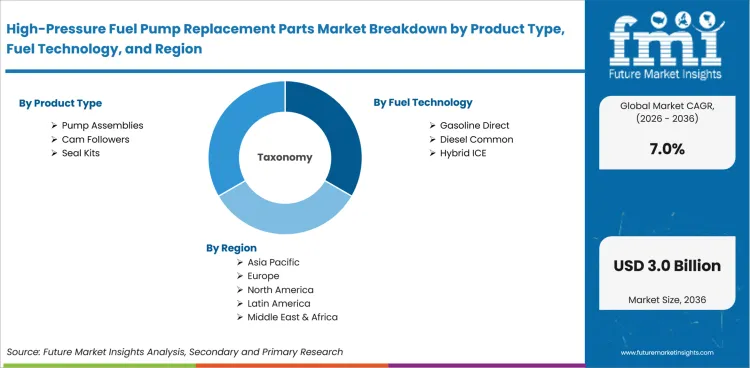
| Parameter | Details |
|---|---|
| Market size by 2036 | USD 3.02 billion |
| Growth rate | 7.0% CAGR (2026-2036) |
| Forecast period | 2026 to 2036 |
| Estimated year value (2026) | USD 1.53 billion |
| By product type | Pump Assemblies, Cam Followers, Seal Kits, Pressure Valves, Repair Kits |
| By fuel technology | Gasoline Direct Systems, Diesel Common Rail Systems, Hybrid ICE Systems, Flex Fuel Systems, Alternative Fuel Systems |
| By vehicle type | Passenger Cars, Light Commercial Vehicles, Heavy Commercial Vehicles, Off-Highway Vehicles, Two Wheelers |
| By sales channel | Independent Aftermarket, OEM Dealer, Online Retail, Fleet Contracts, Core Exchange |
| By failure mode | Wear Leakage, Pressure Loss, Electrical Faults, Contamination, Noise Vibration |
| Regions covered | North America, Latin America, Europe, East Asia, South Asia and Pacific, Middle East & Africa |
| Countries covered | United States, China, India, Germany, Japan, United Kingdom, Brazil, and 30 plus countries |
| Key companies profiled | Bosch Mobility Aftermarket, DENSO Corporation, PHINIA Inc., Hitachi Astemo, AUMOVIO SE, Standard Motor Products, ACDelco |
| Approach | Hybrid bottom-up and top-down methodology starting with verified replacement demand, vehicle parc analysis, direct-injection penetration, channel pricing, and supplier portfolio checks. |
High-Pressure Fuel Pump Replacement Parts Market by Segments
High-Pressure Fuel Pump Replacement Parts Market Segmented by Product Type:
- Pump Assemblies
- Cam Followers
- Seal Kits
- Pressure Valves
- Repair Kits
High-Pressure Fuel Pump Replacement Parts Market Segmented by Fuel Technology:
- Gasoline Direct
- Diesel Common
- Hybrid ICE
- Flex Fuel
- Alternative Fuel
High-Pressure Fuel Pump Replacement Parts Market Segmented by Vehicle Type:
- Passenger Cars
- Light Commercial Vehicles
- Heavy Commercial Vehicles
- Off-Highway Vehicles
- Two Wheelers
High-Pressure Fuel Pump Replacement Parts Market Segmented by Sales Channel:
- Independent Aftermarket
- OEM Dealer
- Online Retail
- Fleet Contracts
- Core Exchange
High-Pressure Fuel Pump Replacement Parts Market Segmented by Failure Mode:
- Wear Leakage
- Pressure Loss
- Electrical Faults
- Contamination
- Noise Vibration
High-Pressure Fuel Pump Replacement Parts Market by Region:
- North America
- United States
- Canada
- Mexico
- Latin America
- Brazil
- Chile
- Rest of Latin America
- Europe
- Germany
- United Kingdom
- Italy
- Spain
- France
- Rest of Europe
- East Asia
- China
- Japan
- South Korea
- South Asia and Pacific
- India
- ASEAN
- Australia and New Zealand
- Rest of South Asia and Pacific
- Middle East & Africa
- Saudi Arabia
- Other GCC Countries
- South Africa
- Rest of Middle East & Africa
Research Sources and Bibliography
- International Organization of Motor Vehicle Manufacturers. (2026, April). Auto industry growth shifted east in 2025 amid global repositioning.
- International Organization of Motor Vehicle Manufacturers. (2026). Production statistics.
- International Organization of Motor Vehicle Manufacturers. (2026). Sales statistics.
- Bureau of Transportation Statistics. (2025, August). Average age of automobiles and trucks in operation in the United States.
- Society of Indian Automobile Manufacturers. (2025, August). SIAM Annual Report 2024–25.
- Germany Trade & Invest. (2025, May). The automotive industry in Germany.
- Society of Motor Manufacturers and Traders. (2026, January). Tough year for auto but new models and Industrial Strategy can deliver growth.
- Japan Automobile Manufacturers Association. (2025, September). The motor industry of Japan 2025.
- International Trade Administration. (2025, November). Japan automotive.
- Associação Nacional dos Fabricantes de Veículos Automotores. (2026, January). Produção e venda de autoveículos crescem em 2025 e Anfavea projeta nova alta em 2026.
- Bosch Mobility. (2026). High-pressure pump HDP.
- Standard Motor Products. (2026, May). Standard Motor Products expands gasoline fuel injection program.
- Hitachi Astemo. (2026). High pressure fuel pumps.
- Standard Motor Products. (2026, May 8). Standard Motor Products expands gasoline fuel injection program. Standard Motor Products.
- PHINIA. (2024). Gasoline direct injection (GDi) fuel pump. PHINIA.
- Council of the European Union. (2024, April 12). Euro 7: Council adopts new rules on emission limits for cars, vans and trucks. Council of the European Union.
- DENSO. (2024, March 15). Demonstrating its extensive diesel knowhow, DENSO introduces a range of new products. DENSO.
- Standard Motor Products, Inc. (2026, May 8). Standard Motor Products expands gasoline fuel injection program. Standard Motor Products.
- Auto Care Association. (2025, November 5). Auto Care Association, MEMA Aftermarket Suppliers Release 2025 Joint E-commerce Trends, Outlook Forecast Report. Auto Care.
- National Highway Traffic Safety Administration. (2026, January 23). Part 573 Safety Recall Report 24V957. U.S. Department of Transportation, National Highway Traffic Safety Administration.
This Report Answers
- What is the current and future size of the high-pressure fuel pump replacement parts market?
- How fast is the high-pressure fuel pump replacement parts market expected to expand between 2026 and 2036?
- Which product type is expected to lead the market by 2026?
- Which fuel technology is expected to account for the leading demand by 2026?
- What factors are driving demand for high-pressure fuel pump replacement parts globally?
- How are gasoline direct injection systems influencing replacement part demand?
- Why are independent aftermarket channels the main sales base for pump assemblies?
- How are remanufactured pumps affecting repair cost and buyer choice?
- Which countries are projected to record faster expansion through 2036?
- What is driving market expansion in India and China?
- Who are the key companies active in the high-pressure fuel pump replacement parts market?
- How does FMI estimate and validate the market forecast?
Frequently Asked Questions
What is the global market demand for High-Pressure Fuel Pump Replacement Parts in 2026?
In 2026, the global market for high-pressure fuel pump replacement parts is expected to be worth USD 1.53 billion.
How big will the market for High-Pressure Fuel Pump Replacement Parts be in 2036?
By 2036, the market for high-pressure fuel pump replacement parts is expected to be worth USD 3.02 billion.
How much is demand for High-Pressure Fuel Pump Replacement Parts expected to expand between 2026 and 2036?
Between 2026 and 2036, demand for high-pressure fuel pump replacement parts is expected to expand at a CAGR of 7.0%.
Which product type segment is likely to be the best seller globally by 2026?
Pump assemblies are expected to make up 47.5% of the product type segment in 2026.
What is causing demand to rise in India?
The India high-pressure fuel pump replacement parts market is projected to record 8.2% CAGR through 2036, backed by BS VI service needs.
What is causing demand to rise in China?
The China high-pressure fuel pump replacement parts market is projected to expand at 7.8% CAGR through 2036, backed by large vehicle output.
What does this report mean by High-Pressure Fuel Pump Replacement Parts Market definition?
The market includes aftermarket parts used to restore high-pressure fuel delivery in gasoline direct and diesel common rail systems.
How does FMI make the High-Pressure Fuel Pump Replacement Parts forecast and check it?
Forecasting uses vehicle parc, replacement incidence, fuel technology mix, service channel pricing, and supplier portfolio checks.
Preview the report firsthand - request a free sample
Get SampleGet the brochure for pricing and purchase details.
Get PDFTable of Content
- Key Takeaways
- Market Size and CAGR
- Top Growth Driver
- Fastest Growing Segment
- Leading Region
- Key Companies
- Emerging Opportunities
- Executive Summary
- Global Market Outlook
- Demand-side Trends
- Supply-side Trends
- Technology Roadmap Analysis
- Analysis and Recommendations
- Analyst Perspective (What is happening? Why now? What should investors know?)
- Key Questions Answered
- How large is the market?
- What is the CAGR?
- What are key trends?
- Which region dominates?
- Who are the leaders?
- Market Overview
- Market Coverage / Taxonomy
- Market Definition / Scope / Limitations
- Research Methodology
- Chapter Orientation
- Analytical Lens and Working Hypotheses
- Market Structure, Signals, and Trend Drivers
- Benchmarking and Cross-market Comparability
- Market Sizing, Forecasting, and Opportunity Mapping
- Research Design and Evidence Framework
- Desk Research Programme (Secondary Evidence)
- Expert Input and Fieldwork (Primary Evidence)
- Tooling, Models, and Reference Databases
- Data Engineering and Model Build
- Quality Assurance and Audit Trail
- Market Background
- Market Dynamics (Drivers, Restraints, Opportunity, Trends)
- Scenario Forecast (Optimistic, Likely, Conservative)
- Impact Analysis
- AI Impact
- Sustainability Impact
- Regulatory Impact
- Technology Impact
- Consumer / Buyer Analysis
- Purchase Drivers
- Adoption Barriers
- Buyer Journey
- Opportunity Map Analysis
- Product Life Cycle Analysis
- Supply Chain Analysis
- Investment Feasibility Matrix
- Value Chain Analysis
- PESTLE and Porter's Analysis
- Regulatory Landscape
- Regional Parent Market Outlook
- Production and Consumption Statistics
- Import and Export Statistics
- Global Market Analysis and Forecast, 2021 to 2036
- Historical Market Size Value (USD Billion) & Volume (Unit) Analysis, 2021 to 2025
- Current and Future Market Size Value (USD Billion) & Volume (Unit) Projections, 2026 to 2036
- Y-o-Y Growth Trend Analysis
- Absolute $ Opportunity Analysis
- Global Market Pricing Analysis, 2021 to 2036
- Global Market Analysis and Forecast, By Product Type, 2021 to 2036
- Introduction / Key Findings
- Historical Market Size Value (USD Billion) & Volume (Unit) Analysis By Product Type, 2021 to 2025
- Current and Future Market Size Value (USD Billion) & Volume (Unit) Analysis and Forecast By Product Type, 2026 to 2036
- Pump Assemblies
- Cam Followers
- Seal Kits
- Pressure Valves
- Repair Kits
- Pump Assemblies
- Y-o-Y Growth Trend Analysis By Product Type, 2021 to 2025
- Absolute $ Opportunity Analysis By Product Type, 2026 to 2036
- Global Market Analysis and Forecast, By Fuel Technology, 2021 to 2036
- Introduction / Key Findings
- Historical Market Size Value (USD Billion) & Volume (Unit) Analysis By Fuel Technology, 2021 to 2025
- Current and Future Market Size Value (USD Billion) & Volume (Unit) Analysis and Forecast By Fuel Technology, 2026 to 2036
- Gasoline Direct
- Diesel Common
- Hybrid ICE
- Flex Fuel
- Alternative Fuel
- Gasoline Direct
- Y-o-Y Growth Trend Analysis By Fuel Technology, 2021 to 2025
- Absolute $ Opportunity Analysis By Fuel Technology, 2026 to 2036
- Global Market Analysis and Forecast, By Vehicle Type, 2021 to 2036
- Introduction / Key Findings
- Historical Market Size Value (USD Billion) & Volume (Unit) Analysis By Vehicle Type, 2021 to 2025
- Current and Future Market Size Value (USD Billion) & Volume (Unit) Analysis and Forecast By Vehicle Type, 2026 to 2036
- Passenger Cars
- Light Commercial Vehicles
- Heavy Commercial Vehicles
- Off-Highway Vehicles
- Two Wheelers
- Passenger Cars
- Y-o-Y Growth Trend Analysis By Vehicle Type, 2021 to 2025
- Absolute $ Opportunity Analysis By Vehicle Type, 2026 to 2036
- Global Market Analysis and Forecast, By Sales Channel, 2021 to 2036
- Introduction / Key Findings
- Historical Market Size Value (USD Billion) & Volume (Unit) Analysis By Sales Channel, 2021 to 2025
- Current and Future Market Size Value (USD Billion) & Volume (Unit) Analysis and Forecast By Sales Channel, 2026 to 2036
- Independent Aftermarket
- OEM Dealer
- Online Retail
- Fleet Contracts
- Core Exchange
- Independent Aftermarket
- Y-o-Y Growth Trend Analysis By Sales Channel, 2021 to 2025
- Absolute $ Opportunity Analysis By Sales Channel, 2026 to 2036
- Global Market Analysis and Forecast, By Failure Mode, 2021 to 2036
- Introduction / Key Findings
- Historical Market Size Value (USD Billion) & Volume (Unit) Analysis By Failure Mode, 2021 to 2025
- Current and Future Market Size Value (USD Billion) & Volume (Unit) Analysis and Forecast By Failure Mode, 2026 to 2036
- Wear Leakage
- Pressure Loss
- Electrical Faults
- Contamination
- Noise Vibration
- Wear Leakage
- Y-o-Y Growth Trend Analysis By Failure Mode, 2021 to 2025
- Absolute $ Opportunity Analysis By Failure Mode, 2026 to 2036
- Global Market Analysis and Forecast, By Region, 2021 to 2036
- Introduction
- Historical Market Size Value (USD Billion) & Volume (Unit) Analysis By Region, 2021 to 2025
- Current Market Size Value (USD Billion) & Volume (Unit) Analysis and Forecast By Region, 2026 to 2036
- North America
- Latin America
- Western Europe
- Eastern Europe
- East Asia
- South Asia and Pacific
- Middle East & Africa
- Market Attractiveness Analysis By Region
- North America Market Analysis and Forecast, By Country, 2021 to 2036
- Historical Market Size Value (USD Billion) & Volume (Unit) Trend Analysis By Market Taxonomy, 2021 to 2025
- Market Size Value (USD Billion) & Volume (Unit) Forecast By Market Taxonomy, 2026 to 2036
- By Country
- USA
- Canada
- Mexico
- By Product Type
- By Fuel Technology
- By Vehicle Type
- By Sales Channel
- By Failure Mode
- By Country
- Market Attractiveness Analysis
- By Country
- By Product Type
- By Fuel Technology
- By Vehicle Type
- By Sales Channel
- By Failure Mode
- Key Takeaways
- Latin America Market Analysis and Forecast, By Country
- Historical Market Size Value (USD Billion) & Volume (Unit) Trend Analysis By Market Taxonomy, 2021 to 2025
- Market Size Value (USD Billion) & Volume (Unit) Forecast By Market Taxonomy, 2026 to 2036
- By Country
- Brazil
- Chile
- Rest of Latin America
- By Product Type
- By Fuel Technology
- By Vehicle Type
- By Sales Channel
- By Failure Mode
- By Country
- Market Attractiveness Analysis
- By Country
- By Product Type
- By Fuel Technology
- By Vehicle Type
- By Sales Channel
- By Failure Mode
- Key Takeaways
- Western Europe Market Analysis and Forecast, By Country
- Historical Market Size Value (USD Billion) & Volume (Unit) Trend Analysis By Market Taxonomy, 2021 to 2025
- Market Size Value (USD Billion) & Volume (Unit) Forecast By Market Taxonomy, 2026 to 2036
- By Country
- Germany
- UK
- Italy
- Spain
- France
- Nordic
- BENELUX
- Rest of Western Europe
- By Product Type
- By Fuel Technology
- By Vehicle Type
- By Sales Channel
- By Failure Mode
- By Country
- Market Attractiveness Analysis
- By Country
- By Product Type
- By Fuel Technology
- By Vehicle Type
- By Sales Channel
- By Failure Mode
- Key Takeaways
- Eastern Europe Market Analysis and Forecast, By Country
- Historical Market Size Value (USD Billion) & Volume (Unit) Trend Analysis By Market Taxonomy, 2021 to 2025
- Market Size Value (USD Billion) & Volume (Unit) Forecast By Market Taxonomy, 2026 to 2036
- By Country
- Russia
- Poland
- Hungary
- Balkan & Baltic
- Rest of Eastern Europe
- By Product Type
- By Fuel Technology
- By Vehicle Type
- By Sales Channel
- By Failure Mode
- By Country
- Market Attractiveness Analysis
- By Country
- By Product Type
- By Fuel Technology
- By Vehicle Type
- By Sales Channel
- By Failure Mode
- Key Takeaways
- East Asia Market Analysis and Forecast, By Country
- Historical Market Size Value (USD Billion) & Volume (Unit) Trend Analysis By Market Taxonomy, 2021 to 2025
- Market Size Value (USD Billion) & Volume (Unit) Forecast By Market Taxonomy, 2026 to 2036
- By Country
- China
- Japan
- South Korea
- By Product Type
- By Fuel Technology
- By Vehicle Type
- By Sales Channel
- By Failure Mode
- By Country
- Market Attractiveness Analysis
- By Country
- By Product Type
- By Fuel Technology
- By Vehicle Type
- By Sales Channel
- By Failure Mode
- Key Takeaways
- South Asia and Pacific Market Analysis and Forecast, By Country
- Historical Market Size Value (USD Billion) & Volume (Unit) Trend Analysis By Market Taxonomy, 2021 to 2025
- Market Size Value (USD Billion) & Volume (Unit) Forecast By Market Taxonomy, 2026 to 2036
- By Country
- India
- ASEAN
- Australia & New Zealand
- Rest of South Asia and Pacific
- By Product Type
- By Fuel Technology
- By Vehicle Type
- By Sales Channel
- By Failure Mode
- By Country
- Market Attractiveness Analysis
- By Country
- By Product Type
- By Fuel Technology
- By Vehicle Type
- By Sales Channel
- By Failure Mode
- Key Takeaways
- Middle East & Africa Market Analysis and Forecast, By Country
- Historical Market Size Value (USD Billion) & Volume (Unit) Trend Analysis By Market Taxonomy, 2021 to 2025
- Market Size Value (USD Billion) & Volume (Unit) Forecast By Market Taxonomy, 2026 to 2036
- By Country
- Kingdom of Saudi Arabia
- Other GCC Countries
- Türkiye
- South Africa
- Other African Union
- Rest of Middle East & Africa
- By Product Type
- By Fuel Technology
- By Vehicle Type
- By Sales Channel
- By Failure Mode
- By Country
- Market Attractiveness Analysis
- By Country
- By Product Type
- By Fuel Technology
- By Vehicle Type
- By Sales Channel
- By Failure Mode
- Key Takeaways
- Key Countries Market Analysis
- USA
- Pricing Analysis
- Market Share Analysis, 2025
- By Product Type
- By Fuel Technology
- By Vehicle Type
- By Sales Channel
- By Failure Mode
- Canada
- Pricing Analysis
- Market Share Analysis, 2025
- By Product Type
- By Fuel Technology
- By Vehicle Type
- By Sales Channel
- By Failure Mode
- Mexico
- Pricing Analysis
- Market Share Analysis, 2025
- By Product Type
- By Fuel Technology
- By Vehicle Type
- By Sales Channel
- By Failure Mode
- Brazil
- Pricing Analysis
- Market Share Analysis, 2025
- By Product Type
- By Fuel Technology
- By Vehicle Type
- By Sales Channel
- By Failure Mode
- Chile
- Pricing Analysis
- Market Share Analysis, 2025
- By Product Type
- By Fuel Technology
- By Vehicle Type
- By Sales Channel
- By Failure Mode
- Germany
- Pricing Analysis
- Market Share Analysis, 2025
- By Product Type
- By Fuel Technology
- By Vehicle Type
- By Sales Channel
- By Failure Mode
- UK
- Pricing Analysis
- Market Share Analysis, 2025
- By Product Type
- By Fuel Technology
- By Vehicle Type
- By Sales Channel
- By Failure Mode
- Italy
- Pricing Analysis
- Market Share Analysis, 2025
- By Product Type
- By Fuel Technology
- By Vehicle Type
- By Sales Channel
- By Failure Mode
- Spain
- Pricing Analysis
- Market Share Analysis, 2025
- By Product Type
- By Fuel Technology
- By Vehicle Type
- By Sales Channel
- By Failure Mode
- France
- Pricing Analysis
- Market Share Analysis, 2025
- By Product Type
- By Fuel Technology
- By Vehicle Type
- By Sales Channel
- By Failure Mode
- India
- Pricing Analysis
- Market Share Analysis, 2025
- By Product Type
- By Fuel Technology
- By Vehicle Type
- By Sales Channel
- By Failure Mode
- ASEAN
- Pricing Analysis
- Market Share Analysis, 2025
- By Product Type
- By Fuel Technology
- By Vehicle Type
- By Sales Channel
- By Failure Mode
- Australia & New Zealand
- Pricing Analysis
- Market Share Analysis, 2025
- By Product Type
- By Fuel Technology
- By Vehicle Type
- By Sales Channel
- By Failure Mode
- China
- Pricing Analysis
- Market Share Analysis, 2025
- By Product Type
- By Fuel Technology
- By Vehicle Type
- By Sales Channel
- By Failure Mode
- Japan
- Pricing Analysis
- Market Share Analysis, 2025
- By Product Type
- By Fuel Technology
- By Vehicle Type
- By Sales Channel
- By Failure Mode
- South Korea
- Pricing Analysis
- Market Share Analysis, 2025
- By Product Type
- By Fuel Technology
- By Vehicle Type
- By Sales Channel
- By Failure Mode
- Russia
- Pricing Analysis
- Market Share Analysis, 2025
- By Product Type
- By Fuel Technology
- By Vehicle Type
- By Sales Channel
- By Failure Mode
- Poland
- Pricing Analysis
- Market Share Analysis, 2025
- By Product Type
- By Fuel Technology
- By Vehicle Type
- By Sales Channel
- By Failure Mode
- Hungary
- Pricing Analysis
- Market Share Analysis, 2025
- By Product Type
- By Fuel Technology
- By Vehicle Type
- By Sales Channel
- By Failure Mode
- Kingdom of Saudi Arabia
- Pricing Analysis
- Market Share Analysis, 2025
- By Product Type
- By Fuel Technology
- By Vehicle Type
- By Sales Channel
- By Failure Mode
- Türkiye
- Pricing Analysis
- Market Share Analysis, 2025
- By Product Type
- By Fuel Technology
- By Vehicle Type
- By Sales Channel
- By Failure Mode
- South Africa
- Pricing Analysis
- Market Share Analysis, 2025
- By Product Type
- By Fuel Technology
- By Vehicle Type
- By Sales Channel
- By Failure Mode
- USA
- Market Structure Analysis
- Competition Dashboard
- Competition Benchmarking
- Market Share Analysis of Top Players
- By Regional
- By Product Type
- By Fuel Technology
- By Vehicle Type
- By Sales Channel
- By Failure Mode
- Emerging Startups
- Innovation Benchmarking
- Competition Analysis
- Competition Deep Dive
- Bosch India
- Overview
- Product Portfolio
- Profitability by Market Segments (Product/Region/Sales Channel)
- Sales Footprint
- Strategy Overview
- Marketing Strategy
- Product Strategy
- Channel Strategy
- DENSO India
- PHINIA India
- Hitachi Astemo India
- Standard Motor Products distribution partners
- Bosch India
- Case Studies
- Success Stories
- Recent Developments
- Competition Deep Dive
- Assumptions & Acronyms Used


