

- 2025 (base history)
- USD 1285.0 Mn
- 2026 (current)
- USD 1434.1 Mn
- 2036 (forecast)
- USD 4297.6 Mn
- CAGR (2026–2036)
- 11.6%
How big is the home sleep apnea diagnostic wearables market in 2026?
The home sleep apnea diagnostic wearables market is valued at USD 1,434.1 million in 2026 and is forecast to reach USD 4,297.6 million by 2036 at an 11.6% CAGR.
The market is rising from USD 1,285.0 million in 2025 to USD 1,434.1 million in 2026 and USD 4,297.6 million by 2036. Wearable products are forecast to represent 66.4% share in 2026 because wrist, ring, patch, and chin formats reduce setup difficulty for patients. Diagnosis is expected to secure 62.0% share in 2026, led by physician-reviewed outputs that support treatment routing and payer documentation.
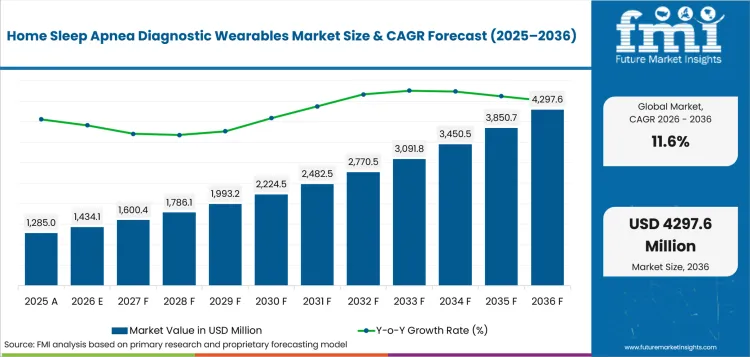
Home Sleep Apnea Diagnostic Wearables Market Overview: Size and Forecast
- 2025 (base history): USD 1,285.0 million
- 2026 (current): USD 1,434.1 million
- 2036 (forecast): USD 4,297.6 million
- CAGR (2026–2036): 11.6%
- Leading Product Type: Wearable
- Wearable Share in 2026: 66.4%
- Leading Application: Diagnosis
- Diagnosis Share in 2026: 62.0%
- Fastest-growing Country: India (14.0% CAGR through 2036)
NICE recommended selected home-testing devices as options to diagnose and assess OSAHS severity in people aged 16 years and older, while FDA’s 2025 clearance record for Onera Sleep Test System 2 describes five sensors used for professionally directed sleep studies.
For buyers, the value is practical: easier patient setup, cleaner report quality, and physician review that helps route patients toward CPAP, oral appliance, or specialist follow-up without adding avoidable lab-night pressure.
Summary of the Home Sleep Apnea Diagnostic Wearables Market
- Market Overview
- Home sleep apnea diagnostic wearables are moving from convenience-led home testing into clinically reviewed workflows that connect screening, diagnosis, and treatment routing.
- Demand and Growth Drivers
- Sleep clinics are shifting selected testing toward patient-applied home systems that reduce lab-night pressure and support faster triage.
- Payers are giving more attention to devices that produce physician-ready reports before CPAP or oral appliance referral.
- Consumer wearable alerts are increasing patient entry into clinical pathways while prescribed diagnostic tests remain central.
- Product and Segment View
- Wearable is forecast to represent 66.4% share in 2026, led by easier setup and fewer contact points during home sleep testing.
- Diagnosis is projected to hold 62.0% share in 2026, influenced by clinical review and therapy-routing requirements.
- Home care is expected to secure 58.0% share in 2026, supported by mailed kits, remote onboarding, and reduced patient travel.
- Geography and Competitive Outlook
- India is projected to record 14.0% CAGR by 2036, backed by mobile-first healthcare access and under-tested patient pools.
- China is expected to expand at 13.2% CAGR by 2036 through connected health platforms and urban sleep-clinic expansion.
- ZOLL Itamar, ResMed, Onera Health, Huxley Medical, and Acurable compete through clinical home-testing systems.
- Analyst Opinion
- Anurag Sharma, Principal Consultant - Healthcare at Future Market Insights, observes, “Home sleep apnea diagnostic wearables are now moving beyond simple sensor capture. Screening alerts create patient entry, wearable home tests create clinical evidence, and specialists decide the therapy pathway. Suppliers treating workflow, validation, and reporting as part of the product should gain stronger buyer confidence.”
Why is the home sleep apnea diagnostic wearables market growing?
Sleep clinics are moving testing closer to patients as home devices reduce travel, scheduling pressure, and lab-night bottlenecks.
- Home testing gives clinics a practical capacity tool when selected patients can complete guided overnight recording outside the laboratory.
- Patient-applied wearables reduce setup burden while preserving physician review for apnea severity, signal quality, and treatment routing.
- Access gaps and diagnostic backlogs support demand for devices that combine comfort, report quality, and workflow integration.
A NICE resource-impact assessment, using Sleep Apnoea Trust estimates, reported that 8,440,000 people aged 16 years and older in England have OSAHS, including 7,596,000 who remain undiagnosed. That gap makes diagnostic access a workflow issue, not only a device issue. Wearable home kits answer this need by reducing clinic visits, simplifying overnight recording, and helping specialists review outputs before CPAP, oral appliance, or further referral decisions.
How is the home sleep apnea diagnostic wearables market segmented?
The market is segmented by product type, care setting, application, end user, and connectivity model.
- Wearable products lead because wrist, ring, patch, and chin formats reduce setup burden for patients.
- Home care leads as mailed kits, remote onboarding, and app upload reduce dependence on sleep-lab scheduling.
- Diagnosis leads because physician-reviewed outputs support CPAP, oral appliance, and specialist referral decisions.
Why do wearable products dominate the home sleep apnea diagnostic wearables market?
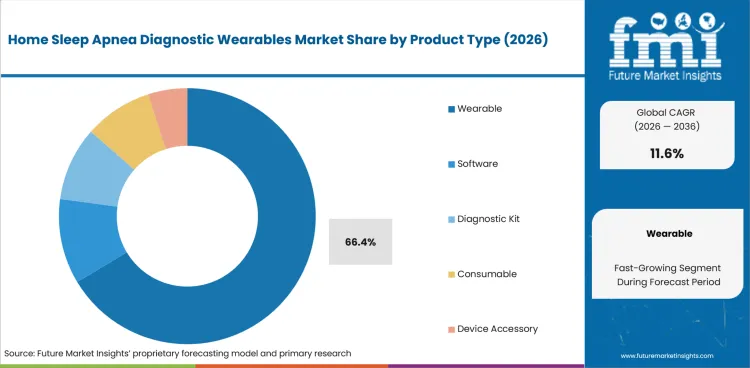
- Wearable is projected to account for 66.4% share in 2026, influenced by patient comfort, self-application, and lower setup burden.
- Diagnostic kits gain use when packaged sensor systems support physician review while keeping test completion outside laboratories.
Which care setting leads the home sleep apnea diagnostic wearables market?
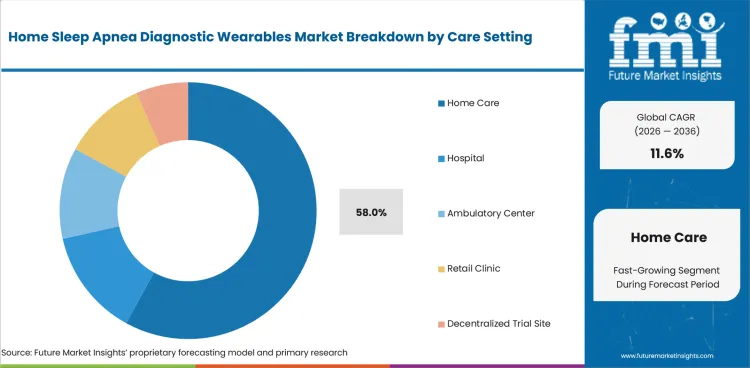
- Home care is anticipated to hold 58.0% share in 2026 through mailed kits, remote onboarding, and lower scheduling pressure.
- Ambulatory centers gain value when specialists need faster triage without moving every patient into overnight polysomnography.
Which application leads the home sleep apnea diagnostic wearables market?
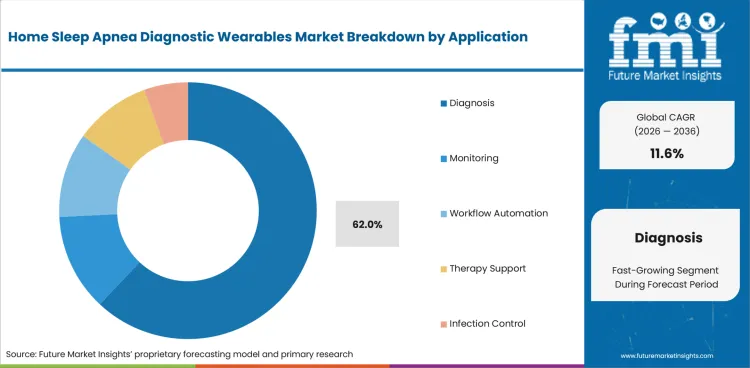
- Diagnosis is forecast to secure 62.0% share in 2026 through clinical severity outputs that support therapy routing.
- Monitoring gains importance when patients need follow-up assessment after therapy start or after changes in risk status.
Which end user leads the home sleep apnea diagnostic wearables market?
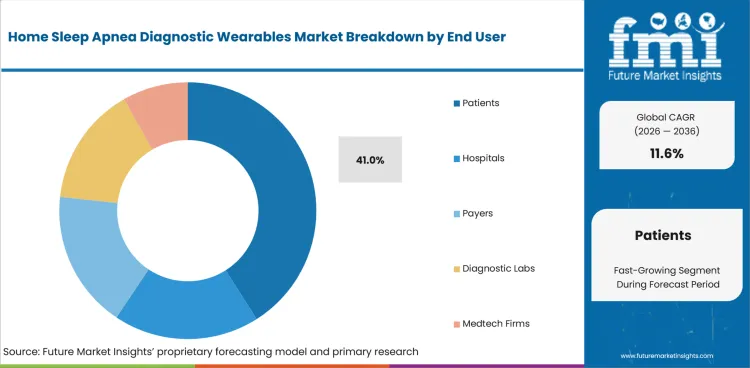
- Patients are expected to represent 41.0% share in 2026 through direct use of prescribed kits within guided home workflows.
- Diagnostic labs retain influence by supporting scoring, report validation, and physician-facing sleep study interpretation.
Which connectivity model leads the home sleep apnea diagnostic wearables market?
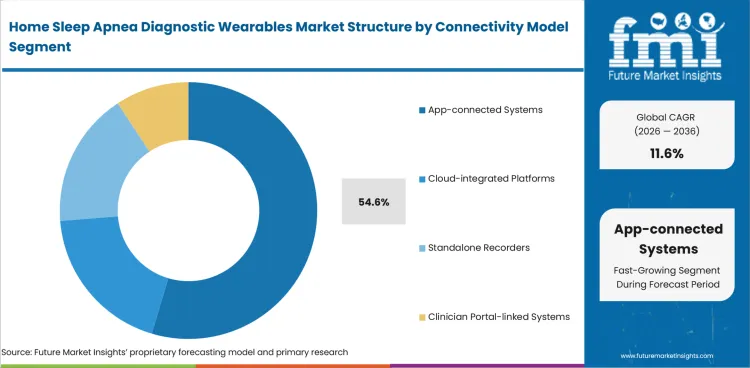
- App-connected systems are projected to hold 54.6% share in 2026, shaped by guided setup and remote upload.
- Cloud-integrated platforms gain traction as clinics need centralized scoring and standardized reporting across distributed testing programs.
What are the drivers, restraints, and opportunities in the home sleep apnea diagnostic wearables market?
Home diagnostic workflow demand supports growth while regulatory claim limits shape how suppliers position screening and diagnosis.
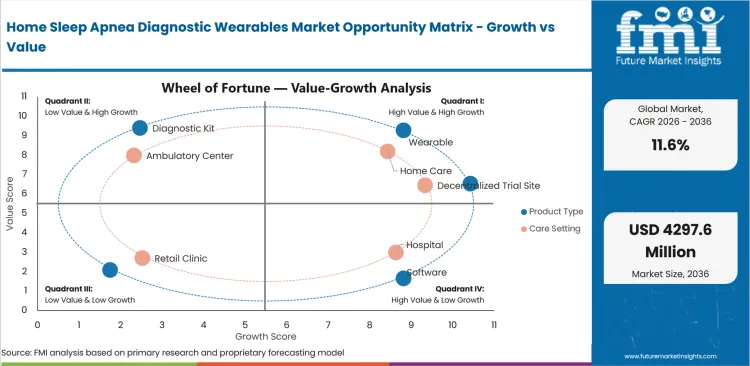
Market dynamics are shaped by clinic capacity pressure, the need for patient-friendly overnight testing, and clearer boundaries between wellness alerts, screening, and prescribed diagnostic workflows.
- Driver: Sleep clinics need patient-applied systems that reduce laboratory bottlenecks and lower repeat-test risk.
- Restraint: Consumer alert tools can create confusion when patients mistake risk notifications for formal diagnosis.
- Opportunity: Multi-parameter wearable patches can deliver richer sleep data without requiring full laboratory attendance.
FDA material for Huxley Medical’s SANSA Cellular states that the device can be worn for up to 10 hours while recording oxygen saturation, respiratory effort, sleep staging, snoring, body position, and actigraphy. This gives buyers a practical reason to value self-applied patch systems.
FDA’s 2025 Onera Sleep Test System 2 clearance describes a wearable system with five sensors designed for sleep studies under professional direction. The opportunity is strongest for suppliers that combine sensor accuracy, workflow support, and report delivery.
Which factors support expansion in the home sleep apnea diagnostic wearables market?
Physician-reviewed home testing and patient-applied sensors support expansion across clinical sleep-care channels.
- Diagnostic wearable revenue builds before software scoring and service logistics add incremental value.
- Supplier pricing reflects sensor accuracy and workflow support before consumables affect repeat revenue.
- Revenue improves as clinics transfer selected sleep apnea assessment from lab nights into home care pathways.
Which countries are growing fastest in the home sleep apnea diagnostic wearables market?
India 14.0%, China 13.2%, Japan 12.8%, South Korea 12.6%, and United Kingdom 12.4% are the fastest-growing country markets through 2036.
.webp "Top Country Growth Comparison Home Sleep Apnea Diagnostic Wearables Market Cagr (2026 2036)")
| Country | CAGR |
|---|---|
| India | 14.0% |
| China | 13.2% |
| Japan | 12.8% |
| South Korea | 12.6% |
| United Kingdom | 12.4% |
Source: Future Market Insights, 2026.
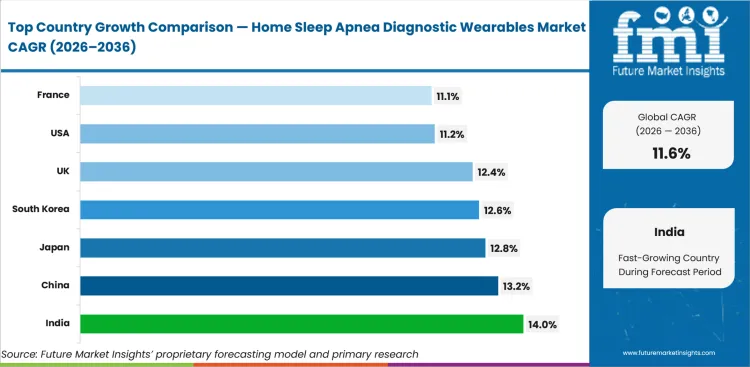
How do country-level CAGRs compare in the home sleep apnea diagnostic wearables market?
- India leads at 14.0% CAGR as mobile-first access supports wider home testing.
- China follows at 13.2% CAGR through connected platforms and urban clinical networks.
- Japan records 12.8% CAGR as aging-related sleep-risk awareness supports clinical-device use.
- South Korea posts 12.6% CAGR through wearable familiarity and hospital digital readiness.
- The United Kingdom reaches 12.4% CAGR as NICE-backed home testing supports NHS pathway interest.
The global market is forecast to grow at 11.6% CAGR, while the broader study still covers regional and country markets beyond these five fastest-growth profiles.
How fast is the home sleep apnea diagnostic wearables market growing in India?
A 14.0% CAGR through 2036 reflects mobile-first healthcare access and widening private sleep-clinic demand.
Country Market Snapshot Table
| Parameter | Value |
|---|---|
| Market Size in 2025 (Value) | USD 30.7 million |
| Market Size in 2026 (Value) | USD 35.0 million |
| Market Forecast in 2036 (Value) | USD 129.7 million |
| CAGR (2026 to 2036) | 14.0% |
| Years Considered | 2021 to 2036 |
| Base Year | 2025 |
| Forecast Period | 2026 to 2036 |
| Units Considered | Value (USD million) |
| Leading Sub-Region | Mumbai, Delhi NCR, Bengaluru, and Hyderabad private sleep corridors |
Market Outlook
India demand is influenced by under-tested patient pools, mobile-first healthcare access, and private sleep-clinic expansion. Suppliers that combine simple setup, app-led report delivery, local distributor support, and clinician interpretation should gain stronger early adoption.
Key Growth Drivers
- Mobile-first access gives wearable sleep tests a practical setup channel.
- Large internet subscriber scale supports remote onboarding and report exchange.
- Private hospitals and specialist clinics are widening diagnostic reach beyond major laboratories.
- ABDM-linked digital pathways can support follow-up and referral workflows.
Key Restraints
- Rural access gaps can limit connected device use.
- Out-of-pocket payment can slow adoption when kits are not bundled with care pathways.
- Clinician review capacity may constrain rapid test-volume expansion.
What is the home sleep apnea diagnostic wearables market outlook in China?
The 13.2% CAGR through 2036 is supported by connected health platforms and large urban clinical networks.
Country Market Snapshot Table
| Parameter | Value |
|---|---|
| Market Size in 2025 (Value) | USD 115.3 million |
| Market Size in 2026 (Value) | USD 130.5 million |
| Market Forecast in 2036 (Value) | USD 451.5 million |
| CAGR (2026 to 2036) | 13.2% |
| Years Considered | 2021 to 2036 |
| Base Year | 2025 |
| Forecast Period | 2026 to 2036 |
| Units Considered | Value (USD million) |
| Leading Sub-Region | Beijing, Shanghai, and Greater Bay Area clinical corridors |
Market Outlook
China demand is shaped by urban sleep clinics, connected health platforms, and private hospital networks. Domestic connected-device makers may compete in screening and entry-level triage, while imported diagnostic systems remain stronger in specialist workflows.
Key Growth Drivers
- Connected healthcare access is supported by large internet-user scale.
- Urban clinical density supports faster adoption in major hospital corridors.
- Private hospital networks can route patients into home diagnostic workflows.
- Sleep-risk awareness is increasing demand for earlier testing and specialist review.
Key Restraints
- Aging-related complexity can increase specialist review needs.
- Cloud-connected diagnostic systems face data governance and regulatory review requirements.
- Price pressure can limit premium imported-system adoption outside major cities.
What is driving home sleep apnea diagnostic wearables growth in Japan?
The 12.8% CAGR through 2036 reflects aging-related sleep-risk awareness and strong clinical-device acceptance.
Country Market Snapshot Table
| Parameter | Value |
|---|---|
| Market Size in 2025 (Value) | USD 65.6 million |
| Market Size in 2026 (Value) | USD 74.0 million |
| Market Forecast in 2036 (Value) | USD 247.0 million |
| CAGR (2026 to 2036) | 12.8% |
| Years Considered | 2021 to 2036 |
| Base Year | 2025 |
| Forecast Period | 2026 to 2036 |
| Units Considered | Value (USD million) |
| Leading Sub-Region | Tokyo and Osaka clinical technology corridors |
Market Outlook
Japan demand is supported by aging-related diagnostic needs, specialist sleep-care capacity, and acceptance of clinically validated devices. Compact wearable systems can reduce patient burden while keeping physician interpretation central to treatment routing.
Key Growth Drivers
- Aging demographics increase sleep-disorder screening and diagnostic demand.
- Clinically validated home systems fit physician-led care pathways.
- Compact sensors reduce patient setup burden for overnight testing.
- Hospital and specialist networks support structured interpretation and referral.
Key Restraints
- Clinical validation expectations can slow entry for less-proven systems.
- Workflow conservatism can limit rapid switching from established testing models.
- Premium device pricing may require stronger evidence before broad adoption.
How is the home sleep apnea diagnostic wearables market performing in South Korea?
The 12.6% CAGR through 2036 reflects wearable familiarity and hospital digital readiness.
Country Market Snapshot Table
| Parameter | Value |
|---|---|
| Market Size in 2025 (Value) | USD 48.0 million |
| Market Size in 2026 (Value) | USD 54.0 million |
| Market Forecast in 2036 (Value) | USD 177.0 million |
| CAGR (2026 to 2036) | 12.6% |
| Years Considered | 2021 to 2036 |
| Base Year | 2025 |
| Forecast Period | 2026 to 2036 |
| Units Considered | Value (USD million) |
| Leading Sub-Region | Seoul Capital Area and Busan clinical networks |
Market Outlook
South Korea demand benefits from connected-care familiarity, hospital technology networks, and patient comfort with app-led health tools. Home testing can support faster triage when reports remain connected to specialist interpretation.
Key Growth Drivers
- Wearable familiarity supports acceptance of patient-applied sleep sensors.
- Hospital technology networks can integrate sleep reports into specialist workflows.
- Connected-care readiness supports app upload and clinician-portal review.
- Urban provider density enables faster adoption of guided home testing.
Key Restraints
- Clinical buyers still need strong evidence for diagnostic claims.
- Data integration requirements can slow workflow deployment.
- Kit logistics and clinician reporting capacity can limit scale-up speed.
How is the home sleep apnea diagnostic wearables market performing in the United Kingdom?
The 12.4% CAGR through 2036 reflects NICE-backed home testing and NHS pathway interest.
Country Market Snapshot Table
| Parameter | Value |
|---|---|
| Market Size in 2025 (Value) | USD 86.3 million |
| Market Size in 2026 (Value) | USD 97.0 million |
| Market Forecast in 2036 (Value) | USD 313.3 million |
| CAGR (2026 to 2036) | 12.4% |
| Years Considered | 2021 to 2036 |
| Base Year | 2025 |
| Forecast Period | 2026 to 2036 |
| Units Considered | Value (USD million) |
| Leading Sub-Region | England respiratory service networks |
Market Outlook
United Kingdom demand is supported by NICE-backed home-testing options, NHS diagnostic backlog pressure, and respiratory service interest in structured home pathways. Suppliers need evidence, implementation support, and clear report quality.
Key Growth Drivers
- NICE-backed home-testing options support clinical acceptance.
- Respiratory service backlogs increase interest in patient-applied tests.
- NHS pathways can use home testing to reduce lab-night pressure.
- Clinician-reviewed reports support therapy routing and documentation.
Key Restraints
- NHS buyers require local service evidence before large-volume switching.
- Procurement and implementation timelines can slow adoption.
- Kit logistics and clinician reporting capacity can constrain rollout.
Who are the leading companies in the home sleep apnea diagnostic wearables market?
ZOLL Itamar, ResMed, Onera Health, Huxley Medical, and Acurable lead the prescribed diagnostic revenue opportunity.
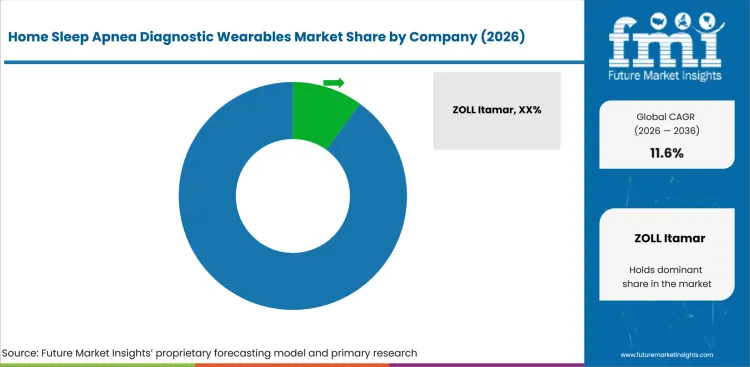
Established sleep diagnostic companies hold an advantage through clinical evidence, payer familiarity, and specialist channel access. Wearable home-testing specialists gain attention by reducing patient setup burden and repeat recording risk.
Competition is shifting toward workflow control as clinics need onboarding, recording quality checks, scoring, report delivery, and physician review in one service path.
Who are the key players in the home sleep apnea diagnostic wearables market?
ZOLL Itamar, ResMed, Onera Health, Huxley Medical, and Acurable are the core diagnostic players in this market.
Apple and Samsung influence screening and referral behavior, but prescribed diagnostic revenue remains concentrated around clinical home-testing suppliers.
- ZOLL Itamar and ResMed benefit from established sleep-care relationships and diagnostic credibility.
- Onera Health and Huxley Medical compete through patch-based systems and clinical data generation.
- Acurable strengthens the specialist wearable-testing field with clinically positioned home assessment tools.
How do top home sleep apnea diagnostic wearables companies compare?
ZOLL Itamar and ResMed score strongest on channel depth, while Onera Health, Huxley Medical, and Acurable push newer wearable formats.
| Company | Market Role | Diagnostic Evidence | Workflow Strength | Geographic Reach |
|---|---|---|---|---|
| ZOLL Itamar | Core prescribed diagnostic leader | Very strong | Very strong | Global |
| ResMed | Core sleep-care channel leader | Very strong | Strong | Global |
| Onera Health | Patch-based home polysomnography specialist | Strong | Strong | Europe and North America |
| Huxley Medical | Patch-based HSAT innovator | Strong | Moderate to strong | United States-led |
| Acurable | Wearable home-testing specialist | Strong | Strong | United Kingdom and Europe |
Key Developments in the Home Sleep Apnea Diagnostic Wearables Market
- In January 2025, Onera Health announced a landmark clinical study validating respiratory outcomes for its patch-based home polysomnography system.
- In June 2025, Samsung expanded availability of its sleep apnea feature across European markets after CE marking certification.
- In June 2025, Onera Health presented new clinical data for its patient-applied patch-based home polysomnography solution at SLEEP 2025.
Key Players in the Home Sleep Apnea Diagnostic Wearables Market
- ZOLL Itamar
- ResMed
- Onera Health
- Huxley Medical
- Acurable
Market Scope & Definition
| Scope Area | Definition |
|---|---|
| Market Definition | Clinically positioned wearable and wearable-adjacent systems used for home sleep apnea screening support, diagnostic testing, physician review, and treatment-routing workflows. |
| Functions Covered | Sensor recording, app-guided setup, cloud upload, scoring support, clinician-portal review, and report delivery. |
| Applications Covered | Diagnosis, monitoring, workflow automation, and therapy-support pathways linked to sleep apnea care. |
| End-Use Industries | Patients, hospitals, diagnostic laboratories, sleep clinics, home-care providers, and clinical buyer organizations. |
| Inclusions | Wrist, ring, patch, chin/chest sensor, diagnostic kit, software/scoring, consumables, and device accessories used in eligible clinical workflows. |
| Exclusions | Wellness-only trackers, informal sleep-risk alerts without diagnostic workflow, and products not positioned for sleep apnea assessment. |
Research Methodology
| Methodology Area | Approach |
|---|---|
| Primary Research | Interviews with sleep-care stakeholders, device suppliers, clinicians, channel partners, and implementation specialists. |
| Desk Research | Review of FDA, NICE, CMS, national statistics, company releases, clinical resources, and public health datasets. |
| Market Sizing and Forecasting | Bottom-up eligible-revenue modelling by device type, care setting, application, end user, connectivity model, and country. |
| Data Validation | Triangulation across source evidence, country adoption signals, clinical pathway fit, and company-positioning checks. |
What does the report cover?
The report covers 2021–2025 history, 2026 base estimates, and 2026–2036 forecasts across product, care-setting, application, end-user, connectivity, regional, country, and company dimensions.
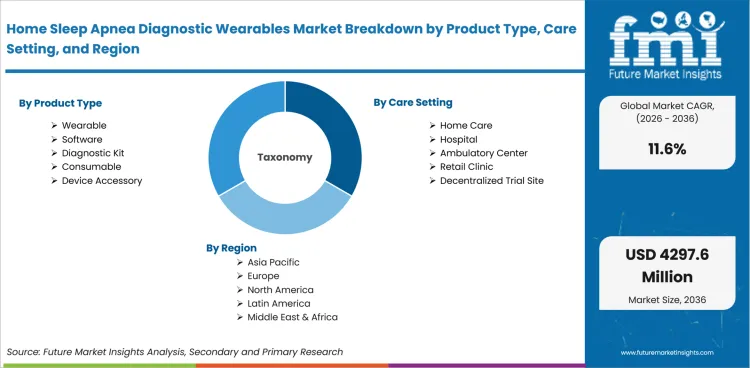
| Coverage Item | Detail |
|---|---|
| Historical Period | 2021 to 2025 |
| Base Year | 2025 |
| Forecast Period | 2026 to 2036 |
| Units | Value in USD million and CAGR |
| Segment Axes | Product type, care setting, application, end user, connectivity model, and region |
| Regions | North America, Latin America, Europe, East Asia, South Asia and Pacific, Middle East and Africa |
| Countries | India, China, Japan, South Korea, and United Kingdom are profiled for fastest-growth comparison |
| Companies | ZOLL Itamar, ResMed, Onera Health, Huxley Medical, and Acurable, with screening/referral ecosystem context where relevant |
| Approach | Bottom-up product-boundary approach using eligible device revenue, test revenue, software fees, channel presence, clinical positioning, and country-level adoption |
Market Segmentation Analysis
Segmented by Product Type
- Wearable systems
- Wrist, ring, patch, chin sensor, and chest sensor formats used for patient-applied home sleep apnea assessment.
- Clinical wearable systems remain separate from wellness-only trackers when the device is not positioned for diagnostic workflow support.
- Diagnostic kits
- Packaged home sleep apnea testing kits that combine sensors, instructions, upload paths, and physician-review support.
- Software, consumables, and accessories
- Software/scoring tools, device accessories, and consumables that support repeat testing, report quality, and clinical documentation.
Segmented by Care Setting
- Home care
- Mailed kits, remote onboarding, app-guided setup, and patient-applied overnight testing outside the sleep laboratory.
- Clinical settings
- Hospitals, sleep clinics, diagnostic labs, and ambulatory centers that prescribe, score, interpret, or route home testing outputs.
- Retail clinic access
- Entry pathways that support screening referral or test distribution when linked to clinician-reviewed diagnostic workflows.
Segmented by Application
- Diagnosis
- Physician-reviewed outputs used to assess apnea severity, signal quality, recording duration, and therapy-routing needs.
- Monitoring and therapy support
- Follow-up assessment after therapy start, risk-status changes, or repeat testing when clinically appropriate.
- Workflow automation
- Onboarding, upload, scoring support, report delivery, and clinician-portal workflows that reduce administrative burden.
Segmented by End User
- Patients
- Users of prescribed or guided home testing kits who apply sensors and complete overnight recording at home.
- Clinical providers
- Hospitals, sleep clinics, diagnostic labs, and home-care providers that manage test distribution, scoring, reporting, and follow-up.
- Stakeholders and buyers
- Payers and medtech firms may influence purchasing, reimbursement, or channel strategy, but they are not patient-facing end users.
Segmented by Connectivity Model
- App-connected systems
- Mobile setup, guided instructions, patient prompts, and upload workflows that reduce test failure risk.
- Cloud-integrated platforms
- Centralized scoring, remote review, multi-site report access, and standardized documentation for distributed testing programs.
- Standalone and clinician-portal-linked systems
- Recorders and portals used when clinics need controlled data transfer, report review, or local workflow integration.
By Region
- North America
- Latin America
- Europe
- East Asia
- South Asia and Pacific
- Middle East and Africa
Research Sources and Bibliography
- Centers for Medicare & Medicaid Services. (2024). Polysomnography and sleep testing article A57496. CMS Medicare Coverage Database.
- China Internet Network Information Center. (2025, May). The 55th statistical report on China’s Internet development. CNNIC.
- Food and Drug Administration. (2025, January 28). 510(k) summary: Huxley Home Sleep Apnea Test SANSA Cellular, K244027. U.S. Food and Drug Administration.
- Food and Drug Administration. (2025, July 3). 510(k) summary: Onera Sleep Test System 2, K243220. U.S. Food and Drug Administration.
- Ministry of Communications, Government of India. (2025, September 3). Indian telecom services performance indicator report, April-June 2025. Press Information Bureau.
- Ministry of Communications, Government of India. (2025, September 23). Satellite Internet in India. Press Information Bureau.
- Ministry of Health and Family Welfare, Government of India. (2026, May 22). 100 crore health records linked with ABHA under ABDM. Press Information Bureau.
- National Bureau of Statistics of China. (2025, February 28). Statistical communiqué of the People’s Republic of China on the 2024 national economic and social development.
- National Institute for Health and Care Excellence. (2024, December 19). Home-testing devices for diagnosing obstructive sleep apnoea hypopnoea syndrome. NICE.
- NHS England. (2025, October). Diagnostic waiting times and activity report: August 2025. NHS England.
- OECD. (2025, November 13). Health at a glance 2025: OECD indicators. OECD Publishing.
- Onera Health. (2025, January 13). Landmark clinical study validates patch-based Onera home-polysomnography system. Onera Health.
- Onera Health. (2025, June 4). New clinical data highlights Onera Health’s patch-based home polysomnography solution at SLEEP 2025.
- Samsung Electronics. (2025, June 5). Samsung expands global availability of sleep apnea feature on Galaxy Watch series. Samsung Newsroom.
- Scottish Health Technologies Group. (2026, June 9). Home-testing devices for diagnosing obstructive sleep apnoea/hypopnoea syndrome. SHTG.
- Statistics Bureau of Japan. (2025). Current population estimates as of October 1, 2024. Statistics Bureau of Japan.
This bibliography is provided for reader reference and is not exhaustive. The full report contains the complete reference list and detailed citations.
This Report Answers
- Market size estimates for 2026 and forecasts through 2036 for the home sleep apnea diagnostic wearables market.
- Segment analysis by product type, care setting, application, end user, connectivity model, and region.
- Country growth comparison for India, China, Japan, South Korea, and the United Kingdom.
- Competitive analysis of core diagnostic companies and clinically positioned wearable home-testing suppliers.
- Review of regulatory claim boundaries, home-testing guidance, and physician-reviewed workflow requirements.
Frequently Asked Questions
How large is the home sleep apnea diagnostic wearables market in 2026?
The market is valued at USD 1,434.1 million in 2026.
What is the forecast value by 2036?
The market is forecast to reach USD 4,297.6 million by 2036.
What CAGR is expected from 2026 to 2036?
The market is expected to expand at an 11.6% CAGR from 2026 to 2036.
Which product type leads the market?
Wearable products lead with a 66.4% share in 2026.
Which country is growing fastest?
India is the fastest-growing profiled country with a 14.0% CAGR through 2036.
Frequently Asked Questions
What is the home sleep apnea diagnostic wearables market size in 2026?
The home sleep apnea diagnostic wearables market size is anticipated to cross USD 1,434.1 million in 2026.
What is the home sleep apnea diagnostic wearables market forecast for 2036?
The home sleep apnea diagnostic wearables industry revenue is predicted to reach USD 4,297.6 million by 2036 as home testing expands.
What is the home sleep apnea diagnostic wearables market CAGR?
The home sleep apnea diagnostic wearables sector is projected to expand at 11.6% CAGR from 2026 to 2036.
What segment leads the home sleep apnea diagnostic wearables market?
Wearable products are likely to capture 66.4% share in 2026 due to easier patient setup and lower recording burden.
What country grows fastest in the home sleep apnea diagnostic wearables market?
India is set to record 14.0% CAGR by 2036, driven by mobile-first healthcare access and private sleep-clinic expansion.
Preview the report firsthand - request a free sample
Get SampleGet the brochure for pricing and purchase details.
Get PDFTable of Content
- Executive Summary
- Global Market Outlook
- Demand-side Trends
- Supply-side Trends
- Technology Roadmap Analysis
- Analysis and Recommendations
- Market Overview
- Market Coverage / Taxonomy
- Market Definition / Scope / Limitations
- Research Methodology
- Chapter Orientation
- Analytical Lens and Working Hypotheses
- Market Structure, Signals, and Trend Drivers
- Benchmarking and Cross-market Comparability
- Market Sizing, Forecasting, and Opportunity Mapping
- Research Design and Evidence Framework
- Desk Research Programme (Secondary Evidence)
- Company Annual and Sustainability Reports
- Peer-reviewed Journals and Academic Literature
- Corporate Websites, Product Literature, and Technical Notes
- Earnings Decks and Investor Briefings
- Statutory Filings and Regulatory Disclosures
- Technical White Papers and Standards Notes
- Trade Journals, Industry Magazines, and Analyst Briefs
- Conference Proceedings, Webinars, and Seminar Materials
- Government Statistics Portals and Public Data Releases
- Press Releases and Reputable Media Coverage
- Specialist Newsletters and Curated Briefings
- Sector Databases and Reference Repositories
- FMI Internal Proprietary Databases and Historical Market Datasets
- Subscription Datasets and Paid Sources
- Social Channels, Communities, and Digital Listening Inputs
- Additional Desk Sources
- Expert Input and Fieldwork (Primary Evidence)
- Primary Modes
- Qualitative Interviews and Expert Elicitation
- Quantitative Surveys and Structured Data Capture
- Blended Approach
- Why Primary Evidence is Used
- Field Techniques
- Interviews
- Surveys
- Focus Groups
- Observational and In-context Research
- Social and Community Interactions
- Stakeholder Universe Engaged
- C-suite Leaders
- Board Members
- Presidents and Vice Presidents
- R&D and Innovation Heads
- Technical Specialists
- Domain Subject-matter Experts
- Scientists
- Physicians and Other Healthcare Professionals
- Governance, Ethics, and Data Stewardship
- Research Ethics
- Data Integrity and Handling
- Primary Modes
- Tooling, Models, and Reference Databases
- Desk Research Programme (Secondary Evidence)
- Data Engineering and Model Build
- Data Acquisition and Ingestion
- Cleaning, Normalisation, and Verification
- Synthesis, Triangulation, and Analysis
- Quality Assurance and Audit Trail
- Market Background
- Market Dynamics
- Drivers
- Restraints
- Opportunity
- Trends
- Scenario Forecast
- Demand in Optimistic Scenario
- Demand in Likely Scenario
- Demand in Conservative Scenario
- Opportunity Map Analysis
- Product Life Cycle Analysis
- Supply Chain Analysis
- Investment Feasibility Matrix
- Value Chain Analysis
- PESTLE and Porter’s Analysis
- Regulatory Landscape
- Regional Parent Market Outlook
- Production and Consumption Statistics
- Import and Export Statistics
- Market Dynamics
- Global Market Analysis 2021 to 2025 and Forecast, 2026 to 2036
- Historical Market Size Value (USD Million) Analysis, 2021 to 2025
- Current and Future Market Size Value (USD Million) Projections, 2026 to 2036
- Year-on-Year Growth Trend Analysis
- Absolute $ Opportunity Analysis
- Global Market Pricing Analysis 2021 to 2025 and Forecast 2026 to 2036
- Global Market Analysis 2021 to 2025 and Forecast 2026 to 2036, By Product Type
- Introduction / Key Findings
- Historical Market Size Value (USD Million) Analysis By Product Type, 2021 to 2025
- Current and Future Market Size Value (USD Million) Analysis and Forecast By Product Type, 2026 to 2036
- Wearable
- Software
- Diagnostic Kit
- Consumable
- Device Accessory
- Wearable
- Year-on-Year Growth Trend Analysis By Product Type, 2021 to 2025
- Absolute $ Opportunity Analysis By Product Type, 2026 to 2036
- Global Market Analysis 2021 to 2025 and Forecast 2026 to 2036, By Care Setting
- Introduction / Key Findings
- Historical Market Size Value (USD Million) Analysis By Care Setting, 2021 to 2025
- Current and Future Market Size Value (USD Million) Analysis and Forecast By Care Setting, 2026 to 2036
- Home Care
- Hospital
- Ambulatory Center
- Retail Clinic
- Home Care
- Home Care
- Year-on-Year Growth Trend Analysis By Care Setting, 2021 to 2025
- Absolute $ Opportunity Analysis By Care Setting, 2026 to 2036
- Global Market Analysis 2021 to 2025 and Forecast 2026 to 2036, By Application
- Introduction / Key Findings
- Historical Market Size Value (USD Million) Analysis By Application, 2021 to 2025
- Current and Future Market Size Value (USD Million) Analysis and Forecast By Application, 2026 to 2036
- Diagnosis
- Monitoring
- Workflow Automation
- Therapy Support
- Workflow Automation
- Diagnosis
- Year-on-Year Growth Trend Analysis By Application, 2021 to 2025
- Absolute $ Opportunity Analysis By Application, 2026 to 2036
- Global Market Analysis 2021 to 2025 and Forecast 2026 to 2036, By End User
- Introduction / Key Findings
- Historical Market Size Value (USD Million) Analysis By End User, 2021 to 2025
- Current and Future Market Size Value (USD Million) Analysis and Forecast By End User, 2026 to 2036
- Patients
- Hospitals
- Payers
- Diagnostic Labs
- Medtech Firms
- Patients
- Year-on-Year Growth Trend Analysis By End User, 2021 to 2025
- Absolute $ Opportunity Analysis By End User, 2026 to 2036
- Global Market Analysis 2021 to 2025 and Forecast 2026 to 2036, By Connectivity Model
- Introduction / Key Findings
- Historical Market Size Value (USD Million) Analysis By Connectivity Model, 2021 to 2025
- Current and Future Market Size Value (USD Million) Analysis and Forecast By Connectivity Model, 2026 to 2036
- App-connected Systems
- Cloud-integrated Platforms
- Standalone Recorders
- Clinician Portal-linked Systems
- App-connected Systems
- Year-on-Year Growth Trend Analysis By Connectivity Model, 2021 to 2025
- Absolute $ Opportunity Analysis By Connectivity Model, 2026 to 2036
- Global Market Analysis 2021 to 2025 and Forecast 2026 to 2036, By Region
- Introduction
- Historical Market Size Value (USD Million) Analysis By Region, 2021 to 2025
- Current Market Size Value (USD Million) Analysis and Forecast By Region, 2026 to 2036
- North America
- Latin America
- Western Europe
- Eastern Europe
- East Asia
- South Asia and Pacific
- Middle East & Africa
- Market Attractiveness Analysis By Region
- North America Market Analysis 2021 to 2025 and Forecast 2026 to 2036, By Country
- Historical Market Size Value (USD Million) Trend Analysis By Market Taxonomy, 2021 to 2025
- Market Size Value (USD Million) Forecast By Market Taxonomy, 2026 to 2036
- By Country
- USA
- Canada
- Mexico
- By Product Type
- By Care Setting
- By Application
- By End User
- By Connectivity Model
- By Country
- Market Attractiveness Analysis
- By Country
- By Product Type
- By Care Setting
- By Application
- By End User
- By Connectivity Model
- Key Takeaways
- Latin America Market Analysis 2021 to 2025 and Forecast 2026 to 2036, By Country
- Historical Market Size Value (USD Million) Trend Analysis By Market Taxonomy, 2021 to 2025
- Market Size Value (USD Million) Forecast By Market Taxonomy, 2026 to 2036
- By Country
- Brazil
- Chile
- Rest of Latin America
- By Product Type
- By Care Setting
- By Application
- By End User
- By Connectivity Model
- By Country
- Market Attractiveness Analysis
- By Country
- By Product Type
- By Care Setting
- By Application
- By End User
- By Connectivity Model
- Key Takeaways
- Western Europe Market Analysis 2021 to 2025 and Forecast 2026 to 2036, By Country
- Historical Market Size Value (USD Million) Trend Analysis By Market Taxonomy, 2021 to 2025
- Market Size Value (USD Million) Forecast By Market Taxonomy, 2026 to 2036
- By Country
- Germany
- UK
- Italy
- Spain
- France
- Nordic
- BENELUX
- Rest of Western Europe
- By Product Type
- By Care Setting
- By Application
- By End User
- By Connectivity Model
- By Country
- Market Attractiveness Analysis
- By Country
- By Product Type
- By Care Setting
- By Application
- By End User
- By Connectivity Model
- Key Takeaways
- Eastern Europe Market Analysis 2021 to 2025 and Forecast 2026 to 2036, By Country
- Historical Market Size Value (USD Million) Trend Analysis By Market Taxonomy, 2021 to 2025
- Market Size Value (USD Million) Forecast By Market Taxonomy, 2026 to 2036
- By Country
- Russia
- Poland
- Hungary
- Balkan & Baltic
- Rest of Eastern Europe
- By Product Type
- By Care Setting
- By Application
- By End User
- By Connectivity Model
- By Country
- Market Attractiveness Analysis
- By Country
- By Product Type
- By Care Setting
- By Application
- By End User
- By Connectivity Model
- Key Takeaways
- East Asia Market Analysis 2021 to 2025 and Forecast 2026 to 2036, By Country
- Historical Market Size Value (USD Million) Trend Analysis By Market Taxonomy, 2021 to 2025
- Market Size Value (USD Million) Forecast By Market Taxonomy, 2026 to 2036
- By Country
- China
- Japan
- South Korea
- By Product Type
- By Care Setting
- By Application
- By End User
- By Connectivity Model
- By Country
- Market Attractiveness Analysis
- By Country
- By Product Type
- By Care Setting
- By Application
- By End User
- By Connectivity Model
- Key Takeaways
- South Asia and Pacific Market Analysis 2021 to 2025 and Forecast 2026 to 2036, By Country
- Historical Market Size Value (USD Million) Trend Analysis By Market Taxonomy, 2021 to 2025
- Market Size Value (USD Million) Forecast By Market Taxonomy, 2026 to 2036
- By Country
- India
- ASEAN
- Australia & New Zealand
- Rest of South Asia and Pacific
- By Product Type
- By Care Setting
- By Application
- By End User
- By Connectivity Model
- By Country
- Market Attractiveness Analysis
- By Country
- By Product Type
- By Care Setting
- By Application
- By End User
- By Connectivity Model
- Key Takeaways
- Middle East & Africa Market Analysis 2021 to 2025 and Forecast 2026 to 2036, By Country
- Historical Market Size Value (USD Million) Trend Analysis By Market Taxonomy, 2021 to 2025
- Market Size Value (USD Million) Forecast By Market Taxonomy, 2026 to 2036
- By Country
- Kingdom of Saudi Arabia
- Other GCC Countries
- Turkiye
- South Africa
- Other African Union
- Rest of Middle East & Africa
- By Product Type
- By Care Setting
- By Application
- By End User
- By Connectivity Model
- By Country
- Market Attractiveness Analysis
- By Country
- By Product Type
- By Care Setting
- By Application
- By End User
- By Connectivity Model
- Key Takeaways
- Key Countries Market Analysis
- USA
- Pricing Analysis
- Market Share Analysis, 2025
- By Product Type
- By Care Setting
- By Application
- By End User
- By Connectivity Model
- Canada
- Pricing Analysis
- Market Share Analysis, 2025
- By Product Type
- By Care Setting
- By Application
- By End User
- By Connectivity Model
- Mexico
- Pricing Analysis
- Market Share Analysis, 2025
- By Product Type
- By Care Setting
- By Application
- By End User
- By Connectivity Model
- Brazil
- Pricing Analysis
- Market Share Analysis, 2025
- By Product Type
- By Care Setting
- By Application
- By End User
- By Connectivity Model
- Chile
- Pricing Analysis
- Market Share Analysis, 2025
- By Product Type
- By Care Setting
- By Application
- By End User
- By Connectivity Model
- Germany
- Pricing Analysis
- Market Share Analysis, 2025
- By Product Type
- By Care Setting
- By Application
- By End User
- By Connectivity Model
- UK
- Pricing Analysis
- Market Share Analysis, 2025
- By Product Type
- By Care Setting
- By Application
- By End User
- By Connectivity Model
- Italy
- Pricing Analysis
- Market Share Analysis, 2025
- By Product Type
- By Care Setting
- By Application
- By End User
- By Connectivity Model
- Spain
- Pricing Analysis
- Market Share Analysis, 2025
- By Product Type
- By Care Setting
- By Application
- By End User
- By Connectivity Model
- France
- Pricing Analysis
- Market Share Analysis, 2025
- By Product Type
- By Care Setting
- By Application
- By End User
- By Connectivity Model
- India
- Pricing Analysis
- Market Share Analysis, 2025
- By Product Type
- By Care Setting
- By Application
- By End User
- By Connectivity Model
- ASEAN
- Pricing Analysis
- Market Share Analysis, 2025
- By Product Type
- By Care Setting
- By Application
- By End User
- By Connectivity Model
- Australia & New Zealand
- Pricing Analysis
- Market Share Analysis, 2025
- By Product Type
- By Care Setting
- By Application
- By End User
- By Connectivity Model
- China
- Pricing Analysis
- Market Share Analysis, 2025
- By Product Type
- By Care Setting
- By Application
- By End User
- By Connectivity Model
- Japan
- Pricing Analysis
- Market Share Analysis, 2025
- By Product Type
- By Care Setting
- By Application
- By End User
- By Connectivity Model
- South Korea
- Pricing Analysis
- Market Share Analysis, 2025
- By Product Type
- By Care Setting
- By Application
- By End User
- By Connectivity Model
- Russia
- Pricing Analysis
- Market Share Analysis, 2025
- By Product Type
- By Care Setting
- By Application
- By End User
- By Connectivity Model
- Poland
- Pricing Analysis
- Market Share Analysis, 2025
- By Product Type
- By Care Setting
- By Application
- By End User
- By Connectivity Model
- Hungary
- Pricing Analysis
- Market Share Analysis, 2025
- By Product Type
- By Care Setting
- By Application
- By End User
- By Connectivity Model
- Kingdom of Saudi Arabia
- Pricing Analysis
- Market Share Analysis, 2025
- By Product Type
- By Care Setting
- By Application
- By End User
- By Connectivity Model
- Turkiye
- Pricing Analysis
- Market Share Analysis, 2025
- By Product Type
- By Care Setting
- By Application
- By End User
- By Connectivity Model
- South Africa
- Pricing Analysis
- Market Share Analysis, 2025
- By Product Type
- By Care Setting
- By Application
- By End User
- By Connectivity Model
- USA
- Market Structure Analysis
- Competition Dashboard
- Competition Benchmarking
- Market Share Analysis of Top Players
- By Regional
- By Product Type
- By Care Setting
- By Application
- By End User
- By Connectivity Model
- Competition Analysis
- Competition Deep Dive
- ZOLL Itamar
- Overview
- Product Portfolio
- Profitability by Market Segments (Product Type/Care Setting/Application/End User/Connectivity Model/Region)
- Sales Footprint
- Strategy Overview
- Marketing Strategy
- Product Strategy
- Channel Strategy
- ResMed
- Onera Health
- Huxley Medical
- Acurable
- Sunrise
- Belun Technology
- Samsung Electronics
- Apple
- ZOLL Itamar
- Competition Deep Dive
- Assumptions & Acronyms Used


