

- Industry Size (2026)
- USD 1.1 Bn
- Forecast (2036)
- USD 2.8 Bn
- CAGR (2026 to 2036)
- 10.10%
Infant Sleep Monitor Market Forecast and Outlook 2026 to 2036
The infant sleep monitor market is valued at USD 1.1 billion in 2026 and is projected to reach USD 2.8 billion by 2036, growing at a CAGR of 10.1% over the forecast period. Between 2026 and 2036, value creation in this market is driven less by unit volume expansion and more by control over technology layers that influence pricing and margins. Hardware components such as motion sensors, cameras, and connectivity modules are gradually commoditizing, limiting margin upside for device-only players.
In contrast, companies that own data analytics, sleep interpretation algorithms, and alert logic retain stronger pricing leverage by positioning products as ongoing monitoring solutions rather than one-time purchases. Subscription models tied to sleep insights, historical trend analysis, and premium alerts concentrate margins with platform-led brands. Cost efficiency improves for firms with scale in manufacturing and software reuse across product generations, while smaller vendors face margin pressure from rising customer acquisition and compliance costs. Over the forecast period, value increasingly accrues to companies that combine reliable overnight performance with trusted data interpretation and recurring digital engagement.
Quick Stats for Infant Sleep Monitor Market
- Infant Sleep Monitor Market Value (2026): USD 1.1 Billion
- Infant Sleep Monitor Market Forecast Value (2036): USD 2.8 Billion
- Infant Sleep Monitor Market Forecast CAGR 2026 to 2036: 10.10%
- Leading Product Type in Infant Sleep Monitor Market: Wearable Sleep Socks or Bands
- Leading Sales Channel in Infant Sleep Monitor Market: Online D2C
- Key Growth Regions in Infant Sleep Monitor Market: Asia Pacific, North America, Middle East & Africa
- Top Key Players in Infant Sleep Monitor Market: Owlet, Nanit, Withings, Philips, Motorola Mobility (Hubble), VTech, Samsung, iBaby Labs, Bebcare, Snuza

Infant Sleep Monitor Market Key Takeaways
| Metric | Value |
|---|---|
| Industry Value (2026) | USD 1.1 Billion |
| Forecast Value (2036) | USD 2.8 Billion |
| Forecast CAGR 2026 to 2036 | 10.10% |
Source: FMI analysis based on primary research and proprietary forecasting model
How Is the Global Infant Sleep Monitor Market Advancing?
The global infant sleep monitor market is advancing steadily, driven by growing awareness among parents and caregivers regarding infant sleep quality and nighttime safety. Infant sleep monitors are increasingly used to track sleep patterns, breathing movement, and physiological indicators that help caregivers understand sleep behavior and identify potential irregularities during rest periods. These devices are deployed across both hospital and home care environments, supporting continuous observation without disrupting infant sleep.
A key driver supporting market growth is the rising demand for home-based infant monitoring solutions that provide real-time insights and alerts. Parents are increasingly adopting wearable and contactless sleep monitoring devices that integrate with mobile applications, allowing remote monitoring and immediate notifications during sleep disturbances. This demand is reinforced by increasing reliance on digital health tools and smart nursery ecosystems that enhance caregiver confidence and peace of mind.
Technological advancements are further strengthening market adoption. Improvements in motion sensing, biosignal detection, and data analytics are enhancing monitoring accuracy while reducing false alerts. Enhanced connectivity and integration with smartphones and smart home systems are improving usability and data accessibility. As infant care continues to incorporate connected health monitoring solutions focused on comfort and continuous insight, the infant sleep monitor market is expected to experience sustained growth over the forecast period.
What Is the Segment-Wise Overview of the Infant Sleep Monitor Market?
The infant sleep monitor market is shaped by rising parental demand for continuous at-home monitoring and strong growth in digital-first purchasing channels. Wearable sleep socks or bands lead the product type segment with a 46% share, as they enable real-time tracking of sleep patterns, movement, and key physiological indicators while remaining comfortable and non-intrusive for infants. These devices are widely adopted for overnight monitoring and caregiver reassurance. On the sales channel side, online D2C platforms account for 52% of demand, reflecting consumer preference for direct brand access, app-integrated products, and convenient home delivery. Together, these segments highlight a market focused on wearable-based monitoring solutions and digitally driven distribution models.
Why Do Wearable Sleep Socks or Bands Lead the Infant Sleep Monitor Market?
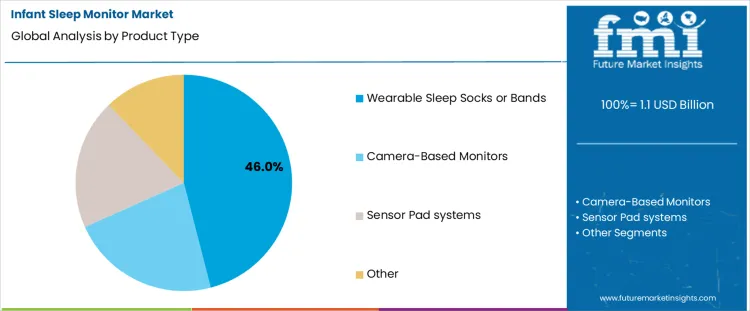
Wearable sleep socks or bands account for 46% of the infant sleep monitor market due to their ability to provide continuous, unobtrusive monitoring during sleep. These devices track sleep duration, movement patterns, heart rate, and, in some cases, oxygen levels without restricting infant comfort. Parents prefer wearables over camera-based monitors because they deliver direct physiological insights rather than visual observation alone. Integration with smartphone applications enables real-time alerts, sleep trend analysis, and historical data tracking, enhancing caregiver confidence. Advances in soft materials, wireless connectivity, and battery performance have improved usability and safety. As demand increases for non-invasive, at-home infant monitoring solutions that offer reassurance without complex setup, wearable sleep socks and bands continue to dominate product adoption.
Why Does Online D2C Dominate Sales Channels in the Infant Sleep Monitor Market?
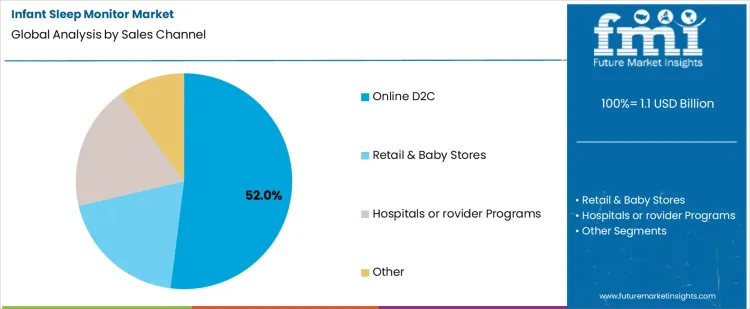
Online D2C channels represent 52% of total sales, making them the leading distribution route in the infant sleep monitor market. Parents increasingly prefer direct-to-consumer platforms due to convenience, transparent product information, and access to integrated digital ecosystems. D2C models allow brands to bundle hardware with mobile applications, cloud-based monitoring, and subscription services, enhancing long-term engagement. Home delivery, easy returns, and responsive customer support further strengthen trust and adoption. Online channels also enable faster rollout of product updates and new features compared to physical retail. As infant sleep monitoring remains a consumer-driven, home-focused purchase decision, online D2C sales continue to outperform traditional retail and institutional channels.
What Are the Key Dynamics for the Infant Sleep Monitor Market?
The infant sleep monitor market is driven by increasing parental focus on continuous monitoring of infant sleep quality and early detection of potential health irregularities. Infant sleep monitors track sleep cycles and physiological indicators such as breathing movement, heart rate, and oxygen saturation to provide real-time insights into an infant’s condition. Key market dynamics include growing awareness of pediatric sleep-related concerns, rising adoption of connected health devices, and increasing availability of non-contact and wearable monitoring solutions. Integration with mobile applications and cloud-based platforms allows caregivers to receive alerts and analyze sleep data conveniently.
How Are the Key Drivers Shaping the Infant Sleep Monitor Market?
Key drivers shaping the market include ongoing improvements in non-invasive monitoring technologies that allow continuous tracking without disturbing the infant’s sleep. Development of real-time alert systems enables caregivers to respond quickly to abnormal patterns, improving perceived safety and usability. The growing preference for home-based monitoring aligns with broader healthcare trends focused on preventive care and early detection. Manufacturers are also integrating sleep monitors with smart home ecosystems, enhancing convenience and interoperability. Increasing collaboration between technology companies and pediatric specialists is improving product credibility and functionality. As caregivers seek data-driven insights to support infant care decisions, demand for reliable and user-friendly sleep monitoring devices continues to strengthen across developed and emerging markets.
What Are the Challenges Impacting the Infant Sleep Monitor Market?
Challenges in the Infant Sleep Monitor Market include concerns regarding data accuracy and the occurrence of false alarms, which may cause unnecessary anxiety among caregivers. Device affordability remains a constraint in price-sensitive regions, limiting wider adoption beyond premium consumer segments. Regulatory ambiguity between consumer wellness devices and medical-grade monitoring equipment can create uncertainty around product claims and performance expectations. Ensuring secure handling and privacy of sensitive infant health data is another critical challenge, particularly for cloud-connected systems. Improper usage due to limited user education may affect monitoring reliability. Addressing these challenges requires continued focus on validation, affordability, data security, and caregiver training.
What Is the Growth Outlook for the Infant Sleep Monitor Market by Country?
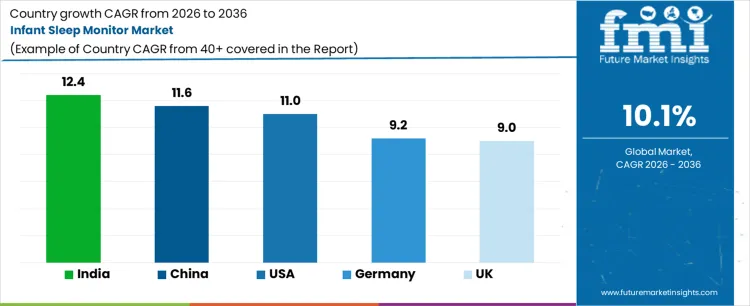
| Country | CAGR (%) |
|---|---|
| India | 12.4% |
| China | 11.6% |
| USA | 11.0% |
| Germany | 9.2% |
| UK | 9.0% |
Source: FMI analysis based on primary research and proprietary forecasting model
The infant sleep monitor market is experiencing strong growth as parents increasingly adopt technology-enabled solutions to support infant safety and sleep quality. India leads with a 12.4% CAGR, driven by rising urbanization, smartphone adoption, and growing awareness of infant monitoring. China follows at 11.6%, supported by strong consumer electronics availability and digital parenting trends. The USA grows at 11.0%, benefiting from advanced smart monitoring technologies and high consumer adoption. Germany (9.2%) and the UK (9.0%) show steady growth, driven by strong safety awareness, regulated product standards, and expanding use of connected baby-care devices.
What Is Driving the Growth of the Infant Sleep Monitor Market in India?
The Infant Sleep Monitor Market in India is growing at a CAGR of 12.4%, driven by rising awareness of infant sleep health and increasing adoption of smart baby-care products among urban households. Growing nuclear family structures and higher participation of working parents are increasing demand for devices that enable continuous sleep and breathing monitoring. Expansion of private maternity hospitals and pediatric clinics is also improving exposure to sleep-monitoring technologies. Smartphone penetration and affordability of connected baby monitors are making app-based infant sleep tracking more accessible. Increasing concern around sleep-related risks and early detection of breathing irregularities is influencing purchasing decisions. E-commerce platforms play a key role in product availability and consumer education. As disposable incomes rise and parents increasingly prioritize technology-enabled infant care, demand for infant sleep monitors in India is expected to grow rapidly.
How Is the Infant Sleep Monitor Market Expanding in China?
The Infant Sleep Monitor Market in China is expanding at a CAGR of 11.6%, supported by growing consumer focus on infant health, safety, and early monitoring. Rising awareness of sleep quality, breathing patterns, and movement tracking is encouraging adoption of smart infant sleep monitoring devices. China’s strong consumer electronics manufacturing ecosystem enables rapid innovation and availability of feature-rich monitoring solutions. Urban parents increasingly prefer connected devices that integrate with mobile apps for real-time alerts and historical data analysis. Growth of online retail platforms and digital parenting communities is also accelerating product adoption. Rising healthcare spending and increased attention to early childhood development are supporting market growth. As technology-driven parenting tools gain wider acceptance, demand for infant sleep monitors in China is expected to remain strong.
What Is Supporting Growth of the Infant Sleep Monitor Market in the USA?
The Infant Sleep Monitor Market in the USA is growing at a CAGR of 11.0%, driven by high adoption of smart home and connected healthcare devices. Parents increasingly use infant sleep monitors to track breathing, heart rate, movement, and sleep patterns, particularly during the first year of life. Strong awareness of sleep-related infant safety and preventive monitoring supports demand. Technological advancements, including wearable sensors, camera-based systems, and AI-enabled analytics, are improving monitoring accuracy and ease of use. Integration with smartphones and smart home ecosystems further enhances adoption. Availability of premium products through specialty baby-care retailers and online platforms supports steady market growth. As parents continue to seek reassurance and data-driven insights into infant sleep, demand for sleep monitoring devices in the USA is expected to remain robust.
How Is the Infant Sleep Monitor Market Developing in Germany?
The Infant Sleep Monitor Market in Germany is expanding at a CAGR of 9.2%, supported by strong emphasis on child safety, product quality, and regulated baby-care standards. German parents show high preference for reliable, medically aligned monitoring devices that support infant well-being without intrusive methods. Growing adoption of non-contact and wearable sleep monitors is driven by awareness of sleep health and breathing irregularities. Integration with pediatric guidance and structured infant care practices supports steady demand. Germany’s strong retail and pharmacy distribution networks improve accessibility of certified sleep monitoring products. Increasing adoption of smart home technologies is indirectly supporting connected infant monitoring solutions. As technology acceptance grows within regulated frameworks, demand for infant sleep monitors in Germany is expected to rise steadily.
How Is the Infant Sleep Monitor Market Expanding in the UK?
The Infant Sleep Monitor Market in the UK is growing at a CAGR of 9.0%, driven by increasing focus on infant safety and sleep quality among new parents. Growing awareness of monitoring breathing and movement during sleep is encouraging adoption of wearable and camera-based sleep monitoring devices. Expansion of online baby-care retail platforms and parenting support communities is improving product visibility and education. Integration of sleep monitors with mobile apps for alerts and sleep analytics is further supporting demand. UK parents increasingly value ease of use, data privacy, and reliability when selecting monitoring solutions. Rsing adoption of smart home devices supports acceptance of connected infant care products. As parental focus on sleep health and monitoring continues to increase, demand for infant sleep monitors in the UK is expected to grow consistently.
How Are Companies Competing in the Infant Sleep Monitor Market?
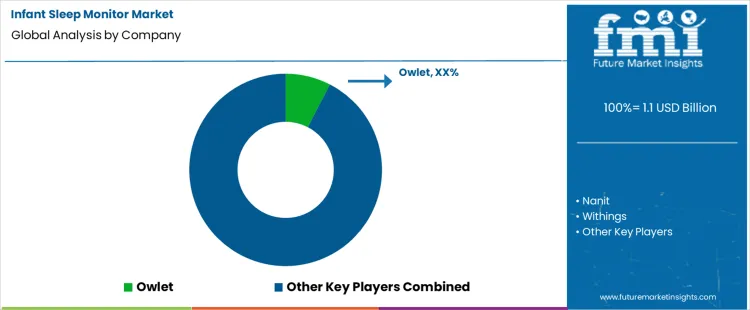
Competition in the infant sleep monitor market is driven by monitoring accuracy, safety assurance, ease of use, and the ability to deliver clear, actionable insights to parents. Infant sleep monitors must reliably track parameters such as heart rate, breathing patterns, movement, and sleep quality while remaining comfortable, non-intrusive, and safe for overnight use. Companies differentiate through sensor precision, wireless connectivity, intelligent alerts, and mobile applications that simplify monitoring without overwhelming caregivers.
Owlet, Nanit, Withings, and Philips compete through advanced sensing and analytics focused on sleep quality and vital sign tracking. Owlet emphasizes wearable sock-based monitoring that provides real-time alerts on heart rate and oxygen levels. Nanit differentiates through camera-based monitoring combined with computer vision and AI-driven sleep analytics, offering insights into sleep patterns and room conditions. Withings focuses on under-mattress and contactless monitoring approaches that track movement and breathing without direct wearables. Philips leverages medical-grade sensing and trusted healthcare branding to extend reliable sleep monitoring into the home.
Motorola Mobility (Hubble), VTech, Samsung, iBaby Labs, Bebcare, and Snuza compete through accessibility, design variety, and specialized features. Motorola Mobility and VTech emphasize connected baby monitors with integrated video, audio, and basic sleep tracking features suited for broad consumer adoption. Samsung applies its smart home ecosystem to infant monitoring, enabling connectivity with other household devices. iBaby Labs and Bebcare focus on health-oriented features such as air quality monitoring and low-radiation designs. Snuza differentiates through clip-on movement monitors that detect breathing motion directly. Across the market, competitive advantage is shaped by monitoring reliability, alert accuracy, non-intrusive design, app usability, and the ability to build parental trust through consistent overnight performance.
Key Players in Infant Sleep Monitor Market
- Owlet
- Nanit
- Withings
- Philips
- Motorola Mobility (Hubble)
- VTech
- Samsung
- iBaby Labs
- Bebcare
- Snuza
Scope of Report
| Attributes | Description |
|---|---|
| Quantitative Unit (2026) | USD Billion |
| Product Type | Wearable Sleep Socks or Bands, Camera-Based Monitors, Sensor Pad Systems, Other |
| Sales Channel | Online D2C, Retail & Baby Stores, Hospitals or Provider Programs, Other |
| Regions Covered | Asia Pacific, Europe, North America, Latin America, Middle East & Africa |
| Countries Covered | China, Japan, South Korea, India, Australia & New Zealand, ASEAN, Rest of Asia Pacific, Germany, United Kingdom, France, Italy, Spain, Nordic, BENELUX, Rest of Europe, United States, Canada, Mexico, Brazil, Chile, Rest of Latin America, Kingdom of Saudi Arabia, Other GCC Countries, Turkey, South Africa, Other African Union, Rest of Middle East & Africa |
| Key Companies Profiled | Owlet, Nanit, Withings, Philips, Motorola Mobility (Hubble), VTech, Samsung, iBaby Labs, Bebcare, Snuza |
| Additional Attributes | Dollar sales by product type and sales channel; regional market size and forecast analysis; growth outlook across major regions; adoption trends for infant sleep monitoring solutions; assessment of accuracy, connectivity, and comfort features influencing demand across online, retail, and hospital-affiliated distribution channels. |
Infant Sleep Monitor Market by Key Segments
Product Type
- Wearable Sleep Socks or Bands
- Camera-Based Monitors
- Sensor Pad systems
- Other
Sales Channel
- Online D2C
- Retail & Baby Stores
- Hospitals or rovider Programs
- Other
Region
- Asia Pacific
- China
- Japan
- South Korea
- India
- Australia & New Zealand
- ASEAN
- Rest of Asia Pacific
- Europe
- Germany
- United Kingdom
- France
- Italy
- Spain
- Nordic
- BENELUX
- Rest of Europe
- North America
- United States
- Canada
- Mexico
- Latin America
- Brazil
- Chile
- Rest of Latin America
- Middle East & Africa
- Kingdom of Saudi Arabia
- Other GCC Countries
- Turkey
- South Africa
- Other African Union
- Rest of Middle East & Africa
Bibliography
- Food and Drug Administration. (2023, November 8). De Novo classification order: Dream Sock (DEN220091). USA Food and Drug Administration, Center for Devices and Radiological Health.
- Food and Drug Administration. (2025, September 16). FDA safety communication: Do not use unauthorized infant devices for monitoring vital signs. USA Food and Drug Administration.
- Owlet Baby Care, Inc. (2023, November 9). Owlet achieves De Novo FDA clearance for Dream Sock-the first over-the-counter medical-grade pulse oximeter cleared for infants. Owlet Investor Relations.
- Owlet Baby Care, Inc. (2024, January 8). Owlet transforms infant care with the launch of FDA-cleared Dream Sock and BabySat. Owlet Investor Relations.
- Philips. (2024). Connected care and patient monitoring solutions for home and clinical environments. Royal Philips.
Frequently Asked Questions
How big is the infant sleep monitor market in 2026?
The global infant sleep monitor market is estimated to be valued at USD 1.1 billion in 2026.
What will be the size of infant sleep monitor market in 2036?
The market size for the infant sleep monitor market is projected to reach USD 2.9 billion by 2036.
How much will be the infant sleep monitor market growth between 2026 and 2036?
The infant sleep monitor market is expected to grow at a 10.1% CAGR between 2026 and 2036.
What are the key product types in the infant sleep monitor market?
The key product types in infant sleep monitor market are wearable sleep socks or bands, camera-based monitors, sensor pad systems and other.
Which sales channel segment to contribute significant share in the infant sleep monitor market in 2026?
In terms of sales channel, online d2c segment to command 52.0% share in the infant sleep monitor market in 2026.
Preview the report firsthand - request a free sample
Get SampleGet the brochure for pricing and purchase details.
Get PDFTable of Content
- Executive Summary
- Global Market Outlook
- Demand-side Trends
- Supply-side Trends
- Technology Roadmap Analysis
- Analysis and Recommendations
- Market Overview
- Market Coverage / Taxonomy
- Market Definition / Scope / Limitations
- Market Background
- Market Dynamics
- Drivers
- Restraints
- Opportunity
- Trends
- Scenario Forecast
- Demand in Optimistic Scenario
- Demand in Likely Scenario
- Demand in Conservative Scenario
- Opportunity Map Analysis
- Product Life Cycle Analysis
- Supply Chain Analysis
- Investment Feasibility Matrix
- Value Chain Analysis
- PESTLE and Porter’s Analysis
- Regulatory Landscape
- Regional Parent Market Outlook
- Production and Consumption Statistics
- Import and Export Statistics
- Market Dynamics
- Global Market Analysis 2021 to 2025 and Forecast, 2026 to 2036
- Historical Market Size Value (USD Million) Analysis, 2021 to 2025
- Current and Future Market Size Value (USD Million) Projections, 2026 to 2036
- Y-o-Y Growth Trend Analysis
- Absolute $ Opportunity Analysis
- Global Market Pricing Analysis 2021 to 2025 and Forecast 2026 to 2036
- Global Market Analysis 2021 to 2025 and Forecast 2026 to 2036, By Product Type
- Introduction / Key Findings
- Historical Market Size Value (USD Million) Analysis By Product Type , 2021 to 2025
- Current and Future Market Size Value (USD Million) Analysis and Forecast By Product Type , 2026 to 2036
- Wearable Sleep Socks or Bands
- Camera-Based Monitors
- Sensor Pad systems
- Other
- Wearable Sleep Socks or Bands
- Y-o-Y Growth Trend Analysis By Product Type , 2021 to 2025
- Absolute $ Opportunity Analysis By Product Type , 2026 to 2036
- Global Market Analysis 2021 to 2025 and Forecast 2026 to 2036, By Sales Channel
- Introduction / Key Findings
- Historical Market Size Value (USD Million) Analysis By Sales Channel, 2021 to 2025
- Current and Future Market Size Value (USD Million) Analysis and Forecast By Sales Channel, 2026 to 2036
- Online D2C
- Retail & Baby Stores
- Hospitals or rovider Programs
- Other
- Online D2C
- Y-o-Y Growth Trend Analysis By Sales Channel, 2021 to 2025
- Absolute $ Opportunity Analysis By Sales Channel, 2026 to 2036
- Global Market Analysis 2021 to 2025 and Forecast 2026 to 2036, By Region
- Introduction
- Historical Market Size Value (USD Million) Analysis By Region, 2021 to 2025
- Current Market Size Value (USD Million) Analysis and Forecast By Region, 2026 to 2036
- North America
- Latin America
- Western Europe
- Eastern Europe
- East Asia
- South Asia and Pacific
- Middle East & Africa
- Market Attractiveness Analysis By Region
- North America Market Analysis 2021 to 2025 and Forecast 2026 to 2036, By Country
- Historical Market Size Value (USD Million) Trend Analysis By Market Taxonomy, 2021 to 2025
- Market Size Value (USD Million) Forecast By Market Taxonomy, 2026 to 2036
- By Country
- USA
- Canada
- Mexico
- By Product Type
- By Sales Channel
- By Country
- Market Attractiveness Analysis
- By Country
- By Product Type
- By Sales Channel
- Key Takeaways
- Latin America Market Analysis 2021 to 2025 and Forecast 2026 to 2036, By Country
- Historical Market Size Value (USD Million) Trend Analysis By Market Taxonomy, 2021 to 2025
- Market Size Value (USD Million) Forecast By Market Taxonomy, 2026 to 2036
- By Country
- Brazil
- Chile
- Rest of Latin America
- By Product Type
- By Sales Channel
- By Country
- Market Attractiveness Analysis
- By Country
- By Product Type
- By Sales Channel
- Key Takeaways
- Western Europe Market Analysis 2021 to 2025 and Forecast 2026 to 2036, By Country
- Historical Market Size Value (USD Million) Trend Analysis By Market Taxonomy, 2021 to 2025
- Market Size Value (USD Million) Forecast By Market Taxonomy, 2026 to 2036
- By Country
- Germany
- UK
- Italy
- Spain
- France
- Nordic
- BENELUX
- Rest of Western Europe
- By Product Type
- By Sales Channel
- By Country
- Market Attractiveness Analysis
- By Country
- By Product Type
- By Sales Channel
- Key Takeaways
- Eastern Europe Market Analysis 2021 to 2025 and Forecast 2026 to 2036, By Country
- Historical Market Size Value (USD Million) Trend Analysis By Market Taxonomy, 2021 to 2025
- Market Size Value (USD Million) Forecast By Market Taxonomy, 2026 to 2036
- By Country
- Russia
- Poland
- Hungary
- Balkan & Baltic
- Rest of Eastern Europe
- By Product Type
- By Sales Channel
- By Country
- Market Attractiveness Analysis
- By Country
- By Product Type
- By Sales Channel
- Key Takeaways
- East Asia Market Analysis 2021 to 2025 and Forecast 2026 to 2036, By Country
- Historical Market Size Value (USD Million) Trend Analysis By Market Taxonomy, 2021 to 2025
- Market Size Value (USD Million) Forecast By Market Taxonomy, 2026 to 2036
- By Country
- China
- Japan
- South Korea
- By Product Type
- By Sales Channel
- By Country
- Market Attractiveness Analysis
- By Country
- By Product Type
- By Sales Channel
- Key Takeaways
- South Asia and Pacific Market Analysis 2021 to 2025 and Forecast 2026 to 2036, By Country
- Historical Market Size Value (USD Million) Trend Analysis By Market Taxonomy, 2021 to 2025
- Market Size Value (USD Million) Forecast By Market Taxonomy, 2026 to 2036
- By Country
- India
- ASEAN
- Australia & New Zealand
- Rest of South Asia and Pacific
- By Product Type
- By Sales Channel
- By Country
- Market Attractiveness Analysis
- By Country
- By Product Type
- By Sales Channel
- Key Takeaways
- Middle East & Africa Market Analysis 2021 to 2025 and Forecast 2026 to 2036, By Country
- Historical Market Size Value (USD Million) Trend Analysis By Market Taxonomy, 2021 to 2025
- Market Size Value (USD Million) Forecast By Market Taxonomy, 2026 to 2036
- By Country
- Kingdom of Saudi Arabia
- Other GCC Countries
- Turkiye
- South Africa
- Other African Union
- Rest of Middle East & Africa
- By Product Type
- By Sales Channel
- By Country
- Market Attractiveness Analysis
- By Country
- By Product Type
- By Sales Channel
- Key Takeaways
- Key Countries Market Analysis
- USA
- Pricing Analysis
- Market Share Analysis, 2025
- By Product Type
- By Sales Channel
- Canada
- Pricing Analysis
- Market Share Analysis, 2025
- By Product Type
- By Sales Channel
- Mexico
- Pricing Analysis
- Market Share Analysis, 2025
- By Product Type
- By Sales Channel
- Brazil
- Pricing Analysis
- Market Share Analysis, 2025
- By Product Type
- By Sales Channel
- Chile
- Pricing Analysis
- Market Share Analysis, 2025
- By Product Type
- By Sales Channel
- Germany
- Pricing Analysis
- Market Share Analysis, 2025
- By Product Type
- By Sales Channel
- UK
- Pricing Analysis
- Market Share Analysis, 2025
- By Product Type
- By Sales Channel
- Italy
- Pricing Analysis
- Market Share Analysis, 2025
- By Product Type
- By Sales Channel
- Spain
- Pricing Analysis
- Market Share Analysis, 2025
- By Product Type
- By Sales Channel
- France
- Pricing Analysis
- Market Share Analysis, 2025
- By Product Type
- By Sales Channel
- India
- Pricing Analysis
- Market Share Analysis, 2025
- By Product Type
- By Sales Channel
- ASEAN
- Pricing Analysis
- Market Share Analysis, 2025
- By Product Type
- By Sales Channel
- Australia & New Zealand
- Pricing Analysis
- Market Share Analysis, 2025
- By Product Type
- By Sales Channel
- China
- Pricing Analysis
- Market Share Analysis, 2025
- By Product Type
- By Sales Channel
- Japan
- Pricing Analysis
- Market Share Analysis, 2025
- By Product Type
- By Sales Channel
- South Korea
- Pricing Analysis
- Market Share Analysis, 2025
- By Product Type
- By Sales Channel
- Russia
- Pricing Analysis
- Market Share Analysis, 2025
- By Product Type
- By Sales Channel
- Poland
- Pricing Analysis
- Market Share Analysis, 2025
- By Product Type
- By Sales Channel
- Hungary
- Pricing Analysis
- Market Share Analysis, 2025
- By Product Type
- By Sales Channel
- Kingdom of Saudi Arabia
- Pricing Analysis
- Market Share Analysis, 2025
- By Product Type
- By Sales Channel
- Turkiye
- Pricing Analysis
- Market Share Analysis, 2025
- By Product Type
- By Sales Channel
- South Africa
- Pricing Analysis
- Market Share Analysis, 2025
- By Product Type
- By Sales Channel
- USA
- Market Structure Analysis
- Competition Dashboard
- Competition Benchmarking
- Market Share Analysis of Top Players
- By Regional
- By Product Type
- By Sales Channel
- Competition Analysis
- Competition Deep Dive
- Owlet
- Overview
- Product Portfolio
- Profitability by Market Segments (Product/Age /Sales Channel/Region)
- Sales Footprint
- Strategy Overview
- Marketing Strategy
- Product Strategy
- Channel Strategy
- Nanit
- Withings
- Philips
- Motorola Mobility (Hubble)
- VTech
- Samsung
- iBaby Labs
- Bebcare
- Snuza
- Owlet
- Competition Deep Dive
- Assumptions & Acronyms Used
- Research Methodology


